
Important Sampling to Evaluate Realtime System Reliability A

Important Sampling to Evaluate Real-time System Reliability - A Case Study by Xiang Mao and Qin Chen 1

Outline Introduction n Technical Background n n n Importance Sampling The RAPIDS Simulator Implementation Experimental Result & Analysis Conclusion 2 08: 22

Introduction n Applications of real-time system: n n Aircraft control Traffic control Factory automation etc. Requirement of high reliability: n Deliver critical outputs in a timely fashion, even in the presence of a few component failures 3 08: 22
Introduction Reliability in real-time system is Dynamic n Modeling vs. Simulation n Drawbacks of Simulation n Require a very long computation times Unreliability ≤ 10 -5 ~ days to weeks n A solution – Importance Sampling n 4 08: 22

Introduction n Major works of the paper: Implementing importance sampling in the RAPIDS simulator; n Analyzing the expected behavior of such a scheme; n Validating the implementation; n Investigating the tunable parameters in the scheme and providing guidelines on their use. n 5

Importance Sampling n n Help understanding – overheated processor Introduction: The set of failed states Unreliability X is a random variable with density function p(x) 6 08: 22

Importance Sampling n Implementation Heuristics Forcing (or accelerate): increase the rate at which state transitions occur. n Balanced failure biasing: bias the system towards more faults n Each of them has a likelihood ratio associated with it. The overall likelihood ratio is just the product of the individual ones. n 7 08: 22

The RAPIDS Simulator (Parallel Virtual Machine) http: //www. ecs. umass. edu/ece/realtime 8 08: 22
Implementation n Event Generator n n n Decide the time of the next system state transition. Implement forcing to accelerate the state changes. Decide whether the next transition is a fault arrival or repair. Implement failure biasing to push the system towards more component faults. Calculate the likelihood ratio associated with each ‘change of measure‘ and store this value along with the event. 9 08: 22
Implementation n Analyzer n n n Receive reports from the simulated system. If it corresponds to one of the above mentioned ‘change of measure‘, update the current simulation weight. If the system fails within the mission time, set the simulation output to the current value of the likelihood ratio; else set the simulation output to zero. 10 08: 22
Experiments Reliability region that Importance Sampling works well n Performance metrics n Simulation acceleration n Sample variance reduction n 11
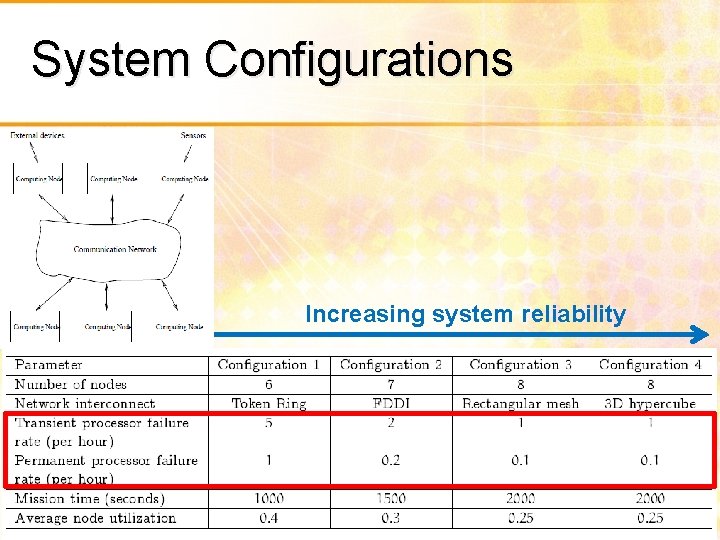
System Configurations Increasing system reliability 12

Simulation Acceleration 13
Bias Parameter n Failure bias n n Bad parameter n n How fast we push the system towards failure Too low or too high sample variance Good parameter n Low sample variance fewer samples/simulation speed-up! 14
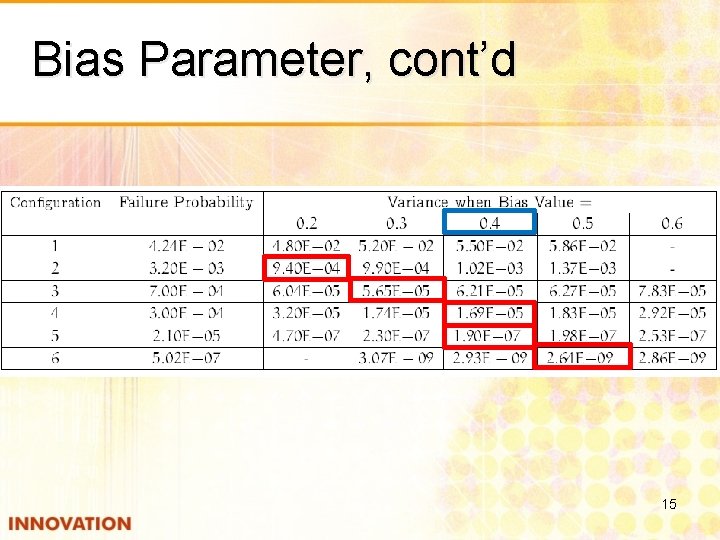
Bias Parameter, cont’d 15

Conclusions Importance Sampling in a simulator testbed n Achieves simulation acceleration, when the system reliability is high (unreliability ≤ 10 -3 ) n Proper tuning up of parameter needed to achieve sample variance reduction n Not suitable for less reliable systems n 16

Question The End? 17 08: 23
- Slides: 17