
IMPORTANT POETRY CONCEPTS Speaker Definition The person from
- Slides: 36
IMPORTANT POETRY CONCEPTS
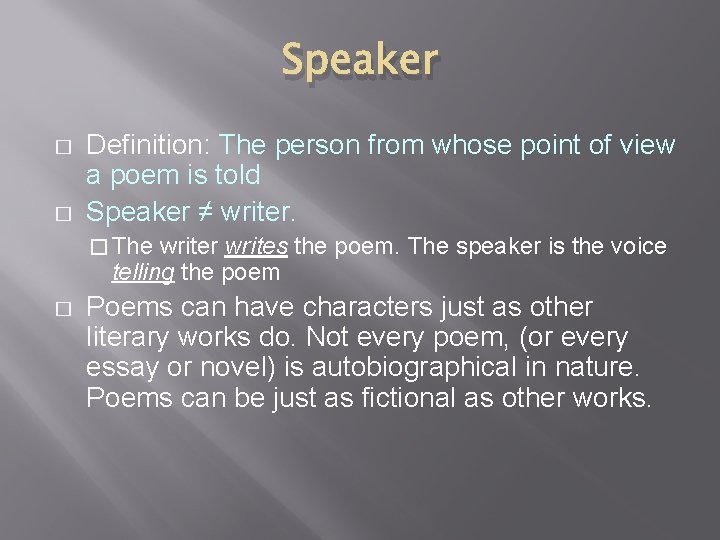
Speaker � � Definition: The person from whose point of view a poem is told Speaker ≠ writer. � The writer writes the poem. The speaker is the voice telling the poem � Poems can have characters just as other literary works do. Not every poem, (or every essay or novel) is autobiographical in nature. Poems can be just as fictional as other works.
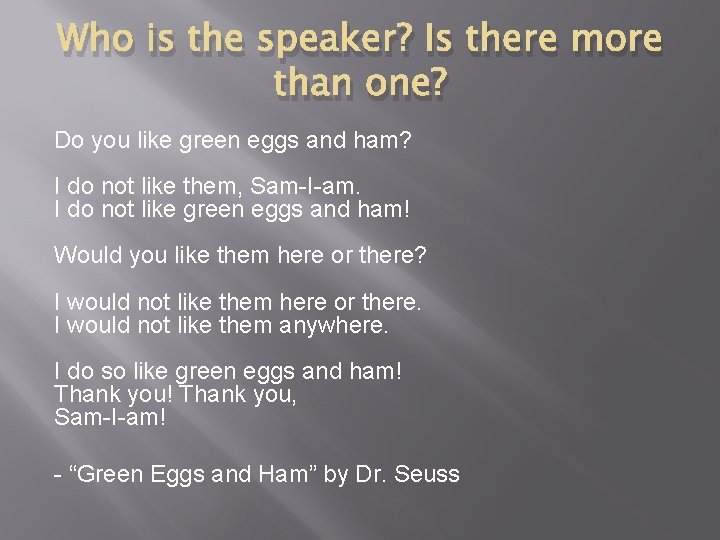
Who is the speaker? Is there more than one? Do you like green eggs and ham? I do not like them, Sam-I-am. I do not like green eggs and ham! Would you like them here or there? I would not like them here or there. I would not like them anywhere. I do so like green eggs and ham! Thank you, Sam-I-am! - “Green Eggs and Ham” by Dr. Seuss
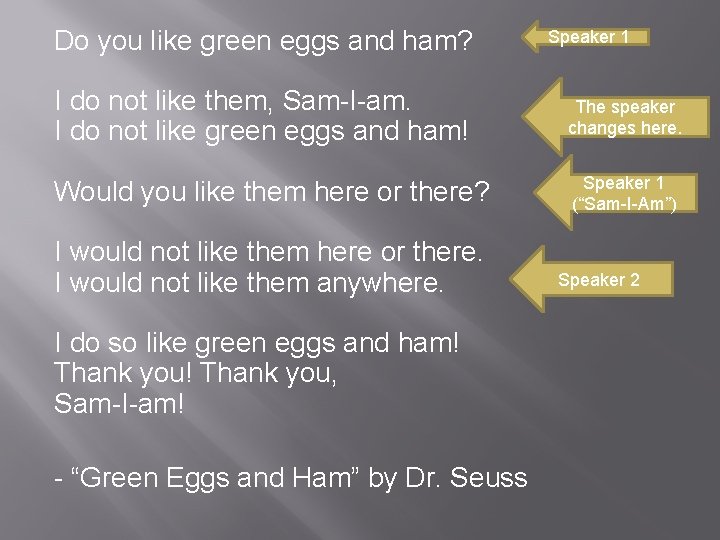
Do you like green eggs and ham? Speaker 1 I do not like them, Sam-I-am. I do not like green eggs and ham! The speaker changes here. Would you like them here or there? Speaker 1 (“Sam-I-Am”) I would not like them here or there. I would not like them anywhere. I do so like green eggs and ham! Thank you, Sam-I-am! - “Green Eggs and Ham” by Dr. Seuss Speaker 2
DICTION The author’s choice of words
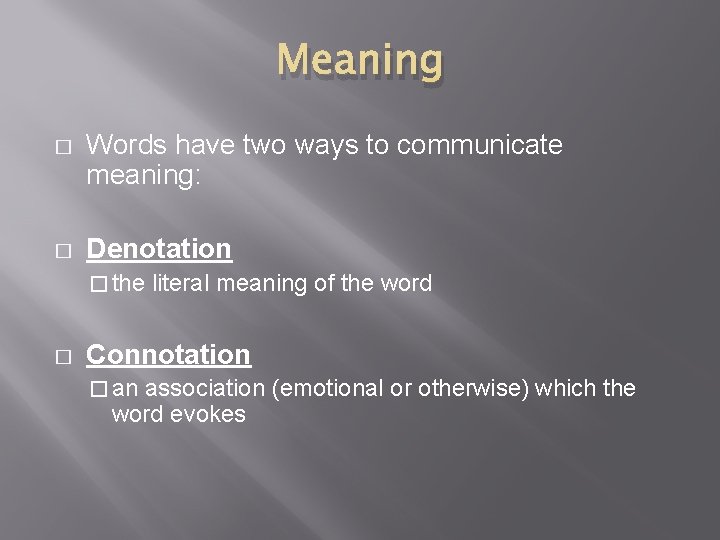
Meaning � Words have two ways to communicate meaning: � Denotation � the literal meaning of the word � Connotation � an association (emotional or otherwise) which the word evokes
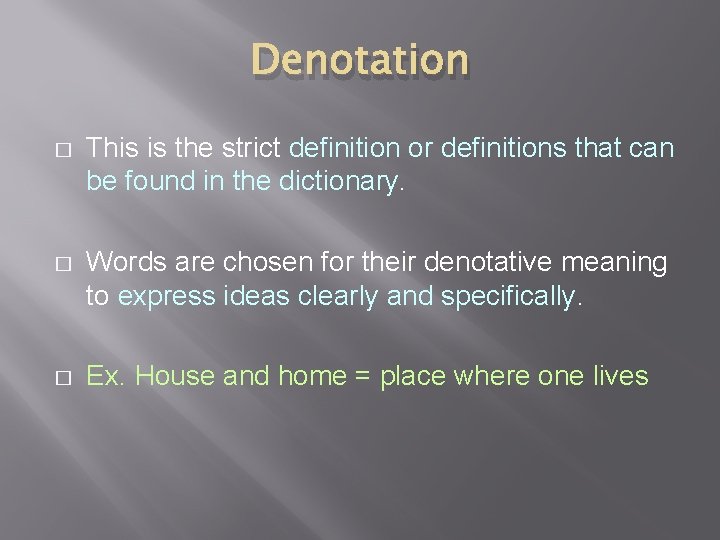
Denotation � This is the strict definition or definitions that can be found in the dictionary. � Words are chosen for their denotative meaning to express ideas clearly and specifically. � Ex. House and home = place where one lives
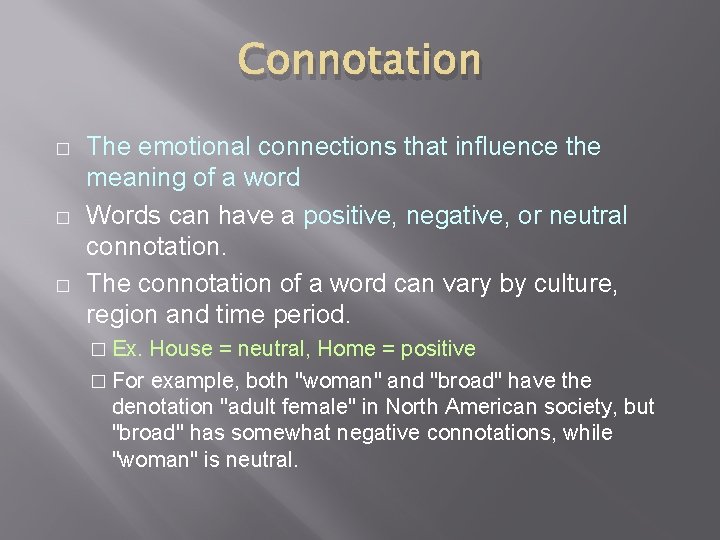
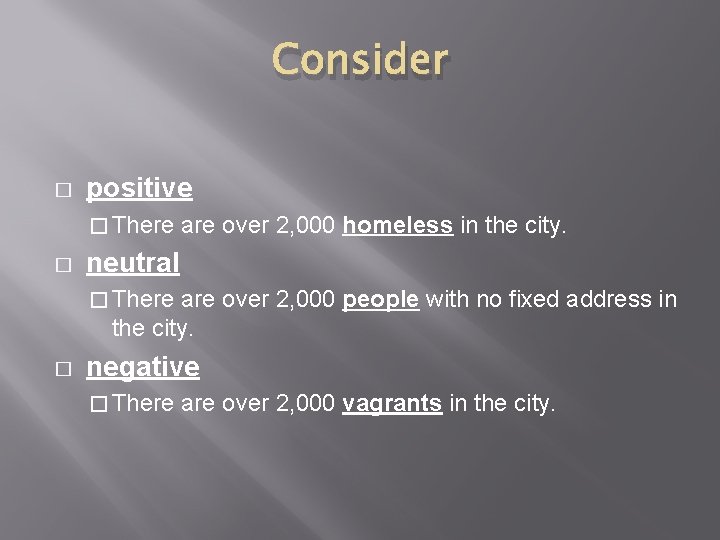
Connotation � � � The emotional connections that influence the meaning of a word Words can have a positive, negative, or neutral connotation. The connotation of a word can vary by culture, region and time period. � Ex. House = neutral, Home = positive � For example, both "woman" and "broad" have the denotation "adult female" in North American society, but "broad" has somewhat negative connotations, while "woman" is neutral.
Consider � positive � There are over 2, 000 homeless in the city. � neutral � There are over 2, 000 people with no fixed address in the city. � negative � There are over 2, 000 vagrants in the city.
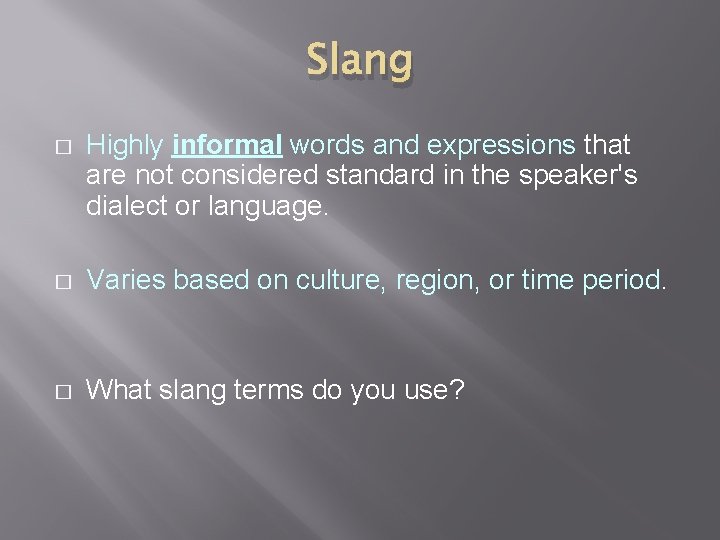
Slang � Highly informal words and expressions that are not considered standard in the speaker's dialect or language. � Varies based on culture, region, or time period. � What slang terms do you use?
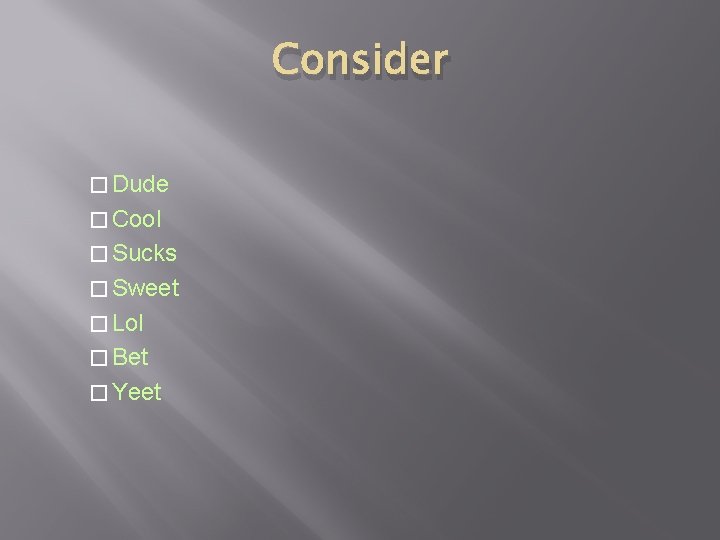
Consider � Dude � Cool � Sucks � Sweet � Lol � Bet � Yeet
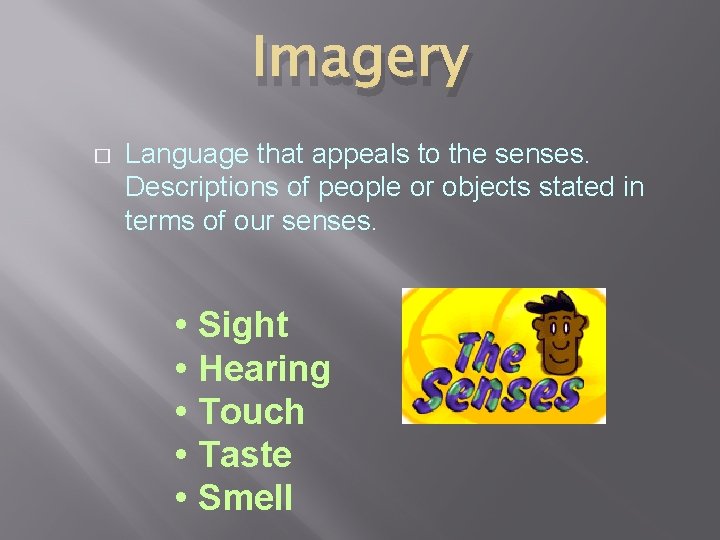
Imagery � Language that appeals to the senses. Descriptions of people or objects stated in terms of our senses. • Sight • Hearing • Touch • Taste • Smell
FORM/STRUCTURE How a poem is constructed: free verse, blank verse, sonnet, etc.
Poetry � Are they free verse, using no rhyme or meter? Are they blank verse, using meter but not rhyme? Are they sonnets, with 14 lines of iambic pentameter and a specific rhyme scheme? Are they villanelles, with 19 lines and a pattern of repeated lines? When you answer questions like those, you will describe the form (or forms) of your poems.
Tone � Tone is the author’s attitude towards the subject. � For example:
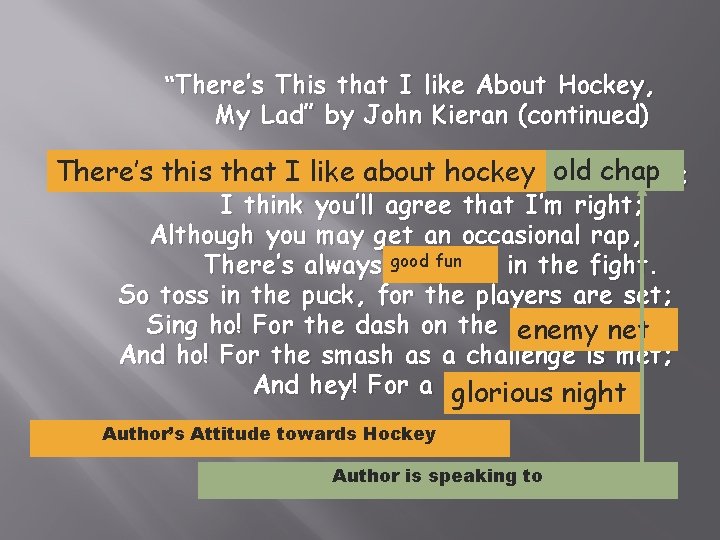
“There’s This that I like About Hockey, My Lad” by John Kieran (continued) oldoldchap There’s this that I like about hockey There’s that I like about hockey, chap; I think you’ll agree that I’m right; Although you may get an occasional rap, There’s always goodfunfun in the fight. So toss in the puck, for the players are set; Sing ho! For the dash on the enemynet; net And ho! For the smash as a challenge is met; And hey! For a gloriousnight! night Author’s Attitude towards Hockey Author is speaking to
Tone Would this poem have a different meaning for the reader if the tone was changed?
The repetition of the initial letter or sound in two or more words in a line. To the lay-person, these are called “tongue-twisters”. Example: How much dew would a dewdrop if a dewdrop did drop dew?
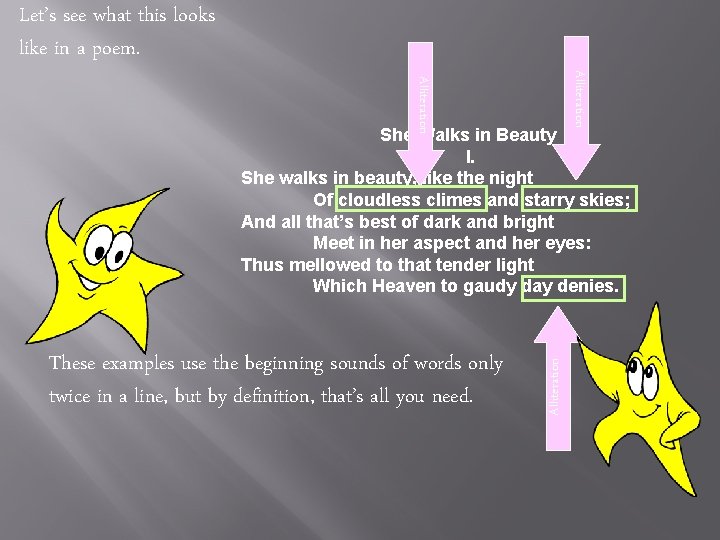
Alliteration Let’s see what this looks like in a poem. These examples use the beginning sounds of words only twice in a line, but by definition, that’s all you need. Alliteration She Walks in Beauty I. She walks in beauty, like the night Of cloudless climes and starry skies; And all that’s best of dark and bright Meet in her aspect and her eyes: Thus mellowed to that tender light Which Heaven to gaudy day denies.
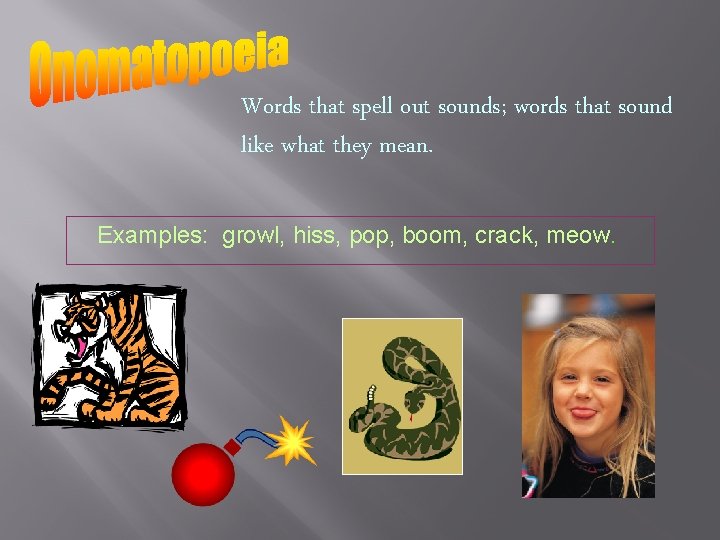
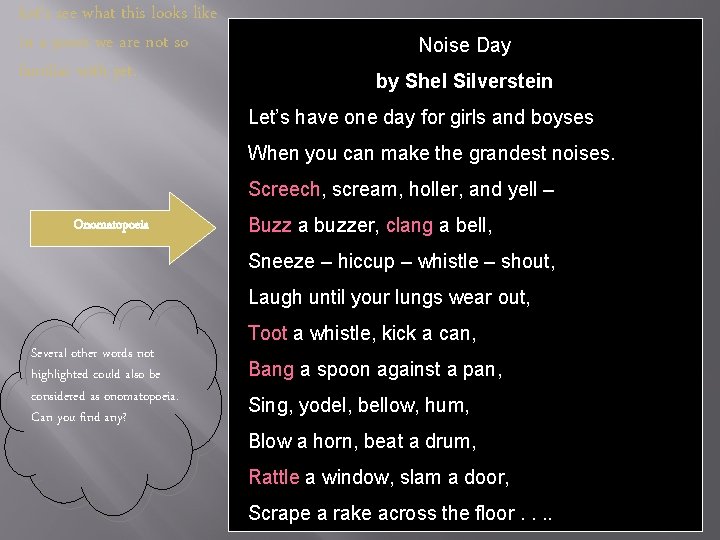
Words that spell out sounds; words that sound like what they mean. Examples: growl, hiss, pop, boom, crack, meow.
Let’s see what this looks like in a poem we are not so familiar with yet. Noise Day by Shel Silverstein Let’s have one day for girls and boyses When you can make the grandest noises. Screech, scream, holler, and yell – Onomatopoeia Buzz a buzzer, clang a bell, Sneeze – hiccup – whistle – shout, Laugh until your lungs wear out, Several other words not highlighted could also be considered as onomatopoeia. Can you find any? Toot a whistle, kick a can, Bang a spoon against a pan, Sing, yodel, bellow, hum, Blow a horn, beat a drum, Rattle a window, slam a door, Scrape a rake across the floor. .
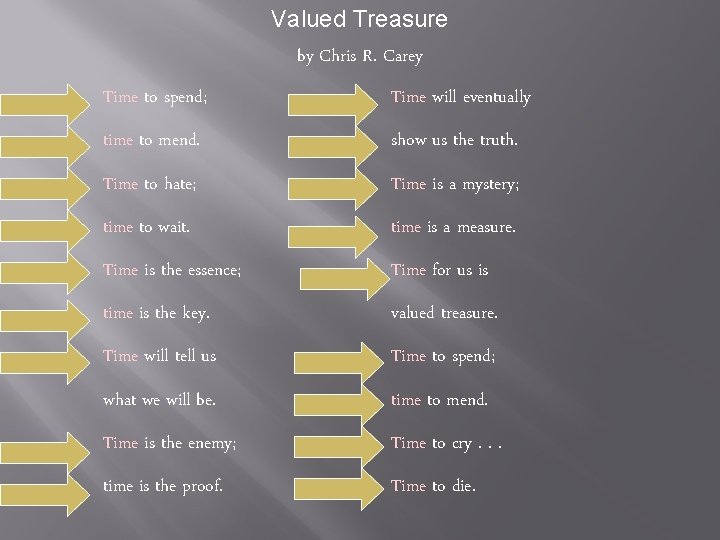
Using the same key word or phrase throughout a poem. This should be fairly self-explanatory, but. . . at risk of sounding like a broken record. . .
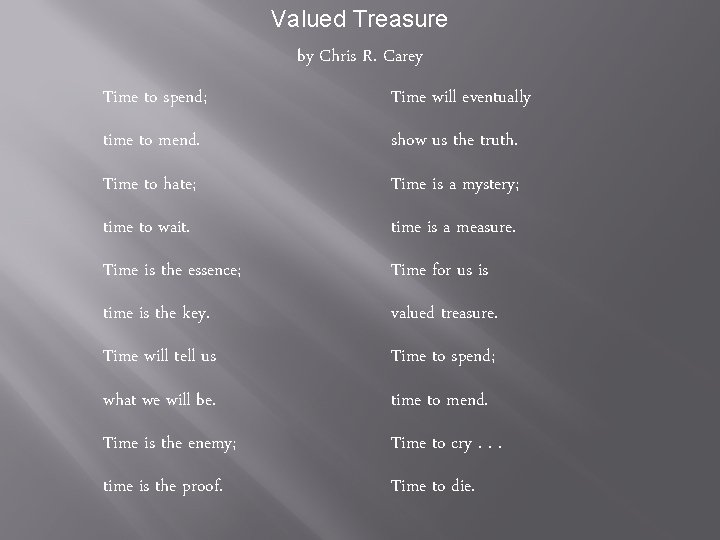
Valued Treasure by Chris R. Carey Time to spend; Time will eventually time to mend. show us the truth. Time to hate; Time is a mystery; time to wait. time is a measure. Time is the essence; Time for us is time is the key. valued treasure. Time will tell us Time to spend; what we will be. time to mend. Time is the enemy; Time to cry. . . time is the proof. Time to die.
So, which is the repeated key word or phrase?
Valued Treasure by Chris R. Carey Time to spend; Time will eventually time to mend. show us the truth. Time to hate; Time is a mystery; time to wait. time is a measure. Time is the essence; Time for us is time is the key. valued treasure. Time will tell us Time to spend; what we will be. time to mend. Time is the enemy; Time to cry. . . time is the proof. Time to die.
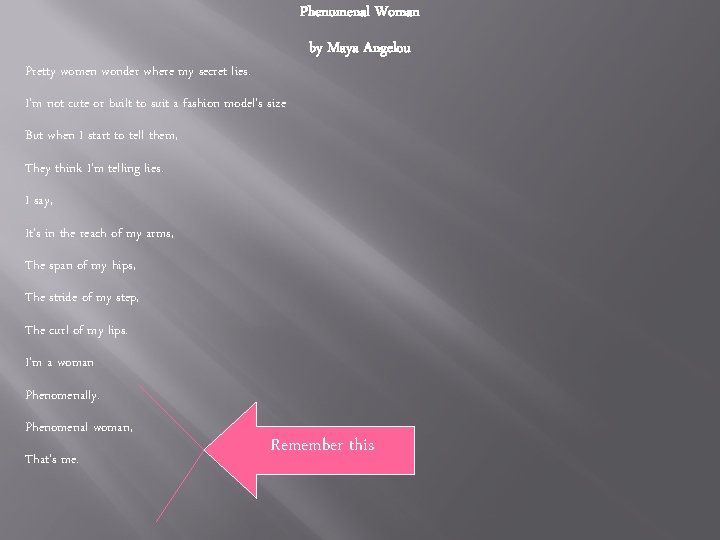
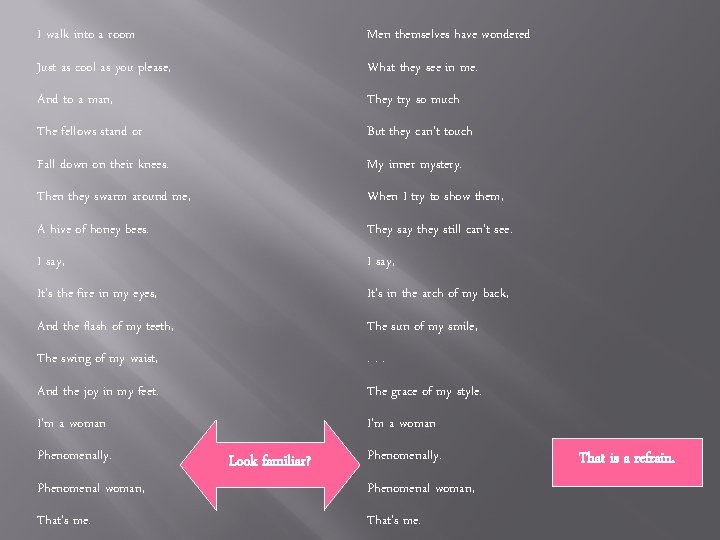
The repetition of one or more phrases or lines at the end of a stanza. It can also be an entire stanza that is repeated periodically throughout a poem, kind of like a chorus of a song.
Phenomenal Woman by Maya Angelou Pretty women wonder where my secret lies. I’m not cute or built to suit a fashion model’s size But when I start to tell them, They think I’m telling lies. I say, It’s in the reach of my arms, The span of my hips, The stride of my step, The curl of my lips. I’m a woman Phenomenally. Phenomenal woman, That’s me. Remember this
I walk into a room Men themselves have wondered Just as cool as you please, What they see in me. And to a man, They try so much The fellows stand or But they can’t touch Fall down on their knees. My inner mystery. Then they swarm around me, When I try to show them, A hive of honey bees. They say they still can’t see. I say, It’s the fire in my eyes, It’s in the arch of my back, And the flash of my teeth, The sun of my smile, The swing of my waist, . . . And the joy in my feet. The grace of my style. I’m a woman Phenomenally. Look familiar? Phenomenally. Phenomenal woman, That’s me. That is a refrain.
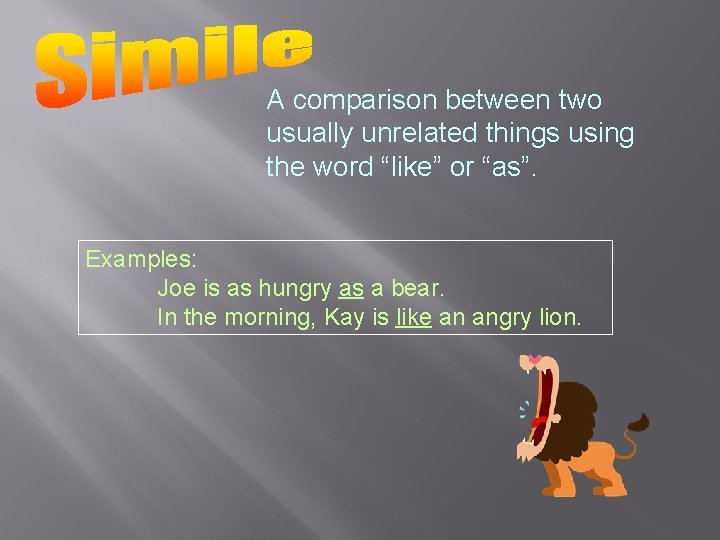
A comparison between two usually unrelated things using the word “like” or “as”. Examples: Joe is as hungry as a bear. In the morning, Kay is like an angry lion.
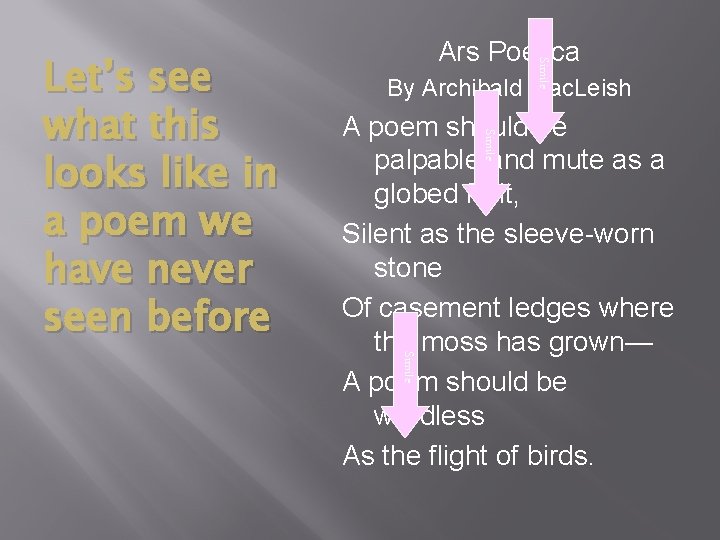
Simile By Archibald Mac. Leish A poem should be palpable and mute as a globed fruit, Silent as the sleeve-worn stone Of casement ledges where the moss has grown— A poem should be wordless As the flight of birds. Simile Let’s see what this looks like in a poem we have never seen before Ars Poetica Simile
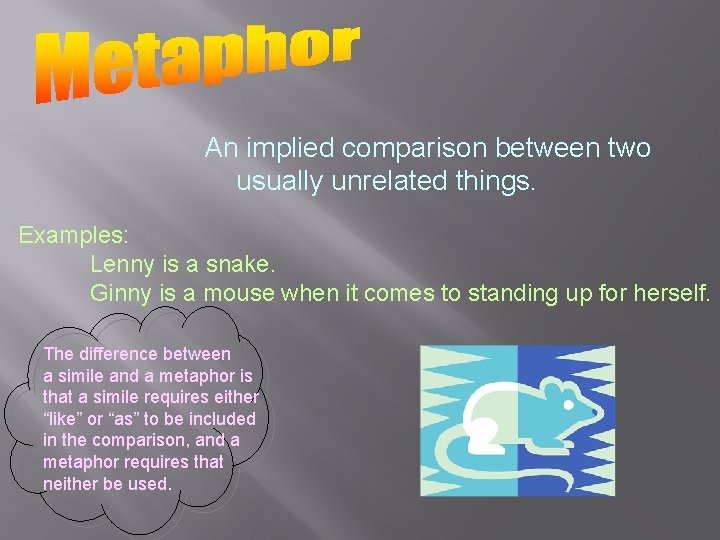
An implied comparison between two usually unrelated things. Examples: Lenny is a snake. Ginny is a mouse when it comes to standing up for herself. The difference between a simile and a metaphor is that a simile requires either “like” or “as” to be included in the comparison, and a metaphor requires that neither be used.
An exaggeration for the sake of emphasis. Examples: I may sweat to death. The blood bank needs a river of blood.
Giving human characteristics to inanimate objects, ideas, or animals. Example: The sun stretched its lazy fingers over the valley.
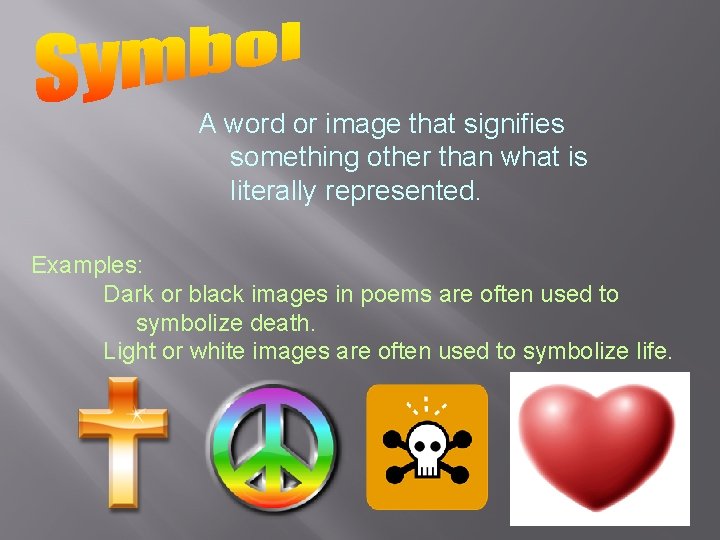
A word or image that signifies something other than what is literally represented. Examples: Dark or black images in poems are often used to symbolize death. Light or white images are often used to symbolize life.
Using words to create a picture in the reader’s mind.
A reference to another piece of literature or to history. Example: “She hath Dian’s wit” (from Romeo and Juliet). This is an allusion to Roman mythology and the goddess Diana (Artemis). The three most common types of allusion refer to mythology, the Bible, and Shakespeare’s writings.