
Important Note Taking Overview What is important in

- Slides: 9
Important Note Taking
Overview What is important in note taking Good Note Taking Strategies Scenario: Note taking practice Outlining what is important from your scenario notes Problem Solving
What Notes are Important? Who was involved Where and When did this happen What actually happened/What did you observe How did this happen? What else do you think is important? In court, the investigator’s notebook is their best reference document. When testifying, the court will allow an investigator to refer to notes made at the time to refresh their memory of events and actions taken.
Good Notes: overview of the things seen/heard and the actions taken A chronology of notes demonstrates the investigator’s mental map of the facts that led to forming reasonable grounds for an arrest and charges Court cases are often extended by adjournments, appeals, or suspects evading immediate capture. This can extend the time between the investigation and the trial by several years. In these protracted cases, it becomes critical for the investigator to have detailed notes that accurately reflect their investigation to trigger their memory of the facts. On occasion, an investigator will complete the initial draft of their notes, and, at some later time may suddenly recall a point that was missed. On such occasions, returning to the pages of notes made at the time and attempting to insert the recalled facts is not an acceptable practice
Note Taking Strategies Start notes by creating a big picture perspective and then move from the general to the more specific observations. In this big picture, you are creating a perspective of the facts that you have been made aware of to begin an investigation. These big picture facts become the starting point of your mental map of events, and these facts will be the framework to begin thinking about offence recognition and forming reasonable grounds to believe and take action. In more specific terms, and to the extent it is possible, begin recording all dates, times, and descriptions of persons, places, and vehicles as they emerge. You may, in fact, have already started a page in your notebook where some exact times, addresses, licence plate numbers, names or persons, and perhaps even blurted statements from a suspect have been jotted down. It is acceptable to use these key pieces of jotted information already recorded to enlarge your detailed notes at the end of the event in a more complete fashion. Record the identities of persons encountered and how the identity of each person was verified. For example: Witness Jane Doe (DOB: 8 May 64) 34345 -8 St Anywhere BC Photo drivers licence ID Record all statements made by witnesses and victims to reflect an accurate account of the information being conveyed. It is often not possible to record every statement made verbatim in notes, and, in most cases, it is not necessary. Today, technology makes it possible to digitally record the verbatim account being provided by a witness or a victim. But, merely digitally recording a statement is not sufficient, since statements will frequently form considerations in establishing reasonable grounds for belief to take action. Recording the critical details being conveyed will provide a written record of the facts considered to form reasonable grounds for belief. If a person is a suspect or is a person who may become a suspect, make every effort to record any statements made by that person verbatim. Suspects will often be found at the scene of a crime posing as a witness or even as a victim. Accurately recording the initial statements made by such a person can produce evidence of guilt in the form of statements that are provably false or even incriminating.
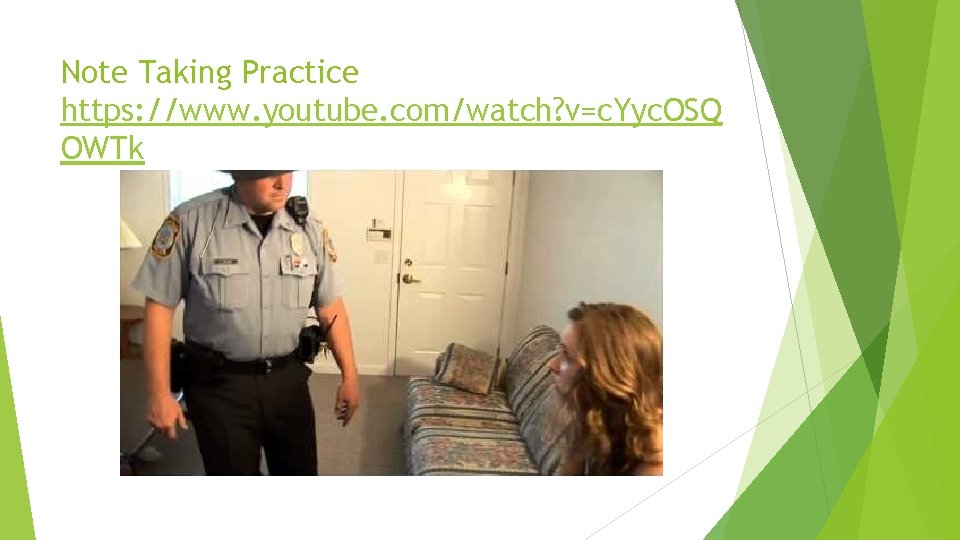
Note Taking Practice https: //www. youtube. com/watch? v=c. Yyc. OSQ OWTk
What did you find? Do you have notes about: The house The perpetrator The victim The Officers What is the most important information?
Problem Solving In community policing, a four-step process known as SARA is often used: • Scanning—identifying problems • Analysis—understanding underlying problems • Response—developing and implementing solutions • Assessment—determining the solutions’ effect
See you in July! Have an awesome few weeks!!!