
Important International Regulations Waste Generally Waste management is
- Slides: 14
Important International Regulations Waste
Generally • Waste management is not a well-developed area of international law. • International law has to date played a limited role in preventing the generation of waste. • Other than the special rules which are applicable in the EC there is no regional or global legal framework for waste management strategy. • Rather, waste has traditionally been regulated incidentally to the attainment of other objectives. • Among the relevant international legal measures are: – Regulating the disposal of wastes at sea – limiting atmospheric emissions of gaseous wastes – preventing the disposal of wastes in rivers and other freshwaters • This approach does not address the source of the problem by preventing waste generation; it merely shifts the disposal problem to another environmental medium.
Problem (Institutional) • At the global level, no UN or other body has overall responsibility for waste • The Stockholm Conference did not focus on the issue of waste. Without specifically mentioning waste, Principle 6 of the 1972 Stockholm Declaration called for the discharge of toxic or other substances to be halted. • The 1982 World Charter for Nature called for ‘special precautions’ to be taken to prevent discharge of radioactive or toxic wastes, but did not encourage minimization of the generation of such wastes. • Principle 14 of the Rio Declaration limited itself to calling for effective co-operation to ‘discourage or prevent the relocation or transfer to other states of any activities and substances that cause severe environmental degradation or are found to be harmful to human health’.
First Attempt (OECD 1976) Organization for Economic Co-operation and Development • Established the basis for more comprehensive international approach to waste management. • Recommendation on a Comprehensive Waste Management Policy: – member countries implement waste policies to protect the environment and ensure rational use of energy and resources while taking account of economic constraints. – Recommended principles included the need to take environmental protection into account; to encourage waste prevention; to promote recycling; to use policy instruments; and to ensure access to information. – Endorsed administrative arrangements, including inventories of wastes to be disposed; the organization of waste collection; the establishment of disposal centers; the promotion of research and development on disposal methods and low-waste technology; and encouraging markets for recycled products
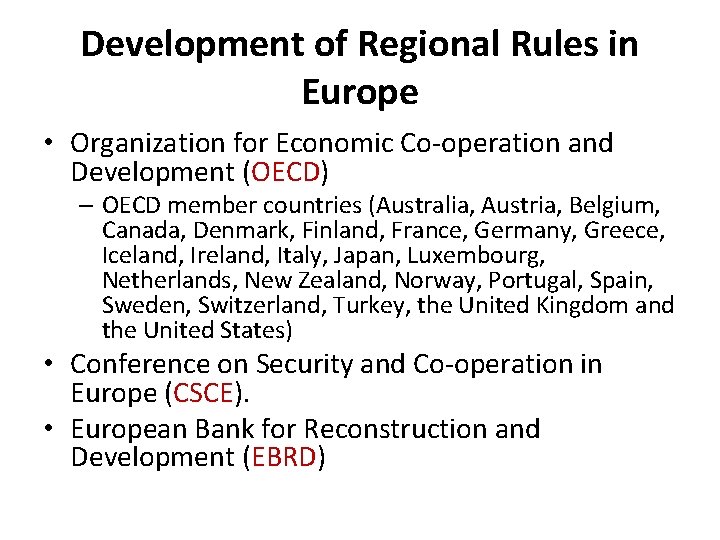
Development of Regional Rules in Europe • Organization for Economic Co-operation and Development (OECD) – OECD member countries (Australia, Austria, Belgium, Canada, Denmark, Finland, France, Germany, Greece, Iceland, Ireland, Italy, Japan, Luxembourg, Netherlands, New Zealand, Norway, Portugal, Spain, Sweden, Switzerland, Turkey, the United Kingdom and the United States) • Conference on Security and Co-operation in Europe (CSCE). • European Bank for Reconstruction and Development (EBRD)
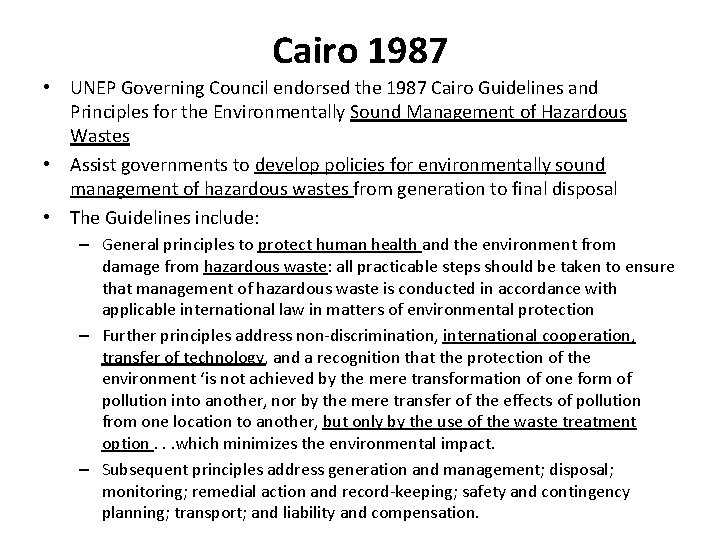
Cairo 1987 • UNEP Governing Council endorsed the 1987 Cairo Guidelines and Principles for the Environmentally Sound Management of Hazardous Wastes • Assist governments to develop policies for environmentally sound management of hazardous wastes from generation to final disposal • The Guidelines include: – General principles to protect human health and the environment from damage from hazardous waste: all practicable steps should be taken to ensure that management of hazardous waste is conducted in accordance with applicable international law in matters of environmental protection – Further principles address non-discrimination, international cooperation, transfer of technology, and a recognition that the protection of the environment ‘is not achieved by the mere transformation of one form of pollution into another, nor by the mere transfer of the effects of pollution from one location to another, but only by the use of the waste treatment option. . . which minimizes the environmental impact. – Subsequent principles address generation and management; disposal; monitoring; remedial action and record-keeping; safety and contingency planning; transport; and liability and compensation.
EC • In 1990, the EC adopted a framework “the Community Strategy for Waste Management” to guide waste management policy for member states. • Following a Commission review of the Strategy, in 1997, the EC Council adopted a revised Community Strategy for Waste Management
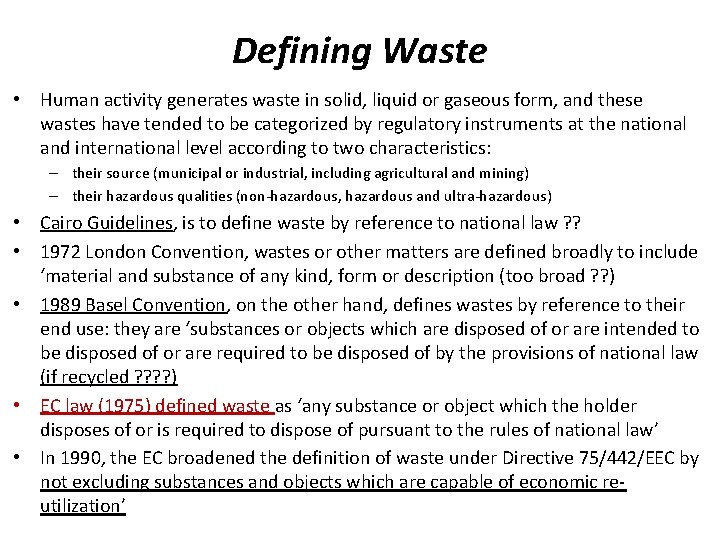
Defining Waste • Human activity generates waste in solid, liquid or gaseous form, and these wastes have tended to be categorized by regulatory instruments at the national and international level according to two characteristics: – their source (municipal or industrial, including agricultural and mining) – their hazardous qualities (non-hazardous, hazardous and ultra-hazardous) • Cairo Guidelines, is to define waste by reference to national law ? ? • 1972 London Convention, wastes or other matters are defined broadly to include ‘material and substance of any kind, form or description (too broad ? ? ) • 1989 Basel Convention, on the other hand, defines wastes by reference to their end use: they are ‘substances or objects which are disposed of or are intended to be disposed of or are required to be disposed of by the provisions of national law (if recycled ? ? ) • EC law (1975) defined waste as ‘any substance or object which the holder disposes of or is required to dispose of pursuant to the rules of national law’ • In 1990, the EC broadened the definition of waste under Directive 75/442/EEC by not excluding substances and objects which are capable of economic reutilization’
Defining Waste • Municipal waste, which is not deemed to be hazardous, generally includes that generated by households, shops, offices and other commercial units, and includes paper and cardboard, glass, plastics, metals, organic matters and putrescible materials • Industrial wastes include general factory rubbish, packaging materials, organic wastes, acids, alkalis and metalli-ferrous sludge. • Mining wastes are a by-product of the extraction process and include topsoil, rock and dirt, which may be contaminated by metals and coal. • Agricultural wastes comprise animal slurries, silage effluents, tank washings following pesticide use, and empty plastic packaging. • Radioactive wastes, which are generally subject to special rules, are the product of nuclear power generation, military sources, and medical, industrial and university establishments • Hazardous wastes was defined in 1991 Bamako Convention and 1989 Basel Convention
Prevention and Treatment • Few binding international obligations establish targets and timetables, quantitative restrictions or other limits on the generation of municipal and industrial waste, including hazardous and radioactive wastes. • As certain polluting gases, such as sulphur dioxide, nitrogen oxide, volatile organic compounds, and carbon dioxide are waste products, treaties establishing quantitative limits on atmospheric emissions of such gases in effect limit the generation of certain wastes
Disposal • International environmental law is more developed in limiting or prohibiting certain methods of disposal of particular waste types, although no single instrument comprehensively and globally regulates waste disposal. • Treaties now regulate: – – the disposal of waste into the sea, the disposal of waste into rivers and lakes, the disposal of waste by incineration, and into the atmosphere as a by-product of other activities. • The General Assembly has called on all states ‘to ensure that no nuclear-waste dumping practices occur that would infringe upon the sovereignty of states • Other treaties promote: – Safe disposal of asbestos – Appropriate’ disposal of wastes during the demolition of buildings or structures – Appropriate disposal of chemicals • With the exception of the EC rules, international regulation of landfill is nonexistent.
Incineration • The incineration of wastes is limited by treaty and acts of international institutions in several regions • In the case of the EC, incineration is subject to conformity with stringent technical standards • The 1996 Protocol and 1972 London Convention prohibits the incineration of wastes at sea • The 1991 Bamako Convention prohibits the incineration of hazardous waste at sea • Land-based incineration of waste is currently dealt with only by EC legislation,
Recycling and Re-use • Political efforts to encourage recycling, recovery and re-use of materials and products have not yet led to international legal commitments • The OECD’s International Energy Agency is committed to research and development on waste heat utilization and municipal and industrial waste utilization for energy conservation • The 1987 Montreal Protocol calls for research and development and the exchange of information on the best technologies for improving the recovery and recycling of certain controlled and transitional ozonedepleting substances • 1989 Basel Convention may provide a basis for future international legislation by identifying disposal operations which may lead to recovery, recycling and re-use • EC law requires member states to encourage the recovery of wastes, including hazardous and toxic wastes, by means of recycling, re-use or reclamation or other processes to extract secondary raw materials and to use waste as a source of energy
Trans-boundary Movements • • 1989 Basel Convention The 1989 Convention on the Control of Trans-boundary Movements of Hazardous Wastes and their Disposal is intended to establish a global regime for the control of international trade in hazardous and other wastes. The Convention, which entered into force on 5 May 1992, established rules designed to regulate trade in wastes rather than prohibit it. The Convention sets forth general obligations requiring all parties to ensure that trans=boundary movements of wastes are reduced to the minimum consistent with environmentally sound and efficient management, it reflects an approach premised upon the view that wastes should, as far as possible, be disposed of in the state where they were generated