
Important Facts about the OT 75 of the
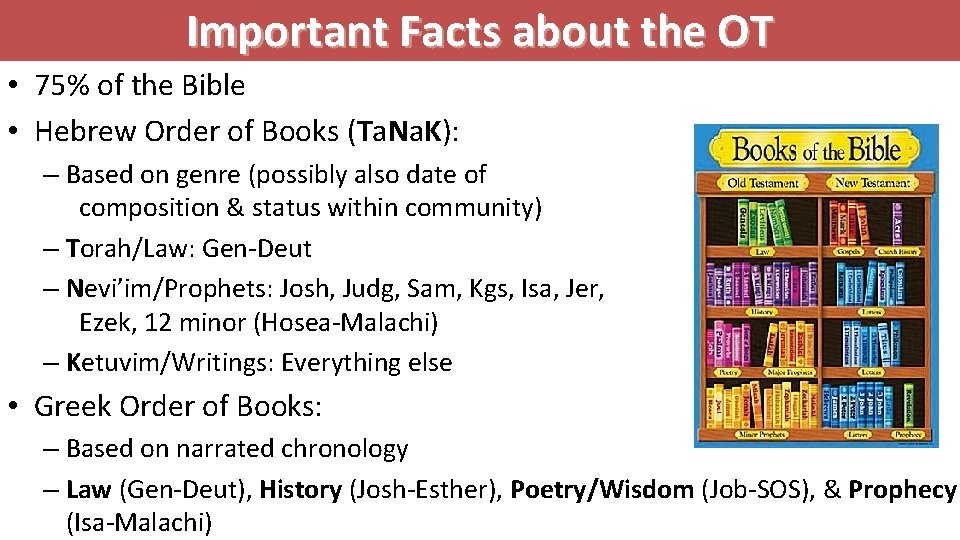
Important Facts about the OT • 75% of the Bible • Hebrew Order of Books (Ta. Na. K): – Based on genre (possibly also date of composition & status within community) – Torah/Law: Gen-Deut – Nevi’im/Prophets: Josh, Judg, Sam, Kgs, Isa, Jer, Ezek, 12 minor (Hosea-Malachi) – Ketuvim/Writings: Everything else • Greek Order of Books: – Based on narrated chronology – Law (Gen-Deut), History (Josh-Esther), Poetry/Wisdom (Job-SOS), & Prophecy (Isa-Malachi)
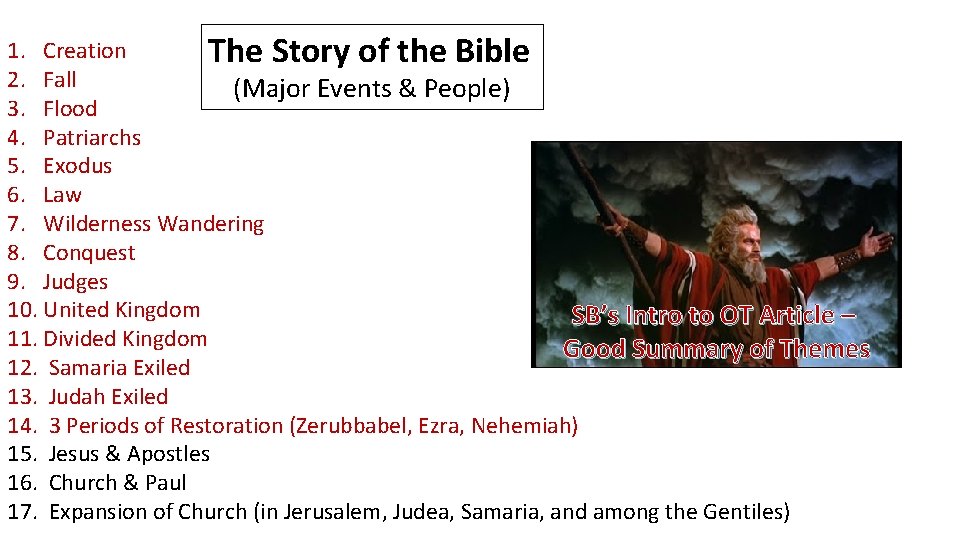
1. Creation The Story of the Bible 2. Fall (Major Events & People) 3. Flood 4. Patriarchs 5. Exodus 6. Law 7. Wilderness Wandering 8. Conquest 9. Judges 10. United Kingdom SB’s Intro to OT Article – 11. Divided Kingdom Good Summary of Themes 12. Samaria Exiled 13. Judah Exiled 14. 3 Periods of Restoration (Zerubbabel, Ezra, Nehemiah) 15. Jesus & Apostles 16. Church & Paul 17. Expansion of Church (in Jerusalem, Judea, Samaria, and among the Gentiles)
Introduction to the Pentateuch Gen - Deut
Summary This set of 5 books narrates history from its earliest beginnings to one people’s covenant with God and preparation to enter a promised land.

"The Pentateuch" • “Five Books” or “Five Scrolls” • These five have always been separate books. • But each book is closely tied to those before & after • • Genesis ties to Exodus by – Egypt Exodus ties to Leviticus by – Tabernacle Leviticus ties to Numbers by – Rituals Numbers ties to Deuteronomy by – Rebellion. • The link tying all 5 together is an association with Moses as author and/or actor. • But the incompleteness of the story in the five books points readers forward in time to the next books of the OT (Josh-Esther). Thus some scholars have proposed a Tetrateuch, Hexateuch, or Enneatuech.
"The Book(s) of Moses" • Gen-Deut are technically anonymous. • But later scripture refers to these as “the book(s) of Moses. ”: "And they set aside the burnt offerings that they might distribute them according to the groupings of the fathers' houses…as it is written in the Book of Moses. And so they did with the bulls. " (2 Chron. 35: 12; cf. Mk. 12: 26; Deut 17: 18; Josh 8: 32; Acts 28: 23; etc. ) • The Book of Moses: About Moses? During time period of Moses? Authored by Moses? • Moses is responsible for writing down some portions of it: "And the Lord said to Moses, “Write these words, for in accordance with these words I have made a covenant with you and with Israel. ” (Ex. 34: 27; cf. Ex. 17: 14) • Other authors/editors contributed to these books: “Then the priest shall write these curses in a book and wash them off into the water of bitterness" (Num. 5: 23; cf. Gen. 12: 6; 13: 7; Deut. 34: 5 -12; Num. 12: 3) • These books reflect Mosaic Authority (e. g. “Noah Webster's” Dictionary).
Hebrew: "The Torah” • English: “law” – these 5 books contain rules/regulations (e. g. Ex 20 -24) • English: “covenant law” – these 5 books contain “relationships between multiple parties based on specific terms with consequences. ” • English: “instructions” (better translation) • Law = a particular genre • The Pentateuch has multiple genres, including: narrative, ritual, poetry, history, prophecy, apologetic, genealogy, sermon, & law. • The focus of these 5 books are on instructions about who God is and who his people are to be in light of God’s Identity.
History of Composition • Indications that Moses was not only contributor to Pentateuch raised questions. • Wellhausen’s “Documentary Hypothesis” (JEDP) • J: J/Yahwist (e. g. Gen 2: 4). • S. Kingdom of Judah, Davidic monarchy, Jerusalem, epic narrative. 840 BCE • E: Elohist (e. g. Gen 1: 1) • N. Kingdom of Israel, tribal traditions of the land, covenant, worship outside Jerusalem. 700 BCE. • JE joined together (“redacted”) before the 6 th c. exile. SB’s Intro to Pent Article – Only Negative on JEDP! Why? • D: Deuteronomist (e. g. Deut 6: 1 -2) • Nearly synonymous with Deut (concerns legal material, covenant, obedience, faithfulness). • Dual redaction: Josiah’s day (621 BC) and in Exile (586 BC). • P: Priestly (Lev. 19: 1 -4) • Temple, ritual, genealogy, feasts, prayer, worship. 500 -450 BCE • JEDP joined together (“redacted”) after the 6 th c. exile • Ex 12 -13: Moses (JE) vs. Moses/Aaron (P) vs. the community (D)
Biblical Covenants • God-Noah covenant of no more universal floods (Gen 9: 8 -17) • God-Abraham & his seed cov’t to bless the world (Gen 12: 1 -3) • God-Israel (in Moses’ Day) cov’t to be God & people (Ex 6: 7; Lev 26: 12) • God-Israel (in Joshua’s day) to be God/people (Deut 29: 1 ff; Josh 24: 25) • God-David & his seed to be father/son, to build a house=temple/dynasty (2 Sam 7: 12 -16) • God-Post-Exilic Israel with a “new cov’t” of God/people (Neh 9: 38; Jer 30: 22; 31: 31 -34).
- Slides: 9