
Important Classifications Merit goods versus Demerit goods Statesector

- Slides: 20
Important Classifications • Merit goods versus Demerit goods • State-sector (public sector) goods or firms (usually have positive externalities, but not necessarily, and MAY BE public goods) vs private sector goods or firms • Public goods (collectively consumed goods) versus Private goods • Common access goods/resources
Merit Goods • Merit goods are goods that are considered to be desirable for consumers, but which are underprovided by the market • They are underprovided and resources are underallocated to production for several different reasons… – Positive externalities (markets underproviding them as described above) and/or – Low levels of income and poverty (some people are too poor to afford them) – Consumer ignorance and unawareness (e. g. do not know the benefits of milk)
Demerit Goods • Demerit goods are goods that are considered to be undesirable for consumers, but which are overprovided by the market • Examples: Cigarettes, alcohol, gambling, etc. • They are overprovided and resources are overallocated to production because of • Negative externalities and/or • Consumer ignorance of the negative effects, unaware of the harmful effects upon others of their action • addictive
PUBLIC (COLLECTIVELY CONSUMED) GOODS also called PURE PUBLIC GOODS
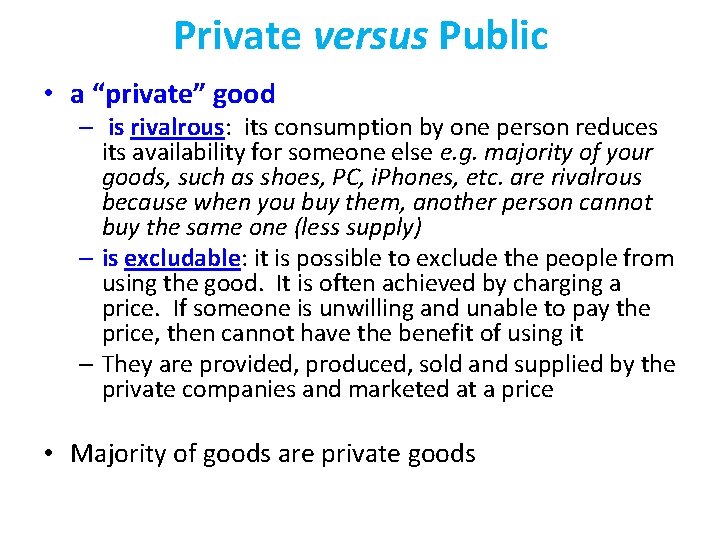
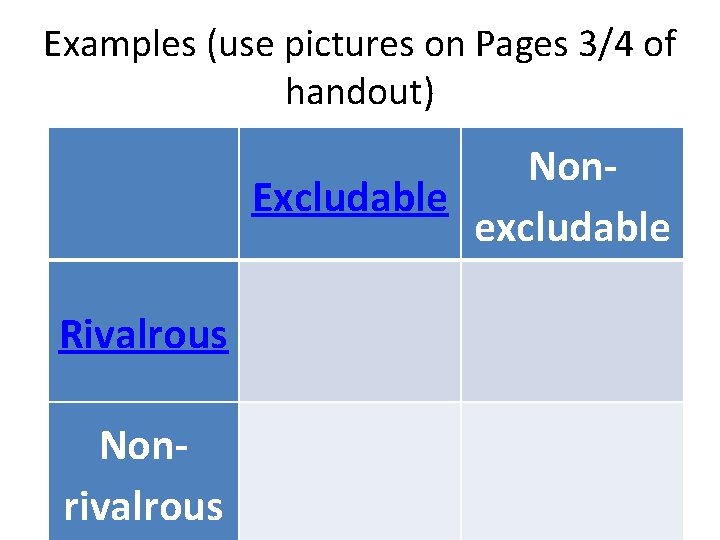
Private versus Public • a “private” good – is rivalrous: its consumption by one person reduces its availability for someone else e. g. majority of your goods, such as shoes, PC, i. Phones, etc. are rivalrous because when you buy them, another person cannot buy the same one (less supply) – is excludable: it is possible to exclude the people from using the good. It is often achieved by charging a price. If someone is unwilling and unable to pay the price, then cannot have the benefit of using it – They are provided, produced, sold and supplied by the private companies and marketed at a price • Majority of goods are private goods
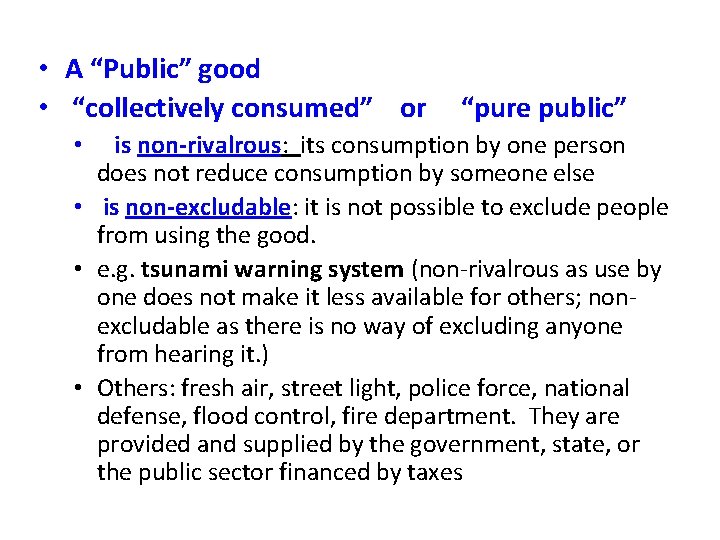
• A “Public” good • “collectively consumed” or “pure public” is non-rivalrous: its consumption by one person does not reduce consumption by someone else • is non-excludable: it is not possible to exclude people from using the good. • e. g. tsunami warning system (non-rivalrous as use by one does not make it less available for others; nonexcludable as there is no way of excluding anyone from hearing it. ) • Others: fresh air, street light, police force, national defense, flood control, fire department. They are provided and supplied by the government, state, or the public sector financed by taxes •
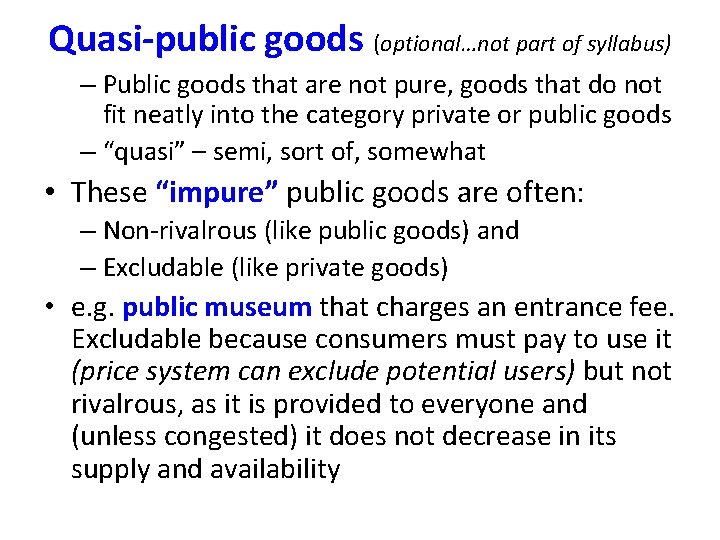
Quasi-public goods (optional…not part of syllabus) – Public goods that are not pure, goods that do not fit neatly into the category private or public goods – “quasi” – semi, sort of, somewhat • These “impure” public goods are often: – Non-rivalrous (like public goods) and – Excludable (like private goods) • e. g. public museum that charges an entrance fee. Excludable because consumers must pay to use it (price system can exclude potential users) but not rivalrous, as it is provided to everyone and (unless congested) it does not decrease in its supply and availability
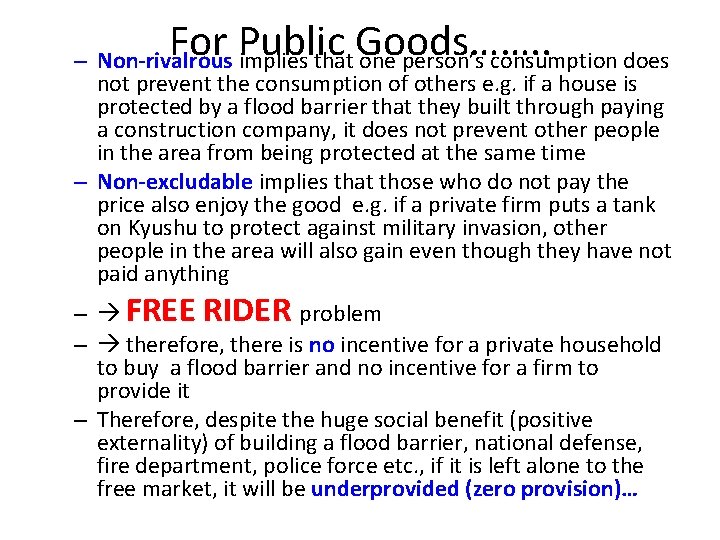
For Public Goods……. . – Non-rivalrous implies that one person’s consumption does not prevent the consumption of others e. g. if a house is protected by a flood barrier that they built through paying a construction company, it does not prevent other people in the area from being protected at the same time – Non-excludable implies that those who do not pay the price also enjoy the good e. g. if a private firm puts a tank on Kyushu to protect against military invasion, other people in the area will also gain even though they have not paid anything – FREE RIDER problem – therefore, there is no incentive for a private household to buy a flood barrier and no incentive for a firm to provide it – Therefore, despite the huge social benefit (positive externality) of building a flood barrier, national defense, fire department, police force etc. , if it is left alone to the free market, it will be underprovided (zero provision)…
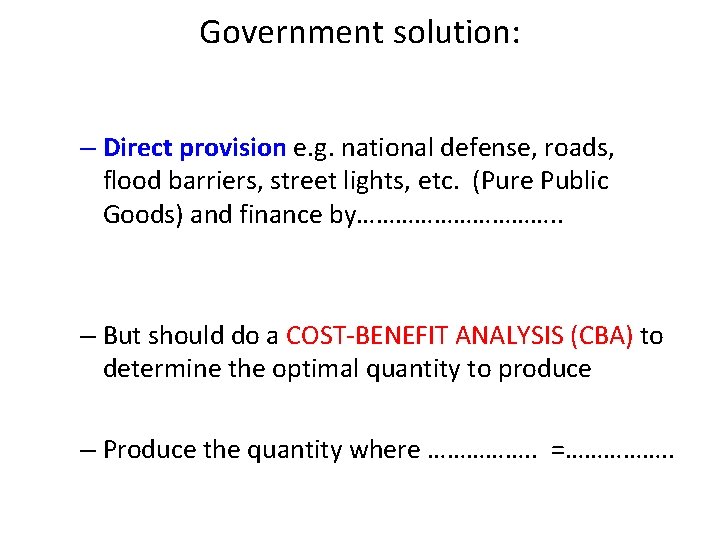
Government solution: – Direct provision e. g. national defense, roads, flood barriers, street lights, etc. (Pure Public Goods) and finance by……………. . – But should do a COST-BENEFIT ANALYSIS (CBA) to determine the optimal quantity to produce – Produce the quantity where ……………. . =……………. .
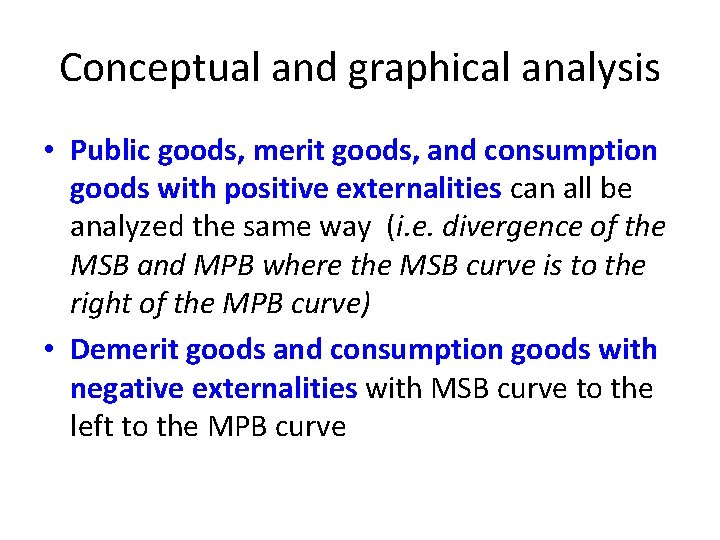
Conceptual and graphical analysis • Public goods, merit goods, and consumption goods with positive externalities can all be analyzed the same way (i. e. divergence of the MSB and MPB where the MSB curve is to the right of the MPB curve) • Demerit goods and consumption goods with negative externalities with MSB curve to the left to the MPB curve
Examples (use pictures on Pages 3/4 of handout) Non. Excludable excludable Rivalrous Nonrivalrous
COMMON ACCESS Resources Pages 3/4 of handout
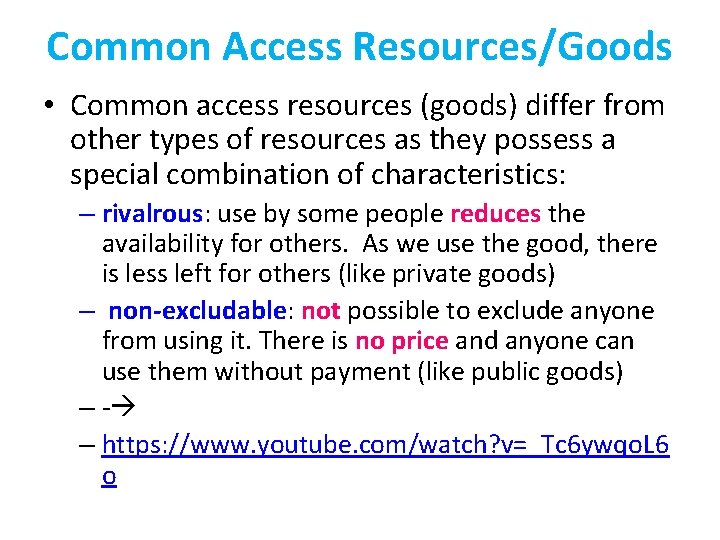
Common Access Resources/Goods • Common access resources (goods) differ from other types of resources as they possess a special combination of characteristics: – rivalrous: use by some people reduces the availability for others. As we use the good, there is less left for others (like private goods) – non-excludable: not possible to exclude anyone from using it. There is no price and anyone can use them without payment (like public goods) – - – https: //www. youtube. com/watch? v=_Tc 6 ywqo. L 6 o
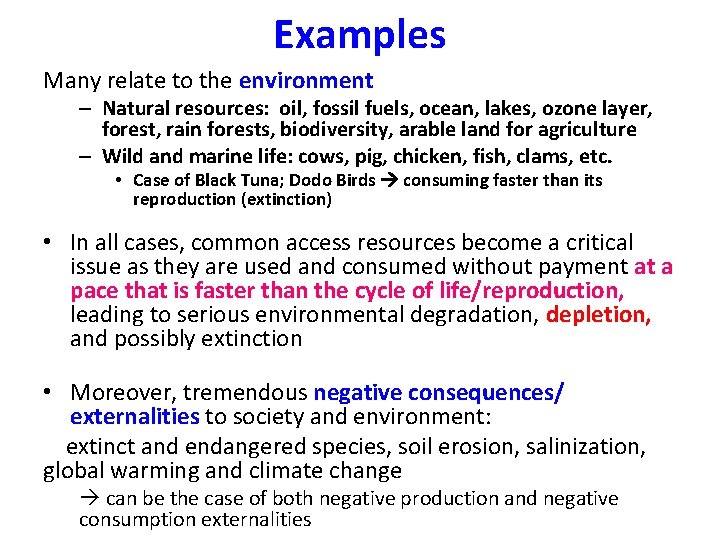
Examples Many relate to the environment – Natural resources: oil, fossil fuels, ocean, lakes, ozone layer, forest, rain forests, biodiversity, arable land for agriculture – Wild and marine life: cows, pig, chicken, fish, clams, etc. • Case of Black Tuna; Dodo Birds consuming faster than its reproduction (extinction) • In all cases, common access resources become a critical issue as they are used and consumed without payment at a pace that is faster than the cycle of life/reproduction, leading to serious environmental degradation, depletion, and possibly extinction • Moreover, tremendous negative consequences/ externalities to society and environment: extinct and endangered species, soil erosion, salinization, global warming and climate change can be the case of both negative production and negative consumption externalities
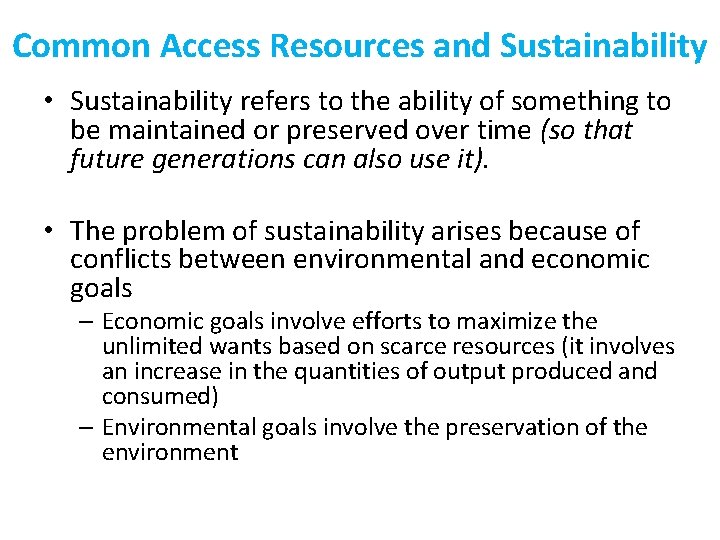
Common Access Resources and Sustainability • Sustainability refers to the ability of something to be maintained or preserved over time (so that future generations can also use it). • The problem of sustainability arises because of conflicts between environmental and economic goals – Economic goals involve efforts to maximize the unlimited wants based on scarce resources (it involves an increase in the quantities of output produced and consumed) – Environmental goals involve the preservation of the environment
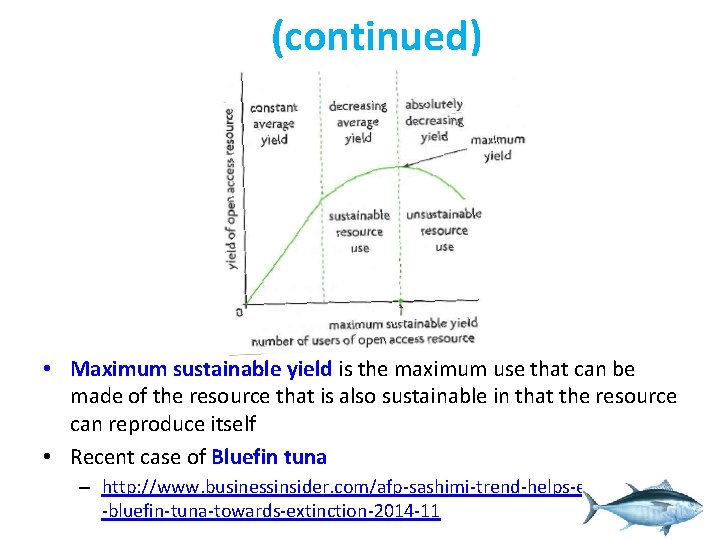
(continued) • Maximum sustainable yield is the maximum use that can be made of the resource that is also sustainable in that the resource can reproduce itself • Recent case of Bluefin tuna – http: //www. businessinsider. com/afp-sashimi-trend-helps-edge-pacific -bluefin-tuna-towards-extinction-2014 -11
Graphical Analysis • Overuse of common access resources from industrial production and high income consumption activities based on fossil fuels external costs (depletion or extinction of wild life, ozone layer, air, etc). e. g consequences of global warming • The economic and welfare analysis is the – Negative production externalities case OR – Negative consumption externalities case
Sustainable Development… can it be achieved? • Overuse of environmental resources in the developing economies can be an important cause of environmental destruction • Examples – Lack of modern agricultural inputs and technology to preserve the soil’s fertility, depleting the minerals in soil, thus making it unproductive in the future (desertification) – Cutting down forests and trees to find more room for agriculture (together with the rising population), – Lack of clean water, irrigation systems, and sanitation – Immense waste disposal impacts the environment – all risk the reproduction and sustainability of the environment
• Asymmetric/Imperfect information • Pages 5/6/7/8 of handout