
Important Additional Risk Minimisation Information for Healthcare Professionals

- Slides: 55
Important Additional Risk Minimisation Information for Healthcare Professionals Training for Abb. Vie Duodopa® Specialist on LCIG System, PEG-J Placement, Aftercare and Minimisation of Procedure Complications Duodopa® (levodopa – carbidopa intestinal gel) EDUKACIJSKI MATERIJAL NAMIJENJEN MINIMIZACIJI RIZIKA, VERZIJA 2 (PLAN UPRAVLJANJA RIZIKOM, VERZIJA 7. 2, 13. OŽUJAK 2017. ) EDUCATIONAL MATERIAL FOR RISK MINIMISATION (RISK MANAGEMENT PLAN VERSION 7. 2, 13 -MARCH-2017) ADCRDUO 180039 Veljača, 2018.
Duodopa: Important Additional Risk Minimisation Information for Healthcare Providers • The information presented in these slides is provided as part of additional Risk Minimisation Program for Duodopa targeted to minimize: – Gastrointestinal (GI) events – Device-related risks – Procedure-related risks associated with the LCIG system • The information does not include a complete list of all risks or safety information on GI or device related procedure events associated with PEG-J: Percutaneous Endoscopic Gastrostomy (PEG) and Jejunal Tube (J) or Duodopa use • Please carefully read your current and locally available Duodopa Prescribing Information and Patient Leaflet Information for comprehensive safety information on Duodopa or Instruction for Use (IFU) for PEG-J 2 EDUCATIONAL MATERIAL FOR RISK MINIMISATION (RISK MANAGEMENT PLAN VERSION 7. 2, 13 -MARCH-2017)
Outline • Goals for additional Risk Minimisation program • Duodopa (LCIG system) • PEG-J – Preparation of the patient – Placement – Aftercare • Procedure complications and actions to take 3 EDUCATIONAL MATERIAL FOR RISK MINIMISATION (RISK MANAGEMENT PLAN VERSION 7. 2, 13 -MARCH-2017)
Goals: Additional Risk Minimisation Program • To inform Healthcare Providers (HCPs) and patients about the Gastrointestinal (GI), Gastrointestinal Device and Procedure-related risks associated with the LCIG system • Educate HCPs on PEG-J and NJ (Naso-jejunal tube) insertion procedures • Inform HCPs and patients about aftercare for long-term PEG-J placement in patients using the LCIG system 4 EDUCATIONAL MATERIAL FOR RISK MINIMISATION (RISK MANAGEMENT PLAN VERSION 7. 2, 13 -MARCH-2017)
Target Population to Inform and Educate • Healthcare Providers • Neurologists • Gastroenterologist/Gastroenterology surgeon • Center nurses • Home care nurses • Abb. Vie Duodopa Specialists 5 EDUCATIONAL MATERIAL FOR RISK MINIMISATION (RISK MANAGEMENT PLAN VERSION 7. 2, 13 -MARCH-2017)
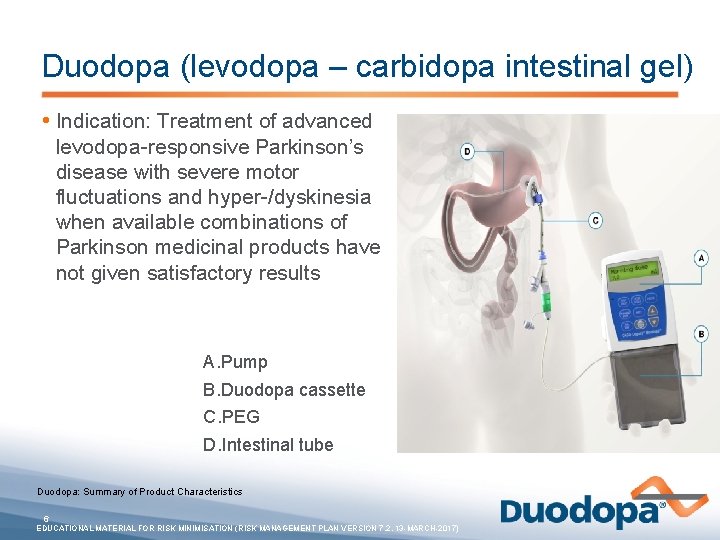
Duodopa (levodopa – carbidopa intestinal gel) • Indication: Treatment of advanced levodopa-responsive Parkinson’s disease with severe motor fluctuations and hyper-/dyskinesia when available combinations of Parkinson medicinal products have not given satisfactory results A. Pump B. Duodopa cassette C. PEG D. Intestinal tube Duodopa: Summary of Product Characteristics 6 EDUCATIONAL MATERIAL FOR RISK MINIMISATION (RISK MANAGEMENT PLAN VERSION 7. 2, 13 -MARCH-2017)
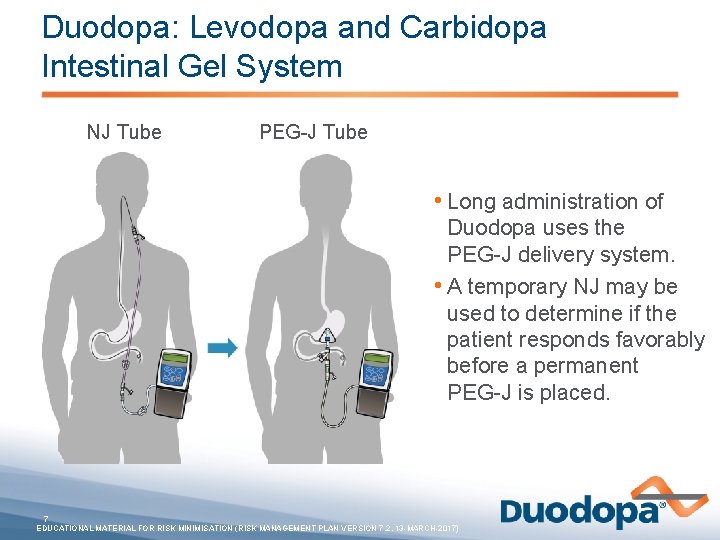
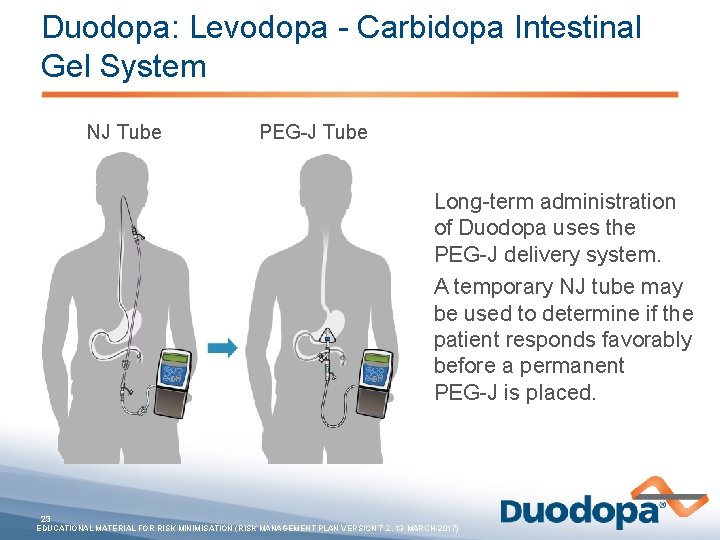
Duodopa: Levodopa and Carbidopa Intestinal Gel System NJ Tube PEG-J Tube • Long administration of Duodopa uses the PEG-J delivery system. • A temporary NJ may be used to determine if the patient responds favorably before a permanent PEG-J is placed. 7 EDUCATIONAL MATERIAL FOR RISK MINIMISATION (RISK MANAGEMENT PLAN VERSION 7. 2, 13 -MARCH-2017)
Duodopa Safety 8 EDUCATIONAL MATERIAL FOR RISK MINIMISATION (RISK MANAGEMENT PLAN VERSION 7. 2, 13 -MARCH-2017)
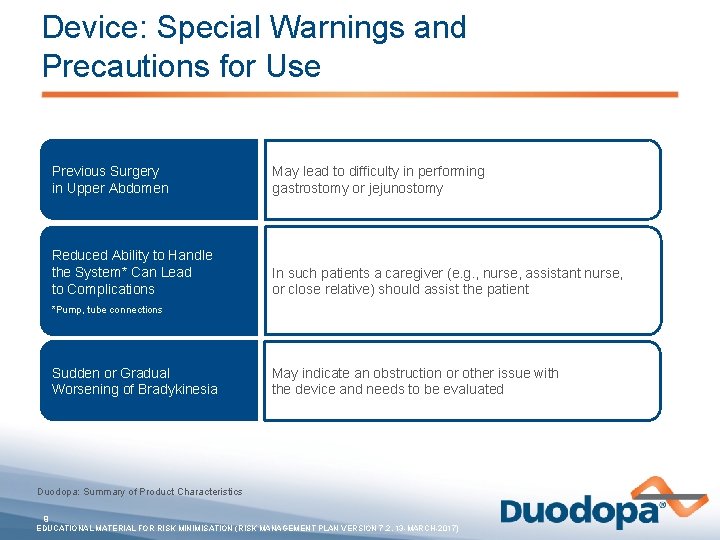
Device: Special Warnings and Precautions for Use Previous Surgery in Upper Abdomen May lead to difficulty in performing gastrostomy or jejunostomy Reduced Ability to Handle the System* Can Lead to Complications In such patients a caregiver (e. g. , nurse, assistant nurse, or close relative) should assist the patient *Pump, tube connections Sudden or Gradual Worsening of Bradykinesia May indicate an obstruction or other issue with the device and needs to be evaluated Duodopa: Summary of Product Characteristics 9 EDUCATIONAL MATERIAL FOR RISK MINIMISATION (RISK MANAGEMENT PLAN VERSION 7. 2, 13 -MARCH-2017)
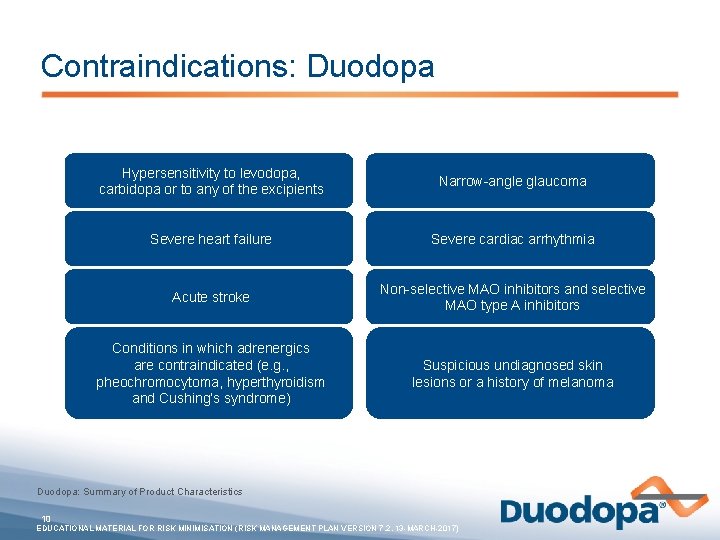
Contraindications: Duodopa Hypersensitivity to levodopa, carbidopa or to any of the excipients Narrow-angle glaucoma Severe heart failure Severe cardiac arrhythmia Acute stroke Non-selective MAO inhibitors and selective MAO type A inhibitors Conditions in which adrenergics are contraindicated (e. g. , pheochromocytoma, hyperthyroidism and Cushing’s syndrome) Suspicious undiagnosed skin lesions or a history of melanoma Duodopa: Summary of Product Characteristics 10 EDUCATIONAL MATERIAL FOR RISK MINIMISATION (RISK MANAGEMENT PLAN VERSION 7. 2, 13 -MARCH-2017)
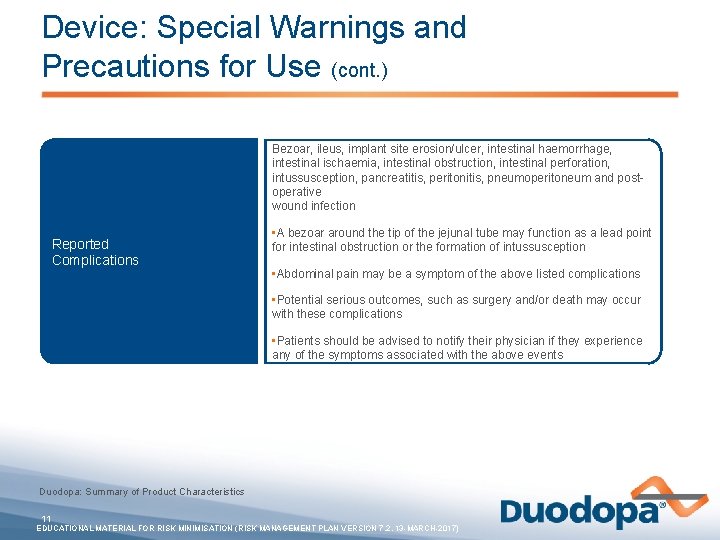
Device: Special Warnings and Precautions for Use (cont. ) Bezoar, ileus, implant site erosion/ulcer, intestinal haemorrhage, intestinal ischaemia, intestinal obstruction, intestinal perforation, intussusception, pancreatitis, peritonitis, pneumoperitoneum and postoperative wound infection Reported Complications • A bezoar around the tip of the jejunal tube may function as a lead point for intestinal obstruction or the formation of intussusception • Abdominal pain may be a symptom of the above listed complications • Potential serious outcomes, such as surgery and/or death may occur with these complications • Patients should be advised to notify their physician if they experience any of the symptoms associated with the above events Duodopa: Summary of Product Characteristics 11 EDUCATIONAL MATERIAL FOR RISK MINIMISATION (RISK MANAGEMENT PLAN VERSION 7. 2, 13 -MARCH-2017)
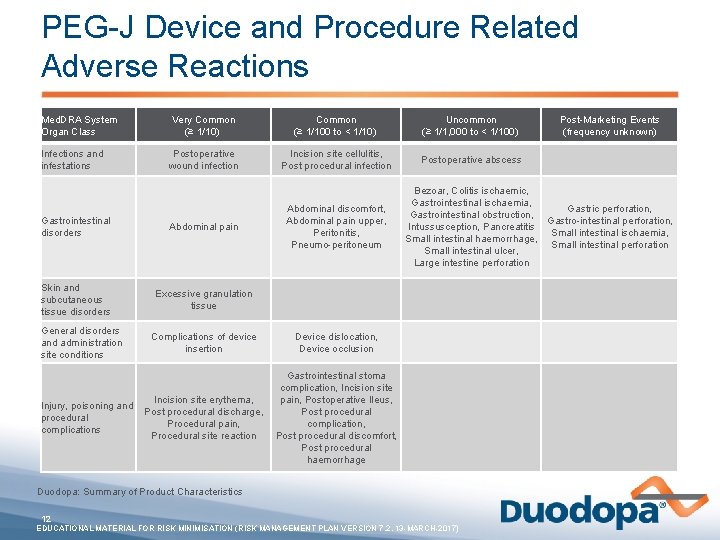
PEG-J Device and Procedure Related Adverse Reactions Med. DRA System Organ Class Very Common (≥ 1/10) Common (≥ 1/100 to < 1/10) Uncommon (≥ 1/1, 000 to < 1/100) Infections and infestations Postoperative wound infection Incision site cellulitis, Post procedural infection Postoperative abscess Gastrointestinal disorders Abdominal pain Skin and subcutaneous tissue disorders Excessive granulation tissue General disorders and administration site conditions Injury, poisoning and procedural complications Abdominal discomfort, Abdominal pain upper, Peritonitis, Pneumo-peritoneum Complications of device insertion Device dislocation, Device occlusion Incision site erythema, Post procedural discharge, Procedural pain, Procedural site reaction Gastrointestinal stoma complication, Incision site pain, Postoperative Ileus, Post procedural complication, Post procedural discomfort, Post procedural haemorrhage Post-Marketing Events (frequency unknown) Bezoar, Colitis ischaemic, Gastrointestinal ischaemia, Gastric perforation, Gastrointestinal obstruction, Gastro-intestinal perforation, Intussusception, Pancreatitis Small intestinal ischaemia, Small intestinal haemorrhage, Small intestinal perforation Small intestinal ulcer, Large intestine perforation Duodopa: Summary of Product Characteristics 12 EDUCATIONAL MATERIAL FOR RISK MINIMISATION (RISK MANAGEMENT PLAN VERSION 7. 2, 13 -MARCH-2017)
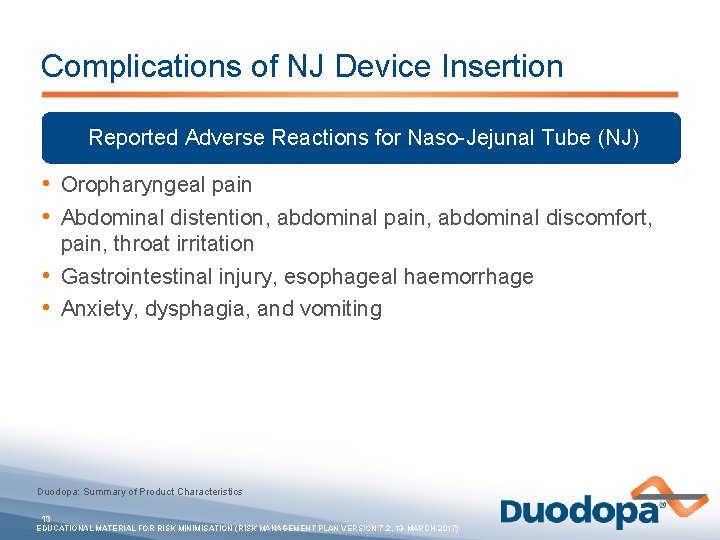
Complications of NJ Device Insertion Reported Adverse Reactions for Naso-Jejunal Tube (NJ) • Oropharyngeal pain • Abdominal distention, abdominal pain, abdominal discomfort, pain, throat irritation • Gastrointestinal injury, esophageal haemorrhage • Anxiety, dysphagia, and vomiting Duodopa: Summary of Product Characteristics 13 EDUCATIONAL MATERIAL FOR RISK MINIMISATION (RISK MANAGEMENT PLAN VERSION 7. 2, 13 -MARCH-2017)
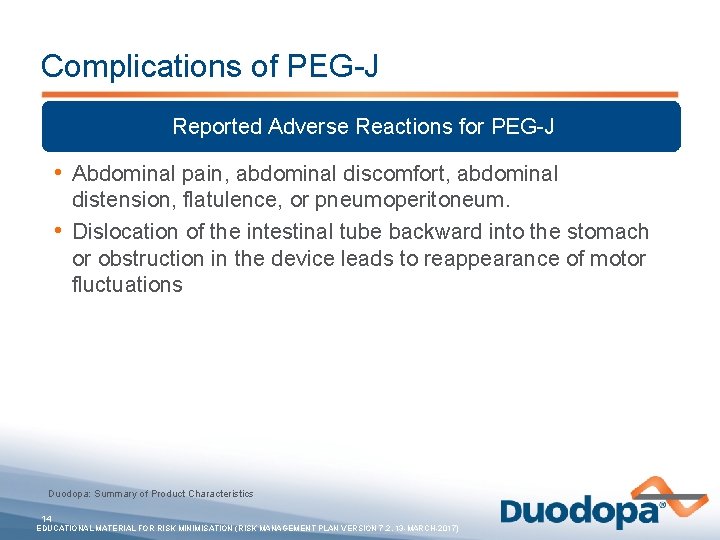
Complications of PEG-J Reported Adverse Reactions for PEG-J • Abdominal pain, abdominal discomfort, abdominal distension, flatulence, or pneumoperitoneum. • Dislocation of the intestinal tube backward into the stomach or obstruction in the device leads to reappearance of motor fluctuations Duodopa: Summary of Product Characteristics 14 EDUCATIONAL MATERIAL FOR RISK MINIMISATION (RISK MANAGEMENT PLAN VERSION 7. 2, 13 -MARCH-2017)
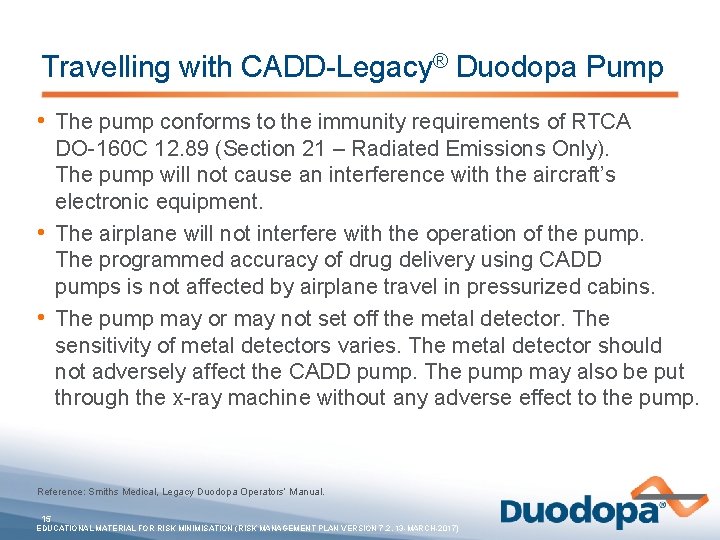
Travelling with CADD-Legacy® Duodopa Pump • The pump conforms to the immunity requirements of RTCA DO-160 C 12. 89 (Section 21 – Radiated Emissions Only). The pump will not cause an interference with the aircraft’s electronic equipment. • The airplane will not interfere with the operation of the pump. The programmed accuracy of drug delivery using CADD pumps is not affected by airplane travel in pressurized cabins. • The pump may or may not set off the metal detector. The sensitivity of metal detectors varies. The metal detector should not adversely affect the CADD pump. The pump may also be put through the x-ray machine without any adverse effect to the pump. Reference: Smiths Medical, Legacy Duodopa Operators’ Manual. 15 EDUCATIONAL MATERIAL FOR RISK MINIMISATION (RISK MANAGEMENT PLAN VERSION 7. 2, 13 -MARCH-2017)
Starting a Patient Logistic Flow: • Preparations • Tube insertions • Calculation • Titration 16 EDUCATIONAL MATERIAL FOR RISK MINIMISATION (RISK MANAGEMENT PLAN VERSION 7. 2, 13 -MARCH-2017)
Starting a New Duodopa Patient in a Clinic with an NJ Tube 1. Naso-Jejunal Tube insertion 2. Duodopa dose calculation and pump programming 3. Titration period 4. PEG-J placement 17 EDUCATIONAL MATERIAL FOR RISK MINIMISATION (RISK MANAGEMENT PLAN VERSION 7. 2, 13 -MARCH-2017)
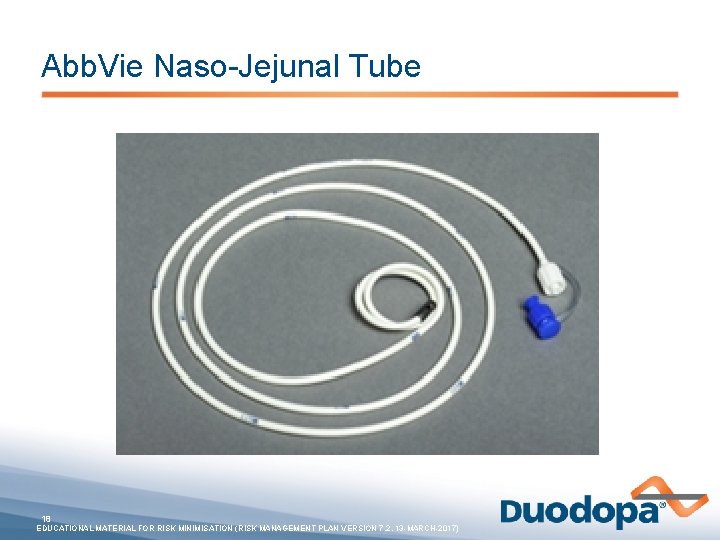
Abb. Vie Naso-Jejunal Tube 18 EDUCATIONAL MATERIAL FOR RISK MINIMISATION (RISK MANAGEMENT PLAN VERSION 7. 2, 13 -MARCH-2017)
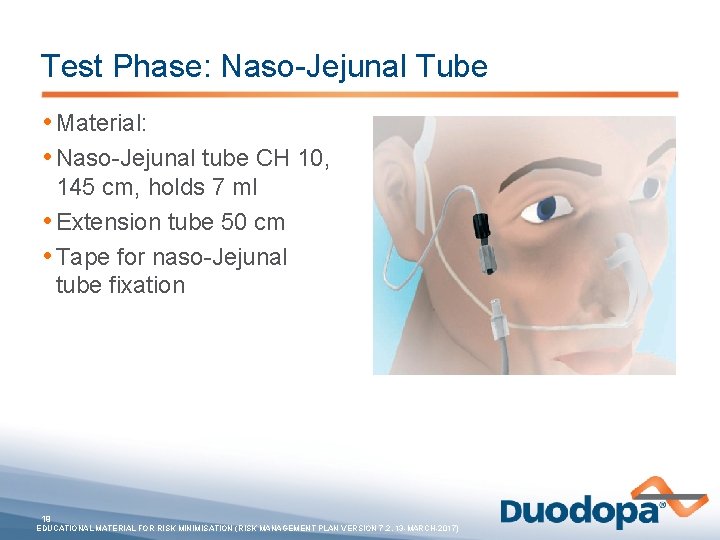
Test Phase: Naso-Jejunal Tube • Material: • Naso-Jejunal tube CH 10, 145 cm, holds 7 ml • Extension tube 50 cm • Tape for naso-Jejunal tube fixation 19 EDUCATIONAL MATERIAL FOR RISK MINIMISATION (RISK MANAGEMENT PLAN VERSION 7. 2, 13 -MARCH-2017)
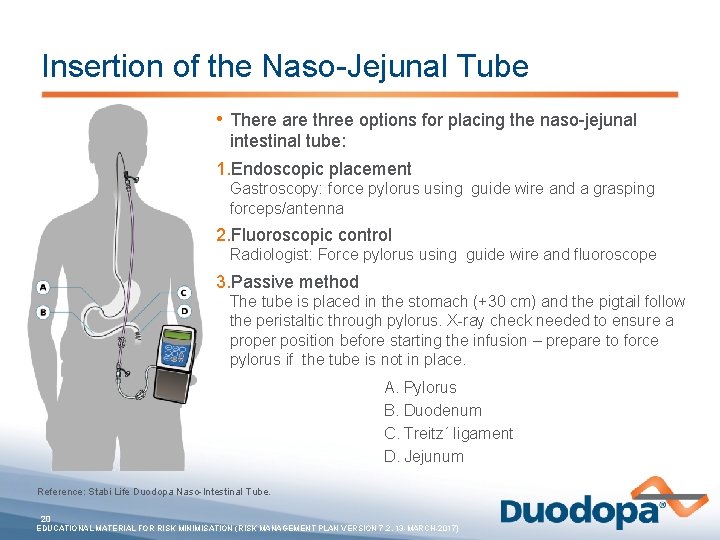
Insertion of the Naso-Jejunal Tube • There are three options for placing the naso-jejunal intestinal tube: 1. Endoscopic placement Gastroscopy: force pylorus using guide wire and a grasping forceps/antenna 2. Fluoroscopic control Radiologist: Force pylorus using guide wire and fluoroscope 3. Passive method The tube is placed in the stomach (+30 cm) and the pigtail follow the peristaltic through pylorus. X-ray check needed to ensure a proper position before starting the infusion – prepare to force pylorus if the tube is not in place. A. Pylorus B. Duodenum C. Treitz´ ligament D. Jejunum Reference: Stabi Life Duodopa Naso-Intestinal Tube. 20 EDUCATIONAL MATERIAL FOR RISK MINIMISATION (RISK MANAGEMENT PLAN VERSION 7. 2, 13 -MARCH-2017)
Critical Aspects of PEG-J Preparation, Placement and Aftercare 21 EDUCATIONAL MATERIAL FOR RISK MINIMISATION (RISK MANAGEMENT PLAN VERSION 7. 2, 13 -MARCH-2017)
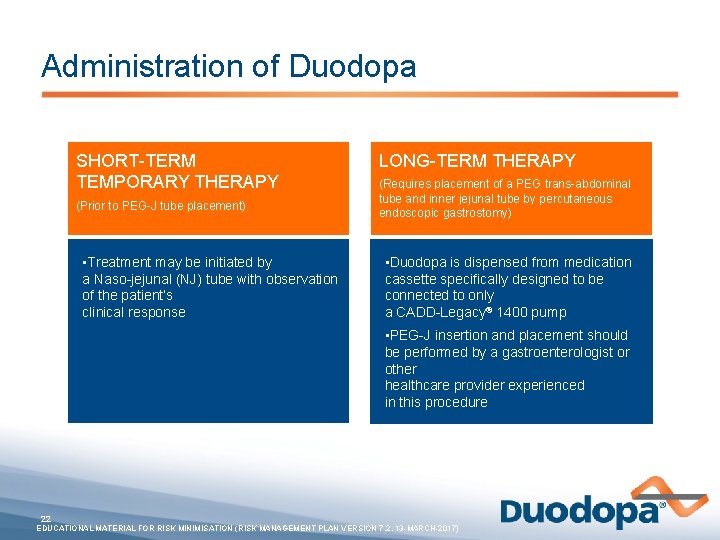
Administration of Duodopa SHORT-TERM TEMPORARY THERAPY (Prior to PEG-J tube placement) • Treatment may be initiated by a Naso-jejunal (NJ) tube with observation of the patient’s clinical response LONG-TERM THERAPY (Requires placement of a PEG trans-abdominal tube and inner jejunal tube by percutaneous endoscopic gastrostomy) • Duodopa is dispensed from medication cassette specifically designed to be connected to only a CADD-Legacy® 1400 pump • PEG-J insertion and placement should be performed by a gastroenterologist or other healthcare provider experienced in this procedure 22 EDUCATIONAL MATERIAL FOR RISK MINIMISATION (RISK MANAGEMENT PLAN VERSION 7. 2, 13 -MARCH-2017)
Duodopa: Levodopa - Carbidopa Intestinal Gel System NJ Tube PEG-J Tube Long-term administration of Duodopa uses the PEG-J delivery system. A temporary NJ tube may be used to determine if the patient responds favorably before a permanent PEG-J is placed. 23 EDUCATIONAL MATERIAL FOR RISK MINIMISATION (RISK MANAGEMENT PLAN VERSION 7. 2, 13 -MARCH-2017)
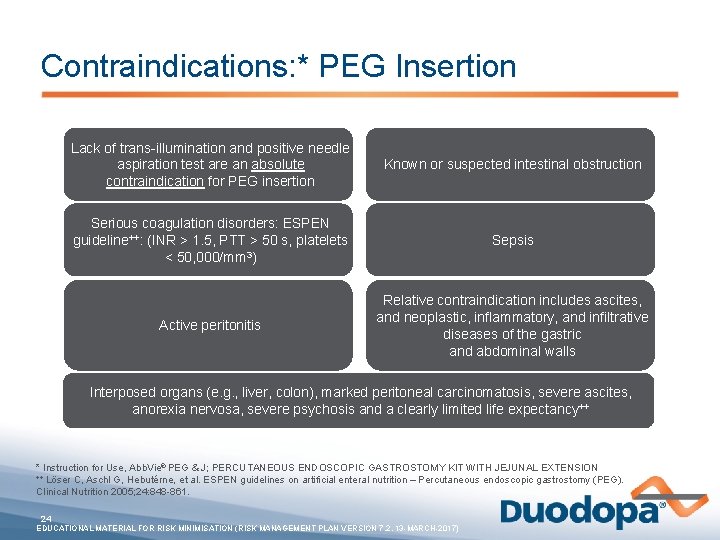
Contraindications: * PEG Insertion Lack of trans-illumination and positive needle aspiration test are an absolute contraindication for PEG insertion Known or suspected intestinal obstruction Serious coagulation disorders: ESPEN guideline++: (INR ˃ 1. 5, PTT ˃ 50 s, platelets < 50, 000/mm 3) Sepsis Active peritonitis Relative contraindication includes ascites, and neoplastic, inflammatory, and infiltrative diseases of the gastric and abdominal walls Interposed organs (e. g. , liver, colon), marked peritoneal carcinomatosis, severe ascites, anorexia nervosa, severe psychosis and a clearly limited life expectancy++ * Instruction for Use, Abb. Vie® PEG & J; PERCUTANEOUS ENDOSCOPIC GASTROSTOMY KIT WITH JEJUNAL EXTENSION ++ Löser C, Aschl G, Hebutérne, et al. ESPEN guidelines on artificial enteral nutrition – Percutaneous endoscopic gastrostomy (PEG). Clinical Nutrition 2005; 24: 848 -861. 24 EDUCATIONAL MATERIAL FOR RISK MINIMISATION (RISK MANAGEMENT PLAN VERSION 7. 2, 13 -MARCH-2017)
PEG-J: Preparation, Placement and Aftercare • Educate HCPs on PEG-J and NJ tube insertion procedures through “Critical Aspects of PEG-J”: • Materials to be used • Preparation of the patient • Placement • Aftercare 25 EDUCATIONAL MATERIAL FOR RISK MINIMISATION (RISK MANAGEMENT PLAN VERSION 7. 2, 13 -MARCH-2017)
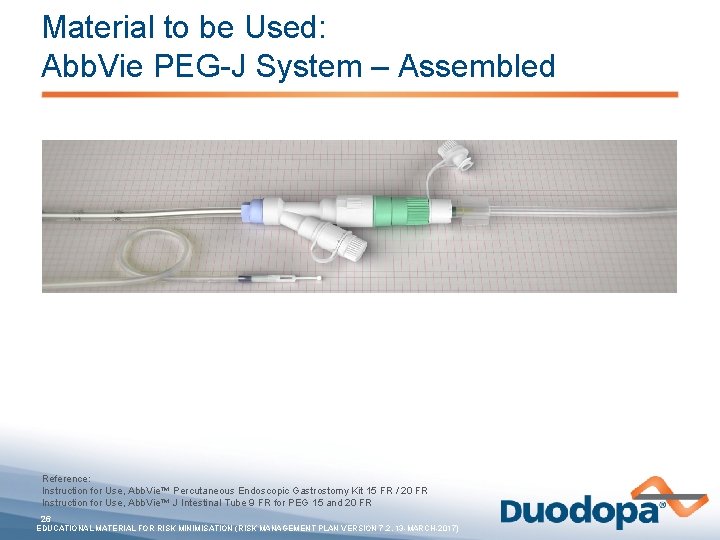
Material to be Used: Abb. Vie PEG-J System – Assembled Reference: Instruction for Use, Abb. Vie™ Percutaneous Endoscopic Gastrostomy Kit 15 FR / 20 FR Instruction for Use, Abb. Vie™ J Intestinal Tube 9 FR for PEG 15 and 20 FR 26 EDUCATIONAL MATERIAL FOR RISK MINIMISATION (RISK MANAGEMENT PLAN VERSION 7. 2, 13 -MARCH-2017)
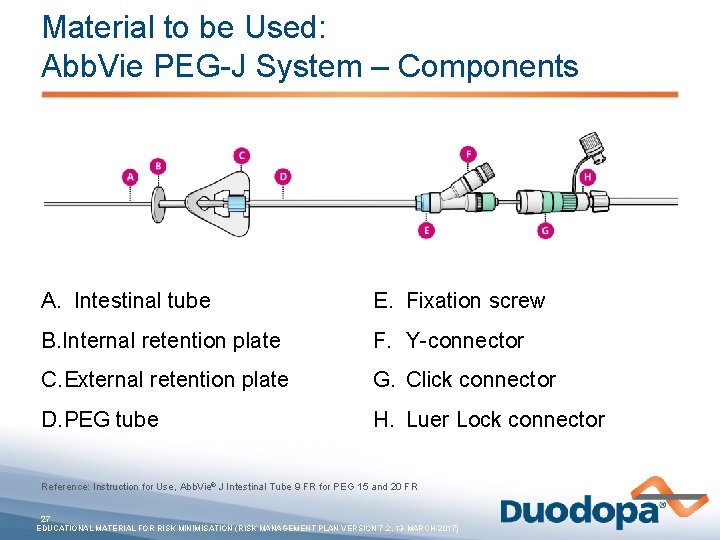
Material to be Used: Abb. Vie PEG-J System – Components A. Intestinal tube E. Fixation screw B. Internal retention plate F. Y-connector C. External retention plate G. Click connector D. PEG tube H. Luer Lock connector Reference: Instruction for Use, Abb. Vie® J Intestinal Tube 9 FR for PEG 15 and 20 FR 27 EDUCATIONAL MATERIAL FOR RISK MINIMISATION (RISK MANAGEMENT PLAN VERSION 7. 2, 13 -MARCH-2017)
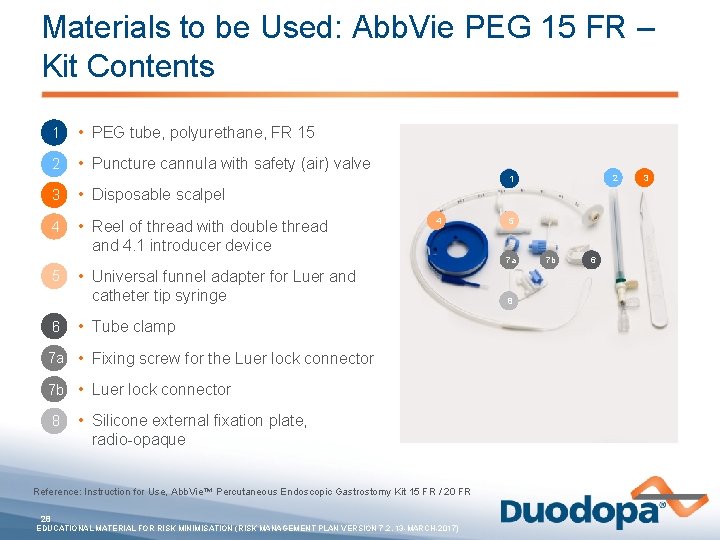
Materials to be Used: Abb. Vie PEG 15 FR – Kit Contents 1 • PEG tube, polyurethane, FR 15 2 • Puncture cannula with safety (air) valve 3 • Disposable scalpel 4 • Reel of thread with double thread 2 1 4 5 and 4. 1 introducer device 7 a 5 • Universal funnel adapter for Luer and catheter tip syringe 6 • Tube clamp 7 a • Fixing screw for the Luer lock connector 7 b • Luer lock connector 8 • Silicone external fixation plate, radio-opaque Reference: Instruction for Use, Abb. Vie™ Percutaneous Endoscopic Gastrostomy Kit 15 FR / 20 FR 28 EDUCATIONAL MATERIAL FOR RISK MINIMISATION (RISK MANAGEMENT PLAN VERSION 7. 2, 13 -MARCH-2017) 8 7 b 6 3
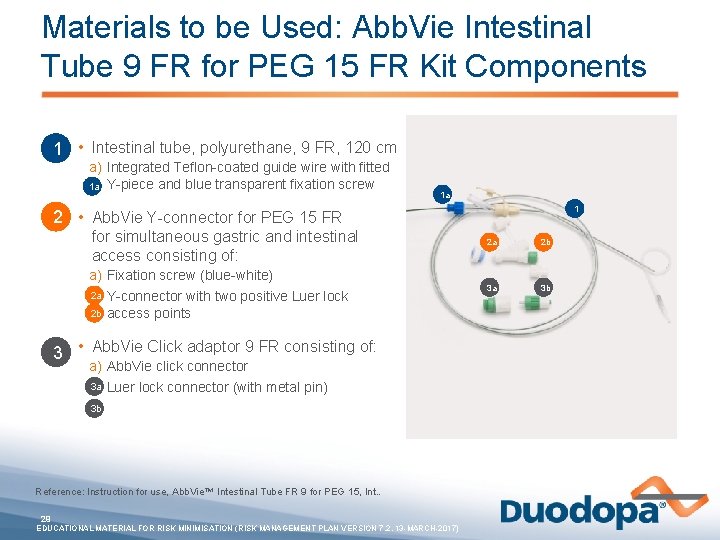
Materials to be Used: Abb. Vie Intestinal Tube 9 FR for PEG 15 FR Kit Components 1 • Intestinal tube, polyurethane, 9 FR, 120 cm a) Integrated Teflon-coated guide wire with fitted 1 a Y-piece and blue transparent fixation screw 1 a 1 2 • Abb. Vie Y-connector for PEG 15 FR for simultaneous gastric and intestinal access consisting of: a) Fixation screw (blue-white) 2 a Y-connector with two positive Luer lock b) 2 b access points 3 • Abb. Vie Click adaptor 9 FR consisting of: a) Abb. Vie click connector 3 a Luer lock connector (with metal pin) b) 3 b Reference: Instruction for use, Abb. Vie™ Intestinal Tube FR 9 for PEG 15, Int. . 29 EDUCATIONAL MATERIAL FOR RISK MINIMISATION (RISK MANAGEMENT PLAN VERSION 7. 2, 13 -MARCH-2017) 2 a 2 b 3 a 3 b
Preparation of the Patient: PEG-J Placement • Prior to the procedure the patient should be: • Fasting overnight, at least 8 hours • Provided with oral hygiene • Given antibiotic prophylaxis per institutional protocol • Current coagulation status per local guideline. ESP advised: — ESPEN guideline++: INR < 1. 5, PTT < 50 s, platelets > 50, 000/mm 3++ • Placed in a supine position for the procedure • Placement of tube system under sterile surgical conditions • On the morning of the procedure the patient should take their oral Parkinson’s disease medications to prevent stiffness during the procedure WARNING: Lack of trans-illumination and positive needle aspiration tests are an absolute contraindication for Abb. Vie™ PEG insertion. Reference: Instruction for use, Abb. Vie™ Intestinal Tube FR 9 for PEG 15, Int. Instruction for Use, Abb. Vie™ Percutaneous Endoscopic Gastrostomy Kit 15 FR / 20 FR ++ Löser C, Aschl G, Hebutérne, et al. ESPEN guidelines on artificial enteral nutrition – Percutaneous endoscopic gastrostomy (PEG). Clinical Nutrition 2005; 24: 848 -861. 30 EDUCATIONAL MATERIAL FOR RISK MINIMISATION (RISK MANAGEMENT PLAN VERSION 7. 2, 13 -MARCH-2017)
PEG Placement: Important Highlights The PEG tube should be placed according to standard procedure as published in the ESPEN-Guidelines and recommended by the tube manufacturer. Reserve at least 40 minutes for the PEG-J procedure; it is essential to reserve enough time for the whole procedure. The standard PEG pullthrough method takes approx. 12 minutes; intestinal tube insertion generally requires 10 to 30 minutes. Angle the PEG toward the pylorus to enable direct access of the inner intestinal tube to pylorus. The skin incision at the puncture site should be slightly larger than the PEG tube. PEG length: 20 cm After placement of the PEG, make a straight cut 20 cm outside of the body. Parkinson’s patients tend to be thin. Be careful not to make skin incisions too deeply into their skin. Before connector assembly, ensure parts are dry and connectors are engaged. Reference: Löser C, Aschl G, Hebutérne, et al. ESPEN guidelines on artificial enteral nutrition – Percutaneous endoscopic gastrostomy (PEG). Clinical Nutrition 2005; 24: 848 -861. 31 EDUCATIONAL MATERIAL FOR RISK MINIMISATION (RISK MANAGEMENT PLAN VERSION 7. 2, 13 -MARCH-2017)
Intestinal Tube Placement; Endoscopic Insertion • The intestinal tube can in general be placed in two different ways: endoscopic insertion or interventional radiology using standard equipment. • Endoscopic insertion: – Long enough endoscope; the Intestinal tube is placed by using an endoscope long enough to reach the ligament of Treitz – Avoid intestinal perforation; make sure to lock the guide wire inside the intestinal tube before insertion üConfirm with X-ray that the distal end of the intestinal tube is located beyond ligament of Treitz Reference: Löser C, Aschl G, Hebutérne, et al. ESPEN guidelines on artificial enteral nutrition – Percutaneous endoscopic gastrostomy (PEG). Clinical Nutrition 2005; 24: 848 -861. 32 EDUCATIONAL MATERIAL FOR RISK MINIMISATION (RISK MANAGEMENT PLAN VERSION 7. 2, 13 -MARCH-2017)
Intestinal Tube Placement; Endoscopic Insertion • Endoscopic instruments to be used; grip the distal end of the intestinal tube using one of the following instruments: – The foreign body forceps, 2: 1 teeth – The two-arm gripper or – The three-arm polyp gripper • Distal end of intestinal tube beyond ligament of Treitz: – Advance the endoscope and the distal end of the intestinal tube under observation until it has safely passed the ligament of Treitz to reduce risk of dislocation of the tube back into the gastric lumen Reference: Löser C, Aschl G, Hebutérne, et al. ESPEN guidelines on artificial enteral nutrition – Percutaneous endoscopic gastrostomy (PEG). Clinical Nutrition 2005; 24: 848 -861. 33 EDUCATIONAL MATERIAL FOR RISK MINIMISATION (RISK MANAGEMENT PLAN VERSION 7. 2, 13 -MARCH-2017)
Aftercare: Day of Placement, Day of Surgery (< 24 Hours After PEG-J Placement) • The Duodopa treatment can normally be initiated directly • • following an uncomplicated PEG-J placement, after consultation with the gastroenterologist Oral feeding might be possible after 2 hours but it is preferred to wait until the next morning Do not change the dressing during the first 24 hours unless necessary Observe for signs of complications such as pain and bleeding GI or specialist should examine the patient before discharge 34 EDUCATIONAL MATERIAL FOR RISK MINIMISATION (RISK MANAGEMENT PLAN VERSION 7. 2, 13 -MARCH-2017)
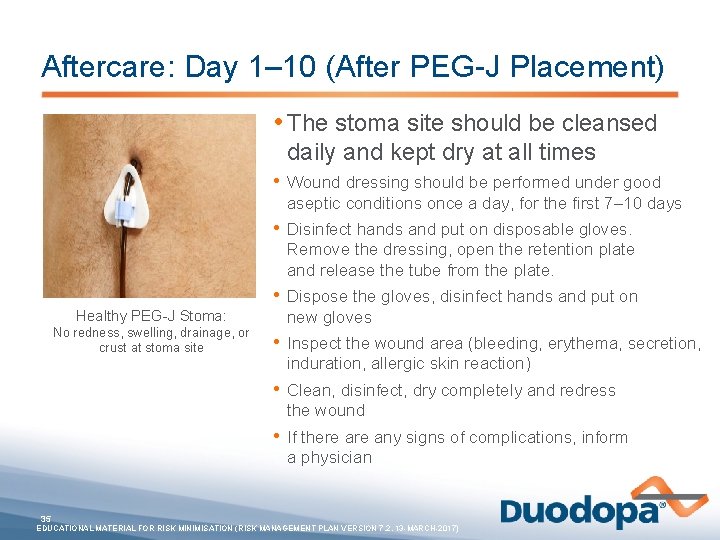
Aftercare: Day 1– 10 (After PEG-J Placement) • The stoma site should be cleansed daily and kept dry at all times • Wound dressing should be performed under good aseptic conditions once a day, for the first 7– 10 days • Disinfect hands and put on disposable gloves. Remove the dressing, open the retention plate and release the tube from the plate. • Dispose the gloves, disinfect hands and put on Healthy PEG-J Stoma: No redness, swelling, drainage, or crust at stoma site new gloves • Inspect the wound area (bleeding, erythema, secretion, induration, allergic skin reaction) • Clean, disinfect, dry completely and redress the wound • If there any signs of complications, inform a physician 35 EDUCATIONAL MATERIAL FOR RISK MINIMISATION (RISK MANAGEMENT PLAN VERSION 7. 2, 13 -MARCH-2017)
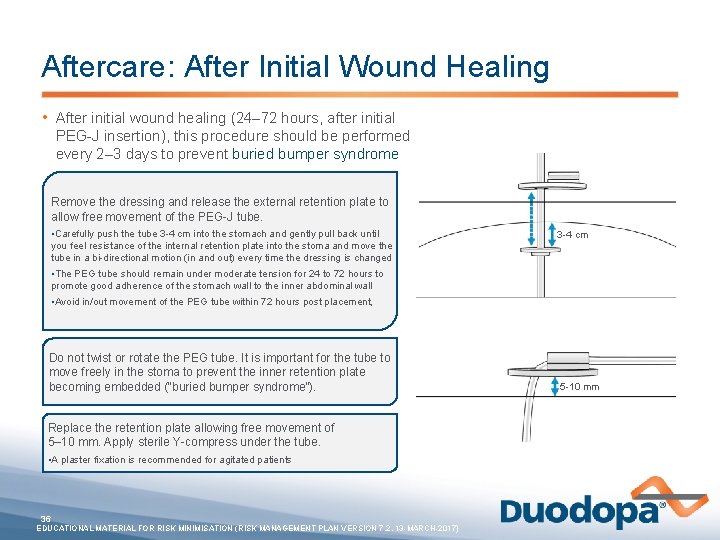
Aftercare: After Initial Wound Healing • After initial wound healing (24– 72 hours, after initial PEG-J insertion), this procedure should be performed every 2– 3 days to prevent buried bumper syndrome Remove the dressing and release the external retention plate to allow free movement of the PEG-J tube. • Carefully push the tube 3 -4 cm into the stomach and gently pull back until you feel resistance of the internal retention plate into the stoma and move the tube in a bi-directional motion (in and out) every time the dressing is changed 3 -4 cm • The PEG tube should remain under moderate tension for 24 to 72 hours to promote good adherence of the stomach wall to the inner abdominal wall • Avoid in/out movement of the PEG tube within 72 hours post placement, Do not twist or rotate the PEG tube. It is important for the tube to move freely in the stoma to prevent the inner retention plate becoming embedded (“buried bumper syndrome”). Replace the retention plate allowing free movement of 5– 10 mm. Apply sterile Y-compress under the tube. • A plaster fixation is recommended for agitated patients 36 EDUCATIONAL MATERIAL FOR RISK MINIMISATION (RISK MANAGEMENT PLAN VERSION 7. 2, 13 -MARCH-2017) 5 -10 mm
Aftercare: Tube Care • Flush the Abb. Vie™ PEG tube daily with room temperature • • • tap or drinking water (via the Flush Port) Flush the Abb. Vie™ J-tube and PEG daily with room temperature tap or drinking water Failure to adequately flush the PEG tube may result in occlusion or blockage The stoma area should be cleansed using an aseptic technique or refer to facility procedures for stoma care The gastric PEG tube should be carefully moved in and out slightly in the stoma every 2– 3 days once the site has healed The stoma site should be clean and dry at all times 37 EDUCATIONAL MATERIAL FOR RISK MINIMISATION (RISK MANAGEMENT PLAN VERSION 7. 2, 13 -MARCH-2017)
PEG-J: Precautions • Disinfectants such as Povidone-Iodine (PVP-I; e. g. , Iso-Betadine®, Braunol®) and Octenidindihydrochlorid-Phenoxyethanol (e. g. , Octanosept®) should not be used; it might negatively affect the physical/mechanical properties of the tube. NOTE: Washing or showering with regular soap and water is possible two weeks after insertion of PEG. Always leave the area clean and dry. Bathing and swimming (after complete initial wound healing) is possible. Fix tube securely with transparent adhesive dressing. Always leave the area clean and dry. 38 EDUCATIONAL MATERIAL FOR RISK MINIMISATION (RISK MANAGEMENT PLAN VERSION 7. 2, 13 -MARCH-2017)
Aftercare: Some Complications and Action to Take • General: • Circular erythema < 5 mm around the outer stoma canal is frequent and not a sign of wound infection – Carefully observe the reddening of the wound during initial wound dressing – Never apply an ointment on a PEG stoma nor an inflamed PEG wound • Encrusted dressing → remove with 0. 9% saline solution • Signs of inflammation → twice daily sterile change of dressing with regular wound inspection, swab if prescribed by a doctor – Severe cases: systemic antibiotic treatment Reference: Löser S. PEG-J Aftercare guideline, unpublished. 39 EDUCATIONAL MATERIAL FOR RISK MINIMISATION (RISK MANAGEMENT PLAN VERSION 7. 2, 13 -MARCH-2017)
Aftercare: Some Complications and Action to Take • Severe discharge → keep the wound as dry as possible, change the dressing several times daily and place multiple Y- sterile compresses • Over granulation tissue → remove granulation tissue only if there are complications (either by surgery or cauterization: Silver Nitrate) • Residual tape → remove with disinfection spray (in special cases with surgical spirit – on intact skin only) • Although rare serious abdominal complications have been reported with the Abb. Vie PEG-J system – All PEG-J patients and their caregivers should be informed to immediately contact their HCPs if they develop abdominal pain, abdominal bleeding, or signs of abdominal obstruction 40 EDUCATIONAL MATERIAL FOR RISK MINIMISATION (RISK MANAGEMENT PLAN VERSION 7. 2, 13 -MARCH-2017)
Patient Aftercare: Discharging From the Hospital 41 EDUCATIONAL MATERIAL FOR RISK MINIMISATION (RISK MANAGEMENT PLAN VERSION 7. 2, 13 -MARCH-2017)
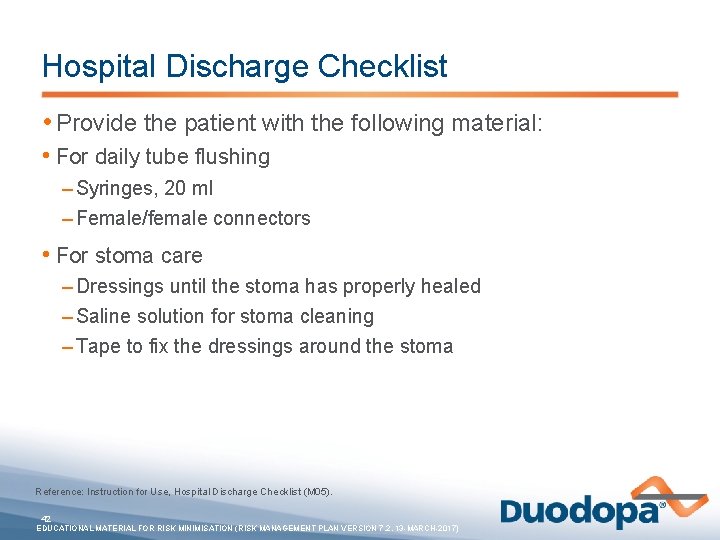
Hospital Discharge Checklist • Provide the patient with the following material: • For daily tube flushing – Syringes, 20 ml – Female/female connectors • For stoma care – Dressings until the stoma has properly healed – Saline solution for stoma cleaning – Tape to fix the dressings around the stoma Reference: Instruction for Use, Hospital Discharge Checklist (M 05). 42 EDUCATIONAL MATERIAL FOR RISK MINIMISATION (RISK MANAGEMENT PLAN VERSION 7. 2, 13 -MARCH-2017)
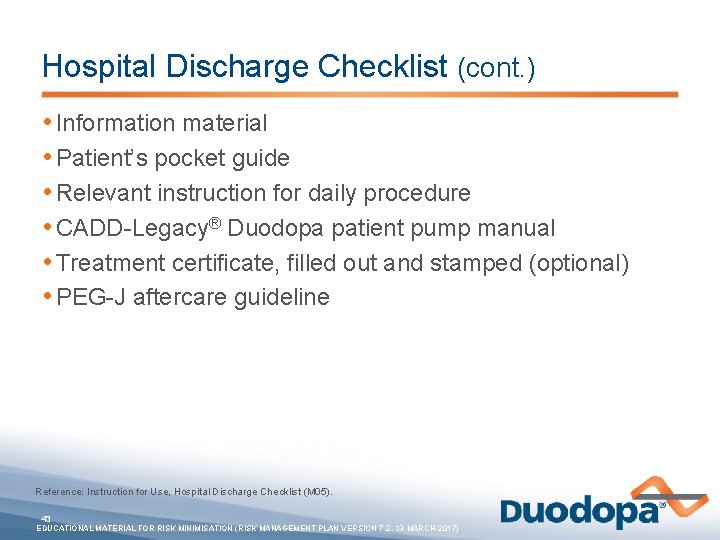
Hospital Discharge Checklist (cont. ) • Information material • Patient’s pocket guide • Relevant instruction for daily procedure • CADD-Legacy® Duodopa patient pump manual • Treatment certificate, filled out and stamped (optional) • PEG-J aftercare guideline Reference: Instruction for Use, Hospital Discharge Checklist (M 05). 43 EDUCATIONAL MATERIAL FOR RISK MINIMISATION (RISK MANAGEMENT PLAN VERSION 7. 2, 13 -MARCH-2017)
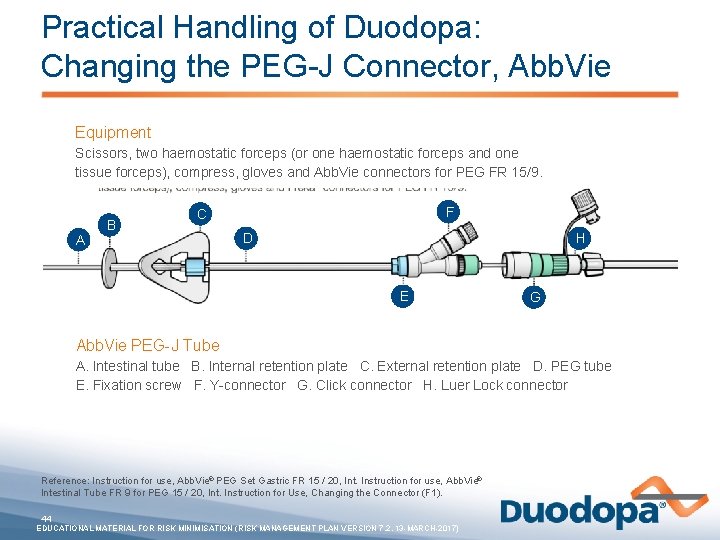
Practical Handling of Duodopa: Changing the PEG-J Connector, Abb. Vie Equipment Scissors, two haemostatic forceps (or one haemostatic forceps and one tissue forceps), compress, gloves and Abb. Vie connectors for PEG FR 15/9. A B F C D H E G Abb. Vie PEG-J Tube A. Intestinal tube B. Internal retention plate C. External retention plate D. PEG tube E. Fixation screw F. Y-connector G. Click connector H. Luer Lock connector Reference: Instruction for use, Abb. Vie® PEG Set Gastric FR 15 / 20, Int. Instruction for use, Abb. Vie® Intestinal Tube FR 9 for PEG 15 / 20, Int. Instruction for Use, Changing the Connector (F 1). 44 EDUCATIONAL MATERIAL FOR RISK MINIMISATION (RISK MANAGEMENT PLAN VERSION 7. 2, 13 -MARCH-2017)
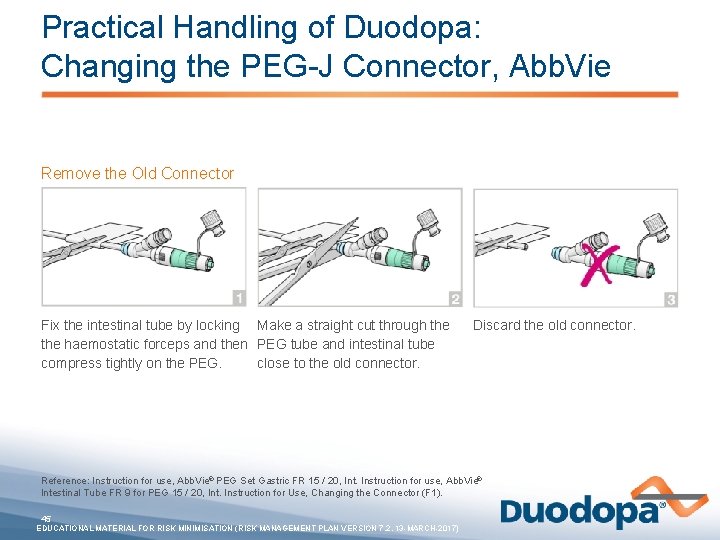
Practical Handling of Duodopa: Changing the PEG-J Connector, Abb. Vie Remove the Old Connector Fix the intestinal tube by locking Make a straight cut through the haemostatic forceps and then PEG tube and intestinal tube compress tightly on the PEG. close to the old connector. Discard the old connector. Reference: Instruction for use, Abb. Vie® PEG Set Gastric FR 15 / 20, Int. Instruction for use, Abb. Vie® Intestinal Tube FR 9 for PEG 15 / 20, Int. Instruction for Use, Changing the Connector (F 1). 45 EDUCATIONAL MATERIAL FOR RISK MINIMISATION (RISK MANAGEMENT PLAN VERSION 7. 2, 13 -MARCH-2017)
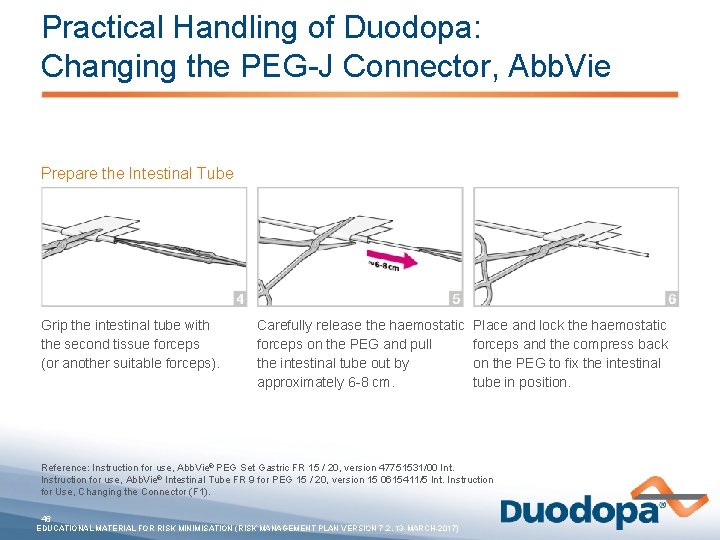
Practical Handling of Duodopa: Changing the PEG-J Connector, Abb. Vie Prepare the Intestinal Tube Grip the intestinal tube with the second tissue forceps (or another suitable forceps). Carefully release the haemostatic forceps on the PEG and pull the intestinal tube out by approximately 6 -8 cm. Place and lock the haemostatic forceps and the compress back on the PEG to fix the intestinal tube in position. Reference: Instruction for use, Abb. Vie® PEG Set Gastric FR 15 / 20, version 47751531/00 Int. Instruction for use, Abb. Vie® Intestinal Tube FR 9 for PEG 15 / 20, version 15 0615411/5 Int. Instruction for Use, Changing the Connector (F 1). 46 EDUCATIONAL MATERIAL FOR RISK MINIMISATION (RISK MANAGEMENT PLAN VERSION 7. 2, 13 -MARCH-2017)
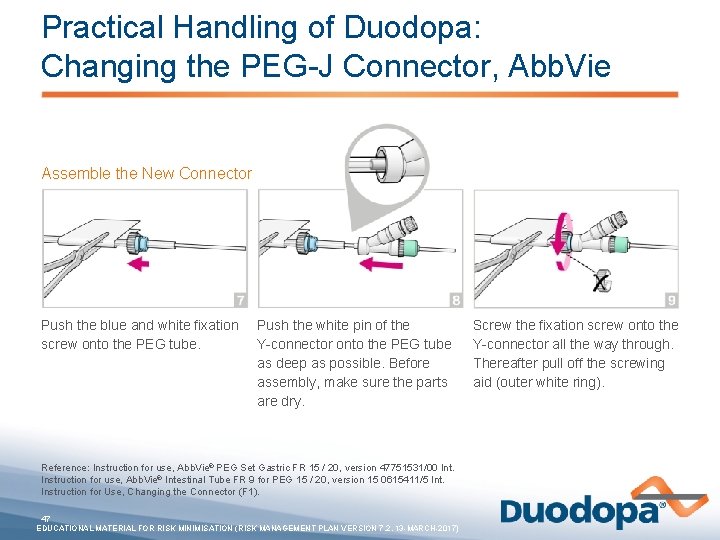
Practical Handling of Duodopa: Changing the PEG-J Connector, Abb. Vie Assemble the New Connector Push the blue and white fixation screw onto the PEG tube. Push the white pin of the Y-connector onto the PEG tube as deep as possible. Before assembly, make sure the parts are dry. Reference: Instruction for use, Abb. Vie® PEG Set Gastric FR 15 / 20, version 47751531/00 Int. Instruction for use, Abb. Vie® Intestinal Tube FR 9 for PEG 15 / 20, version 15 0615411/5 Int. Instruction for Use, Changing the Connector (F 1). 47 EDUCATIONAL MATERIAL FOR RISK MINIMISATION (RISK MANAGEMENT PLAN VERSION 7. 2, 13 -MARCH-2017) Screw the fixation screw onto the Y-connector all the way through. Thereafter pull off the screwing aid (outer white ring).
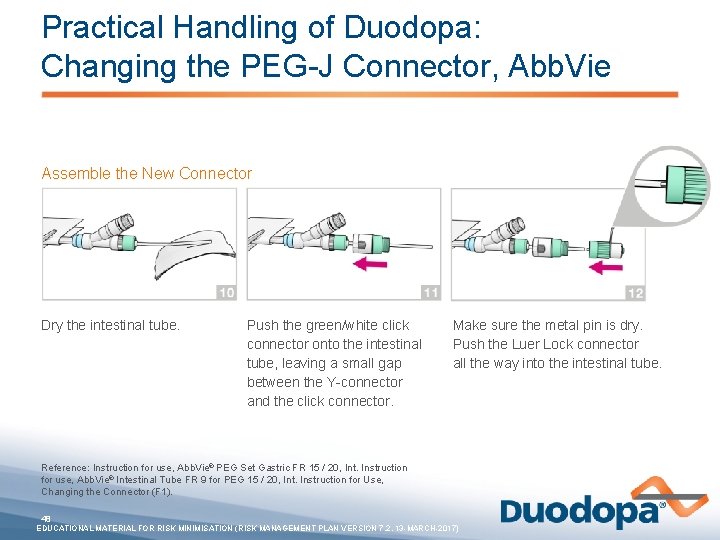
Practical Handling of Duodopa: Changing the PEG-J Connector, Abb. Vie Assemble the New Connector Dry the intestinal tube. Push the green/white click connector onto the intestinal tube, leaving a small gap between the Y-connector and the click connector. Make sure the metal pin is dry. Push the Luer Lock connector all the way into the intestinal tube. Reference: Instruction for use, Abb. Vie® PEG Set Gastric FR 15 / 20, Int. Instruction for use, Abb. Vie® Intestinal Tube FR 9 for PEG 15 / 20, Int. Instruction for Use, Changing the Connector (F 1). 48 EDUCATIONAL MATERIAL FOR RISK MINIMISATION (RISK MANAGEMENT PLAN VERSION 7. 2, 13 -MARCH-2017)
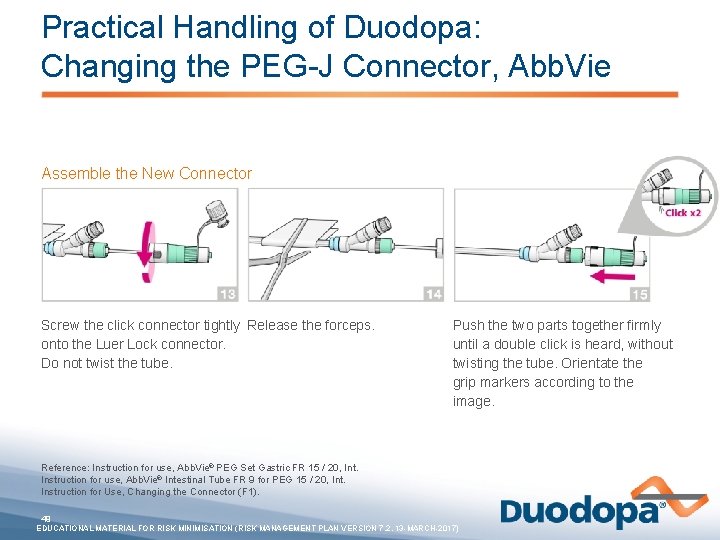
Practical Handling of Duodopa: Changing the PEG-J Connector, Abb. Vie Assemble the New Connector Screw the click connector tightly Release the forceps. onto the Luer Lock connector. Do not twist the tube. Push the two parts together firmly until a double click is heard, without twisting the tube. Orientate the grip markers according to the image. Reference: Instruction for use, Abb. Vie® PEG Set Gastric FR 15 / 20, Int. Instruction for use, Abb. Vie® Intestinal Tube FR 9 for PEG 15 / 20, Int. Instruction for Use, Changing the Connector (F 1). 49 EDUCATIONAL MATERIAL FOR RISK MINIMISATION (RISK MANAGEMENT PLAN VERSION 7. 2, 13 -MARCH-2017)
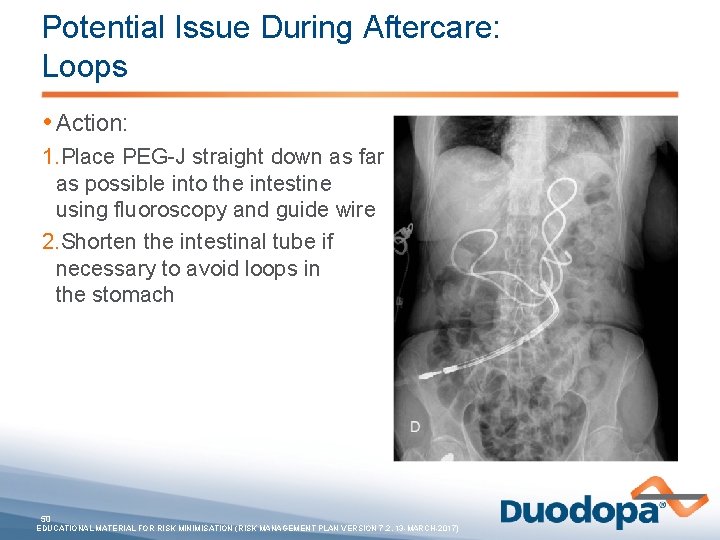
Potential Issue During Aftercare: Loops • Action: 1. Place PEG-J straight down as far as possible into the intestine using fluoroscopy and guide wire 2. Shorten the intestinal tube if necessary to avoid loops in the stomach 50 EDUCATIONAL MATERIAL FOR RISK MINIMISATION (RISK MANAGEMENT PLAN VERSION 7. 2, 13 -MARCH-2017)
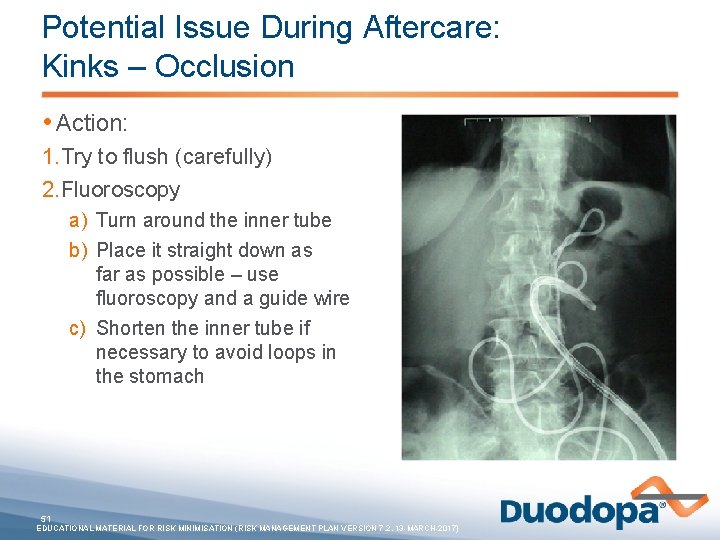
Potential Issue During Aftercare: Kinks – Occlusion • Action: 1. Try to flush (carefully) 2. Fluoroscopy a) Turn around the inner tube b) Place it straight down as far as possible – use fluoroscopy and a guide wire c) Shorten the inner tube if necessary to avoid loops in the stomach 51 EDUCATIONAL MATERIAL FOR RISK MINIMISATION (RISK MANAGEMENT PLAN VERSION 7. 2, 13 -MARCH-2017)
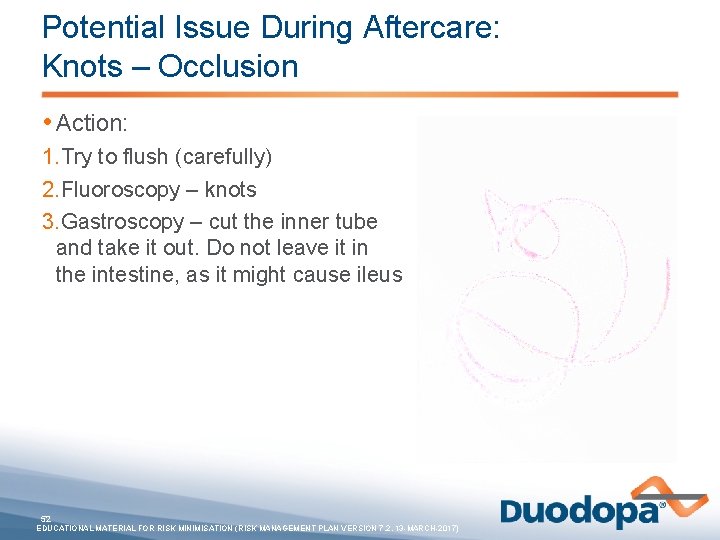
Potential Issue During Aftercare: Knots – Occlusion • Action: 1. Try to flush (carefully) 2. Fluoroscopy – knots 3. Gastroscopy – cut the inner tube and take it out. Do not leave it in the intestine, as it might cause ileus 52 EDUCATIONAL MATERIAL FOR RISK MINIMISATION (RISK MANAGEMENT PLAN VERSION 7. 2, 13 -MARCH-2017)
In Summary • The neurologist should work with a gastroenterologist who is experienced in PEG -J placement • The gastroenterologist should examine patient for GI-related complications following PEG-J insertion procedure, long-term use of the PEG-J and associated tubing • Follow proper PEG-J aftercare procedures to promote appropriate fistula tract formation for the PEG-J and to avoid potential complications, including peritonitis and postoperative wound infections • Local care of the stoma site following PEG-J placement is important; carefully examine the stoma site at each visit and at any time the patient or caregiver is concerned about the site • For more information on specific recommendations for PEG-J procedure and stoma care, please refer to PEG-J insertion video and aftercare materials 53 EDUCATIONAL MATERIAL FOR RISK MINIMISATION (RISK MANAGEMENT PLAN VERSION 7. 2, 13 -MARCH-2017)
Ako primijetite bilo koju nuspojavu, potrebno je obavijestiti liječnika, ljekarnika ili medicinsku sestru. To uključuje i svaku moguću nuspojavu koja nije navedena u uputi o lijeku. Nuspojave možete prijaviti izravno putem nacionalnog sustava za prijavu nuspojava: Agenciji za lijekove i medicinske proizvode (HALMED) putem internetske stranice www. halmed. hr ili potražite HALMED aplikaciju putem Google Play ili Apple App Store trgovine. Prijavljivanjem nuspojava možete pridonijeti u procjeni sigurnosti ovog lijeka. EDUKACIJSKI MATERIJAL NAMIJENJEN MINIMIZACIJI RIZIKA, VERZIJA 2 (PLAN UPRAVLJANJA RIZIKOM, VERZIJA 7. 2, 13. OŽUJAK 2017. ) EDUCATIONAL MATERIAL FOR RISK MINIMISATION (RISK MANAGEMENT PLAN VERSION 7. 2, 13 -MARCH-2017)
55 EDUCATIONAL MATERIAL FOR RISK MINIMISATION (RISK MANAGEMENT PLAN VERSION 7. 2, 13 -MARCH-2017) ADCRDUO 180039 Veljača, 2018.