
Importance Process of CBDRM Dr Muhammad Ibrar Introduction
Importance & Process of CBDRM Dr. Muhammad Ibrar
Introduction ‘Community-based disaster risk management (CBDRM) is a process in which at-risk communities are actively engaged in the identification, analysis, treatment, monitoring and evaluation of disaster risks in order to reduce their vulnerabilities and enhance their capacities’. This means that people are at the heart of decision making and implementation of disaster risk management activities.
…Contd. The involvement of most vulnerable social groups is considered as paramount (dominant) in this process, while the support of the least vulnerable groups to them is necessary for successful implementation. CBDRM emerged as an alternative during the 1980 s and 1990 s. Over the past two decades it has become apparent that top-down approaches fail to address the needs of vulnerable communities, often ignoring local capacities and resources.
…Contd. The top-down approach can increase vulnerabilities and weaken the quality of life, security and strong. The CBDRM approach emphasizes the active involvement of communities in all phases of risk management.
Principles of CBDRM is built upon the following principles: � CBDRM contributes to addressing the root causes of vulnerabilities and transforming the structures that generate inequality and underdevelopment. � CBDRM is a development approach. Recognizing the need for community action for disaster risk reduction in all development practice. � Any efforts to reduce disaster risks should build upon a community’s knowledge and experience about hazards, vulnerabilities and disaster risk reduction. It will also be essential to recognize the importance of local customs, culture and materials while developing and implementing risk reduction programs.
…Contd. • • • CBDRM requires a high level of coordination and cooperation amongst stakeholders e. g. among Government departments, NGOs, donors, vulnerable groups. CBDRM advocates and workers believe that they are accountable to the people first and foremost. CBDRM aims at achieving disaster risk reduction, sustainable development and poverty reduction, people empowerment and equity (justice). CBDRM is envisioned as an integral component of sustainable development, since it helps in avoiding the negative impacts of disasters on development.
Processes of CBDRM The CBDRM process is the whole process of assessment of community’s hazards, vulnerabilities, and capacities and planning and implementation of risk reduction activities, projects and programs with the full involvement of the community. The CBDRM process has seven in order stages, which can be implemented before a disaster occurs or after one has happened to reduce future risks. Each stage grows out of the presiding stage and leads to further action. Together the sequence can build up a planning and implementation system, which can become a powerful disaster risk management tool. Following are the seven steps in the CBDRM Process:
…Contd. a. Selecting the Community b. Rapport Building and Understanding the Community c. Community Based Participatory Disaster Risk Assessment d. Community Based Disaster Risk Management Planning e. Capacity Building of Community Based Disaster Management Organizations f. Community Managed Implementation g. Participatory Monitoring and Evaluation
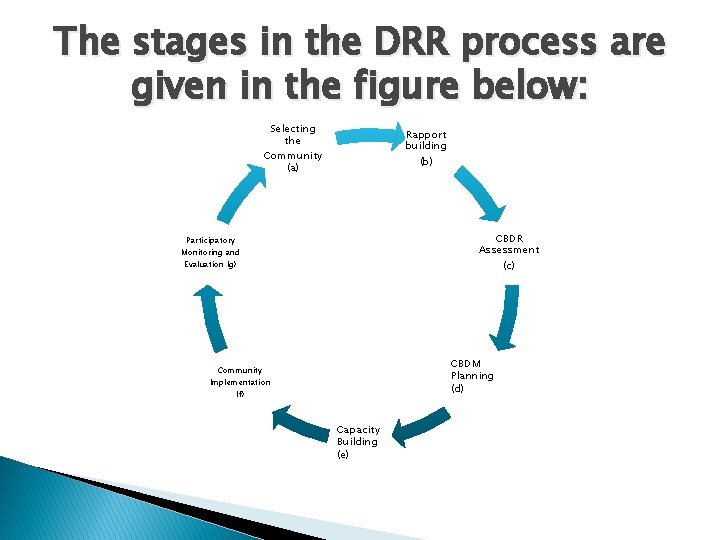
The stages in the DRR process are given in the figure below: Selecting the Community (a) Rapport building (b) CBDR Assessment (c) Participatory Monitoring and Evaluation (g) CBDM Planning (d) Community Implementation (f) Capacity Building (e)
a. Selecting the community The first task of local authorities is to conduct a detailed risks assessment survey of the whole area under its jurisdiction. The selection of community for implementation of CBDRM activities depends upon a number of factors and criteria but most importantly the risk exposure of the particular community. Given below is a list of criteria for identifying communities for CBDRM activities:
…Contd. ⇒ Severity of communities exposure to risk (level of vulnerability) ⇒ Number of people to benefiting ⇒ willingness of communities to engage in DRR activities ⇒ Poverty status of the community ⇒ Governmental priority of physical social and economic vulnerability ⇒ Budget availability ⇒ Accessibility (convenience)
…Contd. All of the above mentioned criteria would not be equally important in given area. The local authority can make decisions on the basis of factors that might be more important locally, than the others. A thorough survey will need to be conducted for the identification of vulnerable communities.
b. Rapport Building and Understanding Once the most vulnerable communities are identified it would be important to understand the local social relationships and power structures key economic groups and to build the good informal relationship with the local people. Local authorities supporting the community in disaster risk reduction need to build a picture of nature and needs and resources of the community. This step usually involves interacting and integrating with the community and gathering basic information to have a general description of the community.
…Contd. A relationship of trust and friendship is key in facilitating effective participation. If community members have trust in the outsiders who are working with them, then open sharing about issues, problems concerns and solution can take place. Local Authorities can take a number of actions in order to develop trust, with and understanding of the community. This can include the following:
…Contd. Living in the community � Being transparent and open about their purpose � Participating in daily life activities in the community and cultural events � Listening to the issue and problems of local people � Learning new skills from local people � Performing local tasks �
…Contd. The behavior of LA staff is very important in establishing a proper relationship of trust and openness. Ways in which they should behave include: ⇒ Show humility (humbleness) ⇒ Understand local culture, problems and way of life ⇒ Be tolerant ⇒ Have interest in what people have to say ⇒ Be observant rather than judgmental ⇒ Have confidence that local people can achieve what they set out to do and transmit that confidence.
C. Community Based Participatory Disaster Risk Assessment (CBPDRA) Community Based Participatory Disaster Risk Assessment is a process to identify the risk the communities, villages face and how people overcome those risks. This will be conducted in most vulnerable and priority communities. This process involves hazard assessments, vulnerability assessment, capacity assessment, analysis and prioritization of risk. The CBPDRA will be conducted by the Local Authorities with the involvement of the local people, community leaders and subject experts.
D. Community Based Disaster Risk Management Planning (CBDRMP) At this stage, further analysis will be conducted jointly by the local authorities and communities to analyze the risks and identify strategies and solutions to address them. Based on this analysis a detailed risk reduction and response plan will be developed for the particular communities. The planning process will involve analysis of local stakeholder and local resources. Roles and responsibilities of the various stakeholders for implementation of activities will be clarified.
E. Capacity Building of CBDRM Organizations To effectively undertake risk reduction measures, it is best to have an organization within the community that will deal with disaster risk management. The form of organization can vary depending upon the situation in the community. It is important to have an understanding of existing organizations within the community. A disaster management committee can be one of the communities within an existing organization.
…Contd. However, if there is no organization yet in the community, a community disaster management organization (CDRMO) can be isinitiated. CDRMO the. The of objective enable communities to become better prepared for implementing disasters and to become disaster resilient in long term.
f. Community Managed Implementation. The implementation of the plan should be done through the community organization at community level with support from local authorities and technical and research institutions. The implementation process will include various structural and non-structural activities; e. g. community training, disaster response drills, community early warning systems, disaster elastic construction of houses, forest plantation, construction of bridges etc for vulnerability reduction and hazard mitigation.
…Contd. The community-based organization would be responsible for overall management of the disaster management activities. The Local Authority should play a facilitating and coordinating role for the implementation of the community plan and mobilization of the resources.
g. Participatory Community Monitoring and Evaluation (PCME) mmunity nitoring ipatory Evaluation (PCME) involves the local community, development agencies, local authorities and other stake holders in measuring the progress made, and identifying necessary follow-up actions. The approach assumes that all concerned parties need to know effective and project efforts have been.
- Slides: 23