
IMPORTANCE OF USING CITRATE ANTICOAGULATION FOR CVVHDF IN
- Slides: 1
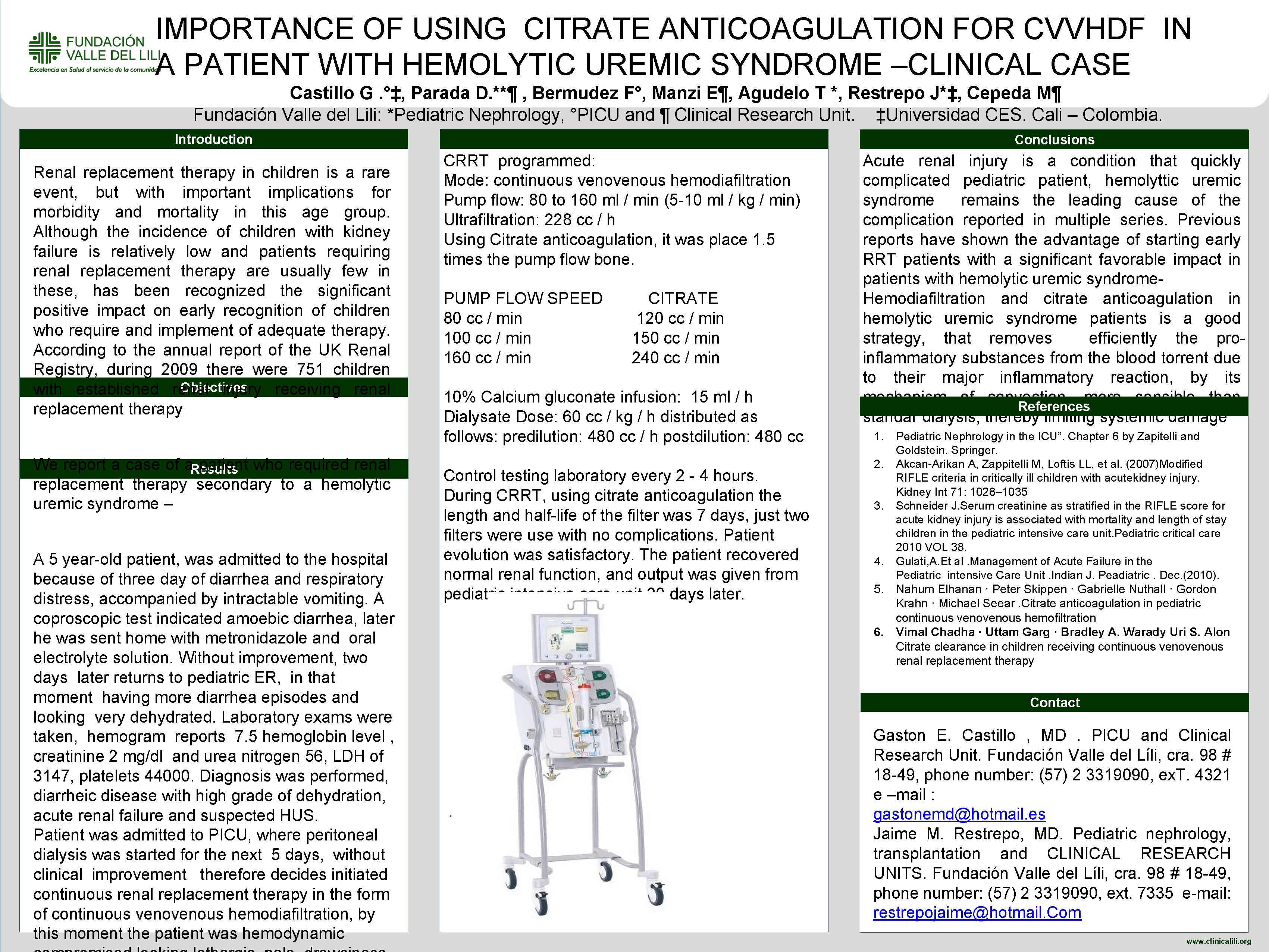
IMPORTANCE OF USING CITRATE ANTICOAGULATION FOR CVVHDF IN A PATIENT WITH HEMOLYTIC UREMIC SYNDROME –CLINICAL CASE Castillo G. °‡, Parada D. **¶ , Bermudez F°, Manzi E¶, Agudelo T *, Restrepo J*‡, Cepeda M¶ Fundación Valle del Lili: *Pediatric Nephrology, °PICU and ¶ Clinical Research Unit. ‡Universidad CES. Cali – Colombia. Introduction Renal replacement therapy in children is a rare event, but with important implications for morbidity and mortality in this age group. Although the incidence of children with kidney failure is relatively low and patients requiring renal replacement therapy are usually few in these, has been recognized the significant positive impact on early recognition of children who require and implement of adequate therapy. According to the annual report of the UK Renal Registry, during 2009 there were 751 children Objectives with established renal injury receiving renal replacement therapy We report a case of a. Results patient who required renal replacement therapy secondary to a hemolytic uremic syndrome – A 5 year-old patient, was admitted to the hospital because of three day of diarrhea and respiratory distress, accompanied by intractable vomiting. A coproscopic test indicated amoebic diarrhea, later he was sent home with metronidazole and oral electrolyte solution. Without improvement, two days later returns to pediatric ER, in that moment having more diarrhea episodes and looking very dehydrated. Laboratory exams were taken, hemogram reports 7. 5 hemoglobin level , creatinine 2 mg/dl and urea nitrogen 56, LDH of 3147, platelets 44000. Diagnosis was performed, diarrheic disease with high grade of dehydration, acute renal failure and suspected HUS. Patient was admitted to PICU, where peritoneal dialysis was started for the next 5 days, without clinical improvement therefore decides initiated continuous renal replacement therapy in the form of continuous venous hemodiafiltration, by this moment the patient was hemodynamic Conclusions CRRT programmed: Mode: continuous venous hemodiafiltration Pump flow: 80 to 160 ml / min (5 -10 ml / kg / min) Ultrafiltration: 228 cc / h Using Citrate anticoagulation, it was place 1. 5 times the pump flow bone. PUMP FLOW SPEED 80 cc / min 100 cc / min 160 cc / min CITRATE 120 cc / min 150 cc / min 240 cc / min 10% Calcium gluconate infusion: 15 ml / h Dialysate Dose: 60 cc / kg / h distributed as follows: predilution: 480 cc / h postdilution: 480 cc Control testing laboratory every 2 - 4 hours. During CRRT, using citrate anticoagulation the length and half-life of the filter was 7 days, just two filters were use with no complications. Patient evolution was satisfactory. The patient recovered normal renal function, and output was given from pediatric intensive care unit 20 days later. Acute renal injury is a condition that quickly complicated pediatric patient, hemolyttic uremic syndrome remains the leading cause of the complication reported in multiple series. Previous reports have shown the advantage of starting early RRT patients with a significant favorable impact in patients with hemolytic uremic syndrome. Hemodiafiltration and citrate anticoagulation in hemolytic uremic syndrome patients is a good strategy, that removes efficiently the proinflammatory substances from the blood torrent due to their major inflammatory reaction, by its mechanism of convection, more sensible than References standar dialysis, thereby limiting systemic damage 1. 2. 3. 4. 5. 6. Pediatric Nephrology in the ICU”. Chapter 6 by Zapitelli and Goldstein. Springer. Akcan-Arikan A, Zappitelli M, Loftis LL, et al. (2007)Modified RIFLE criteria in critically ill children with acutekidney injury. Kidney Int 71: 1028– 1035 Schneider J. Serum creatinine as stratified in the RIFLE score for acute kidney injury is associated with mortality and length of stay children in the pediatric intensive care unit. Pediatric critical care 2010 VOL 38. Gulati, A. Et al. Management of Acute Failure in the Pediatric intensive Care Unit. Indian J. Peadiatric. Dec. (2010). Nahum Elhanan · Peter Skippen · Gabrielle Nuthall · Gordon Krahn · Michael Seear. Citrate anticoagulation in pediatric continuous venous hemofiltration Vimal Chadha · Uttam Garg · Bradley A. Warady Uri S. Alon Citrate clearance in children receiving continuous venous renal replacement therapy Contact . Gaston E. Castillo , MD. PICU and Clinical Research Unit. Fundación Valle del Líli, cra. 98 # 18 -49, phone number: (57) 2 3319090, ex. T. 4321 e –mail : gastonemd@hotmail. es Jaime M. Restrepo, MD. Pediatric nephrology, transplantation and CLINICAL RESEARCH UNITS. Fundación Valle del Líli, cra. 98 # 18 -49, phone number: (57) 2 3319090, ext. 7335 e-mail: restrepojaime@hotmail. Com www. clinicalili. org