
IMPORTANCE OF THE ZERO POINT IN DCP TESTING

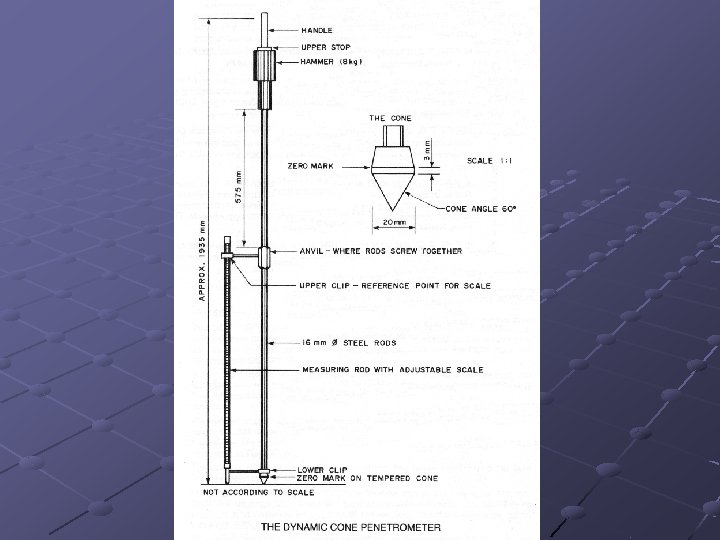
- Slides: 18
IMPORTANCE OF THE ZERO POINT IN DCP TESTING OF FLEXIBLE PAVEMENTS FRANK NETTERBERG Pavement Materials & Geotechnical Specialist
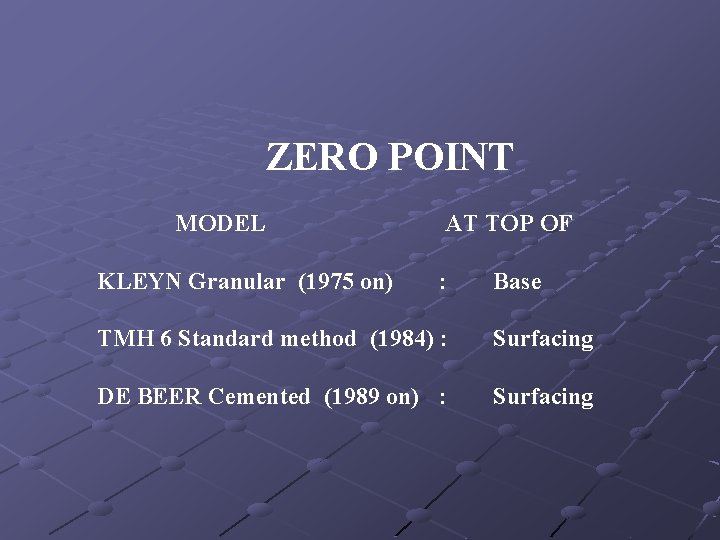
ZERO POINT MODEL KLEYN Granular (1975 on) AT TOP OF : Base TMH 6 Standard method (1984) : Surfacing DE BEER Cemented (1989 on) : Surfacing
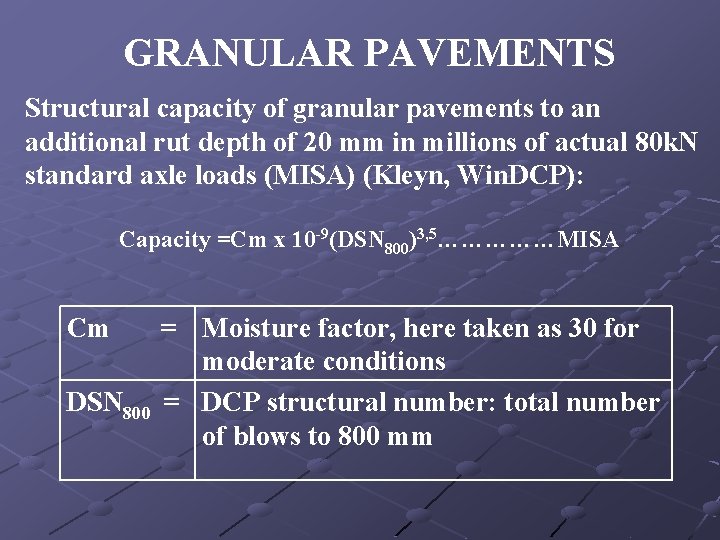
GRANULAR PAVEMENTS Structural capacity of granular pavements to an additional rut depth of 20 mm in millions of actual 80 k. N standard axle loads (MISA) (Kleyn, Win. DCP): Capacity =Cm x 10 -9(DSN 800)3, 5……………MISA Cm DSN 800 = Moisture factor, here taken as 30 for moderate conditions = DCP structural number: total number of blows to 800 mm
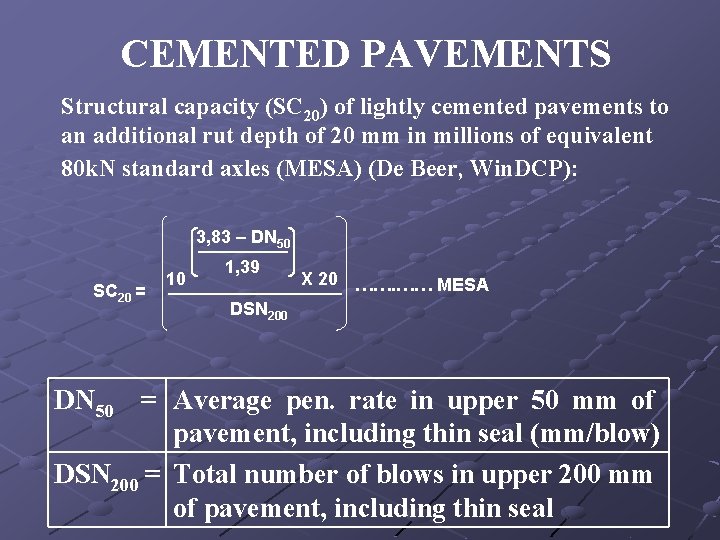
CEMENTED PAVEMENTS Structural capacity (SC 20) of lightly cemented pavements to an additional rut depth of 20 mm in millions of equivalent 80 k. N standard axles (MESA) (De Beer, Win. DCP): 3, 83 – DN 50 SC 20 = 10 1, 39 X 20 ……. …… MESA DSN 200 DN 50 = Average pen. rate in upper 50 mm of pavement, including thin seal (mm/blow) DSN 200 = Total number of blows in upper 200 mm of pavement, including thin seal
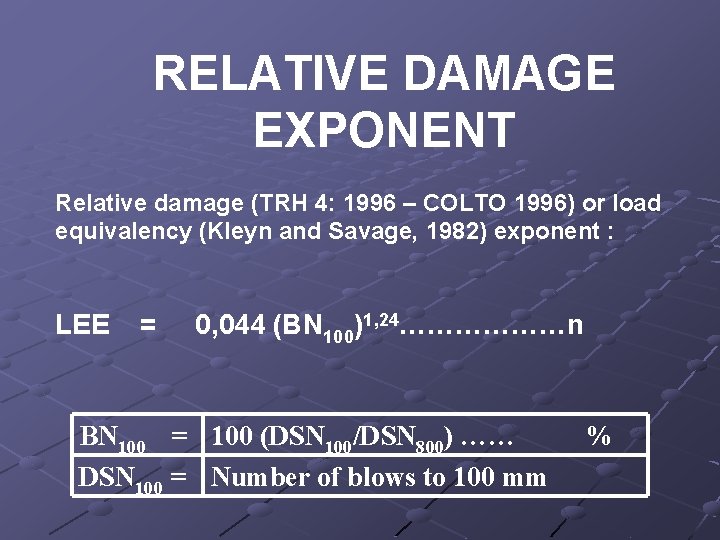
RELATIVE DAMAGE EXPONENT Relative damage (TRH 4: 1996 – COLTO 1996) or load equivalency (Kleyn and Savage, 1982) exponent : LEE = 0, 044 (BN 100)1, 24………………n BN 100 = 100 (DSN 100/DSN 800) …… DSN 100 = Number of blows to 100 mm %
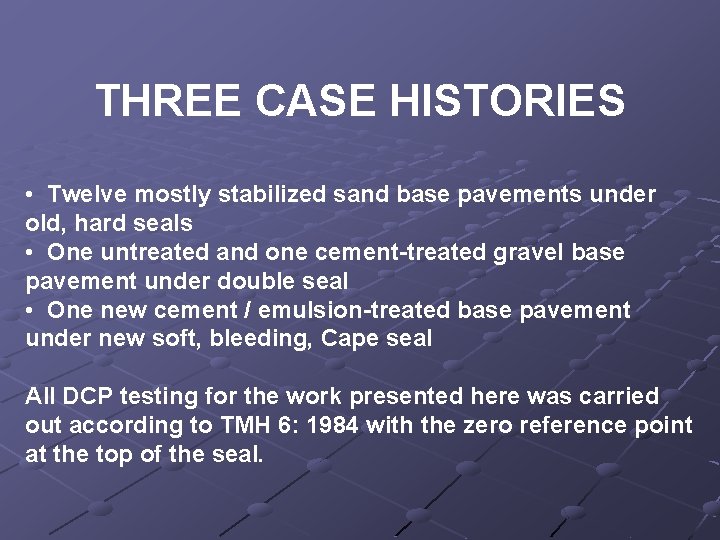
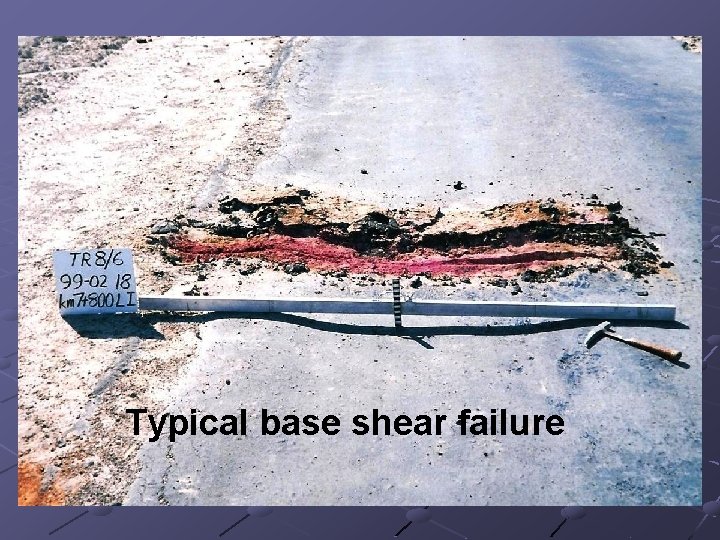
THREE CASE HISTORIES • Twelve mostly stabilized sand base pavements under old, hard seals • One untreated and one cement-treated gravel base pavement under double seal • One new cement / emulsion-treated base pavement under new soft, bleeding, Cape seal All DCP testing for the work presented here was carried out according to TMH 6: 1984 with the zero reference point at the top of the seal.
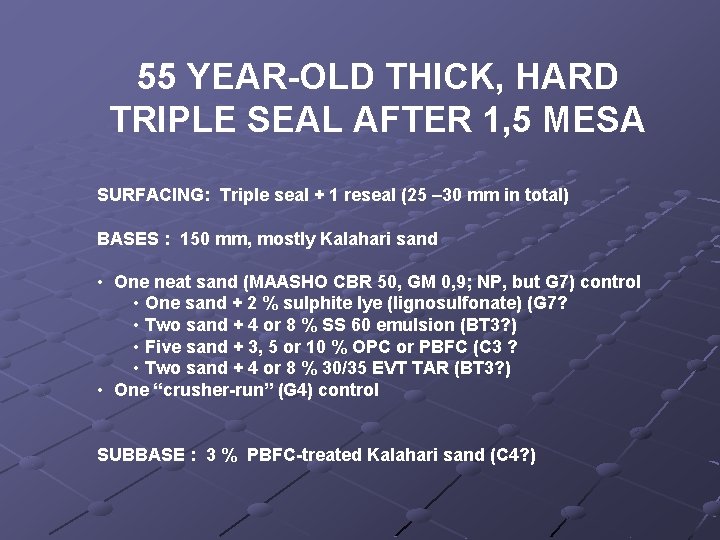
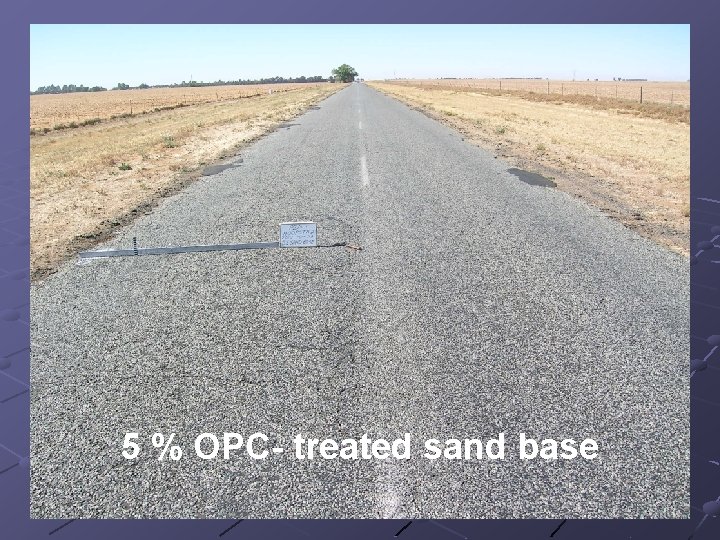
55 YEAR-OLD THICK, HARD TRIPLE SEAL AFTER 1, 5 MESA SURFACING: Triple seal + 1 reseal (25 – 30 mm in total) BASES : 150 mm, mostly Kalahari sand • One neat sand (MAASHO CBR 50, GM 0, 9; NP, but G 7) control • One sand + 2 % sulphite lye (lignosulfonate) (G 7? • Two sand + 4 or 8 % SS 60 emulsion (BT 3? ) • Five sand + 3, 5 or 10 % OPC or PBFC (C 3 ? • Two sand + 4 or 8 % 30/35 EVT TAR (BT 3? ) • One “crusher-run” (G 4) control SUBBASE : 3 % PBFC-treated Kalahari sand (C 4? )
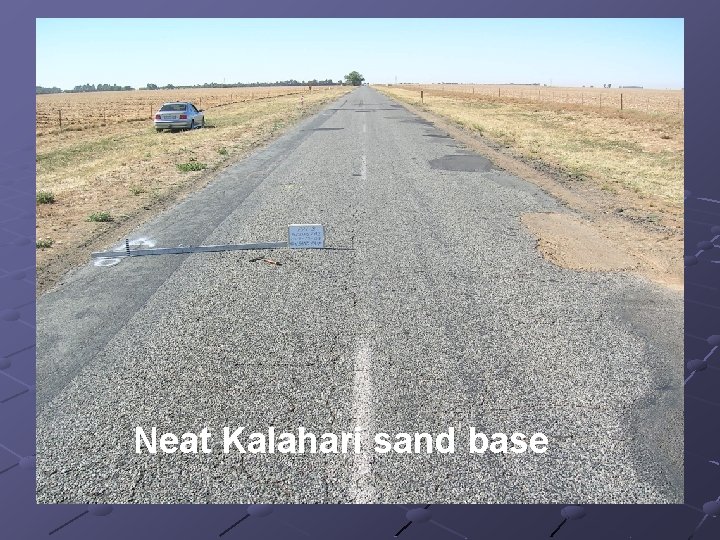
Neat Kalahari sand base
5 % OPC- treated sand base
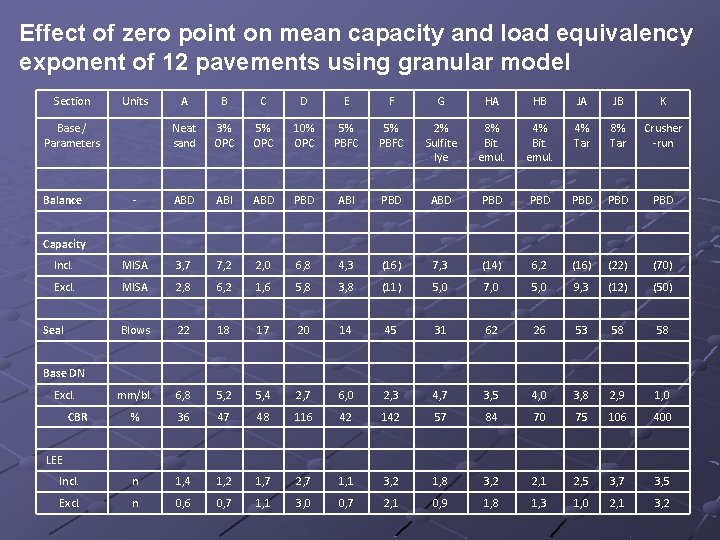
Effect of zero point on mean capacity and load equivalency exponent of 12 pavements using granular model Section Units A B C D E F G HA HB JA JB K Neat sand 3% OPC 5% OPC 10% OPC 5% PBFC 2% Sulfite lye 8% Bit. emul. 4% Tar 8% Tar Crusher -run - ABD ABI ABD PBD ABI PBD ABD PBD PBD PBD Incl. MISA 3, 7 7, 2 2, 0 6, 8 4, 3 (16) 7, 3 (14) 6, 2 (16) (22) (70) Excl. MISA 2, 8 6, 2 1, 6 5, 8 3, 8 (11) 5, 0 7, 0 5, 0 9, 3 (12) (50) Blows 22 18 17 20 14 45 31 62 26 53 58 58 mm/bl. 6, 8 5, 2 5, 4 2, 7 6, 0 2, 3 4, 7 3, 5 4, 0 3, 8 2, 9 1, 0 % 36 47 48 116 42 142 57 84 70 75 106 400 Incl. n 1, 4 1, 2 1, 7 2, 7 1, 1 3, 2 1, 8 3, 2 2, 1 2, 5 3, 7 3, 5 Excl. n 0, 6 0, 7 1, 1 3, 0 0, 7 2, 1 0, 9 1, 8 1, 3 1, 0 2, 1 3, 2 Base / Parameters Balance Capacity Seal Base DN Excl. CBR LEE
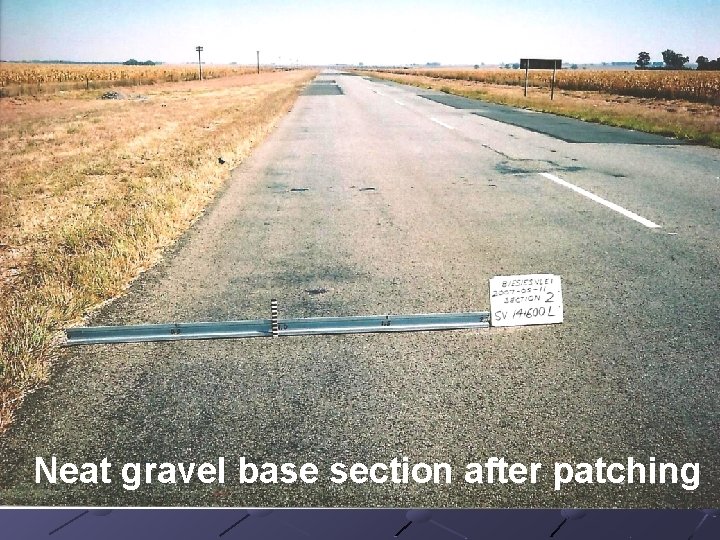
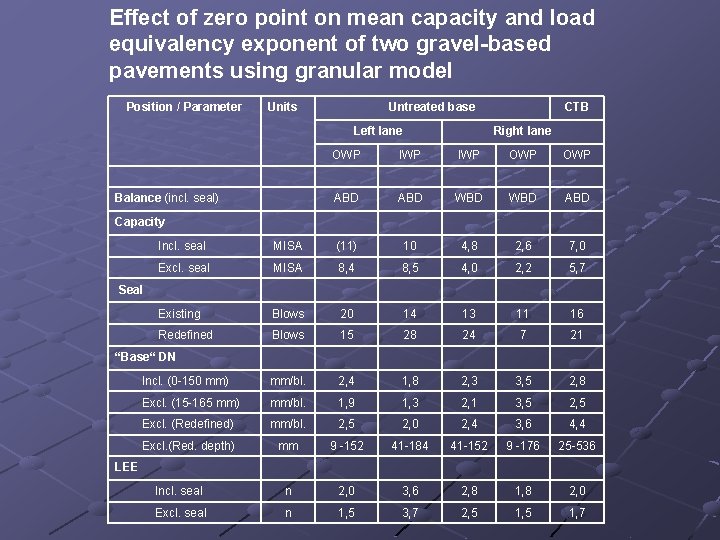
30 YEAR-OLD DOUBLE SEAL SURFACING : Double seal + 1 slurry + 1 reseal (13 – 19 mm in total) BASES: 150 mm calcrete gravel (GM 2, 0) • One neat (PI 12, G 6) • One 4 % PBFC (C 3? ) SUBBASE : 2 % PBFC-treated calcrete (C 4 ? ) TRAFFIC : 0, 5 MESA
Neat gravel base section after patching
Effect of zero point on mean capacity and load equivalency exponent of two gravel-based pavements using granular model Position / Parameter Units Untreated base Left lane Balance (incl. seal) CTB Right lane OWP IWP OWP ABD WBD ABD Capacity Incl. seal MISA (11) 10 4, 8 2, 6 7, 0 Excl. seal MISA 8, 4 8, 5 4, 0 2, 2 5, 7 Existing Blows 20 14 13 11 16 Redefined Blows 15 28 24 7 21 Incl. (0 -150 mm) mm/bl. 2, 4 1, 8 2, 3 3, 5 2, 8 Excl. (15 -165 mm) mm/bl. 1, 9 1, 3 2, 1 3, 5 2, 5 Excl. (Redefined) mm/bl. 2, 5 2, 0 2, 4 3, 6 4, 4 Excl. (Red. depth) mm 9 -152 41 -184 41 -152 9 -176 25 -536 Incl. seal n 2, 0 3, 6 2, 8 1, 8 2, 0 Excl. seal n 1, 5 3, 7 2, 5 1, 7 Seal “Base“ DN LEE
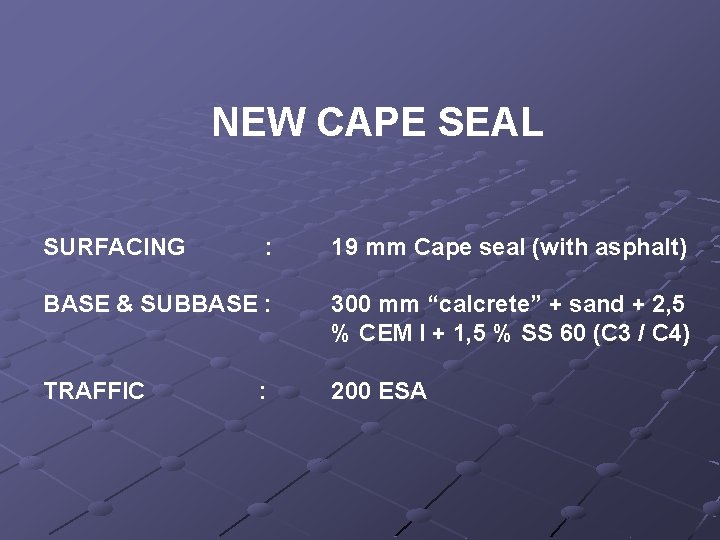
NEW CAPE SEAL SURFACING : 19 mm Cape seal (with asphalt) BASE & SUBBASE : 300 mm “calcrete” + sand + 2, 5 % CEM I + 1, 5 % SS 60 (C 3 / C 4) TRAFFIC 200 ESA :
Typical base shear failure
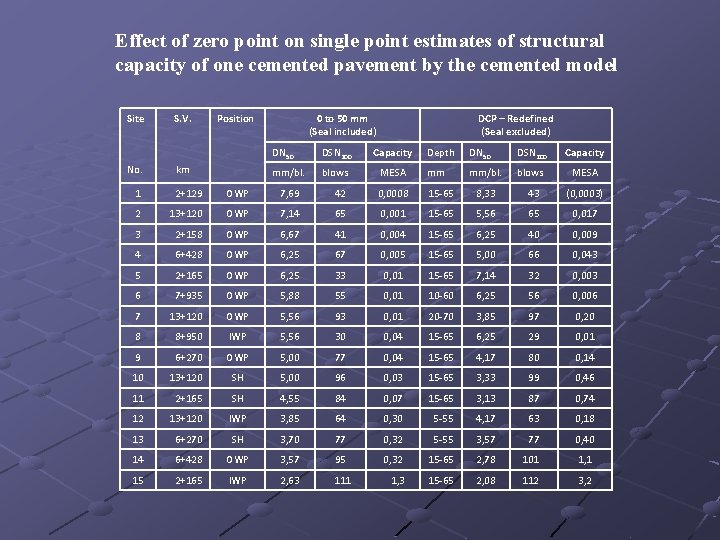
Effect of zero point on single point estimates of structural capacity of one cemented pavement by the cemented model Site No. S. V. Position km 0 to 50 mm (Seal included) DCP – Redefined (Seal excluded) DN 50 DSN 200 Capacity Depth DN 50 DSN 200 Capacity mm/bl. blows MESA mm mm/bl. blows MESA 1 2+129 OWP 7, 69 42 0, 0008 15 -65 8, 33 43 (0, 0003) 2 13+120 OWP 7, 14 65 0, 001 15 -65 5, 56 65 0, 017 3 2+158 OWP 6, 67 41 0, 004 15 -65 6, 25 40 0, 009 4 6+428 OWP 6, 25 67 0, 005 15 -65 5, 00 66 0, 043 5 2+165 OWP 6, 25 33 0, 01 15 -65 7, 14 32 0, 003 6 7+935 OWP 5, 88 55 0, 01 10 -60 6, 25 56 0, 006 7 13+120 OWP 5, 56 93 0, 01 20 -70 3, 85 97 0, 20 8 8+950 IWP 5, 56 30 0, 04 15 -65 6, 25 29 0, 01 9 6+270 OWP 5, 00 77 0, 04 15 -65 4, 17 80 0, 14 10 13+120 SH 5, 00 96 0, 03 15 -65 3, 33 99 0, 46 11 2+165 SH 4, 55 84 0, 07 15 -65 3, 13 87 0, 74 12 13+120 IWP 3, 85 64 0, 30 5 -55 4, 17 63 0, 18 13 6+270 SH 3, 70 77 0, 32 5 -55 3, 57 77 0, 40 14 6+428 OWP 3, 57 95 0, 32 15 -65 2, 78 101 1, 1 15 2+165 IWP 2, 63 111 1, 3 15 -65 2, 08 112 3, 2
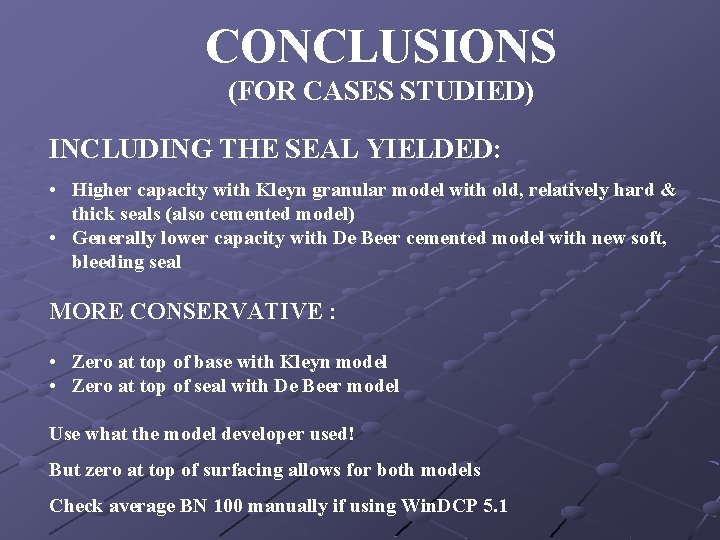
CONCLUSIONS (FOR CASES STUDIED) INCLUDING THE SEAL YIELDED: • Higher capacity with Kleyn granular model with old, relatively hard & thick seals (also cemented model) • Generally lower capacity with De Beer cemented model with new soft, bleeding seal MORE CONSERVATIVE : • Zero at top of base with Kleyn model • Zero at top of seal with De Beer model Use what the model developer used! But zero at top of surfacing allows for both models Check average BN 100 manually if using Win. DCP 5. 1