
Importance of Tax Types and Objectives of Tax
Importance of Tax, Types and Objectives of Tax Acts and rules and regulations. There are many responsibilities of state to its countrymen. State is represented by the government. Hence, the government of any country performs a number of activities in order to maintain law and order, peace and security, satisfying with the requirement of basic needs and public utilities etc. It also initiates various development programmers and maintains diplomatic and friendly relation with other nations in the world. In order to carry out all these activities and discharge its overall responsibilities towards the people, it needs sufficient revenue. Such revenue is known as government revenue. It is also known as public revenue. Government revenue is collected through various sources according to the provisions of the financial are taxes, fees and charges, fines and penalties, foreign grants etc. Among them, tax is the main sources of collecting the government revenue.
The concept of tax was initiated from Great Britain in 1799 to collect revenue for the government to manage the war against France. It didn't come into practice after that for a long time. Income tax system was regularly begun from 1840 onwards in different countries in the world. It was begun from 1840 in Switzerland, 1849 in Austria, 1860 in England India, 1862 in USA, 1864 in Italy and 1959 in Nepal as a regular source of government revenue. Iraq has adopted the first income tax law 52 in 1927 after the foundation of the modern Iraqi state in 1921. The first income tax law was greatly inspired by the Modal Income Tax Ordinance of 1922, which Great Britain had prepared for use in its colonies. Since 1927 and until the adoption of the current income tax law 113 in 1982, there was no real improving or modernization of the tax system.
Clarification on tax: Definition of tax In the beginning we should clarify the meaning of tax, Tax is defined in many ways, and common definition is as below: - It is the process by which the sovereign, through its law making body, Raises revenues in order to use it for expenses of government. - It is a means for the government in increasing its revenue under the authority of the law, purposely used to promote welfare and protection of its citizenry. - It is the collection of the share of individual and organizational income by a government under the authority of the law. The tax is an amount of money paid to the state, final, without services directly, for their coverage of public expenditure or Expenses and to achieve the objectives of state, goals economic, financial and social.
Tax elements 1 The tax is amount of money. 2 Paid to the state. 3 Final “From this point can find out the difference between the tax and loan “Because the amount of the loan should be returned, but the amount of the tax cannot be returned. 4 Without direct service, the tax payer does not receive direct and or special benefit in return “this means the difference between the tax and fee is in submitting the direct service. 5 To cover the public expenditure or Expenses. 6 It is spent by the government for the common interest and benefit of the people. 7 Organized by a law. 8 To achieve the state objectives, of economic, financial and social goals.
Objectives of Tax is permanent instrument for collecting revenues. It is a major source of revenue in the developed world and has been appearing as an important source of revenue in the developing world as well. It has been an instrument of social and economic policy for the government. Taxes are primary revenue yielding tools of the Government of modern. The government levies taxes in order to achieve following objectives: - For collection of revenue to run and administer the Government; - To use as a tool for implementation of its policies; and - For fair distribution of wealth.
Tax rules: Adam Smith in his famous book “Wealth of Nations” has elaborated following Canons of Taxation: 1 Convenience of payment (Appropriate) Taxes should be collected at a time and in a manner convenient for taxpayer, this means the time of the tax calculation should be suitable with the income generating time. 2 Economy Taxes should not be expensive to collect and should not discourage business. this means the tax revenues are more than the cost of tax expenses.
3 Justice: The tax should take in consideration the taxpayer's ability to pay; there is horizontal and vertical Justice. Horizontal justice: the tax must be imposed on each sample in a single chip, such as a doctor, lawyer, engineer, Vertical Justice: It is taking into consideration the size of the income during the tax calculating, as in the case of the relative tax. 4 - Certainty (Clarification) Tax liabilities should be clear and certain, this means the legal items for the Tax should be clear to all. Following are some broad principles for levy of taxes:
5 - The Benefit Principle. This principle holds that the individuals should be taxed in proportion to the benefits they receive from the governments and that taxes should be paid by those people who receive the direct benefit of government programs and projects out of the taxes paid. 6 - The Ability-to-Pay Principle. This principle holds that taxes should relate with the person’s income or the ability to pay, that is, those with greater income or wealth who can afford to pay should be taxed. Similarly, even rate of tax could increase with higher income. 7 - The Equal-Distribution Principle. Income, wealth, and transaction may be taxed at a fixed percentage; that is, people who earn more and spend more should pay more taxes, but not pay a higher rate of tax

Structure of taxes Proportional tax. A tax system that requires the same percentage of income from all taxpayers, regardless of their earnings. A proportional tax applies the same tax rate across low-, middle- and high-income taxpayers. The proportional tax is in contrast to a progressive tax, where taxpayers with higher incomes pay higher tax rates than taxpayers with lower incomes. A proportional tax is also called a flat tax. - Regressive tax. A tax that takes a larger percentage from a person’s low-income than from another person’s high-income. A regressive tax is generally a tax that is applied uniformly. This means that it hits lower-income individuals harder. - Progressive tax. A tax that takes a larger percentage from high-income earners than it does from low-income earners. In other words, the more one earns, the more tax he would have to pay. The tax amount is proportionately equal to someone’s status in the society. A rich man should pay more than a poor man.
The stages of taxation -The first phase (primitive stage), a stage before state formation, which was represented in the tribal or clan, as a tax concept that was not clear. -The second stage (advanced conventional): At this stage, the state formations were clear as a political system, was to impose a direct tax, including the tax on land. -The third stage (the next phase of state formation): At this stage, the economic relations between the countries each other. With direct taxes, as has been the imposition of an indirect tax, including import and export tax. -Fourth stage (stage to achieve well-being): At this stage, use state taxes to achieve the goal of social welfare. We find that the State taxes here have become used to keep up with political, social and economic developments.
-: Sources of tax legislation • • • • • Tax legislation is based on the following sources: Firstly - internal sources- : 1 - Typical sources: It consists of: (A) constitutional. The principle of taxpayer satisfaction The principle of the legality of the tax (B) the general principles of tax - : The Justice and Equality Clarification Appropriate Economy (C) Tax law. at the beginning the income tax law imposed in Iraq in 1927, as Law 52 then amended to the law number 36 of 1939, was amended Law 56 of 1956 and then modified by law 59 of 1959, and after a change of government system in Iraq, has been changed to law 113 of 1982 and in force from 1983 to today (D) The general rules 2 -Explanatory sources: It includes judicial interpretations about the result of a dispute between the taxpayer and tax administration for legal items. Secondly - foreign or international sources: It includes international agreements that determine the economic relations system.
System of taxation in Iraq Direct Tax A direct tax is the one, which is paid by the person or entity on which it is legally imposed. It is collected from the persons or entities on the income they have earned exceeding a certain specified limit. Tax is generally calculated at a certain percentage on the income. Examples: 1 Income Tax: and it is the broadest type of tax and impose a larger slice of the taxpayer who working in different economic activities, which generate them revenue of a year, and is a progressive tax on the whole, except in specific cases where the relative tax be, and regulates these tax law No. 133 Iraqi income tax for the year 1982 in force. 2 Property Tax: The tax is levied on the total annual revenue of the year to the taxpayer of the real estate income excluding housing Personal and regulates rulings by Property Tax Law No. 162 of 1959 in force Taxes on capital: these include taxes
Indirect Tax An indirect tax is the one, which is imposed to one person or entity but paid partly or fully by others. It is transferable to others. The tax is collected from customers by including it in the price of the goods or services they have purchased. The producers collect such a tax from wholesalers the wholesalers from retailers and the retailers from the final consumers. Excise duty, custom duty, VAT etc. are some of the examples of indirect tax. Personal income Tax Personal income tax refers to the tax imposed on individuals or families who earn income exceeding a certain specified limit subject to change as per the provisions made in financial rules and regulations. Corporate Tax Corporate tax is the tax imposed on the incomes of a business entity. It occupies the most part of the government revenue collected from taxes. Corporate tax rates are generally applied in flat system with high rate of large undertakings and low rates for smaller ones. The small and large undertakings are categorizes as per the size of the activities.
Excise duty is the tax levied on luxurious products. It is intended to discourage the consumption of harmful products on one side and to collect government revenue in considerable extent on the other side. Custom Duty Custom duty is the tax charged on the goods dealt in the foreign trade especially on the imported goods to encourage and promote export and to protect national industries. Government simply gives exemption of this tax on export trade and imposes on import trade. Custom duty may be export duty or import duty as its nature and imposed to the trading goods. Land revenue Tax Land revenue tax is the one, which is imposed to the landlords on the revenue generated from land especially while selling or purchasing land. Value Added Tax (VAT) Value added tax is the tax levied on value added on the price of the product at each stage of production, and or distribution activities. Value added is the difference between sales values and purchase value or the conversion cost plus profit. Conversion cost means the expenses on rent, depreciation, maintenance, insurance, salary etc. It is imposed on the goods at import, production and selling stages.
the Importance of Tax is a major source of government revenue and its contributes for the overall development and prosperity of a country. • Raising government revenue in terms of income tax, custom duty, excise duty, entertainment tax, VAT, land revenue tax etc. From various sectors in order to initiate development and welfare programmers. • Maintaining economic stability by reducing economic inequalities by means of equitable distribution of wealth by way of imposing tax to the income earners and improving the economic condition of the general people. • Regulating the economic sectors into right direction by encouraging the production and distribution of useful goods and discouraging the harmful products by imposing high tax rate on them. • Building and strengthening the national economy by encouraging and protecting national industries and promoting export trade. • Reducing regional economic disparity by encouraging the entrepreneurs to establish industries in remote and backward regions by giving tax exemptions, rebates and concessions etc.
Article 1. Of law tax 113 in 1982 The meaning of the following expressions is as follows unless the context stipulates otherwise: (1) Tax: The income tax imposed by this Law. (2) Income: The net income of the taxpayer earned from sources specified in Article 2 of this Law. (3) Assessment year: The period of 12 months starting the first day of January of each year - with due consideration to special periods referred to in this Law. (4) Person: Natural or juristic persons. (5) Juristic Person: Any administration or State Organization to which juristic
(6) Company: Joint Stock or Limited Liability Companies incorporated in or outside Iraq but undertaking commercial enterprises or having offices or control centers therein. (7) Partnership: Companies other than those referred to in paragraph (6), such as collective companies. (8) Taxpayer: Any person subject to taxation in accordance with this Law. (9) Married person: A natural person bound by a permanent legal marriage contract recognized by Iraqi laws, provided that the spouses are alive, not divorced or separated.
Taxation standards Introduction-: State depends on several standards in it is taxed as part of the sources of income, given the multiplicity of sources of income for the state came to several ways in taxation, including : standard political dependency Standard political relationship A relationship that consists between the state and individuals by granting that nationality State, as is the case for Iraq when granting Iraqi nationality to individuals 2 - Standard economic dependency (A) standard money site or source of income Standard source of capital, It takes a source of income to achieve as a reality to impose the tax. (B) standard residence The criterion for a residence as defined by article 1 paragraph 10 of the Income Tax Law No. 113 of 1982.
Article 1 paragraph 10 : A. Iraqi who lives in Iraq for four months in the year to achieve income, or were temporarily absent from Iraq. Like (Study, treatment( B - Iraqi who lives in Iraq outside of the employees of the public sector or retired, and is considered a resident without consideration to the length of stay. Example-: 1 -Ahmed Iraqi residence in Iraq of 01. 02. 2014 and left Iraq in 01/04/2014 2 -Samir Iraqi, have left Iraq from 01/03/2012 until 01/07/2013, and it was his visit to Iraq during this time, in 01/09/2012 visited Iraq and left in 01/02/2013. (a) The Iraqi who has been resident in Iraq for a period of not less than 4 months during the year in which the income has arisen or resided temporarily outside Iraq with a permanent domicile or place of business in Iraq.
(b) The Iraqi official, employee or pensioner of the official departments and establishments of socialist sector who is resident outside Iraq or whose services have been loaned by the Government to a juristic person outside Iraq, if he is exempted from tax in his place of work. (c) Arab nationalities from Arab countries, working in Iraq regardless of the period of their residence. (d) Non-Iraqi person other than a national of other Arab countries who : (i) resided in Iraq during the year in which the income arose, for a total period of not less than 6 months or he resided in Iraq for a period of not less than four consecutive months. (ii) is residing in Iraq regardless of the period of his residence if he is employed by a juristic person in Iraq or he has a scientific or technical specialization and he is being employed for an industrial project which has the right to enjoy the exemptions of the Encouragement of Industrial Projects Law.
(e) Any juristic person incorporated under Iraqi Laws or other laws having its place of management and Control in Iraq. (11)Non-resident: The person who does not meet the residence qualifications stated in paragraph (10) above, even if income has arisen for him in Iraq from any source. Example-: Select the resident and non-resident in the following cases for years (2002. 2003, 2004. 2005, 2006. 1 -Iraqi lived in Jordan since 1/9/2002, and then returned to Iraq on 1/5/2006, and had visited Iraq in 01/10/2003 until 1/4/2004. 2 - James visited Iraq on 1/10/2002 and then left in one 1/4 / 2003 and then returned to Iraq in 01/10/2003, and then to Korea in treacherous 01. 02. 2004, returned to Iraq in one 1/4 / 2004, and left the following year in 01. 02. 2005 and returned to Iraq in 01/11/2005. Then he left in 01/03/2006.
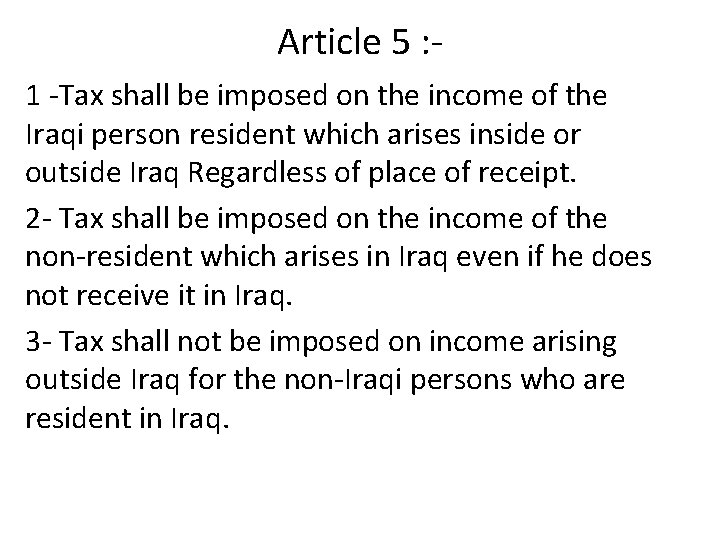
Article 5 : 1 -Tax shall be imposed on the income of the Iraqi person resident which arises inside or outside Iraq Regardless of place of receipt. 2 - Tax shall be imposed on the income of the non-resident which arises in Iraq even if he does not receive it in Iraq. 3 - Tax shall not be imposed on income arising outside Iraq for the non-Iraqi persons who are resident in Iraq.
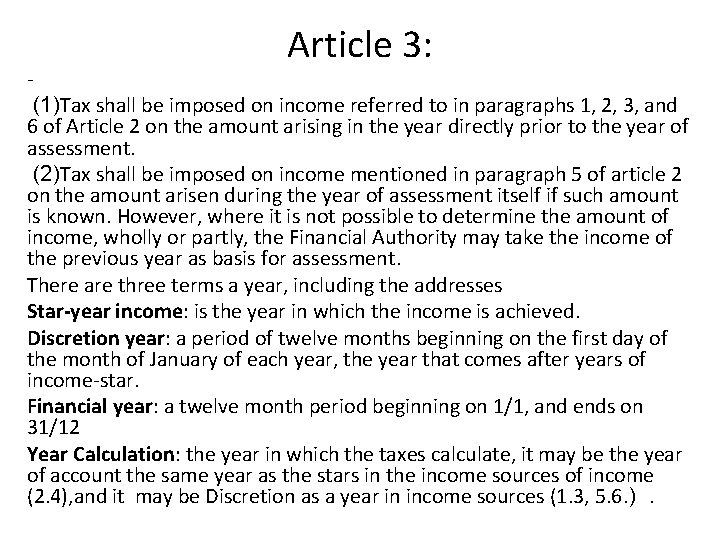
Article 3: (1)Tax shall be imposed on income referred to in paragraphs 1, 2, 3, and 6 of Article 2 on the amount arising in the year directly prior to the year of assessment. (2)Tax shall be imposed on income mentioned in paragraph 5 of article 2 on the amount arisen during the year of assessment itself if such amount is known. However, where it is not possible to determine the amount of income, wholly or partly, the Financial Authority may take the income of the previous year as basis for assessment. There are three terms a year, including the addresses Star-year income: is the year in which the income is achieved. Discretion year: a period of twelve months beginning on the first day of the month of January of each year, the year that comes after years of income-star. Financial year: a twelve month period beginning on 1/1, and ends on 31/12 Year Calculation: the year in which the taxes calculate, it may be the year of account the same year as the stars in the income sources of income (2. 4), and it may be Discretion as a year in income sources (1. 3, 5. 6. ).
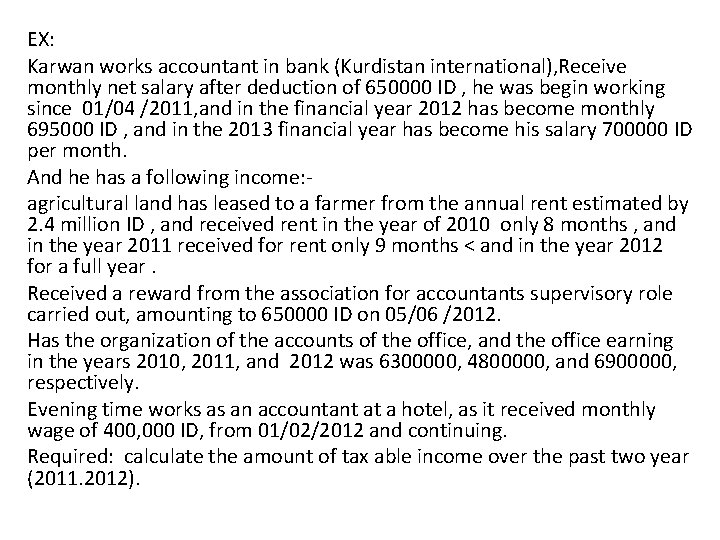
EX: Karwan works accountant in bank (Kurdistan international), Receive monthly net salary after deduction of 650000 ID , he was begin working since 01/04 /2011, and in the financial year 2012 has become monthly 695000 ID , and in the 2013 financial year has become his salary 700000 ID per month. And he has a following income: agricultural land has leased to a farmer from the annual rent estimated by 2. 4 million ID , and received rent in the year of 2010 only 8 months , and in the year 2011 received for rent only 9 months < and in the year 2012 for a full year. Received a reward from the association for accountants supervisory role carried out, amounting to 650000 ID on 05/06 /2012. Has the organization of the accounts of the office, and the office earning in the years 2010, 2011, and 2012 was 6300000, 4800000, and 6900000, respectively. Evening time works as an accountant at a hotel, as it received monthly wage of 400, 000 ID, from 01/02/2012 and continuing. Required: calculate the amount of tax able income over the past two year (2011. 2012).
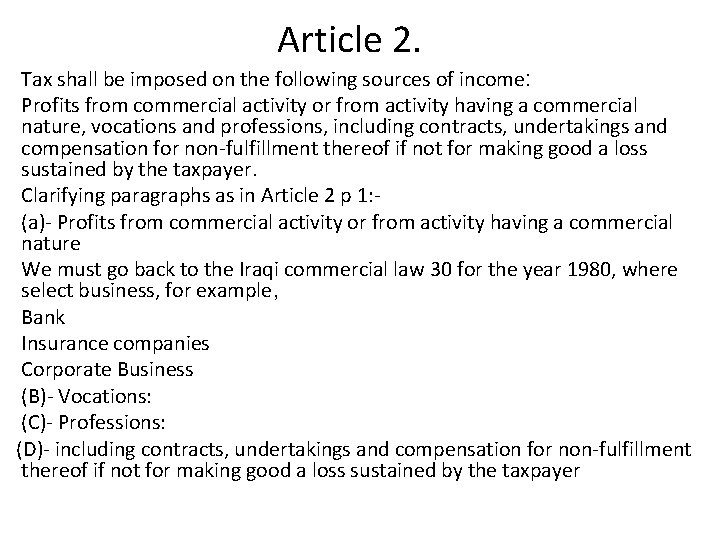
Article 2. Tax shall be imposed on the following sources of income: Profits from commercial activity or from activity having a commercial nature, vocations and professions, including contracts, undertakings and compensation for non-fulfillment thereof if not for making good a loss sustained by the taxpayer. Clarifying paragraphs as in Article 2 p 1: (a)- Profits from commercial activity or from activity having a commercial nature We must go back to the Iraqi commercial law 30 for the year 1980, where select business, for example, Bank Insurance companies Corporate Business (B)- Vocations: (C)- Professions: (D)- including contracts, undertakings and compensation for non-fulfillment thereof if not for making good a loss sustained by the taxpayer
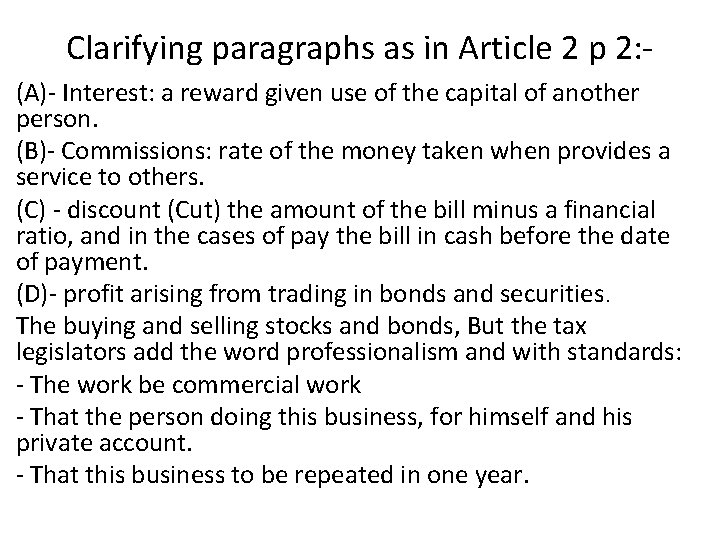
Clarifying paragraphs as in Article 2 p 2: (A)- Interest: a reward given use of the capital of another person. (B)- Commissions: rate of the money taken when provides a service to others. (C) - discount (Cut) the amount of the bill minus a financial ratio, and in the cases of pay the bill in cash before the date of payment. (D)- profit arising from trading in bonds and securities. The buying and selling stocks and bonds, But the tax legislators add the word professionalism and with standards: - The work be commercial work - That the person doing this business, for himself and his private account. - That this business to be repeated in one year.
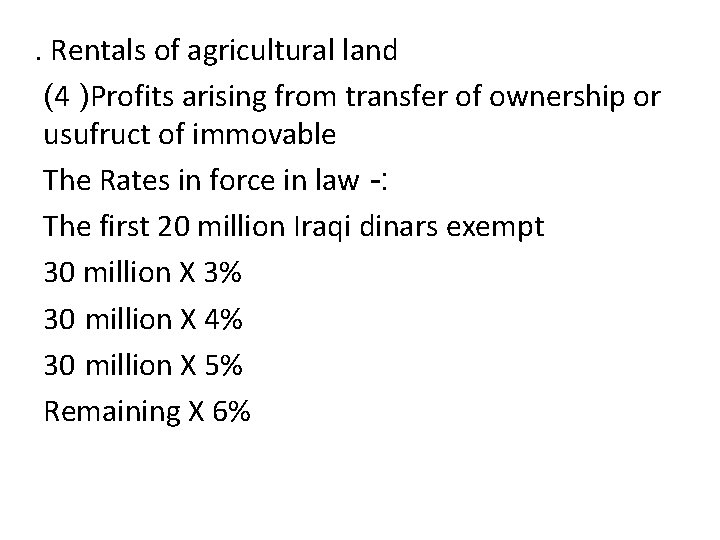
. Rentals of agricultural land (4 )Profits arising from transfer of ownership or usufruct of immovable The Rates in force in law -: The first 20 million Iraqi dinars exempt 30 million X 3% 30 million X 4% 30 million X 5% Remaining X 6%
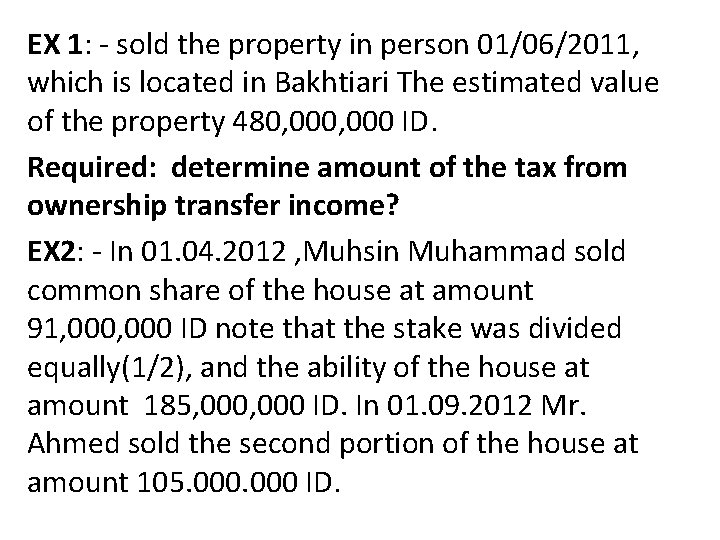
EX 1: - sold the property in person 01/06/2011, which is located in Bakhtiari The estimated value of the property 480, 000 ID. Required: determine amount of the tax from ownership transfer income? EX 2: - In 01. 04. 2012 , Muhsin Muhammad sold common share of the house at amount 91, 000 ID note that the stake was divided equally(1/2), and the ability of the house at amount 185, 000 ID. In 01. 09. 2012 Mr. Ahmed sold the second portion of the house at amount 105. 000 ID.
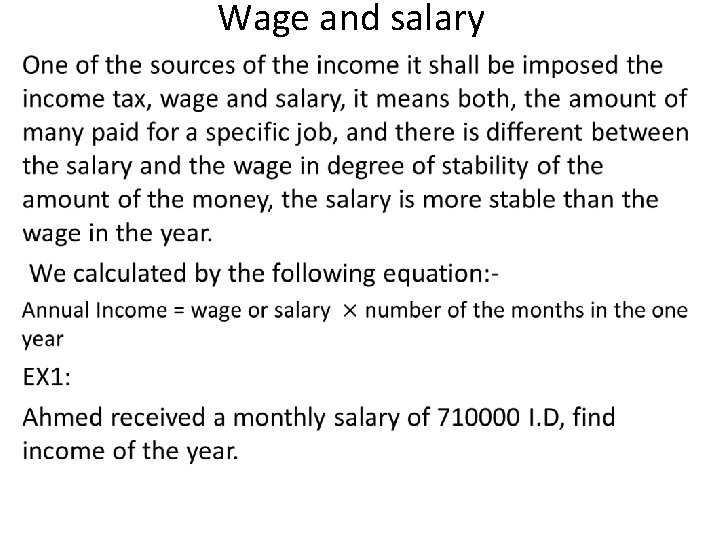
Wage and salary •
- Slides: 29