
Importance of Lab Values for Therapists in the

Importance of Lab Values for Therapists in the Acute Care Setting Ryan Rubio SPT

Why is this important? �Easy to forget if not referenced regularly �Patient safety �Quality of care

Objectives �Know important values to search for �Know normal ranges for these values �Use them to paint a picture of your patient �Predict how it will affect your treatment �Recognize implications and contraindications

Let’s Narrow it Down �In a chart, the amount of lab results can look overwhelming…
More Common Lab Values �Sodium (Na+) �Potassium (K+) �Ammonia �Platelets (PLT) �Magnesium (Mg+) �Glucose �White Blood Cell (WBC) �Prothrombin Time/ International Normalized Ratio (PT/INR) �D-Dimer �Hematocrit (HCT) �Hemoglobin (Hgb)
Sodium (Na+) � Generates electrical signals needed for communication in several areas of the body, such as the brain, nervous system, and muscles. Helps to regulate fluid levels in the body. � Abnormal levels can indicate kidney dysfunction and increased blood pressure. Patient can present with dehydration and edema. � Levels increased by: excess sweating, diabetes insipidus, respiratory loss, osmotic diuresis � Decreased by: CHF, renal failure, nephrotic syndrome, cirrhosis, adrenal insufficiency, GI or skin loss Normal Range: 135 -145 m. Eq/L Levels < 130 m. Eq/L Hyponatremia can result in muscle cramps, fainting, disorientation, and altered mental status. > 150 m. Eq/L Hypernatremia can result in thirst, nausea, vomiting, and seizures.
Potassium (K+) � Vital in regulating heartbeat and maintaining proper function of muscles. � Abnormal levels increase risk of developing shock, respiratory failure, or heart rhythm disturbances. � Levels increased by: renal failure, severe dehydration, low blood volume, low mineralocorticoids, acute acidosis, insulin. � Decreased by: hyperglycemia, vomiting, diarrhea, excess sweating, cystic fibrosis, eating disorders, licorice abuse. Normal level: 3. 5 -5. 0 m. Eq/L If < 3. 0 m. Eq/L or > 5. 3 m. Eq/L PT must justify benefits of treatment. Hypokalemia can result in nausea, vomiting, altered mental status and risk of arrhythmia or muscle spasms. Hyperkalemia can result in suppression of the activity of the heart.
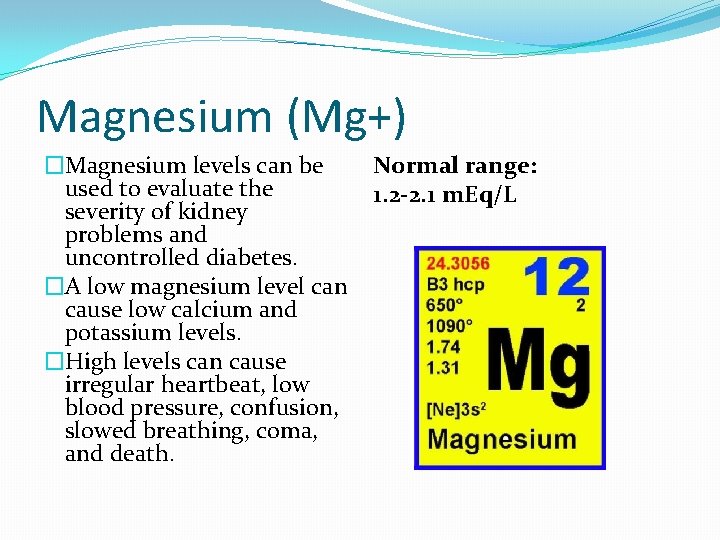
Magnesium (Mg+) �Magnesium levels can be used to evaluate the severity of kidney problems and uncontrolled diabetes. �A low magnesium level can cause low calcium and potassium levels. �High levels can cause irregular heartbeat, low blood pressure, confusion, slowed breathing, coma, and death. Normal range: 1. 2 -2. 1 m. Eq/L
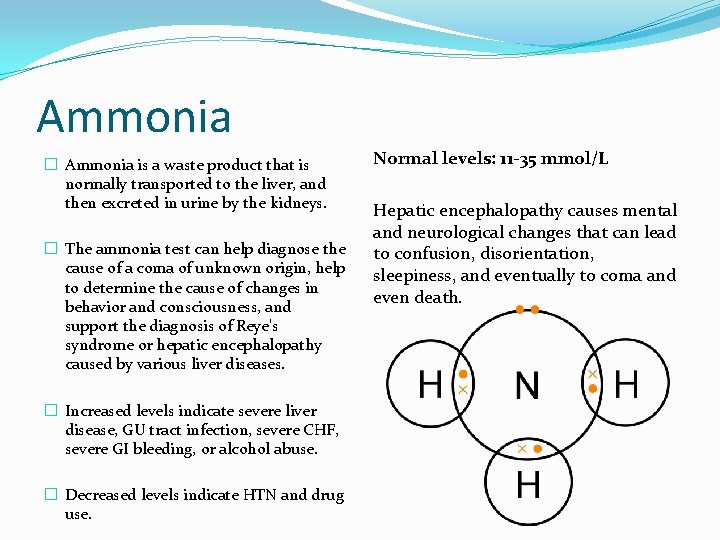
Ammonia � Ammonia is a waste product that is normally transported to the liver, and then excreted in urine by the kidneys. � The ammonia test can help diagnose the cause of a coma of unknown origin, help to determine the cause of changes in behavior and consciousness, and support the diagnosis of Reye's syndrome or hepatic encephalopathy caused by various liver diseases. � Increased levels indicate severe liver disease, GU tract infection, severe CHF, severe GI bleeding, or alcohol abuse. � Decreased levels indicate HTN and drug use. Normal levels: 11 -35 mmol/L Hepatic encephalopathy causes mental and neurological changes that can lead to confusion, disorientation, sleepiness, and eventually to coma and even death.
White Blood Cell Count (WBC) �White blood cells, also called leukocytes, are cells that exist in the blood, the lymphatic system, and tissues and are an important part of the body's immune system. �They help protect against infections and also have a role in inflammation, allergic responses, and protecting against cancer. Normal range: 4, 000 -11, 000/cmm <500 - Patient isolated to room. 500 -1, 000 – MD approval to ambulate in hallway. Mask required by PT. >1, 000 – Adhere to isolation precautions. Patient may still ambulate in hallway.
Platelets (PLT) � Contribute to blood clotting. Normal range: 150 -450 K/cmm � Various platelet function tests are used to evaluate the ability of platelets to clump together and begin to form a clot. <20 K/cmm Guarded therapy. High risk of bleeding. No exercise permitted. � Patient does not have to have open wounds for excessive bleeding to be a risk. Bleeding can be internal. � Normal values increased by: malignancies, anemia, acute infections, cirrhosis, cardiac disease, chronic pancreatitis <35 K/cmm Cardiovascular/endurance exercise contraindicated 20 -50 K/cmm Light exercise permitted (AROM) < 50 K/cmm No MMT or resistive exercise
Hemaglobin (Hgb) Hematocrit (HCT) �Hemoglobin – indicates severity of anemia or polycythemia. �Hematocrit – measures the percentage of RBC in whole blood sample. �These levels can measure the severity of anemia or polycythemia and help make decisions about blood transfusions. This test can indicate if there is a problem with red blood cell production and/or lifespan, but it cannot determine the underlying cause. �Increased by: dehydration, COPD, CHF, smoking, chronic lung disease, congenital heart disease �Decreased by: anemia, hemolysis, chronic renal failure, lymphoma, leukemia, hyperthyroidism, cirrhosis
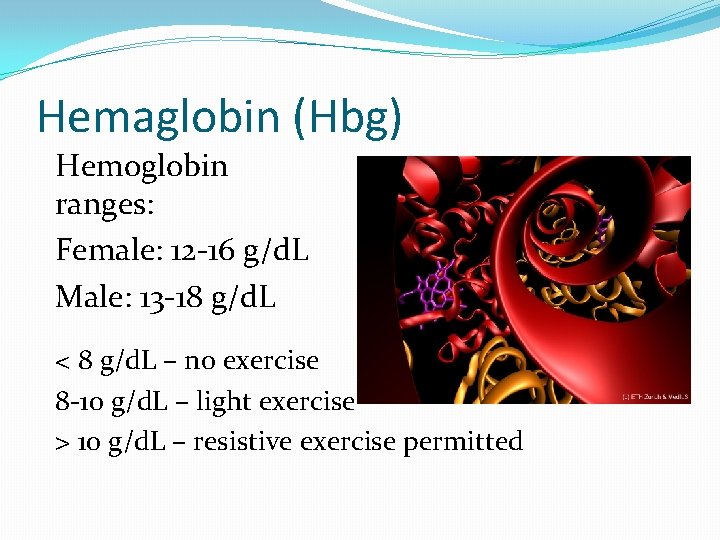
Hemaglobin (Hbg) Hemoglobin ranges: Female: 12 -16 g/d. L Male: 13 -18 g/d. L < 8 g/d. L – no exercise 8 -10 g/d. L – light exercise > 10 g/d. L – resistive exercise permitted
Hematocrit (HCT) Hematocrit ranges: Female: 37%-48% Male: 42%-52% < 25% - no exercise 25 – 30% - light exercise 30 – 32% - add resistive exercise to tolerance
Prothrombin Time/INR �The PT and INR are used to monitor the effectiveness of the anticoagulant warfarin. This drug affects the function of the coagulation cascade and helps inhibit the formation of blood clots. �PT is measured in seconds. �INR is the ratio of the patient’s PT compared to the normal rate. �Levels prolonged by: anticoagulation therapy, DIC, liver disease, coagulation factor deficiencies, biliary obstructions, decreased vitamin K �Decreased by: thrombophlebitis, vitamin K supplementation �Lovenox is an anticoagulant that does NOT affect PT/INR.
Prothrombin Time/INR Normal PT ranges: 8. 8 – 11. 6 s 1. 5 – 2. 0 times the normal Therapeutic range for DVT or clot risk patients > 25 s – Guarded therapy; High risk of bleeding into tissues Normal INR ranges: < 1. 5 s 2. 0 -3. 0 s - Therapeutic range for DVT or clot risk patients 2. 5 – 3. 5 s – Therapeutic for mitral valve replacement patients
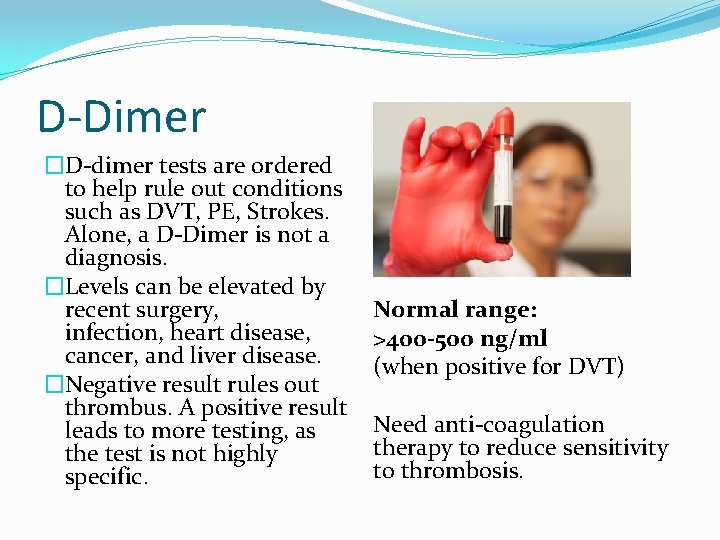
D-Dimer �D-dimer tests are ordered to help rule out conditions such as DVT, PE, Strokes. Alone, a D-Dimer is not a diagnosis. �Levels can be elevated by recent surgery, infection, heart disease, cancer, and liver disease. �Negative result rules out thrombus. A positive result leads to more testing, as the test is not highly specific. Normal range: >400 -500 ng/ml (when positive for DVT) Need anti-coagulation therapy to reduce sensitivity to thrombosis.
Glucose � Glucose is the primary energy source for the body’s cells. �Chronically high blood glucose levels can cause progressive damage to body organs such as the kidneys, eyes, heart and blood vessels, and nerves. �Chronic hypoglycemia can lead to brain and nerve damage. Normal range: 70 -100 mg/d. L > 250 - 300 mg/d. L Risk of ketoacidosis. Patient cannot be exercised. < 70 mg/d. L Patient needs carbohydrate snack to boost levels in order to tolerate activity.
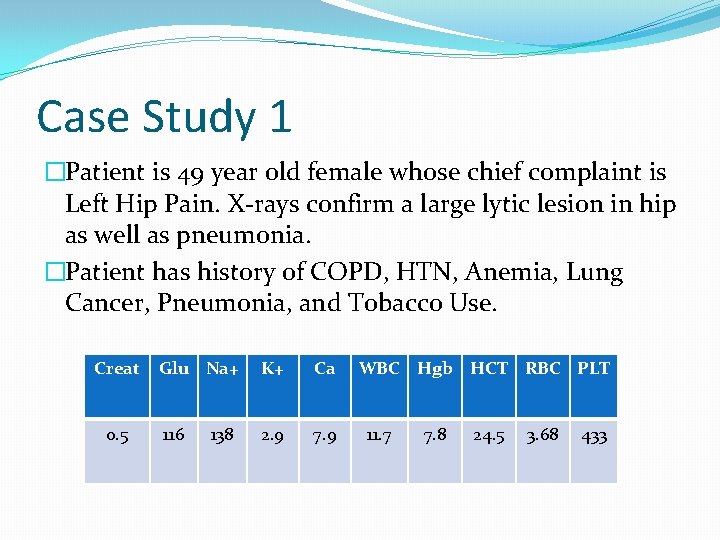
Case Study 1 �Patient is 49 year old female whose chief complaint is Left Hip Pain. X-rays confirm a large lytic lesion in hip as well as pneumonia. �Patient has history of COPD, HTN, Anemia, Lung Cancer, Pneumonia, and Tobacco Use. Creat 0. 5 Glu Na+ K+ Ca 116 2. 9 7. 9 138 WBC Hgb HCT RBC PLT 11. 7 7. 8 24. 5 3. 68 433
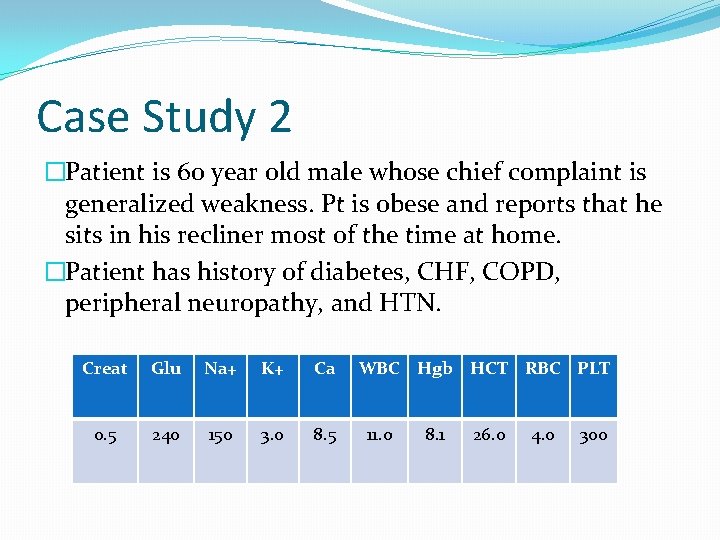
Case Study 2 �Patient is 60 year old male whose chief complaint is generalized weakness. Pt is obese and reports that he sits in his recliner most of the time at home. �Patient has history of diabetes, CHF, COPD, peripheral neuropathy, and HTN. Creat Glu Na+ K+ Ca 0. 5 240 150 3. 0 8. 5 WBC Hgb HCT RBC PLT 11. o 8. 1 26. 0 4. 0 300
Questions?
References 1. Wachie, Joanne Cardiovascular and Pulmonary Physical Therapy, 2 nd edition. 2010. Saunders/Elsevier. 2. Ghazinouri et al. Lab Values Interpretation Resources Update 2012. http: //www. acutept. org/associations/11622/files/Lab. Values. Resource. Upda te 2012. pdf. Published December 2011. Accessed July 20, 2012. 3. Mc. Ardle WD, Katch FI. Exercise Physiology: Nutrition, Energy, and Human Performance. 7 th ed. Baltimore, MD: Lippincott Williams & Wilkins; 2010 4. Riddle D, Wells P. Diagnosis of Lower-Extremity Deep Vein Thrombosis in Outpatients. Physical Therapy. 2004; 84 (8). 729 -735. 5. Adam S, Key N, Greenberg C. D-Dimer Antigen: Current Concepts and Future Prospects. Blood. 2009; 113 (13) 2878 -2887. 6. Tompkins J. Laboratory Reference Values and Therapy Implications. 2006. Mayo Clinic.
- Slides: 22