
Importance of Glocose Monitors 1 An estimated 135


- Slides: 10
Importance of Glocose Monitors 1. An estimated 135 million people worldwide — 18. 2 million in the United States have diabetes mellitus: 2. a disease in which the pancreas secretes an inadequate supply of insulin. 3. When blood glucose concentration is high, insulin lowers glucose levels from the extracellular form of glucose 4. When insulin production is deficient or absent, extracellular glucose concentrations in the blood rise unchecked to above-normal levels; this condition is called hyperglycemia. 5. Hyperglycemia is potentially fatal and can also lead to severe damage to the heart, kidneys, eyes, blood vessels, and nerves. 6. The normal fasting glucose concentration is between 70 and 110 mg/d. L in blood serum or plasma 2
Purpose of BGM’s • BGMs measure blood glucose concentration using: • reagent strip, cartridge, or cuvette and a drop of capillary blood from a finger puncture. • Health professionals and individuals with diabetes use battery-powered monitors to manage diabetes • Test for transient high or low blood glucose levels (e. g. , during surgery). 3
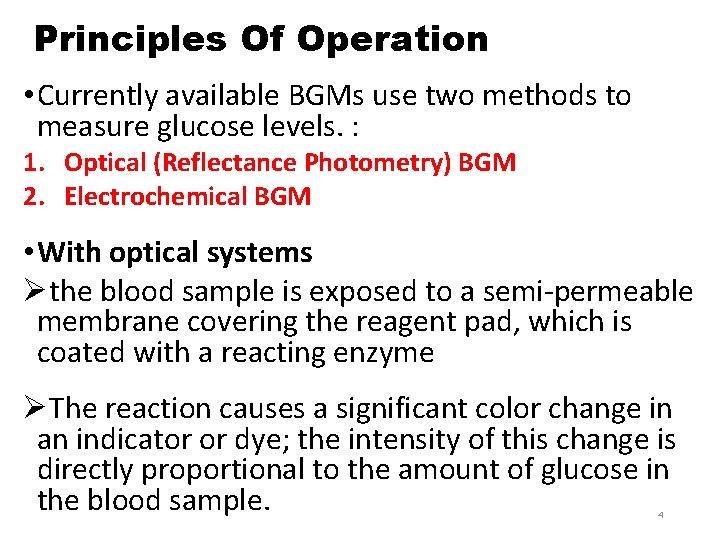
Principles Of Operation • Currently available BGMs use two methods to measure glucose levels. : 1. Optical (Reflectance Photometry) BGM 2. Electrochemical BGM • With optical systems Øthe blood sample is exposed to a semi-permeable membrane covering the reagent pad, which is coated with a reacting enzyme ØThe reaction causes a significant color change in an indicator or dye; the intensity of this change is directly proportional to the amount of glucose in the blood sample. 4
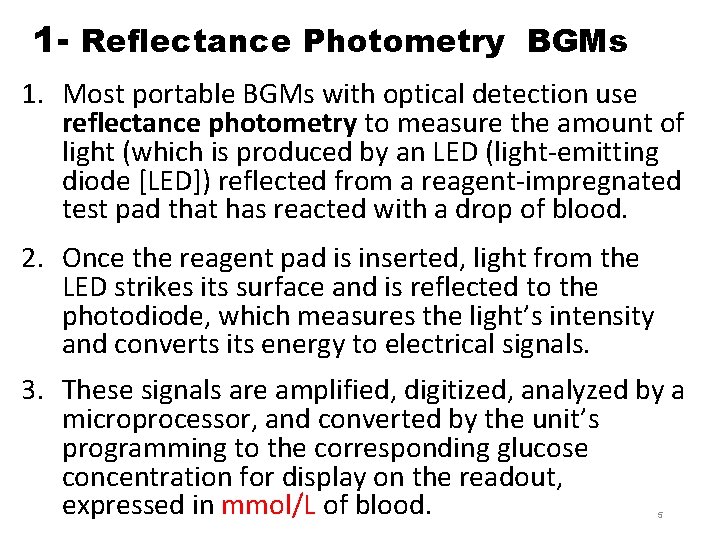
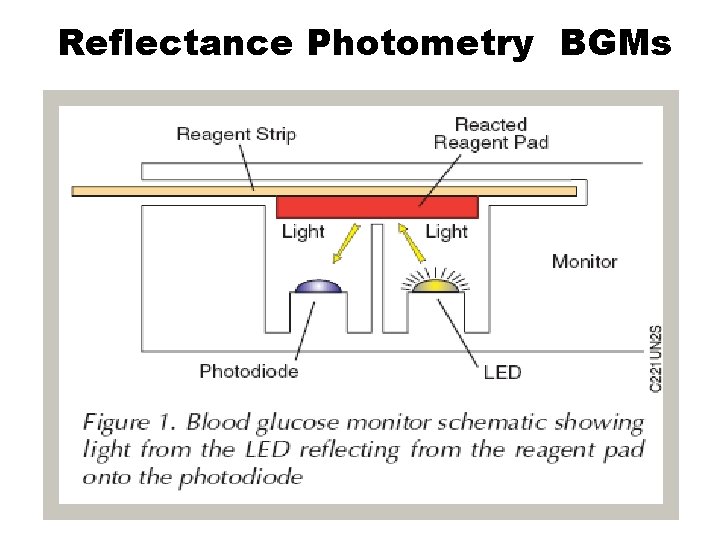
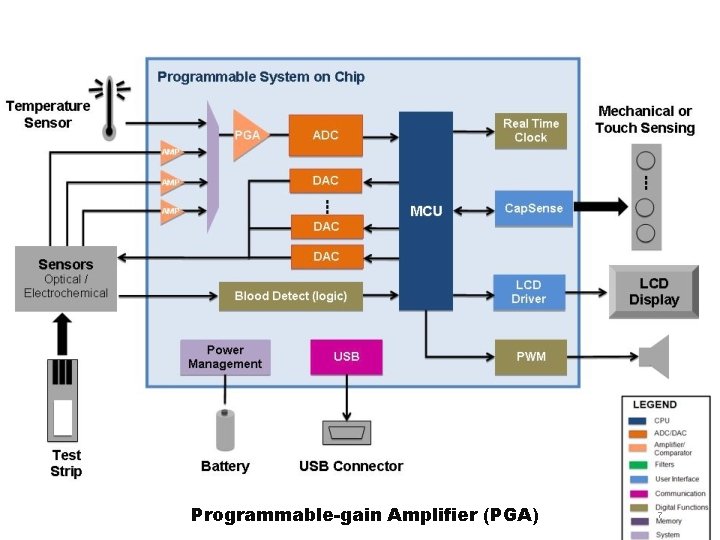
1 - Reflectance Photometry BGMs 1. Most portable BGMs with optical detection use reflectance photometry to measure the amount of light (which is produced by an LED (light-emitting diode [LED]) reflected from a reagent-impregnated test pad that has reacted with a drop of blood. 2. Once the reagent pad is inserted, light from the LED strikes its surface and is reflected to the photodiode, which measures the light’s intensity and converts its energy to electrical signals. 3. These signals are amplified, digitized, analyzed by a microprocessor, and converted by the unit’s programming to the corresponding glucose concentration for display on the readout, expressed in mmol/L of blood. 5
Reflectance Photometry BGMs 6
Programmable-gain Amplifier (PGA) 7
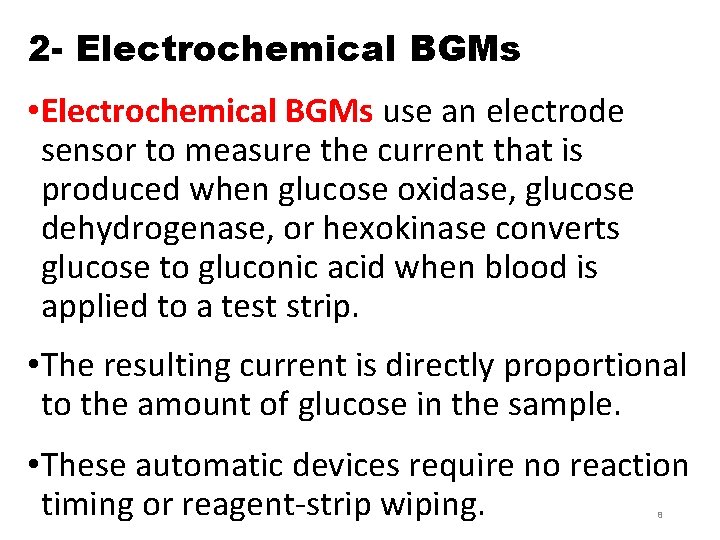
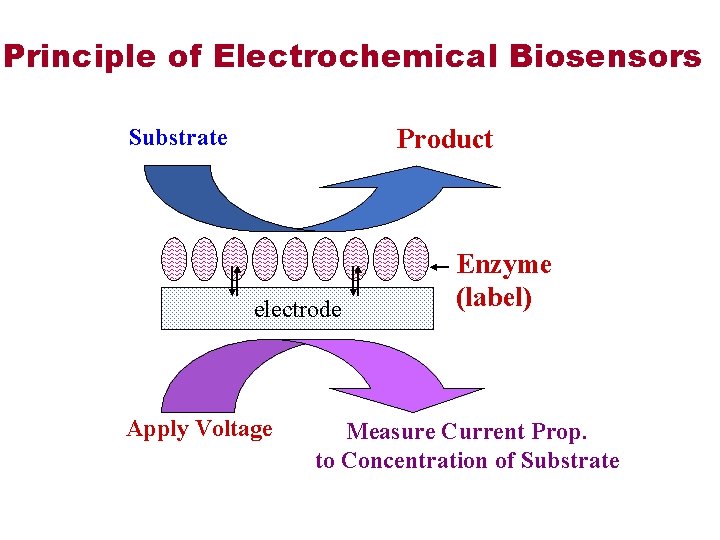
2 - Electrochemical BGMs • Electrochemical BGMs use an electrode sensor to measure the current that is produced when glucose oxidase, glucose dehydrogenase, or hexokinase converts glucose to gluconic acid when blood is applied to a test strip. • The resulting current is directly proportional to the amount of glucose in the sample. • These automatic devices require no reaction timing or reagent-strip wiping. 8
Principle of Electrochemical Biosensors Product Substrate electrode Apply Voltage Enzyme (label) Measure Current Prop. to Concentration of Substrate
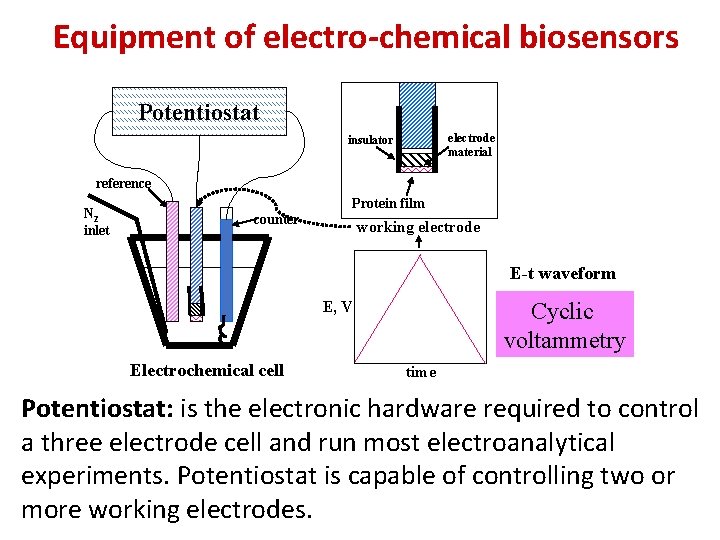
Equipment of electro-chemical biosensors Potentiostat electrode material insulator reference N 2 inlet Protein film counter working electrode E-t waveform Cyclic voltammetry E, V Electrochemical cell time Potentiostat: is the electronic hardware required to control a three electrode cell and run most electroanalytical experiments. Potentiostat is capable of controlling two or more working electrodes.