
Implicit PerceptualMotor Sequence Learning as a Function of
- Slides: 5
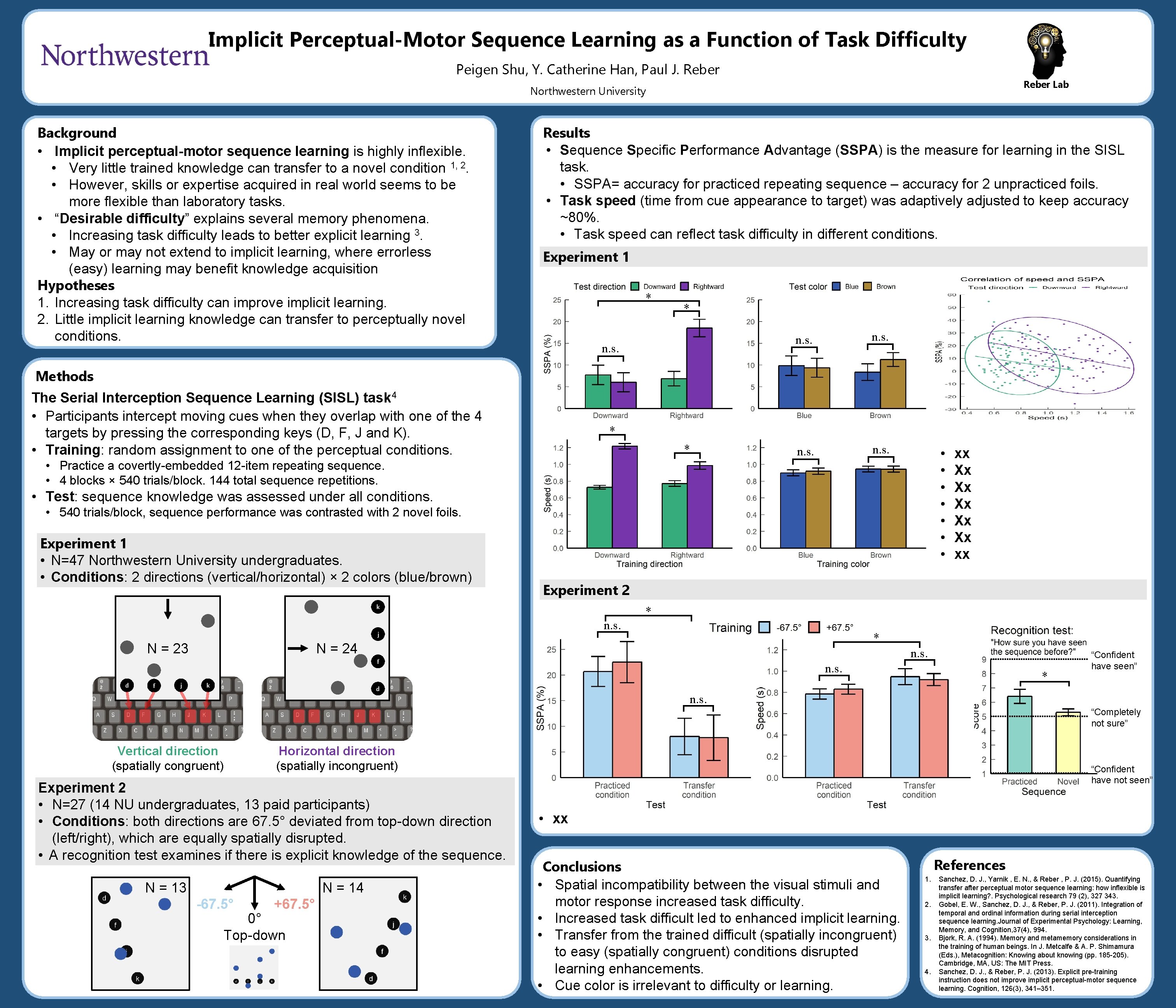
Implicit Perceptual-Motor Sequence Learning as a Function of Task Difficulty Peigen Shu, Y. Catherine Han, Paul J. Reber Lab Northwestern University Background • Implicit perceptual-motor sequence learning is highly inflexible. • Very little trained knowledge can transfer to a novel condition 1, 2. • However, skills or expertise acquired in real world seems to be more flexible than laboratory tasks. • “Desirable difficulty” explains several memory phenomena. • Increasing task difficulty leads to better explicit learning 3. • May or may not extend to implicit learning, where errorless (easy) learning may benefit knowledge acquisition Hypotheses 1. Increasing task difficulty can improve implicit learning. 2. Little implicit learning knowledge can transfer to perceptually novel conditions. Results • Sequence Specific Performance Advantage (SSPA) is the measure for learning in the SISL task. • SSPA= accuracy for practiced repeating sequence – accuracy for 2 unpracticed foils. • Task speed (time from cue appearance to target) was adaptively adjusted to keep accuracy ~80%. • Task speed can reflect task difficulty in different conditions. Experiment 1 * * n. s. Methods The Serial Interception Sequence Learning (SISL) task 4 • Participants intercept moving cues when they overlap with one of the 4 targets by pressing the corresponding keys (D, F, J and K). • Training: random assignment to one of the perceptual conditions. * * • • Practice a covertly-embedded 12 -item repeating sequence. • 4 blocks × 540 trials/block. 144 total sequence repetitions. • Test: sequence knowledge was assessed under all conditions. • 540 trials/block, sequence performance was contrasted with 2 novel foils. Experiment 1 • N=47 Northwestern University undergraduates. • Conditions: 2 directions (vertical/horizontal) × 2 colors (blue/brown) Experiment 2 k * n. s. j * N = 24 N = 23 n. s. f d f j k xx Xx Xx Xx xx n. s. d * “Confident have seen” n. s. “Completely not sure” Vertical direction (spatially congruent) Horizontal direction (spatially incongruent) Experiment 2 • N=27 (14 NU undergraduates, 13 paid participants) • Conditions: both directions are 67. 5° deviated from top-down direction (left/right), which are equally spatially disrupted. • A recognition test examines if there is explicit knowledge of the sequence. N = 13 N = 14 -67. 5° +67. 5° 0° Top-down “Confident have not seen” • xx Conclusions • Spatial incompatibility between the visual stimuli and motor response increased task difficulty. • Increased task difficult led to enhanced implicit learning. • Transfer from the trained difficult (spatially incongruent) to easy (spatially congruent) conditions disrupted learning enhancements. • Cue color is irrelevant to difficulty or learning. References 1. 2. 3. 4. Sanchez, D. J. , Yarnik , E. N. , & Reber , P. J. (2015). Quantifying transfer after perceptual motor sequence learning: how inflexible is implicit learning? . Psychological research 79 (2), 327 343. Gobel, E. W. , Sanchez, D. J. , & Reber, P. J. (2011). Integration of temporal and ordinal information during serial interception sequence learning. Journal of Experimental Psychology: Learning, Memory, and Cognition, 37(4), 994. Bjork, R. A. (1994). Memory and metamemory considerations in the training of human beings. In J. Metcalfe & A. P. Shimamura (Eds. ), Metacognition: Knowing about knowing (pp. 185 -205). Cambridge, MA, US: The MIT Press. Sanchez, D. J. , & Reber, P. J. (2013). Explicit pre-training instruction does not improve implicit perceptual-motor sequence learning. Cognition, 126(3), 341– 351.
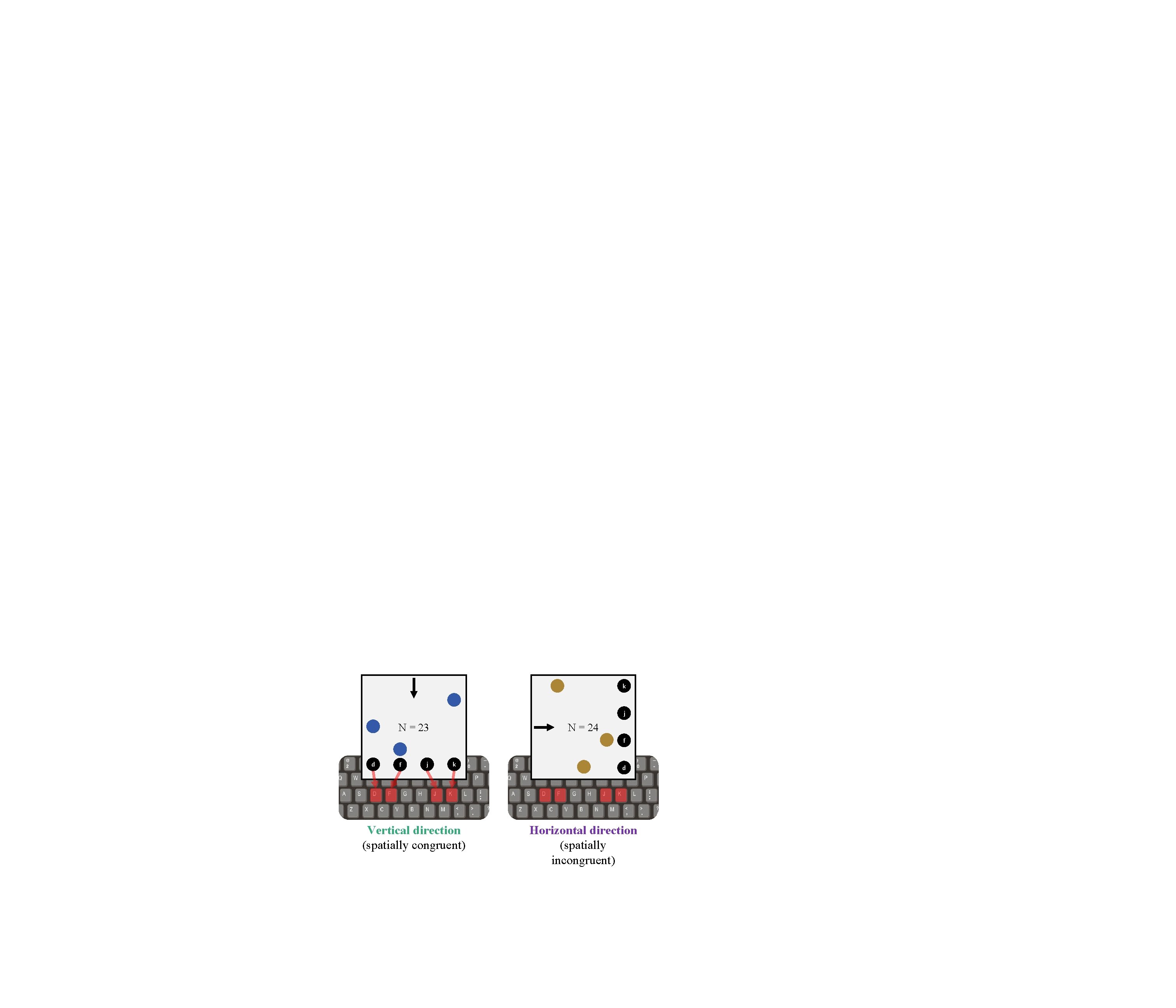
k j N = 24 N = 23 f d f j k Vertical direction (spatially congruent) d Horizontal direction (spatially incongruent)
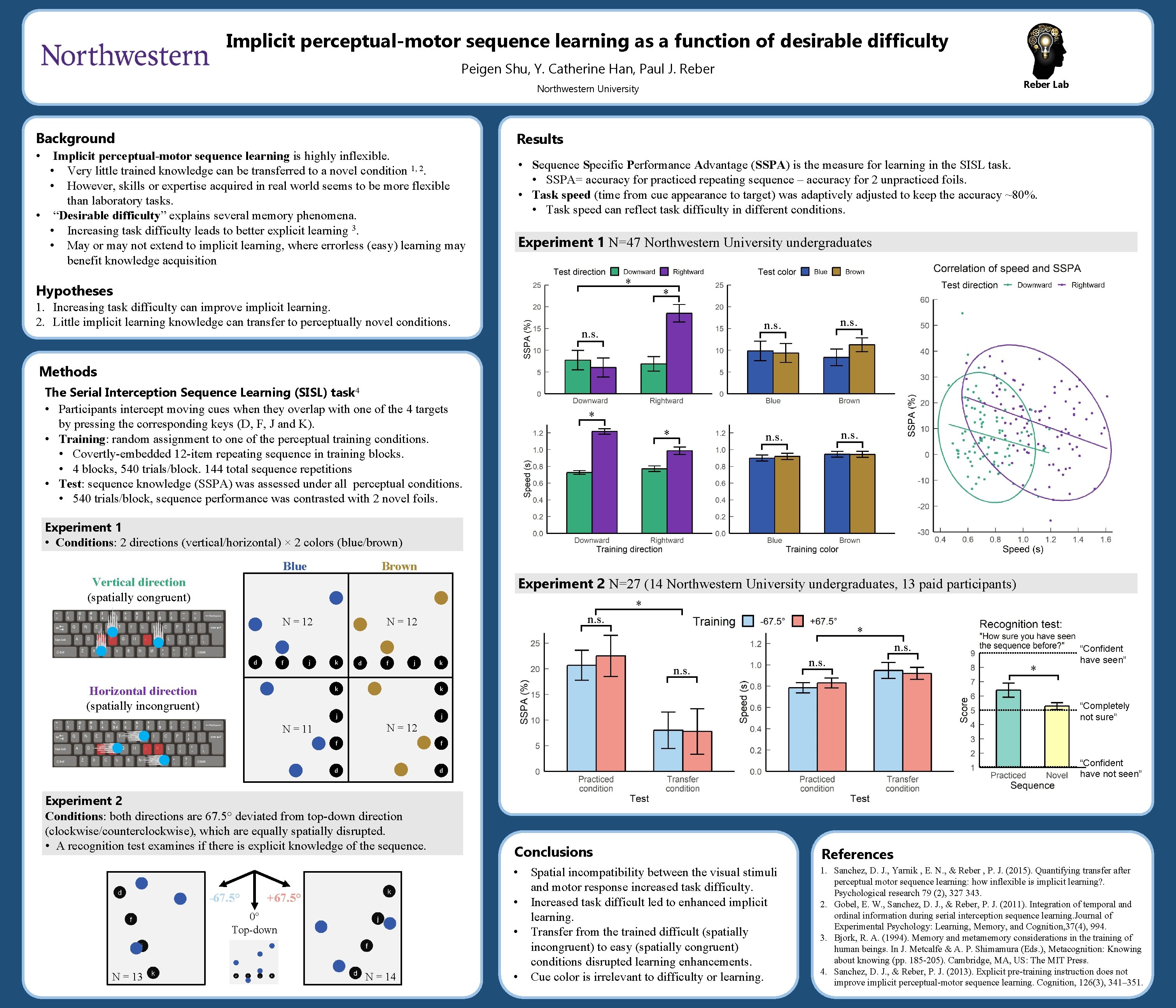
Implicit perceptual-motor sequence learning as a function of desirable difficulty Peigen Shu, Y. Catherine Han, Paul J. Reber Lab Northwestern University Background Results • Implicit perceptual-motor sequence learning is highly inflexible. • Very little trained knowledge can be transferred to a novel condition 1, 2. • However, skills or expertise acquired in real world seems to be more flexible than laboratory tasks. • “Desirable difficulty” explains several memory phenomena. • Increasing task difficulty leads to better explicit learning 3. • May or may not extend to implicit learning, where errorless (easy) learning may benefit knowledge acquisition • Sequence Specific Performance Advantage (SSPA) is the measure for learning in the SISL task. • SSPA= accuracy for practiced repeating sequence – accuracy for 2 unpracticed foils. • Task speed (time from cue appearance to target) was adaptively adjusted to keep the accuracy ~80%. • Task speed can reflect task difficulty in different conditions. Experiment 1 N=47 Northwestern University undergraduates * Hypotheses 1. Increasing task difficulty can improve implicit learning. 2. Little implicit learning knowledge can transfer to perceptually novel conditions. * n. s. Methods The Serial Interception Sequence Learning (SISL) task 4 • Participants intercept moving cues when they overlap with one of the 4 targets by pressing the corresponding keys (D, F, J and K). • Training: random assignment to one of the perceptual training conditions. • Covertly-embedded 12 -item repeating sequence in training blocks. • 4 blocks, 540 trials/block. 144 total sequence repetitions • Test: sequence knowledge (SSPA) was assessed under all perceptual conditions. • 540 trials/block, sequence performance was contrasted with 2 novel foils. * * Experiment 1 • Conditions: 2 directions (vertical/horizontal) × 2 colors (blue/brown) Blue Brown Experiment 2 N=27 (14 Northwestern University undergraduates, 13 paid participants) Vertical direction (spatially congruent) * N = 12 n. s. N = 12 * n. s. d f j Horizontal direction (spatially incongruent) k d f j * “Completely not sure” j j N = 12 N = 11 f f “Confident have not seen” d d Experiment 2 Conditions: both directions are 67. 5° deviated from top-down direction (clockwise/counterclockwise), which are equally spatially disrupted. • A recognition test examines if there is explicit knowledge of the sequence. +67. 5° Conclusions References • 1. Sanchez, D. J. , Yarnik , E. N. , & Reber , P. J. (2015). Quantifying transfer after perceptual motor sequence learning: how inflexible is implicit learning? . Psychological research 79 (2), 327 343. 2. Gobel, E. W. , Sanchez, D. J. , & Reber, P. J. (2011). Integration of temporal and ordinal information during serial interception sequence learning. Journal of Experimental Psychology: Learning, Memory, and Cognition, 37(4), 994. 3. Bjork, R. A. (1994). Memory and metamemory considerations in the training of human beings. In J. Metcalfe & A. P. Shimamura (Eds. ), Metacognition: Knowing about knowing (pp. 185 -205). Cambridge, MA, US: The MIT Press. 4. Sanchez, D. J. , & Reber, P. J. (2013). Explicit pre-training instruction does not improve implicit perceptual-motor sequence learning. Cognition, 126(3), 341– 351. • 0° Top-down N = 13 n. s. k k -67. 5° k “Confident have seen” • N = 14 • Spatial incompatibility between the visual stimuli and motor response increased task difficulty. Increased task difficult led to enhanced implicit learning. Transfer from the trained difficult (spatially incongruent) to easy (spatially congruent) conditions disrupted learning enhancements. Cue color is irrelevant to difficulty or learning.
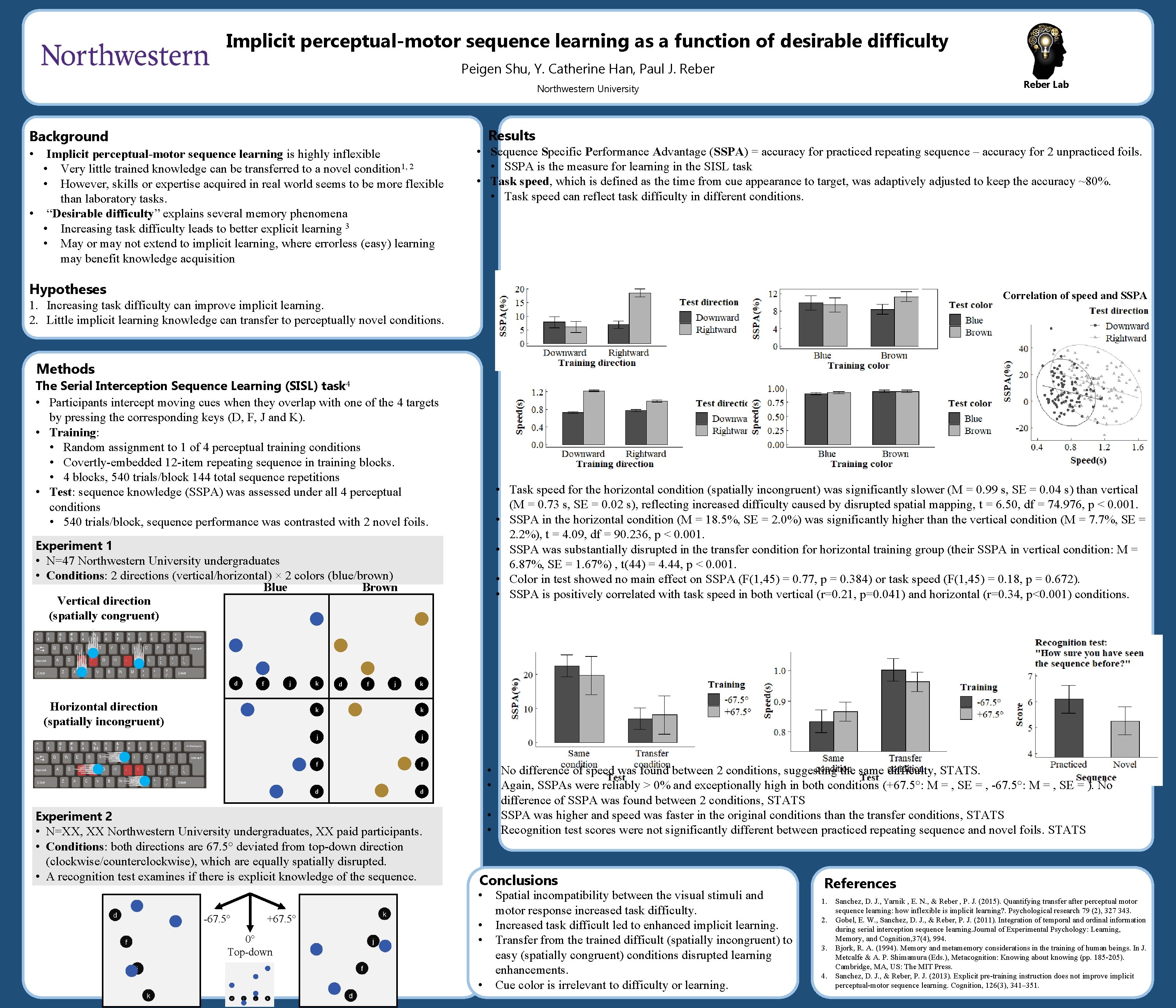
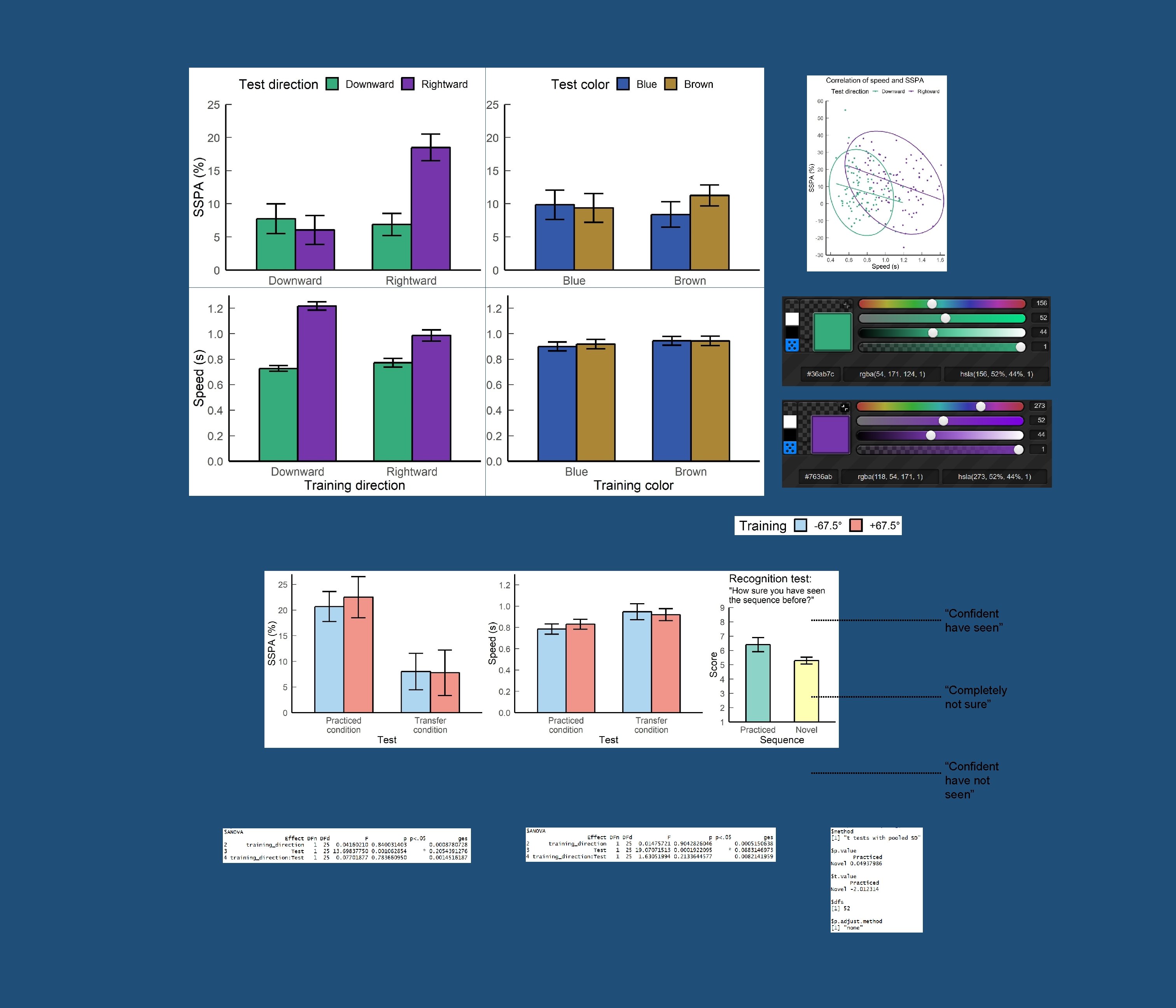
Implicit perceptual-motor sequence learning as a function of desirable difficulty Peigen Shu, Y. Catherine Han, Paul J. Reber Lab Northwestern University Results Background • Implicit perceptual-motor sequence learning is highly inflexible • Very little trained knowledge can be transferred to a novel condition 1, 2 • However, skills or expertise acquired in real world seems to be more flexible than laboratory tasks. • “Desirable difficulty” explains several memory phenomena • Increasing task difficulty leads to better explicit learning 3 • May or may not extend to implicit learning, where errorless (easy) learning may benefit knowledge acquisition • Sequence Specific Performance Advantage (SSPA) = accuracy for practiced repeating sequence – accuracy for 2 unpracticed foils. • SSPA is the measure for learning in the SISL task • Task speed, which is defined as the time from cue appearance to target, was adaptively adjusted to keep the accuracy ~80%. • Task speed can reflect task difficulty in different conditions. Hypotheses Correlation of speed and SSPA 1. Increasing task difficulty can improve implicit learning. 2. Little implicit learning knowledge can transfer to perceptually novel conditions. Methods The Serial Interception Sequence Learning (SISL) task 4 • Participants intercept moving cues when they overlap with one of the 4 targets by pressing the corresponding keys (D, F, J and K). • Training: • Random assignment to 1 of 4 perceptual training conditions • Covertly-embedded 12 -item repeating sequence in training blocks. • 4 blocks, 540 trials/block 144 total sequence repetitions • Test: sequence knowledge (SSPA) was assessed under all 4 perceptual conditions • 540 trials/block, sequence performance was contrasted with 2 novel foils. • Task speed for the horizontal condition (spatially incongruent) was significantly slower (M = 0. 99 s, SE = 0. 04 s) than vertical (M = 0. 73 s, SE = 0. 02 s), reflecting increased difficulty caused by disrupted spatial mapping, t = 6. 50, df = 74. 976, p < 0. 001. • SSPA in the horizontal condition (M = 18. 5%, SE = 2. 0%) was significantly higher than the vertical condition (M = 7. 7%, SE = 2. 2%), t = 4. 09, df = 90. 236, p < 0. 001. • SSPA was substantially disrupted in the transfer condition for horizontal training group (their SSPA in vertical condition: M = 6. 87%, SE = 1. 67%) , t(44) = 4. 44, p < 0. 001. • Color in test showed no main effect on SSPA (F(1, 45) = 0. 77, p = 0. 384) or task speed (F(1, 45) = 0. 18, p = 0. 672). • SSPA is positively correlated with task speed in both vertical (r=0. 21, p=0. 041) and horizontal (r=0. 34, p<0. 001) conditions. Experiment 1 • N=47 Northwestern University undergraduates • Conditions: 2 directions (vertical/horizontal) × 2 colors (blue/brown) Blue Brown Vertical direction (spatially congruent) d j f Horizontal direction (spatially incongruent) k d f j k k k j j f f d d Experiment 2 • N=XX, XX Northwestern University undergraduates, XX paid participants. • Conditions: both directions are 67. 5° deviated from top-down direction (clockwise/counterclockwise), which are equally spatially disrupted. • A recognition test examines if there is explicit knowledge of the sequence. Conclusions • No difference of speed was found between 2 conditions, suggesting the same difficulty, STATS. • Again, SSPAs were reliably > 0% and exceptionally high in both conditions (+67. 5°: M = , SE = , -67. 5°: M = , SE = ). No difference of SSPA was found between 2 conditions, STATS • SSPA was higher and speed was faster in the original conditions than the transfer conditions, STATS • Recognition test scores were not significantly different between practiced repeating sequence and novel foils. STATS Conclusions • -67. 5° +67. 5° 0° Top-down References • • • Spatial incompatibility between the visual stimuli and motor response increased task difficulty. Increased task difficult led to enhanced implicit learning. Transfer from the trained difficult (spatially incongruent) to easy (spatially congruent) conditions disrupted learning enhancements. Cue color is irrelevant to difficulty or learning. References 1. 2. 3. 4. Sanchez, D. J. , Yarnik , E. N. , & Reber , P. J. (2015). Quantifying transfer after perceptual motor sequence learning: how inflexible is implicit learning? . Psychological research 79 (2), 327 343. Gobel, E. W. , Sanchez, D. J. , & Reber, P. J. (2011). Integration of temporal and ordinal information during serial interception sequence learning. Journal of Experimental Psychology: Learning, Memory, and Cognition, 37(4), 994. Bjork, R. A. (1994). Memory and metamemory considerations in the training of human beings. In J. Metcalfe & A. P. Shimamura (Eds. ), Metacognition: Knowing about knowing (pp. 185 -205). Cambridge, MA, US: The MIT Press. Sanchez, D. J. , & Reber, P. J. (2013). Explicit pre-training instruction does not improve implicit perceptual-motor sequence learning. Cognition, 126(3), 341– 351.
“Confident have seen” “Completely not sure” “Confident have not seen”