
Implicit perceptualmotor sequence learning as a function of
- Slides: 1
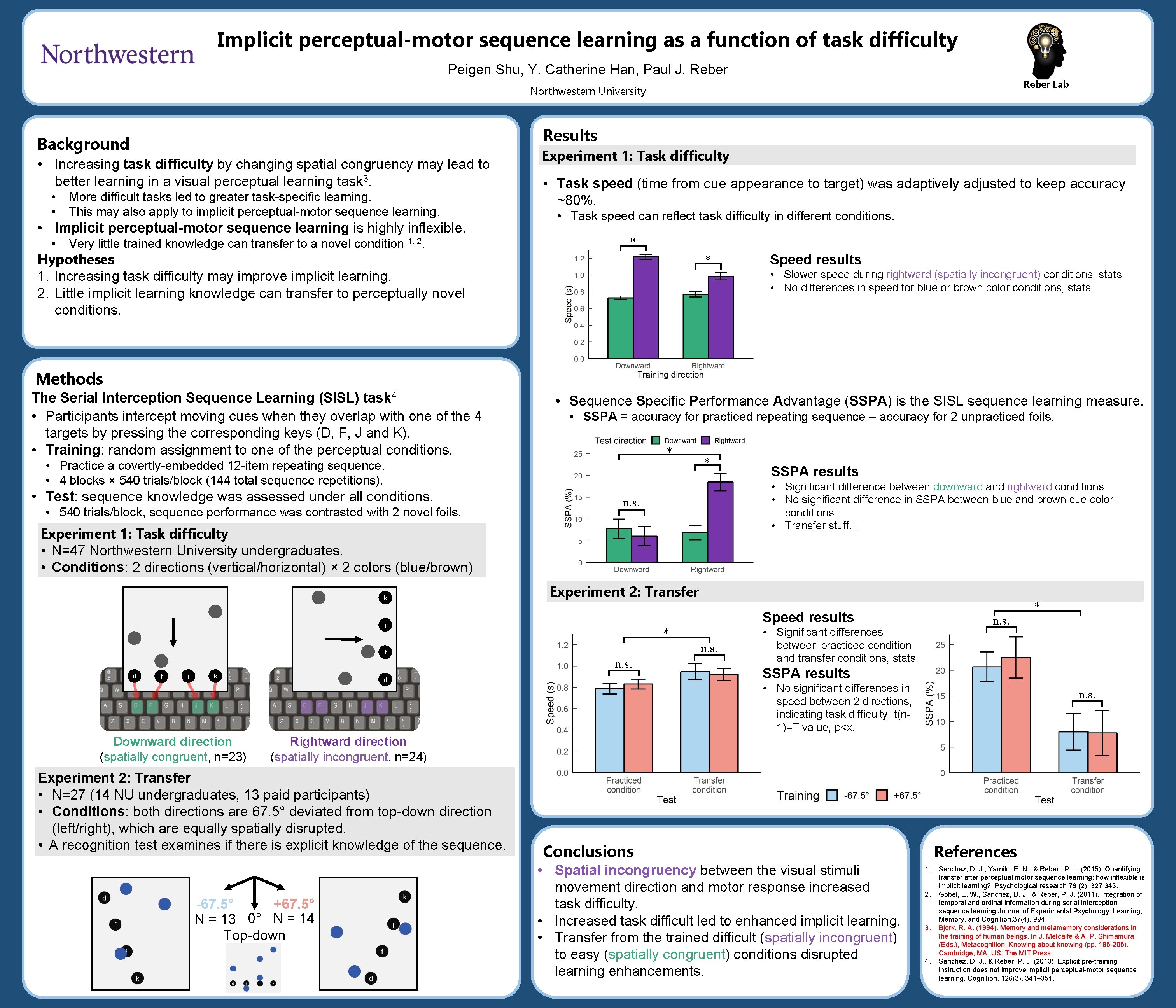
Implicit perceptual-motor sequence learning as a function of task difficulty Peigen Shu, Y. Catherine Han, Paul J. Reber Lab Northwestern University Results Background • Increasing task difficulty by changing spatial congruency may lead to better learning in a visual perceptual learning task 3. • • More difficult tasks led to greater task-specific learning. This may also apply to implicit perceptual-motor sequence learning. • Implicit perceptual-motor sequence learning is highly inflexible. • Very little trained knowledge can transfer to a novel condition 1, 2. Experiment 1: Task difficulty • Task speed (time from cue appearance to target) was adaptively adjusted to keep accuracy ~80%. • Task speed can reflect task difficulty in different conditions. * Hypotheses 1. Increasing task difficulty may improve implicit learning. 2. Little implicit learning knowledge can transfer to perceptually novel conditions. * Speed results • Slower speed during rightward (spatially incongruent) conditions, stats • No differences in speed for blue or brown color conditions, stats Methods The Serial Interception Sequence Learning (SISL) task 4 • Participants intercept moving cues when they overlap with one of the 4 targets by pressing the corresponding keys (D, F, J and K). • Training: random assignment to one of the perceptual conditions. • Sequence Specific Performance Advantage (SSPA) is the SISL sequence learning measure. • SSPA = accuracy for practiced repeating sequence – accuracy for 2 unpracticed foils. * • Practice a covertly-embedded 12 -item repeating sequence. • 4 blocks × 540 trials/block (144 total sequence repetitions). • Test: sequence knowledge was assessed under all conditions. • 540 trials/block, sequence performance was contrasted with 2 novel foils. * • Significant difference between downward and rightward conditions • No significant difference in SSPA between blue and brown cue color conditions • Transfer stuff… n. s. Experiment 1: Task difficulty • N=47 Northwestern University undergraduates. • Conditions: 2 directions (vertical/horizontal) × 2 colors (blue/brown) k Experiment 2: Transfer * n. s. f n. s. f j k Downward direction (spatially congruent, n=23) * Speed results j d SSPA results d n. s. • Significant differences between practiced condition and transfer conditions, stats SSPA results • No significant differences in speed between 2 directions, indicating task difficulty, t(n 1)=T value, p<x. n. s. Rightward direction (spatially incongruent, n=24) Experiment 2: Transfer • N=27 (14 NU undergraduates, 13 paid participants) • Conditions: both directions are 67. 5° deviated from top-down direction (left/right), which are equally spatially disrupted. • A recognition test examines if there is explicit knowledge of the sequence. -67. 5° +67. 5° N = 13 0° N = 14 Top-down Conclusions • Spatial incongruency between the visual stimuli movement direction and motor response increased task difficulty. • Increased task difficult led to enhanced implicit learning. • Transfer from the trained difficult (spatially incongruent) to easy (spatially congruent) conditions disrupted learning enhancements. References 1. 2. 3. 4. Sanchez, D. J. , Yarnik , E. N. , & Reber , P. J. (2015). Quantifying transfer after perceptual motor sequence learning: how inflexible is implicit learning? . Psychological research 79 (2), 327 343. Gobel, E. W. , Sanchez, D. J. , & Reber, P. J. (2011). Integration of temporal and ordinal information during serial interception sequence learning. Journal of Experimental Psychology: Learning, Memory, and Cognition, 37(4), 994. Bjork, R. A. (1994). Memory and metamemory considerations in the training of human beings. In J. Metcalfe & A. P. Shimamura (Eds. ), Metacognition: Knowing about knowing (pp. 185 -205). Cambridge, MA, US: The MIT Press. Sanchez, D. J. , & Reber, P. J. (2013). Explicit pre-training instruction does not improve implicit perceptual-motor sequence learning. Cognition, 126(3), 341– 351.