
Implicatures in law Intention in legal documents The
- Slides: 70
Implicatures in law
Intention in legal documents The interpretation of any legal document requires analysis of a relevant intention which has been incorporated into the text The notion of intentionality relates to the problem of implicitness and explicitness in language Grice’s conversational implicatures (1975)
Grice’s Cooperative Principle and conversational maxims This model helps us to understand how communication works and how people use language to communicate sth other than what the words literally mean There is a difference between the meaning (the words spoken and the message (how they are understood) This difference can be accounted for in terms of ‘implicature’ Legal examples rely on the same communicative conventions
Your friend Sally is talking about a mutual acquaintance, Bernard Activity ‘I’m not saying Bernard is a liar, but don’t you think it’s strange that he said he was there but no-one remembers seeing him? ’ Is Sally saying Bernard is a liar?
Grice’s conversational maxims Imagine you overhear the following conversation: A: Are John and Mary back together again? B: I saw a red Porche parked outside 1128 Green Street last night…and it was still there this morning!
In the exchange above, we might assume that B’s response is providing A with the information requested. Grice’s conversational maximes We can make the connection between the question and the answer by relying on presupposition: B presupposes that A also knows the following: John has a red Porche Mary lives at 1128 Green Street
Activity Consider the following question and answer sequence: Police officer: Did you take part in the robbery? Suspect: I wasn’t even near the bank on John Street.
If the topic had already been introduced by the police, it is ‘given’ and so of no consequence Cont. If it is ‘new’ the police officer would probably ask some follow-up questions The suspect also indicates that there is a bank on John Street; he does not put the fact in exactly that way; rather, sth like ‘there is a bank on John Street’ is embedded in his utterance - presupposition
Example Police officer: Can you step out of the car? Driver: Yes (but driver does not move)
An indirect speech act: request, not a question Comment There is a difference between the (literal) meaning of an utterance and its message Grice’s Co-operative Principle and maxims help explain how people arrive at the message
Grice’s Cooperative Principle In order to help us understand how context works in deciphering meaning in a given situation, we can look to Grice’s Cooperative Principle, which explains how people act in conversation: ‘Make your conversational contribution such as is required, at the stage at which it occurs, by the accepted purpose or direction of the talk exchange in which you are engaged’
Grice’s conversational maxims Grice is not telling us what to do, but rather providing an explanation for how we behave in communicative situations ad how we assume other people behave
Grice’s conversational maximes Grice further divided his Cooperative Principle into sub-principles of: Quantity Relevance Quality Manner
Grice’s Conversational Maxims 1. Quantity: ‘Make your contribution as informative as is required’ and ‘do not make your contribution more informative than is required’ 2. Quality: ‘Do not say what you believe to be false’ and ‘Do not say that for which you lack adequate evidence’ 3. Manner: ‘Avoid obscurity of expression’, ‘Avoid ambiguity’, ‘Be brief’, ‘Be orderly’ 4. Relevance: ‘Be relevant’
Flouting a maxim Leads to implicature The implicature is generated to make the contribution meaningful A clash occurs when fulfilling one maxim would lead to the violation of another
Grice’s conversational maximes When we break any of the sub-principles, we create an instance of conversational implicature: A: I heard you did well on the exam B: Yes, and pigs fly. Flouting the maxim of quality, as I am telling an obvious untruth
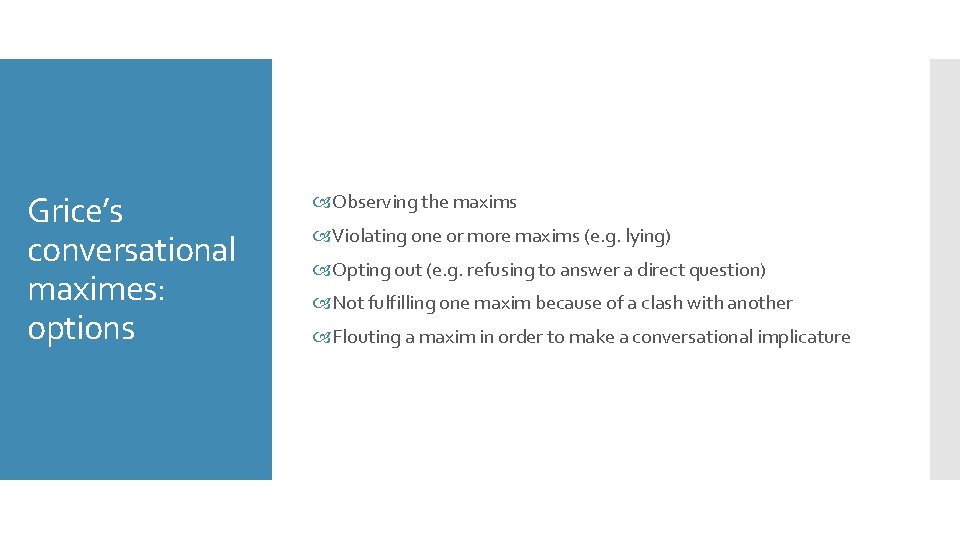
Grice’s conversational maximes: options Observing the maxims Violating one or more maxims (e. g. lying) Opting out (e. g. refusing to answer a direct question) Not fulfilling one maxim because of a clash with another Flouting a maxim in order to make a conversational implicature
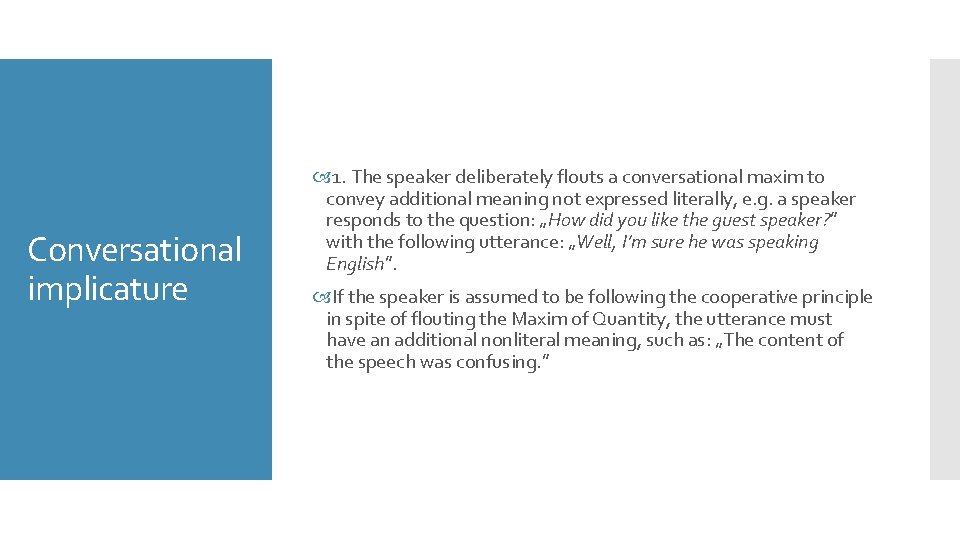
Conversational implicature 1. The speaker deliberately flouts a conversational maxim to convey additional meaning not expressed literally, e. g. a speaker responds to the question: „How did you like the guest speaker? ” with the following utterance: „Well, I’m sure he was speaking English”. If the speaker is assumed to be following the cooperative principle in spite of flouting the Maxim of Quantity, the utterance must have an additional nonliteral meaning, such as: „The content of the speech was confusing. ”
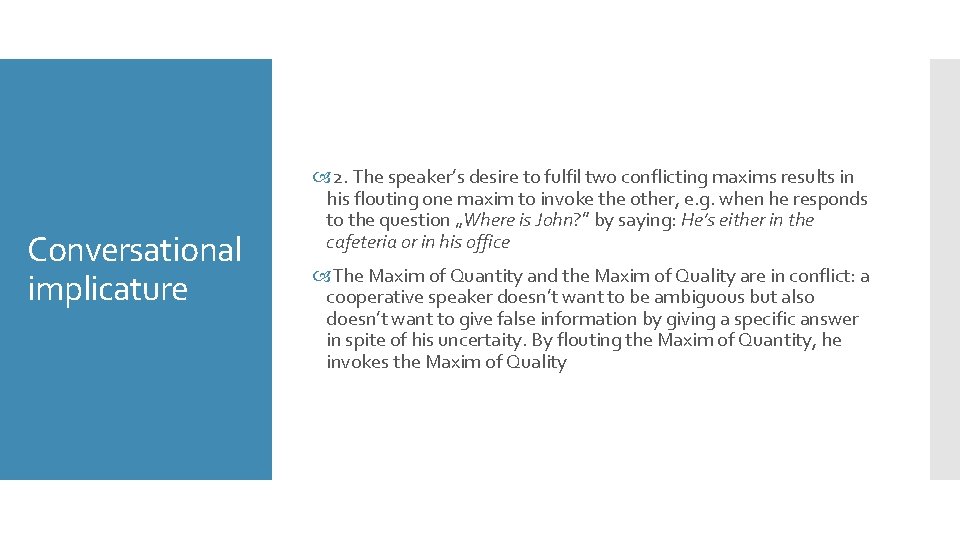
Conversational implicature 2. The speaker’s desire to fulfil two conflicting maxims results in his flouting one maxim to invoke the other, e. g. when he responds to the question „Where is John? ” by saying: He’s either in the cafeteria or in his office The Maxim of Quantity and the Maxim of Quality are in conflict: a cooperative speaker doesn’t want to be ambiguous but also doesn’t want to give false information by giving a specific answer in spite of his uncertaity. By flouting the Maxim of Quantity, he invokes the Maxim of Quality
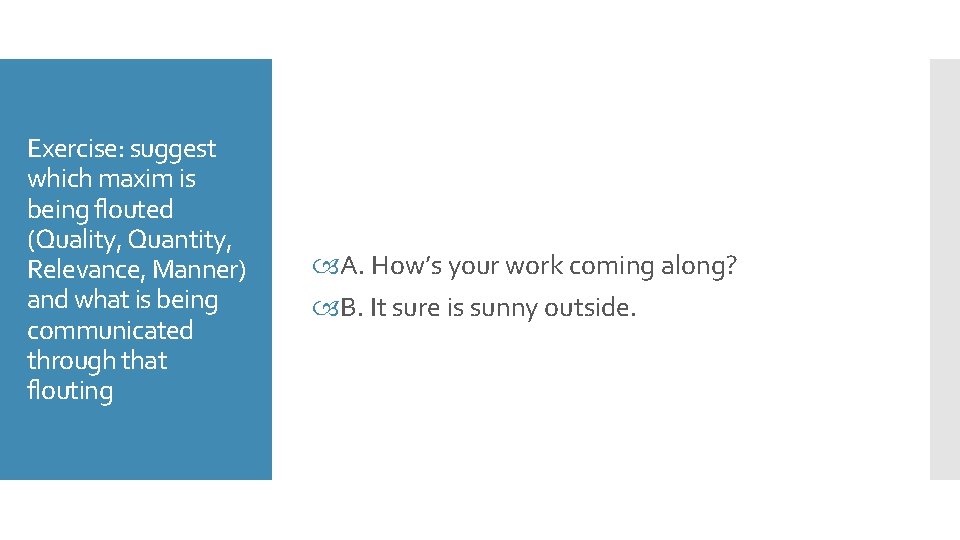
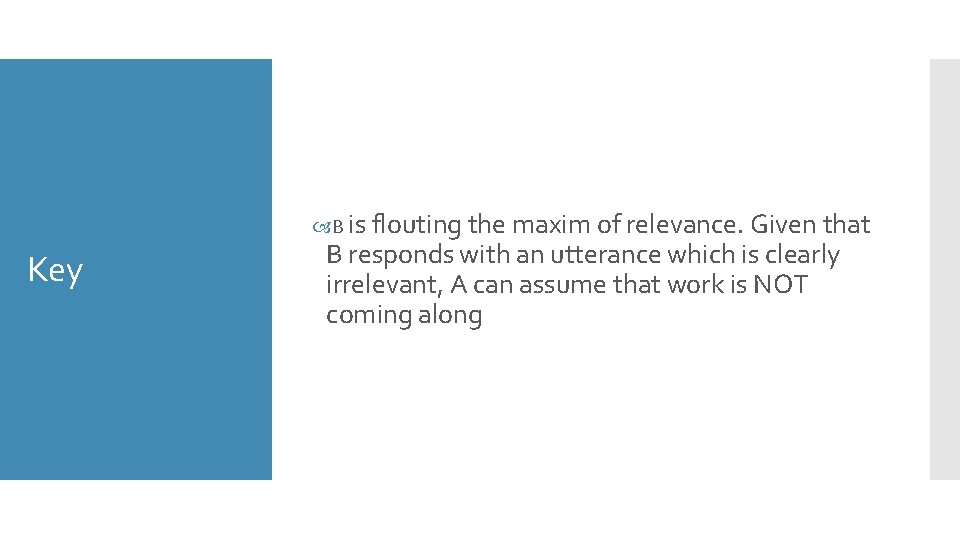
Exercise: suggest which maxim is being flouted (Quality, Quantity, Relevance, Manner) and what is being communicated through that flouting A. How’s your work coming along? B. It sure is sunny outside.
B is flouting the maxim of relevance. Given that Key B responds with an utterance which is clearly irrelevant, A can assume that work is NOT coming along
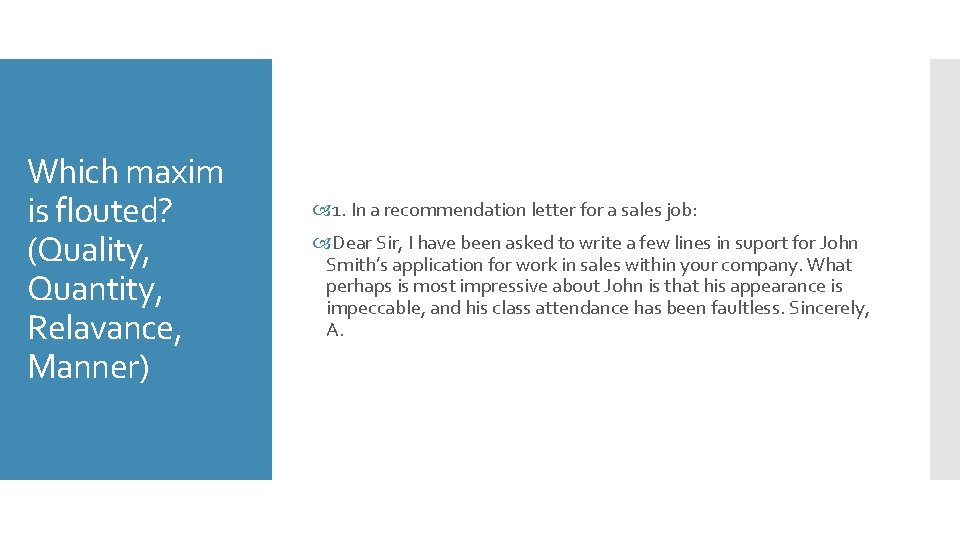
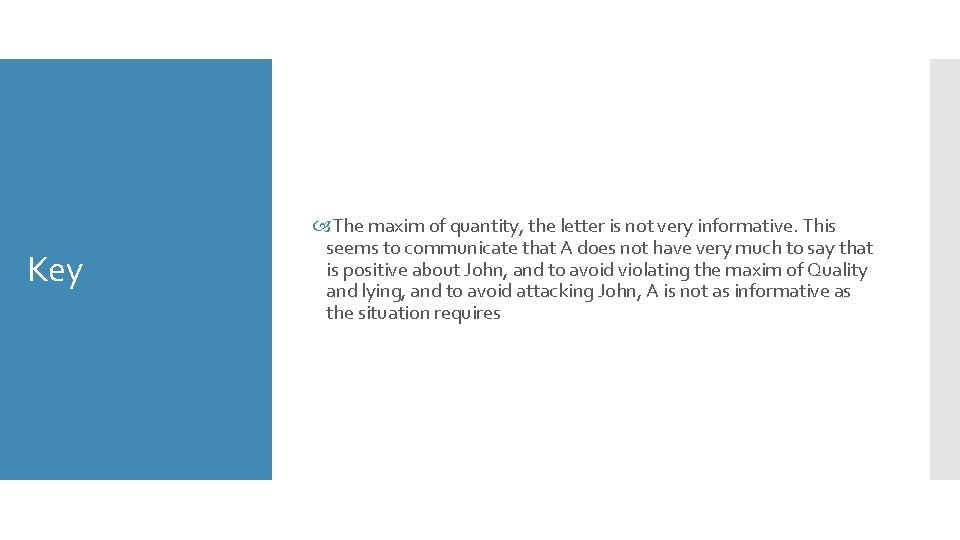
Which maxim is flouted? (Quality, Quantity, Relavance, Manner) 1. In a recommendation letter for a sales job: Dear Sir, I have been asked to write a few lines in suport for John Smith’s application for work in sales within your company. What perhaps is most impressive about John is that his appearance is impeccable, and his class attendance has been faultless. Sincerely, A.
Key The maxim of quantity, the letter is not very informative. This seems to communicate that A does not have very much to say that is positive about John, and to avoid violating the maxim of Quality and lying, and to avoid attacking John, A is not as informative as the situation requires
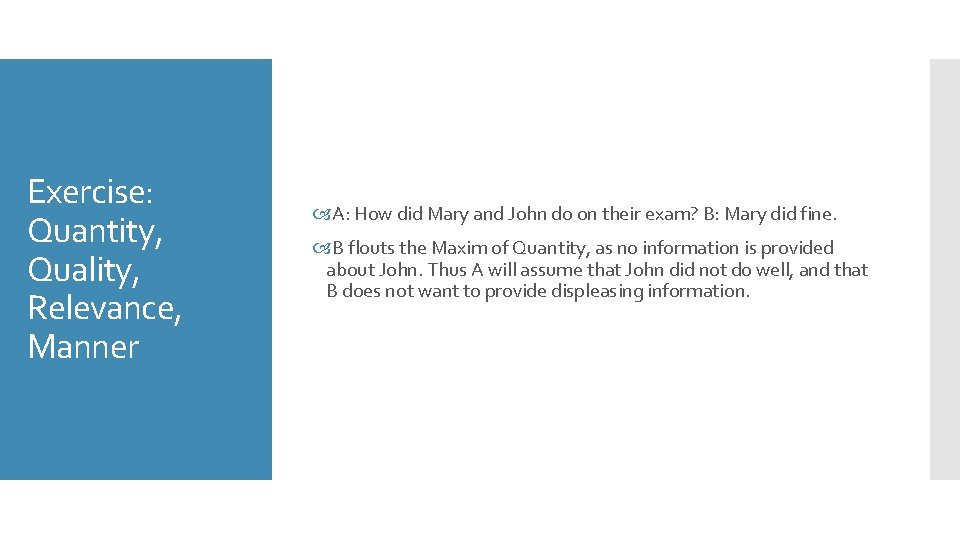
Exercise: Quantity, Quality, Relevance, Manner A: How did Mary and John do on their exam? B: Mary did fine. B flouts the Maxim of Quantity, as no information is provided about John. Thus A will assume that John did not do well, and that B does not want to provide displeasing information.
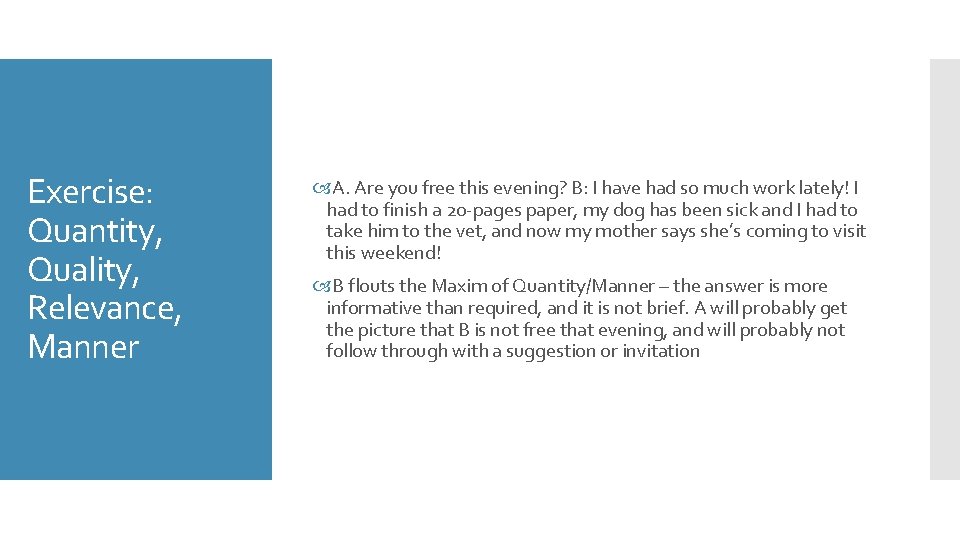
Exercise: Quantity, Quality, Relevance, Manner A. Are you free this evening? B: I have had so much work lately! I had to finish a 20 -pages paper, my dog has been sick and I had to take him to the vet, and now my mother says she’s coming to visit this weekend! B flouts the Maxim of Quantity/Manner – the answer is more informative than required, and it is not brief. A will probably get the picture that B is not free that evening, and will probably not follow through with a suggestion or invitation
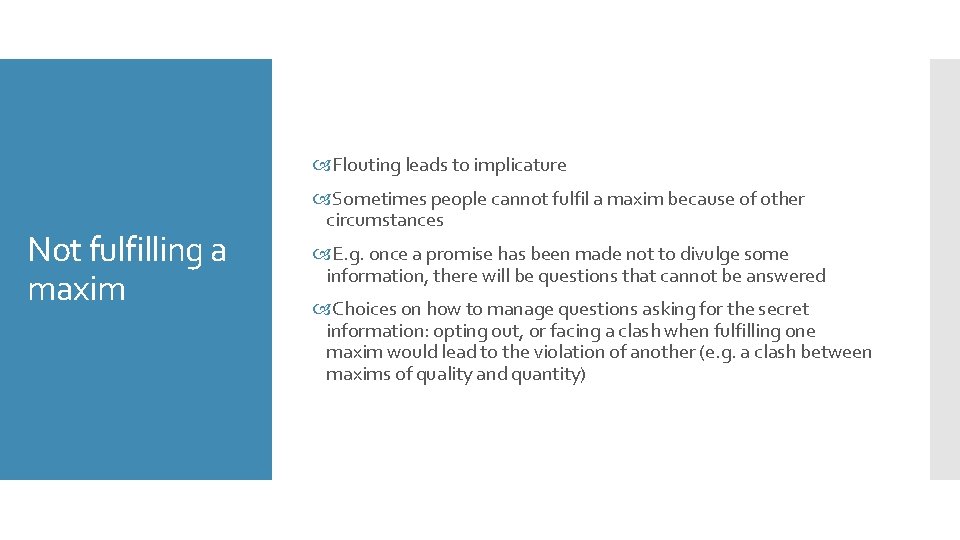
Flouting leads to implicature Not fulfilling a maxim Sometimes people cannot fulfil a maxim because of other circumstances E. g. once a promise has been made not to divulge some information, there will be questions that cannot be answered Choices on how to manage questions asking for the secret information: opting out, or facing a clash when fulfilling one maxim would lead to the violation of another (e. g. a clash between maxims of quality and quantity)
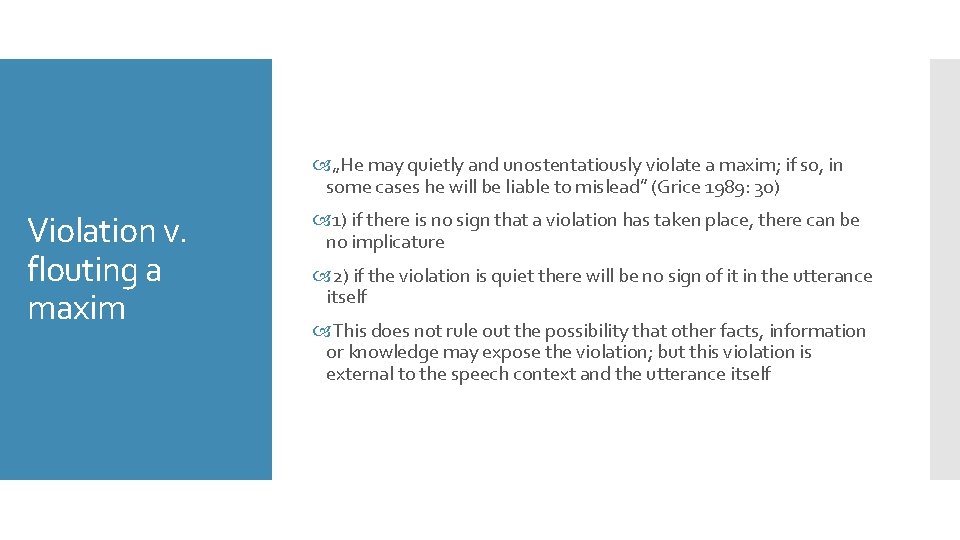
„He may quietly and unostentatiously violate a maxim; if so, in some cases he will be liable to mislead” (Grice 1989: 30) Violation v. flouting a maxim 1) if there is no sign that a violation has taken place, there can be no implicature 2) if the violation is quiet there will be no sign of it in the utterance itself This does not rule out the possibility that other facts, information or knowledge may expose the violation; but this violation is external to the speech context and the utterance itself
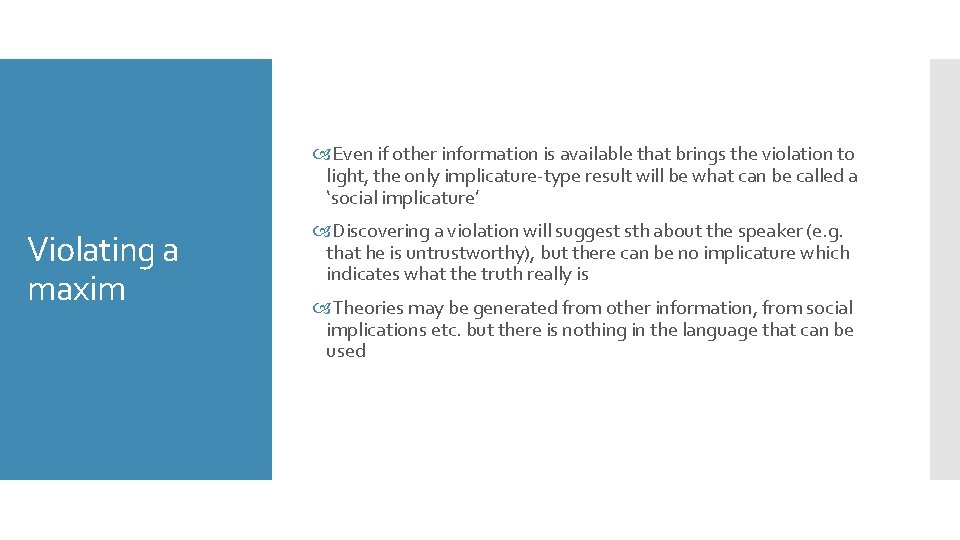
Even if other information is available that brings the violation to light, the only implicature-type result will be what can be called a ‘social implicature’ Violating a maxim Discovering a violation will suggest sth about the speaker (e. g. that he is untrustworthy), but there can be no implicature which indicates what the truth really is Theories may be generated from other information, from social implications etc. but there is nothing in the language that can be used
Presupposition - when a speaker’s choice of words shows that he is taking sth for granted E. g. : John stopped crying at noon – makes sense if it is assumed that John was crying just before noon.
an implicit assumption about the world or background belief relating to an utterance whose truth is taken for granted, e. g. : Jane no longer writes fiction. Presupposition: Jane once wrote fiction. Presupposition Have you stopped eating meat? Presupposition: you had once eaten meat. Have you talked to Hans? Presupposition: Hans exists.
Presupposition A presupposition must be mutually known or assumed by the speaker and addressee for the utterance to be considered appropriate in context.
Presuppositions are also hidden, but ‘hidden’ in plain sight Presupposition They are found by paying attention to what is said The working of presupposition – very straightforward
Co-Operative Principle in a legal context The Co-operative Principle and presupposition may work differently in a legal context because of the rules and conventions of speaking and interpretation which apply in many legal situations Legal conversations may be designed with another audience in mind (p. 64, 66/7)
Presupposition : example Mr Smith has never beaten his wife. Exactly how should he answer the following? Lawyer: Mr Smith, tell me, when did you stop beating your wife?
Presuppositions Potential to confuse witnesses and mislead hearers by inserting as given content something that is new or disputed Questions presupposing the presence of items or events (‘Did you see the broken glass? ” elicit different responses from those that did not make the presupposition („Did you see any broken glass? ”)
Presuppositions remain present even if the sentence is negated: Test for presupposition s ‘Mr Smith, tell me, when did you not stop beating your wife? ’ The question presupposes that Mr Smith has a wife. It would make no sense to say: ‘Mr Smith has stopped beating his wife and/but Mr Smith doesn’t have a wife’. Presuppositions – embedded in the utterance; absolutely unproblematic
Presupposition – implicature - inference While presupposition is embedded in the sentence, inference or implicature is sth that the speaker can assume the hearer will know or understand An implicature has to be generated by the hearer to ‘make sense’ of the utterance An inference is a conclusion the hearer may reasonably come to, but it is not logically entailed by an utterance, nor is it result of implicature An inference involves applying common sense, or shared knowledge, to an interaction
Non-fulfillment of maxims can happen in a number of ways Summary This may lead to implicature or social implicature The violation can be difficult to detect Presuppositions are embedded in an utterance Presuppositions remain true even if the utterance is negated
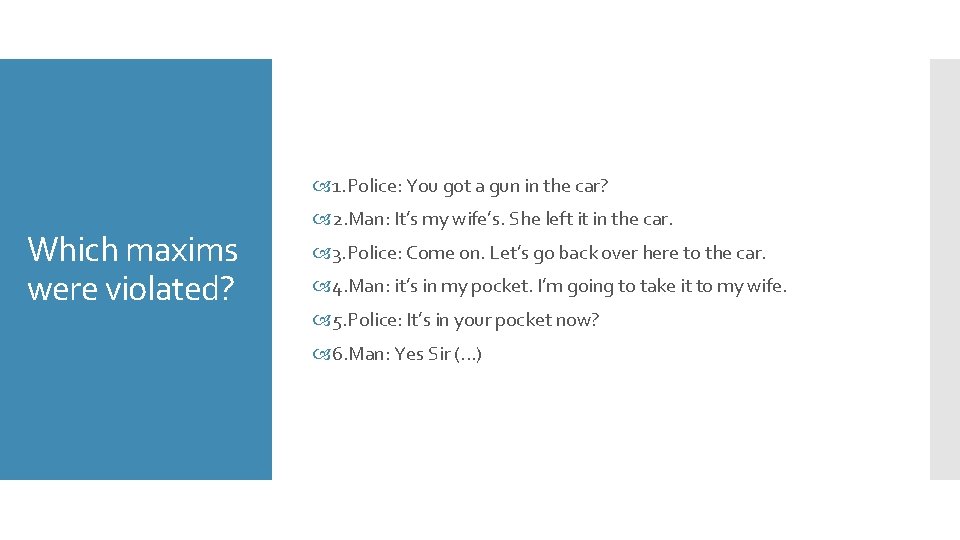
1. Police: You got a gun in the car? Which maxims were violated? 2. Man: It’s my wife’s. She left it in the car. 3. Police: Come on. Let’s go back over here to the car. 4. Man: it’s in my pocket. I’m going to take it to my wife. 5. Police: It’s in your pocket now? 6. Man: Yes Sir (. . . )
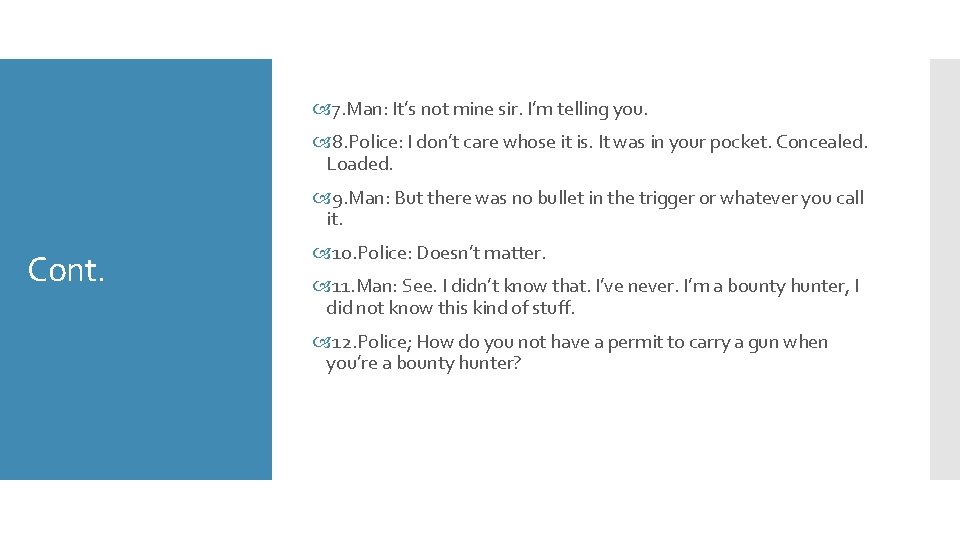
7. Man: It’s not mine sir. I’m telling you. 8. Police: I don’t care whose it is. It was in your pocket. Concealed. Loaded. 9. Man: But there was no bullet in the trigger or whatever you call it. Cont. 10. Police: Doesn’t matter. 11. Man: See. I didn’t know that. I’ve never. I’m a bounty hunter, I did not know this kind of stuff. 12. Police; How do you not have a permit to carry a gun when you’re a bounty hunter?
Flouting the maxim of quantity, relevance and quality Key It is expected that people co-operate with the police; this means that responses should not require the police to generate an implicature 8. ‘I don’t care…’ may indicate that the police officer has decided that the suspect has said enough; the law is indifferent to anything more The man’s continued talking gets him into more trouble
Activity: What kind of person is the interviewee? Is he a witness, a suspect or an expert of some kind? Point to as much evidence in the transcript as possible
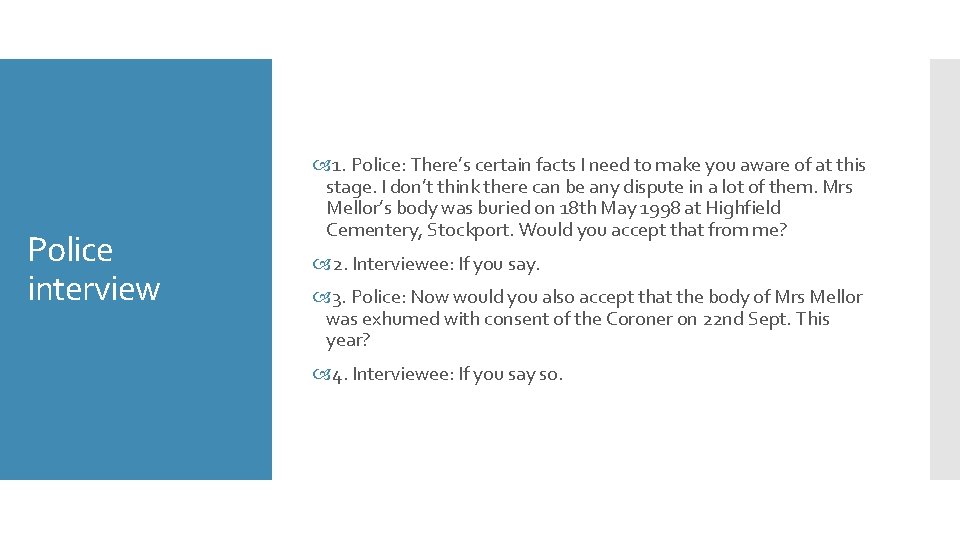
Police interview 1. Police: There’s certain facts I need to make you aware of at this stage. I don’t think there can be any dispute in a lot of them. Mrs Mellor’s body was buried on 18 th May 1998 at Highfield Cementery, Stockport. Would you accept that from me? 2. Interviewee: If you say. 3. Police: Now would you also accept that the body of Mrs Mellor was exhumed with consent of the Coroner on 22 nd Sept. This year? 4. Interviewee: If you say so.
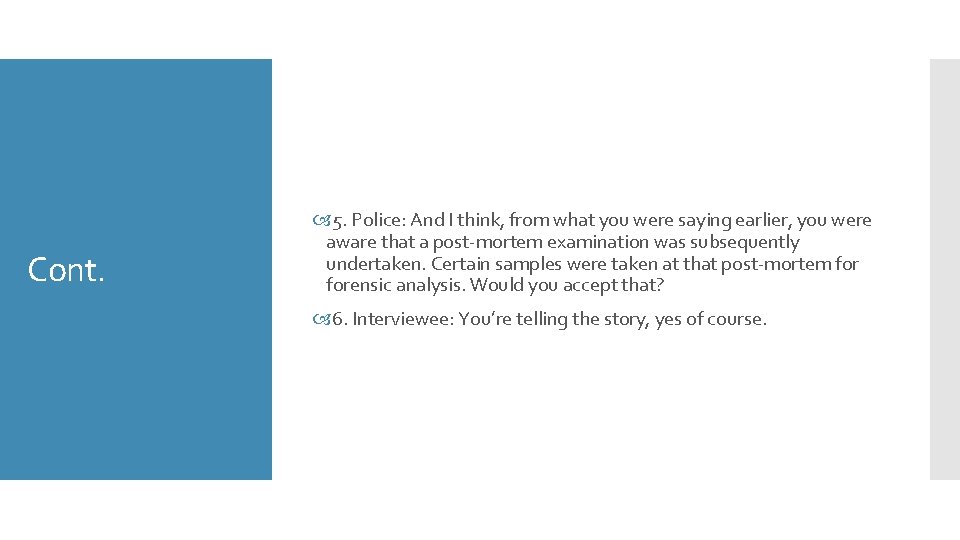
Cont. 5. Police: And I think, from what you were saying earlier, you were aware that a post-mortem examination was subsequently undertaken. Certain samples were taken at that post-mortem forensic analysis. Would you accept that? 6. Interviewee: You’re telling the story, yes of course.
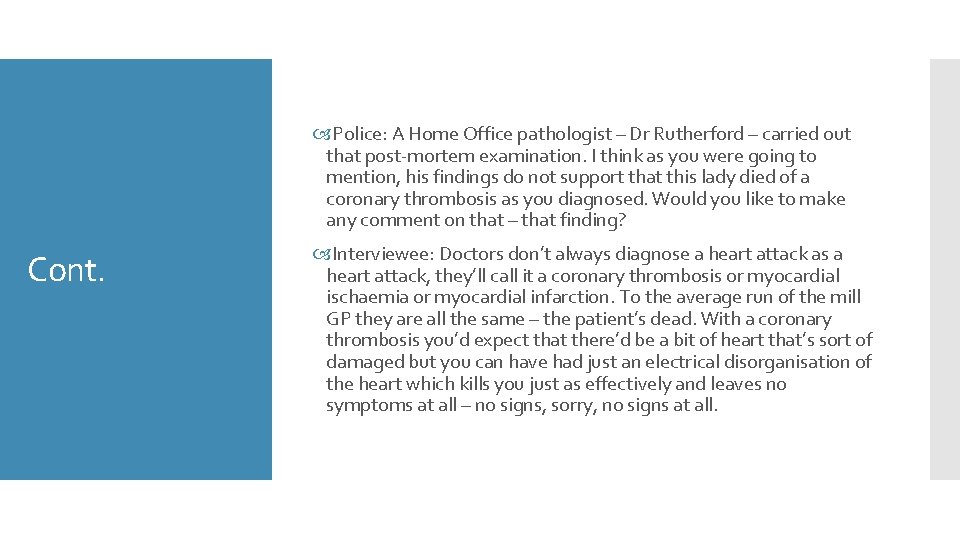
Police: A Home Office pathologist – Dr Rutherford – carried out that post-mortem examination. I think as you were going to mention, his findings do not support that this lady died of a coronary thrombosis as you diagnosed. Would you like to make any comment on that – that finding? Cont. Interviewee: Doctors don’t always diagnose a heart attack as a heart attack, they’ll call it a coronary thrombosis or myocardial ischaemia or myocardial infarction. To the average run of the mill GP they are all the same – the patient’s dead. With a coronary thrombosis you’d expect that there’d be a bit of heart that’s sort of damaged but you can have had just an electrical disorganisation of the heart which kills you just as effectively and leaves no symptoms at all – no signs, sorry, no signs at all.
Cont. 9. Police: Well, in his expert opinion there was nothing to support your diagnosis is what I’m saying. 10. Interviewee: And he couldn’t rule out a disorganised electrical activity in the heart.
Cont. 11. Police: Forensic examination of the samples taken, including muscle tissue, at that post-mortem have been examined. These are the samples taken from Mrs Mellor. And there’s certainly a high level of morphine still contained in her body – a fatal level to be precise. Can you account for that? 12. Interviewee: No.
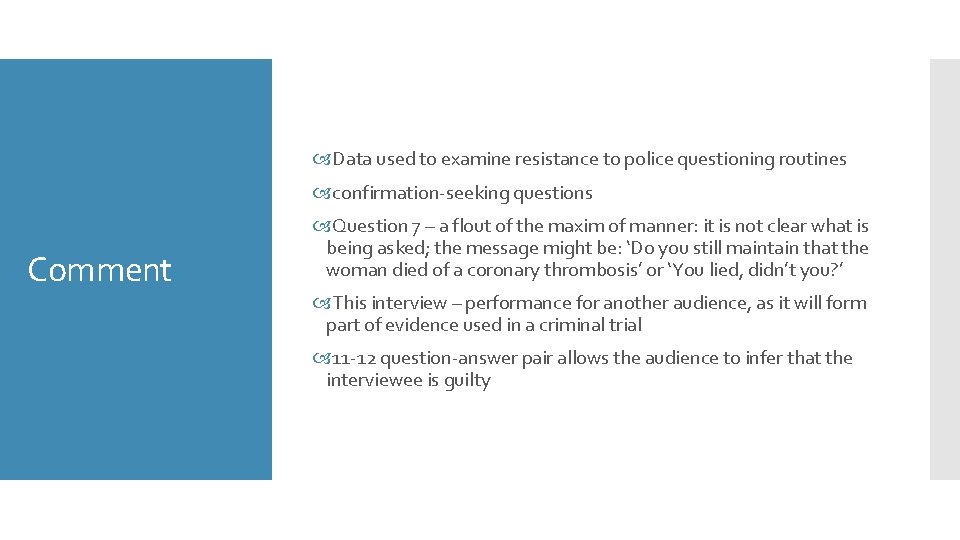
Data used to examine resistance to police questioning routines confirmation-seeking questions Comment Question 7 – a flout of the maxim of manner: it is not clear what is being asked; the message might be: ‘Do you still maintain that the woman died of a coronary thrombosis’ or ‘You lied, didn’t you? ’ This interview – performance for another audience, as it will form part of evidence used in a criminal trial 11 -12 question-answer pair allows the audience to infer that the interviewee is guilty
Explanation This is an extract from police interviews with Harold Shipman, a GP found guilty of causing the death of a number of elderly patients under his care Responses – evasive, clever and deceptive If he were innocent, how might he have answered these questions differently?
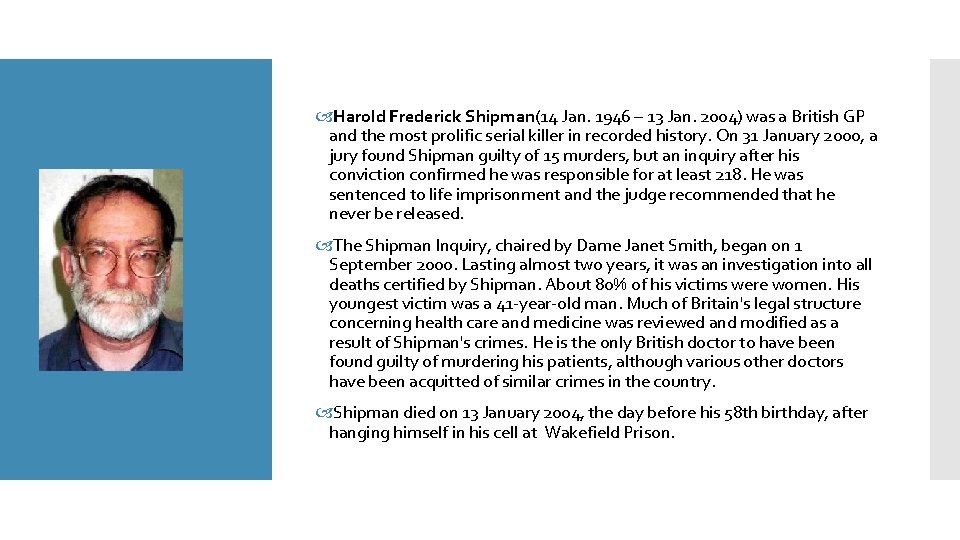
Harold Frederick Shipman(14 Jan. 1946 – 13 Jan. 2004) was a British GP and the most prolific serial killer in recorded history. On 31 January 2000, a jury found Shipman guilty of 15 murders, but an inquiry after his conviction confirmed he was responsible for at least 218. He was sentenced to life imprisonment and the judge recommended that he never be released. The Shipman Inquiry, chaired by Dame Janet Smith, began on 1 September 2000. Lasting almost two years, it was an investigation into all deaths certified by Shipman. About 80% of his victims were women. His youngest victim was a 41 -year-old man. Much of Britain's legal structure concerning health care and medicine was reviewed and modified as a result of Shipman's crimes. He is the only British doctor to have been found guilty of murdering his patients, although various other doctors have been acquitted of similar crimes in the country. Shipman died on 13 January 2004, the day before his 58 th birthday, after hanging himself in his cell at Wakefield Prison.
The Co-operative Principle and presupposition can work differently in a legal context Summary They work differently because of the rules and conventions of speaking and interpretation which apply in many legal situations Legal conversations may be designed with another audience in mind
Is silence golden? A distinction can be made between silence that does not communicate anything and that which does (‘communicative silence’)
What is the meaning of silence in the following examples? Lawyer: Were you at the garage on the evening of 26 th of May 2012? Witness: -----
Context – important in the interpretation of silence 1 st example – formal setting It is not clear what the witness is doing Comment The silent response suggests a violation, but in this context, it is not really ‘unostentatious’ The witness is probably faced with a clash: to fulfil the maxim of quantity would mean violating the maxim of quality It is not clear what the implicature would be Witness has sth to hide – inference, or social implicature
What is the meaning of silence in the following examples? Sally: What time did you say we should be at the party? George: _______
Comment (2) George may be annoyed with Sally and be giving her ‘the silent treatment’, he may not have heard the question, etc. There is no single convention that would tell us what George’s silence means It is not clear whether his silence is communicative
Silence in a legal context What silence means in a legal context is often stipulated by the law itself
Compare two versions of the caution in the UK ‘You do not have to say anything unless you wish to do so, but what you say may be given in evidence’ (before 1994) ‘You do not have to say anything, but it may harm your defence if you do not mention when questioned something which you later rely on in court. Anything you do say may be given in evidence’.
‘but it may harm your defence if you do not mention when questioned something which you later rely on in court’. Comment This presupposes that the detainee has a defence, in the sense that he will have to defend himself in court Entailment: there will be a trial It is very difficult for the detainee to know what kinds of information and evidence may be needed for this defence
Comment The legislation stipulates that silence (‘failure to mention’ can be used by the court to ‘draw such inferences from the failure as appear proper’ (Criminal Justice and Public Order Act 1994, s. 34) Even though the law stipulates how silence can be understood, it is not clear to whom the inferences have to ‘appear proper’, nor exactly what ‘proper’ means
Miranda warning ‘You have the right to remain silent. Anything you say can and will be used against you in a court of law. You have the right to speak to an attorney present during any questioning. If you cannot afford a lawyer, one will be provided for you at government expense’
The right to silence and a right against self-incrimination are enshrined in the Fifth Amendment to the US Constitution
Comment If the detainee says sth, does this constitute a waiver of the right to silence? If the detainee does not speak, do the officers cease asking questions? (Research shows that they do not)
The police asks questions to get information Comment It is not a good idea to flout the maxim of quantity or relevance when speaking with the police If an appropriate question is not asked, it may be impossible to ‘mention’ crucial information
The following utterances have all been said by a person in the US who has been read their Miranda rights Activity What message is communicated in each instance? Bear 2 things in mind: 1) the other rights that are included in the Miranda warning; 2) the conversational context, especially the power difference between police and detainee.
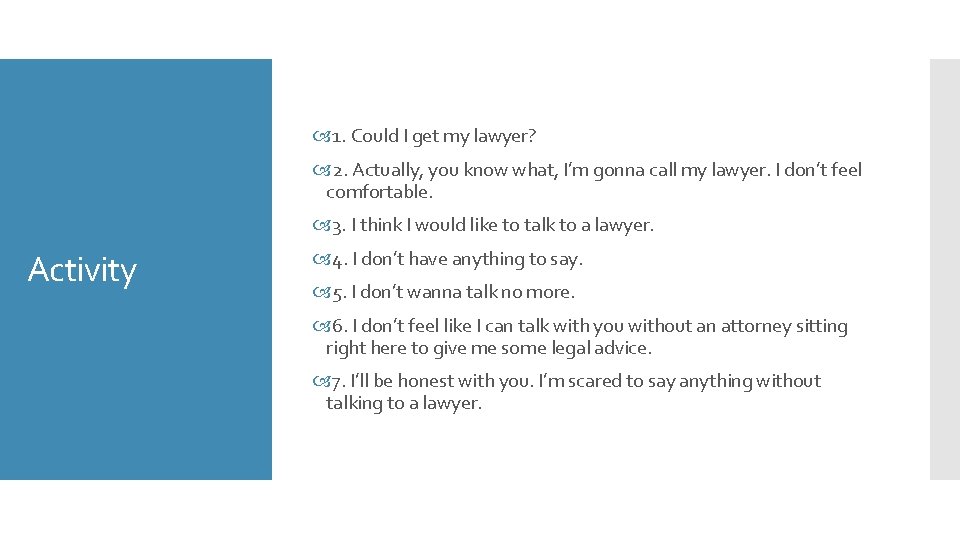
1. Could I get my lawyer? 2. Actually, you know what, I’m gonna call my lawyer. I don’t feel comfortable. 3. I think I would like to talk to a lawyer. Activity 4. I don’t have anything to say. 5. I don’t wanna talk no more. 6. I don’t feel like I can talk with you without an attorney sitting right here to give me some legal advice. 7. I’ll be honest with you. I’m scared to say anything without talking to a lawyer.
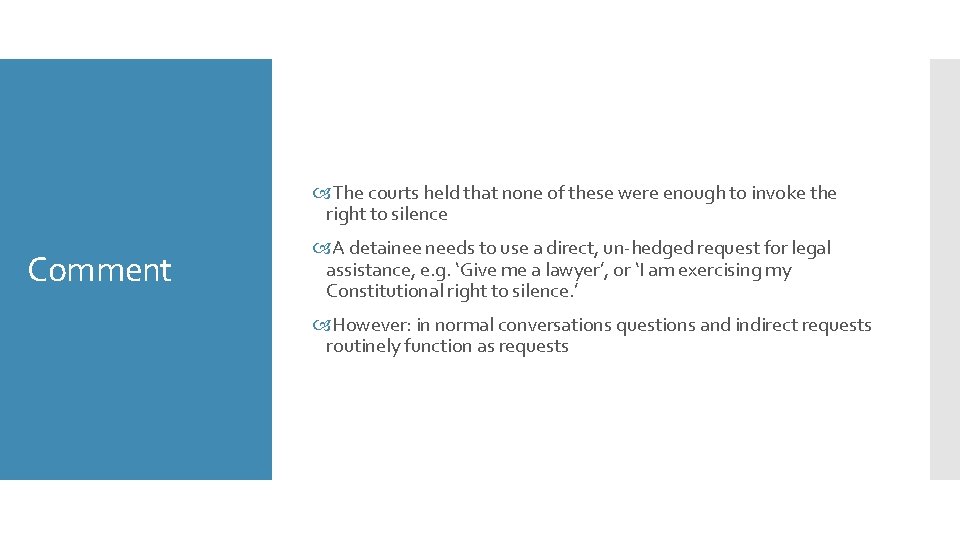
The courts held that none of these were enough to invoke the right to silence Comment A detainee needs to use a direct, un-hedged request for legal assistance, e. g. ‘Give me a lawyer’, or ‘I am exercising my Constitutional right to silence. ’ However: in normal conversations questions and indirect requests routinely function as requests
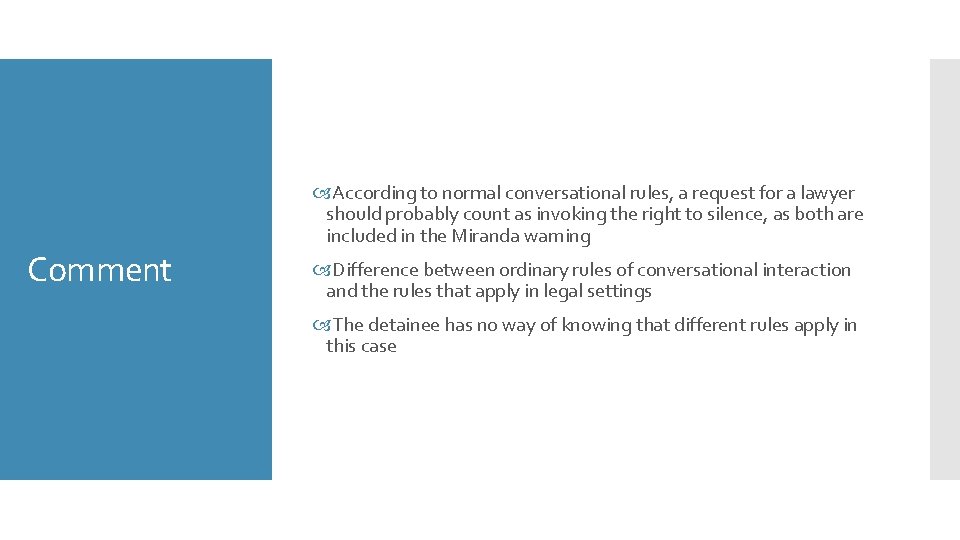
Comment According to normal conversational rules, a request for a lawyer should probably count as invoking the right to silence, as both are included in the Miranda warning Difference between ordinary rules of conversational interaction and the rules that apply in legal settings The detainee has no way of knowing that different rules apply in this case
Comment These ideas suggest that communication is very straightforward Control of language
Summary Maxims operate in police and legal encounters according to the conventions of those contexts These conventions and rules operate even though they may be hidden