
Implicature I Definition The term Implicature accounts for
- Slides: 12
Implicature
I. Definition • The term “Implicature” accounts for what a speaker can imply, suggest or mean, as distinct from what the speaker literally says. (Grice, 1975)
II. Types of implicature 1. Conversational implicature: => derives from the cooperative principle of conversation and a number of maxims expected to be followed by participants in a speech event. Example: A: Would you prefer coffee or tea? B: I like coffee.
1. 1. The cooperative principle • Make your conversational contribution such as is required, at the stage at which it occurs, by the accepted purpose or direction of the talk exchange in which you are engaged (Yule, 1966) • In other words, the listener presumes that the speaker is being cooperative and is speaking truthfully, informatively, relevantly, exactly, and appropriately.
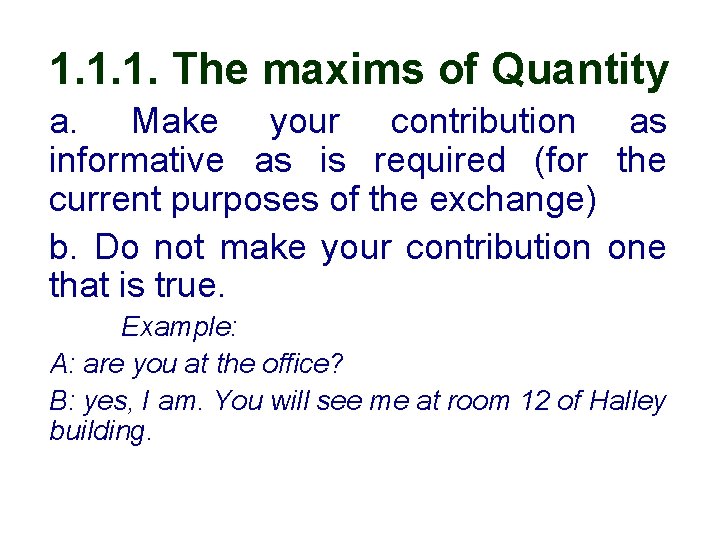
1. 1. 1. The maxims of Quantity a. Make your contribution as informative as is required (for the current purposes of the exchange) b. Do not make your contribution one that is true. Example: A: are you at the office? B: yes, I am. You will see me at room 12 of Halley building.
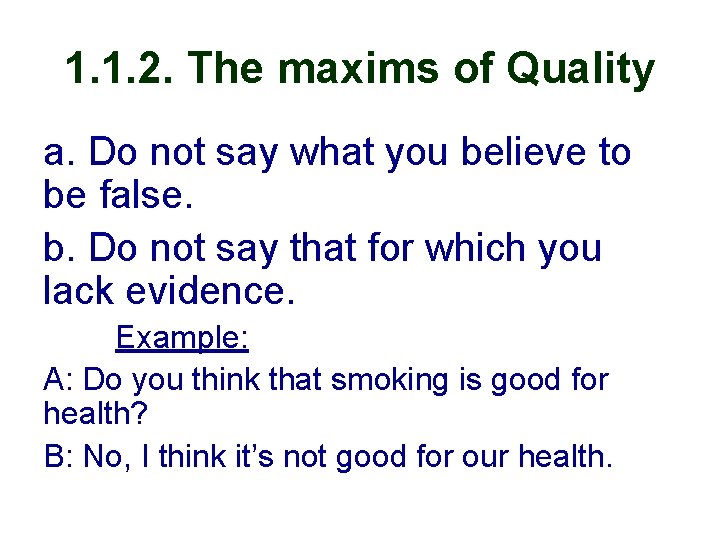
1. 1. 2. The maxims of Quality a. Do not say what you believe to be false. b. Do not say that for which you lack evidence. Example: A: Do you think that smoking is good for health? B: No, I think it’s not good for our health.
1. 1. 3. The maxim of Relation a. Be relevant example: A: why do you learn English? B; Yes, I learn it because of my hobby.
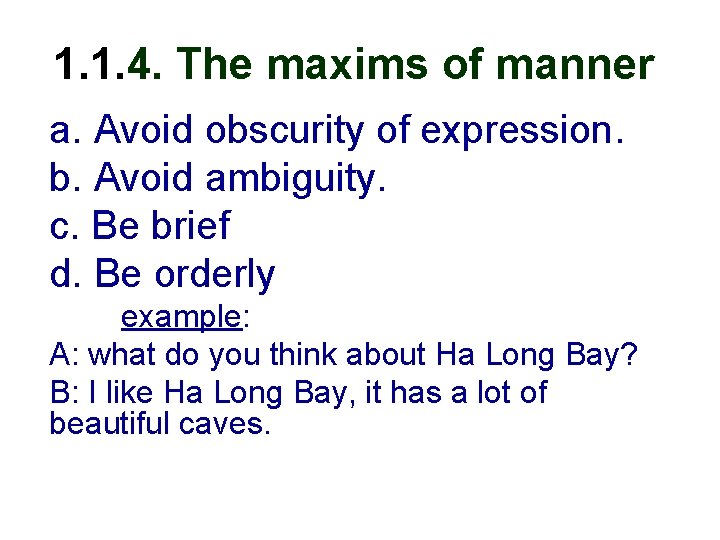
1. 1. 4. The maxims of manner a. Avoid obscurity of expression. b. Avoid ambiguity. c. Be brief d. Be orderly example: A: what do you think about Ha Long Bay? B: I like Ha Long Bay, it has a lot of beautiful caves.
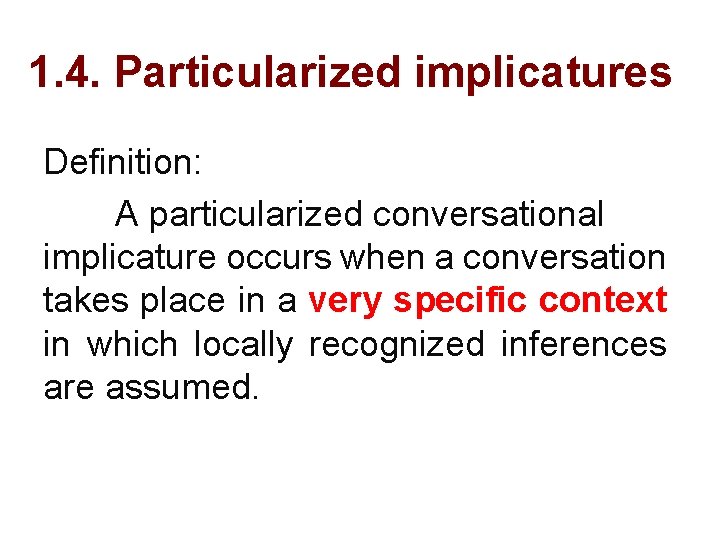
1. 4. Particularized implicatures Definition: A particularized conversational implicature occurs when a conversation takes place in a very specific context in which locally recognized inferences are assumed.
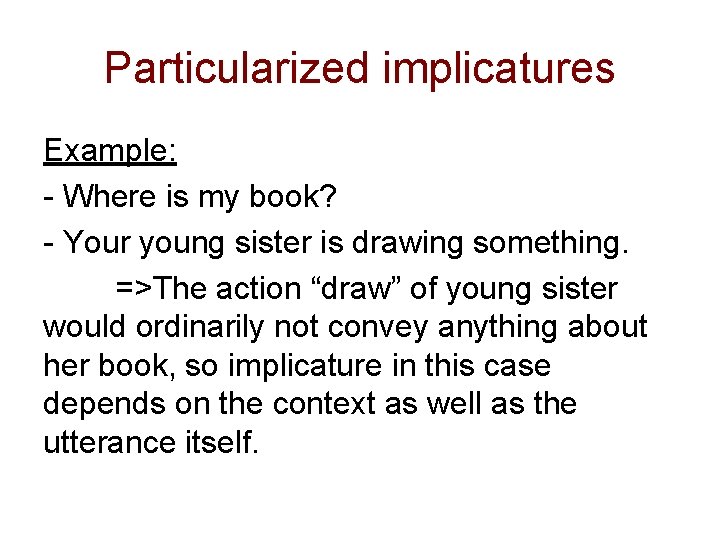
Particularized implicatures Example: - Where is my book? - Your young sister is drawing something. =>The action “draw” of young sister would ordinarily not convey anything about her book, so implicature in this case depends on the context as well as the utterance itself.
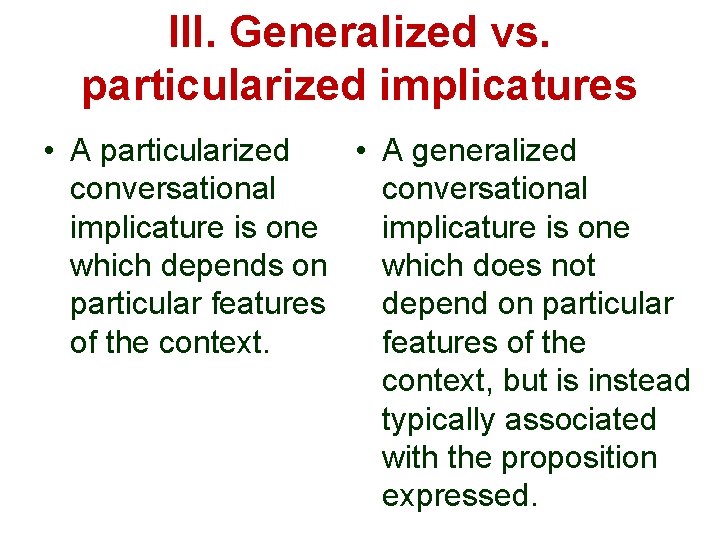
III. Generalized vs. particularized implicatures • A particularized • A generalized conversational implicature is one which depends on which does not particular features depend on particular of the context. features of the context, but is instead typically associated with the proposition expressed.
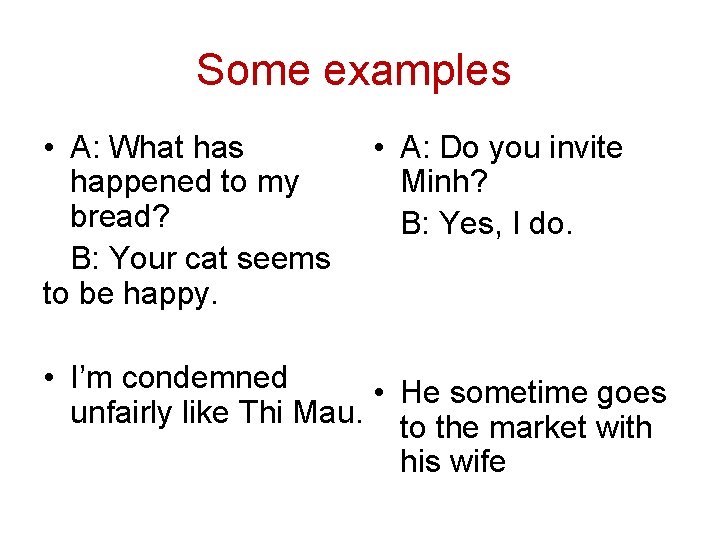
Some examples • A: What has happened to my bread? B: Your cat seems to be happy. • A: Do you invite Minh? B: Yes, I do. • I’m condemned • He sometime goes unfairly like Thi Mau. to the market with his wife