
Implications of Water Constraints on Electricity Capacity Expansion
- Slides: 1
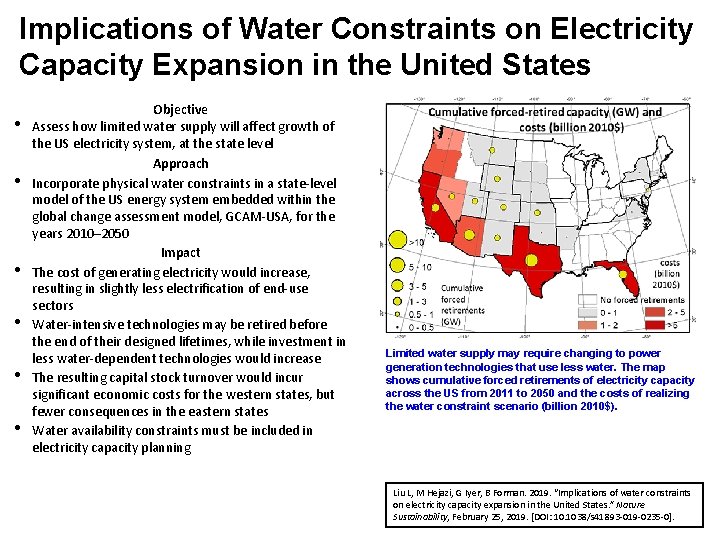
Implications of Water Constraints on Electricity Capacity Expansion in the United States • • • Objective Assess how limited water supply will affect growth of the US electricity system, at the state level Approach Incorporate physical water constraints in a state-level model of the US energy system embedded within the global change assessment model, GCAM-USA, for the years 2010– 2050 Impact The cost of generating electricity would increase, resulting in slightly less electrification of end-use sectors Water-intensive technologies may be retired before the end of their designed lifetimes, while investment in less water-dependent technologies would increase The resulting capital stock turnover would incur significant economic costs for the western states, but fewer consequences in the eastern states Water availability constraints must be included in electricity capacity planning Limited water supply may require changing to power generation technologies that use less water. The map shows cumulative forced retirements of electricity capacity across the US from 2011 to 2050 and the costs of realizing the water constraint scenario (billion 2010$). Liu L, M Hejazi, G Iyer, B Forman. 2019. “Implications of water constraints on electricity capacity expansion in the United States. ” Nature Sustainability, February 25, 2019. [DOI: 10. 1038/s 41893 -019 -0235 -0].