
Implementing THRIVE Phase 1 Developing a full understanding


![Establishing Priorities Based on our work mapping the pathways in [enter place name] and](https://slidetodoc.com/presentation_image_h/c3b69625de989705b5d6a44a313f88bf/image-18.jpg "Establishing Priorities Based on our work mapping the pathways in [enter place name] and")

- Slides: 28
Implementing THRIVE Phase 1: Developing a full understanding of your current system “If we keep on doing what we have been doing, we are going to keep on getting what we have been getting” 1
Our Presentation Today 1. Overview of THRIVE and i-THRIVE 2. Phase 1: Understanding your system 3. Establishing Priorities 4. Gap Analysis 5. Next Steps 2
Overview of THRIVE and i-THRIVE 3
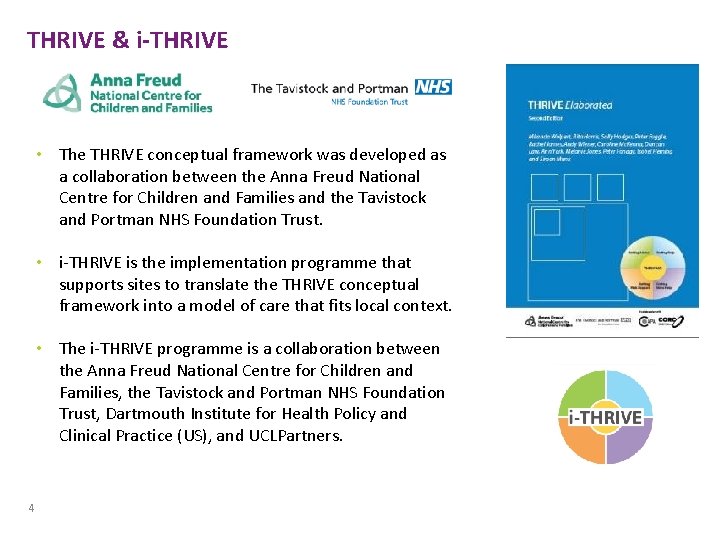
THRIVE & i-THRIVE • The THRIVE conceptual framework was developed as a collaboration between the Anna Freud National Centre for Children and Families and the Tavistock and Portman NHS Foundation Trust. • i-THRIVE is the implementation programme that supports sites to translate the THRIVE conceptual framework into a model of care that fits local context. • The i-THRIVE programme is a collaboration between the Anna Freud National Centre for Children and Families, the Tavistock and Portman NHS Foundation Trust, Dartmouth Institute for Health Policy and Clinical Practice (US), and UCLPartners. 4
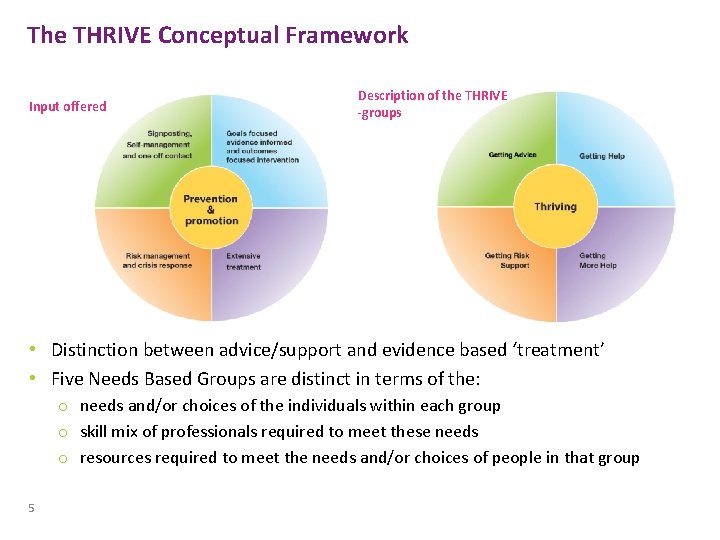
The THRIVE Conceptual Framework Input offered Description of the THRIVE -groups • Distinction between advice/support and evidence based ‘treatment’ • Five Needs Based Groups are distinct in terms of the: o needs and/or choices of the individuals within each group o skill mix of professionals required to meet these needs o resources required to meet the needs and/or choices of people in that group 5
The THRIVE Conceptual Framework: An Overview by Prof Miranda Wolpert, Lead THRIVE Author https: //youtu. be/t 8 MTo. Mwx. Kq. A 6
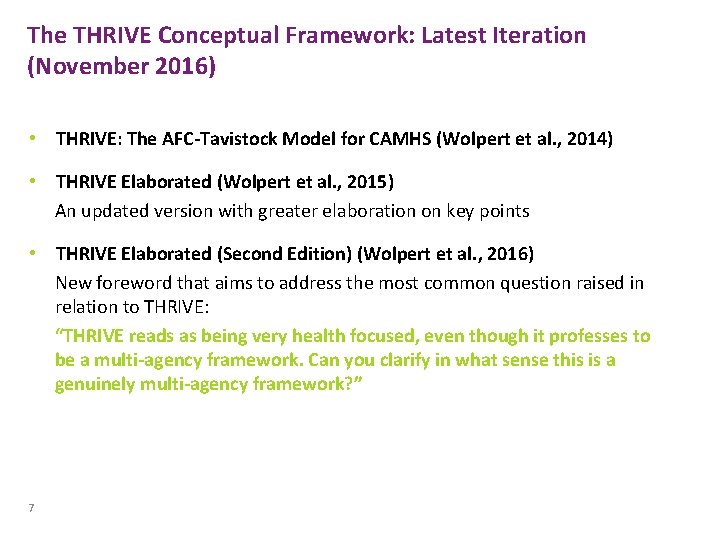
The THRIVE Conceptual Framework: Latest Iteration (November 2016) • THRIVE: The AFC-Tavistock Model for CAMHS (Wolpert et al. , 2014) • THRIVE Elaborated (Wolpert et al. , 2015) An updated version with greater elaboration on key points • THRIVE Elaborated (Second Edition) (Wolpert et al. , 2016) New foreword that aims to address the most common question raised in relation to THRIVE: “THRIVE reads as being very health focused, even though it professes to be a multi-agency framework. Can you clarify in what sense this is a genuinely multi-agency framework? ” 7
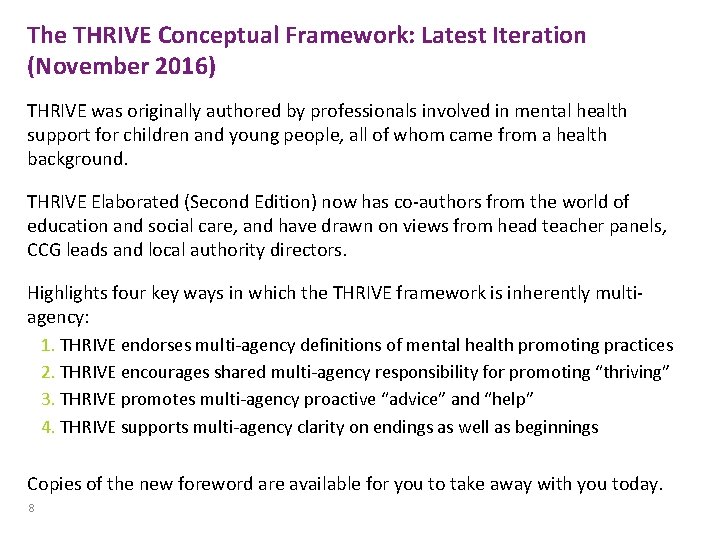
The THRIVE Conceptual Framework: Latest Iteration (November 2016) THRIVE was originally authored by professionals involved in mental health support for children and young people, all of whom came from a health background. THRIVE Elaborated (Second Edition) now has co-authors from the world of education and social care, and have drawn on views from head teacher panels, CCG leads and local authority directors. Highlights four key ways in which the THRIVE framework is inherently multiagency: 1. THRIVE endorses multi-agency definitions of mental health promoting practices 2. THRIVE encourages shared multi-agency responsibility for promoting “thriving” 3. THRIVE promotes multi-agency proactive “advice” and “help” 4. THRIVE supports multi-agency clarity on endings as well as beginnings Copies of the new foreword are available for you to take away with you today. 8
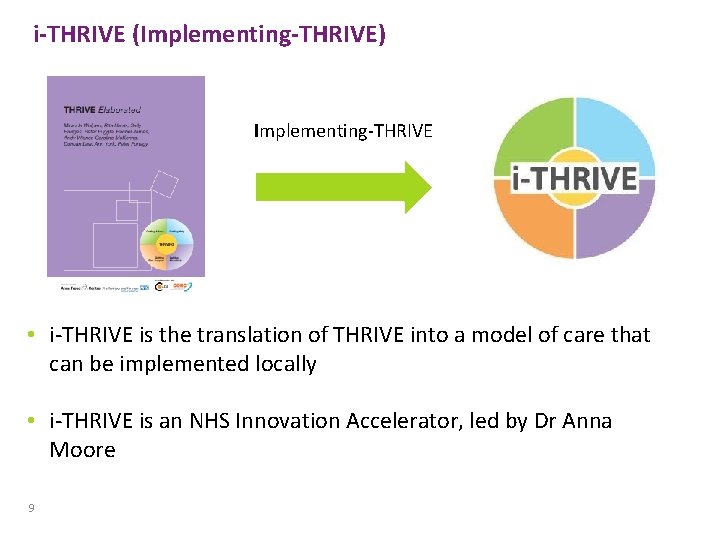
i-THRIVE (Implementing-THRIVE) Implementing-THRIVE • i-THRIVE is the translation of THRIVE into a model of care that can be implemented locally • i-THRIVE is an NHS Innovation Accelerator, led by Dr Anna Moore 9
Core principles and components of the i -THRIVE model of care 10
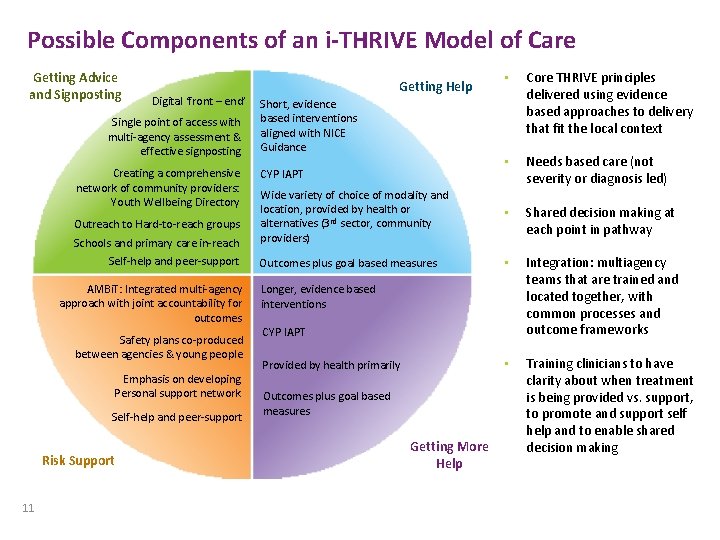
Possible Components of an i-THRIVE Model of Care Getting Advice and Signposting Digital ‘front – end’ Single point of access with multi-agency assessment & effective signposting Creating a comprehensive network of community providers: Youth Wellbeing Directory Outreach to Hard-to-reach groups Schools and primary care in-reach Self-help and peer-support AMBi. T: Integrated multi-agency approach with joint accountability for outcomes Safety plans co-produced between agencies & young people Emphasis on developing Personal support network Self-help and peer-support Risk Support 11 • Core THRIVE principles delivered using evidence based approaches to delivery that fit the local context • Needs based care (not severity or diagnosis led) Wide variety of choice of modality and location, provided by health or alternatives (3 rd sector, community providers) • Shared decision making at each point in pathway Outcomes plus goal based measures • Integration: multiagency teams that are trained and located together, with common processes and outcome frameworks • Training clinicians to have clarity about when treatment is being provided vs. support, to promote and support self help and to enable shared decision making Getting Help Short, evidence based interventions aligned with NICE Guidance CYP IAPT Longer, evidence based interventions CYP IAPT Provided by health primarily Outcomes plus goal based measures Getting More Help
Aligned to existing programmes • The i-THRIVE programme complements existing transformation and Quality Improvement programmes in the NHS • Builds on local strengths across whole system 12
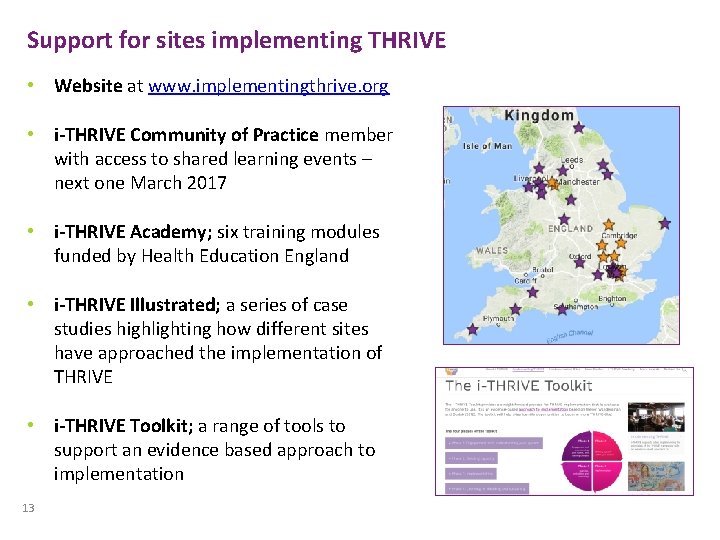
Support for sites implementing THRIVE • Website at www. implementingthrive. org • i-THRIVE Community of Practice member with access to shared learning events – next one March 2017 • i-THRIVE Academy; six training modules funded by Health Education England • i-THRIVE Illustrated; a series of case studies highlighting how different sites have approached the implementation of THRIVE • i-THRIVE Toolkit; a range of tools to support an evidence based approach to implementation 13
i-THRIVE Approach to Implementation Phase 1: Understanding Your System 14
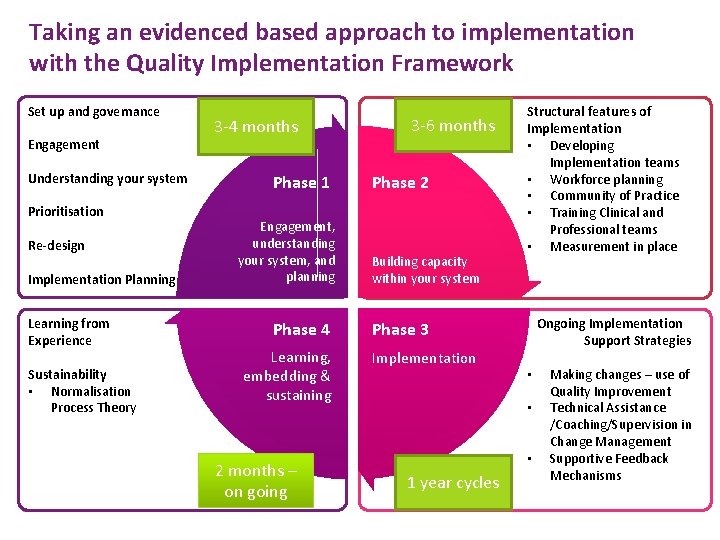
Taking an evidenced based approach to implementation with the Quality Implementation Framework Set up and governance Engagement Understanding your system Prioritisation Re-design Implementation Planning Learning from Experience Sustainability • Normalisation Process Theory 15 3 -4 months Phase 1 Engagement, understanding your system, and planning Phase 4 Learning, embedding & sustaining 2 months – on going 3 -6 months Phase 2 Building capacity within your system Phase 3 Implementation Structural features of Implementation • Developing Implementation teams • Workforce planning • Community of Practice • Training Clinical and Professional teams • Measurement in place Ongoing Implementation Support Strategies • • • 1 year cycles Making changes – use of Quality Improvement Technical Assistance /Coaching/Supervision in Change Management Supportive Feedback Mechanisms
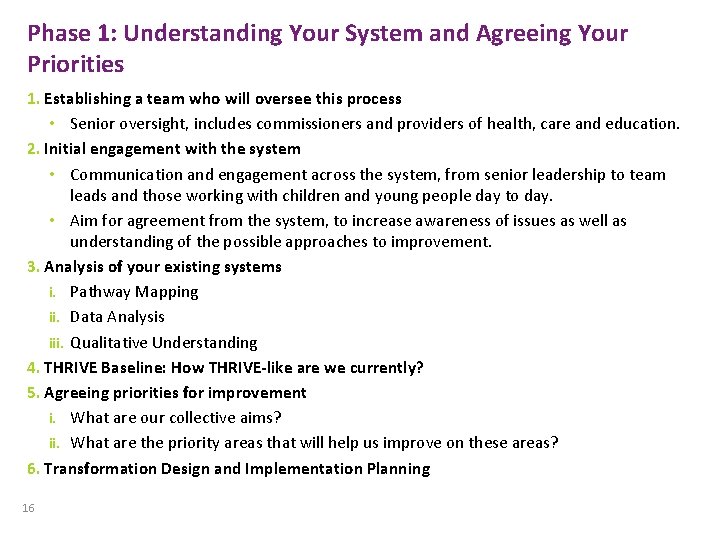
Phase 1: Understanding Your System and Agreeing Your Priorities 1. Establishing a team who will oversee this process • Senior oversight, includes commissioners and providers of health, care and education. 2. Initial engagement with the system • Communication and engagement across the system, from senior leadership to team leads and those working with children and young people day to day. • Aim for agreement from the system, to increase awareness of issues as well as understanding of the possible approaches to improvement. 3. Analysis of your existing systems i. Pathway Mapping ii. Data Analysis iii. Qualitative Understanding 4. THRIVE Baseline: How THRIVE-like are we currently? 5. Agreeing priorities for improvement i. What are our collective aims? ii. What are the priority areas that will help us improve on these areas? 6. Transformation Design and Implementation Planning 16
i-THRIVE Approach to Implementation Phase 1: Understanding Your System Establishing Priorities 17
Establishing Priorities Based on our work mapping the pathways in [enter place name] and the results of the THRIVE Assessment Tool we will now begin to identify key priorities to focus on moving forward. Session today: • Review of the top line priorities based on the THRIVE Assessment Tool exercise from [enter date] workshop • Discuss potential priorities now that we have had time to further think about our system • In groups identify your five top priorities and rank them in order • Share with the group as a whole and agree consensus on top five priorities to take forward 18
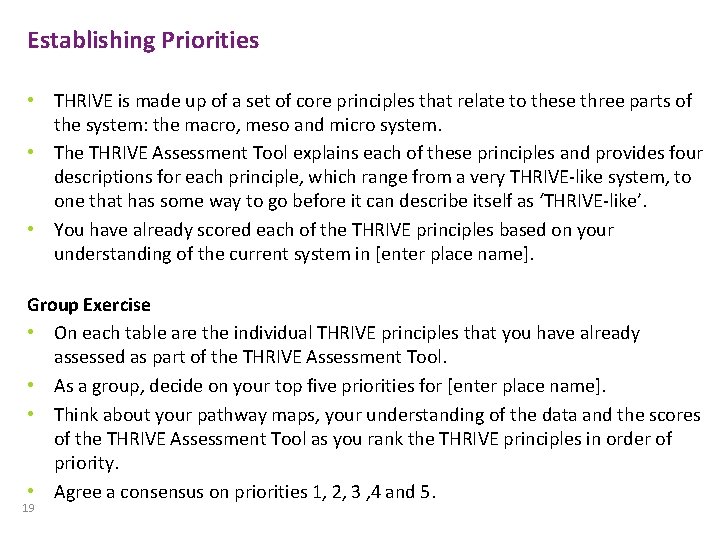
Establishing Priorities • THRIVE is made up of a set of core principles that relate to these three parts of the system: the macro, meso and micro system. • The THRIVE Assessment Tool explains each of these principles and provides four descriptions for each principle, which range from a very THRIVE-like system, to one that has some way to go before it can describe itself as ‘THRIVE-like’. • You have already scored each of the THRIVE principles based on your understanding of the current system in [enter place name]. Group Exercise • On each table are the individual THRIVE principles that you have already assessed as part of the THRIVE Assessment Tool. • As a group, decide on your top five priorities for [enter place name]. • Think about your pathway maps, your understanding of the data and the scores of the THRIVE Assessment Tool as you rank the THRIVE principles in order of priority. • Agree a consensus on priorities 1, 2, 3 , 4 and 5. 19
Establishing Priorities Group Exercise – Feedback • Now that you have identified your top five priorities on your tables, share these with the whole group. • Each table will take their turn in sharing their top five with the whole group. Group Exercise – Agreeing Consensus • As a whole group you can now see what the top five priorities are for each table. • Agree a consensus as a whole group and identify the top five priorities for [enter name place] that you will address going forward. • Write these top five priorities on flip chart paper and make sure that they are visible to everyone in the room. 20
i-THRIVE Approach to Implementation Phase 1: Understanding Your System Gap Analysis 21
Gap Analysis Now that we have identified our five key priorities it is helpful to look at those priorities individually and establish: • The ‘ideal’ as set out in the THRIVE principle • What is currently in place? • What is in development? • Identified gaps • What training might be useful? • Recommendations about transformation 22
Gap Analysis: group exercise One hour On your tables begin to complete the i-THRIVE Gap Analysis Tool • For priority one, write the agreed priority in the left hand column • Work you way through each column and add the requested information • This is in draft form so don’t worry about having the perfect wording – you will be able to tweak and refine this at a later date • Repeat with priorities two, three, four and five • Spend roughly 20 minutes on each priority 23
Gap Analysis: group exercise 30 mins Share any key pieces of information that you have identified in using the i-THRIVE Gap Analysis Tool • What are the major gaps that you have identified? • Are there any quick wins that you think could lead to immediate progress? • Do you agree on the training that might be needed to support the workforce in moving towards the ideal of the THRIVE principle? • Have you got any great recommendations for transformation? Capture any feedback on flipchart paper. 24
Next Steps 25
Next steps • Use the priorities and gap analysis work to develop a plan for service redesign • Discussion on plans for wider engagement and sharing of future steps • Redesign workshop 26
For more information: i-THRIVE www. implementingthrive. org Twitter @i. THRIVEinfo 27
For more information: the i-THRIVE Programme Team Anna Moore: i-THRIVE Lead Currently on Maternity Leave Emma Louisy: i-THRIVE Programme Manager ELouisy@Tavi-Port. nhs. uk Rachel James: i-THRIVE Clinical Lead rjames@tavi-port. nhs. uk Ilse Lee: Senior Research Assistant and Community of Practice Manager Ilse. Lee@annafreud. org 28