
Implementing the Transition to Independence TIP Model Simcoe





- Slides: 54
Implementing the Transition to Independence (TIP) Model : Simcoe Muskoka Spring 2015
Transition Age Youth (TAY) are youth between the ages of 14 -29 years old : transitioning from ADOLESCENCE to ADULTHOOD. 13. 7% of the total population served by the NSM LHIN are transition age youth* * Statistic Canada 2011
Why focus on TAY? Time of significant changes in social, emotional, physical and cognitive domains. Steep rise in the emergence of mental health issues, often complicated by substance abuse issues. TAY have unique needs that are often not met by existing services and resources.
Transition Age Youth face barriers to accessing support that can not be addressed by a single agency and instead require collective and coordinated action.
EDUCATED, HEALTHY, CREATIVE, AND RESILIENT YOUNG PEOPLE ARE CRITICAL TO THE ECONOMIC AND SOCIAL FUTURE OF OUR PROVINCE.
By supporting positive youth development today… we are minimizing costs …to our health care, justice, child protection & social assistance systems in the future
BACKGROUND
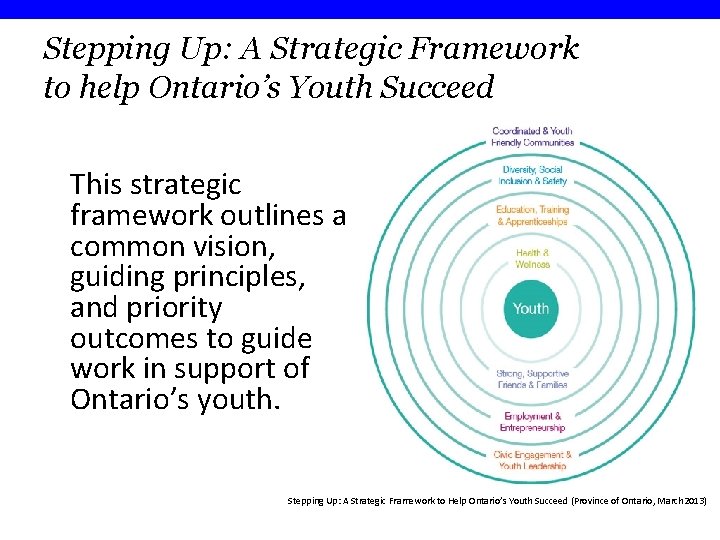
Stepping Up: A Strategic Framework to help Ontario’s Youth Succeed This strategic framework outlines a common vision, guiding principles, and priority outcomes to guide work in support of Ontario’s youth. Stepping Up: A Strategic Framework to Help Ontario’s Youth Succeed (Province of Ontario, March 2013)
Ontario youth need all hands on deck: As young people transition through the stages of adolescence and early adulthood, they will connect with many different people, programs, organizations and systems – from teachers to mall security guards to health clinics. All of these interactions matter. Supporting young people to reach their full potential requires positive contributions across sectors and communities. Stepping Up: A Strategic Framework to help Ontario’s Youth Succeed
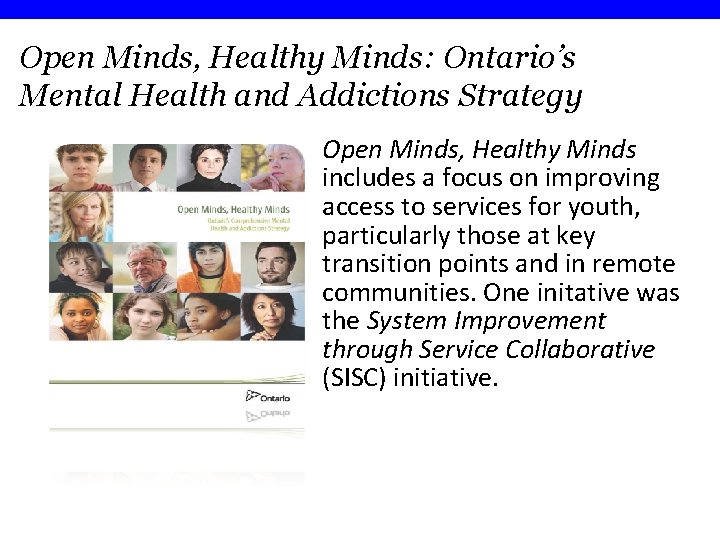
Open Minds, Healthy Minds: Ontario’s Mental Health and Addictions Strategy Open Minds, Healthy Minds includes a focus on improving access to services for youth, particularly those at key transition points and in remote communities. One initative was the System Improvement through Service Collaborative (SISC) initiative.
The Simcoe/Muskoka Service Collaborative was one of the first collaboratives as part of this initiative. In 2012, representatives from various sectors across Simcoe County and Muskoka District were engaged in a process to implement an intervention that would make a difference in the lives of youth in their communities.
The Simcoe/Muskoka Service Collaborative decided to focus on improving outcomes for transition age youth in their communities by developing an integrated system of care across all sectors that would include: 1. Implementation of the Transition to Independence Process (TIP) Model 2. Strengthening youth and family engagement at the agency and system levels
In May 2014, the Simcoe/Muskoka Service Collaborative transitioned to the Simcoe/Muskoka TAY System of Supports Partnership. The TAY SOS Partnership is an ongoing, cross-sectoral community-led initiative that will continue to support the development of an integrated system of supports for TAY by building on existing community resources. Its objective is to give youth in Simcoe/Muskoka the best possible transition to a successful adulthood.
VISION of the TAY SOS PARTNERSHIP: TAY will receive services that are inclusive of all in preparing and facilitating them in their movement toward greater self-sufficiency and successful achievement of their goals related to relevant transition domains
GOAL: TAY will have the opportunities and resources they need to grow into responsible, contributing adults. MANDATE: To plan, implement, monitor and evaluate a Simcoe/Muskoka System of Supports for Transition Age Youth.
Implementing the Transition to Independence Process Model in Simcoe/Muskoka
Why bring the Transition to Independence Process (TIP) Model to Simcoe-Muskoka? 1. Evidence of effectiveness 2. Fit with current services being provided by agencies in Simcoe Muskoka
TIP is a community-based and evidence-supported model designed for TAY with emotional and behavioral difficulties. It provides a common framework/language for direct service providers working with youth across sectors that builds on the existing skills, roles, and initiatives within the community.
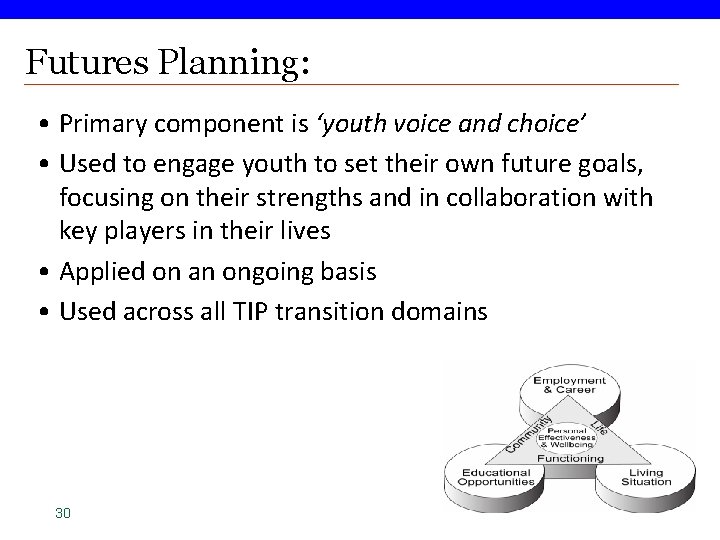
The TIP Model gives service providers the tools to support TAY in their transition to successful adulthood across 5 developmental (or transition) domains.
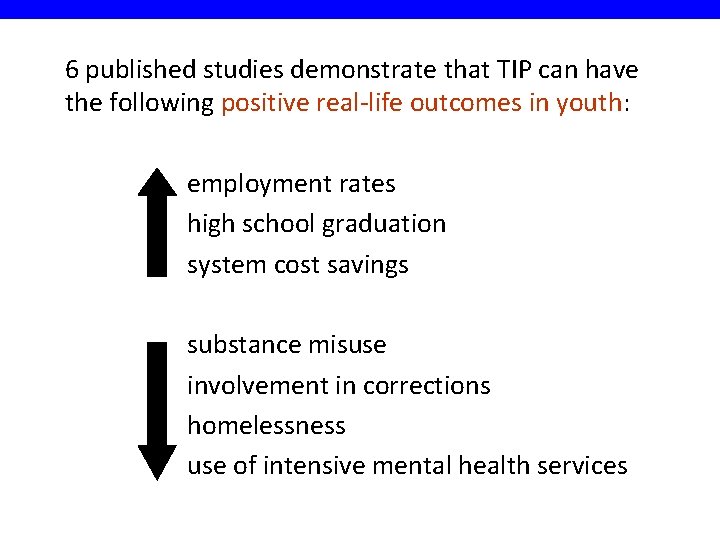
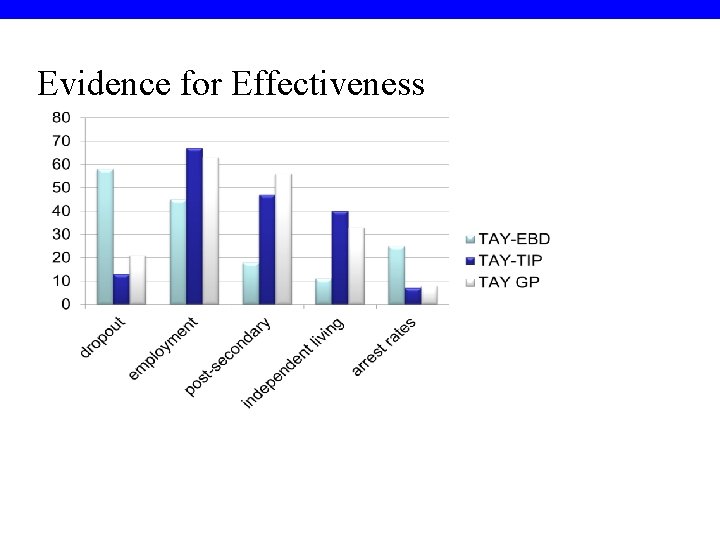
6 published studies demonstrate that TIP can have the following positive real-life outcomes in youth: employment rates high school graduation system cost savings substance misuse involvement in corrections homelessness use of intensive mental health services
Evidence for Effectiveness
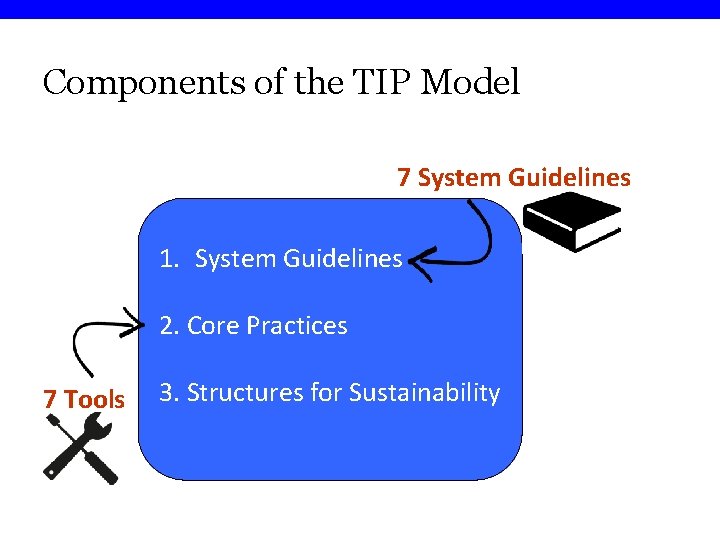
Components of the TIP Model 7 System Guidelines 1. System Guidelines 2. Core Practices 7 Tools 3. Structures for Sustainability
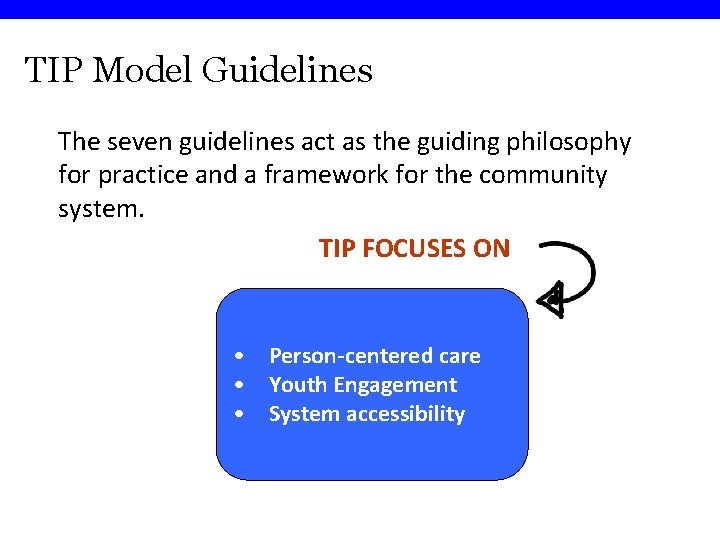
TIP Model Guidelines The seven guidelines act as the guiding philosophy for practice and a framework for the community system. TIP FOCUSES ON • Person-centered care • Youth Engagement • System accessibility
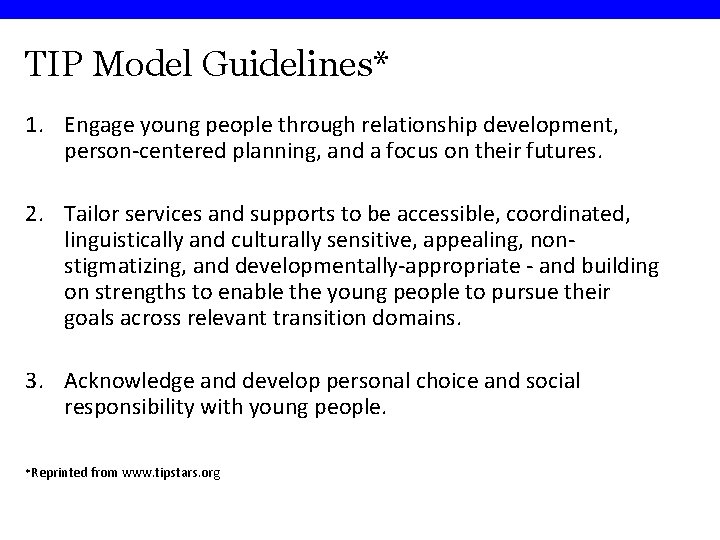
TIP Model Guidelines* 1. Engage young people through relationship development, person-centered planning, and a focus on their futures. 2. Tailor services and supports to be accessible, coordinated, linguistically and culturally sensitive, appealing, nonstigmatizing, and developmentally-appropriate - and building on strengths to enable the young people to pursue their goals across relevant transition domains. 3. Acknowledge and develop personal choice and social responsibility with young people. *Reprinted from www. tipstars. org
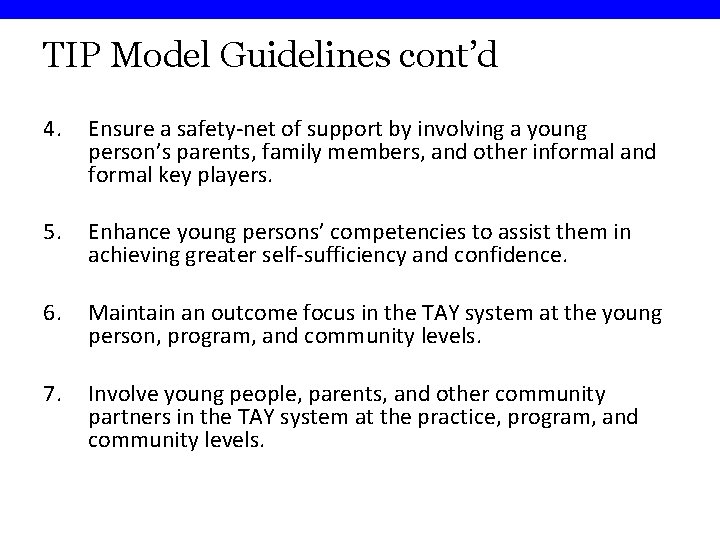
TIP Model Guidelines cont’d 4. Ensure a safety-net of support by involving a young person’s parents, family members, and other informal and formal key players. 5. Enhance young persons’ competencies to assist them in achieving greater self-sufficiency and confidence. 6. Maintain an outcome focus in the TAY system at the young person, program, and community levels. 7. Involve young people, parents, and other community partners in the TAY system at the practice, program, and community levels.
TIP Model Core Practices Direct service providers use 7 core practices to enhance the effectiveness of their work with youth related to the transition domains. Service providers may choose to use all or selected core practices, as appropriate.
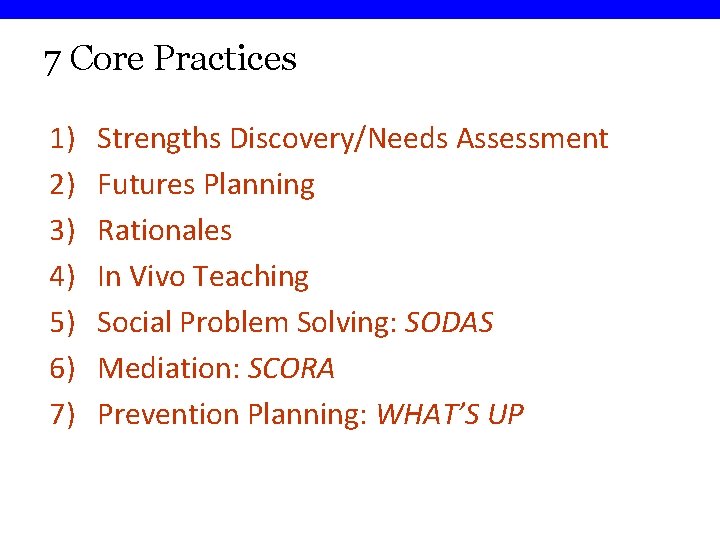
7 Core Practices 1) 2) 3) 4) 5) 6) 7) Strengths Discovery/Needs Assessment Futures Planning Rationales In Vivo Teaching Social Problem Solving: SODAS Mediation: SCORA Prevention Planning: WHAT’S UP
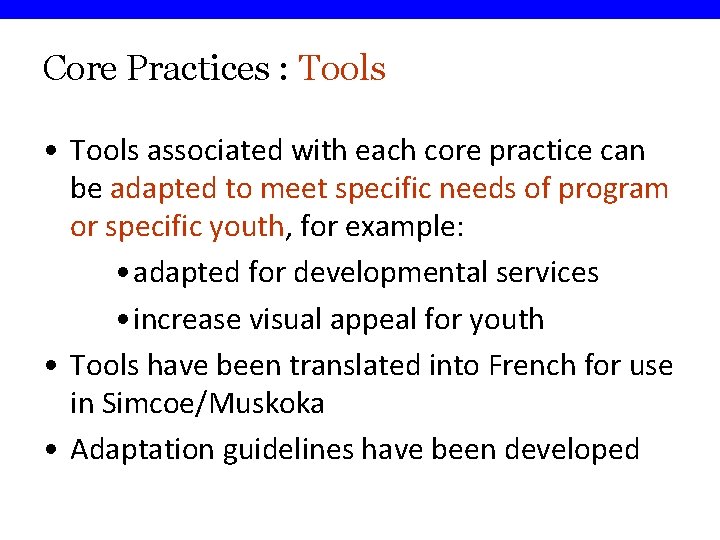
Core Practices : Tools • Tools associated with each core practice can be adapted to meet specific needs of program or specific youth, for example: • adapted for developmental services • increase visual appeal for youth • Tools have been translated into French for use in Simcoe/Muskoka • Adaptation guidelines have been developed
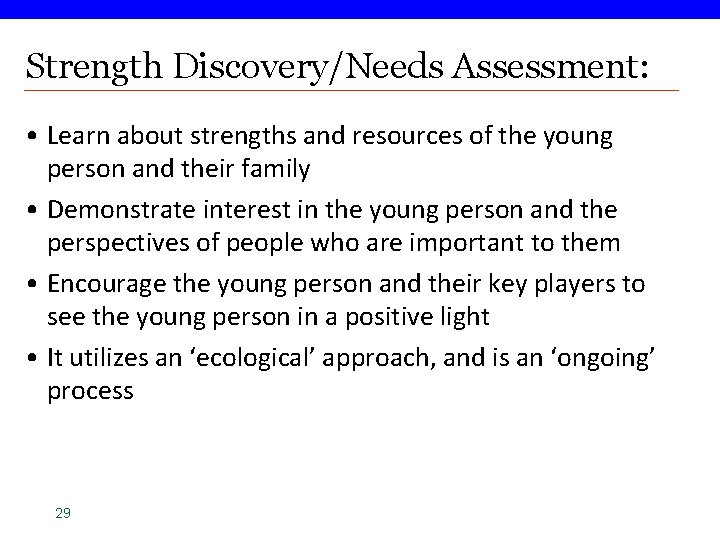
Strength Discovery/Needs Assessment: • Learn about strengths and resources of the young person and their family • Demonstrate interest in the young person and the perspectives of people who are important to them • Encourage the young person and their key players to see the young person in a positive light • It utilizes an ‘ecological’ approach, and is an ‘ongoing’ process 29
Futures Planning: • Primary component is ‘youth voice and choice’ • Used to engage youth to set their own future goals, focusing on their strengths and in collaboration with key players in their lives • Applied on an ongoing basis • Used across all TIP transition domains 30
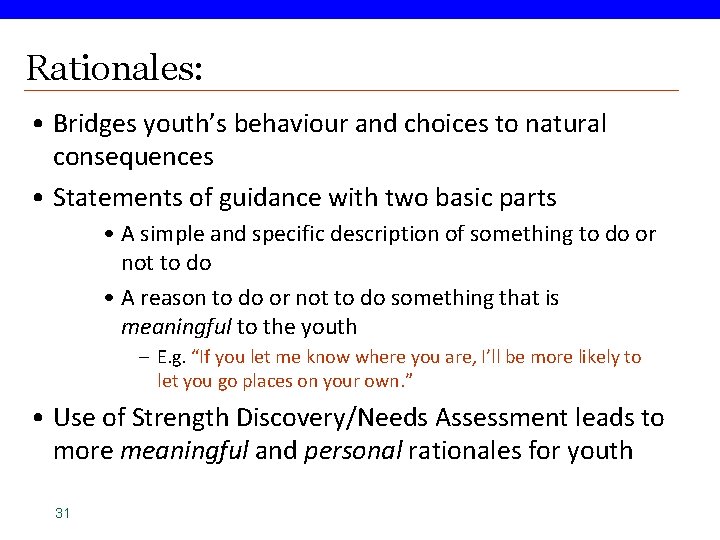
Rationales: • Bridges youth’s behaviour and choices to natural consequences • Statements of guidance with two basic parts • A simple and specific description of something to do or not to do • A reason to do or not to do something that is meaningful to the youth – E. g. “If you let me know where you are, I’ll be more likely to let you go places on your own. ” • Use of Strength Discovery/Needs Assessment leads to more meaningful and personal rationales for youth 31
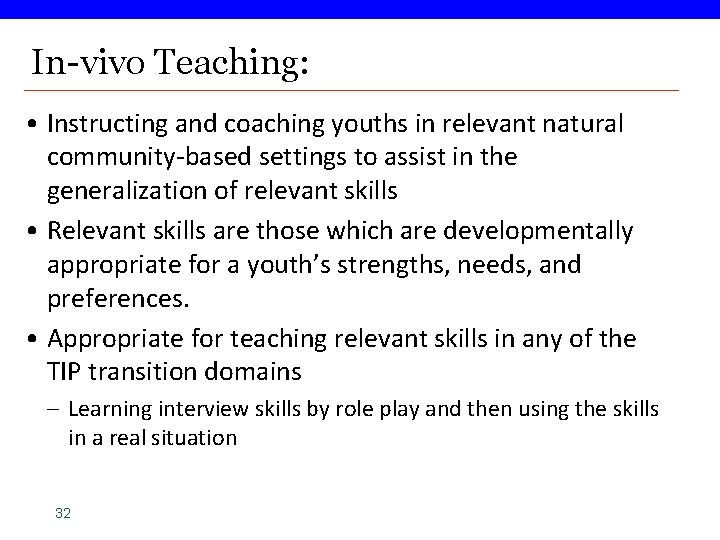
In-vivo Teaching: • Instructing and coaching youths in relevant natural community-based settings to assist in the generalization of relevant skills • Relevant skills are those which are developmentally appropriate for a youth’s strengths, needs, and preferences. • Appropriate for teaching relevant skills in any of the TIP transition domains – Learning interview skills by role play and then using the skills in a real situation 32
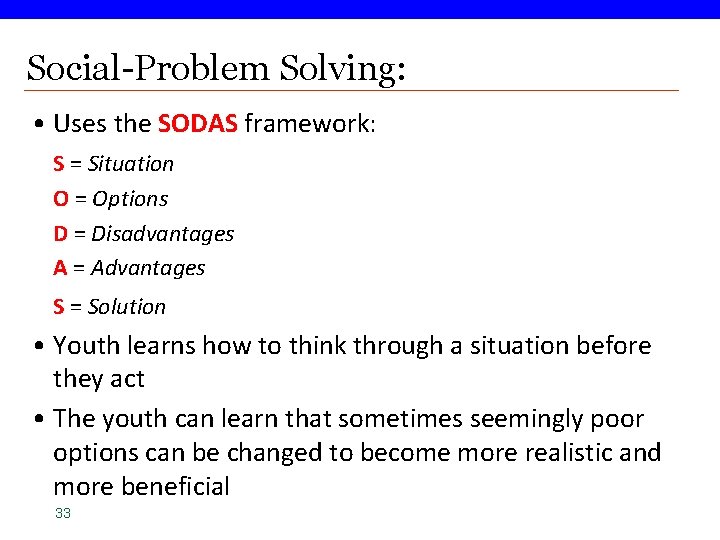
Social-Problem Solving: • Uses the SODAS framework: S = Situation O = Options D = Disadvantages A = Advantages S = Solution • Youth learns how to think through a situation before they act • The youth can learn that sometimes seemingly poor options can be changed to become more realistic and more beneficial 33
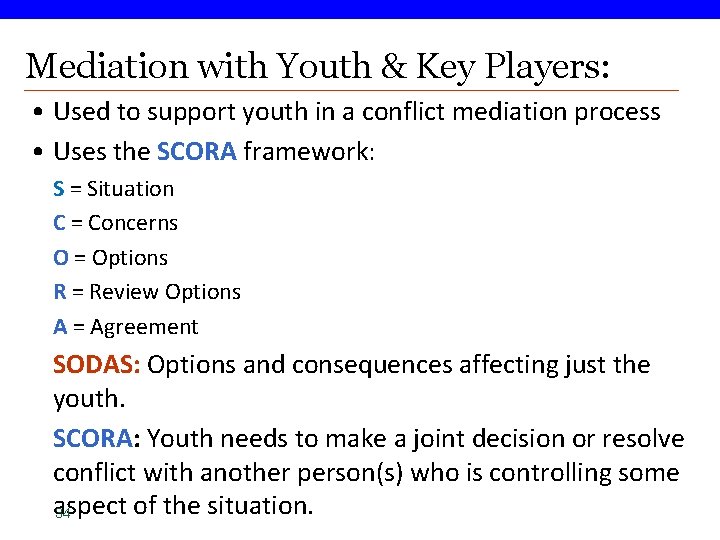
Mediation with Youth & Key Players: • Used to support youth in a conflict mediation process • Uses the SCORA framework: S = Situation C = Concerns O = Options R = Review Options A = Agreement SODAS: Options and consequences affecting just the youth. SCORA: Youth needs to make a joint decision or resolve conflict with another person(s) who is controlling some aspect of the situation. 34
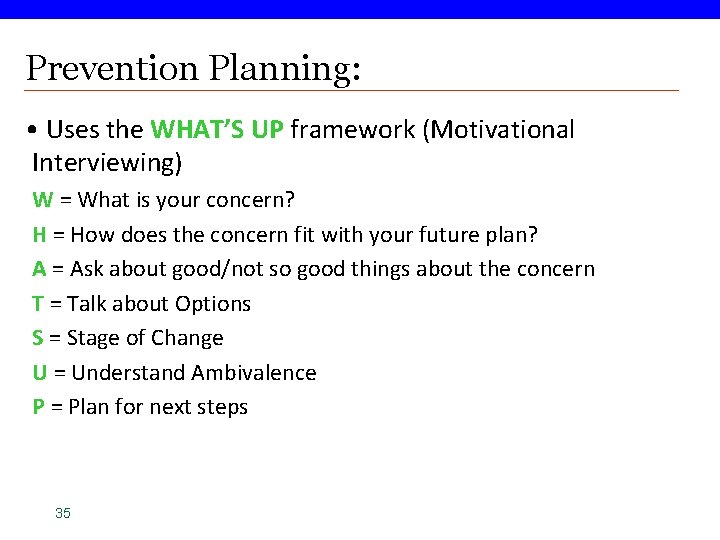
Prevention Planning: • Uses the WHAT’S UP framework (Motivational Interviewing) W = What is your concern? H = How does the concern fit with your future plan? A = Ask about good/not so good things about the concern T = Talk about Options S = Stage of Change U = Understand Ambivalence P = Plan for next steps 35
TIP Solutions Review: TIP Solutions Review is a team-based process where staff complete descriptive outlines of their work with a selected youth, and their use of TIP model core practices and guidelines. Provides an opportunity for: • continuing competency enhancement within programs and for all team members • problem solving challenges and celebrating successes • reflective practice and feedback
TIP Model Training
National Network for Youth Transition (NNYT) and the STARS Training Academy are the official purveyors of the TIP Model. STARS has completed 3 training sessions in Simcoe/Muskoka and has certified 4 service providers as TIP Model trainers for local communities.
TIP Model training includes 3 days (over 2 sessions) of in-person training focused on the TIP Model Guidelines and Core Practices. These interactive training sessions make use of: Group role-play Use of case studies Video demonstrations
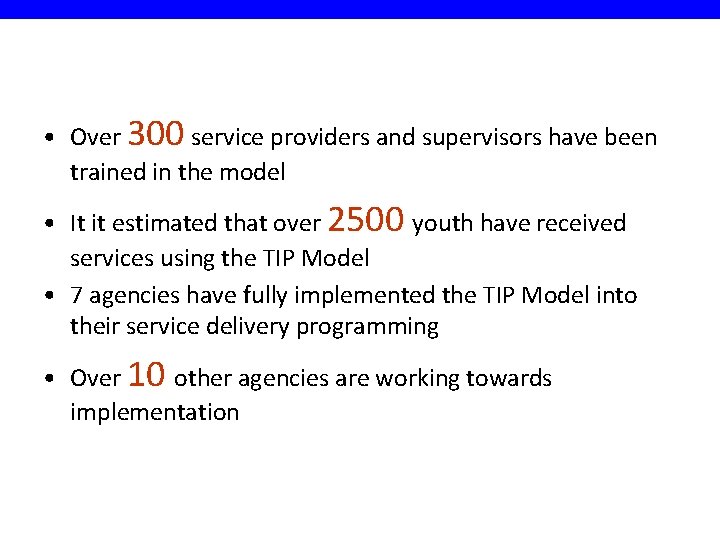
• Over 300 service providers and supervisors have been trained in the model • It it estimated that over 2500 youth have received services using the TIP Model • 7 agencies have fully implemented the TIP Model into their service delivery programming • Over 10 other agencies are working towards implementation
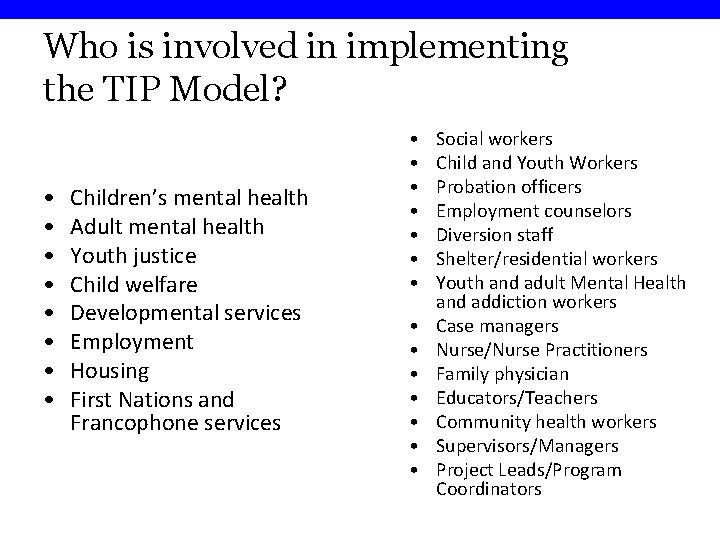
Who is involved in implementing the TIP Model? • • Children’s mental health Adult mental health Youth justice Child welfare Developmental services Employment Housing First Nations and Francophone services • • • • Social workers Child and Youth Workers Probation officers Employment counselors Diversion staff Shelter/residential workers Youth and adult Mental Health and addiction workers Case managers Nurse/Nurse Practitioners Family physician Educators/Teachers Community health workers Supervisors/Managers Project Leads/Program Coordinators
How will the TIP Model be sustained in Simcoe/Muskoka? 1. Coaching 2. TIP Model Community of Practice 3. Locally-based certified TIP Model trainers 4. TAY System of Support Partnership 42
1. Coaching • Development of agency-specific Implementation plans for TIP Model & Coaching
2. TIP Model Community of Practice The TIP Model Community of Practice launched in May 2014. Meetings are open to all TIP-trained service providers and supervisors and are held quarterly and co-chaired by CMHA Simcoe County and Catupla Community Support Services. Co. P Objectives: – Engage in a process of collective learning about the TIP Model. – Commit to learning more about transitioning youth to independence and share a competence that distinguishes us from other people. – Engage in joint discussions to help each other and share information and build on relationships to help us learn from one another. – Develop a shared repertoire of resources, experiences, stories, tools and ways of addressing recurring problems. – Understanding that change will take time and sustained interaction.
3. Local Site-Based TIP Trainers As of May 2015, 4 local service providers have been certified as TIP Model trainers and have conducted X training sessions and trained over X providers. Trainers have incorporated diverse case studies based on local youth.
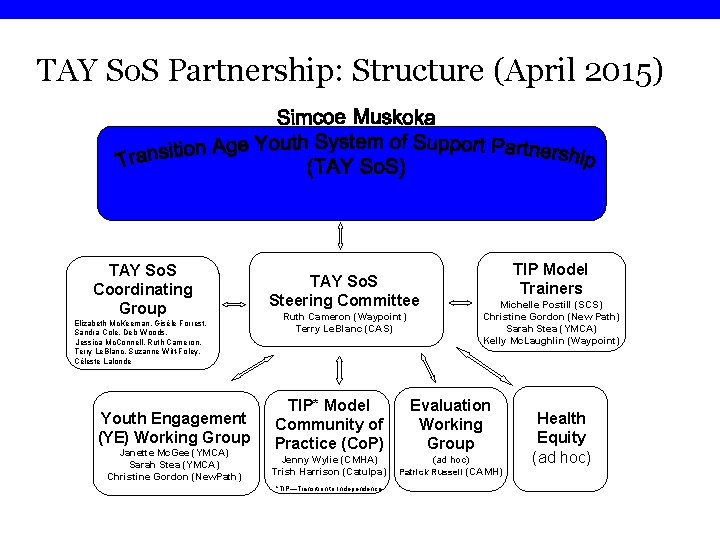
4. TAY SOS Partnership The TAY SOS Partnership Steering Committee, Coordinating Group, and Working Groups continue to support the development of a system of support for TAY in Simcoe Muskoka, including TIP Model Implementation. These groups make use of protocols to ensure that information flows between groups to support ongoing system improvement.
TAY So. S Partnership Objectives 1. 2. 3. 4. 5. 6. 7. 8. Engage in collaborative community planning that promotes implementation of the TIP Model across all sectors Establish and support (or direct, as required) effective structures required to implement the TAY Partnership Vision including on-going Working Groups i. e. Health Equity, Youth and Family Engagement Co. P, TIP Model Co. P, Quality Assurance/Evaluation, Youth and Family Councils. Build effective partnerships with young people, and their families/support networks, to promote implementation of the TAY Partnership Vision. Receive, review and advise on impacts of system initiatives, provincial legislation, regulation and available data as it relates to the TAY Partnership Vision. Act as a common voice for TAY Service Providers in Simcoe/Muskoka. Advocate for TAY Service Providers in Simcoe/Muskoka. Actively support youth engagement at all levels of the TAY system of supports. Evaluate and monitor the TAY System of Supports including implementation and fidelity of TIP Model.
TAY So. S Partnership: Structure (April 2015) TAY So. S Coordinating Group Elizabeth Mc. Keeman, Gisèle Forrest, Sandra Cole, Deb Woods, Jessica Mc. Connell, Ruth Cameron, Terry Le. Blanc, Suzanne Witt-Foley, Céleste Lalonde Youth Engagement (YE) Working Group Janette Mc. Gee (YMCA) Sarah Stea (YMCA) Christine Gordon (New. Path) TIP Model Trainers TAY So. S Steering Committee Michelle Postill (SCS) Christine Gordon (New Path) Sarah Stea (YMCA) Kelly Mc. Laughlin (Waypoint) Ruth Cameron (Waypoint) Terry Le. Blanc (CAS) TIP* Model Community of Practice (Co. P) Evaluation Working Group Jenny Wylie (CMHA) Trish Harrison (Catulpa) Patrick Russell (CAMH) *TIP—Transition to Independence (ad hoc) Health Equity (ad hoc)
Evaluation
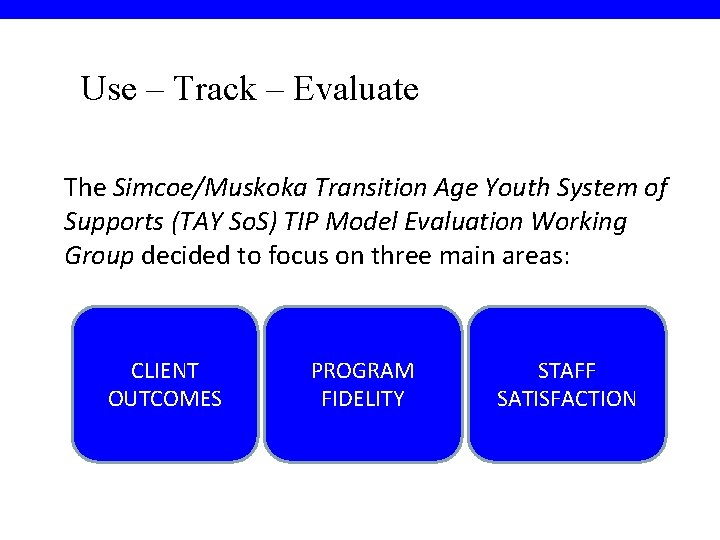
Use – Track – Evaluate The Simcoe/Muskoka Transition Age Youth System of Supports (TAY So. S) TIP Model Evaluation Working Group decided to focus on three main areas: CLIENT OUTCOMES PROGRAM FIDELITY STAFF SATISFACTION
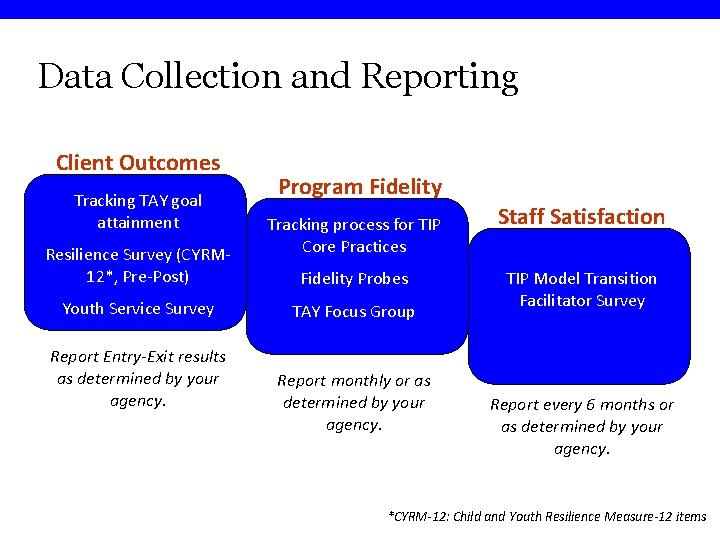
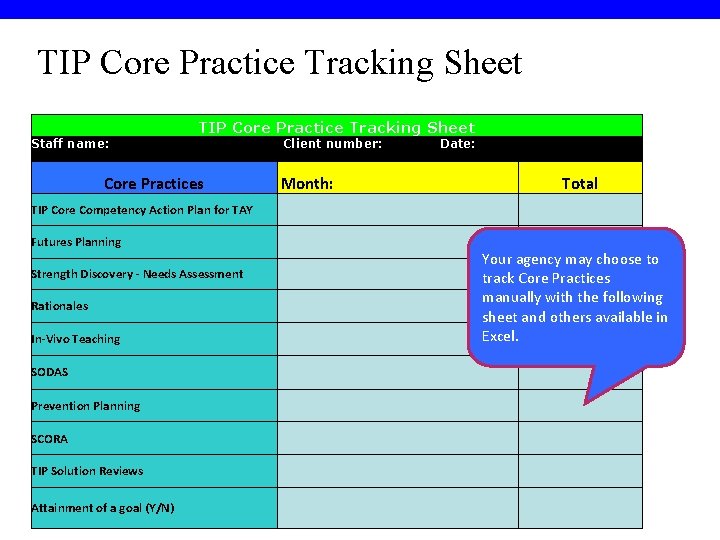
Data Collection and Reporting Client Outcomes Tracking TAY goal attainment Resilience Survey (CYRM 12*, Pre-Post) Youth Service Survey Report Entry-Exit results as determined by your agency. Program Fidelity Tracking process for TIP Core Practices Fidelity Probes TAY Focus Group Report monthly or as determined by your agency. Staff Satisfaction TIP Model Transition Facilitator Survey Report every 6 months or as determined by your agency. *CYRM-12: Child and Youth Resilience Measure-12 items
TIP Core Practice Tracking Sheet Staff name: TIP Core Practice Tracking Sheet Core Practices Client number: Month: Date: Total TIP Core Competency Action Plan for TAY Futures Planning Strength Discovery - Needs Assessment Rationales In-Vivo Teaching SODAS Prevention Planning SCORA TIP Solution Reviews Attainment of a goal (Y/N) Your agency may choose to track Core Practices manually with the following sheet and others available in Excel.
Program Fidelity measures ensure that the TIP Model is effective in improving the progress of youth, and determine where more support is required for TIPtrained service providers. The TIP Model uses: – Fidelity QI Probes: periodic assessment of TIP-trained direct service providers regarding use of TIP core practices and guidelines – Fidelity QI Young Person Focus Group: assess if young people find the TIP core practices effective 53
Where we are at today