
Implementing the SelfSufficiency Matrix Updated 4192011 Minnesota Housing





- Slides: 71
Implementing the Self-Sufficiency Matrix Updated 4/19/2011 Minnesota Housing | mnhousing. gov
Staff Training Tool • For Minnesota LTH and FHPAP Programs • Based on Abt Associates Training and Michigan’s Implementation Minnesota Housing | mnhousing. gov 2
Training Overview • What is the self-sufficiency matrix? • Using the matrix assessment • Minnesota implementation • Self-sufficiency domains and flowcharts • Reporting • Next steps April 2018 Minnesota Housing | mnhousing. gov 3
Background • One of many assessment tools used to measure need, target services, and evaluate supportive service provision. • First implemented by The Arizona Homeless Evaluation Project and now used by many other states, cities and counties. • This Self-Sufficiency Matrix was tested for validity and reliability. 10/21/2021 Minnesota Housing | mnhousing. gov 4
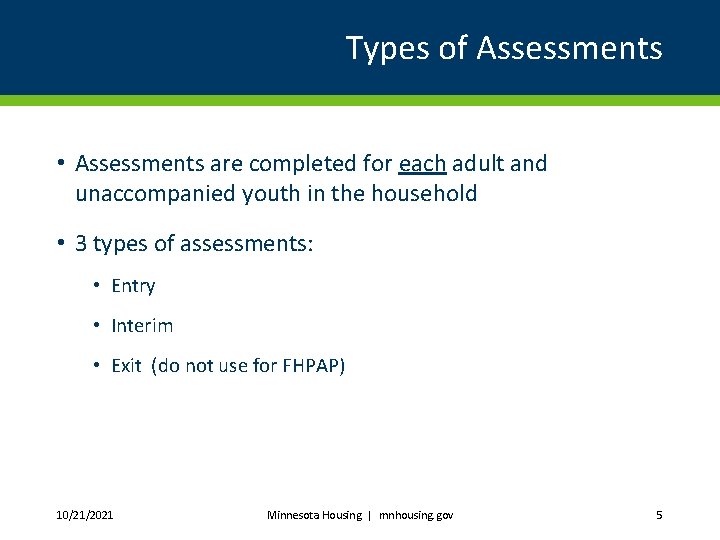
Types of Assessments • Assessments are completed for each adult and unaccompanied youth in the household • 3 types of assessments: • Entry • Interim • Exit (do not use for FHPAP) 10/21/2021 Minnesota Housing | mnhousing. gov 5
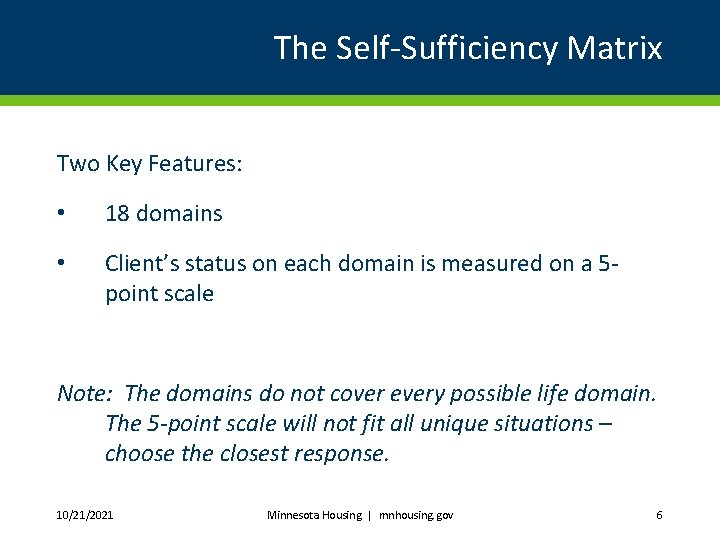
The Self-Sufficiency Matrix Two Key Features: • 18 domains • Client’s status on each domain is measured on a 5 point scale Note: The domains do not cover every possible life domain. The 5 -point scale will not fit all unique situations – choose the closest response. 10/21/2021 Minnesota Housing | mnhousing. gov 6
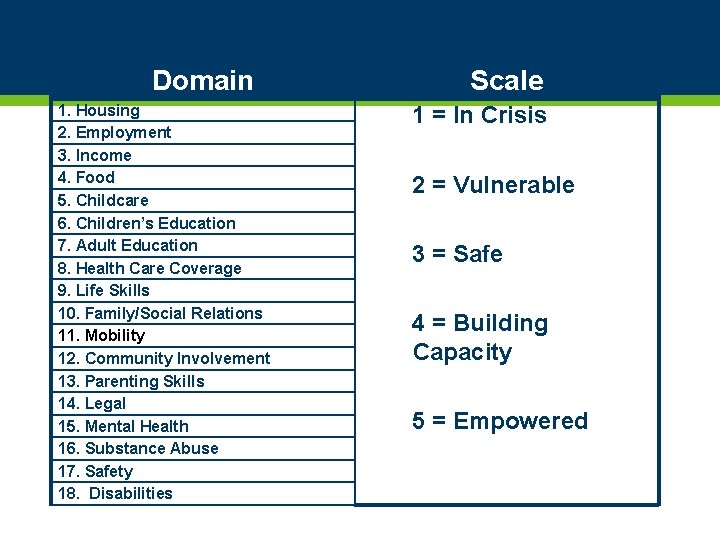
Domain 1. Housing 2. Employment 3. Income 4. Food 5. Childcare 6. Children’s Education 7. Adult Education 8. Health Care Coverage 9. Life Skills 10. Family/Social Relations 11. Mobility 12. Community Involvement 13. Parenting Skills 14. Legal 15. Mental Health 16. Substance Abuse 17. Safety 18. Disabilities Scale 1 = In Crisis 2 = Vulnerable 3 = Safe 4 = Building Capacity 5 = Empowered
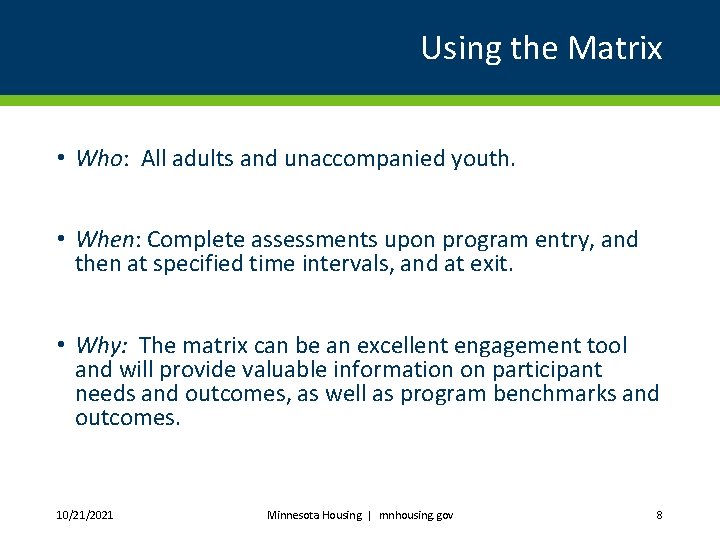
Using the Matrix • Who: All adults and unaccompanied youth. • When: Complete assessments upon program entry, and then at specified time intervals, and at exit. • Why: The matrix can be an excellent engagement tool and will provide valuable information on participant needs and outcomes, as well as program benchmarks and outcomes. 10/21/2021 Minnesota Housing | mnhousing. gov 8
How to complete the matrix: Different programs have different guidelines: • Long-term Homelessness Programs (LTH) • Family Homelessness Prevention and Assistance Program (FHPAP) 10/21/2021 Minnesota Housing | mnhousing. gov 9
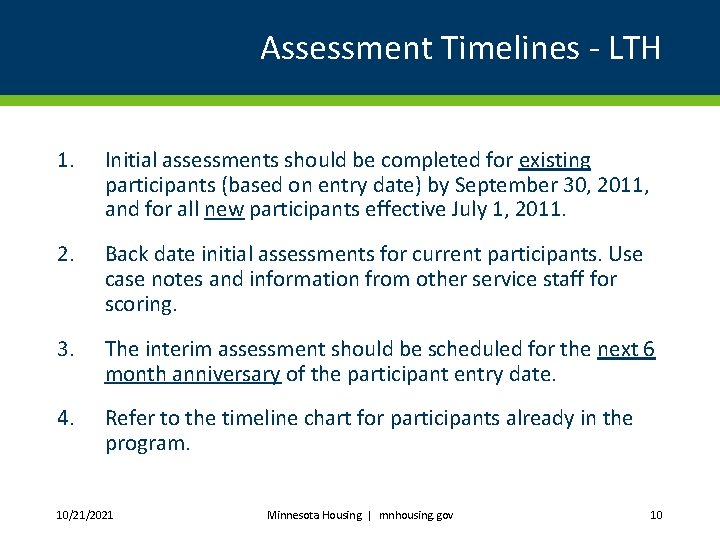
Assessment Timelines - LTH 1. Initial assessments should be completed for existing participants (based on entry date) by September 30, 2011, and for all new participants effective July 1, 2011. 2. Back date initial assessments for current participants. Use case notes and information from other service staff for scoring. 3. The interim assessment should be scheduled for the next 6 month anniversary of the participant entry date. 4. Refer to the timeline chart for participants already in the program. 10/21/2021 Minnesota Housing | mnhousing. gov 10
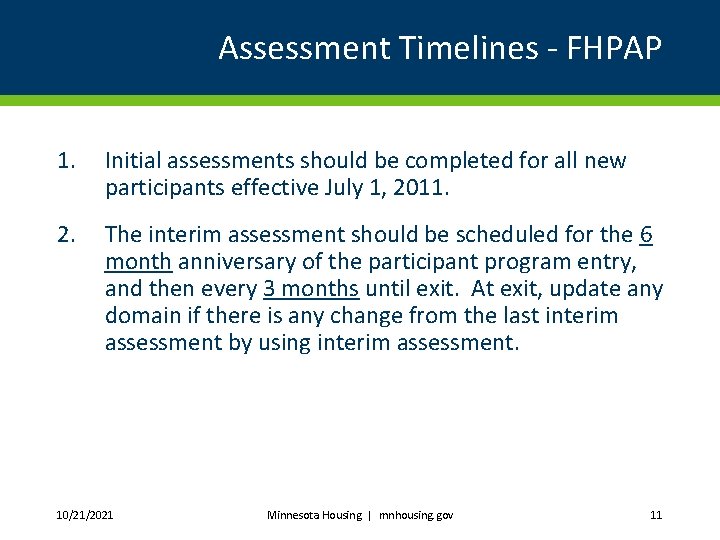
Assessment Timelines - FHPAP 1. Initial assessments should be completed for all new participants effective July 1, 2011. 2. The interim assessment should be scheduled for the 6 month anniversary of the participant program entry, and then every 3 months until exit. At exit, update any domain if there is any change from the last interim assessment by using interim assessment. 10/21/2021 Minnesota Housing | mnhousing. gov 11
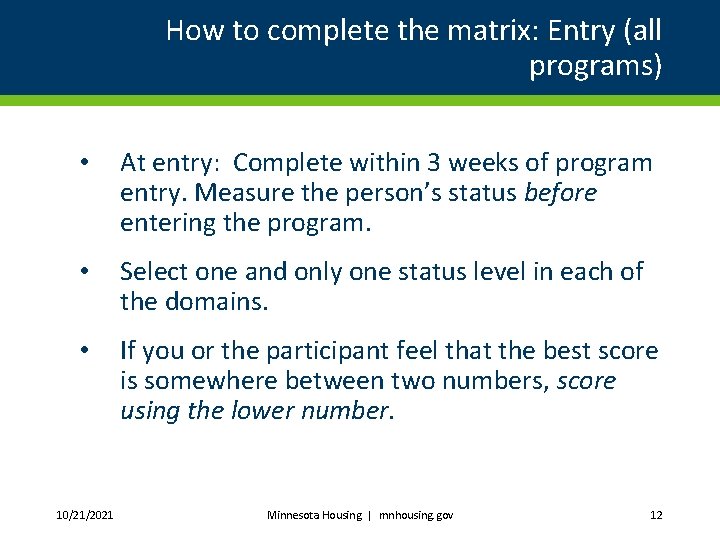
How to complete the matrix: Entry (all programs) • At entry: Complete within 3 weeks of program entry. Measure the person’s status before entering the program. • Select one and only one status level in each of the domains. • If you or the participant feel that the best score is somewhere between two numbers, score using the lower number. 10/21/2021 Minnesota Housing | mnhousing. gov 12
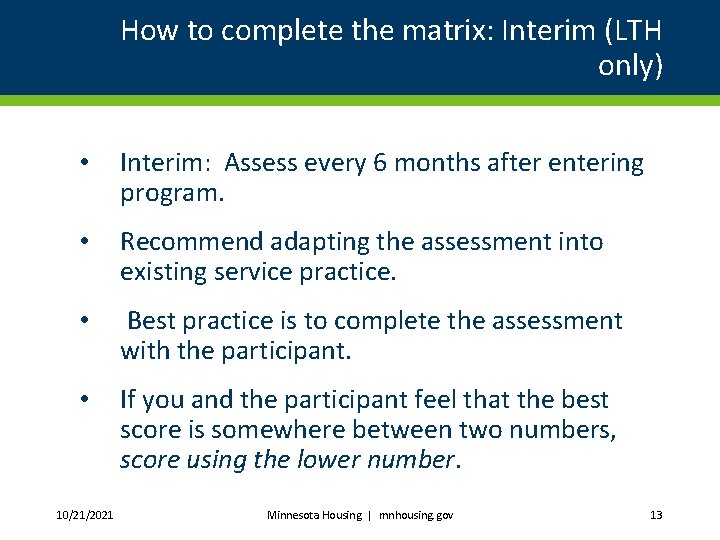
How to complete the matrix: Interim (LTH only) • Interim: Assess every 6 months after entering program. • Recommend adapting the assessment into existing service practice. • Best practice is to complete the assessment with the participant. • If you and the participant feel that the best score is somewhere between two numbers, score using the lower number. 10/21/2021 Minnesota Housing | mnhousing. gov 13
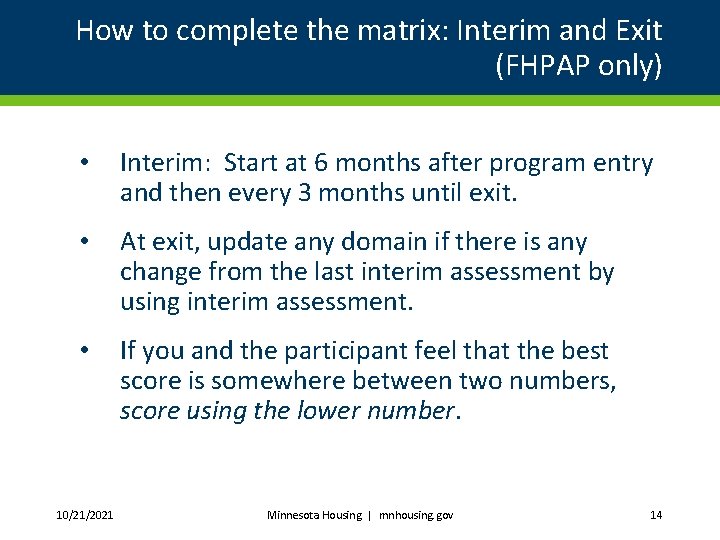
How to complete the matrix: Interim and Exit (FHPAP only) • Interim: Start at 6 months after program entry and then every 3 months until exit. • At exit, update any domain if there is any change from the last interim assessment by using interim assessment. • If you and the participant feel that the best score is somewhere between two numbers, score using the lower number. 10/21/2021 Minnesota Housing | mnhousing. gov 14
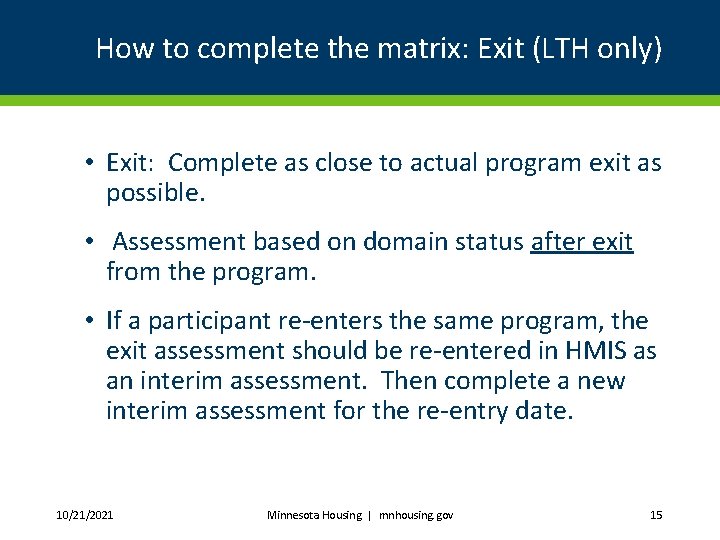
How to complete the matrix: Exit (LTH only) • Exit: Complete as close to actual program exit as possible. • Assessment based on domain status after exit from the program. • If a participant re-enters the same program, the exit assessment should be re-entered in HMIS as an interim assessment. Then complete a new interim assessment for the re-entry date. 10/21/2021 Minnesota Housing | mnhousing. gov 15
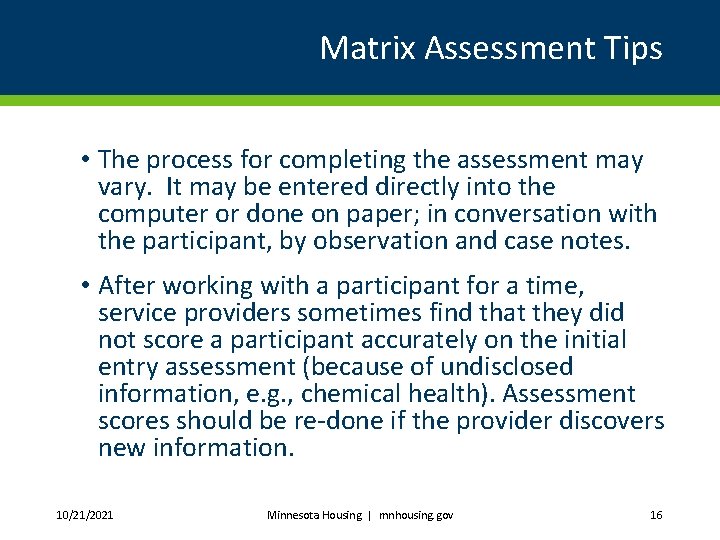
Matrix Assessment Tips • The process for completing the assessment may vary. It may be entered directly into the computer or done on paper; in conversation with the participant, by observation and case notes. • After working with a participant for a time, service providers sometimes find that they did not score a participant accurately on the initial entry assessment (because of undisclosed information, e. g. , chemical health). Assessment scores should be re-done if the provider discovers new information. 10/21/2021 Minnesota Housing | mnhousing. gov 16
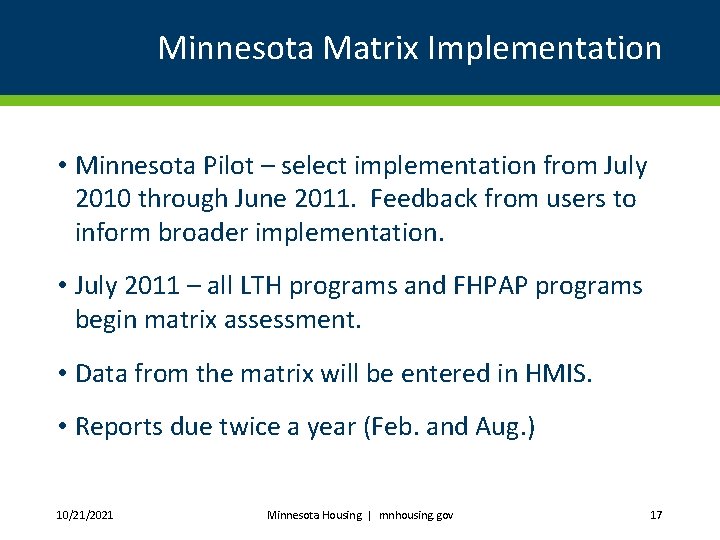
Minnesota Matrix Implementation • Minnesota Pilot – select implementation from July 2010 through June 2011. Feedback from users to inform broader implementation. • July 2011 – all LTH programs and FHPAP programs begin matrix assessment. • Data from the matrix will be entered in HMIS. • Reports due twice a year (Feb. and Aug. ) 10/21/2021 Minnesota Housing | mnhousing. gov 17
Self-Determination and Skills • The 18 Domains • in the Self-Sufficiency Matrix 10/21/2021 Minnesota Housing | mnhousing. gov 18
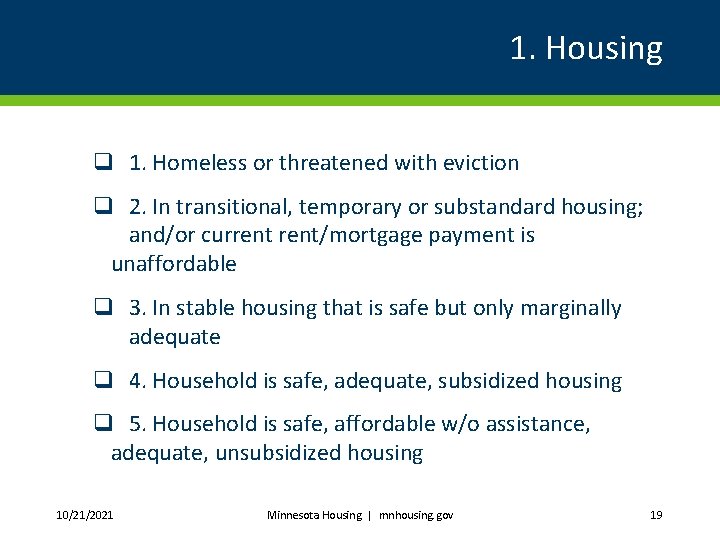
1. Housing q 1. Homeless or threatened with eviction q 2. In transitional, temporary or substandard housing; and/or current/mortgage payment is unaffordable q 3. In stable housing that is safe but only marginally adequate q 4. Household is safe, adequate, subsidized housing q 5. Household is safe, affordable w/o assistance, adequate, unsubsidized housing 10/21/2021 Minnesota Housing | mnhousing. gov 19
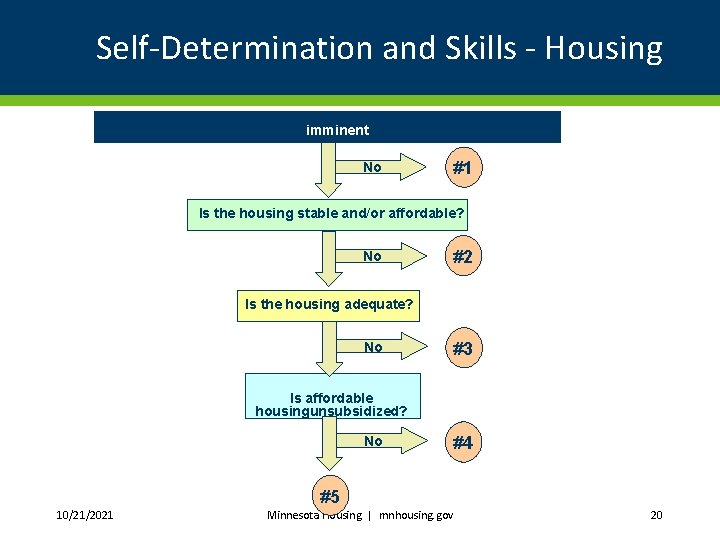
Self-Determination and Skills - Housing Is the client housed and not at imminent risk of losing that housing? No #1 Is the housing stable and/or affordable? No #2 Is the housing adequate? #3 No Is affordable housingunsubsidized? No #4 #5 10/21/2021 Minnesota Housing | mnhousing. gov 20
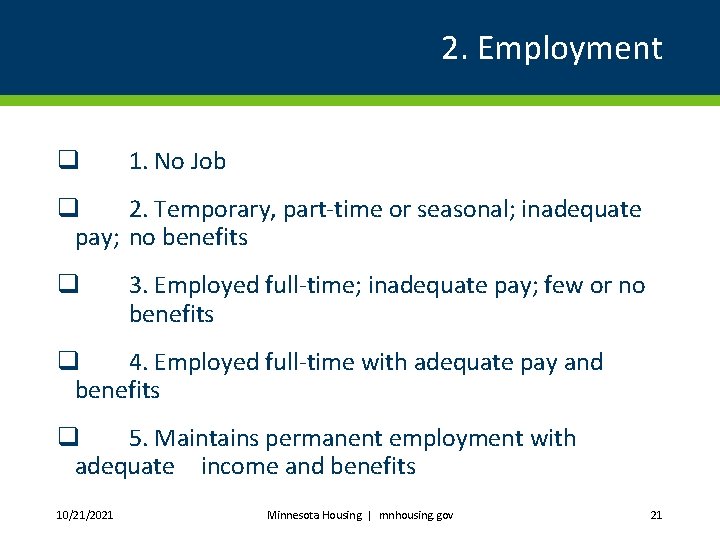
2. Employment q 1. No Job q 2. Temporary, part-time or seasonal; inadequate pay; no benefits q 3. Employed full-time; inadequate pay; few or no benefits q 4. Employed full-time with adequate pay and benefits q 5. Maintains permanent employment with adequate income and benefits 10/21/2021 Minnesota Housing | mnhousing. gov 21
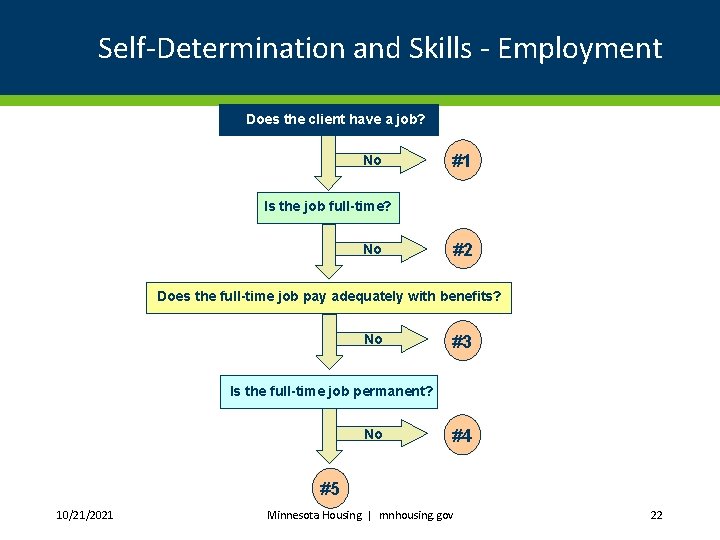
Self-Determination and Skills - Employment Does the client have a job? No #1 Is the job full-time? No #2 Does the full-time job pay adequately with benefits? No #3 Is the full-time job permanent? No #4 #5 10/21/2021 Minnesota Housing | mnhousing. gov 22
3. Income q 1. No Income q 2. Inadequate income and/or spontaneous or inappropriate spending. q 3. Can meet basic needs with subsidy; appropriate spending. (If the client is receiving income supports like SSI, but still lacks enough income to meet all basic expenses, use a 3 rating) q 4. Can meet basic needs and manage debt without assistance. (If the client is receiving income supports like SSI, and is able to balance their budget use 4) q 5. Income is sufficient, well managed; has discretionary income and is able to save. 10/21/2021 Minnesota Housing | mnhousing. gov 23
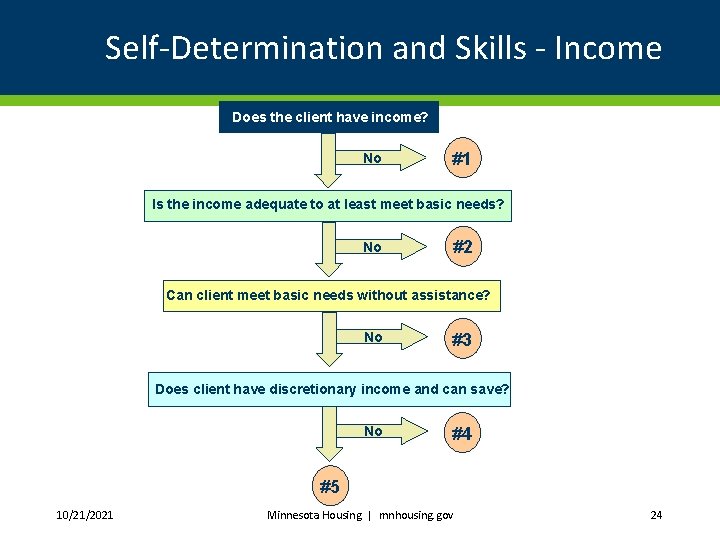
Self-Determination and Skills - Income Does the client have income? No #1 Is the income adequate to at least meet basic needs? No #2 Can client meet basic needs without assistance? No #3 Does client have discretionary income and can save? No #4 #5 10/21/2021 Minnesota Housing | mnhousing. gov 24
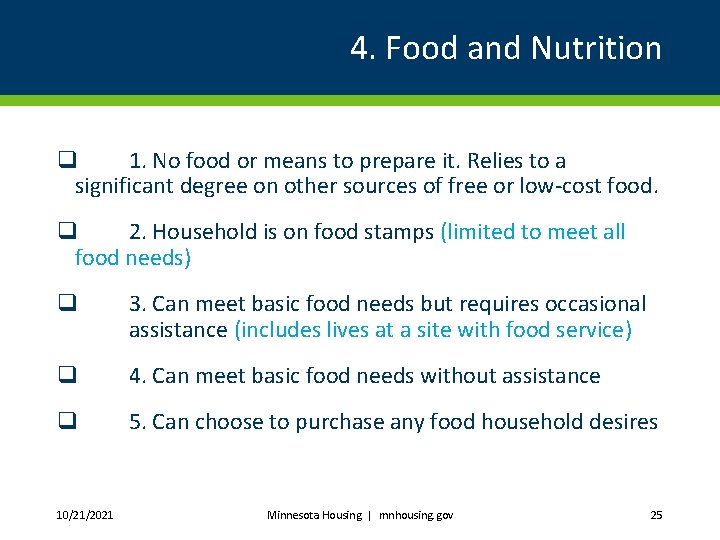
4. Food and Nutrition q 1. No food or means to prepare it. Relies to a significant degree on other sources of free or low-cost food. q 2. Household is on food stamps (limited to meet all food needs) q 3. Can meet basic food needs but requires occasional assistance (includes lives at a site with food service) q 4. Can meet basic food needs without assistance q 5. Can choose to purchase any food household desires 10/21/2021 Minnesota Housing | mnhousing. gov 25
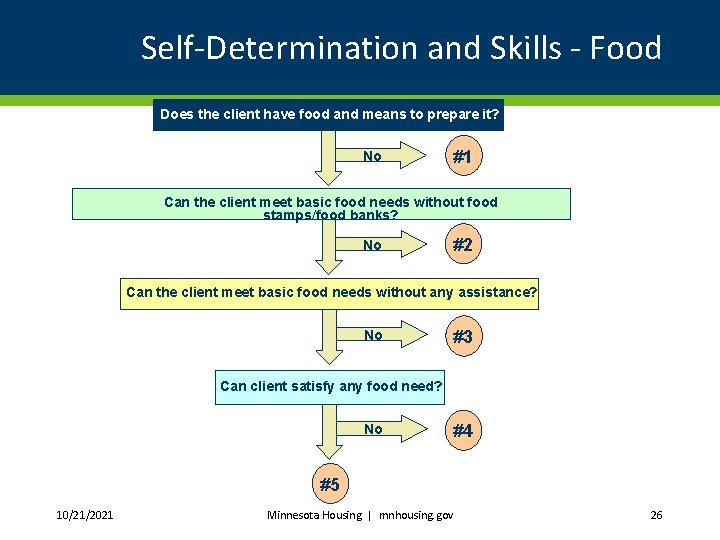
Self-Determination and Skills - Food Does the client have food and means to prepare it? No #1 Can the client meet basic food needs without food stamps/food banks? No #2 Can the client meet basic food needs without any assistance? #3 No Can client satisfy any food need? No #4 #5 10/21/2021 Minnesota Housing | mnhousing. gov 26
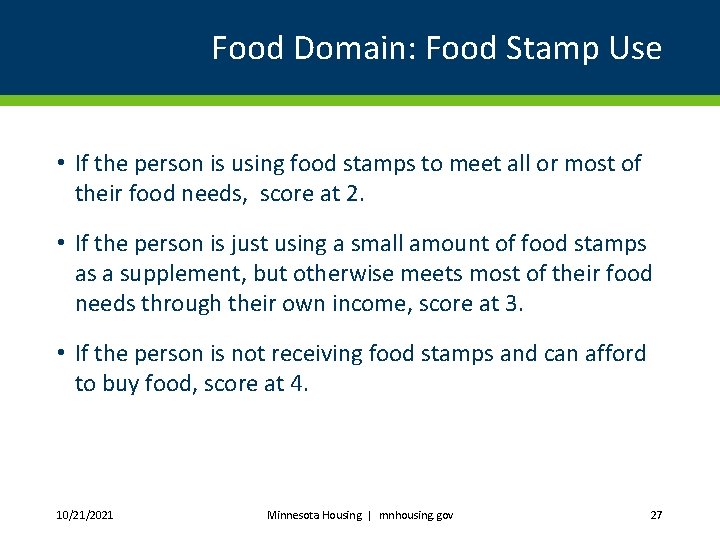
Food Domain: Food Stamp Use • If the person is using food stamps to meet all or most of their food needs, score at 2. • If the person is just using a small amount of food stamps as a supplement, but otherwise meets most of their food needs through their own income, score at 3. • If the person is not receiving food stamps and can afford to buy food, score at 4. 10/21/2021 Minnesota Housing | mnhousing. gov 27
5. Childcare q 1. Needs childcare, but none is available/accessible and/or child is not eligible q 2. Childcare is unreliable or unaffordable; inadequate supervision is a problem for childcare that is available q 3. Affordable subsidized childcare is available but limited q 4. Reliable, affordable childcare is available; no need for subsidies q 5. Able to select quality childcare of choice skip if no age appropriate children 10/21/2021 Minnesota Housing | mnhousing. gov 28
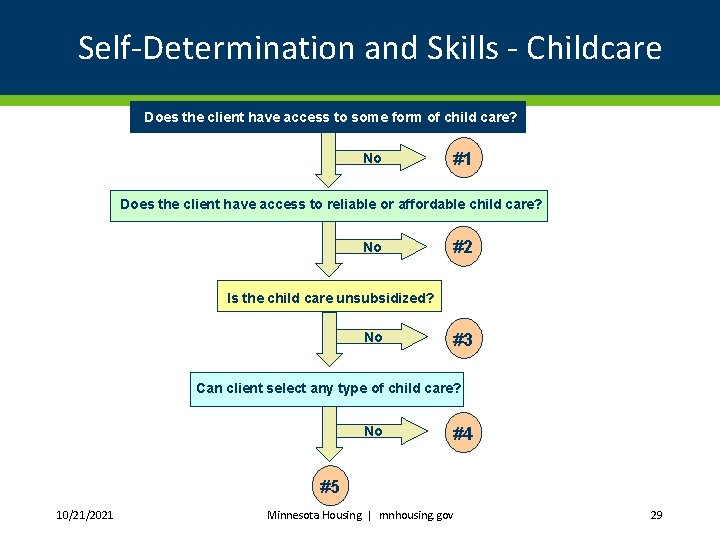
Self-Determination and Skills - Childcare Does the client have access to some form of child care? No #1 Does the client have access to reliable or affordable child care? No #2 Is the child care unsubsidized? #3 No Can client select any type of child care? No #4 #5 10/21/2021 Minnesota Housing | mnhousing. gov 29
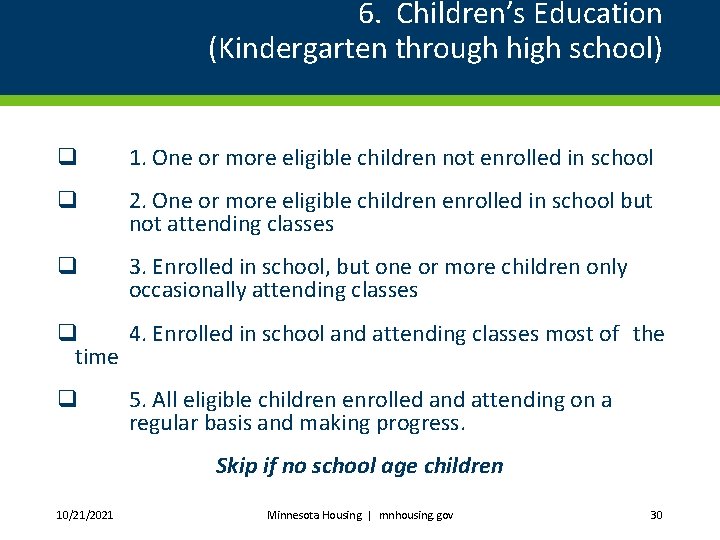
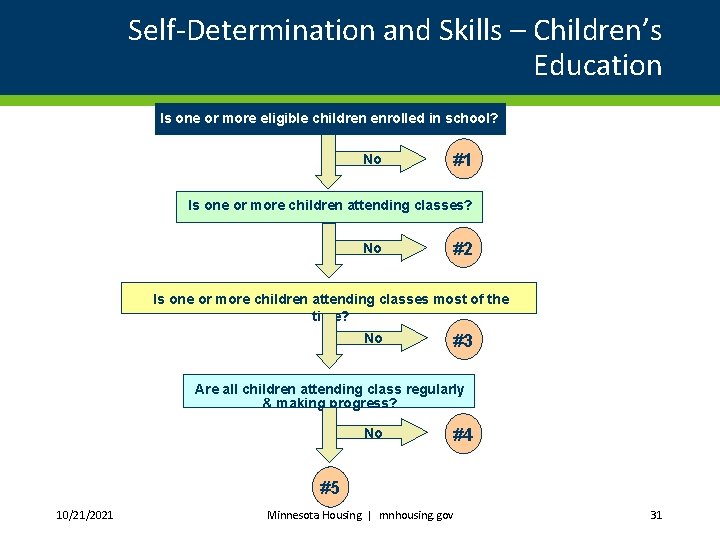
6. Children’s Education (Kindergarten through high school) q 1. One or more eligible children not enrolled in school q 2. One or more eligible children enrolled in school but not attending classes q 3. Enrolled in school, but one or more children only occasionally attending classes q 4. Enrolled in school and attending classes most of the time q 5. All eligible children enrolled and attending on a regular basis and making progress. Skip if no school age children 10/21/2021 Minnesota Housing | mnhousing. gov 30
Self-Determination and Skills – Children’s Education Is one or more eligible children enrolled in school? No #1 Is one or more children attending classes? No #2 Is one or more children attending classes most of the time? #3 No Are all children attending class regularly & making progress? No #4 #5 10/21/2021 Minnesota Housing | mnhousing. gov 31
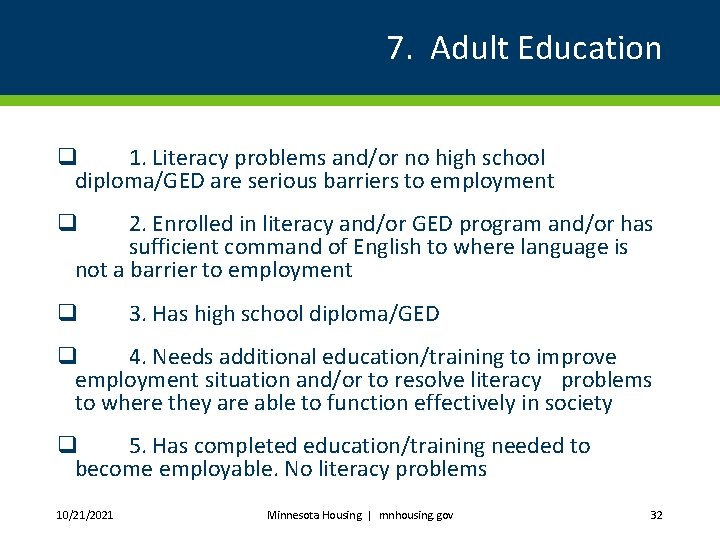
7. Adult Education q 1. Literacy problems and/or no high school diploma/GED are serious barriers to employment 2. Enrolled in literacy and/or GED program and/or has sufficient command of English to where language is not a barrier to employment q q 3. Has high school diploma/GED q 4. Needs additional education/training to improve employment situation and/or to resolve literacy problems to where they are able to function effectively in society q 5. Has completed education/training needed to become employable. No literacy problems 10/21/2021 Minnesota Housing | mnhousing. gov 32
Self-Determination and Skills – Adult Education Does the client have a high school diploma or GED? No Is literacy a serious barrier to employment? Yes #1 #2 Does the client have the education/literacy skills to function effectively in society? No #3 Has the client completed education/training needed to become employable? No 10/21/2021 #5 #4 33
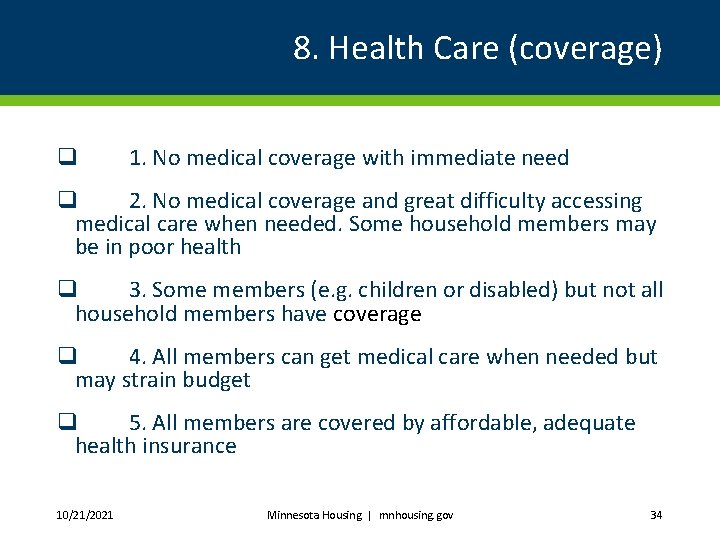
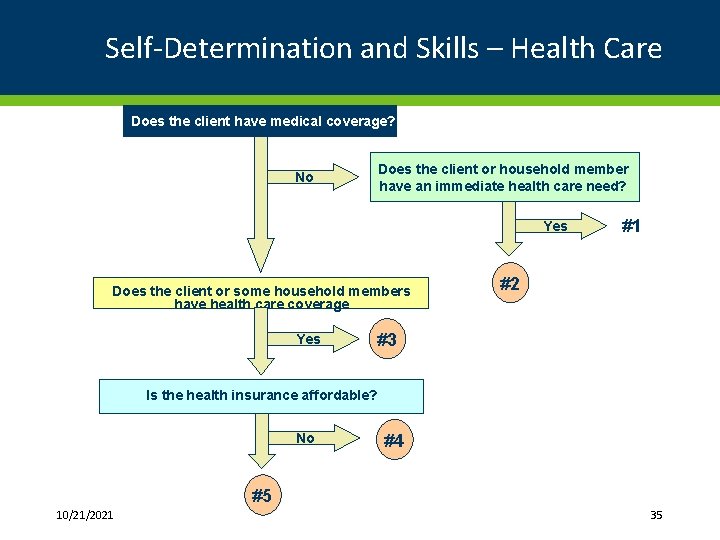
8. Health Care (coverage) q 1. No medical coverage with immediate need q 2. No medical coverage and great difficulty accessing medical care when needed. Some household members may be in poor health q 3. Some members (e. g. children or disabled) but not all household members have coverage q 4. All members can get medical care when needed but may strain budget q 5. All members are covered by affordable, adequate health insurance 10/21/2021 Minnesota Housing | mnhousing. gov 34
Self-Determination and Skills – Health Care Does the client have medical coverage? Does the client or household member have an immediate health care need? No Yes Does the client or some household members have health care coverage Yes #1 #2 #3 Is the health insurance affordable? No #4 #5 10/21/2021 35
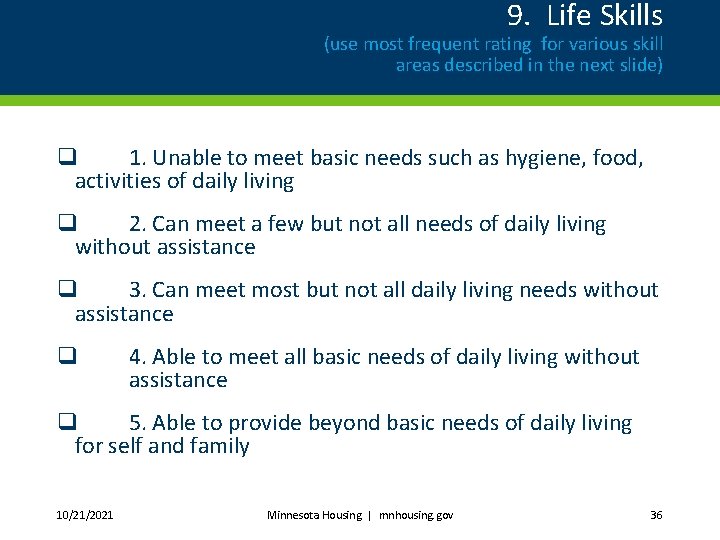
9. Life Skills (use most frequent rating for various skill areas described in the next slide) q 1. Unable to meet basic needs such as hygiene, food, activities of daily living q 2. Can meet a few but not all needs of daily living without assistance q 3. Can meet most but not all daily living needs without assistance q 4. Able to meet all basic needs of daily living without assistance q 5. Able to provide beyond basic needs of daily living for self and family 10/21/2021 Minnesota Housing | mnhousing. gov 36
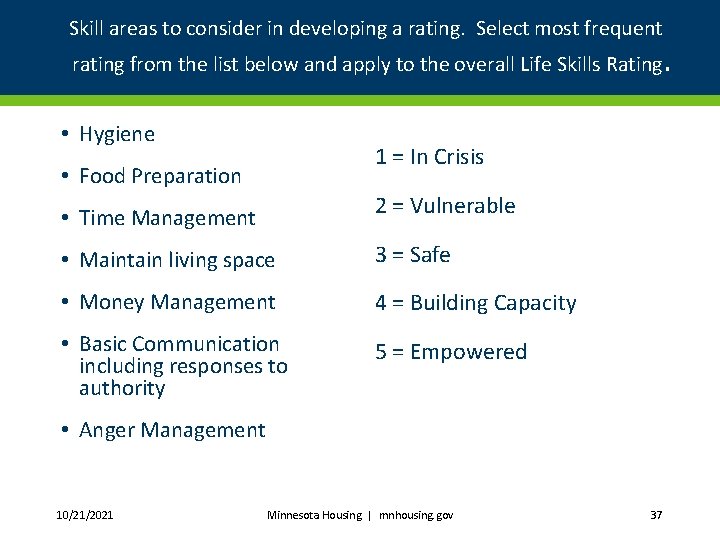
Skill areas to consider in developing a rating. Select most frequent rating from the list below and apply to the overall Life Skills Rating • Hygiene 1 = In Crisis • Food Preparation 2 = Vulnerable • Time Management • Maintain living space 3 = Safe • Money Management 4 = Building Capacity • Basic Communication including responses to authority 5 = Empowered • Anger Management 10/21/2021 Minnesota Housing | mnhousing. gov 37 .
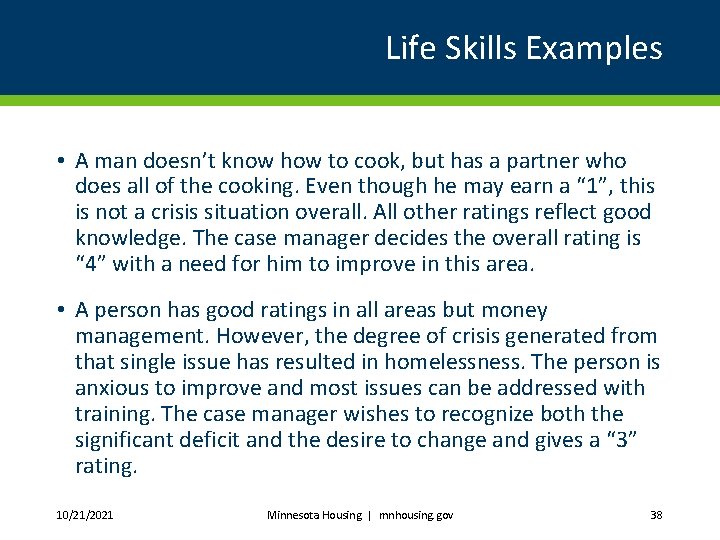
Life Skills Examples • A man doesn’t know how to cook, but has a partner who does all of the cooking. Even though he may earn a “ 1”, this is not a crisis situation overall. All other ratings reflect good knowledge. The case manager decides the overall rating is “ 4” with a need for him to improve in this area. • A person has good ratings in all areas but money management. However, the degree of crisis generated from that single issue has resulted in homelessness. The person is anxious to improve and most issues can be addressed with training. The case manager wishes to recognize both the significant deficit and the desire to change and gives a “ 3” rating. 10/21/2021 Minnesota Housing | mnhousing. gov 38
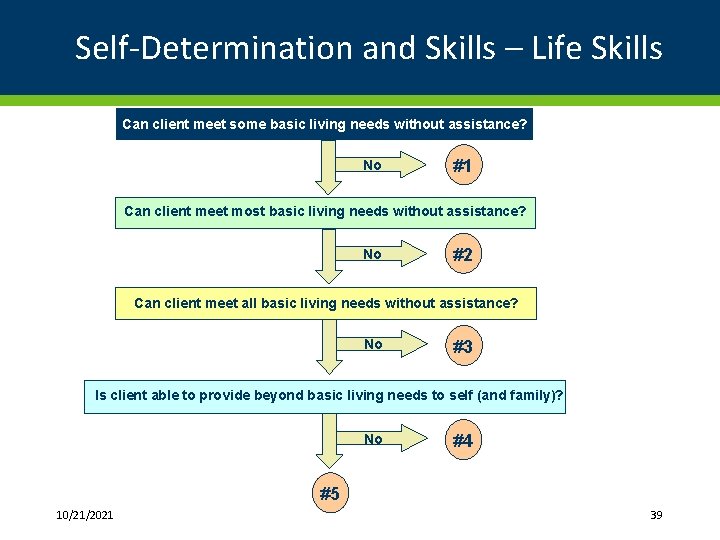
Self-Determination and Skills – Life Skills Can client meet some basic living needs without assistance? No #1 Can client meet most basic living needs without assistance? No #2 Can client meet all basic living needs without assistance? No #3 Is client able to provide beyond basic living needs to self (and family)? No #4 #5 10/21/2021 39
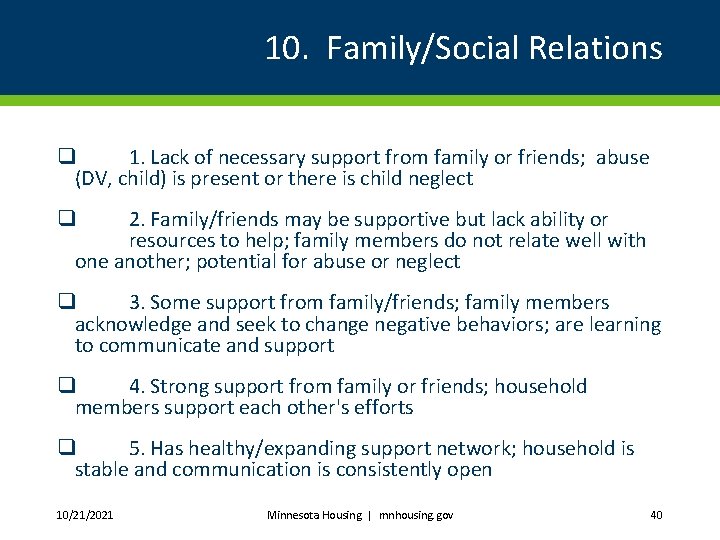
10. Family/Social Relations q 1. Lack of necessary support from family or friends; abuse (DV, child) is present or there is child neglect 2. Family/friends may be supportive but lack ability or resources to help; family members do not relate well with one another; potential for abuse or neglect q q 3. Some support from family/friends; family members acknowledge and seek to change negative behaviors; are learning to communicate and support q 4. Strong support from family or friends; household members support each other's efforts q 5. Has healthy/expanding support network; household is stable and communication is consistently open 10/21/2021 Minnesota Housing | mnhousing. gov 40
Self-Determination and Skills – Family Relations Does client have support from family or friends? No #1 Do family/friends relate well and are active in changing negative behaviors? No #2 No #3 Is the support network expanding? No #4 #5 10/21/2021 41
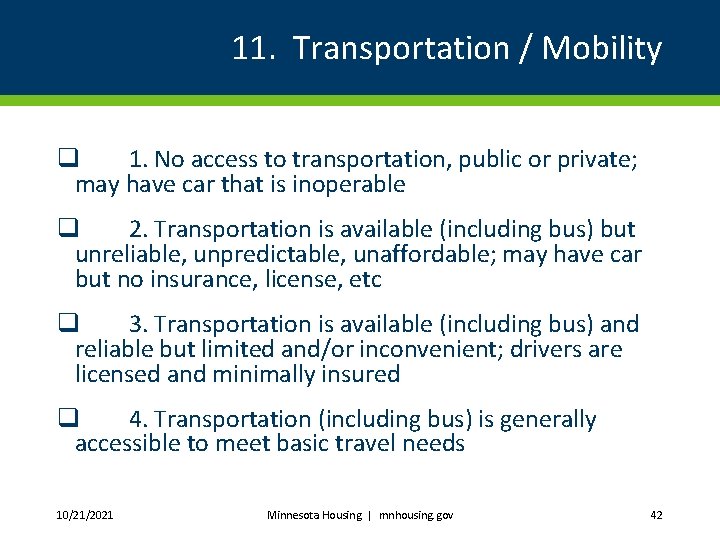
11. Transportation / Mobility q 1. No access to transportation, public or private; may have car that is inoperable q 2. Transportation is available (including bus) but unreliable, unpredictable, unaffordable; may have car but no insurance, license, etc q 3. Transportation is available (including bus) and reliable but limited and/or inconvenient; drivers are licensed and minimally insured q 4. Transportation (including bus) is generally accessible to meet basic travel needs 10/21/2021 Minnesota Housing | mnhousing. gov 42
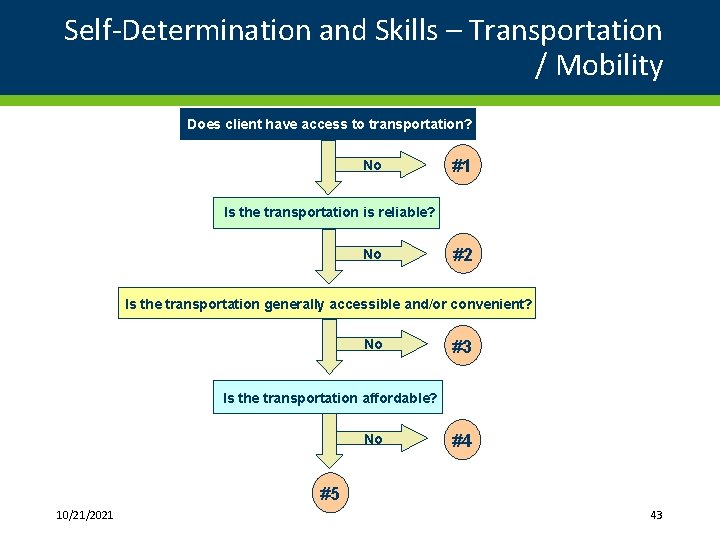
Self-Determination and Skills – Transportation / Mobility Does client have access to transportation? No #1 Is the transportation is reliable? No #2 Is the transportation generally accessible and/or convenient? No #3 Is the transportation affordable? No #4 #5 10/21/2021 43
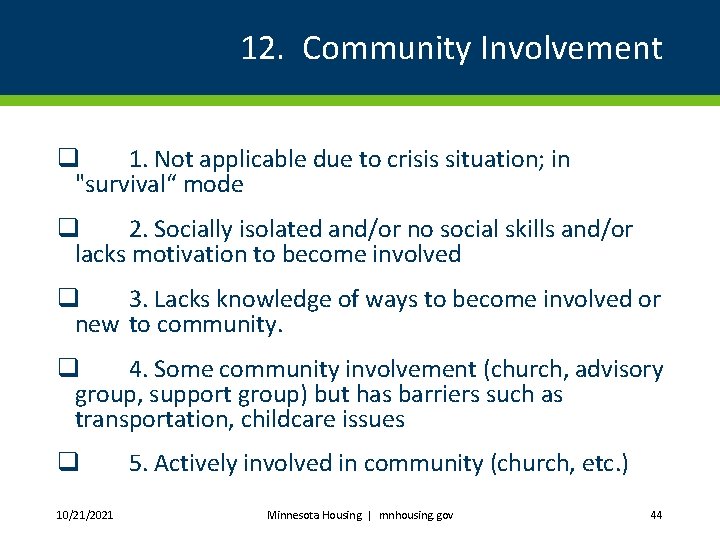
12. Community Involvement q 1. Not applicable due to crisis situation; in "survival“ mode q 2. Socially isolated and/or no social skills and/or lacks motivation to become involved q 3. Lacks knowledge of ways to become involved or new to community. q 4. Some community involvement (church, advisory group, support group) but has barriers such as transportation, childcare issues q 10/21/2021 5. Actively involved in community (church, etc. ) Minnesota Housing | mnhousing. gov 44
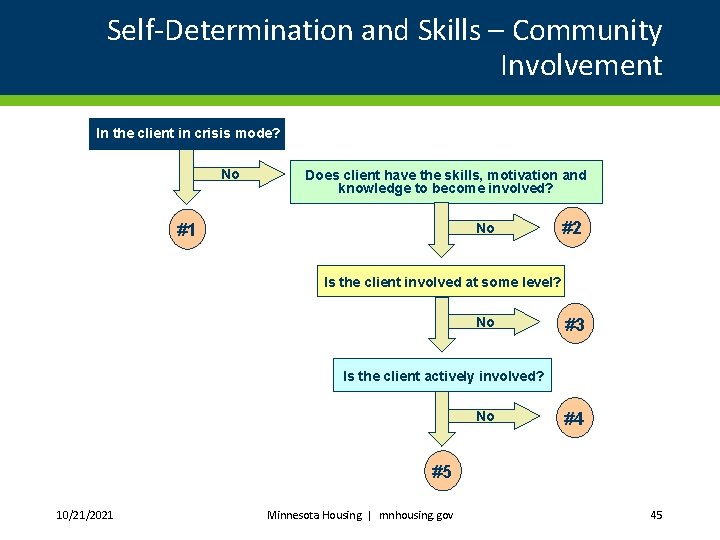
Self-Determination and Skills – Community Involvement In the client in crisis mode? No Does client have the skills, motivation and knowledge to become involved? #1 No #2 Is the client involved at some level? No #3 Is the client actively involved? No #4 #5 10/21/2021 Minnesota Housing | mnhousing. gov 45
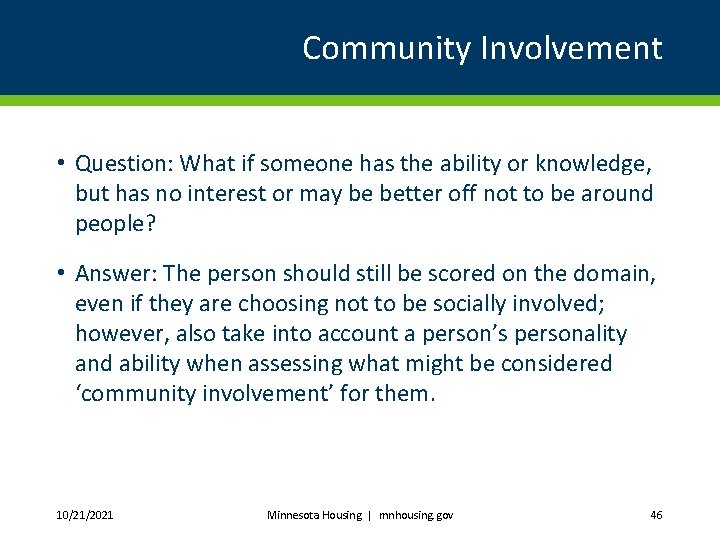
Community Involvement • Question: What if someone has the ability or knowledge, but has no interest or may be better off not to be around people? • Answer: The person should still be scored on the domain, even if they are choosing not to be socially involved; however, also take into account a person’s personality and ability when assessing what might be considered ‘community involvement’ for them. 10/21/2021 Minnesota Housing | mnhousing. gov 46
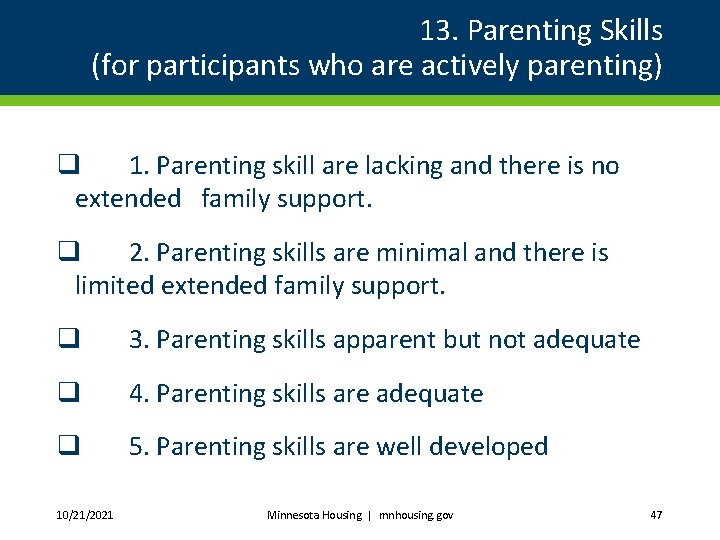
13. Parenting Skills (for participants who are actively parenting) q 1. Parenting skill are lacking and there is no extended family support. q 2. Parenting skills are minimal and there is limited extended family support. q 3. Parenting skills apparent but not adequate q 4. Parenting skills are adequate q 5. Parenting skills are well developed 10/21/2021 Minnesota Housing | mnhousing. gov 47
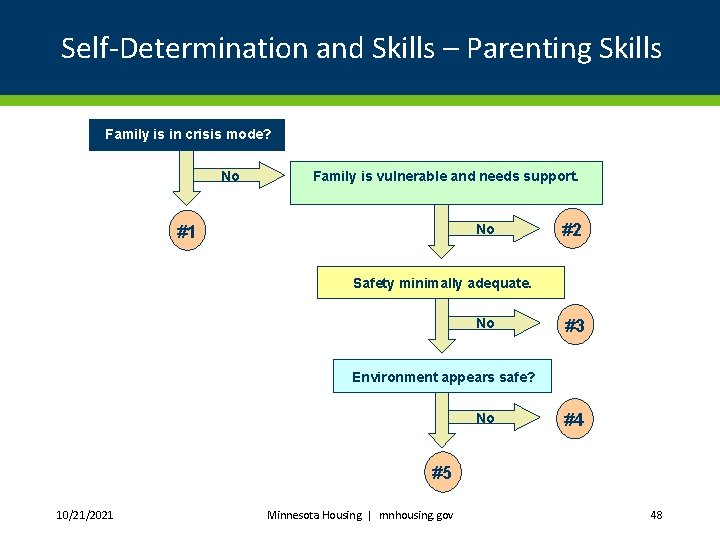
Self-Determination and Skills – Parenting Skills Family is in crisis mode? No Family is vulnerable and needs support. #1 No #2 Safety minimally adequate. No #3 Environment appears safe? No #4 #5 10/21/2021 Minnesota Housing | mnhousing. gov 48
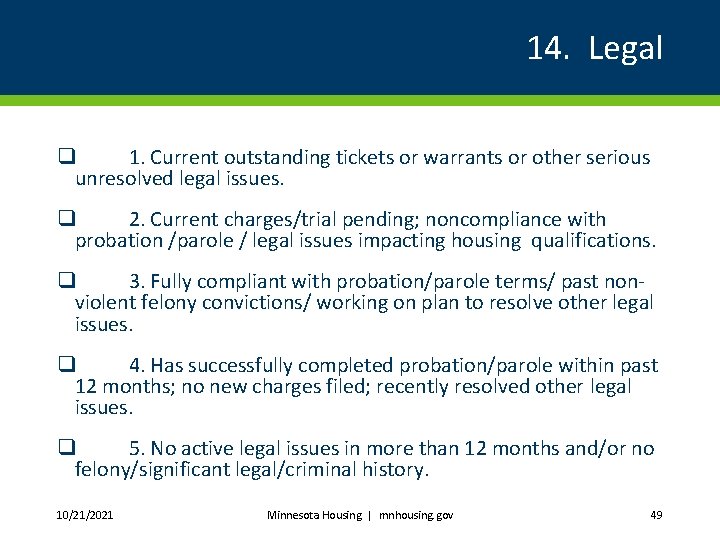
14. Legal q 1. Current outstanding tickets or warrants or other serious unresolved legal issues. q 2. Current charges/trial pending; noncompliance with probation /parole / legal issues impacting housing qualifications. q 3. Fully compliant with probation/parole terms/ past nonviolent felony convictions/ working on plan to resolve other legal issues. q 4. Has successfully completed probation/parole within past 12 months; no new charges filed; recently resolved other legal issues. q 5. No active legal issues in more than 12 months and/or no felony/significant legal/criminal history. 10/21/2021 Minnesota Housing | mnhousing. gov 49
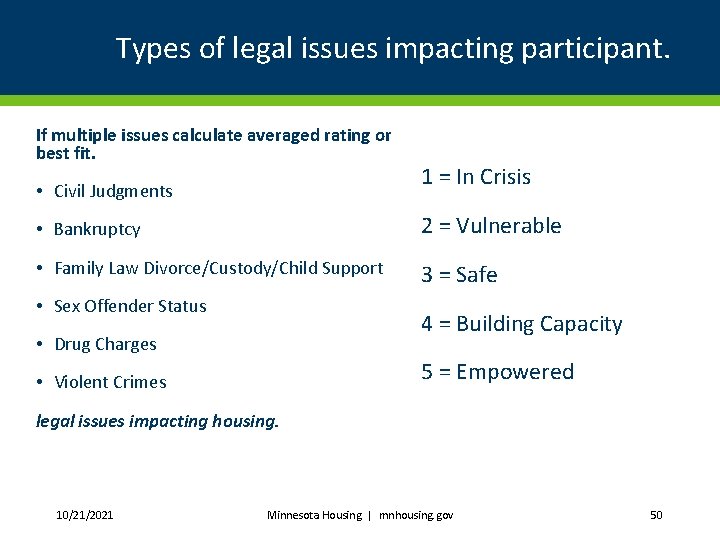
Types of legal issues impacting participant. If multiple issues calculate averaged rating or best fit. • Civil Judgments 1 = In Crisis • Bankruptcy 2 = Vulnerable • Family Law Divorce/Custody/Child Support 3 = Safe • Sex Offender Status 4 = Building Capacity • Drug Charges 5 = Empowered • Violent Crimes legal issues impacting housing. 10/21/2021 Minnesota Housing | mnhousing. gov 50
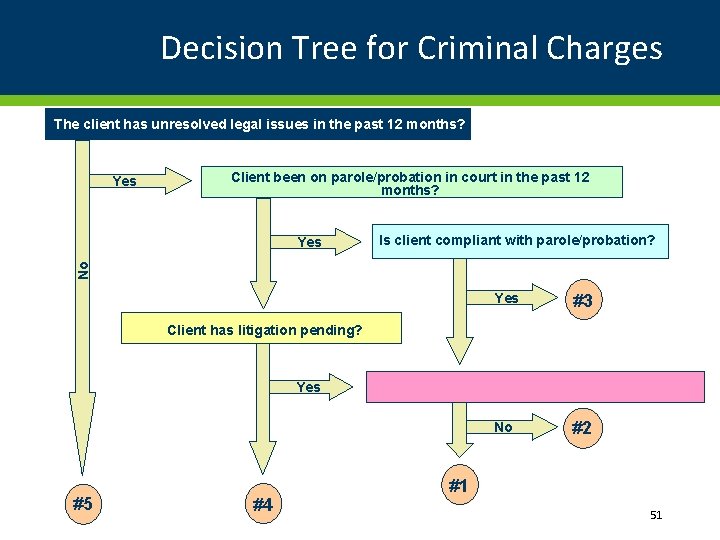
Decision Tree for Criminal Charges The client has unresolved legal issues in the past 12 months? Yes Client been on parole/probation in court in the past 12 months? Is client compliant with parole/probation? No Yes #3 No #2 Client has litigation pending? Yes #5 #4 #1 51
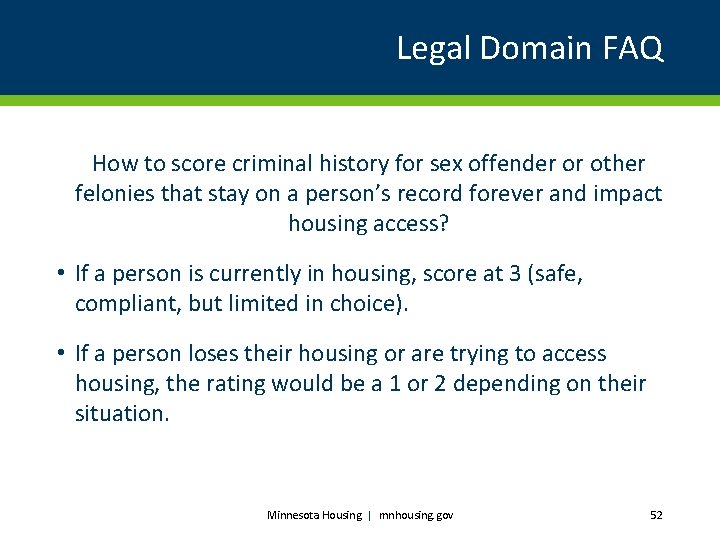
Legal Domain FAQ How to score criminal history for sex offender or other felonies that stay on a person’s record forever and impact housing access? • If a person is currently in housing, score at 3 (safe, compliant, but limited in choice). • If a person loses their housing or are trying to access housing, the rating would be a 1 or 2 depending on their situation. Minnesota Housing | mnhousing. gov 52
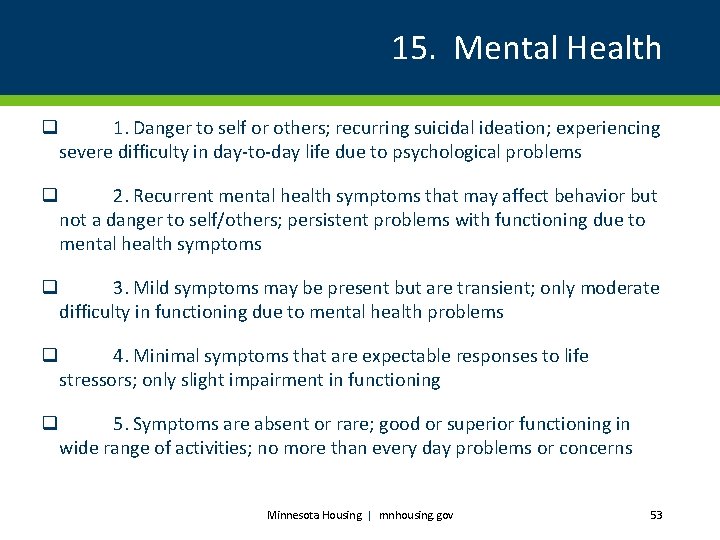
15. Mental Health q 1. Danger to self or others; recurring suicidal ideation; experiencing severe difficulty in day-to-day life due to psychological problems q 2. Recurrent mental health symptoms that may affect behavior but not a danger to self/others; persistent problems with functioning due to mental health symptoms q 3. Mild symptoms may be present but are transient; only moderate difficulty in functioning due to mental health problems q 4. Minimal symptoms that are expectable responses to life stressors; only slight impairment in functioning q 5. Symptoms are absent or rare; good or superior functioning in wide range of activities; no more than every day problems or concerns Minnesota Housing | mnhousing. gov 53
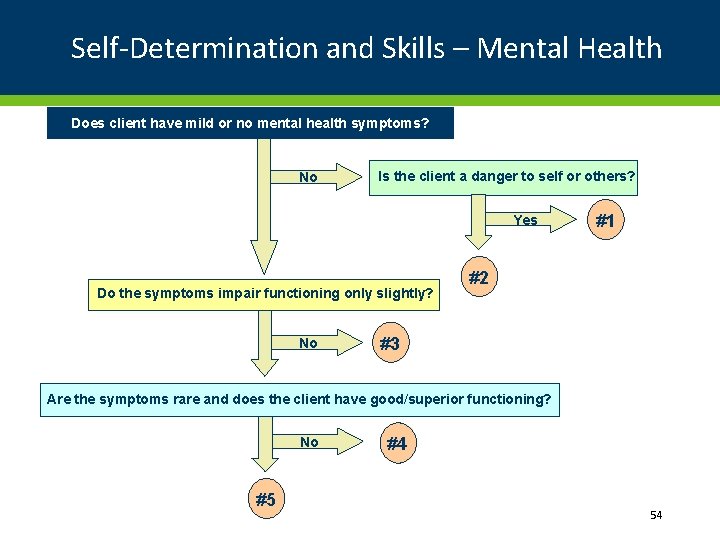
Self-Determination and Skills – Mental Health Does client have mild or no mental health symptoms? No Is the client a danger to self or others? Yes Do the symptoms impair functioning only slightly? No #1 #2 #3 Are the symptoms rare and does the client have good/superior functioning? No #5 #4 54
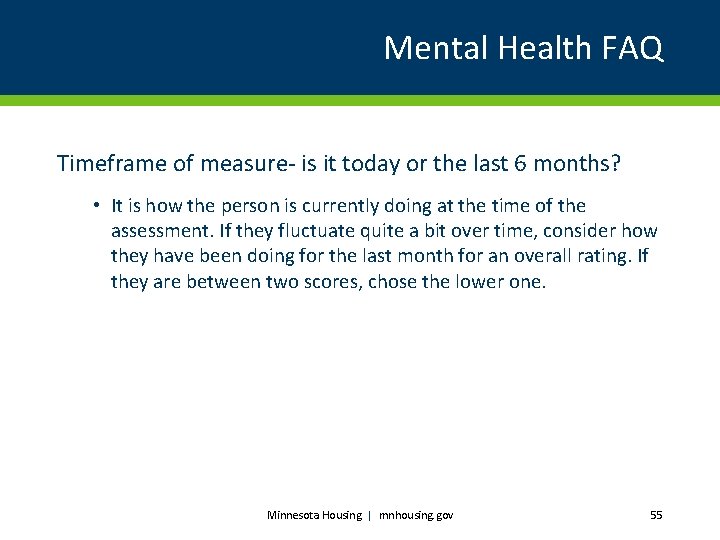
Mental Health FAQ Timeframe of measure- is it today or the last 6 months? • It is how the person is currently doing at the time of the assessment. If they fluctuate quite a bit over time, consider how they have been doing for the last month for an overall rating. If they are between two scores, chose the lower one. Minnesota Housing | mnhousing. gov 55
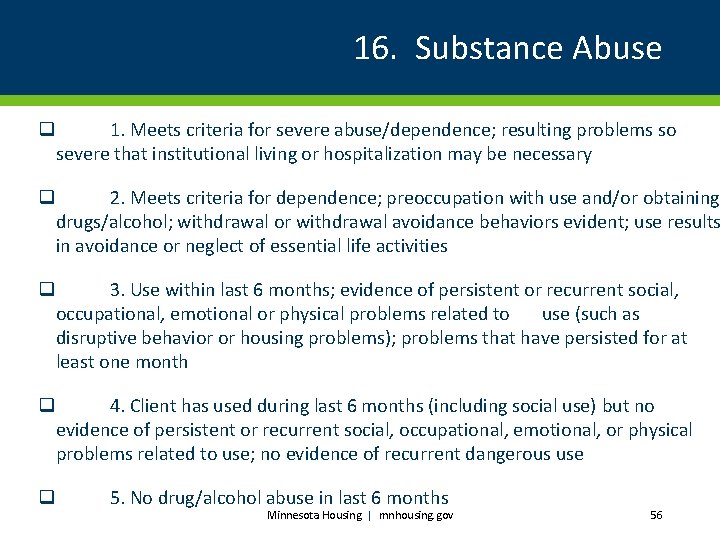
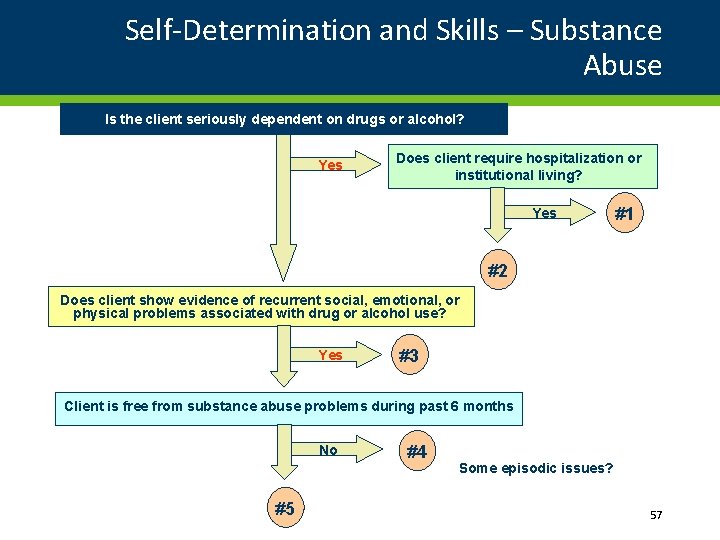
16. Substance Abuse q 1. Meets criteria for severe abuse/dependence; resulting problems so severe that institutional living or hospitalization may be necessary q 2. Meets criteria for dependence; preoccupation with use and/or obtaining drugs/alcohol; withdrawal or withdrawal avoidance behaviors evident; use results in avoidance or neglect of essential life activities q 3. Use within last 6 months; evidence of persistent or recurrent social, occupational, emotional or physical problems related to use (such as disruptive behavior or housing problems); problems that have persisted for at least one month q 4. Client has used during last 6 months (including social use) but no evidence of persistent or recurrent social, occupational, emotional, or physical problems related to use; no evidence of recurrent dangerous use q 5. No drug/alcohol abuse in last 6 months Minnesota Housing | mnhousing. gov 56
Self-Determination and Skills – Substance Abuse Is the client seriously dependent on drugs or alcohol? Yes Does client require hospitalization or institutional living? Yes #1 #2 Does client show evidence of recurrent social, emotional, or physical problems associated with drug or alcohol use? Yes #3 Client is free from substance abuse problems during past 6 months No #5 #4 Some episodic issues? 57
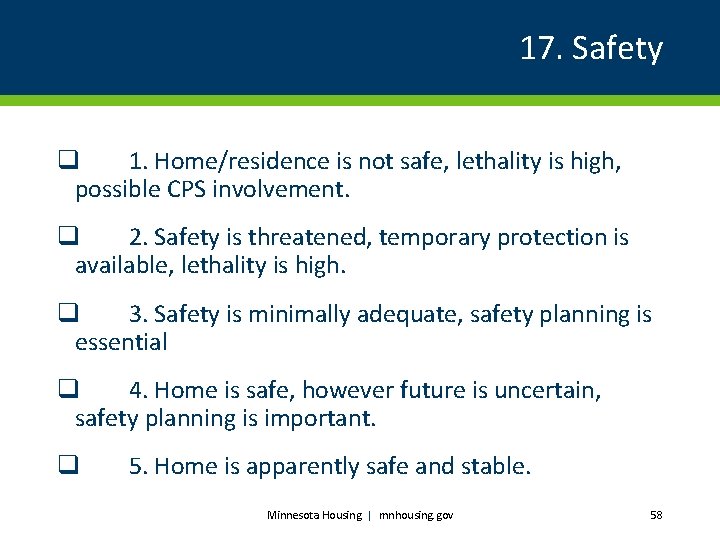
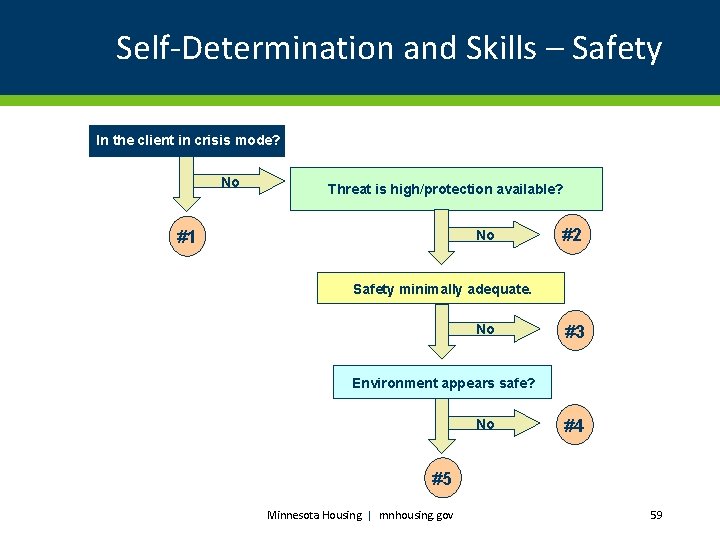
17. Safety q 1. Home/residence is not safe, lethality is high, possible CPS involvement. q 2. Safety is threatened, temporary protection is available, lethality is high. q 3. Safety is minimally adequate, safety planning is essential q 4. Home is safe, however future is uncertain, safety planning is important. q 5. Home is apparently safe and stable. Minnesota Housing | mnhousing. gov 58
Self-Determination and Skills – Safety In the client in crisis mode? No Threat is high/protection available? #1 No #2 Safety minimally adequate. No #3 Environment appears safe? No #4 #5 Minnesota Housing | mnhousing. gov 59
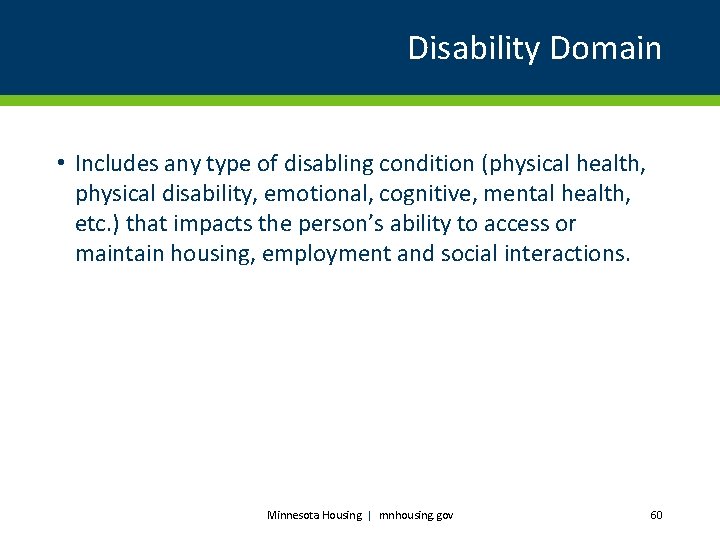
Disability Domain • Includes any type of disabling condition (physical health, physical disability, emotional, cognitive, mental health, etc. ) that impacts the person’s ability to access or maintain housing, employment and social interactions. Minnesota Housing | mnhousing. gov 60
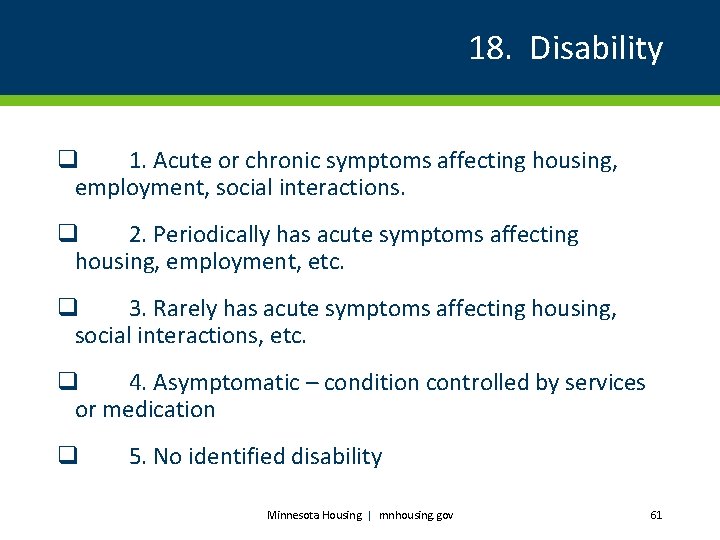
18. Disability q 1. Acute or chronic symptoms affecting housing, employment, social interactions. q 2. Periodically has acute symptoms affecting housing, employment, etc. q 3. Rarely has acute symptoms affecting housing, social interactions, etc. q 4. Asymptomatic – condition controlled by services or medication q 5. No identified disability Minnesota Housing | mnhousing. gov 61
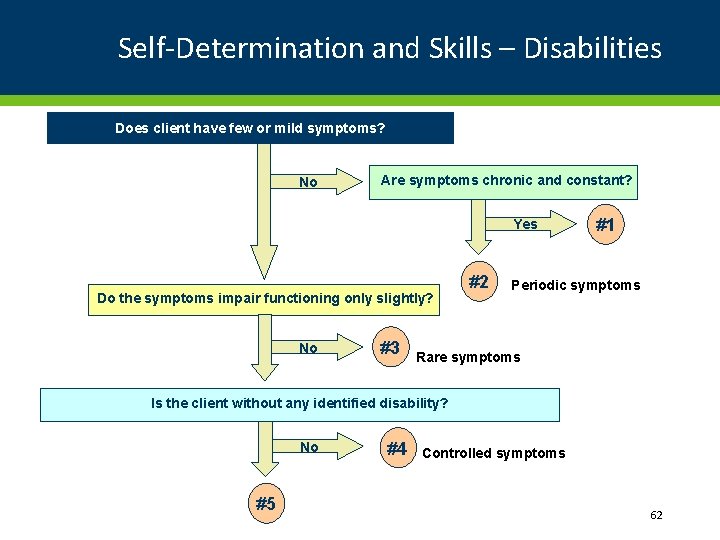
Self-Determination and Skills – Disabilities Does client have few or mild symptoms? No Are symptoms chronic and constant? Yes Do the symptoms impair functioning only slightly? No #3 #2 #1 Periodic symptoms Rare symptoms Is the client without any identified disability? No #5 #4 Controlled symptoms 62
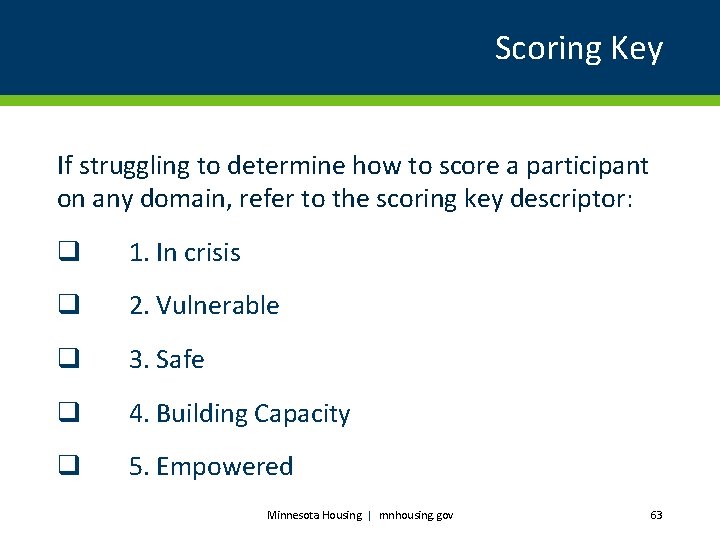
Scoring Key If struggling to determine how to score a participant on any domain, refer to the scoring key descriptor: q 1. In crisis q 2. Vulnerable q 3. Safe q 4. Building Capacity q 5. Empowered Minnesota Housing | mnhousing. gov 63
Text here Collecting Good Quality Data Minnesota Housing | mnhousing. gov 64
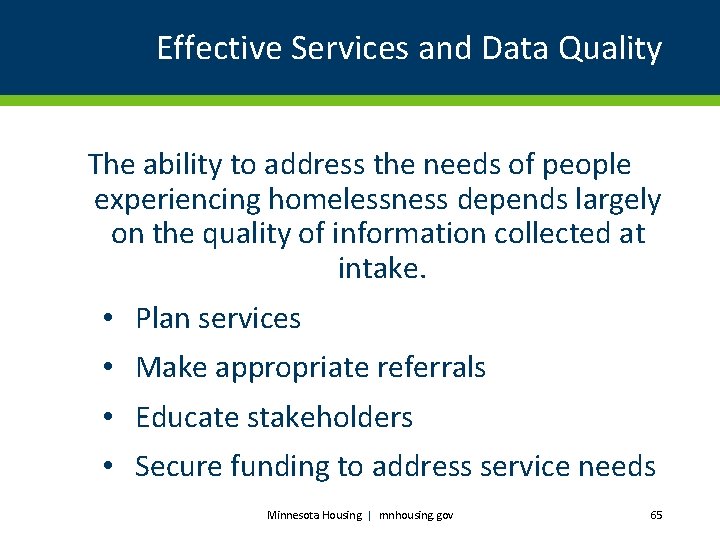
Effective Services and Data Quality The ability to address the needs of people experiencing homelessness depends largely on the quality of information collected at intake. • Plan services • Make appropriate referrals • Educate stakeholders • Secure funding to address service needs Minnesota Housing | mnhousing. gov 65
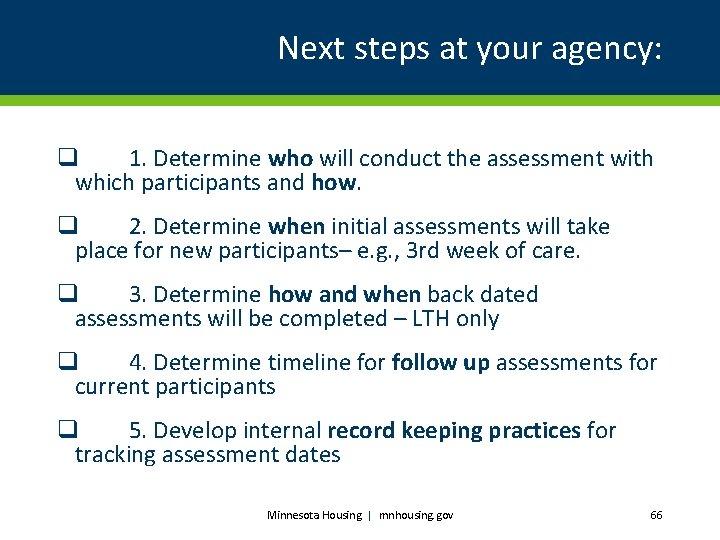
Next steps at your agency: q 1. Determine who will conduct the assessment with which participants and how. q 2. Determine when initial assessments will take place for new participants– e. g. , 3 rd week of care. q 3. Determine how and when back dated assessments will be completed – LTH only q 4. Determine timeline for follow up assessments for current participants q 5. Develop internal record keeping practices for tracking assessment dates Minnesota Housing | mnhousing. gov 66
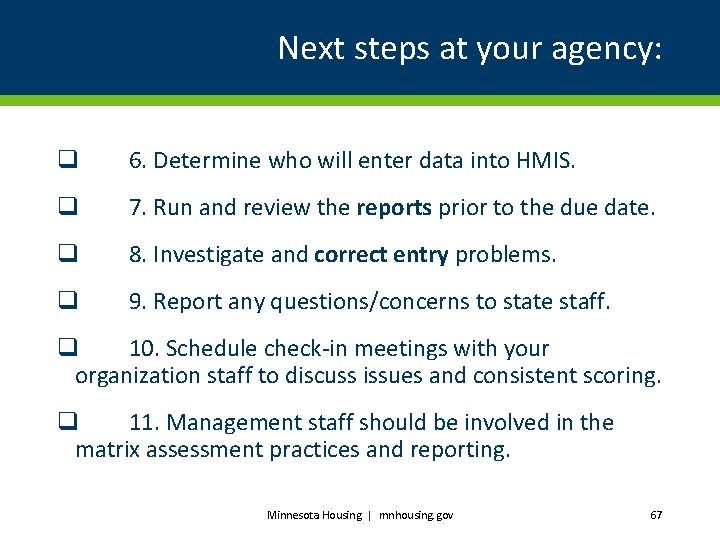
Next steps at your agency: q 6. Determine who will enter data into HMIS. q 7. Run and review the reports prior to the due date. q 8. Investigate and correct entry problems. q 9. Report any questions/concerns to state staff. q 10. Schedule check-in meetings with your organization staff to discuss issues and consistent scoring. q 11. Management staff should be involved in the matrix assessment practices and reporting. Minnesota Housing | mnhousing. gov 67
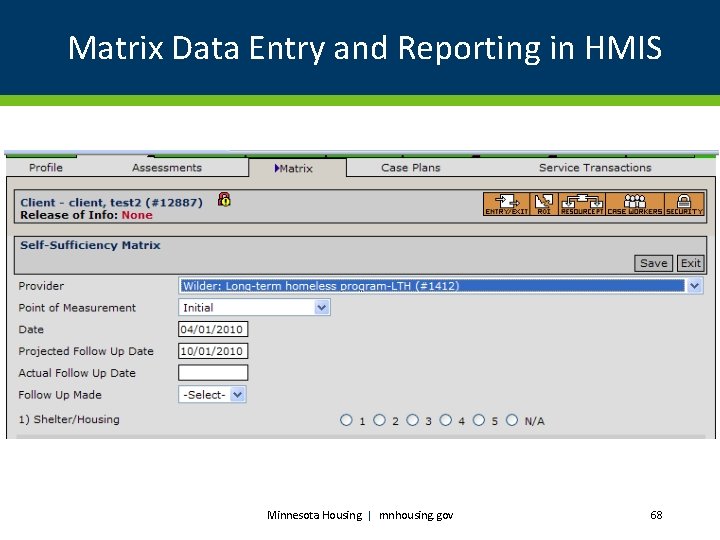
Matrix Data Entry and Reporting in HMIS Minnesota Housing | mnhousing. gov 68
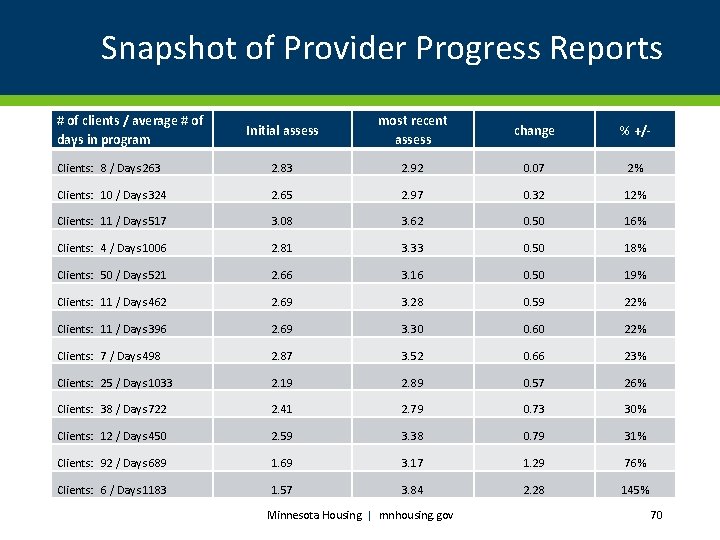
Minnesota Matrix Reports ART Reports • Individual Participant • Client Progress (1 P) and Client Achievement (2 P) • Program Summary • Domains at Population Entry (3 S) and Exit (4 S) • Progress Summary (1 -2 S) • Data Checking Minnesota Housing | mnhousing. gov 69
Snapshot of Provider Progress Reports # of clients / average # of days in program Initial assess most recent assess change % +/- Clients: 8 / Days 263 2. 83 2. 92 0. 07 2% Clients: 10 / Days 324 2. 65 2. 97 0. 32 12% Clients: 11 / Days 517 3. 08 3. 62 0. 50 16% Clients: 4 / Days 1006 2. 81 3. 33 0. 50 18% Clients: 50 / Days 521 2. 66 3. 16 0. 50 19% Clients: 11 / Days 462 2. 69 3. 28 0. 59 22% Clients: 11 / Days 396 2. 69 3. 30 0. 60 22% Clients: 7 / Days 498 2. 87 3. 52 0. 66 23% Clients: 25 / Days 1033 2. 19 2. 89 0. 57 26% Clients: 38 / Days 722 2. 41 2. 79 0. 73 30% Clients: 12 / Days 450 2. 59 3. 38 0. 79 31% Clients: 92 / Days 689 1. 69 3. 17 1. 29 76% Clients: 6 / Days 1183 1. 57 3. 84 2. 28 145% Minnesota Housing | mnhousing. gov 70
Thank you! Questions? Please contact the appropriate staff: l Ji-Young Choi l Vicki Farden l Alison Niemi (DHS) Minnesota Housing | mnhousing. gov 71