
Implementing the Northern Spotted Owl Conservation Strategy for

- Slides: 15
Implementing the Northern Spotted Owl Conservation Strategy for the Klickitat HCP Planning Unit Scott D. Mc. Leod Washington State Department of Natural Resources
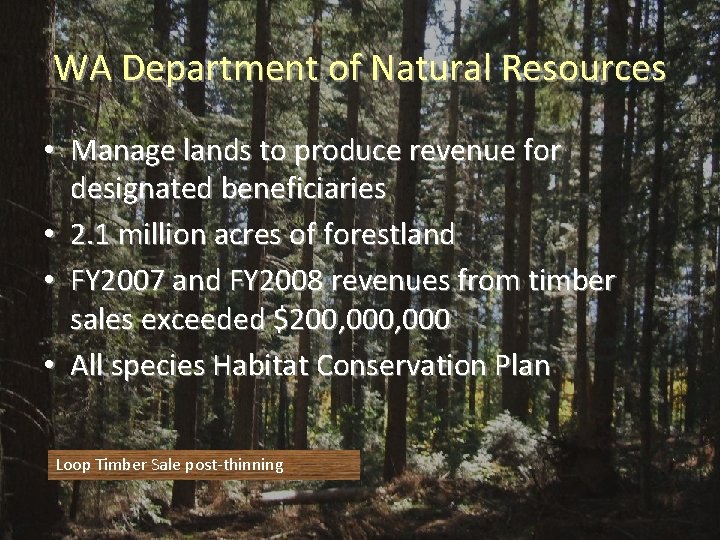
WA Department of Natural Resources • Manage lands to produce revenue for designated beneficiaries • 2. 1 million acres of forestland • FY 2007 and FY 2008 revenues from timber sales exceeded $200, 000 • All species Habitat Conservation Plan Loop Timber Sale post-thinning
HCP Conservation Objective Provide habitat that makes a significant contribution to: • demographic support, • maintenance of species distribution and • facilitation of dispersal.
Issues With Original HCP Strategy • Some designated NRF areas not ecologically suited for growing habitat • Forest health issues • Adjacent landowners managing habitat in ways not anticipated in the mid-1990 s
Ecological Underpinnings • Recognize potential conflicts between habitat targets and natural disturbance processes • Acknowledge that forest health problems are destroying habitat regardless of protection efforts • Understanding the role of succession and the transitory nature of designated habitat • Active management is required
Adaptive Management • More historic forest cover types • Active management at landscape level to promote habitat development • Shifted habitat requirement to landscapes where NRF habitat can be grown & sustained • Provided specific nest site protection • Retain large legacies • Address forest health issues
Silvicultural Prescriptions • The art and science of managing forests to accomplish objectives • Rotational prescriptions with threshold targets: – Meaningful – Measurable – Use caution with surrogates • Identify post-harvest and expected future • Stand average conditions and stand variability
HCP Landscape Strategy Use landscape units larger than WAUs Conduct long-term planning Focus on habitat development Manage for site potential based on plant association • The Stand is the operational unit • •
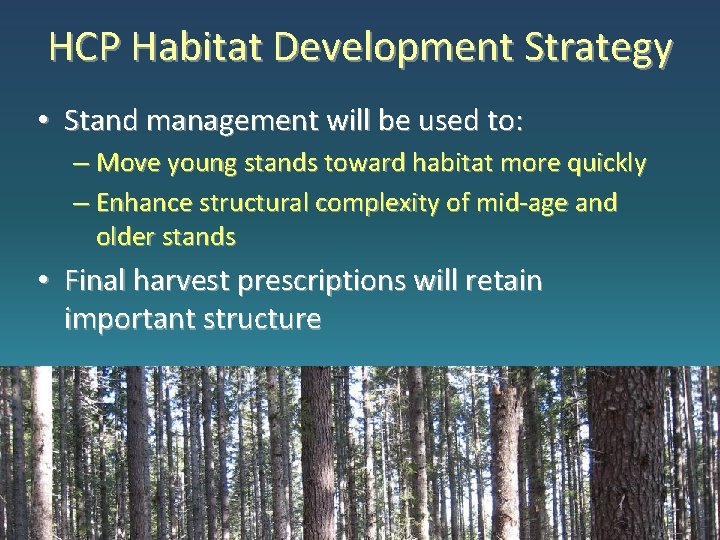
HCP Habitat Development Strategy • Stand management will be used to: – Move young stands toward habitat more quickly – Enhance structural complexity of mid-age and older stands • Final harvest prescriptions will retain important structure
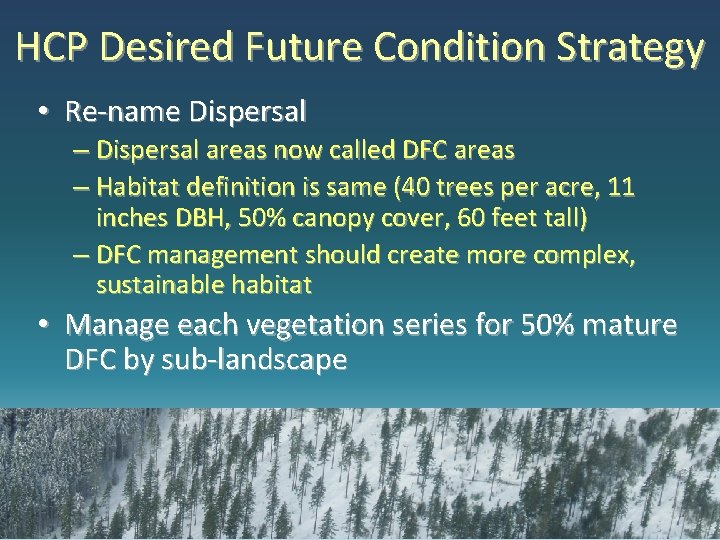
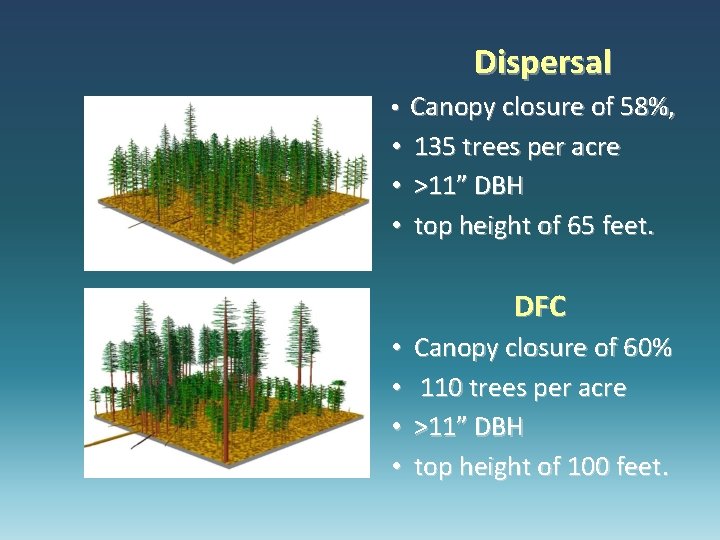
HCP Desired Future Condition Strategy • Re-name Dispersal – Dispersal areas now called DFC areas – Habitat definition is same (40 trees per acre, 11 inches DBH, 50% canopy cover, 60 feet tall) – DFC management should create more complex, sustainable habitat • Manage each vegetation series for 50% mature DFC by sub-landscape
Dispersal • Canopy closure of 58%, • 135 trees per acre • >11” DBH • top height of 65 feet. DFC • • Canopy closure of 60% 110 trees per acre >11” DBH top height of 100 feet.
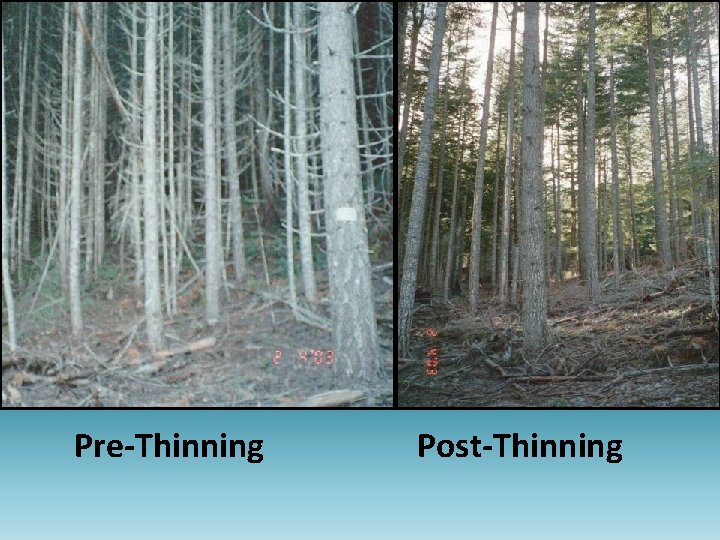
Pre-Thinning Post-Thinning
Learning Process of Small Steps • Western spruce budworm – multi-canopies – species composition • Down woody debris levels – No real reduction in fire hazard – Lost revenue due to waiting too long • Stand density still too high – Little hope for seral species to establish – Competition too high for vigorous large trees
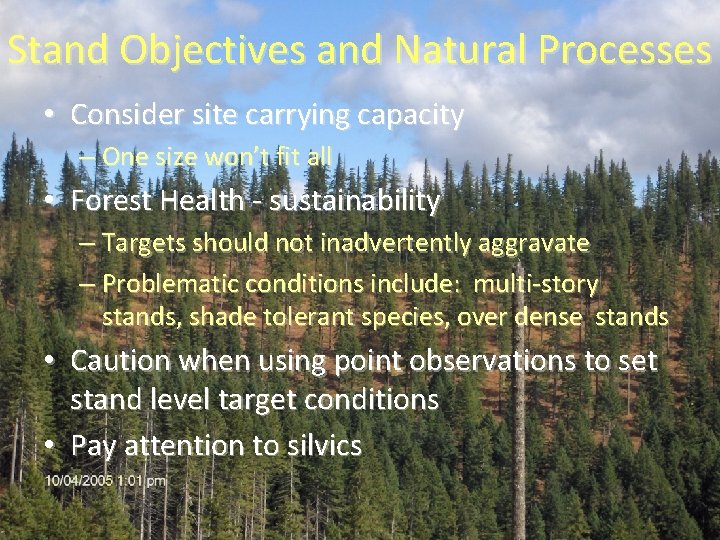
Stand Objectives and Natural Processes • Consider site carrying capacity – One size won’t fit all • Forest Health - sustainability – Targets should not inadvertently aggravate – Problematic conditions include: multi-story stands, shade tolerant species, over dense stands • Caution when using point observations to set stand level target conditions • Pay attention to silvics