
Implementing the New Framework for the Supervision and
- Slides: 82
Implementing the New Framework for the Supervision and Evaluation of Educators Day 1 Westfield Public Schools May 2 -3, 2013 Facilitator: Patricia Haggerty Consultant, Teachers 21 pjhagg@aol. com
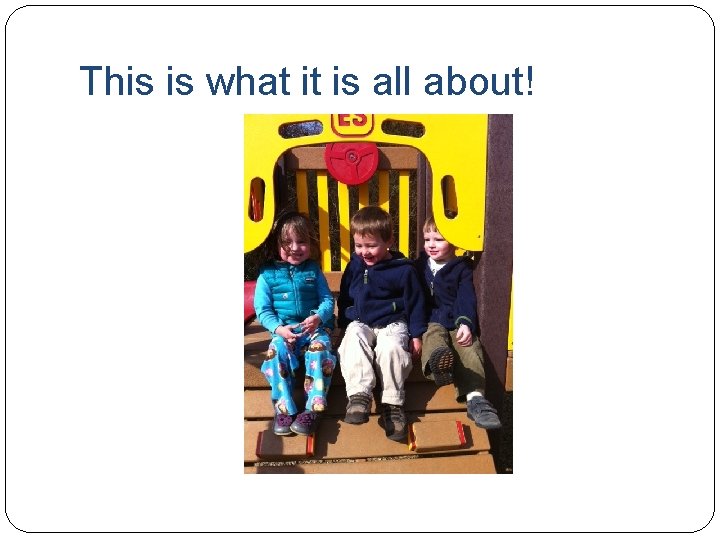
This is what it is all about!
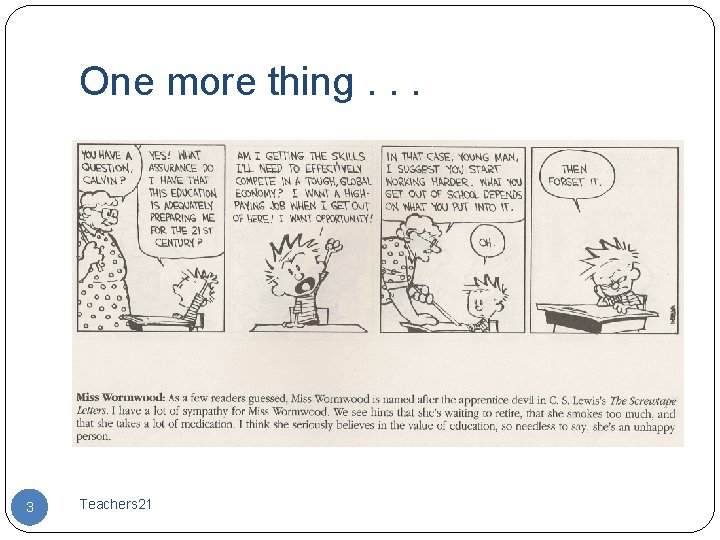
One more thing. . . 3 Teachers 21
Goals for today’s session: Continue to explore how to build trust and create a culture that encourages risk taking and selfreflection Ensure that all participants understand the purpose, goals and structure of the new Massachusetts Educator Evaluation System. Understand the aspects of the beginning of the five step cycle (self-assessment, goal setting, implementation) 4 Teachers 21
It’s about questions---your questions! 1. How do we create the mindset for all staff to embrace this system? 2. How do we create the buy in and how will we know it is changing practice? 3. How will the supervisor have the time to do this model with due diligence in order to actually bring about change? 5 Teachers 21
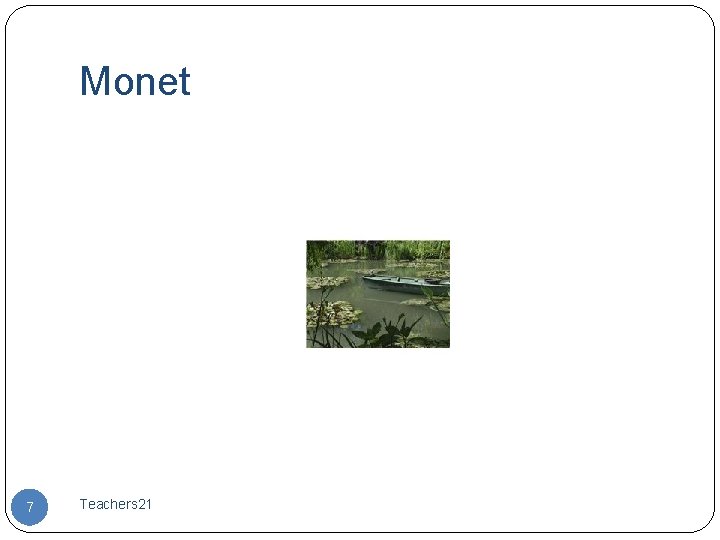
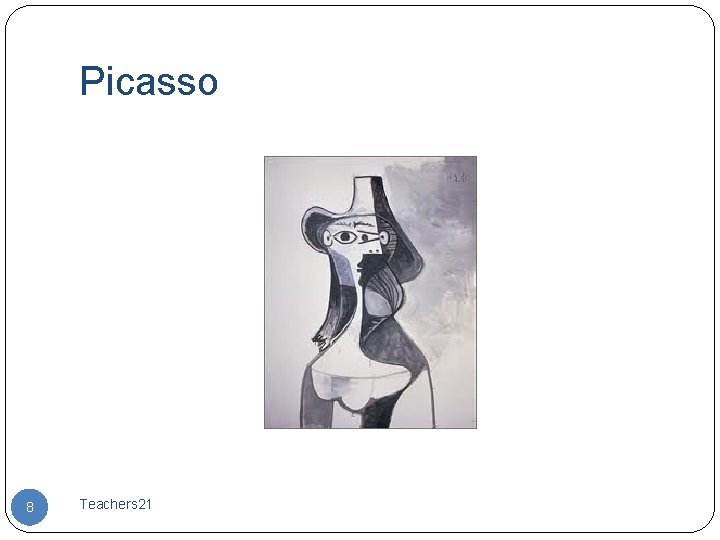
The Big Picture Think of this process as a Monet rather than a Picasso. Why? 6 Teachers 21
Monet 7 Teachers 21
Picasso 8 Teachers 21
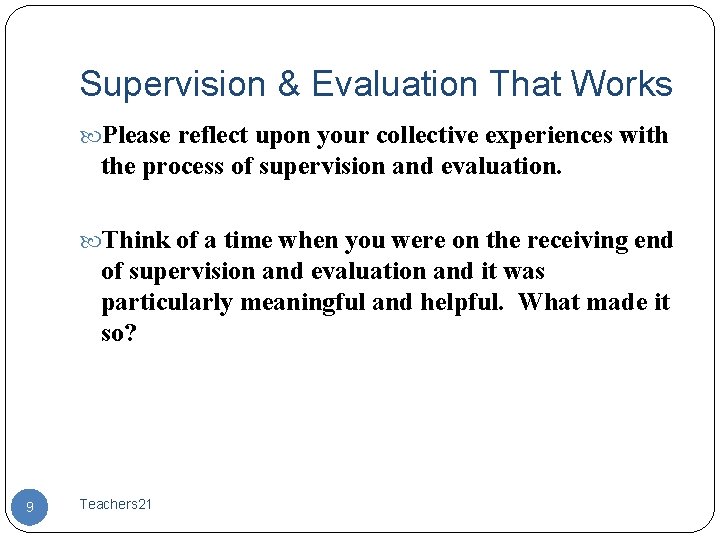
Supervision & Evaluation That Works Please reflect upon your collective experiences with the process of supervision and evaluation. Think of a time when you were on the receiving end of supervision and evaluation and it was particularly meaningful and helpful. What made it so? 9 Teachers 21
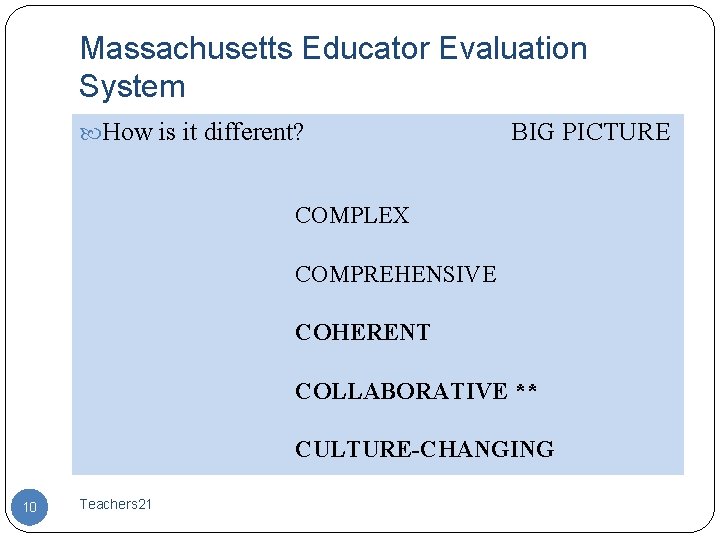
Massachusetts Educator Evaluation System How is it different? BIG PICTURE COMPLEX COMPREHENSIVE COHERENT COLLABORATIVE ** CULTURE-CHANGING 10 Teachers 21
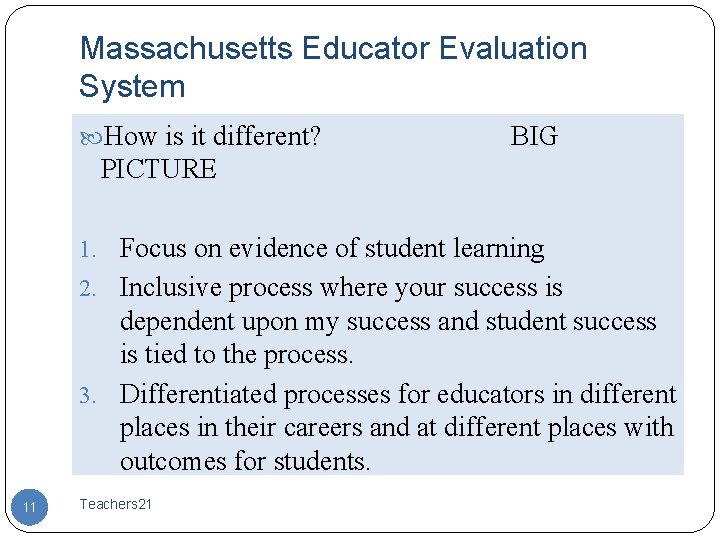
Massachusetts Educator Evaluation System How is it different? BIG PICTURE 1. Focus on evidence of student learning 2. Inclusive process where your success is dependent upon my success and student success is tied to the process. 3. Differentiated processes for educators in different places in their careers and at different places with outcomes for students. 11 Teachers 21
It is. . . COMPLEX 12 Teachers 21
By the numbers 2 3 2 1 16 5 13 Teachers 21 4, 4, 4 2 33
It is. . . COMPREHENSIVE 14 Teachers 21
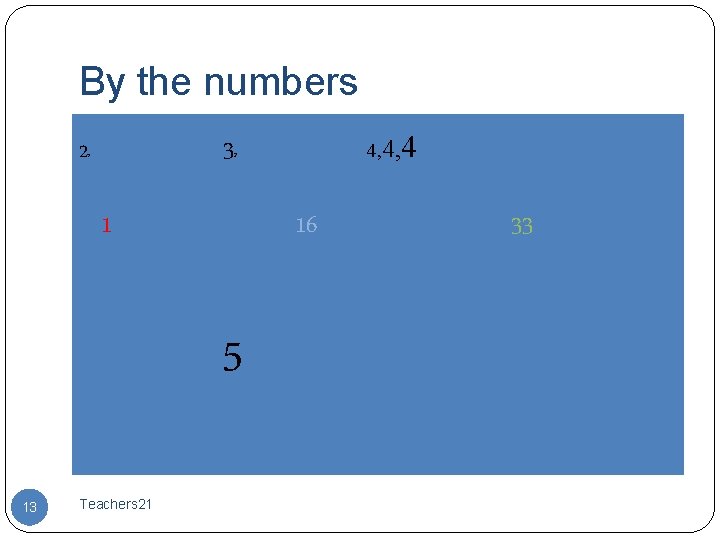
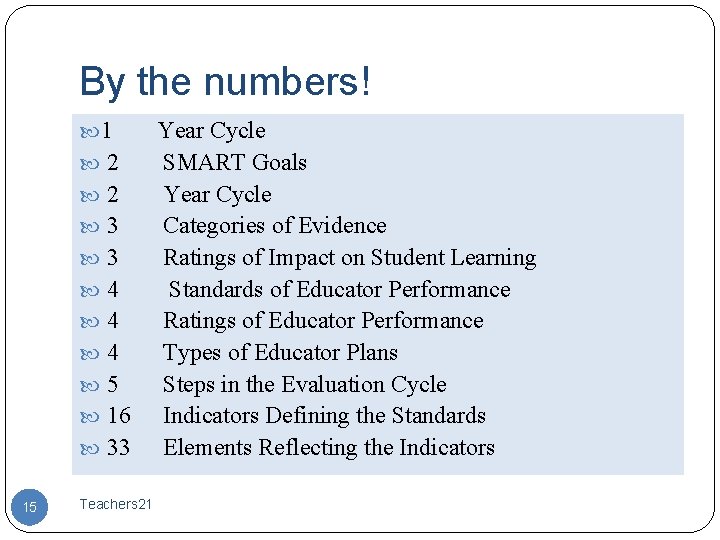
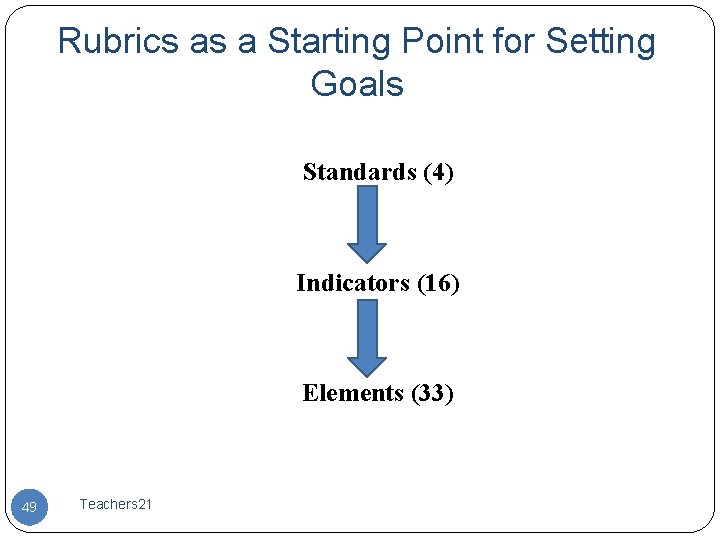
By the numbers! 1 Year Cycle 2 SMART Goals 2 Year Cycle 3 Categories of Evidence 3 Ratings of Impact on Student Learning 4 Standards of Educator Performance 4 Ratings of Educator Performance 4 Types of Educator Plans 5 Steps in the Evaluation Cycle 16 Indicators Defining the Standards 33 Elements Reflecting the Indicators 15 Teachers 21
COLLABORATION If the supervision and evaluation process is seen as something “done to us” and not a process that we help to shape, its value as a learning tool and as a mechanism to improve and insure quality will be greatly diminished. Ø Self assessment Ø Educator proposes goals Ø Self directed growth plan Ø Educator collects, analyzes, and presents evidence Ø New system applies to every educator 16 Teachers 21
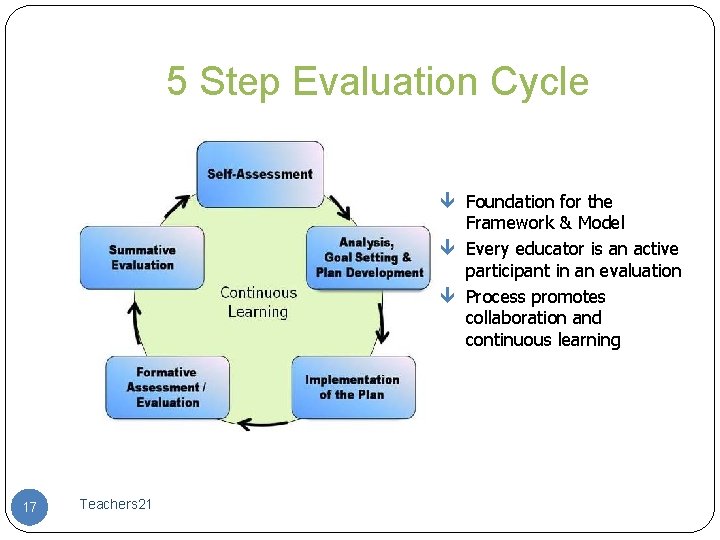
5 Step Evaluation Cycle Foundation for the Framework & Model Every educator is an active participant in an evaluation Process promotes collaboration and continuous learning 17 Teachers 21
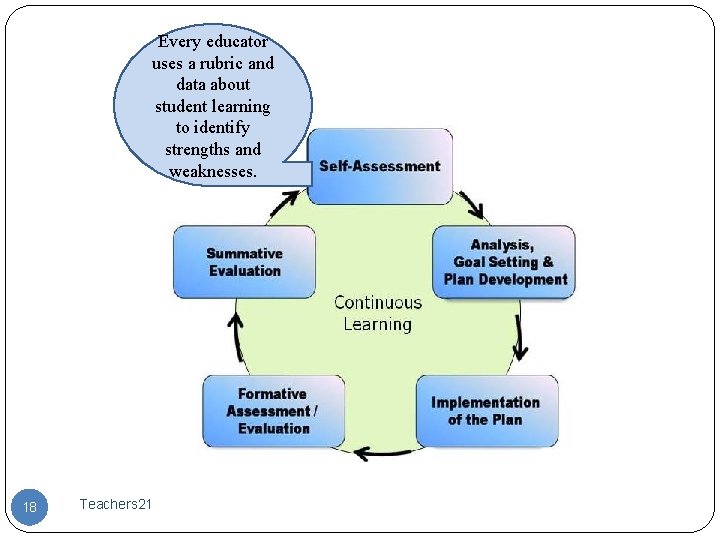
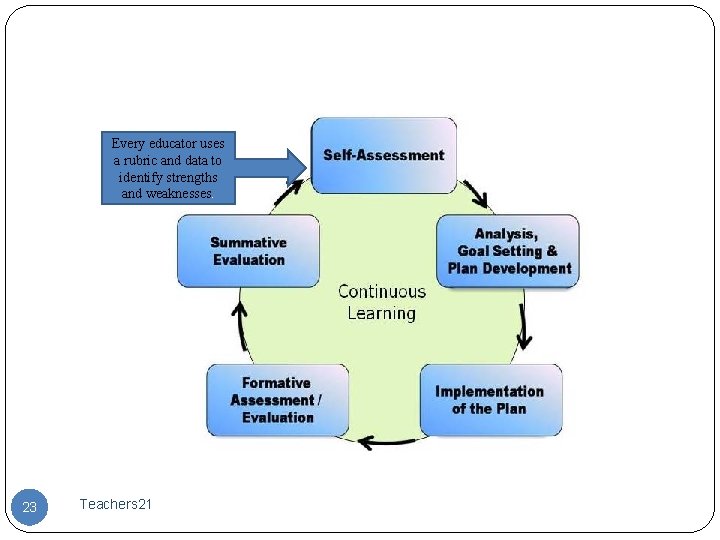
Every educator uses a rubric and data about student learning to identify strengths and weaknesses. 18 Teachers 21
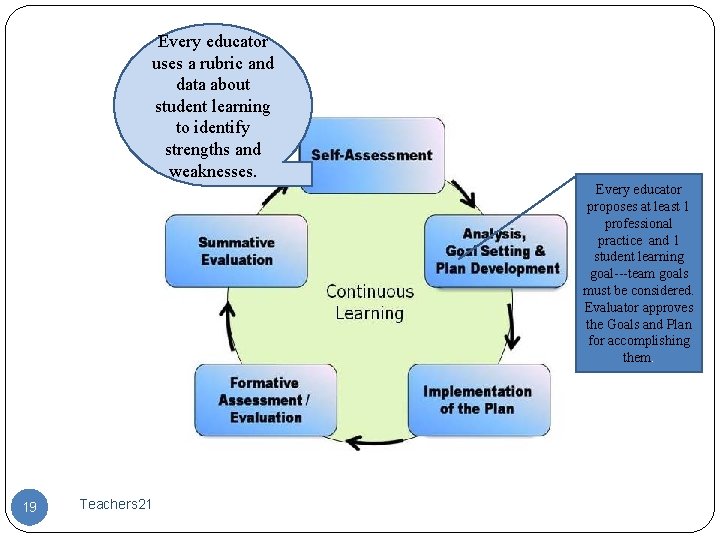
Every educator uses a rubric and data about student learning to identify strengths and weaknesses. Every educator proposes at least 1 professional practice and 1 student learning goal---team goals must be considered. Evaluator approves the Goals and Plan for accomplishing them. 19 Teachers 21
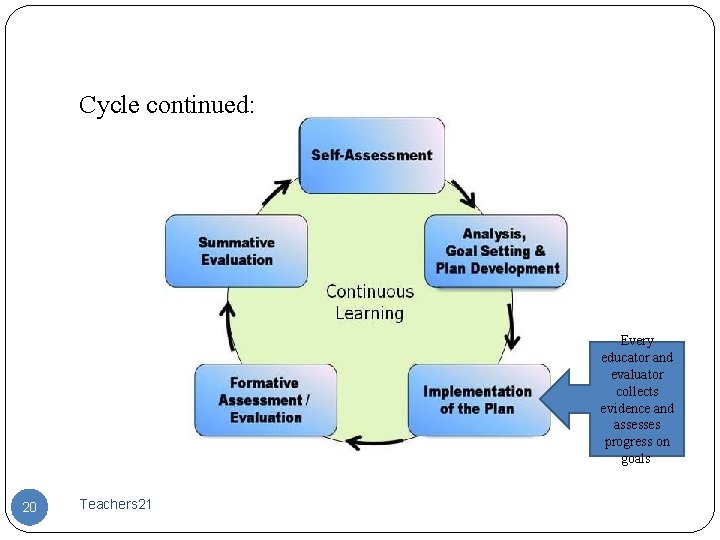
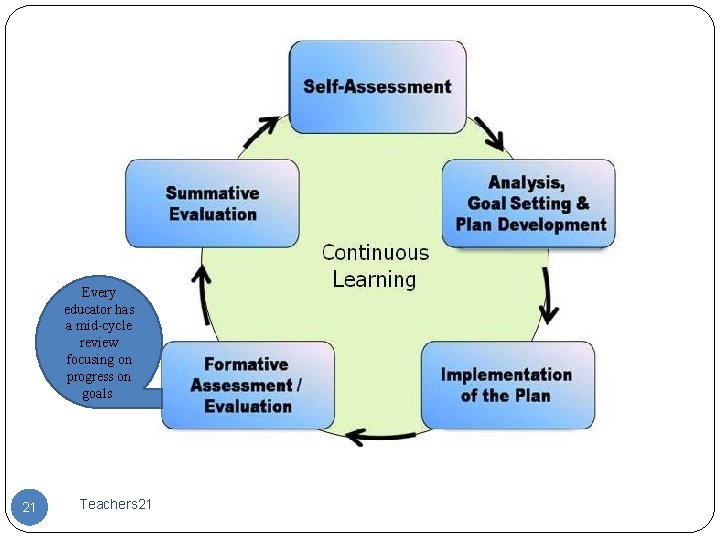
Cycle continued: Every educator and evaluator collects evidence and assesses progress on goals. 20 Teachers 21
Every educator has a mid-cycle review focusing on progress on goals. 21 Teachers 21
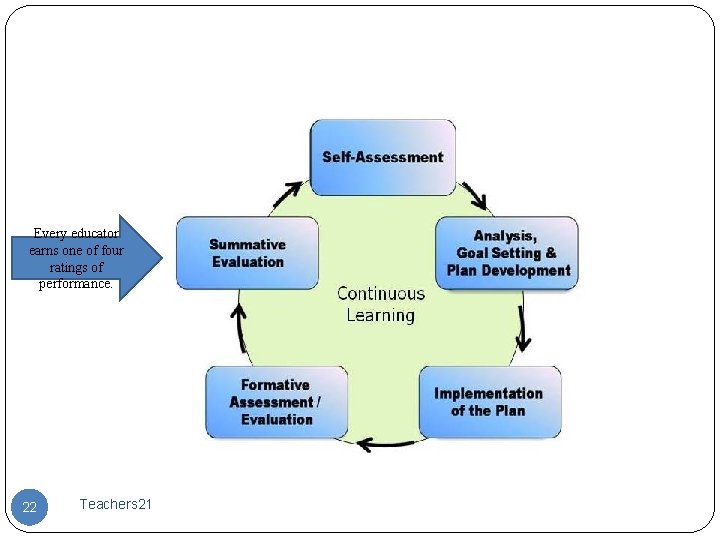
Every educator earns one of four ratings of performance. 22 Teachers 21
Every educator uses a rubric and data to identify strengths and weaknesses. 23 Teachers 21
Paradigm Shift: Self-Assessment . . . the greatest effects on student learning occur when teachers become learners of their own teaching, and when students become their own teachers. Hattie, Visible Learning for Teachers, 2012 Two areas of focus: 1. The learning record of my students 2. My own reflection about how to strengthen and improve my practice 24 Teachers 21
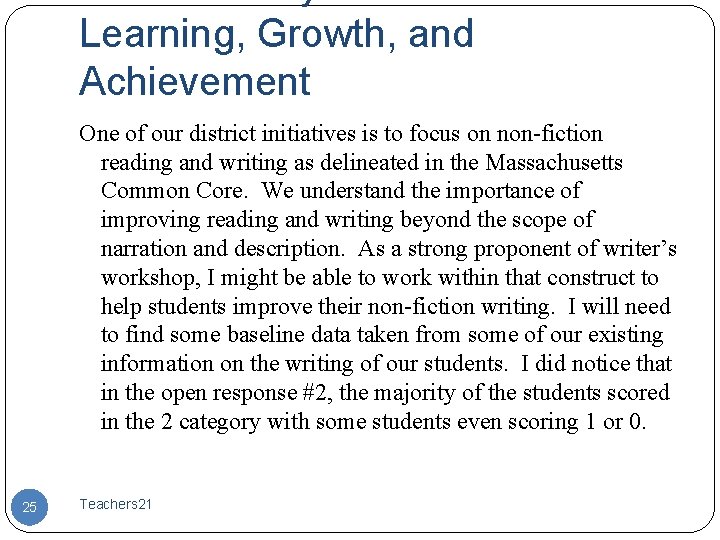
Learning, Growth, and Achievement One of our district initiatives is to focus on non-fiction reading and writing as delineated in the Massachusetts Common Core. We understand the importance of improving reading and writing beyond the scope of narration and description. As a strong proponent of writer’s workshop, I might be able to work within that construct to help students improve their non-fiction writing. I will need to find some baseline data taken from some of our existing information on the writing of our students. I did notice that in the open response #2, the majority of the students scored in the 2 category with some students even scoring 1 or 0. 25 Teachers 21
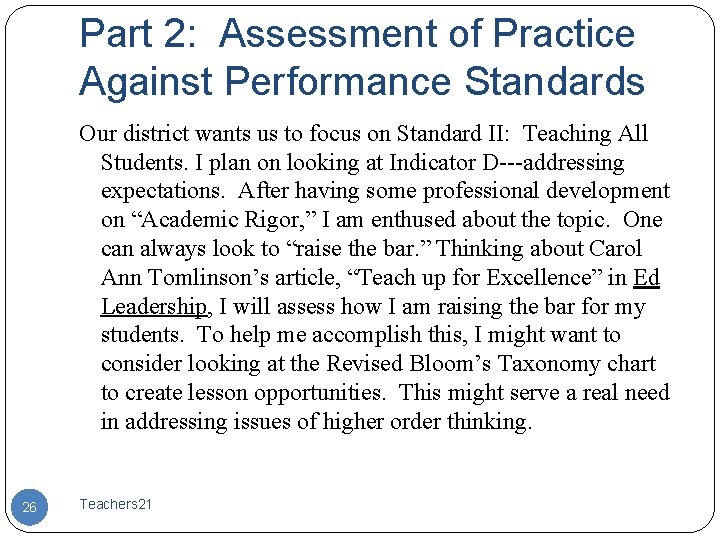
Part 2: Assessment of Practice Against Performance Standards Our district wants us to focus on Standard II: Teaching All Students. I plan on looking at Indicator D---addressing expectations. After having some professional development on “Academic Rigor, ” I am enthused about the topic. One can always look to “raise the bar. ” Thinking about Carol Ann Tomlinson’s article, “Teach up for Excellence” in Ed Leadership, I will assess how I am raising the bar for my students. To help me accomplish this, I might want to consider looking at the Revised Bloom’s Taxonomy chart to create lesson opportunities. This might serve a real need in addressing issues of higher order thinking. 26 Teachers 21
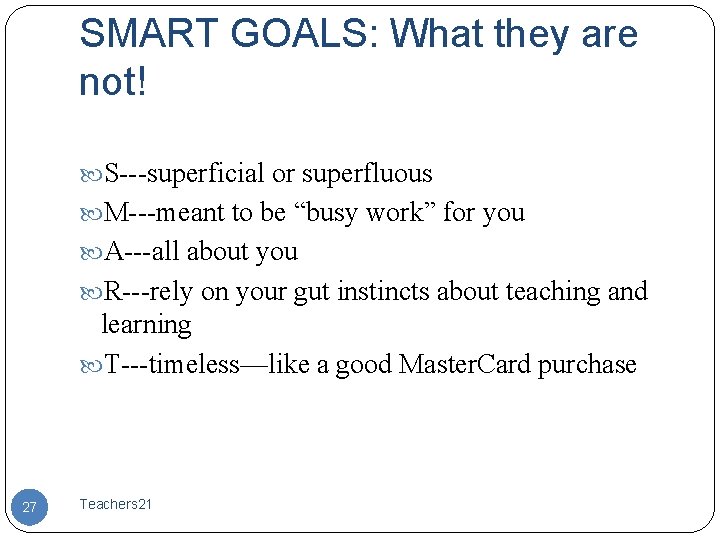
SMART GOALS: What they are not! S---superficial or superfluous M---meant to be “busy work” for you A---all about you R---rely on your gut instincts about teaching and learning T---timeless—like a good Master. Card purchase 27 Teachers 21
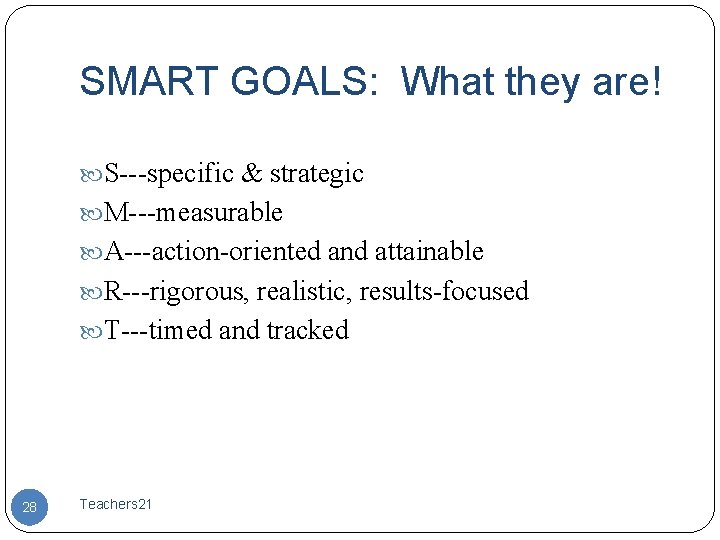
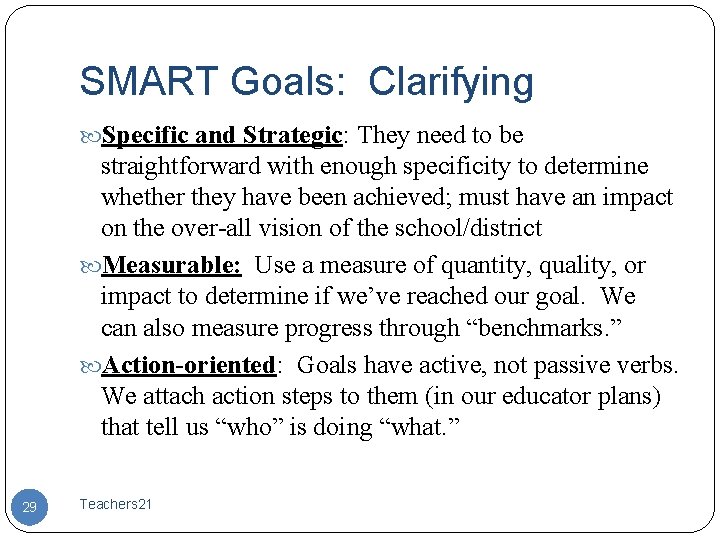
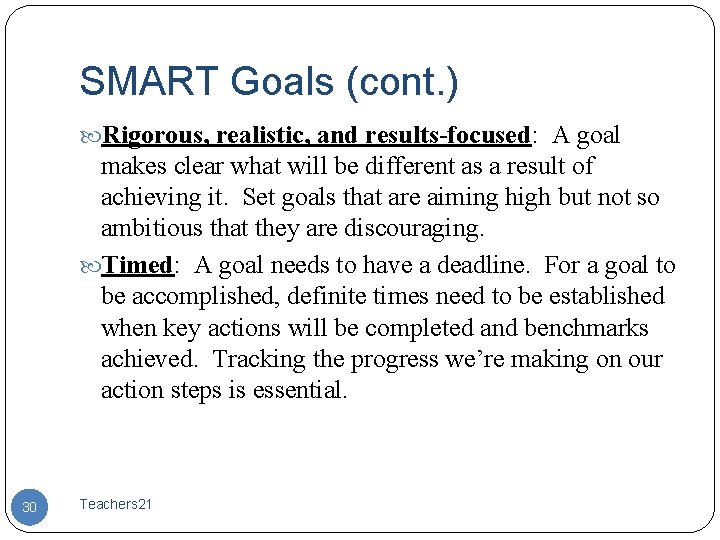
SMART GOALS: What they are! S---specific & strategic M---measurable A---action-oriented and attainable R---rigorous, realistic, results-focused T---timed and tracked 28 Teachers 21
SMART Goals: Clarifying Specific and Strategic: They need to be straightforward with enough specificity to determine whether they have been achieved; must have an impact on the over-all vision of the school/district Measurable: Use a measure of quantity, quality, or impact to determine if we’ve reached our goal. We can also measure progress through “benchmarks. ” Action-oriented: Goals have active, not passive verbs. We attach action steps to them (in our educator plans) that tell us “who” is doing “what. ” 29 Teachers 21
SMART Goals (cont. ) Rigorous, realistic, and results-focused: A goal makes clear what will be different as a result of achieving it. Set goals that are aiming high but not so ambitious that they are discouraging. Timed: A goal needs to have a deadline. For a goal to be accomplished, definite times need to be established when key actions will be completed and benchmarks achieved. Tracking the progress we’re making on our action steps is essential. 30 Teachers 21
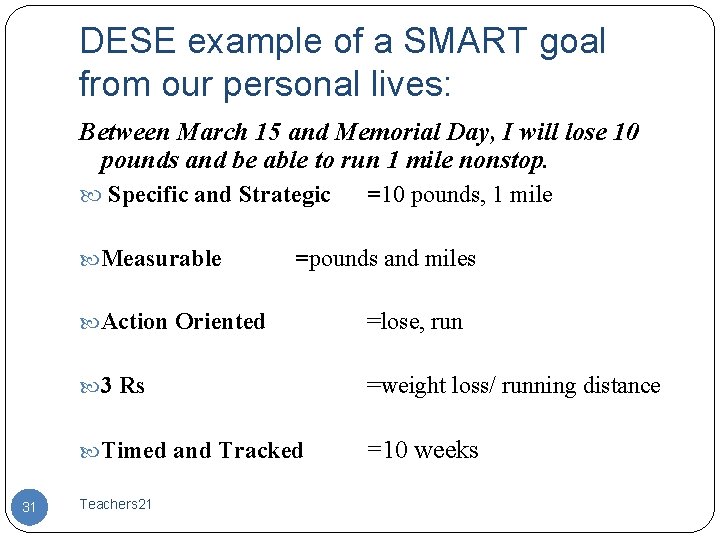
DESE example of a SMART goal from our personal lives: Between March 15 and Memorial Day, I will lose 10 pounds and be able to run 1 mile nonstop. Specific and Strategic =10 pounds, 1 mile Measurable =pounds and miles Action Oriented =lose, run 31 3 Rs =weight loss/ running distance Timed and Tracked =10 weeks Teachers 21
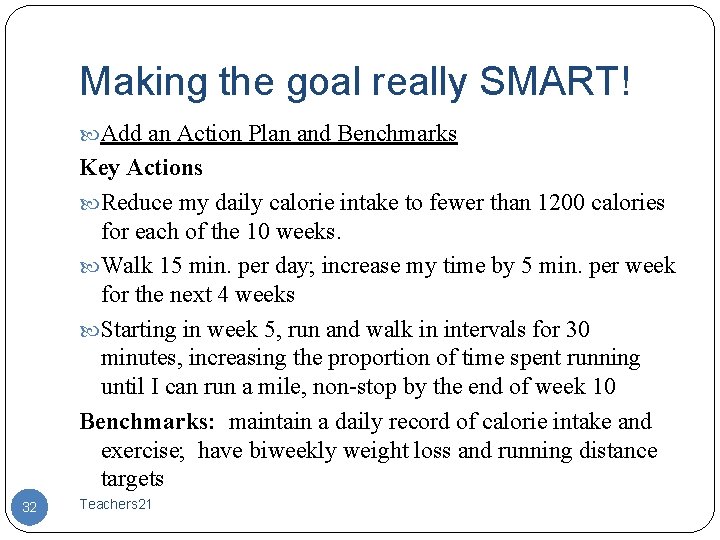
Making the goal really SMART! Add an Action Plan and Benchmarks Key Actions Reduce my daily calorie intake to fewer than 1200 calories for each of the 10 weeks. Walk 15 min. per day; increase my time by 5 min. per week for the next 4 weeks Starting in week 5, run and walk in intervals for 30 minutes, increasing the proportion of time spent running until I can run a mile, non-stop by the end of week 10 Benchmarks: maintain a daily record of calorie intake and exercise; have biweekly weight loss and running distance targets 32 Teachers 21
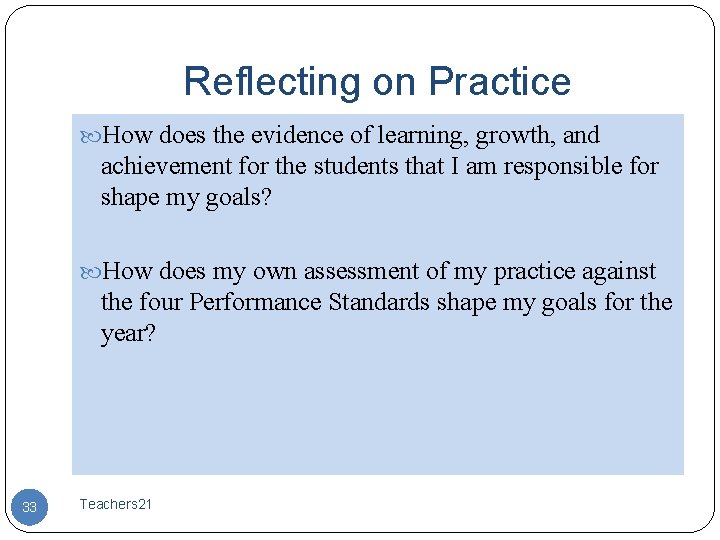
Reflecting on Practice How does the evidence of learning, growth, and achievement for the students that I am responsible for shape my goals? How does my own assessment of my practice against the four Performance Standards shape my goals for the year? 33 Teachers 21
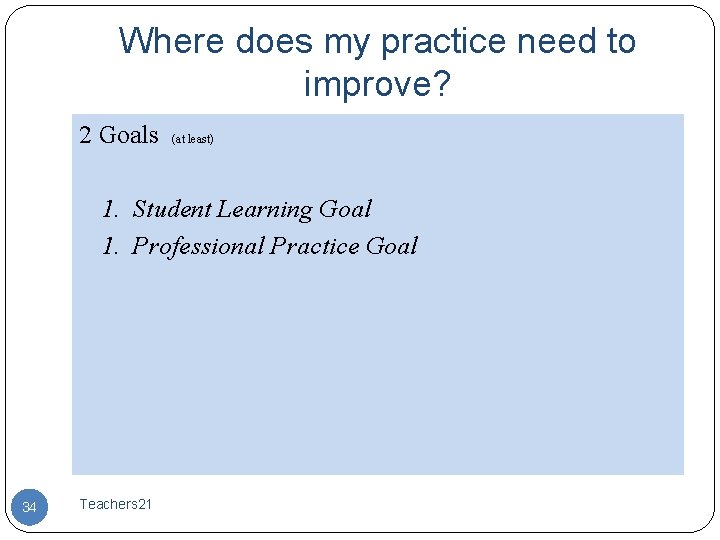
Where does my practice need to improve? 2 Goals (at least) 1. Student Learning Goal 1. Professional Practice Goal 34 Teachers 21
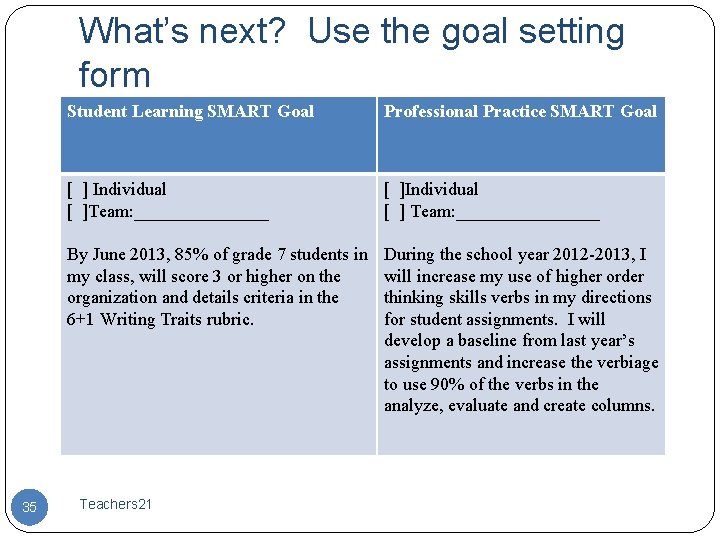
What’s next? Use the goal setting form 35 Student Learning SMART Goal Professional Practice SMART Goal [ ] Individual [ ]Team: ________ [ ]Individual [ ] Team: ________ By June 2013, 85% of grade 7 students in my class, will score 3 or higher on the organization and details criteria in the 6+1 Writing Traits rubric. During the school year 2012 -2013, I will increase my use of higher order thinking skills verbs in my directions for student assignments. I will develop a baseline from last year’s assignments and increase the verbiage to use 90% of the verbs in the analyze, evaluate and create columns. Teachers 21
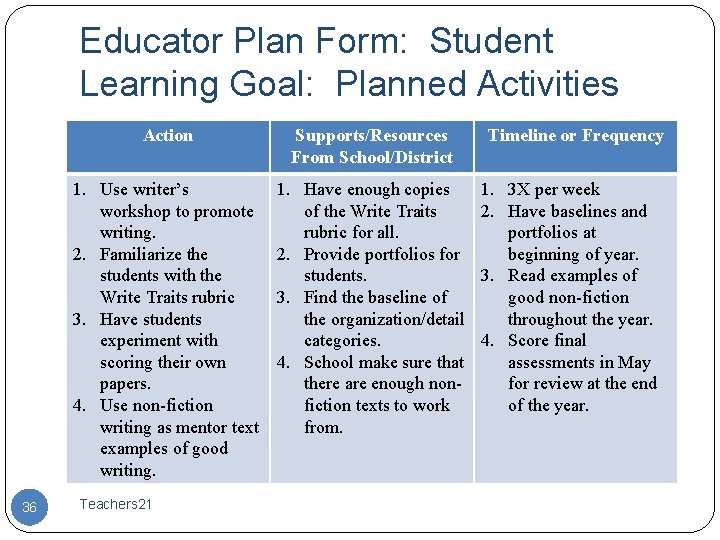
Educator Plan Form: Student Learning Goal: Planned Activities 36 Action Supports/Resources From School/District Timeline or Frequency 1. Use writer’s workshop to promote writing. 2. Familiarize the students with the Write Traits rubric 3. Have students experiment with scoring their own papers. 4. Use non-fiction writing as mentor text examples of good writing. 1. Have enough copies of the Write Traits rubric for all. 2. Provide portfolios for students. 3. Find the baseline of the organization/detail categories. 4. School make sure that there are enough nonfiction texts to work from. 1. 3 X per week 2. Have baselines and portfolios at beginning of year. 3. Read examples of good non-fiction throughout the year. 4. Score final assessments in May for review at the end of the year. Teachers 21
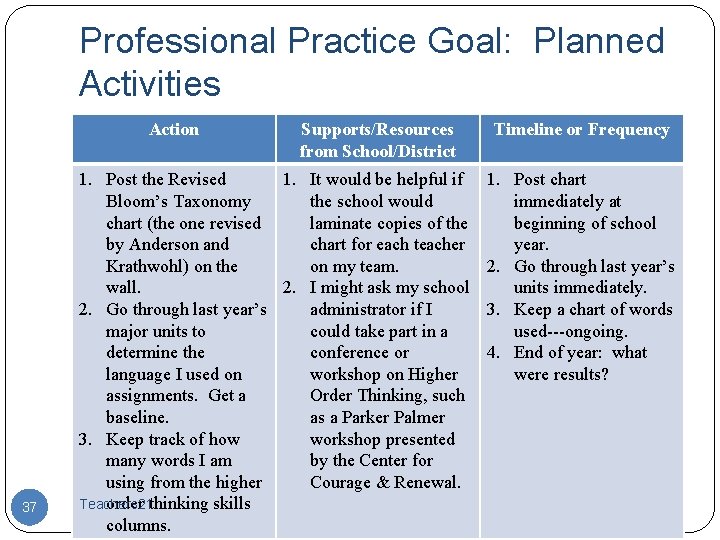
Professional Practice Goal: Planned Activities Action 37 Supports/Resources from School/District 1. Post the Revised 1. It would be helpful if Bloom’s Taxonomy the school would chart (the one revised laminate copies of the by Anderson and chart for each teacher Krathwohl) on the on my team. wall. 2. I might ask my school 2. Go through last year’s administrator if I major units to could take part in a determine the conference or language I used on workshop on Higher assignments. Get a Order Thinking, such baseline. as a Parker Palmer 3. Keep track of how workshop presented many words I am by the Center for using from the higher Courage & Renewal. Teachers 21 order thinking skills columns. Timeline or Frequency 1. Post chart immediately at beginning of school year. 2. Go through last year’s units immediately. 3. Keep a chart of words used---ongoing. 4. End of year: what were results?
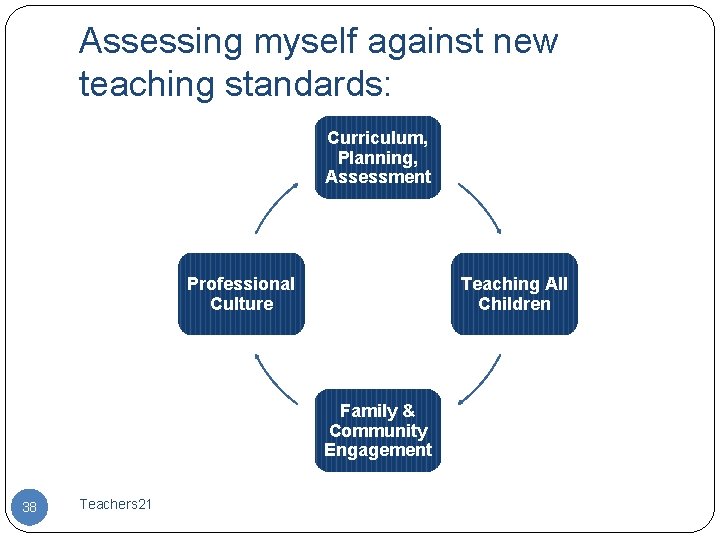
Assessing myself against new teaching standards: Curriculum, Planning, Assessment Professional Culture Teaching All Children Family & Community Engagement 38 Teachers 21
Developing a shared Understanding of Effective Teaching II. Significant Shift Rubrics 39 Teachers 21
40 Teachers 21
41 Teachers 21
42 Teachers 21
43 Teachers 21
44 Teachers 21
45 Teachers 21
46 Teachers 21
47 Teachers 21
48 Teachers 21
Rubrics as a Starting Point for Setting Goals Standards (4) Indicators (16) Elements (33) 49 Teachers 21
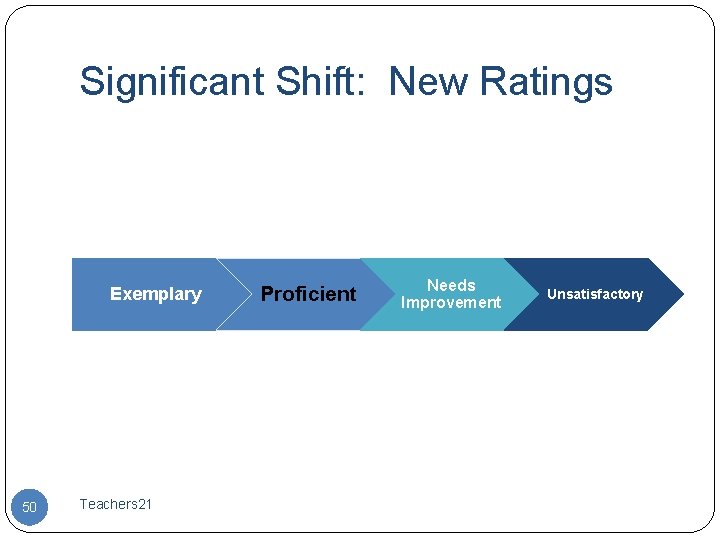
Significant Shift: New Ratings Exemplary 50 Teachers 21 Proficient Needs Improvement Unsatisfactory
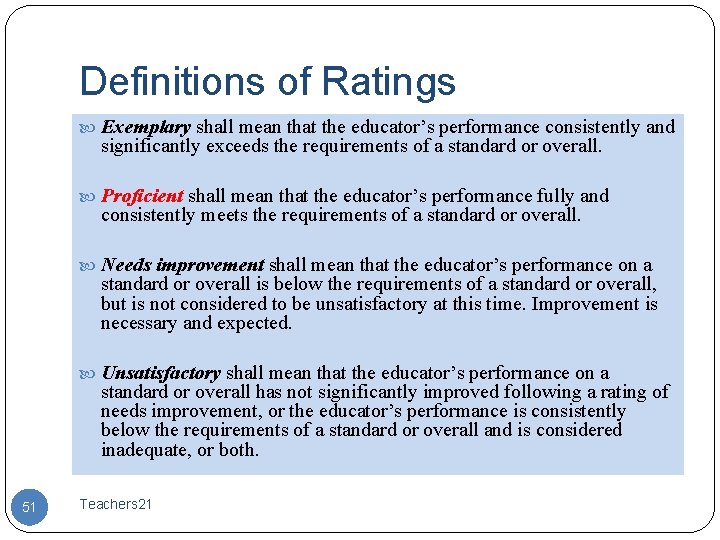
Definitions of Ratings Exemplary shall mean that the educator’s performance consistently and significantly exceeds the requirements of a standard or overall. Proficient shall mean that the educator’s performance fully and consistently meets the requirements of a standard or overall. Needs improvement shall mean that the educator’s performance on a standard or overall is below the requirements of a standard or overall, but is not considered to be unsatisfactory at this time. Improvement is necessary and expected. Unsatisfactory shall mean that the educator’s performance on a standard or overall has not significantly improved following a rating of needs improvement, or the educator’s performance is consistently below the requirements of a standard or overall and is considered inadequate, or both. 51 Teachers 21
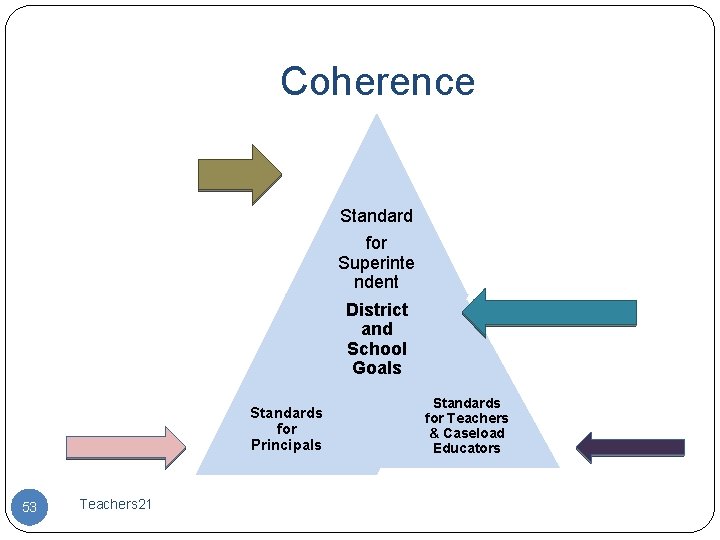
It is. . . COHERENT 52 Teachers 21
Coherence Standard for Superinte ndent District and School Goals Standards for Principals 53 Teachers 21 Standards for Teachers & Caseload Educators
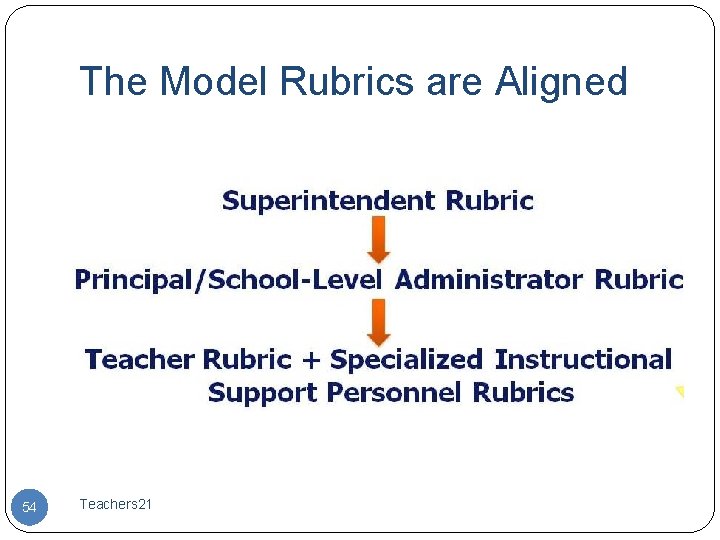
The Model Rubrics are Aligned 54 Teachers 21
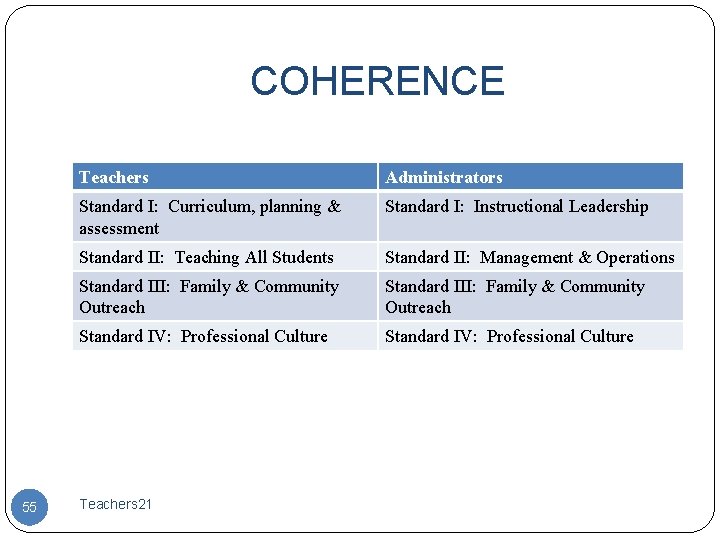
COHERENCE 55 Teachers Administrators Standard I: Curriculum, planning & assessment Standard I: Instructional Leadership Standard II: Teaching All Students Standard II: Management & Operations Standard III: Family & Community Outreach Standard IV: Professional Culture Teachers 21
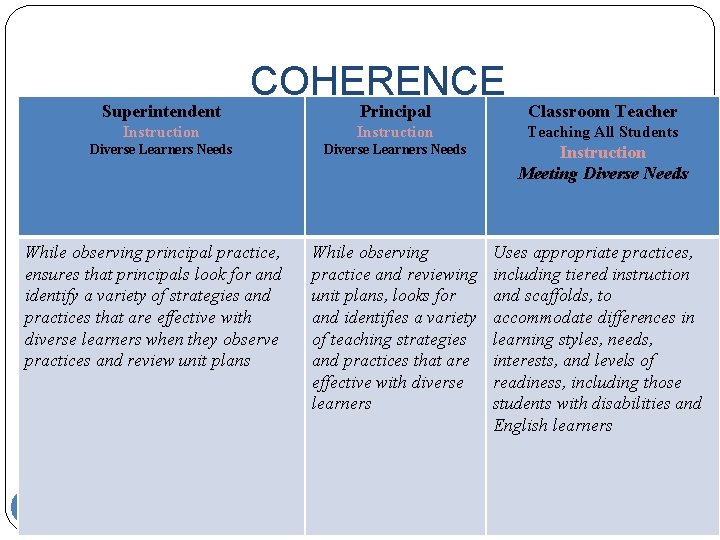
Superintendent COHERENCE Principal Classroom Teacher Instruction Teaching All Students Diverse Learners Needs Instruction Meeting Diverse Needs While observing principal practice, ensures that principals look for and identify a variety of strategies and practices that are effective with diverse learners when they observe practices and review unit plans 56 Teachers 21 While observing practice and reviewing unit plans, looks for and identifies a variety of teaching strategies and practices that are effective with diverse learners Uses appropriate practices, including tiered instruction and scaffolds, to accommodate differences in learning styles, needs, interests, and levels of readiness, including those students with disabilities and English learners
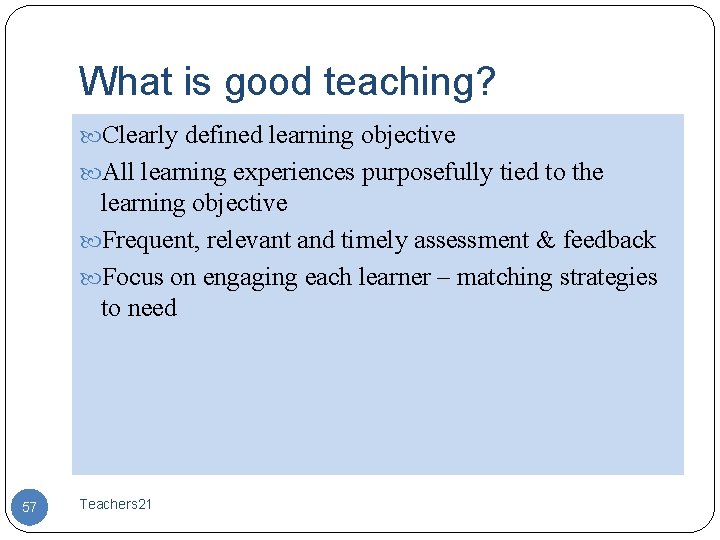
What is good teaching? Clearly defined learning objective All learning experiences purposefully tied to the learning objective Frequent, relevant and timely assessment & feedback Focus on engaging each learner – matching strategies to need 57 Teachers 21
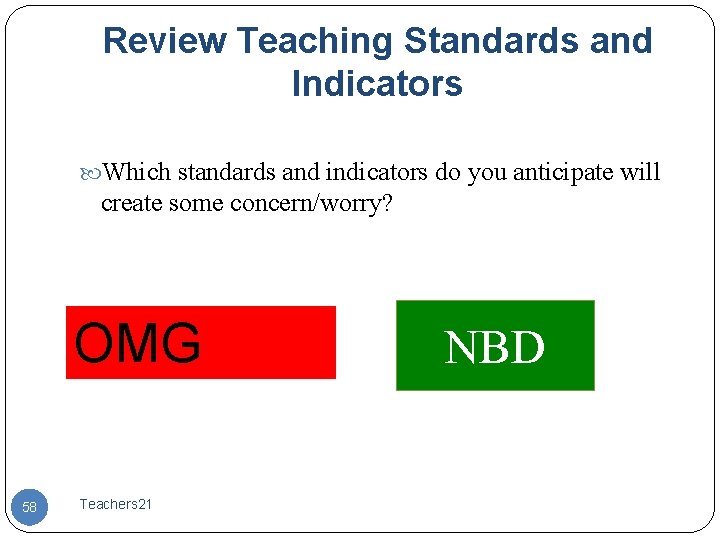
Review Teaching Standards and Indicators Which standards and indicators do you anticipate will create some concern/worry? OMG 58 Teachers 21 NBD
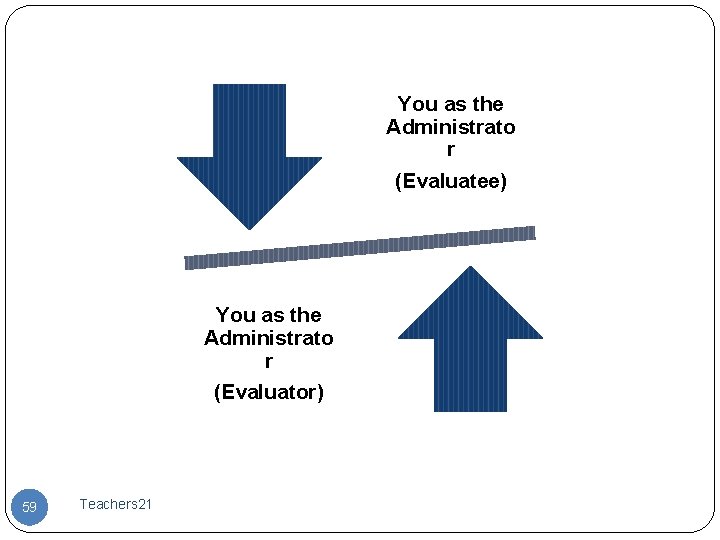
You as the Administrato r (Evaluatee) You as the Administrato r (Evaluator) 59 Teachers 21
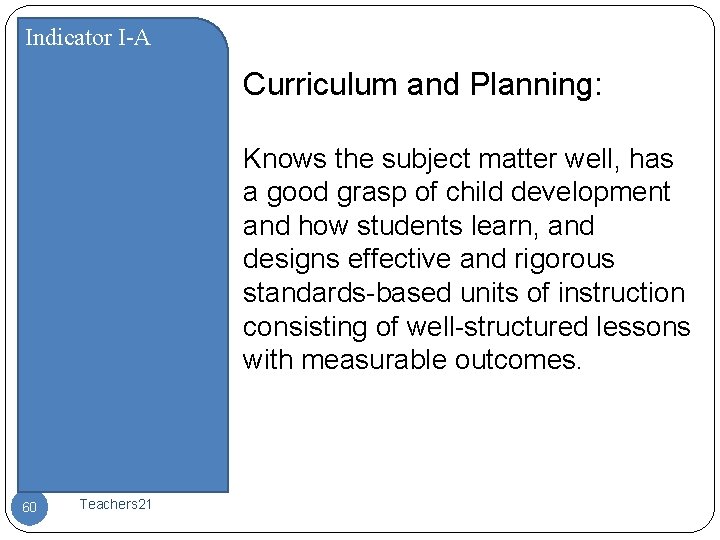
Indicator I-A Curriculum and Planning: Knows the subject matter well, has a good grasp of child development and how students learn, and designs effective and rigorous standards-based units of instruction consisting of well-structured lessons with measurable outcomes. 60 Teachers 21
Indicator I-B Assessment: Uses a variety of informal and formal methods of assessments to measure student learning, growth, and understanding to develop differentiated and enhanced learning experiences and improve future instruction. 61 Teachers 21
Indicator I-C Analysis: Analyzes data from assessments, draws conclusions, and shares them appropriately. 62 Teachers 21
Indicator II-A Instruction: Uses instructional practices that reflect high expectations regarding content and quality of effort and work; engage all students; and are personalized to accommodate diverse learning styles, needs, interests, and levels of readiness. 63 Teachers 21
Indicator II-B Learning Environment: Creates and maintains a safe and collaborative learning environment that motivates students to take academic risks, challenge themselves, and claim ownership of their learning 64 Teachers 21
Indicator II- C Cultural Proficiency: Actively creates and maintains an environment in which students’ diverse backgrounds, identities, strengths, and challenges are respected. 65 Teachers 21
Indicator II-D Expectations: Plans and implements lessons that set clear and high expectations and also make knowledge accessible for all students. 66 Teachers 21
CULTURE 67 Teachers 21
Frankness: Engaging in frank conversation about what good practice looks like can be culturally and logistically challenging in schools: it requires time, professionalism, and an environment of trust that places student needs at the center of the decisionmaking and dialogue. 68 Teachers 21
COLLABORATIVE 69 Teachers 21
TRUST ---an essential ingredient in successful implementation of this new framework “School leaders and teachers need to create schools, staffrooms, and classroom environments in which error is welcomed as a learning opportunity, in which discarding incorrect knowledge and understanding is welcomed, and in which teachers can feel safe to learn, re-learn, and explore knowledge and understanding. ” ---John Hattie, 2012 70 Teachers 21
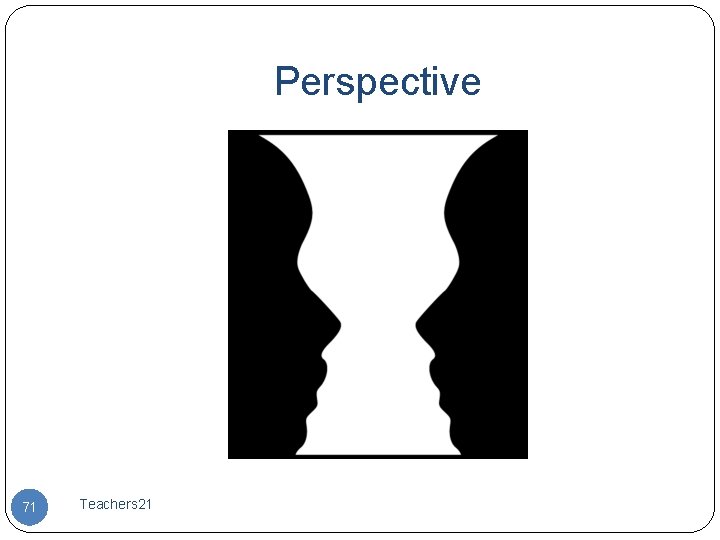
Perspective 71 Teachers 21
Significant Shift: Multiple Measures of Student Learning Teacher effectiveness must be linked to student learning Moving our “sensors” so that data about learning as well as teaching can be collected 72 Teachers 21
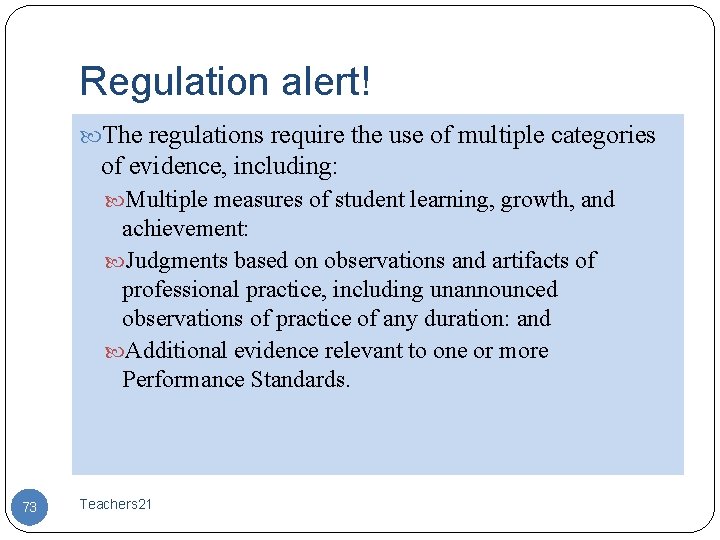
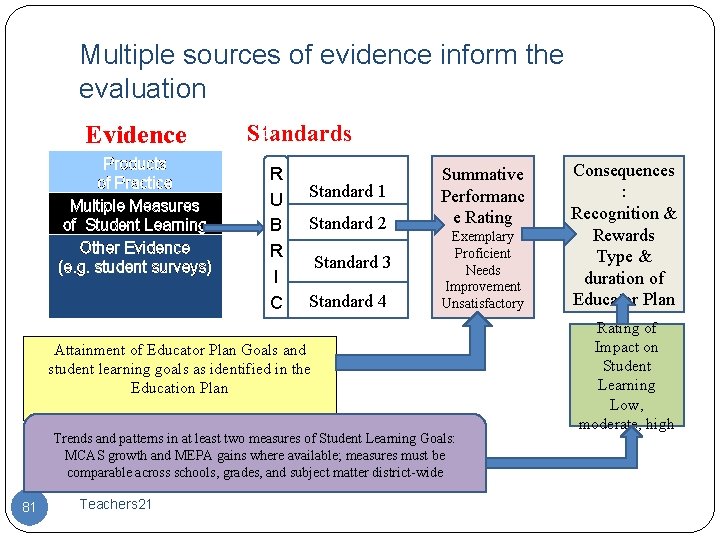
Regulation alert! The regulations require the use of multiple categories of evidence, including: Multiple measures of student learning, growth, and achievement: Judgments based on observations and artifacts of professional practice, including unannounced observations of practice of any duration: and Additional evidence relevant to one or more Performance Standards. 73 Teachers 21
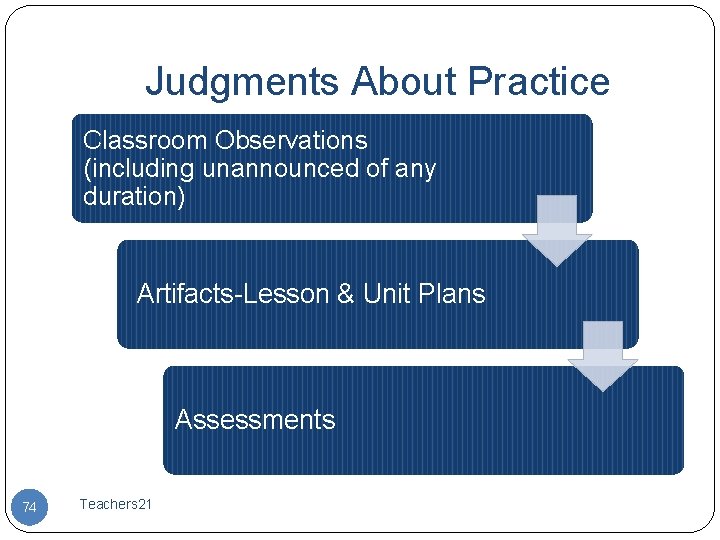
Judgments About Practice Classroom Observations (including unannounced of any duration) Artifacts-Lesson & Unit Plans Assessments 74 Teachers 21
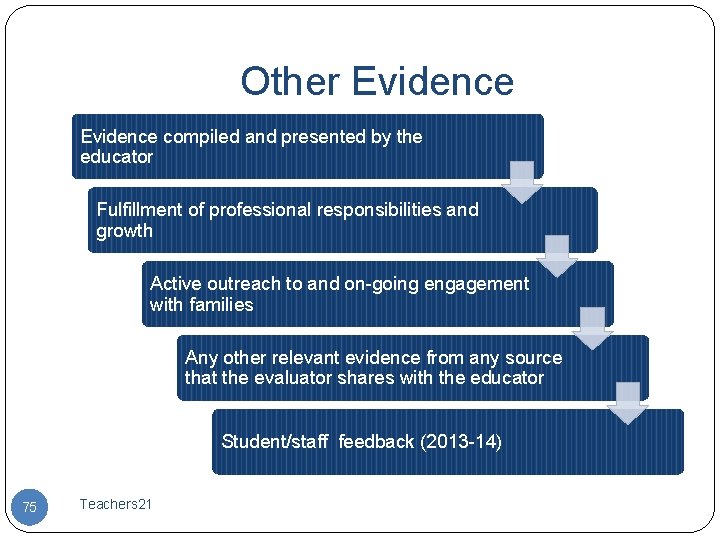
Other Evidence compiled and presented by the educator Fulfillment of professional responsibilities and growth Active outreach to and on-going engagement with families Any other relevant evidence from any source that the evaluator shares with the educator Student/staff feedback (2013 -14) 75 Teachers 21
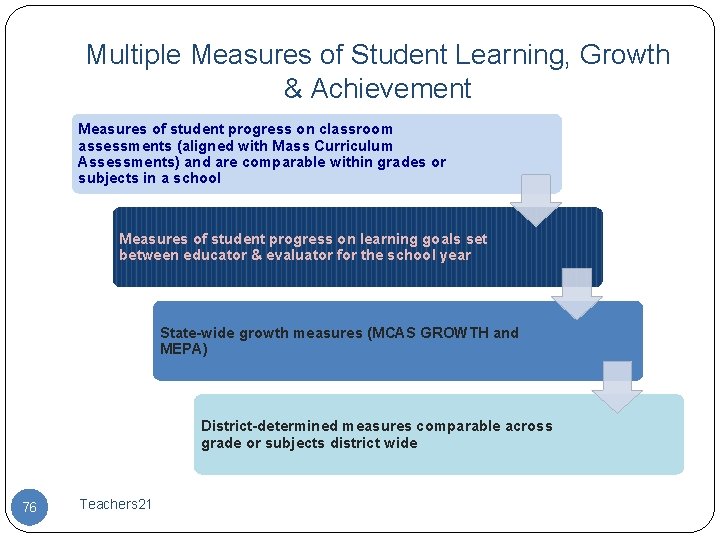
Multiple Measures of Student Learning, Growth & Achievement Measures of student progress on classroom assessments (aligned with Mass Curriculum Assessments) and are comparable within grades or subjects in a school Measures of student progress on learning goals set between educator & evaluator for the school year State-wide growth measures (MCAS GROWTH and MEPA) District-determined measures comparable across grade or subjects district wide 76 Teachers 21
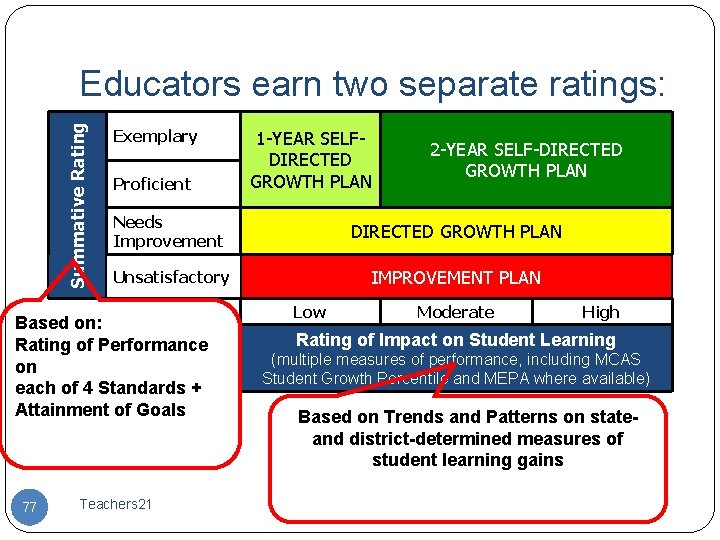
Summative Rating Educators earn two separate ratings: Exemplary Proficient 2 -YEAR SELF-DIRECTED GROWTH PLAN Needs Improvement DIRECTED GROWTH PLAN Unsatisfactory IMPROVEMENT PLAN Based on: Rating of Performance on each of 4 Standards + Attainment of Goals 77 1 -YEAR SELFDIRECTED GROWTH PLAN Teachers 21 Low Moderate High Rating of Impact on Student Learning (multiple measures of performance, including MCAS Student Growth Percentile and MEPA where available) Based on Trends and Patterns on stateand district-determined measures of student learning gains
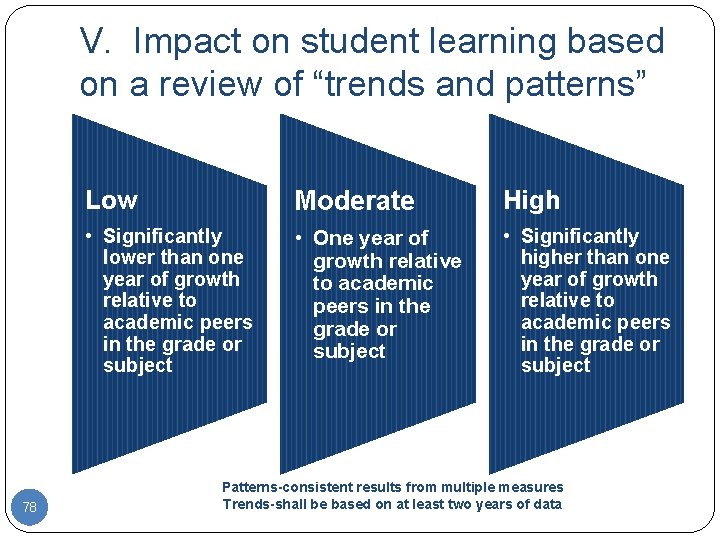
V. Impact on student learning based on a review of “trends and patterns” 78 Low Moderate High • Significantly lower than one year of growth relative to academic peers in the grade or subject • One year of growth relative to academic peers in the grade or subject • Significantly higher than one year of growth relative to academic peers in the grade or subject Patterns-consistent results from multiple measures Trends-shall be based on at least two years of data
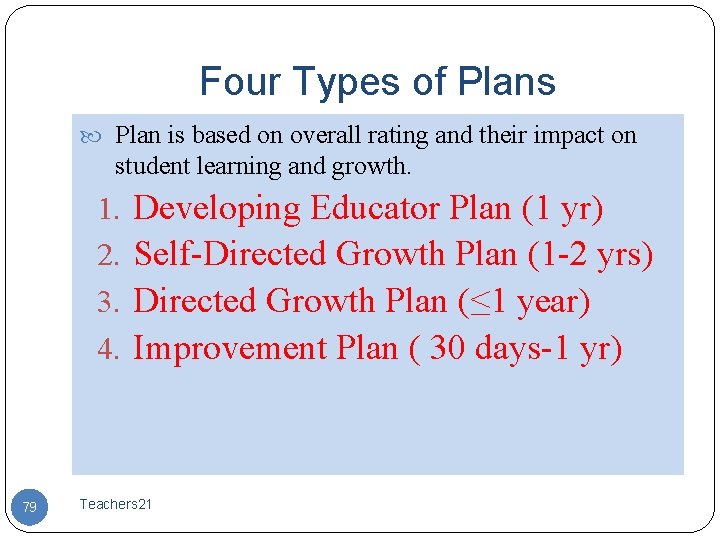
Four Types of Plans Plan is based on overall rating and their impact on student learning and growth. 1. Developing Educator Plan (1 yr) 2. Self-Directed Growth Plan (1 -2 yrs) 3. Directed Growth Plan (≤ 1 year) 4. Improvement Plan ( 30 days-1 yr) 79 Teachers 21
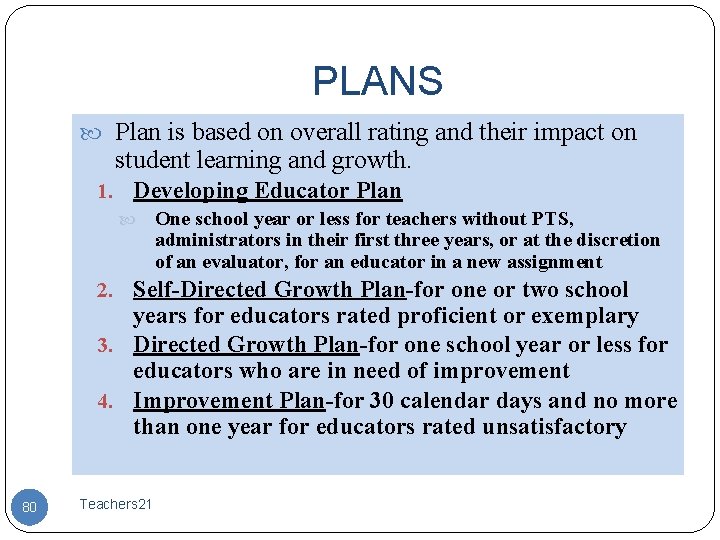
PLANS Plan is based on overall rating and their impact on student learning and growth. 1. Developing Educator Plan One school year or less for teachers without PTS, administrators in their first three years, or at the discretion of an evaluator, for an educator in a new assignment 2. Self-Directed Growth Plan-for one or two school years for educators rated proficient or exemplary 3. Directed Growth Plan-for one school year or less for educators who are in need of improvement 4. Improvement Plan-for 30 calendar days and no more than one year for educators rated unsatisfactory 80 Teachers 21
Multiple sources of evidence inform the evaluation Evidence Products of Practice (e. g. observations) Multiple Measures of Student Learning Other Evidence (e. g. student surveys) Standards R R U UBRI CB R I C S Standard 1 Standard 2 SStandard 3 Standard 4 Summative Performanc e Rating Exemplary Proficient Needs Improvement Unsatisfactory Attainment of Educator Plan Goals and student learning goals as identified in the Education Plan Trends and patterns in at least two measures of Student Learning Goals: MCAS growth and MEPA gains where available; measures must be comparable across schools, grades, and subject matter district-wide 81 Teachers 21 Consequences : Recognition & Rewards Type & duration of Educator Plan Rating of Impact on Student Learning Low, moderate, high
82 Teachers 21