
Implementing the EU CO 2 Storage Directive Challenges
- Slides: 12
Implementing the EU CO 2 Storage Directive: Challenges and Opportunities 7 November 2011 Public Engagement in the UK Louise Barr, Head of Outreach and Engagement Office of Carbon Capture and Storage Department of Energy & Climate Change 1
• What do we mean by public engagement? • What is the national message?
“CCS has a key part to play in ensuring that we can keep the lights on at the same time as fighting climate change. . …. The UK has the skills and opportunity to lead the world in this technology, which is why in the spending review we committed to investing up to a billion pounds in CCS” Chris Huhne, Secretary of State 3
Why CCS is important… UK has legally binding CO₂ reduction targets under the Climate Change Act 2008: 80% by 2050 Through the Copenhagen Accord, the EU agreed global temperatures should not increase above 2 o C According to estimates made by the IEA, tackling climate change will cost more in the future without CCS by 70% 4
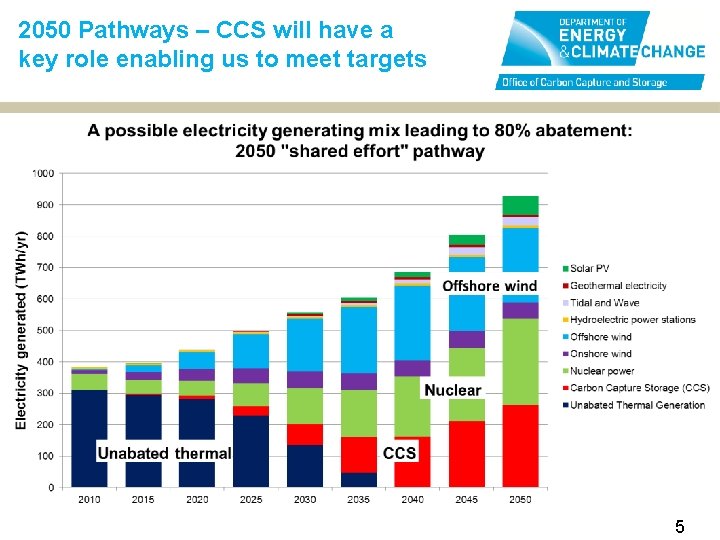
2050 Pathways – CCS will have a key role enabling us to meet targets 5
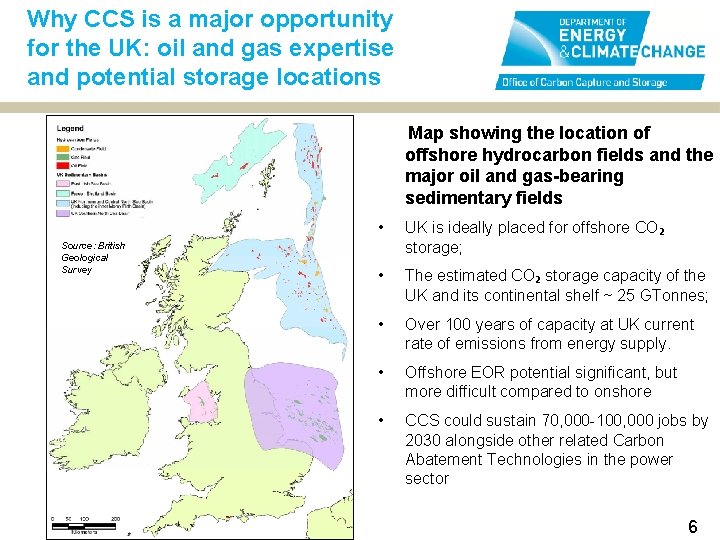
Why CCS is a major opportunity for the UK: oil and gas expertise and potential storage locations Map showing the location of offshore hydrocarbon fields and the major oil and gas-bearing sedimentary fields Source: British Geological Survey • UK is ideally placed for offshore CO₂ storage; • The estimated CO₂ storage capacity of the UK and its continental shelf ~ 25 GTonnes; • Over 100 years of capacity at UK current rate of emissions from energy supply. • Offshore EOR potential significant, but more difficult compared to onshore • CCS could sustain 70, 000 -100, 000 jobs by 2030 alongside other related Carbon Abatement Technologies in the power sector 6
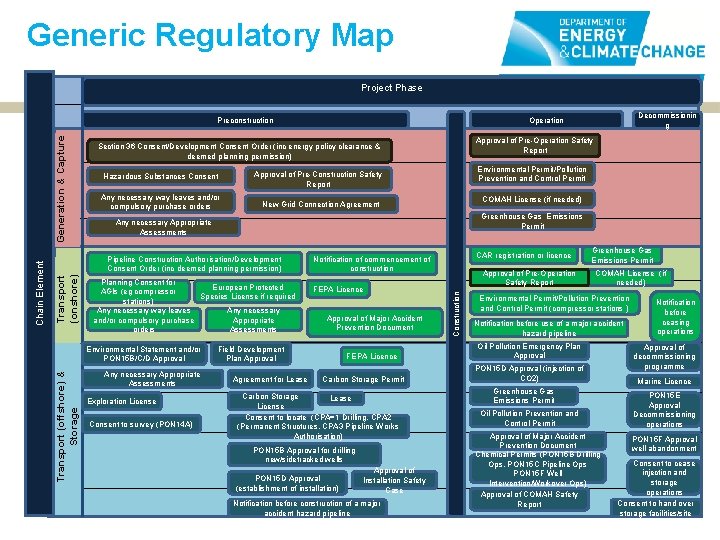
Generic Regulatory Map Project Phase Hazardous Substances Consent Approval of Pre-Operation Safety Report Environmental Permit/Pollution Prevention and Control Permit Approval of Pre-Construction Safety Report [Quotes from Longannet decision] Any necessary way leaves and/or New Grid Connection Agreement COMAH License (if needed) compulsory purchase orders Greenhouse Gas Emissions Permit Any necessary Appropriate Assessments [NGO] Planning Consent for European Protected AGIs (eg compressor Species License if required stations) Any necessary way leaves Any necessary and/or compulsory purchase Appropriate orders Assessments Any necessary Appropriate Assessments Exploration License Consent to survey (PON 14 A) FEPA Licence Approval of Major Accident Prevention Document Field Development Plan Approval Agreement for Lease CAR registration or licence Notification of commencement of construction FEPA Licence Carbon Storage Permit Carbon Storage Lease License Consent to locate (CPA=1 Drilling, CPA 2 (Permanent Structures, CPA 3 Pipeline Works Authorisation) PON 15 B Approval for drilling new/sidetracked wells PON 15 D Approval (establishment of installation) Approval of Installation Safety Case Notification before construction of a major accident hazard pipeline Approval of Pre-Operation Safety Report Construction Transport (onshore) Pipeline Construction Authorisation/Development Consent Order (inc deemed planning permission) Environmental Statement and/or PON 15 B/C/D Approval Contract Decommissionin g Award Operation Section 36 Consent/Development Consent Order (inc energy policy clearance & deemed planning permission) Transport (offshore) & Storage Chain Element Generation & Capture Preconstruction Greenhouse Gas Emissions Permit COMAH License (if needed) Environmental Permit/Pollution Prevention and Control Permit (compressor stations ) Notification before use of a major accident hazard pipeline Oil Pollution Emergency Plan Approval PON 15 D Approval (injection of CO 2) Greenhouse Gas Emissions Permit Oil Pollution Prevention and Control Permit Approval of Major Accident Prevention Document Chemical Permits (PON 15 B Drilling Ops, PON 15 C Pipeline Ops PON 15 F Well Intervention/Workover Ops) Approval of COMAH Safety Report Notification before ceasing operations Approval of decommissioning programme Marine Licence PON 15 E Approval Decommissioning operations PON 15 F Approval well abandonment Consent to cease injection and storage operations Consent to hand over storage facilities/site
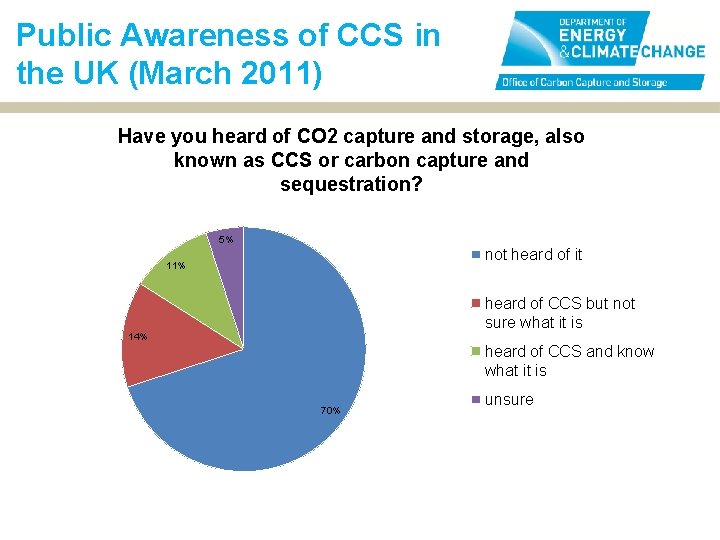
Public Awareness of CCS in the UK (March 2011) Have you heard of CO 2 capture and storage, also known as CCS or carbon capture and sequestration? 5% not heard of it 11% heard of CCS but not sure what it is 14% heard of CCS and know what it is 70% unsure
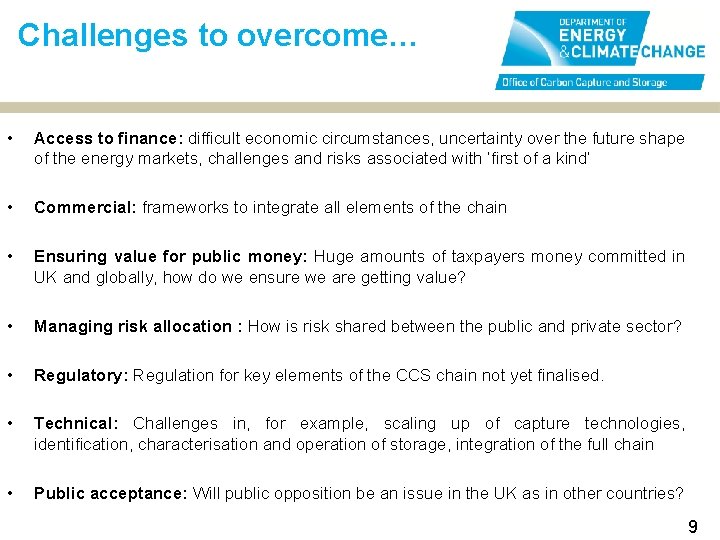
Challenges to overcome… • Access to finance: difficult economic circumstances, uncertainty over the future shape of the energy markets, challenges and risks associated with ‘first of a kind’ • Commercial: frameworks to integrate all elements of the chain • Ensuring value for public money: Huge amounts of taxpayers money committed in UK and globally, how do we ensure we are getting value? • Managing risk allocation : How is risk shared between the public and private sector? • Regulatory: Regulation for key elements of the CCS chain not yet finalised. • Technical: Challenges in, for example, scaling up of capture technologies, identification, characterisation and operation of storage, integration of the full chain • Public acceptance: Will public opposition be an issue in the UK as in other countries? 9
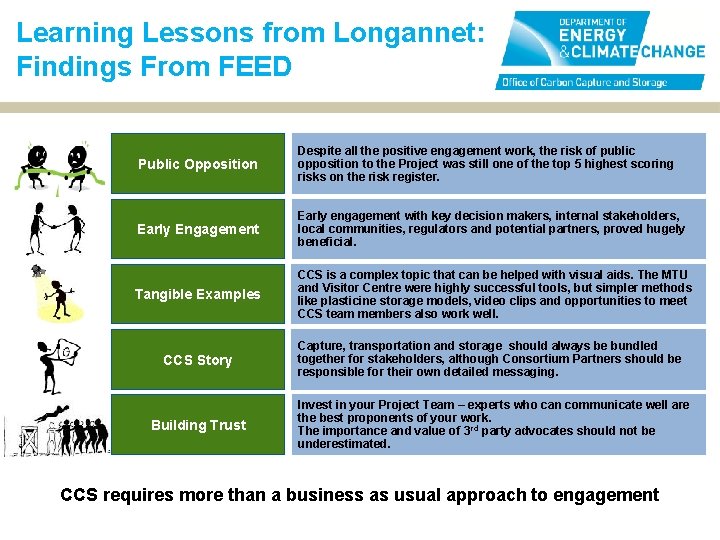
Learning Lessons from Longannet: Findings From FEED Public Opposition Despite all the positive engagement work, the risk of public opposition to the Project was still one of the top 5 highest scoring risks on the risk register. Early Engagement Early engagement with key decision makers, internal stakeholders, local communities, regulators and potential partners, proved hugely beneficial. Tangible Examples CCS is a complex topic that can be helped with visual aids. The MTU and Visitor Centre were highly successful tools, but simpler methods like plasticine storage models, video clips and opportunities to meet CCS team members also work well. CCS Story Building Trust Capture, transportation and storage should always be bundled together for stakeholders, although Consortium Partners should be responsible for their own detailed messaging. Invest in your Project Team – experts who can communicate well are the best proponents of your work. The importance and value of 3 rd party advocates should not be underestimated. CCS requires more than a business as usual approach to engagement
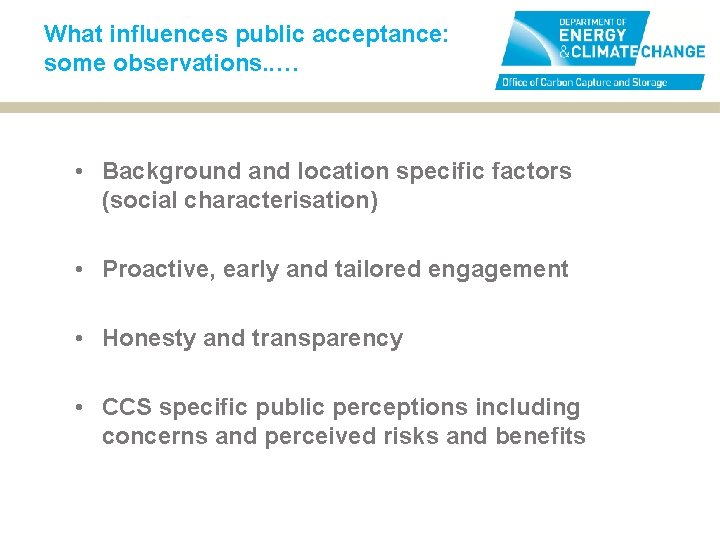
What influences public acceptance: some observations. . … • Background and location specific factors (social characterisation) • Proactive, early and tailored engagement • Honesty and transparency • CCS specific public perceptions including concerns and perceived risks and benefits
http: //www. decc. gov. uk/en/content/cms/emissi ons/ccs/demo_prog/feed. aspx 12