
Implementing the ESS Vision 2020 Background and mandate
Implementing the ESS Vision 2020
Background and mandate “A vision is void if it is not followed by a strategy and concrete actions towards implementation” ESS Vision 2020 First steps towards implementation: • Creation of a temporary Partnership Group Task Force mandated to prepare the DGINS discussions on implementation 1. Evaluation of the on-going and frozen ESS. VIP projects 2. Identification of new areas of Vision relevant work 3. Definition of the criteria for the evaluation of new projects 4. Give thoughts to the future associated governance • DGINS Discussion – 24 September 2014
Organisation of work of the TF • Chair: chair of the PG (SE) • Transparent working arrangements • Three sub-groups: 1. Proposal for a permanent governance structure aligned to the existing ESS governance organisation and based on a portfolio management approach 2. Initial analysis of the five priority areas in the ESS Vision 2020 including a stocktaking of ongoing initiatives and identification of gaps 3. Evaluation of currently running and frozen ESS. VIP projects, using the criteria in Annex C in the Vision 2020 as a starting point

• partner and a leader for innovation • strategic alliances public and private • usability and quality of source data • sound methodolo gy and effective quality assurance mechanism • exploiting the potential on new data sources • establishing alliances and partnership with data owners • new IT tools and methodolog ical developmen t • partnership of the ESS • enterprise architectur e • standards • common methods and tools • sharing IT services and infrastruct ures • (micro) data exchange and statistical confidentia lity DISSEMINATION • quality assurance tools fit for purpose • improving existing data collection methods STATISTICAL PROCESSES • response to user groups • Co. P and ESS Quality Assurance Framework NEW DATA SOURCES • agile and responsive attitude to users’ needs QUALITY USERS Strategic aims • disseminati on and communicat ion strategy • pool of European statistics • portfolio of disseminati on products and services • European statistics brand
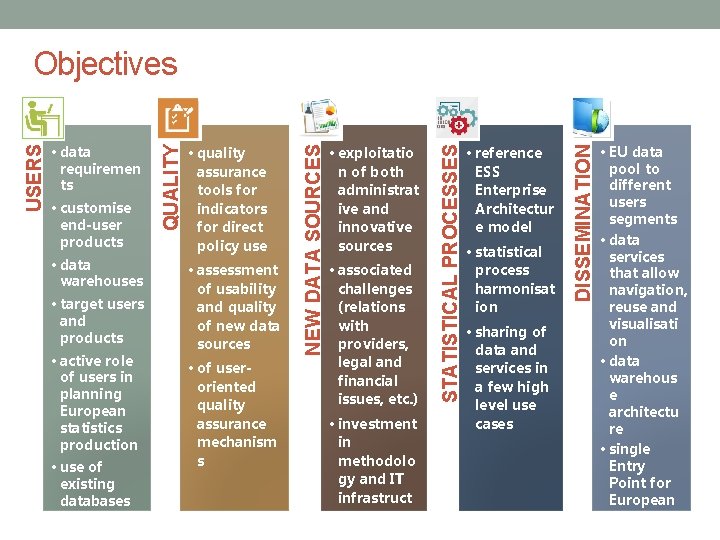
• target users and products • active role of users in planning European statistics production • use of existing databases and multiple • assessment of usability and quality of new data sources • of useroriented quality assurance mechanism s • associated challenges (relations with providers, legal and financial issues, etc. ) • investment in methodolo gy and IT infrastruct ure • reference ESS Enterprise Architectur e model • statistical process harmonisat ion • sharing of data and services in a few high level use cases DISSEMINATION • data warehouses • exploitatio n of both administrat ive and innovative sources STATISTICAL PROCESSES • customise end-user products • quality assurance tools for indicators for direct policy use NEW DATA SOURCES • data requiremen ts QUALITY USERS Objectives • EU data pool to different users segments • data services that allow navigation, reuse and visualisati on • data warehous e architectu re • single Entry Point for European statistics (open

Portfolio of actions Selection and prioritisation criteria Implementation through a portfolio of • Projects • Programs • Other actions to enable the accomplishment of the Vision goals • Strategic alignment and relevance • Potential contribution to building infrastructure and services that could be used across several statistical domains • Effective use of integrated data sources, including new data sources • Statistical products enhancement

Priority actions • ESS Enterprise Architecture • Capabilities and Infrastructures • Standardisation process • Interoperable technology • Common platforms for microdata exchange • New Methods and Tools • Methodology for integrating new sources • Big Data • Data pool for dissemination • Optimal exploitation of new data sources • strategic alliances with public and private partners • legal and privacy framework • capability building • quality of data sources
Evaluation of ESS. VIPs The evaluation • Provided useful insights in the development of the Vision portfolio • Proposes to make use of the experience gained from ESS. VIPs • Considers that current and frozen ESS. VIP projects are based on valuable and still valid considerations • BUT weaknesses in • planning • clear goal and results setting • buy-in of all involved • manageability • coordination • cost/benefit and risk analysis • taking into account the national perspective
ESS. VIPs as part of the ESS Vision 2020 portfolio • Agreement on removing 3 projects (ICT, NAPS-S and PRIX) from the list of the ESS. VIPs, while some of their elements could be continued (Eurostat-internal projects or different context) • Recognition that SIMSTAT, ESBRs, Validation are generally in line with the ESS Vision 2020 – further elaboration of business cases and work plans and presented to ESSC • Similarly for the business cases for ADMIN and ESDEN, as well as the 3 cross-cutting projects (DW, IMS and SERV) • ESSnets 2015 (facilitating tool) will be discussed in the November ESSC
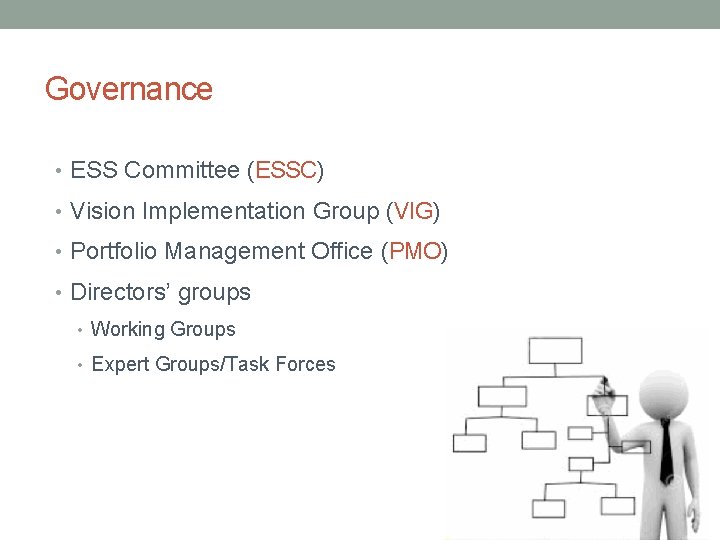
Governance • ESS Committee (ESSC) • Vision Implementation Group (VIG) • Portfolio Management Office (PMO) • Directors’ groups • Working Groups • Expert Groups/Task Forces
Time table • DGINS discussion on implementation on the ESS Vision 2020 – 24 th September • PG TF “Implementation of the ESS Vision 2020” prolonged till the end 2014 • VIG set-up – January 2015 • oversee and coordinate the implementation of the ESS Vision 2020 • advise the ESSC on the prioritisation of VIPs • Support by PMO (Eurostat) + Vision implementation network (VIN) • ESSC – November 2014 • Emerging content of the portfolio and concrete deliverables in each of the 5 key areas, including potential new VIPs • ESSC February 2014 • ESS Vision 2020 portfolio • business cases and work plans • ESS EA • ESSC May 2014 • Annual Work Programme • New projects • ESSnets / Centres of Excellence
Feedback sought from Director’s Groups • Initial reactions? • Specific issues for DSS • ADMIN • New sources and combination of sources • Modernisation of Social Statistics • Communication
Thank you for your attention!
- Slides: 13