
Implementing the EAL curriculum in primary settings 1

![Question 2: prior schooling Did [name of student] attend school before arriving in Australia?](https://slidetodoc.com/presentation_image_h2/dba4aa785eb0a793a22336b760b7bd96/image-14.jpg "Question 2: prior schooling Did [name of student] attend school before arriving in Australia?")
![Question 3: home language literacy What can [name of student] read and write in](https://slidetodoc.com/presentation_image_h2/dba4aa785eb0a793a22336b760b7bd96/image-15.jpg "Question 3: home language literacy What can [name of student] read and write in")
![Question 4: time spent learning and using English Has [name of student] learnt or](https://slidetodoc.com/presentation_image_h2/dba4aa785eb0a793a22336b760b7bd96/image-16.jpg "Question 4: time spent learning and using English Has [name of student] learnt or")
- Slides: 34
Implementing the EAL curriculum in primary settings 1. Whole-school implementation 2. Language and Learning Interview 3. Pathways A and B Sample Progressions 30 July 2020
Acknowledgment of Country In recognition of Aboriginal and Torres Strait Islander people’s spiritual and cultural connection to country, we acknowledge the traditional custodians of the Kulin Nations. We acknowledge the continued care of the lands and waterways over generations and celebrate the continuation of a living culture that has a unique role in this region. We pay our respects to Elders past, present and emerging, for they hold the memories, traditions, culture and hopes of all Aboriginal and Torres Strait Islander peoples across the nation and hope they will walk with us on our journey.
1. Whole-school implementation
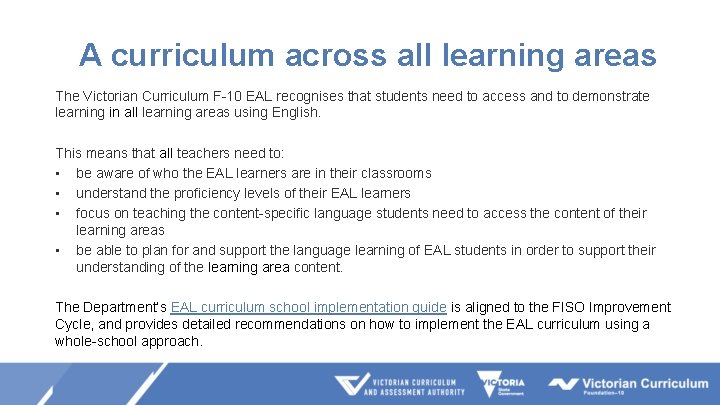
A curriculum across all learning areas The Victorian Curriculum F-10 EAL recognises that students need to access and to demonstrate learning in all learning areas using English. This means that all teachers need to: • be aware of who the EAL learners are in their classrooms • understand the proficiency levels of their EAL learners • focus on teaching the content-specific language students need to access the content of their learning areas • be able to plan for and support the language learning of EAL students in order to support their understanding of the learning area content. The Department’s EAL curriculum school implementation guide is aligned to the FISO Improvement Cycle, and provides detailed recommendations on how to implement the EAL curriculum using a whole-school approach.
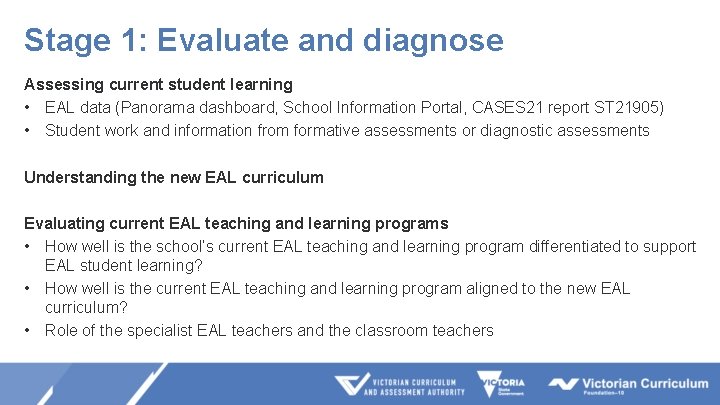
Stage 1: Evaluate and diagnose Assessing current student learning • EAL data (Panorama dashboard, School Information Portal, CASES 21 report ST 21905) • Student work and information from formative assessments or diagnostic assessments Understanding the new EAL curriculum Evaluating current EAL teaching and learning programs • How well is the school’s current EAL teaching and learning program differentiated to support EAL student learning? • How well is the current EAL teaching and learning program aligned to the new EAL curriculum? • Role of the specialist EAL teachers and the classroom teachers
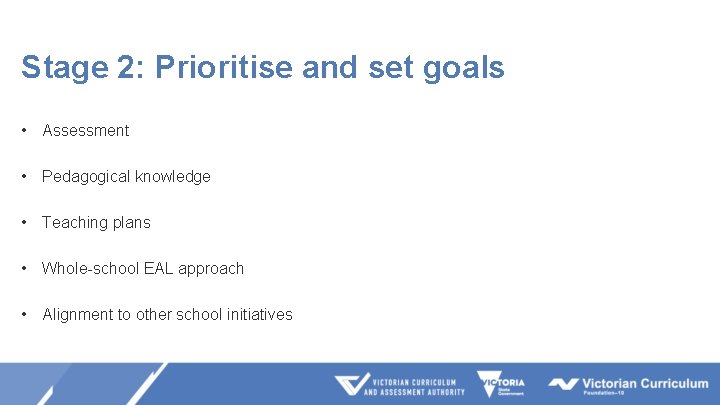
Stage 2: Prioritise and set goals • Assessment • Pedagogical knowledge • Teaching plans • Whole-school EAL approach • Alignment to other school initiatives
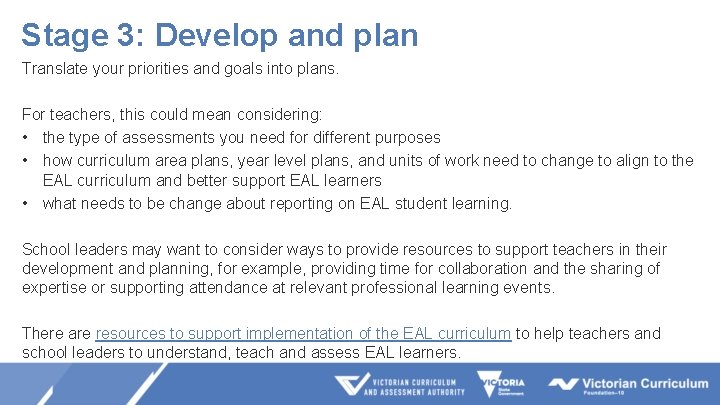
Stage 3: Develop and plan Translate your priorities and goals into plans. For teachers, this could mean considering: • the type of assessments you need for different purposes • how curriculum area plans, year level plans, and units of work need to change to align to the EAL curriculum and better support EAL learners • what needs to be change about reporting on EAL student learning. School leaders may want to consider ways to provide resources to support teachers in their development and planning, for example, providing time for collaboration and the sharing of expertise or supporting attendance at relevant professional learning events. There are resources to support implementation of the EAL curriculum to help teachers and school leaders to understand, teach and assess EAL learners.
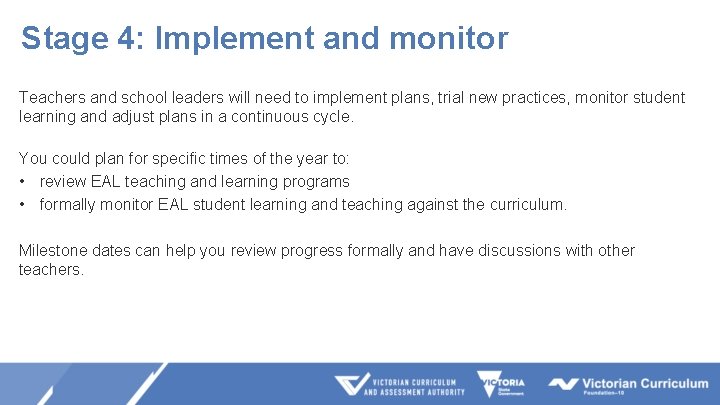
Stage 4: Implement and monitor Teachers and school leaders will need to implement plans, trial new practices, monitor student learning and adjust plans in a continuous cycle. You could plan for specific times of the year to: • review EAL teaching and learning programs • formally monitor EAL student learning and teaching against the curriculum. Milestone dates can help you review progress formally and have discussions with other teachers.
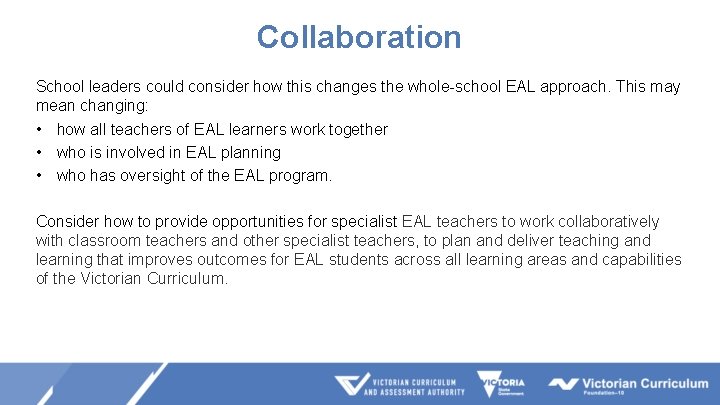
Collaboration School leaders could consider how this changes the whole-school EAL approach. This may mean changing: • how all teachers of EAL learners work together • who is involved in EAL planning • who has oversight of the EAL program. Consider how to provide opportunities for specialist EAL teachers to work collaboratively with classroom teachers and other specialist teachers, to plan and deliver teaching and learning that improves outcomes for EAL students across all learning areas and capabilities of the Victorian Curriculum.
Assessment and reporting against the EAL curriculum • An EAL learner’s English language proficiency is assessed against the EAL curriculum until their proficiency in all three language modes approximate that of their peers. • Specialist teachers report on their learning area content. • For further advice and information about assessment and reporting, see Assessment of Student Achievement and Progress Foundation to 10.
2. Language and learning interview
Overview of Language and Learning interview The purpose of the interview is to find out about the student’s prior learning experiences, including: • their development of literacy in their home language or other languages • any previous learning of English. This, along with other student assessment tasks, will assist in determining the most suitable EAL pathway for the student to start on. The Language and Learning Interview is a starting point only. It can be used as the starting point to developing a sociolinguistic profile of the EAL student. Schools are encouraged to modify or extend the interview to suit their context and needs.
Question 1: main language used at home NO Is the main language used at home a language other than English? As most families would answer Yes, take this opportunity to explore further. Some parents may think that answering No is the ‘right’ answer. In some circumstances parents or carers may answer ‘No’ because the student: • is an international student living with an English-speaking host family • was adopted from overseas by an English-speaking family • is part of a bilingual or multilingual family using English as one of the languages in the home. The interviewing teacher will need to ask additional questions to find out which language the student mostly uses at home. In these circumstances it is appropriate to answer Yes to this question. If the answer is definitely No, the student may still require EAL support and will benefit from EAL-informed teaching practices.
Question 2: prior schooling Did [name of student] attend school before arriving in Australia? 2. 1. 1 How long did [name of student] attend school in their country of origin? 2. 1. 2 How would you describe the extent of [name of student]’s prior school learning? 2. 2 Why didn’t [name of student] attend school?
Question 3: home language literacy What can [name of student] read and write in their home language? • Language and literacy levels in the home language and/or other languages are likely to reflect the experience of formal schooling in the student’s country of origin. Some students will have been educated to an age-equivalent level in their home country. This foundation in their learning will help them to transition to school life in Australia, even if they cannot yet speak English. • Students’ competence in learning to read and write in English is likely to be linked to their proficiency in their first language, in terms of oracy and literacy. • All language skills are an asset in learning a new language. Recognising and supporting these plurilingual skills in the classroom supports student wellbeing and engagement. • Students enrolling in Foundation are not expected to have literacy skills in any language when they start school. However they can speak and understand their home language and this can still be used to support their learning at school.
Question 4: time spent learning and using English Has [name of student] learnt or used English before? YES 4. 1 How did [name of student] learn English? • The answers to Question 4 will provide some information about the student’s English language proficiency, however, more structured assessments will need to be carried out by the classroom teacher in order to determine the student’s level and beginning pathway on the Victorian Curriculum F 10 EAL. • The checklist in Question 4. 3 might form part of these classroom assessment activities. The parents, carers or students may or may not be able to answer this in an interview. • Suggested initial diagnostic assessment activities for primary and secondary students are available from the TEAL assessment resource centre. 4. 2 How long has [name of student] been learning or using English? 4. 3 What can [name of student] do in English?
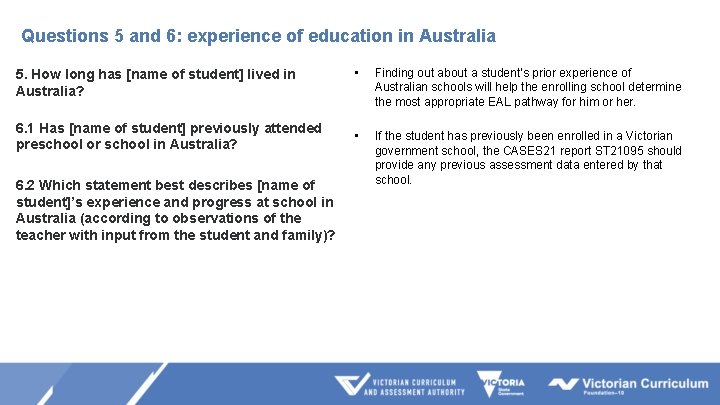
Questions 5 and 6: experience of education in Australia 5. How long has [name of student] lived in Australia? 6. 1 Has [name of student] previously attended preschool or school in Australia? 6. 2 Which statement best describes [name of student]’s experience and progress at school in Australia (according to observations of the teacher with input from the student and family)? • Finding out about a student’s prior experience of Australian schools will help the enrolling school determine the most appropriate EAL pathway for him or her. • If the student has previously been enrolled in a Victorian government school, the CASES 21 report ST 21095 should provide any previous assessment data entered by that school.
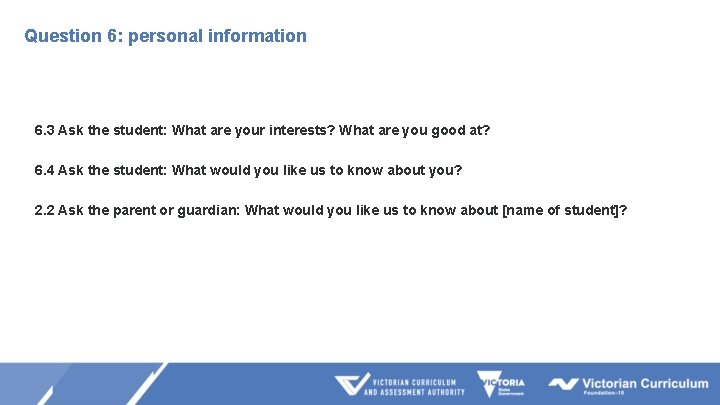
Question 6: personal information 6. 3 Ask the student: What are your interests? What are you good at? 6. 4 Ask the student: What would you like us to know about you? 2. 2 Ask the parent or guardian: What would you like us to know about [name of student]?
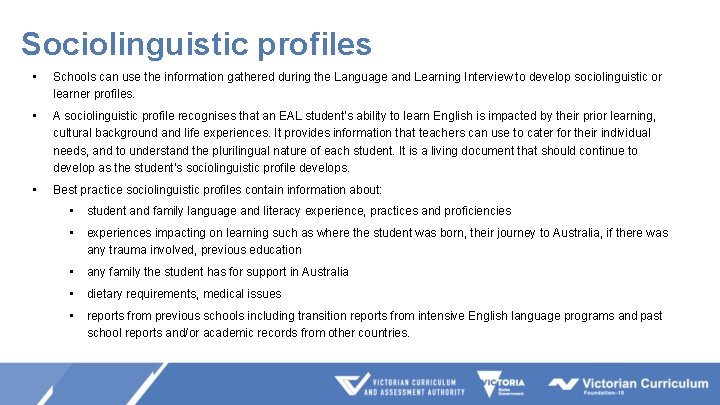
Sociolinguistic profiles • Schools can use the information gathered during the Language and Learning Interview to develop sociolinguistic or learner profiles. • A sociolinguistic profile recognises that an EAL student’s ability to learn English is impacted by their prior learning, cultural background and life experiences. It provides information that teachers can use to cater for their individual needs, and to understand the plurilingual nature of each student. It is a living document that should continue to develop as the student’s sociolinguistic profile develops. • Best practice sociolinguistic profiles contain information about: • student and family language and literacy experience, practices and proficiencies • experiences impacting on learning such as where the student was born, their journey to Australia, if there was any trauma involved, previous education • any family the student has for support in Australia • dietary requirements, medical issues • reports from previous schools including transition reports from intensive English language programs and past school reports and/or academic records from other countries.
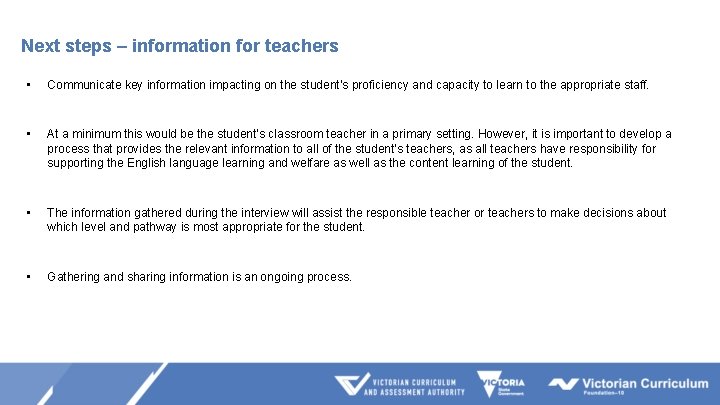
Next steps – information for teachers • Communicate key information impacting on the student’s proficiency and capacity to learn to the appropriate staff. • At a minimum this would be the student’s classroom teacher in a primary setting. However, it is important to develop a process that provides the relevant information to all of the student’s teachers, as all teachers have responsibility for supporting the English language learning and welfare as well as the content learning of the student. • The information gathered during the interview will assist the responsible teacher or teachers to make decisions about which level and pathway is most appropriate for the student. • Gathering and sharing information is an ongoing process.
3. Pathways A and B sample progression
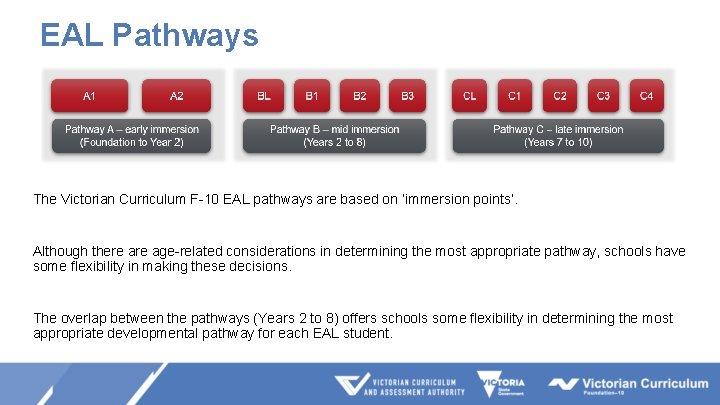
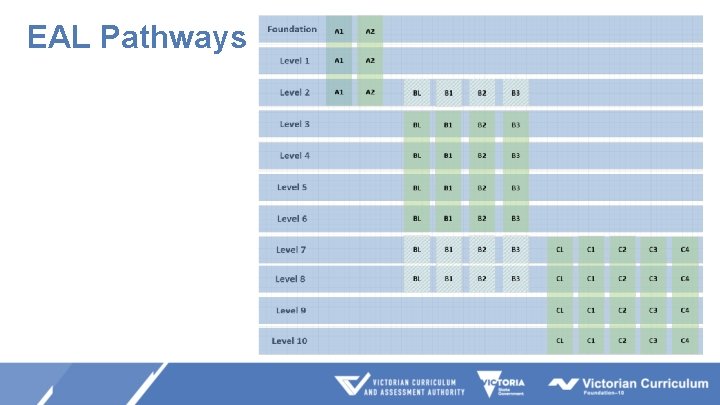
EAL Pathways The Victorian Curriculum F-10 EAL pathways are based on ‘immersion points’. Although there age-related considerations in determining the most appropriate pathway, schools have some flexibility in making these decisions. The overlap between the pathways (Years 2 to 8) offers schools some flexibility in determining the most appropriate developmental pathway for each EAL student.
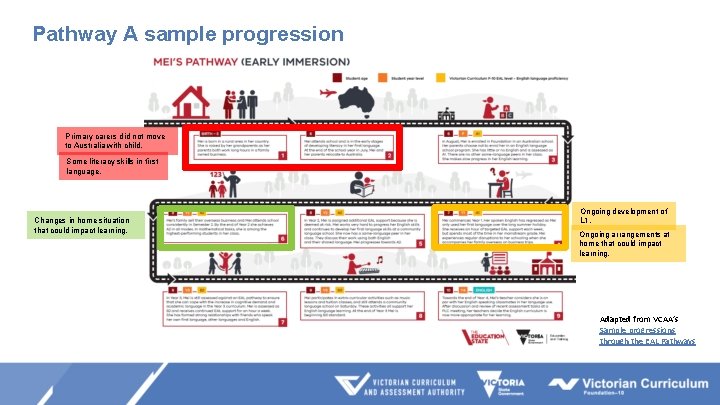
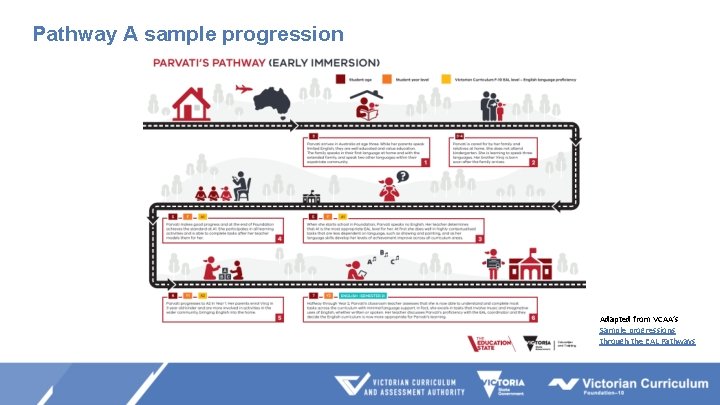
What do the levels in Pathway A mean? EAL Pathway A: early immersion (Foundation to Year 2) EAL learners at Pathway A: • • • are in the early years of their lives and are still exploring the world through concrete experiences typically develop their language and literacy skills through experiences in the school context may have some experience of informal prior learning or preschool in Australia or overseas may have some experience of formal learning in their home language or other languages are able to interact and communicate using known languages and non-verbal language. Two levels of language learning in EAL Pathway A: • • A 1 – little or no experience of literacy in English A 2 – emerging/consolidating levels of English proficiency Generally students who enter Foundation are pre-literate, regardless of their language background, and hence there is no Level AL. EAL students who enter Foundation with minimal literacy in other languages will begin their early immersion in English at Level A 1.
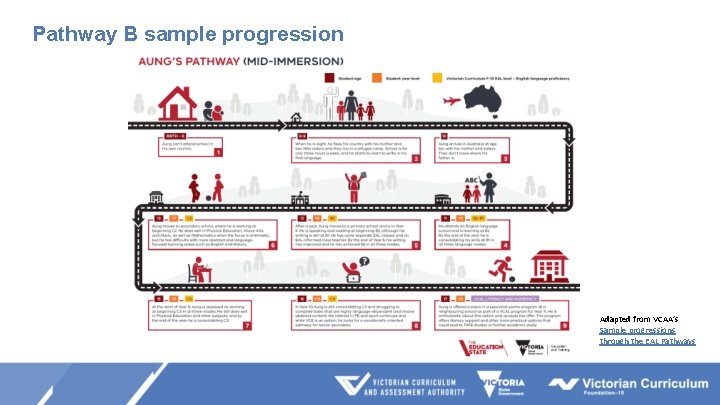
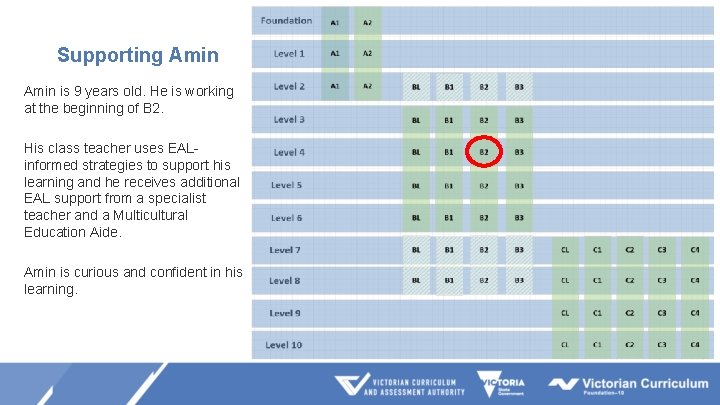
What do the levels in Pathway B mean? EAL Pathway B: mid immersion (Years 2 to 8) EAL learners at Pathway B: • have approximately seven to 13 years of life experiences, and have developed some understanding of the world • may have some experience of informal learning in their home language or other languages • may not have experienced formal schooling in any language • may have experienced formal learning (in home language or other languages) that is equivalent to their Englishspeaking peers • have experience of the social use of at least one language, which they can use as they learn English at school. Four levels of language learning: • BL – no or limited prior formal learning and no or limited levels of literacy in English and first language • B 1 – with prior experience of formal learning, beginner levels of English proficiency • B 2 – with prior experience of formal learning, emerging levels of English proficiency • B 3 – with prior experience of formal learning, consolidating levels of English proficiency EAL learners without prior formal learning and with minimal home language literacy experience will begin this pathway at Level BL. Depending on their proficiency in English, learners with prior experience of formal learning may begin Pathway B at any other level.
EAL Pathways
Pathway A sample progression Primary carers did not move to Australia with child. Some literacy skills in first language. Changes in home situation that could impact learning. Ongoing development of L 1. Ongoing arrangements at home that could impact learning. Adapted from VCAA’s Sample progressions through the EAL Pathways
Pathway A sample progression Adapted from VCAA’s Sample progressions through the EAL Pathways
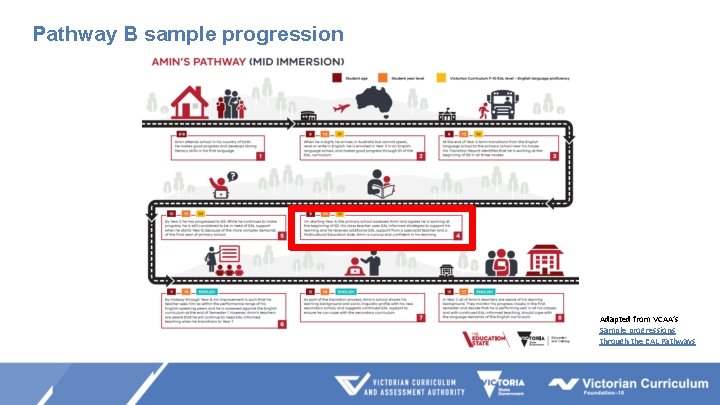
Pathway B sample progression Adapted from VCAA’s Sample progressions through the EAL Pathways
Pathway B sample progression Adapted from VCAA’s Sample progressions through the EAL Pathways
Supporting Amin is 9 years old. He is working at the beginning of B 2. His class teacher uses EALinformed strategies to support his learning and he receives additional EAL support from a specialist teacher and a Multicultural Education Aide. Amin is curious and confident in his learning.
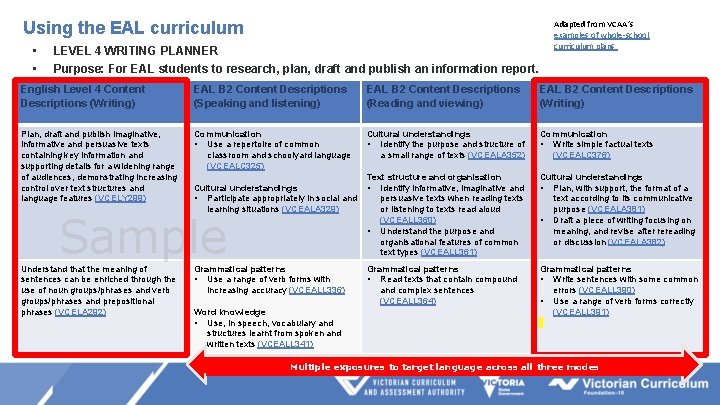
Using the EAL curriculum • • LEVEL 4 WRITING PLANNER Purpose: For EAL students to research, plan, draft and publish an information report. Adapted from VCAA’s examples of whole-school curriculum plans English Level 4 Content Descriptions (Writing) EAL B 2 Content Descriptions (Speaking and listening) EAL B 2 Content Descriptions (Reading and viewing) EAL B 2 Content Descriptions (Writing) Plan, draft and publish imaginative, informative and persuasive texts containing key information and supporting details for a widening range of audiences, demonstrating increasing control over text structures and language features (VCELY 299) Communication • Use a repertoire of common classroom and schoolyard language (VCEALC 325) Cultural understandings • Identify the purpose and structure of a small range of texts (VCEALA 352) Communication • Write simple factual texts (VCEALC 376) Text structure and organisation • Identify informative, imaginative and persuasive texts when reading texts or listening to texts read aloud (VCEALL 360) • Understand the purpose and organisational features of common text types (VCEALL 361) Cultural understandings • Plan, with support, the format of a text according to its communicative purpose (VCEALA 381) • Draft a piece of writing focusing on meaning, and revise after rereading or discussion (VCEALA 382) Grammatical patterns • Read texts that contain compound and complex sentences (VCEALL 364) Grammatical patterns • Write sentences with some common errors (VCEALL 390) • Use a range of verb forms correctly (VCEALL 391) Cultural understandings • Participate appropriately in social and learning situations (VCEALA 329) Sample Understand that the meaning of sentences can be enriched through the use of noun groups/phrases and verb groups/phrases and prepositional phrases (VCELA 292) Grammatical patterns • Use a range of verb forms with increasing accuracy (VCEALL 336) Word knowledge • Use, in speech, vocabulary and structures learnt from spoken and written texts (VCEALL 341) Multiple exposures to target language across all three modes
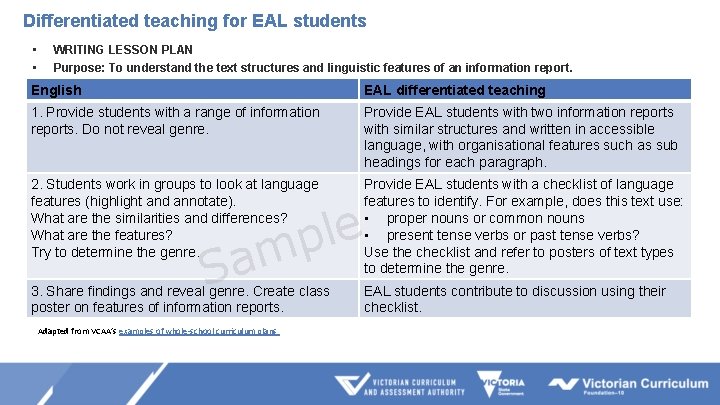
Differentiated teaching for EAL students • • WRITING LESSON PLAN Purpose: To understand the text structures and linguistic features of an information report. English EAL differentiated teaching 1. Provide students with a range of information reports. Do not reveal genre. Provide EAL students with two information reports with similar structures and written in accessible language, with organisational features such as sub headings for each paragraph. 2. Students work in groups to look at language features (highlight and annotate). What are the similarities and differences? What are the features? Try to determine the genre. Provide EAL students with a checklist of language features to identify. For example, does this text use: • proper nouns or common nouns • present tense verbs or past tense verbs? Use the checklist and refer to posters of text types to determine the genre. 3. Share findings and reveal genre. Create class poster on features of information reports. EAL students contribute to discussion using their checklist. e l p am S Adapted from VCAA’s examples of whole-school curriculum plans
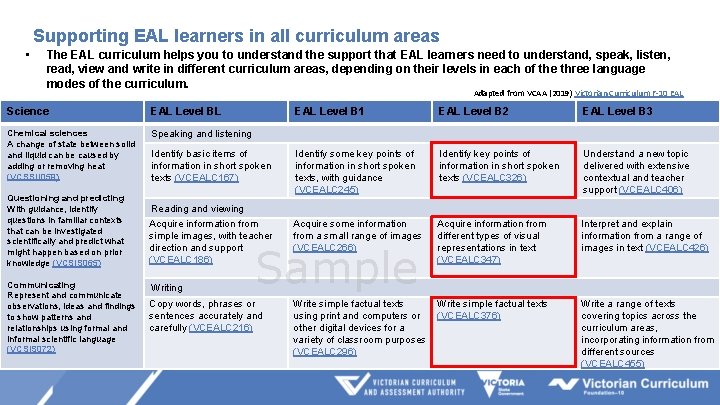
Supporting EAL learners in all curriculum areas • The EAL curriculum helps you to understand the support that EAL learners need to understand, speak, listen, read, view and write in different curriculum areas, depending on their levels in each of the three language modes of the curriculum. Adapted from VCAA (2019) Victorian Curriculum F-10 EAL Science EAL Level BL Chemical sciences A change of state between solid and liquid can be caused by adding or removing heat (VCSSU 059) Speaking and listening Questioning and predicting With guidance, identify questions in familiar contexts that can be investigated scientifically and predict what might happen based on prior knowledge (VCSIS 065) Communicating Represent and communicate observations, ideas and findings to show patterns and relationships using formal and informal scientific language (VCSIS 072) Identify basic items of information in short spoken texts (VCEALC 167) EAL Level B 1 EAL Level B 2 EAL Level B 3 Identify some key points of information in short spoken texts, with guidance (VCEALC 245) Identify key points of information in short spoken texts (VCEALC 326) Understand a new topic delivered with extensive contextual and teacher support (VCEALC 406) Acquire some information from a small range of images (VCEALC 266) Acquire information from different types of visual representations in text (VCEALC 347) Interpret and explain information from a range of images in text (VCEALC 426) Write simple factual texts using print and computers or other digital devices for a variety of classroom purposes (VCEALC 296) Write simple factual texts (VCEALC 376) Write a range of texts covering topics across the curriculum areas, incorporating information from different sources (VCEALC 455) Reading and viewing Acquire information from simple images, with teacher direction and support (VCEALC 186) Writing Sample Copy words, phrases or sentences accurately and carefully (VCEALC 216)
LINKS EAL Regional Program Officers Vic. TESOL CONTACT For any questions concerning the EAL curriculum, please contact: Kellie Heintz, EAL Curriculum Manager, VCAA Victorian Curriculum F-10 EAL Kellie. Heintz@education. vic. gov. au Language and learning interview Sample progressions through the EAL Pathways through the EAL curriculum (DET adaptation) TEAL assessment resources Assessment of Student Achievement and Progress Foundation to 10 First language assessment materials EAL curriculum school implementation guide Resources for implementing the new EAL curriculum