
IMPLEMENTING THE CCSS IN SOCIAL STUDIES AND SCIENCE
- Slides: 20
IMPLEMENTING THE CCSS IN SOCIAL STUDIES AND SCIENCE AUGUST 2011
CONTENT LITERACY Reading and writing in the content fields (content literacy) represents one of the major changes in the recently adopted Common Core Standards. Content teachers will now be held accountable for supporting literacy standards in their content instruction. The Common Core Standards specify literacy-based standards for both reading and writing in each of the areas of History/Social Studies, Science, and Technical subjects. Take Note: This does not mean that content area teachers have to become reading teachers – a common complaint leveled at the idea of literacy-based content standards. What it does mean is that content area teachers will be held accountable for supporting the literacy skills necessary for students to function successfully in a complex and integrated world.
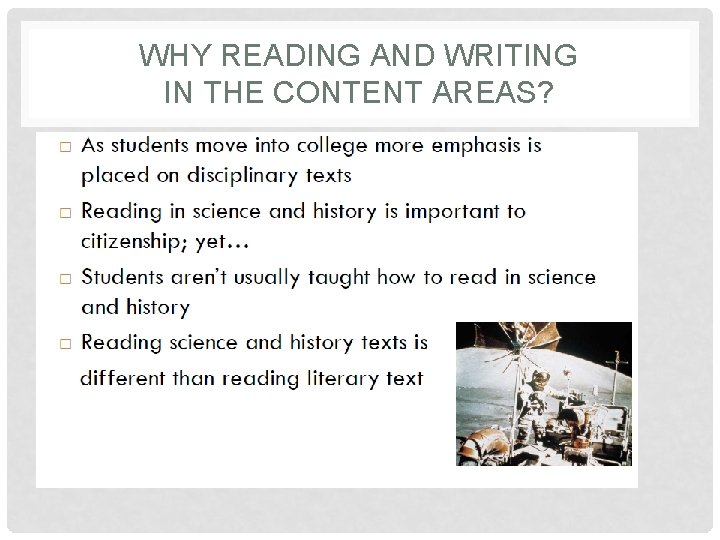
WHY READING AND WRITING IN THE CONTENT AREAS?
DISCIPLINARY LITERACY
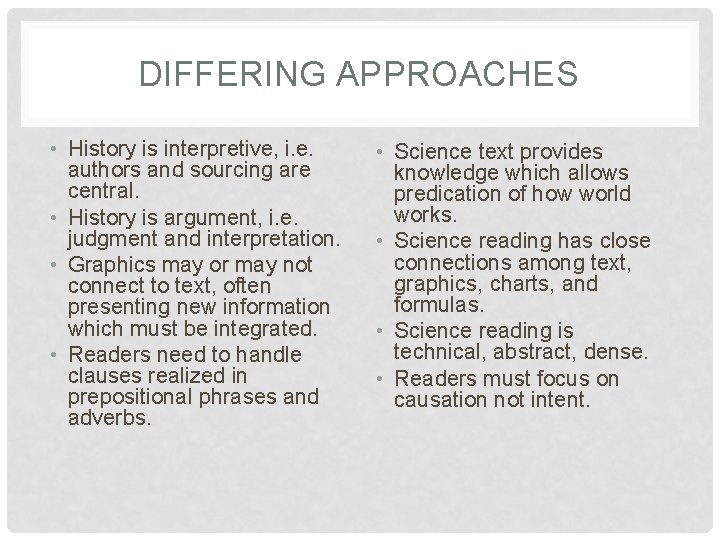
DIFFERING APPROACHES • History is interpretive, i. e. authors and sourcing are central. • History is argument, i. e. judgment and interpretation. • Graphics may or may not connect to text, often presenting new information which must be integrated. • Readers need to handle clauses realized in prepositional phrases and adverbs. • Science text provides knowledge which allows predication of how world works. • Science reading has close connections among text, graphics, charts, and formulas. • Science reading is technical, abstract, dense. • Readers must focus on causation not intent.
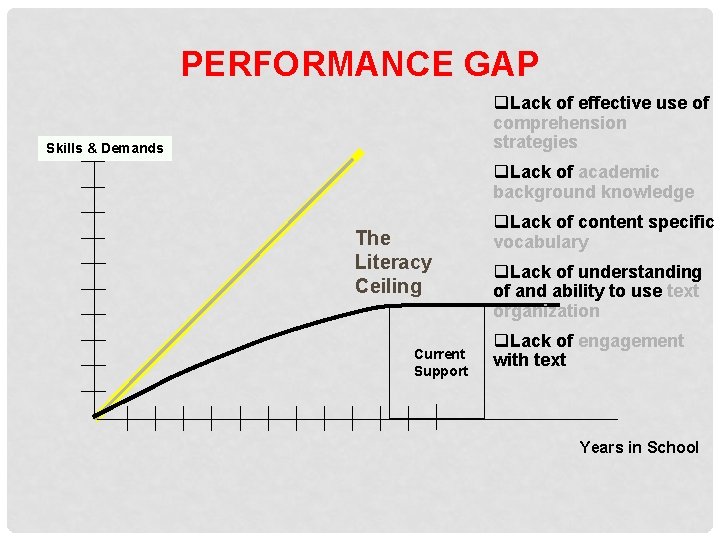
PERFORMANCE GAP q. Lack of effective use of comprehension strategies Skills & Demands q. Lack of academic background knowledge The Literacy Ceiling Current Support q. Lack of content specific vocabulary q. Lack of understanding of and ability to use text organization q. Lack of engagement with text Years in School
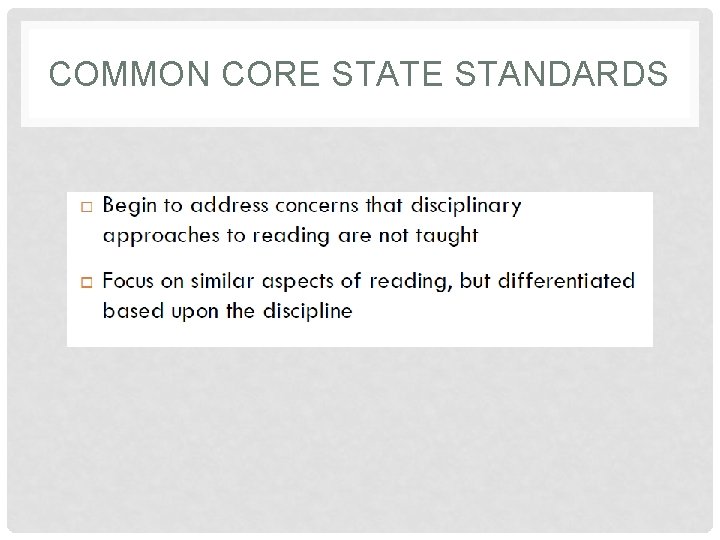
COMMON CORE STATE STANDARDS
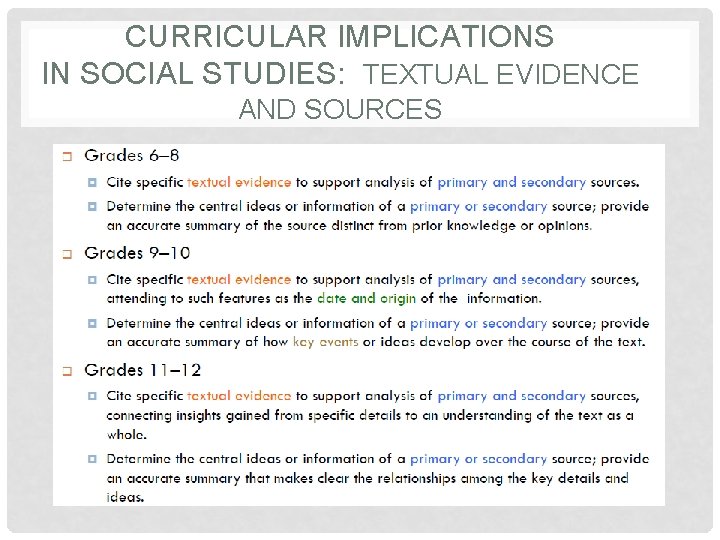
CURRICULAR IMPLICATIONS IN SOCIAL STUDIES: TEXTUAL EVIDENCE AND SOURCES
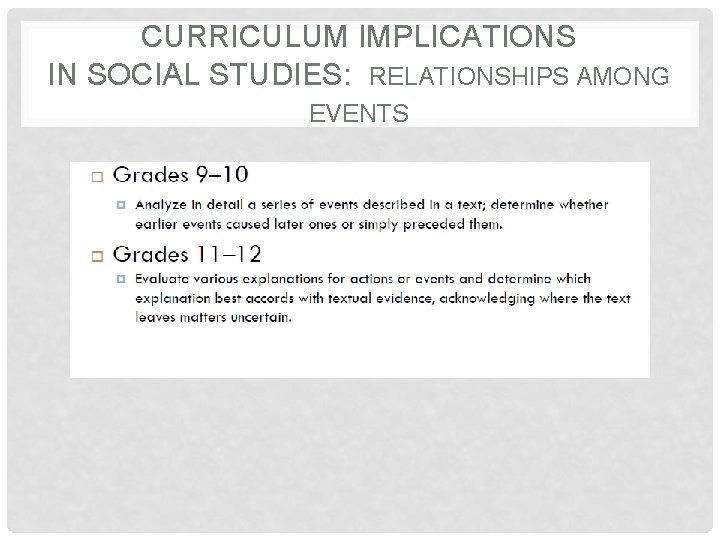
CURRICULUM IMPLICATIONS IN SOCIAL STUDIES: RELATIONSHIPS AMONG EVENTS
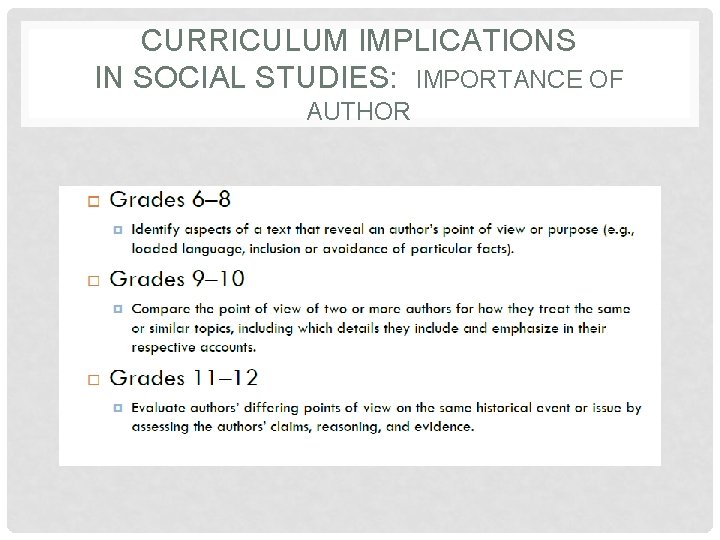
CURRICULUM IMPLICATIONS IN SOCIAL STUDIES: IMPORTANCE OF AUTHOR
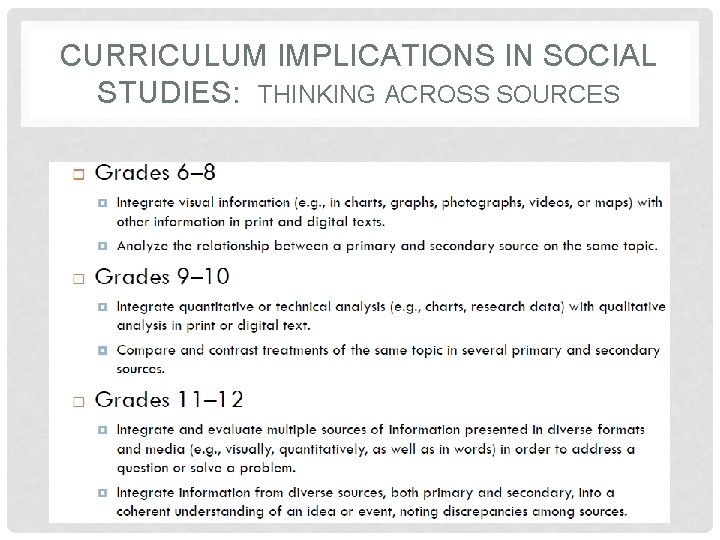
CURRICULUM IMPLICATIONS IN SOCIAL STUDIES: THINKING ACROSS SOURCES
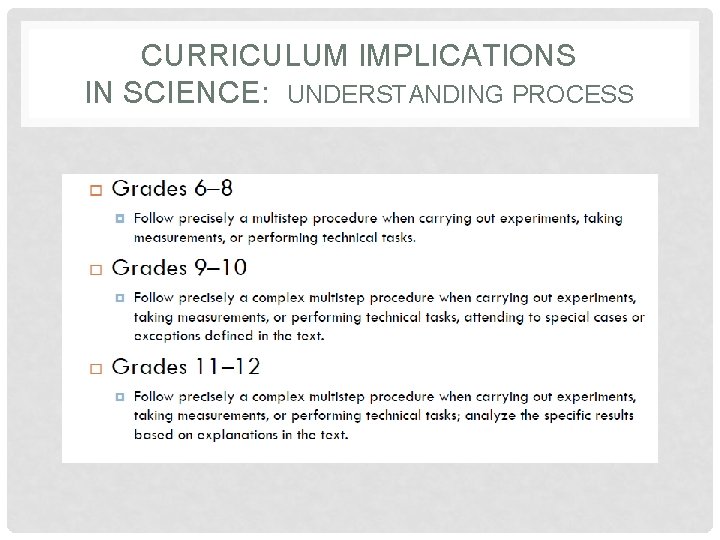
CURRICULUM IMPLICATIONS IN SCIENCE: UNDERSTANDING PROCESS
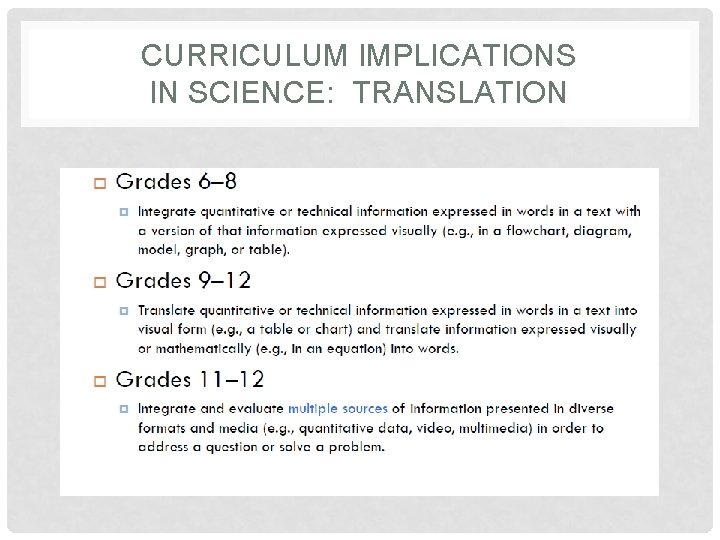
CURRICULUM IMPLICATIONS IN SCIENCE: TRANSLATION
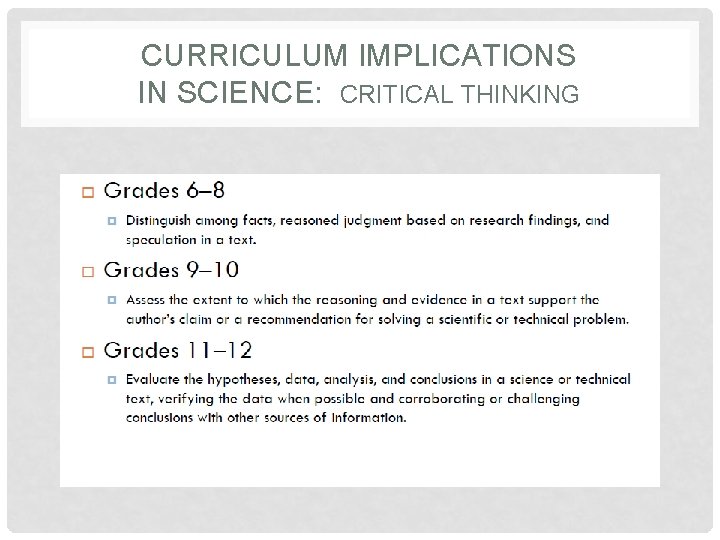
CURRICULUM IMPLICATIONS IN SCIENCE: CRITICAL THINKING
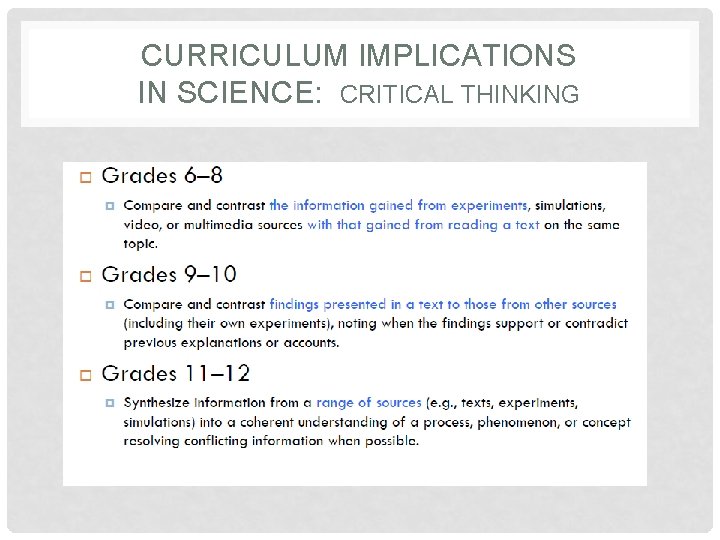
CURRICULUM IMPLICATIONS IN SCIENCE: CRITICAL THINKING
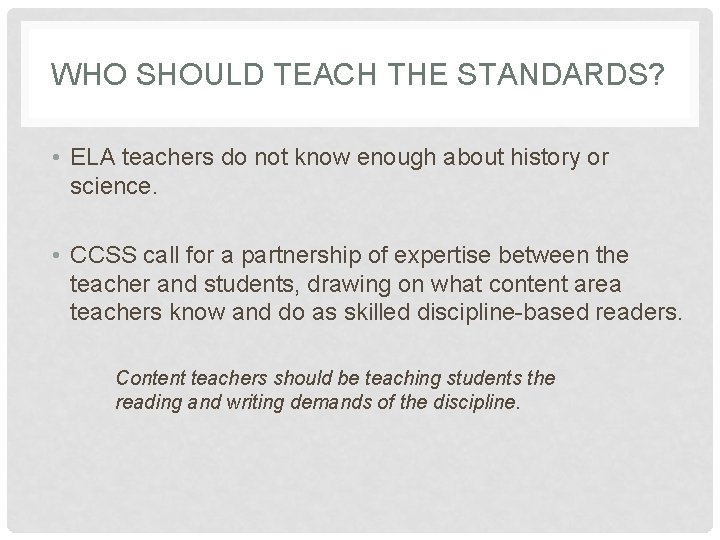
WHO SHOULD TEACH THE STANDARDS? • ELA teachers do not know enough about history or science. • CCSS call for a partnership of expertise between the teacher and students, drawing on what content area teachers know and do as skilled discipline-based readers. Content teachers should be teaching students the reading and writing demands of the discipline.
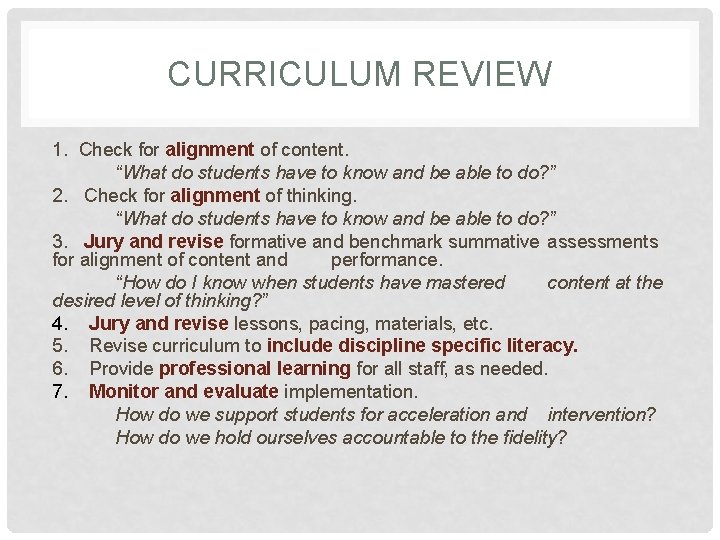
CURRICULUM REVIEW 1. Check for alignment of content. “What do students have to know and be able to do? ” 2. Check for alignment of thinking. “What do students have to know and be able to do? ” 3. Jury and revise formative and benchmark summative assessments for alignment of content and performance. “How do I know when students have mastered content at the desired level of thinking? ” 4. Jury and revise lessons, pacing, materials, etc. 5. Revise curriculum to include discipline specific literacy. 6. Provide professional learning for all staff, as needed. 7. Monitor and evaluate implementation. How do we support students for acceleration and intervention? How do we hold ourselves accountable to the fidelity?
CURRICULUM RESOURCES High School Science Priority Expectations Michigan Social Studies http: //www. micitizenshipcurriculum. org/ Mid Michigan Power Standards Project
CURRICULUM RESOURCES Collaborative Curriculum Groups CGRESD CCSS for Science and SS New Science Conceptual Framework 2011 Research brief on Adolescent Literacy without Limits Find CCS information on MDE site (including alignment documents) http: //www. michigan. gov/mde/0, 1607, 7 -140 -232021 --, 00. html
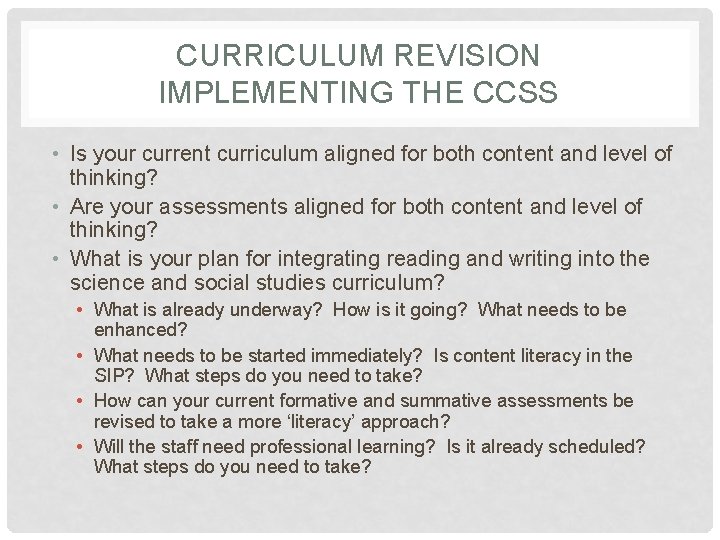
CURRICULUM REVISION IMPLEMENTING THE CCSS • Is your current curriculum aligned for both content and level of thinking? • Are your assessments aligned for both content and level of thinking? • What is your plan for integrating reading and writing into the science and social studies curriculum? • What is already underway? How is it going? What needs to be enhanced? • What needs to be started immediately? Is content literacy in the SIP? What steps do you need to take? • How can your current formative and summative assessments be revised to take a more ‘literacy’ approach? • Will the staff need professional learning? Is it already scheduled? What steps do you need to take?