
Implementing the Care Act assessment caresupport planning and






- Slides: 35
Implementing the Care Act – assessment, care/support planning and review November 2014
The Care Act 2014 • Replaces almost all existing adult social care law, except MHA and MCA • Changes to the legal framework to be implemented from April 2015 • (Funding reform scheduled for April 2016) • Final guidance now out – www. tinyurl. com/Care. Act. Guidance
The intentions of the Act • • Guiding principle is promoting wellbeing Prevention a formal duty for the first time “Co-produced” assessments and plans New rights for carers: – Right to assessments extended – Duty (not just power) to meet carer needs • National eligibility criteria • More specific duties to provide information • “Modernised” law
Key requirements The new framework is much more prescriptive than before about processes and documentation: • Option of supported self-assessment must be offered • Assessments must describe all needs, eligible or not and whether or not to be met by carers • Assessments, explanations of eligibility decisions and care/support plans must be given to people in writing • People should be told in advance the questions they are going to be asked • Must give personalised written advice about prevention • Advocacy may be a duty if people would have “substantial difficulty” in being involved
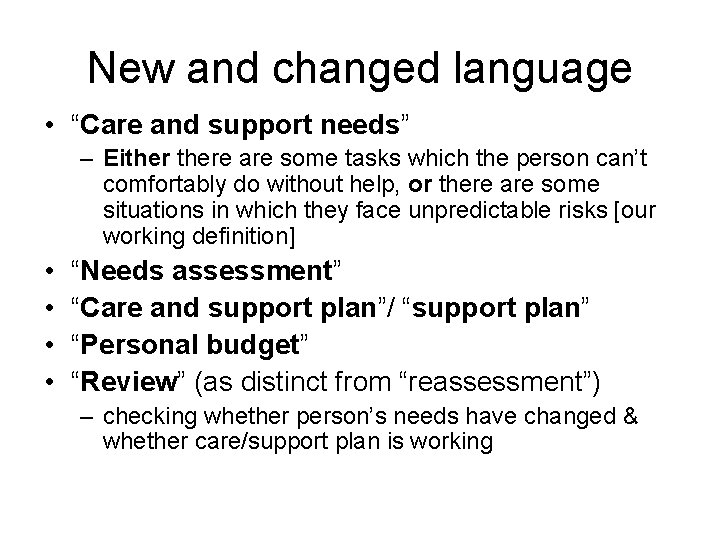
New and changed language • “Care and support needs” – Eithere are some tasks which the person can’t comfortably do without help, or there are some situations in which they face unpredictable risks [our working definition] • • “Needs assessment” “Care and support plan”/ “support plan” “Personal budget” “Review” (as distinct from “reassessment”) – checking whether person’s needs have changed & whether care/support plan is working
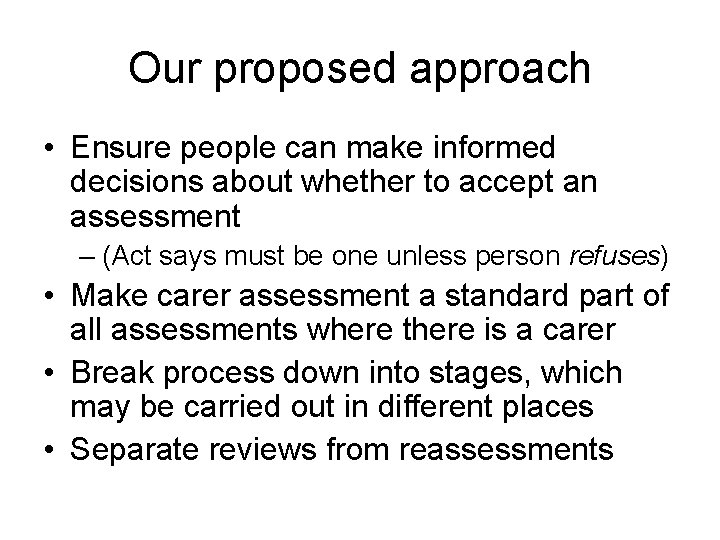
Our proposed approach • Ensure people can make informed decisions about whether to accept an assessment – (Act says must be one unless person refuses) • Make carer assessment a standard part of all assessments where there is a carer • Break process down into stages, which may be carried out in different places • Separate reviews from reassessments
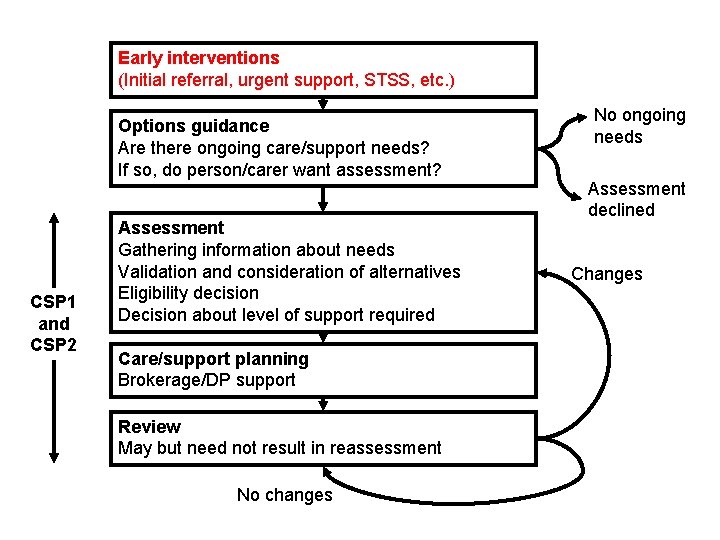
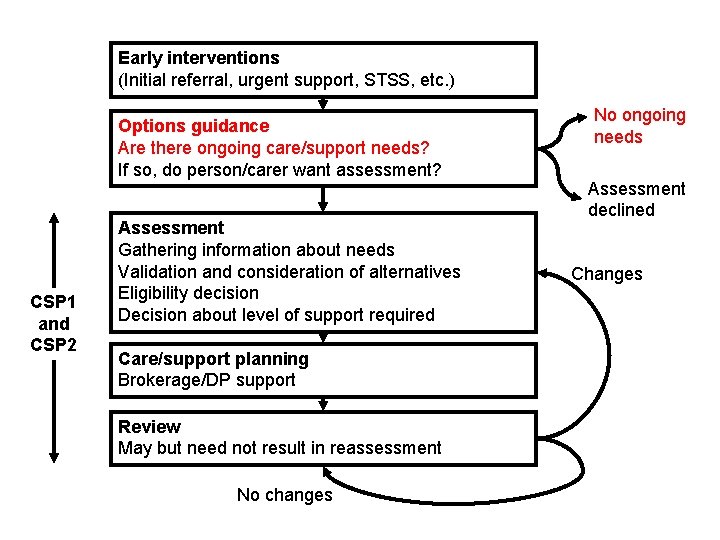
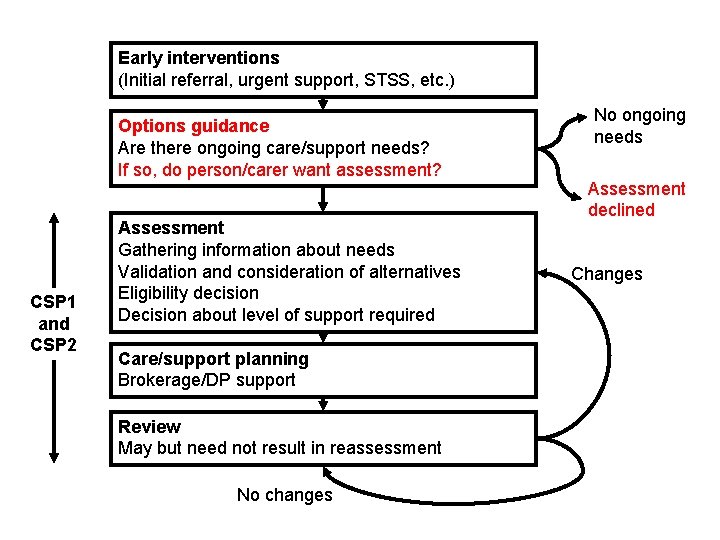
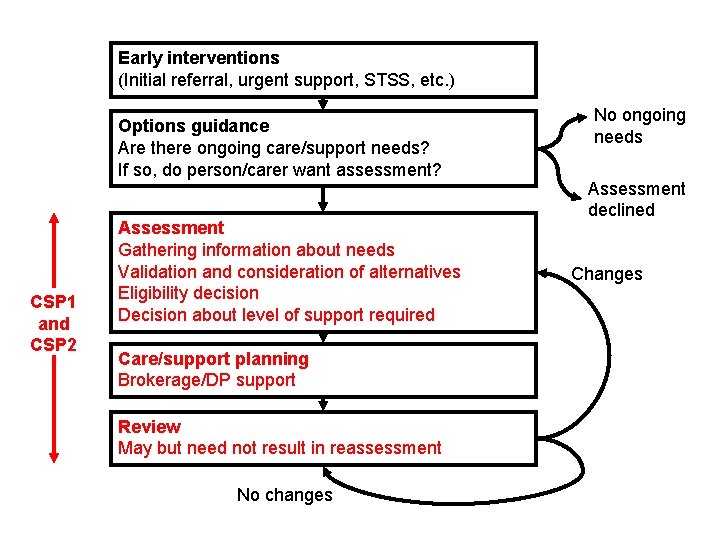
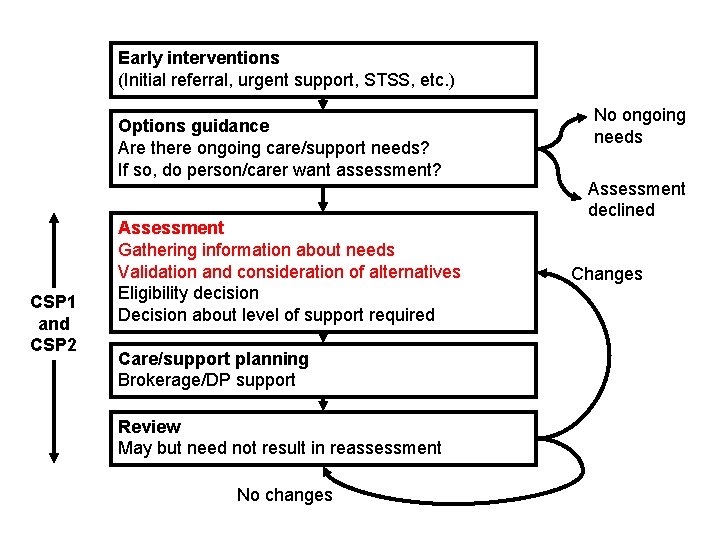
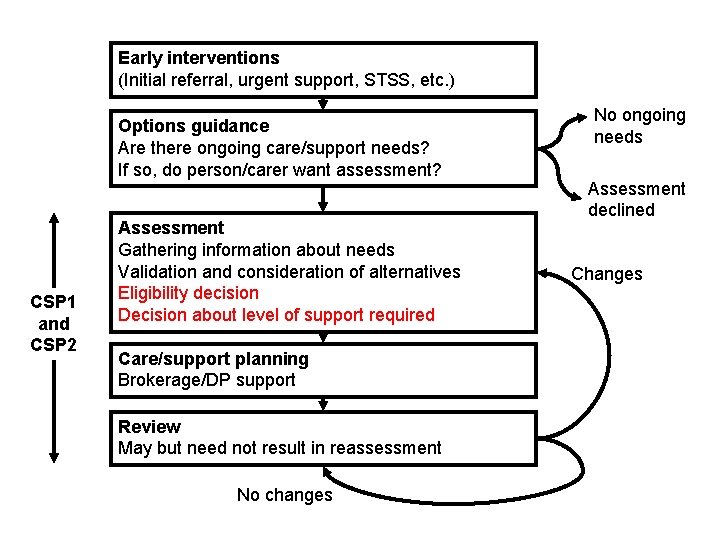
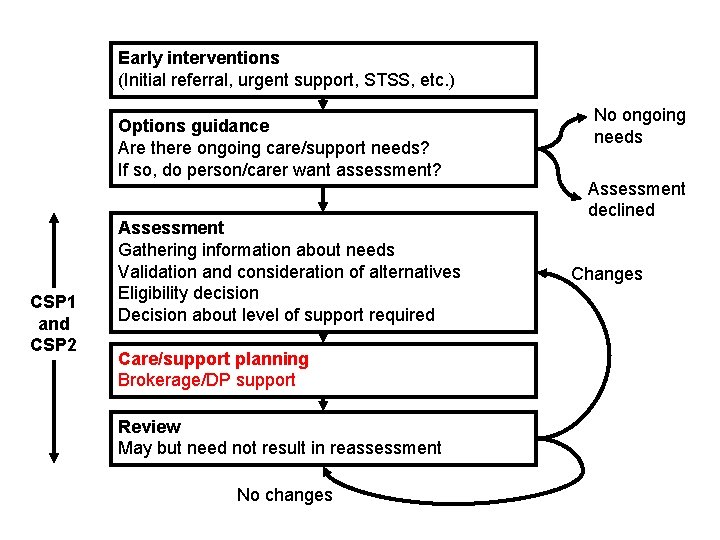
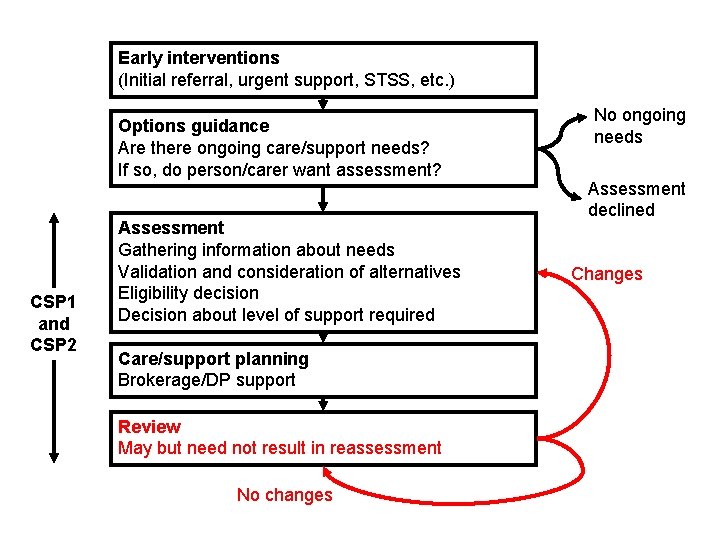
Early interventions (Initial referral, urgent support, STSS, etc. ) Options guidance Are there ongoing care/support needs? If so, do person/carer want assessment? CSP 1 and CSP 2 Assessment Gathering information about needs Validation and consideration of alternatives Eligibility decision Decision about level of support required Care/support planning Brokerage/DP support Review May but need not result in reassessment No changes No ongoing needs Assessment declined Changes
Early interventions (Initial referral, urgent support, STSS, etc. ) Options guidance Are there ongoing care/support needs? If so, do person/carer want assessment? CSP 1 and CSP 2 Assessment Gathering information about needs Validation and consideration of alternatives Eligibility decision Decision about level of support required Care/support planning Brokerage/DP support Review May but need not result in reassessment No changes No ongoing needs Assessment declined Changes
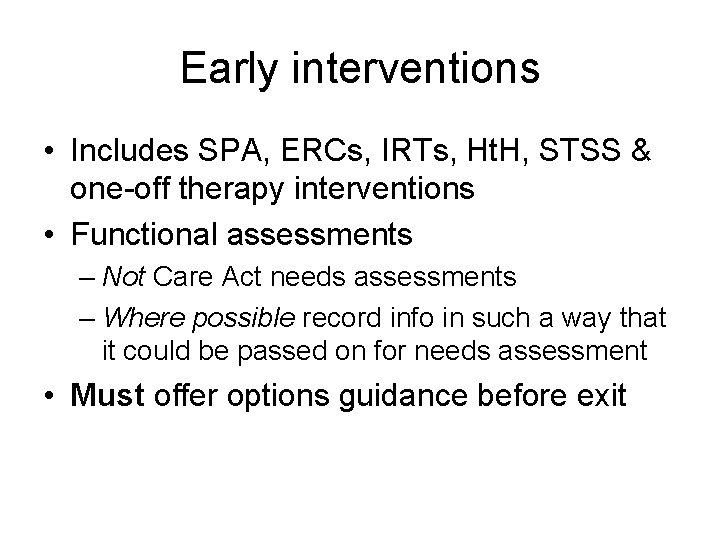
Early interventions • Includes SPA, ERCs, IRTs, Ht. H, STSS & one-off therapy interventions • Functional assessments – Not Care Act needs assessments – Where possible record info in such a way that it could be passed on for needs assessment • Must offer options guidance before exit
Early interventions (Initial referral, urgent support, STSS, etc. ) Options guidance Are there ongoing care/support needs? If so, do person/carer want assessment? CSP 1 and CSP 2 Assessment Gathering information about needs Validation and consideration of alternatives Eligibility decision Decision about level of support required Care/support planning Brokerage/DP support Review May but need not result in reassessment No changes No ongoing needs Assessment declined Changes
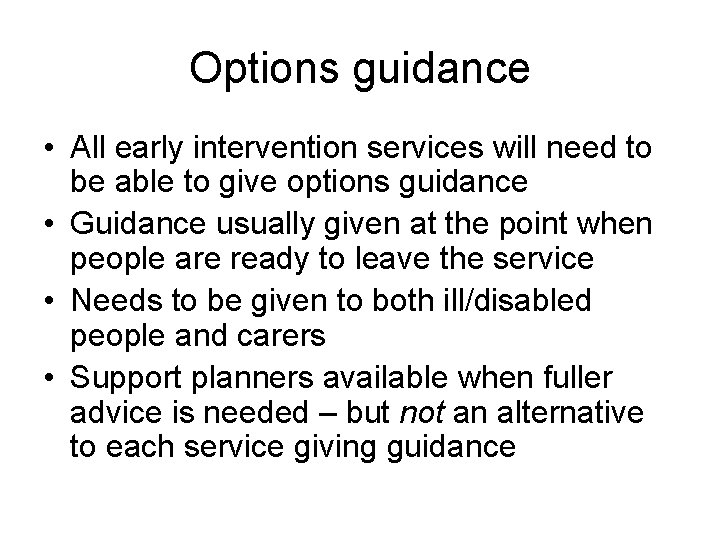
Options guidance • All early intervention services will need to be able to give options guidance • Guidance usually given at the point when people are ready to leave the service • Needs to be given to both ill/disabled people and carers • Support planners available when fuller advice is needed – but not an alternative to each service giving guidance
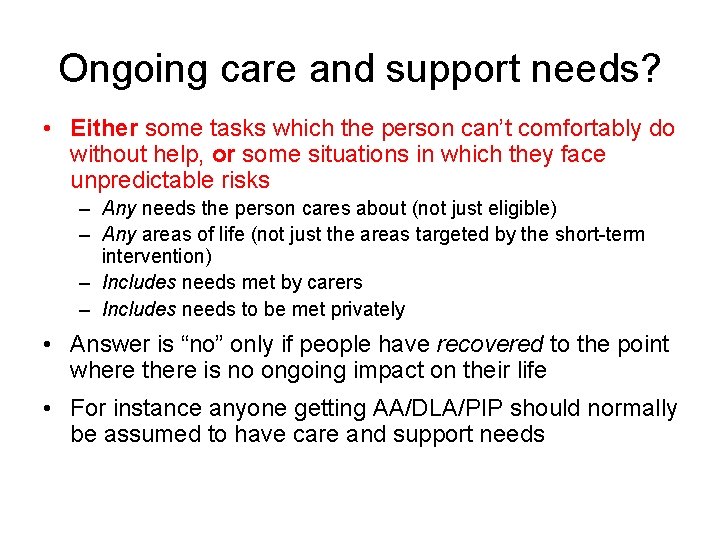
Ongoing care and support needs? • Either some tasks which the person can’t comfortably do without help, or some situations in which they face unpredictable risks – Any needs the person cares about (not just eligible) – Any areas of life (not just the areas targeted by the short-term intervention) – Includes needs met by carers – Includes needs to be met privately • Answer is “no” only if people have recovered to the point where there is no ongoing impact on their life • For instance anyone getting AA/DLA/PIP should normally be assumed to have care and support needs
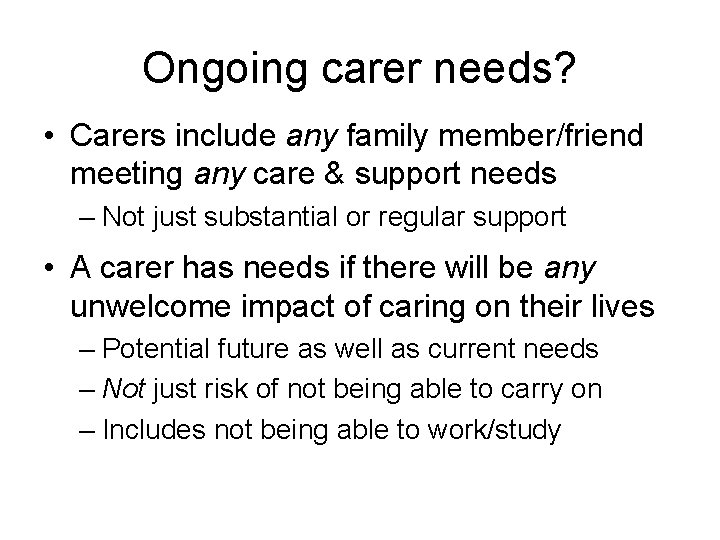
Ongoing carer needs? • Carers include any family member/friend meeting any care & support needs – Not just substantial or regular support • A carer has needs if there will be any unwelcome impact of caring on their lives – Potential future as well as current needs – Not just risk of not being able to carry on – Includes not being able to work/study
If there are no ongoing needs • Must provide general advice about how to prevent or delay future needs • Need to document that there are no ongoing needs and how that decision was taken
Early interventions (Initial referral, urgent support, STSS, etc. ) Options guidance Are there ongoing care/support needs? If so, do person/carer want assessment? CSP 1 and CSP 2 Assessment Gathering information about needs Validation and consideration of alternatives Eligibility decision Decision about level of support required Care/support planning Brokerage/DP support Review May but need not result in reassessment No changes No ongoing needs Assessment declined Changes
“Refusing” assessment? • The Act says we must assess people with needs (users + carers) unless they refuse an assessment • But many people won’t want an assessment if they know it won’t lead to services and that advice is available without it • Unnecessary formal assessments can be a burden for disabled people and carers and divert resources from meeting needs. Options guidance needs to include: – Explaining what the benefits of assessment are (and are not) – Offering advice and information without an assessment • We must assess people at risk of abuse/neglect; and must assess people without the capacity to refuse unless we believe it would not be in their best interests.
Information and advice • Relevant at all stages of the process • Particularly important if someone with care/support needs refuses assessment • Will need to include: – Details of mutual support groups (Carers’ Northumberland, Alzheimer’s Society…) – Advice about relevant resources in the community – Info about sources of financial advice • Guidance says must be personalised – not just standard leaflets/web addresses
Early interventions (Initial referral, urgent support, STSS, etc. ) Options guidance Are there ongoing care/support needs? If so, do person/carer want assessment? CSP 1 and CSP 2 Assessment Gathering information about needs Validation and consideration of alternatives Eligibility decision Decision about level of support required Care/support planning Brokerage/DP support Review May but need not result in reassessment No changes No ongoing needs Assessment declined Changes
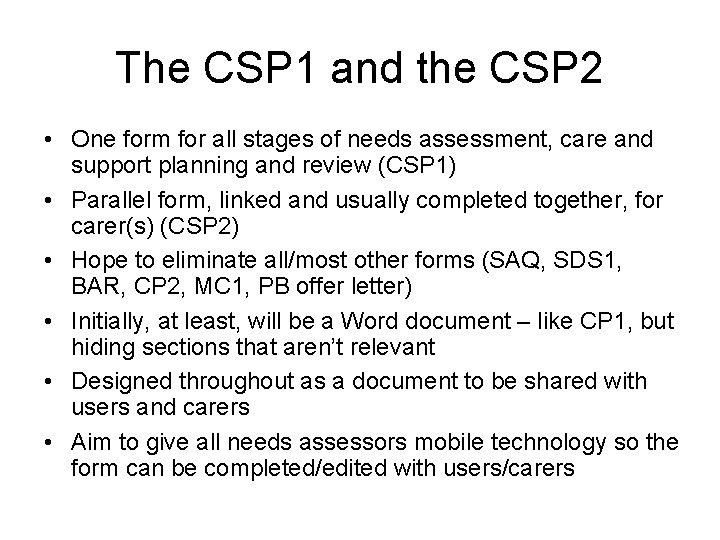
The CSP 1 and the CSP 2 • One form for all stages of needs assessment, care and support planning and review (CSP 1) • Parallel form, linked and usually completed together, for carer(s) (CSP 2) • Hope to eliminate all/most other forms (SAQ, SDS 1, BAR, CP 2, MC 1, PB offer letter) • Initially, at least, will be a Word document – like CP 1, but hiding sections that aren’t relevant • Designed throughout as a document to be shared with users and carers • Aim to give all needs assessors mobile technology so the form can be completed/edited with users/carers
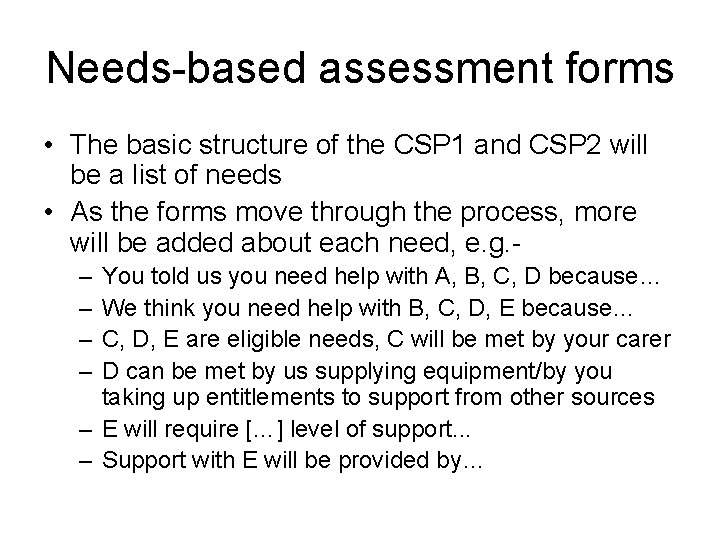
Needs-based assessment forms • The basic structure of the CSP 1 and CSP 2 will be a list of needs • As the forms move through the process, more will be added about each need, e. g. – – You told us you need help with A, B, C, D because… We think you need help with B, C, D, E because… C, D, E are eligible needs, C will be met by your carer D can be met by us supplying equipment/by you taking up entitlements to support from other sources – E will require […] level of support. . . – Support with E will be provided by…
Early interventions (Initial referral, urgent support, STSS, etc. ) Options guidance Are there ongoing care/support needs? If so, do person/carer want assessment? CSP 1 and CSP 2 Assessment Gathering information about needs Validation and consideration of alternatives Eligibility decision Decision about level of support required Care/support planning Brokerage/DP support Review May but need not result in reassessment No changes No ongoing needs Assessment declined Changes
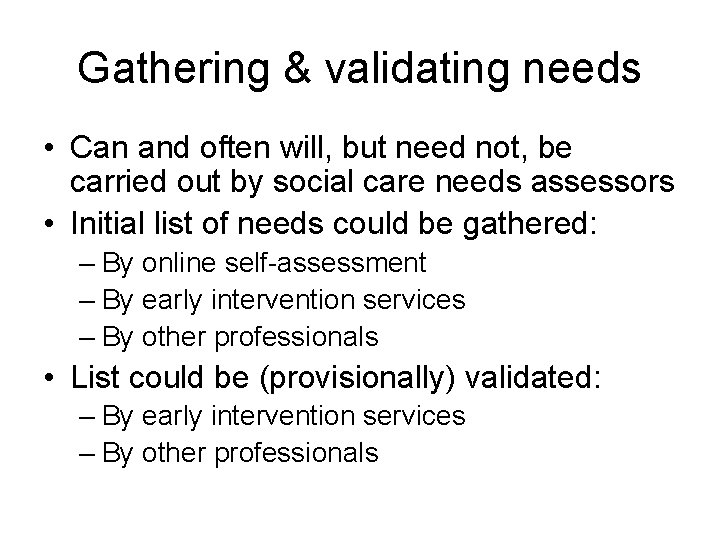
Gathering & validating needs • Can and often will, but need not, be carried out by social care needs assessors • Initial list of needs could be gathered: – By online self-assessment – By early intervention services – By other professionals • List could be (provisionally) validated: – By early intervention services – By other professionals
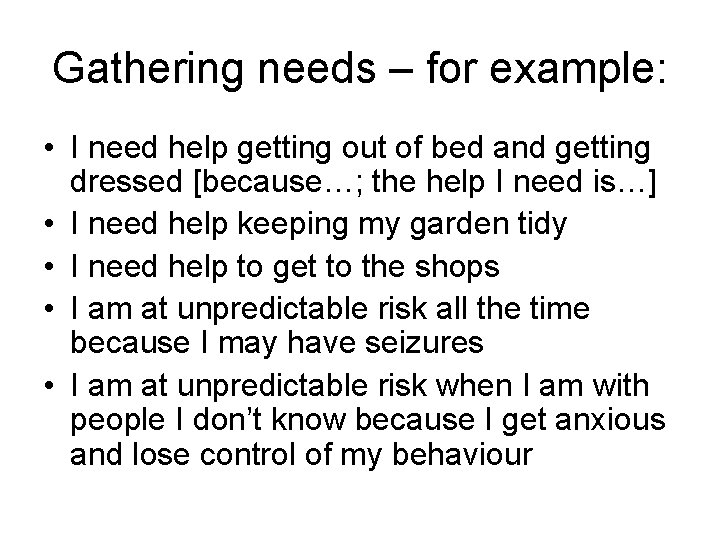
Gathering needs – for example: • I need help getting out of bed and getting dressed [because…; the help I need is…] • I need help keeping my garden tidy • I need help to get to the shops • I am at unpredictable risk all the time because I may have seizures • I am at unpredictable risk when I am with people I don’t know because I get anxious and lose control of my behaviour
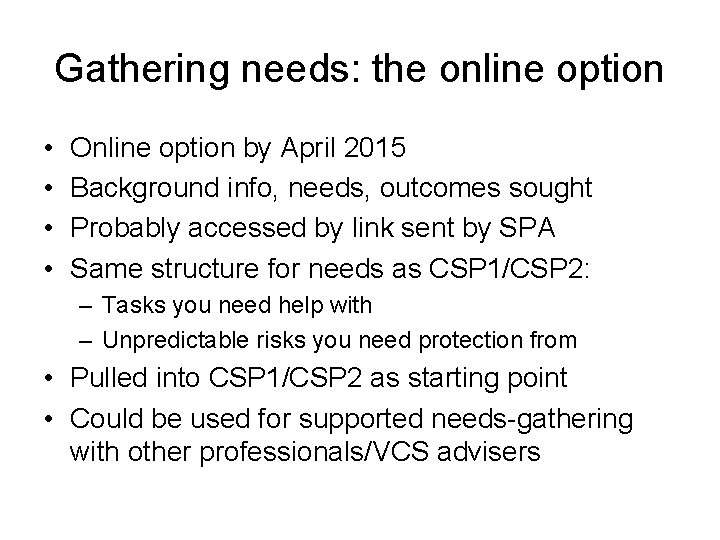
Gathering needs: the online option • • Online option by April 2015 Background info, needs, outcomes sought Probably accessed by link sent by SPA Same structure for needs as CSP 1/CSP 2: – Tasks you need help with – Unpredictable risks you need protection from • Pulled into CSP 1/CSP 2 as starting point • Could be used for supported needs-gathering with other professionals/VCS advisers
Validating user/carer needs • Validation is confirming whether needs exist, not whether they are eligible for support • Validation will involve asking: – – – Is there any doubt this is the person’s own view? Might there be conflicts/safeguarding issues? Might there be issues about mental capacity? Might needs be under- or over-stated? Are there solutions other than personal support? • Initial validation may be by early intervention services/other professionals • Some validation may be by phone • In complex situations, additional face to face validation will always be needed
Early interventions (Initial referral, urgent support, STSS, etc. ) Options guidance Are there ongoing care/support needs? If so, do person/carer want assessment? CSP 1 and CSP 2 Assessment Gathering information about needs Validation and consideration of alternatives Eligibility decision Decision about level of support required Care/support planning Brokerage/DP support Review May but need not result in reassessment No changes No ongoing needs Assessment declined Changes
Eligibility and level of support • Recommendations by needs assessors • Decisions by budget holders • As now, level of support will be expressed as notional number of hours of support • (But hours will generally be linked to specific needs on the CSP 1/CSP 2) • Users/carers may be sent completed assessment including level of support (& tariff cost for this) instead of PB offer letter
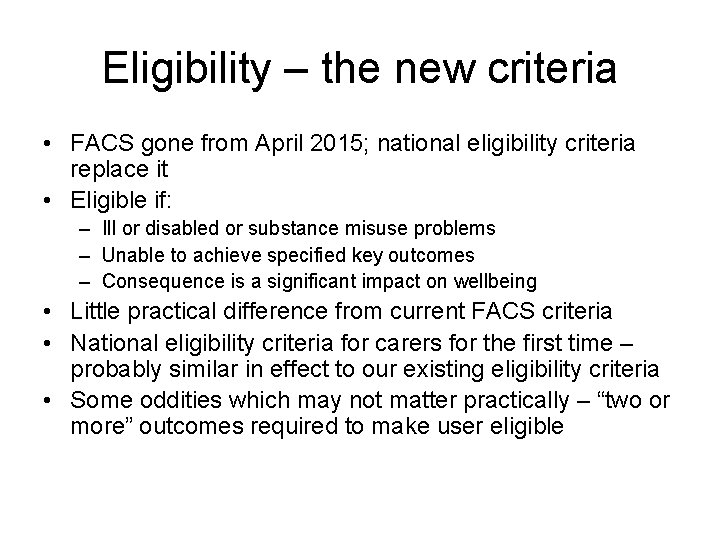
Eligibility – the new criteria • FACS gone from April 2015; national eligibility criteria replace it • Eligible if: – Ill or disabled or substance misuse problems – Unable to achieve specified key outcomes – Consequence is a significant impact on wellbeing • Little practical difference from current FACS criteria • National eligibility criteria for carers for the first time – probably similar in effect to our existing eligibility criteria • Some oddities which may not matter practically – “two or more” outcomes required to make user eligible
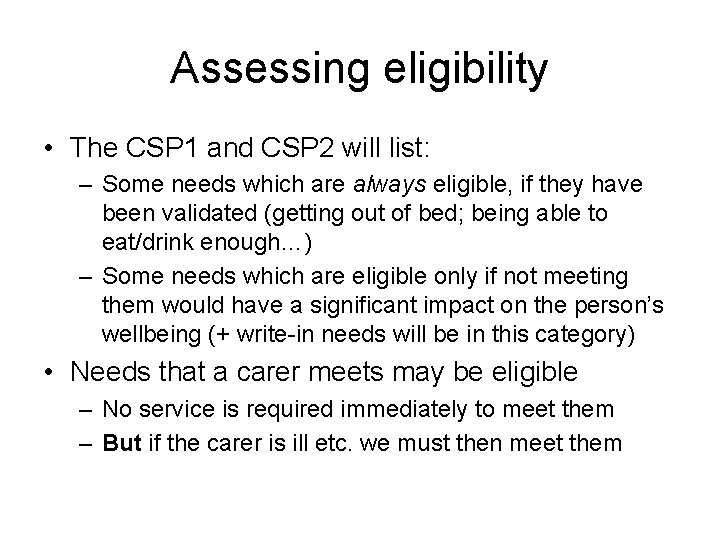
Assessing eligibility • The CSP 1 and CSP 2 will list: – Some needs which are always eligible, if they have been validated (getting out of bed; being able to eat/drink enough…) – Some needs which are eligible only if not meeting them would have a significant impact on the person’s wellbeing (+ write-in needs will be in this category) • Needs that a carer meets may be eligible – No service is required immediately to meet them – But if the carer is ill etc. we must then meet them
Early interventions (Initial referral, urgent support, STSS, etc. ) Options guidance Are there ongoing care/support needs? If so, do person/carer want assessment? CSP 1 and CSP 2 Assessment Gathering information about needs Validation and consideration of alternatives Eligibility decision Decision about level of support required Care/support planning Brokerage/DP support Review May but need not result in reassessment No changes No ongoing needs Assessment declined Changes
Brokerage/DPs • CSP 1/CSP 2 with validated needs, eligibility decisions & approved support levels will be sent to brokers/DP team for action • May be no need for further budget holder approval unless either: – The costs are more than tariff/standard preferred provider rates – The proposed arrangements are unusual • May be scope for other brokers
Early interventions (Initial referral, urgent support, STSS, etc. ) Options guidance Are there ongoing care/support needs? If so, do person/carer want assessment? CSP 1 and CSP 2 Assessment Gathering information about needs Validation and consideration of alternatives Eligibility decision Decision about level of support required Care/support planning Brokerage/DP support Review May but need not result in reassessment No changes No ongoing needs Assessment declined Changes
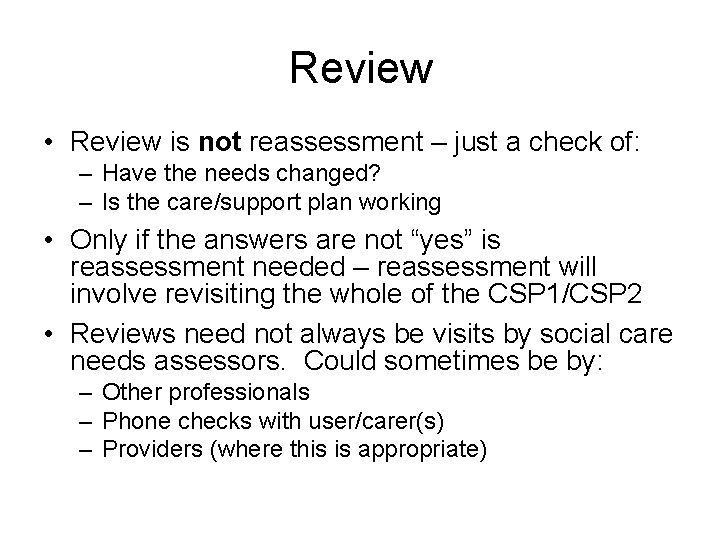
Review • Review is not reassessment – just a check of: – Have the needs changed? – Is the care/support plan working • Only if the answers are not “yes” is reassessment needed – reassessment will involve revisiting the whole of the CSP 1/CSP 2 • Reviews need not always be visits by social care needs assessors. Could sometimes be by: – Other professionals – Phone checks with user/carer(s) – Providers (where this is appropriate)
What next? • We want your views – now and on reflection • Aim to finalise forms by January • Training programme February/March • Implementation from 1 April – Expect to pilot new approaches (online needs gathering/phone validation) – won’t rush these – Changeover from CP 1 at reviews
For further information • National guidance at: www. tinyurl. com/Care. Act. Guidance • Updated information/FAQs at: www. northumberland. gov. uk/Care. Act Email for queries and comments: Care. Act@northumbria. nhs. uk