
Implementing the Australian Curriculum for Mathematics F to
- Slides: 33
Implementing the Australian Curriculum for Mathematics F to 10 Judy Anderson The University of Sydney Judy. anderson@sydney. edu. au
Key messages … 1. Balance is important 2. Evaluate the types of questions and tasks used during mathematics lessons 3. Assessment, assessment!!! 4. Alignment between curriculum, teaching and assessment
Mathematics teaching should include opportunities for (Cockcroft, 1982): l exposition by the teacher; l discussion between teacher and pupils and between pupils themselves; l appropriate practical work; l consolidation and practice of fundamental skills and routines; l problem solving, including the application of mathematics to everyday situations; and l investigational work.
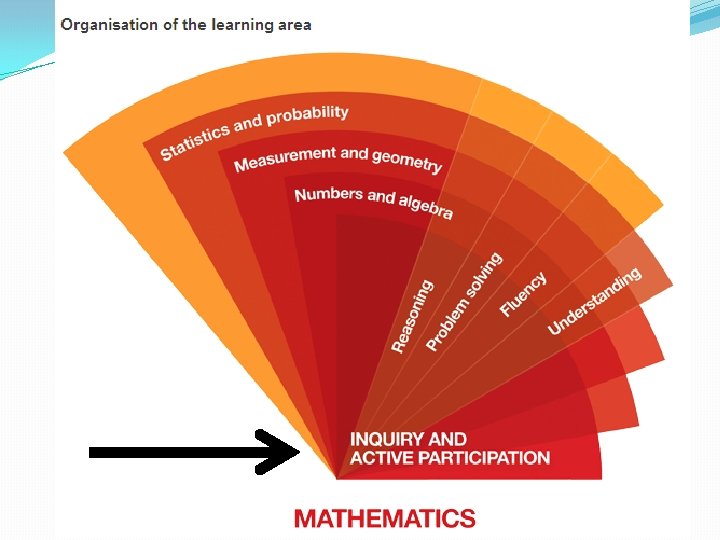
Understanding Students build a robust knowledge of adaptable and transferable mathematical concepts. They make connections between related concepts and progressively apply the familiar to develop new ideas. Fluency Students develop skills in choosing appropriate procedures, carrying out procedures flexibly, accurately, efficiently and appropriately, and recalling factual knowledge and concepts readily.
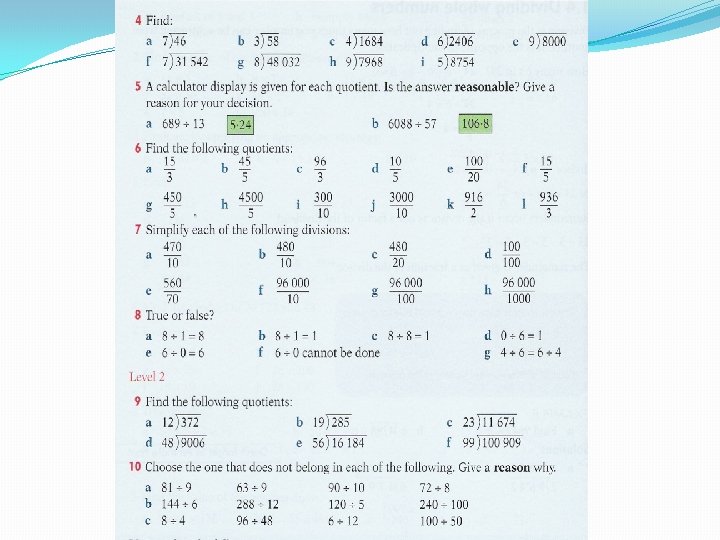
Which tasks would support these proficiencies? Examine the types of questions and tasks you use during mathematics lessons.
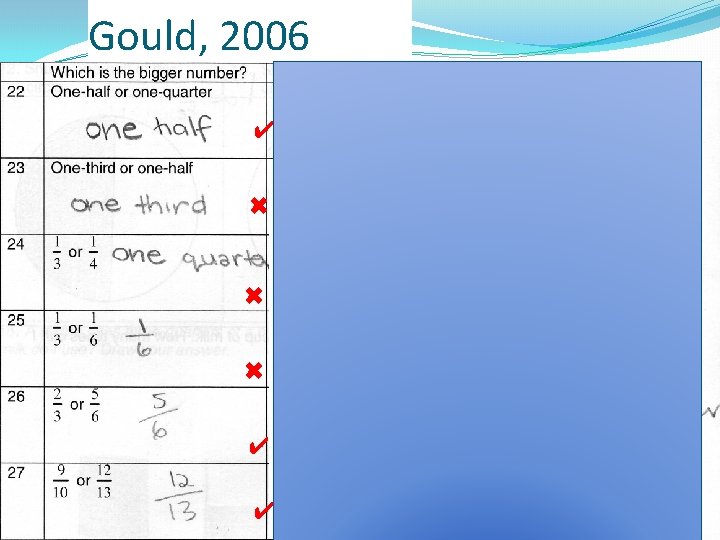
Gould, 2006 ✔ Because three is a larger number ✖ than 2 Because four is a larger number ✖ than three Because six is a larger number ✖ than 3 Because 5 & 6 are larger ✔ numbers than 2 & 3 Because 12 & 13 are larger ✔numbers than 9 & 10
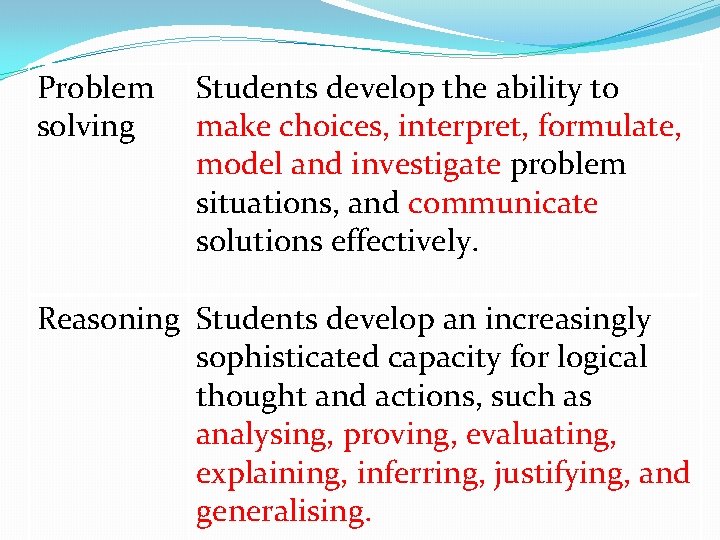
Problem solving Students develop the ability to make choices, interpret, formulate, model and investigate problem situations, and communicate solutions effectively. Reasoning Students develop an increasingly sophisticated capacity for logical thought and actions, such as analysing, proving, evaluating, explaining, inferring, justifying, and generalising.
Which tasks would support these proficiencies? Examine the types of questions and tasks you use during mathematics lessons.
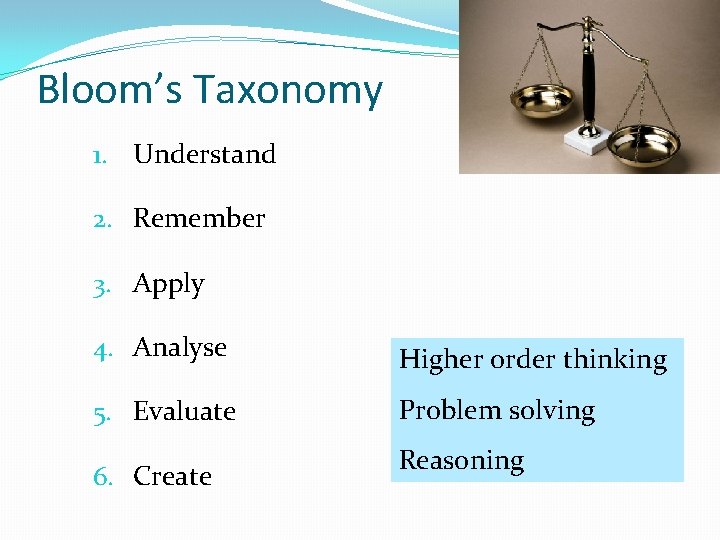
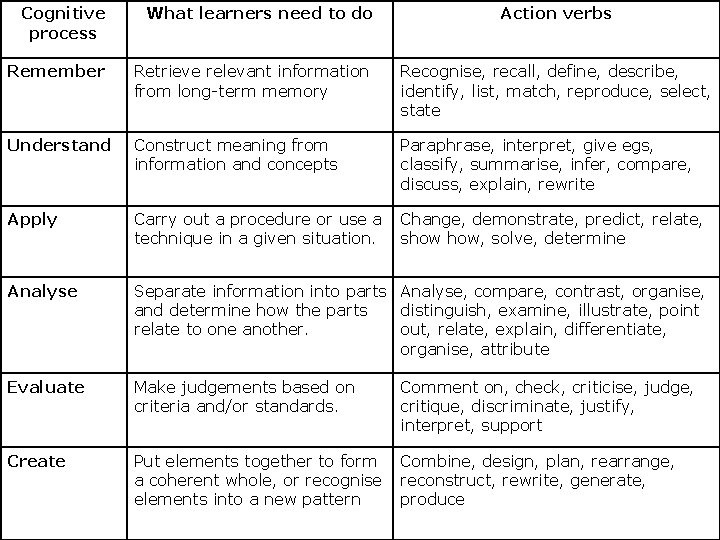
Bloom’s Taxonomy 1. Understand 2. Remember 3. Apply 4. Analyse Higher order thinking 5. Evaluate Problem solving 6. Create Reasoning
Cognitive process What learners need to do Action verbs Remember Retrieve relevant information from long-term memory Recognise, recall, define, describe, identify, list, match, reproduce, select, state Understand Construct meaning from information and concepts Paraphrase, interpret, give egs, classify, summarise, infer, compare, discuss, explain, rewrite Apply Carry out a procedure or use a technique in a given situation. Change, demonstrate, predict, relate, show how, solve, determine Analyse Separate information into parts Analyse, compare, contrast, organise, and determine how the parts distinguish, examine, illustrate, point relate to one another. out, relate, explain, differentiate, organise, attribute Evaluate Make judgements based on criteria and/or standards. Comment on, check, criticise, judge, critique, discriminate, justify, interpret, support Create Put elements together to form a coherent whole, or recognise elements into a new pattern Combine, design, plan, rearrange, reconstruct, rewrite, generate, produce
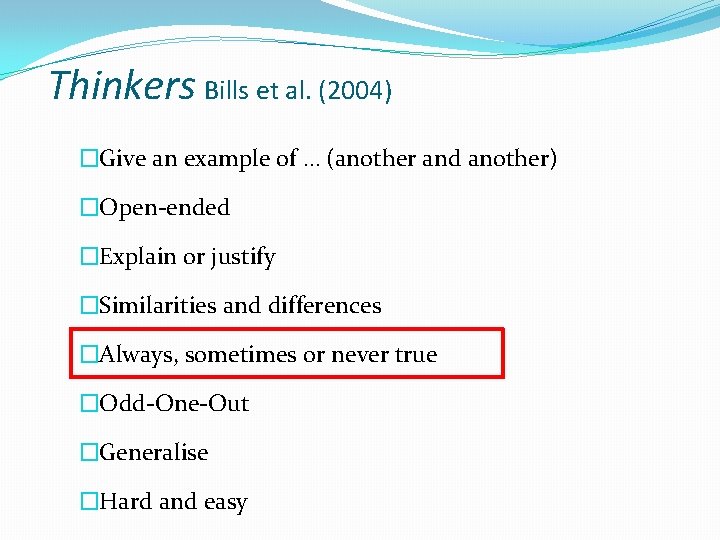
Thinkers Bills et al. (2004) �Give an example of … (another and another) �Open-ended �Explain or justify �Similarities and differences �Always, sometimes or never true �Odd-One-Out �Generalise �Hard and easy
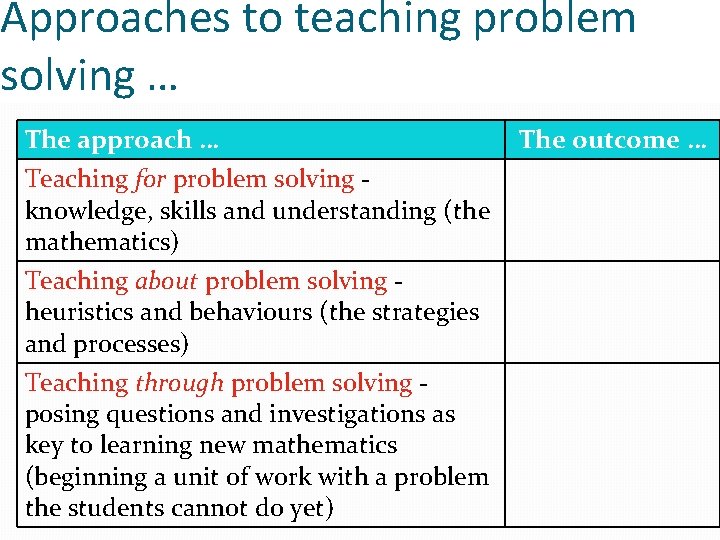
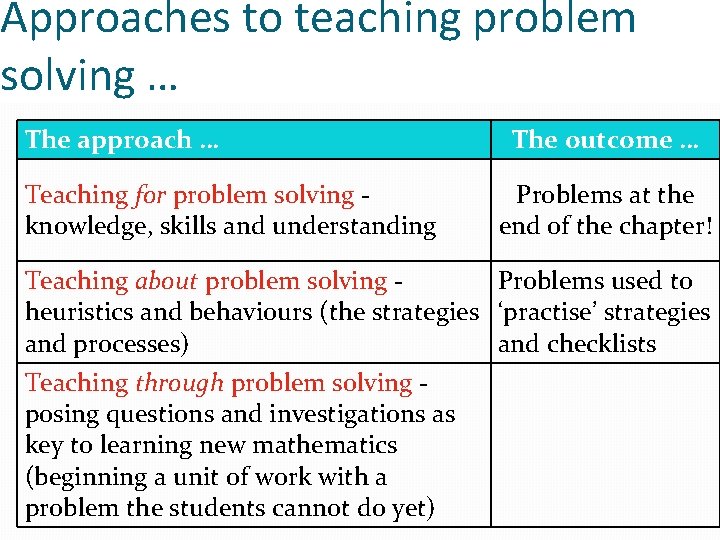
Approaches to teaching problem solving … The approach … Teaching for problem solving knowledge, skills and understanding (the mathematics) Teaching about problem solving heuristics and behaviours (the strategies and processes) Teaching through problem solving posing questions and investigations as key to learning new mathematics (beginning a unit of work with a problem the students cannot do yet) The outcome …
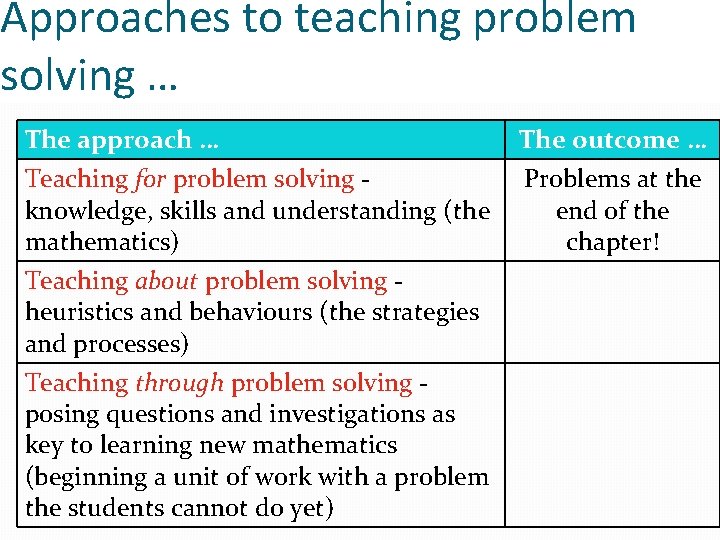
Approaches to teaching problem solving … The approach … The outcome … Teaching for problem solving knowledge, skills and understanding (the mathematics) Problems at the end of the chapter! Teaching about problem solving heuristics and behaviours (the strategies and processes) Teaching through problem solving posing questions and investigations as key to learning new mathematics (beginning a unit of work with a problem the students cannot do yet)
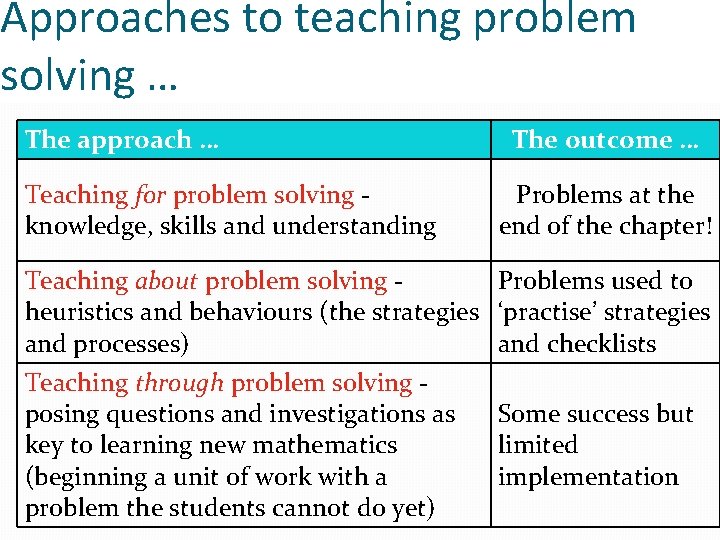
Approaches to teaching problem solving … The approach … Teaching for problem solving knowledge, skills and understanding The outcome … Problems at the end of the chapter! Teaching about problem solving Problems used to heuristics and behaviours (the strategies ‘practise’ strategies and processes) and checklists Teaching through problem solving posing questions and investigations as key to learning new mathematics (beginning a unit of work with a problem the students cannot do yet)
Approaches to teaching problem solving … The approach … Teaching for problem solving knowledge, skills and understanding The outcome … Problems at the end of the chapter! Teaching about problem solving Problems used to heuristics and behaviours (the strategies ‘practise’ strategies and processes) and checklists Teaching through problem solving posing questions and investigations as key to learning new mathematics (beginning a unit of work with a problem the students cannot do yet) Some success but limited implementation
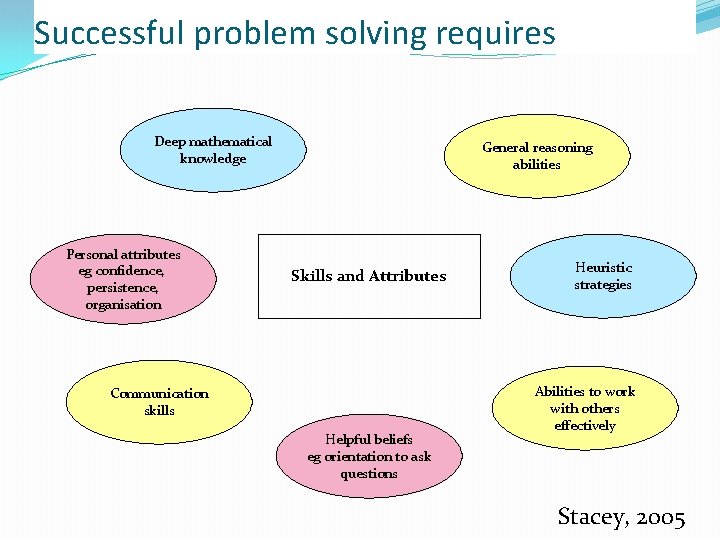
Successful problem solving requires Deep mathematical knowledge Personal attributes eg confidence, persistence, organisation General reasoning abilities Skills and Attributes Communication skills Helpful beliefs eg orientation to ask questions Heuristic strategies Abilities to work with others effectively Stacey, 2005
Which tasks or problems?
Types of problems? ? ? �Open-ended �Rich tasks �Real-world problem �Challenge �Investigation �Inquiry �Problem-based �Reflective inquiry � �
Which tasks or problems? Content specific questions requiring a range of levels of thinking
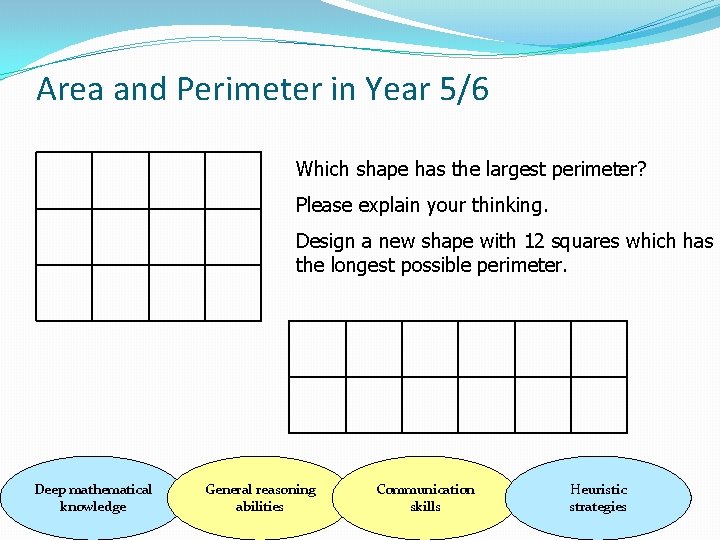
Area and Perimeter in Year 5/6 Which shape has the largest perimeter? Please explain your thinking. Design a new shape with 12 squares which has the longest possible perimeter. Deep mathematical knowledge General reasoning abilities Communication skills Heuristic strategies
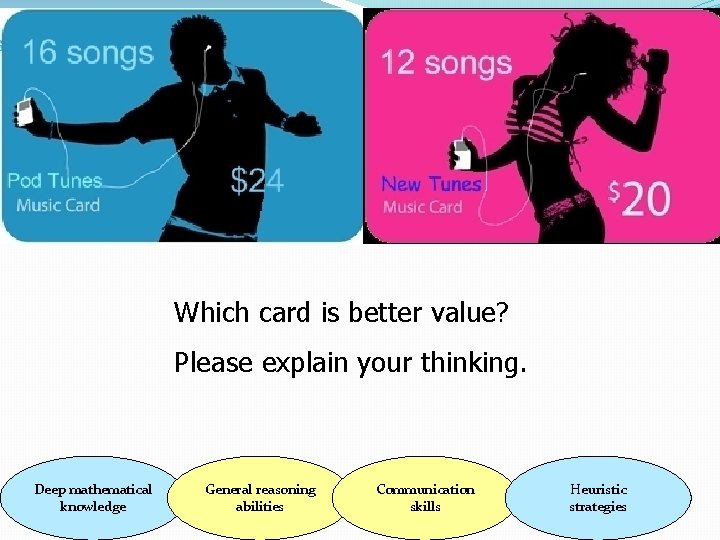
Which card is better value? Please explain your thinking. Deep mathematical knowledge General reasoning abilities Communication skills Heuristic strategies
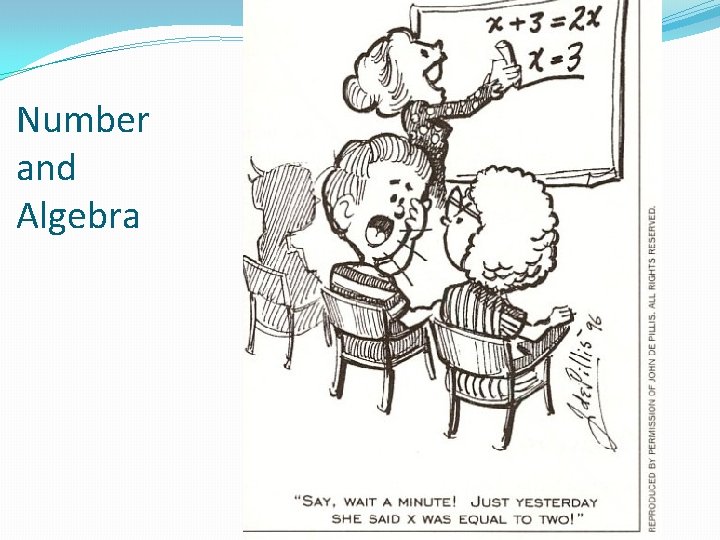
Number and Algebra
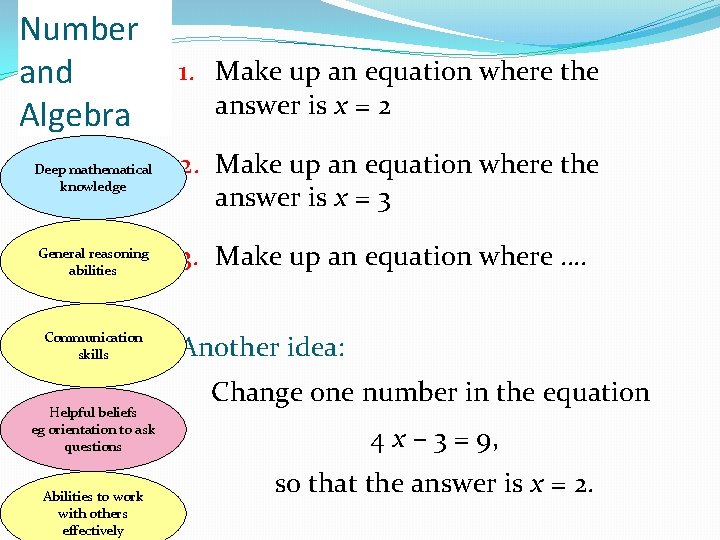
Number and Algebra Deep mathematical knowledge General reasoning abilities Communication skills Helpful beliefs eg orientation to ask questions Abilities to work with others effectively 1. Make up an equation where the answer is x = 2 2. Make up an equation where the answer is x = 3 3. Make up an equation where …. Another idea: Change one number in the equation 4 x – 3 = 9, so that the answer is x = 2.
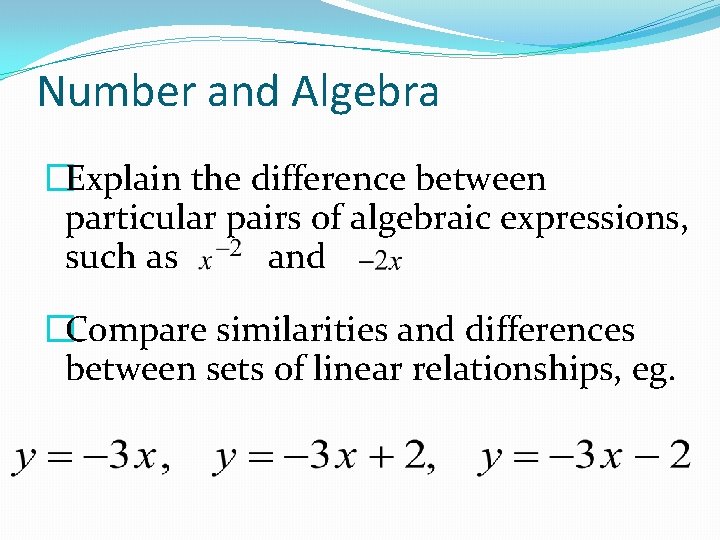
Number and Algebra �Explain the difference between particular pairs of algebraic expressions, such as and �Compare similarities and differences between sets of linear relationships, eg.
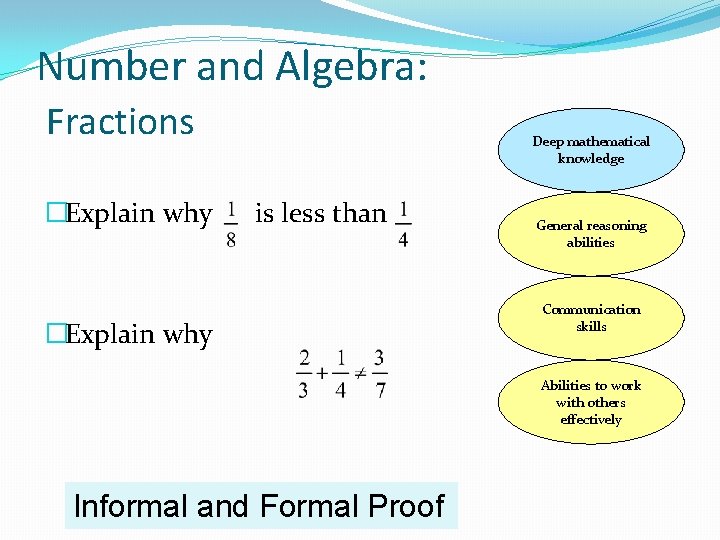
Number and Algebra: Fractions �Explain why Deep mathematical knowledge is less than �Explain why General reasoning abilities Communication skills Abilities to work with others effectively Informal and Formal Proof
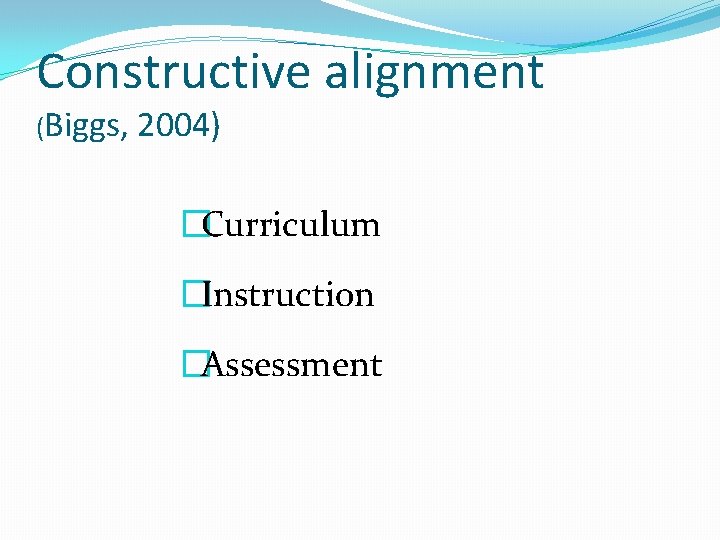
Constructive alignment (Biggs, 2004) �Curriculum �Instruction �Assessment
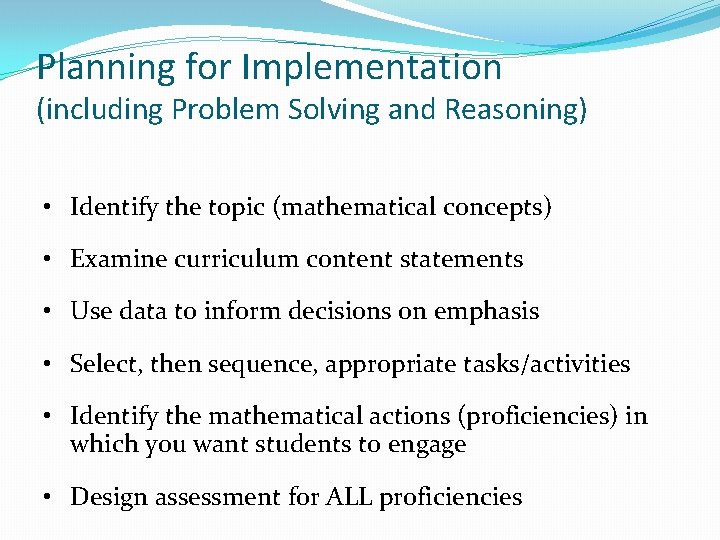
Planning for Implementation (including Problem Solving and Reasoning) • Identify the topic (mathematical concepts) • Examine curriculum content statements • Use data to inform decisions on emphasis • Select, then sequence, appropriate tasks/activities • Identify the mathematical actions (proficiencies) in which you want students to engage • Design assessment for ALL proficiencies
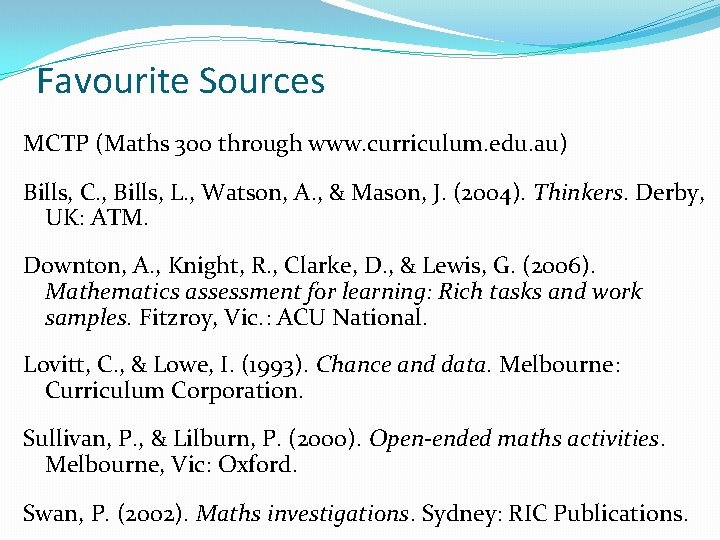
Favourite Sources MCTP (Maths 300 through www. curriculum. edu. au) Bills, C. , Bills, L. , Watson, A. , & Mason, J. (2004). Thinkers. Derby, UK: ATM. Downton, A. , Knight, R. , Clarke, D. , & Lewis, G. (2006). Mathematics assessment for learning: Rich tasks and work samples. Fitzroy, Vic. : ACU National. Lovitt, C. , & Lowe, I. (1993). Chance and data. Melbourne: Curriculum Corporation. Sullivan, P. , & Lilburn, P. (2000). Open-ended maths activities. Melbourne, Vic: Oxford. Swan, P. (2002). Maths investigations. Sydney: RIC Publications.
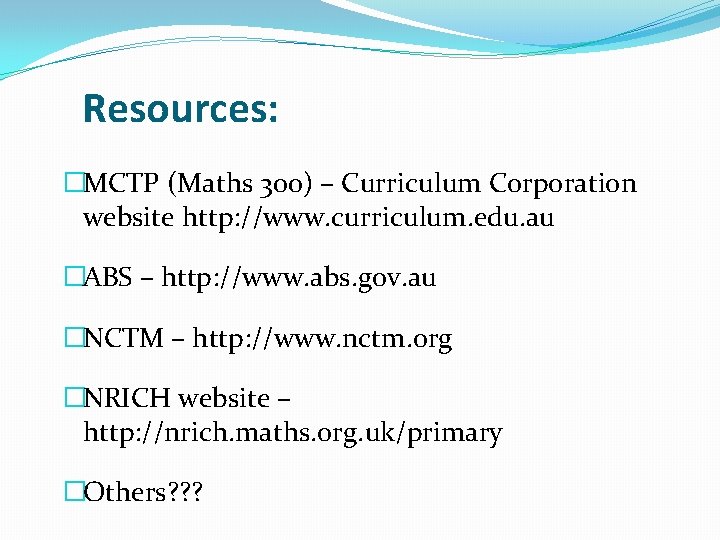
Resources: �MCTP (Maths 300) – Curriculum Corporation website http: //www. curriculum. edu. au �ABS – http: //www. abs. gov. au �NCTM – http: //www. nctm. org �NRICH website – http: //nrich. maths. org. uk/primary �Others? ? ?
Key messages … 1. Balance is important 2. Evaluate the types of questions and tasks used during mathematics lessons 3. Assessment, assessment!!! 4. Alignment between curriculum, teaching and assessment