
Implementing ProjectionBased Reduced Order Modeling in SU 2

Implementing Projection-Based Reduced Order Modeling in SU 2 Jessie Lauzon and Juan J. Alonso 11 June 2020
Contents § Overview of Projection-Based Reduced Order Modeling (PROM) › Motivation › Concept of PROM § Implementation in SU 2 › Code and then optimize § Early Results § Upcoming Future Work › Space-time ROM for unsteady applications
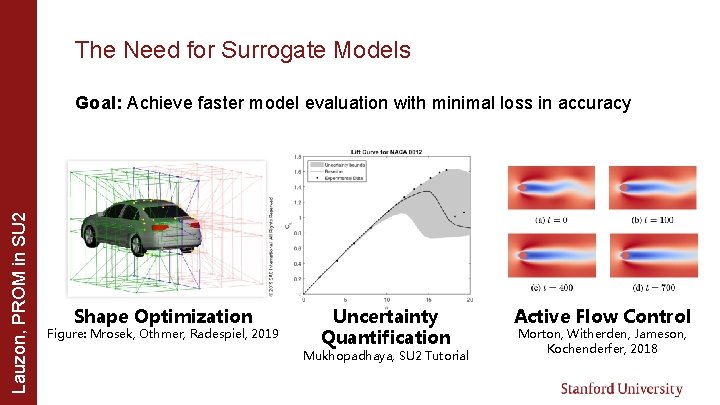
The Need for Surrogate Models Lauzon, PROM in SU 2 Goal: Achieve faster model evaluation with minimal loss in accuracy Shape Optimization Figure: Mrosek, Othmer, Radespiel, 2019 Uncertainty Quantification Mukhopadhaya, SU 2 Tutorial Active Flow Control Morton, Witherden, Jameson, Kochenderfer, 2018

Projection-Based Reduced Order Model (PROM) HDM High-Dimensional Model Lauzon, PROM in SU 2 LDM Low-Dimensional Model
PROM for CFD, in reality • Use Least-Squares Petrov-Galerkin (LSPG) projection • Shown to be more stable for CFD than standard Galerkin projection • Jacobian is required for "projection” step Lauzon, PROM in SU 2 • Matrix-matrix multiplication also required with Jacobian!
PROM for CFD, in reality • Use Least-Squares Petrov-Galerkin (LSPG) projection • Shown to be more stable for CFD than standard Galerkin projection • Jacobian is required for "projection” step Lauzon, PROM in SU 2 • Matrix-matrix multiplication also required with Jacobian! Intrusive & Expensive
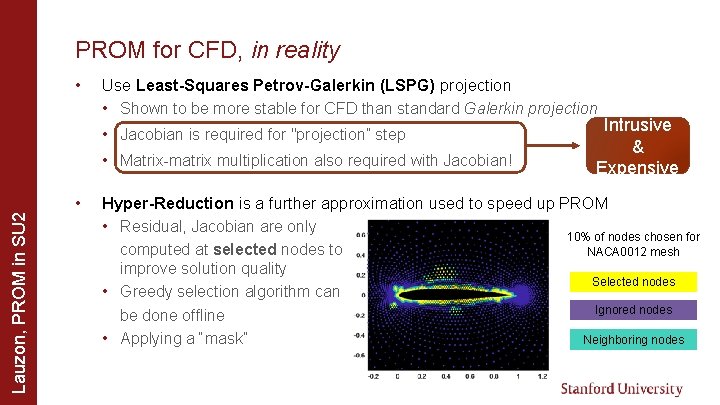
PROM for CFD, in reality • Use Least-Squares Petrov-Galerkin (LSPG) projection • Shown to be more stable for CFD than standard Galerkin projection • Jacobian is required for "projection” step Lauzon, PROM in SU 2 • Matrix-matrix multiplication also required with Jacobian! • Intrusive & Expensive Hyper-Reduction is a further approximation used to speed up PROM • Residual, Jacobian are only 10% of nodes chosen for computed at selected nodes to NACA 0012 mesh improve solution quality Selected nodes • Greedy selection algorithm can Ignored nodes be done offline • Applying a “mask” Neighboring nodes

Implementation WHAT IF ANYONE COULD CREATE THEIR OWN ROM? rom
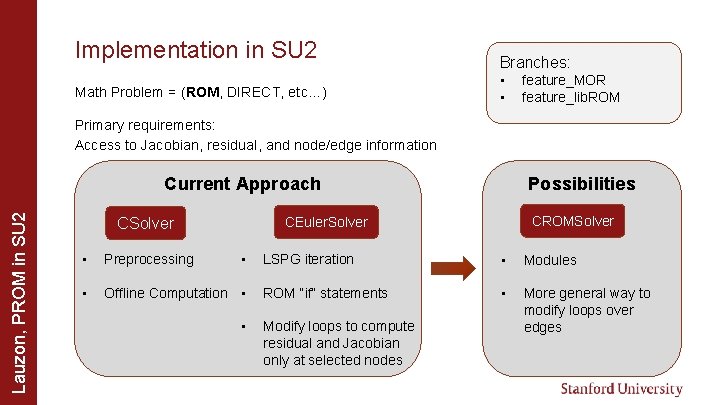
Implementation in SU 2 Math Problem = (ROM, DIRECT, etc…) Branches: • • feature_MOR feature_lib. ROM Primary requirements: Access to Jacobian, residual, and node/edge information Possibilities Lauzon, PROM in SU 2 Current Approach CSolver CROMSolver CEuler. Solver • Preprocessing • Offline Computation • • • LSPG iteration • Modules ROM “if” statements • More general way to modify loops over edges Modify loops to compute residual and Jacobian only at selected nodes
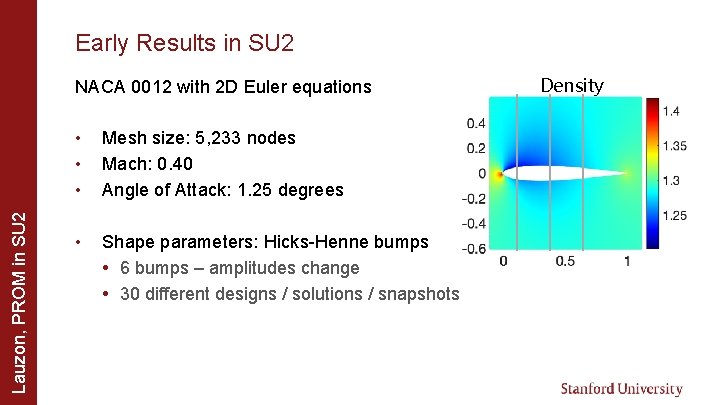
Early Results in SU 2 Lauzon, PROM in SU 2 NACA 0012 with 2 D Euler equations • • • Mesh size: 5, 233 nodes Mach: 0. 40 Angle of Attack: 1. 25 degrees • Shape parameters: Hicks-Henne bumps • 6 bumps – amplitudes change • 30 different designs / solutions / snapshots Density
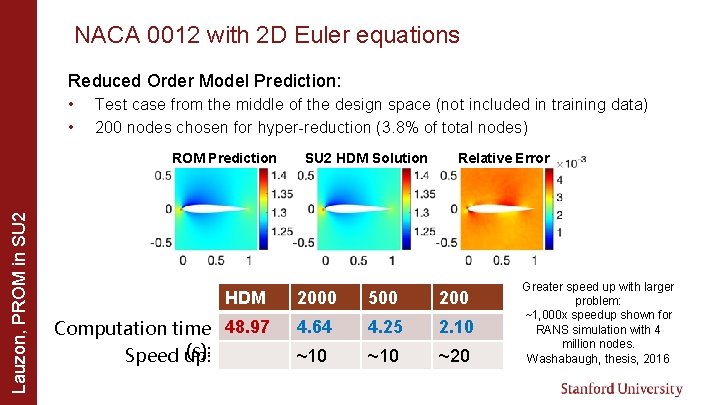
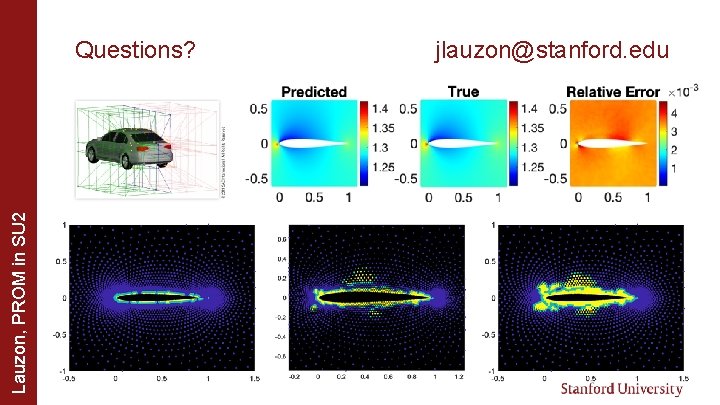
NACA 0012 with 2 D Euler equations Reduced Order Model Prediction: • • Test case from the middle of the design space (not included in training data) 200 nodes chosen for hyper-reduction (3. 8% of total nodes) Lauzon, PROM in SU 2 ROM Prediction SU 2 HDM Solution Relative Error HDM 2000 500 200 Computation time 48. 97 (s): Speed up: 4. 64 4. 25 2. 10 ~10 ~20 Greater speed up with larger problem: ~1, 000 x speedup shown for RANS simulation with 4 million nodes. Washabaugh, thesis, 2016
Summary • Demonstrated proof of concept of ROM implementation within SU 2 • Projection-based LSPG iterations • Hyper-reduction Lauzon, PROM in SU 2 Ongoing Work • Expand capability to include RANS simulations • Comparisons with other interpolation-based ROMs • Organize code • Create user-friendly configuration file options • Next major step focuses on unsteady ROM • Space-time ROM
Lauzon, PROM in SU 2 Questions? jlauzon@stanford. edu
References M. Mrosek; C. Othmer; R. Radespiel, Reduced-Order Modeling of Vehicle Aerodynamics via Proper Orthogonal Decomposition. SAE Int. J. Passeng. Cars - Mech. Syst. , 2019 J. Morton; F. D. Witherden; A. Jameson; M. J. Kochenderfer, Deep Dynamical Modeling and Control of Unsteady Fluid Flows. ar. Xiv: 1805. 07472, 2018. K. M. Washabaugh, Faster fidelity for better design, A scalable model order reduction framework for steady aerodynamic design applications. Ph. D thesis, Stanford University, August 2016.
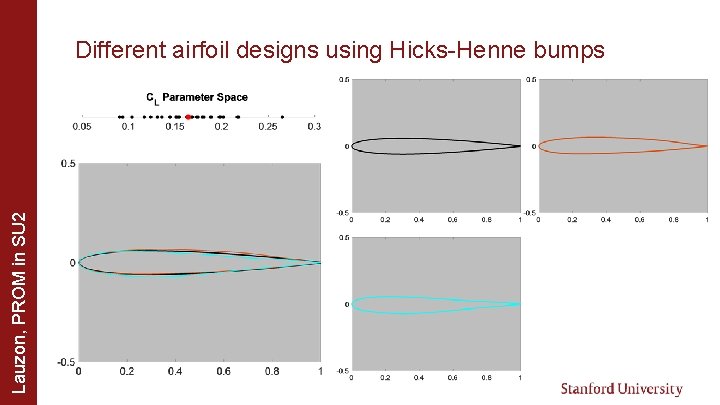
Lauzon, PROM in SU 2 Different airfoil designs using Hicks-Henne bumps
- Slides: 15