
Implementing Portfolio Decisions and Mutual Fund Valuation Session
- Slides: 42
Implementing Portfolio Decisions and Mutual Fund Valuation
Session Overview Trading plays an important role in the investment management process. The National Market System coordinates stock trading across multiple market centers. Electronic trading directly between investors is very common for stocks. Mutual fund traders play an important role in ensuring fund compliance, achieving best execution, selecting broker-dealers for trade execution and managing trading across funds. Bond trading is much more fragmented than stock trading.
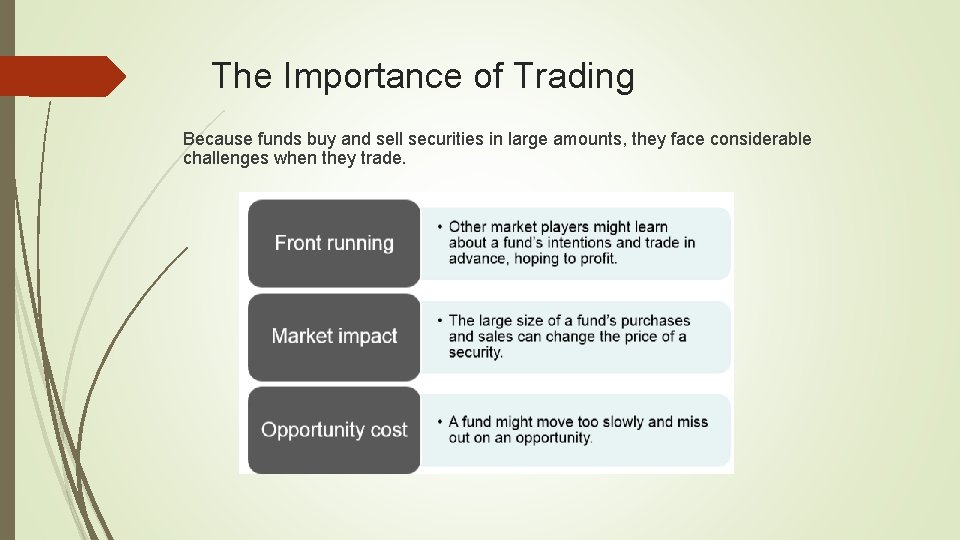
The Importance of Trading Because funds buy and sell securities in large amounts, they face considerable challenges when they trade.
Trading Consideration Funds must weight the relative importance of: Obtaining the most favorable price. Protecting a fund’s anonymity. Obtaining a speedy execution. Minimizing transaction costs.
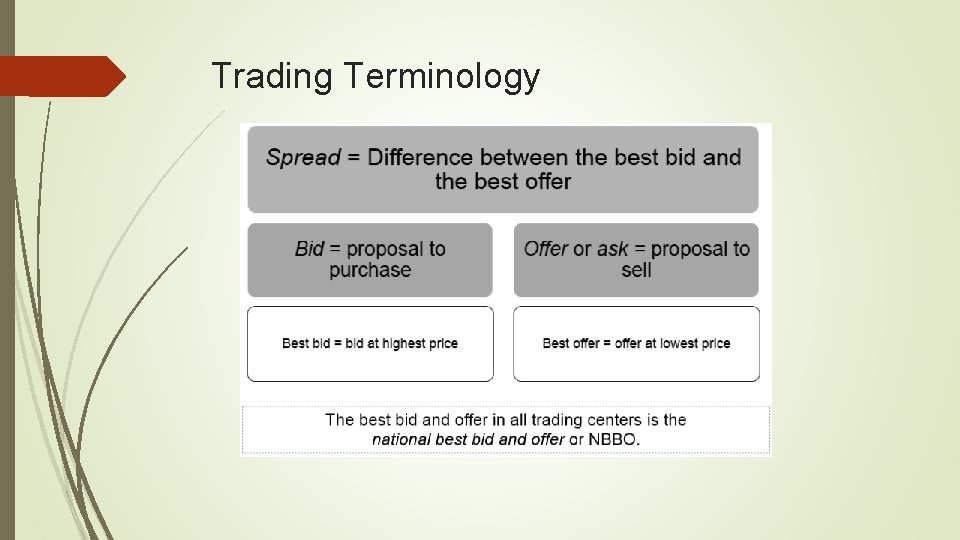
Trading Terminology
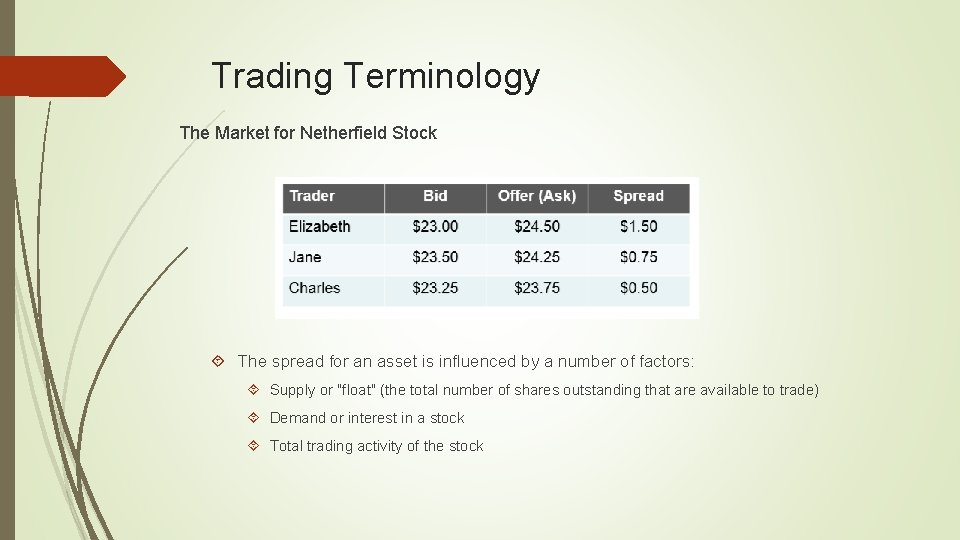
Trading Terminology The Market for Netherfield Stock The spread for an asset is influenced by a number of factors: Supply or "float" (the total number of shares outstanding that are available to trade) Demand or interest in a stock Total trading activity of the stock
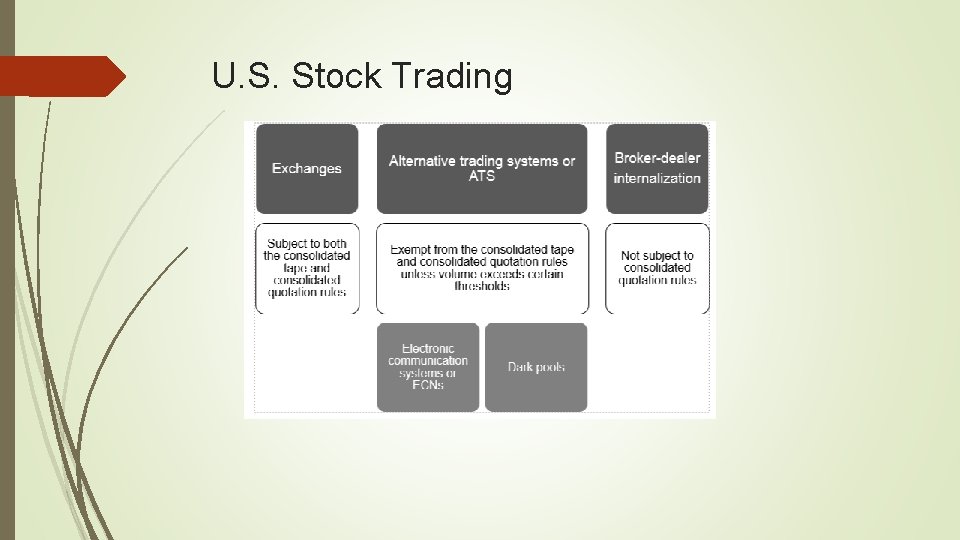
National Market System Established in 1975 to advance: Efficient execution of trades. Fair competition among broker-dealers and among markets. Widespread public availability of trade information. Two key rules: Consolidated transaction reporting rule or consolidated tape rule = price and size of all stock trades must be centrally reported. Consolidated quotation rule = Bids and offers on stocks must be centrally reported. The data reported must be publicly available
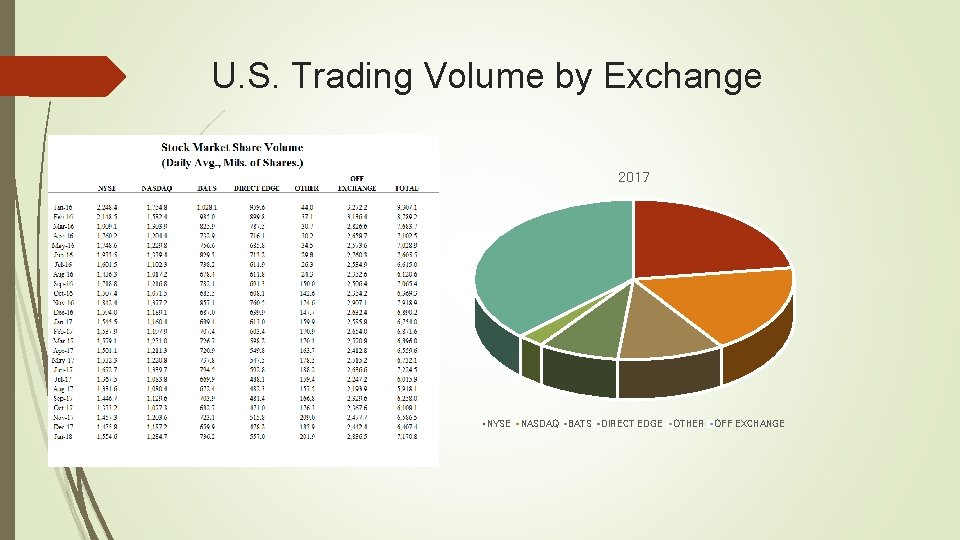
U. S. Trading Volume by Exchange 2017 NYSE NASDAQ BATS DIRECT EDGE OTHER OFF EXCHANGE
U. S. Stock Trading
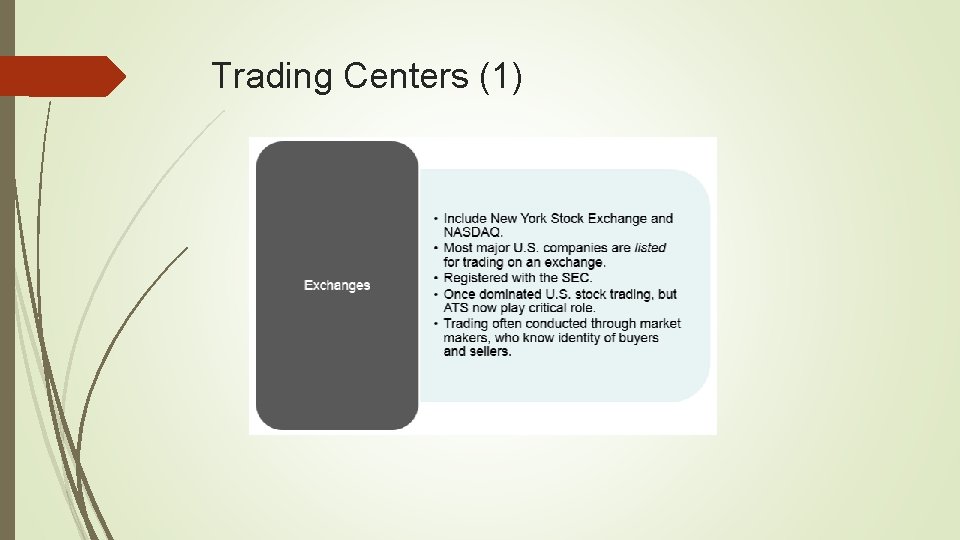
Trading Centers (1)
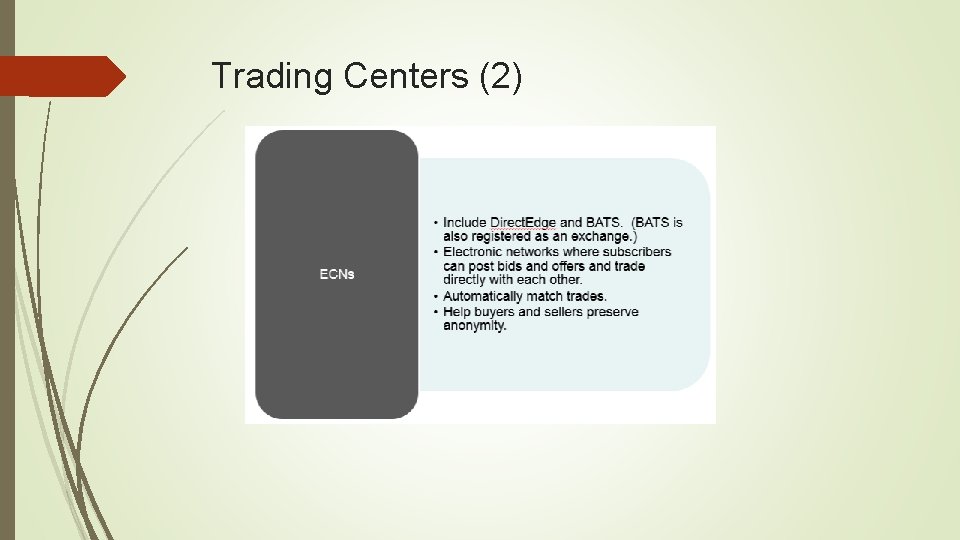
Trading Centers (2)
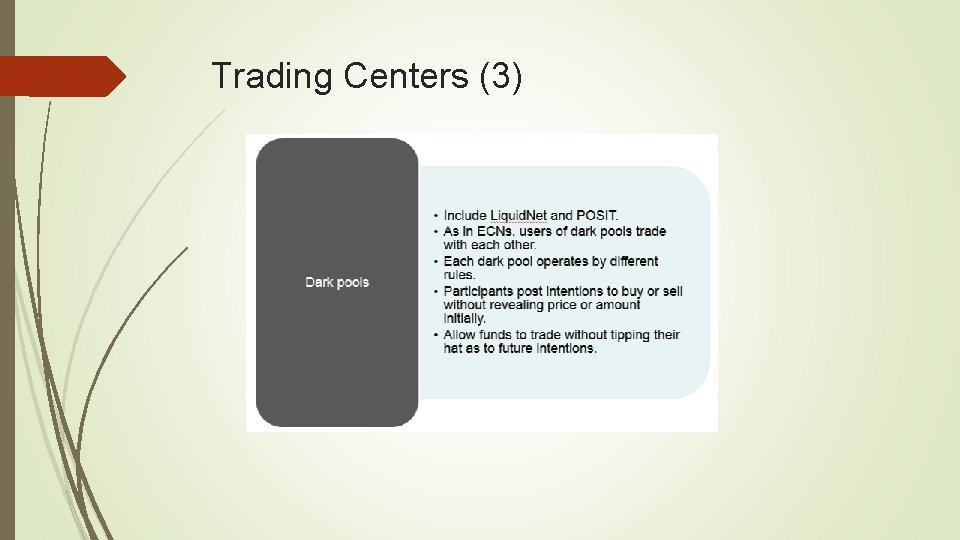
Trading Centers (3)
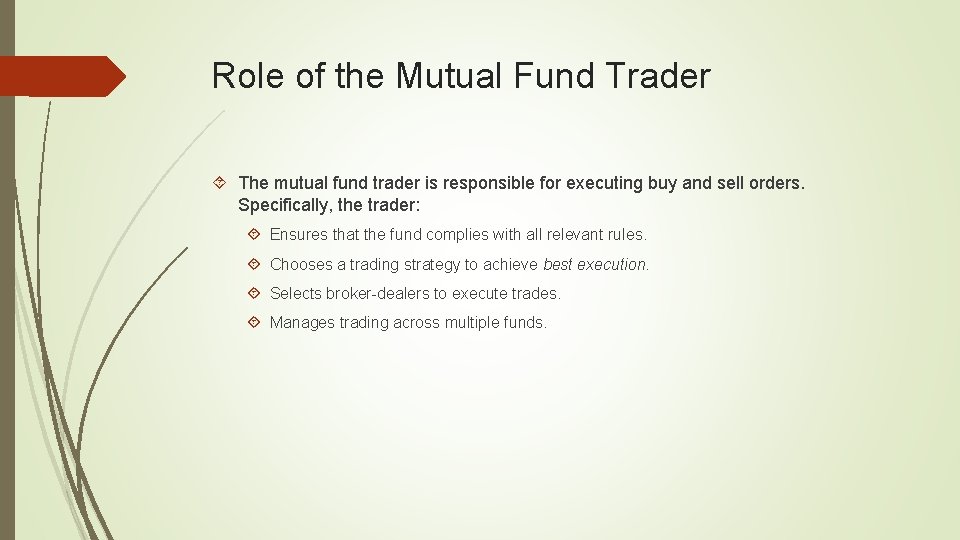
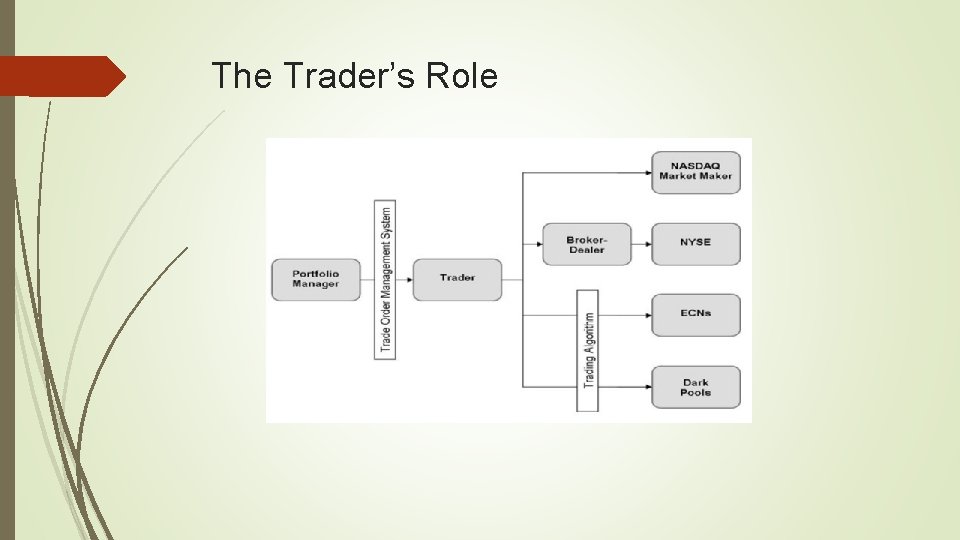
Role of the Mutual Fund Trader The mutual fund trader is responsible for executing buy and sell orders. Specifically, the trader: Ensures that the fund complies with all relevant rules. Chooses a trading strategy to achieve best execution. Selects broker-dealers to execute trades. Manages trading across multiple funds.
The Trader’s Role
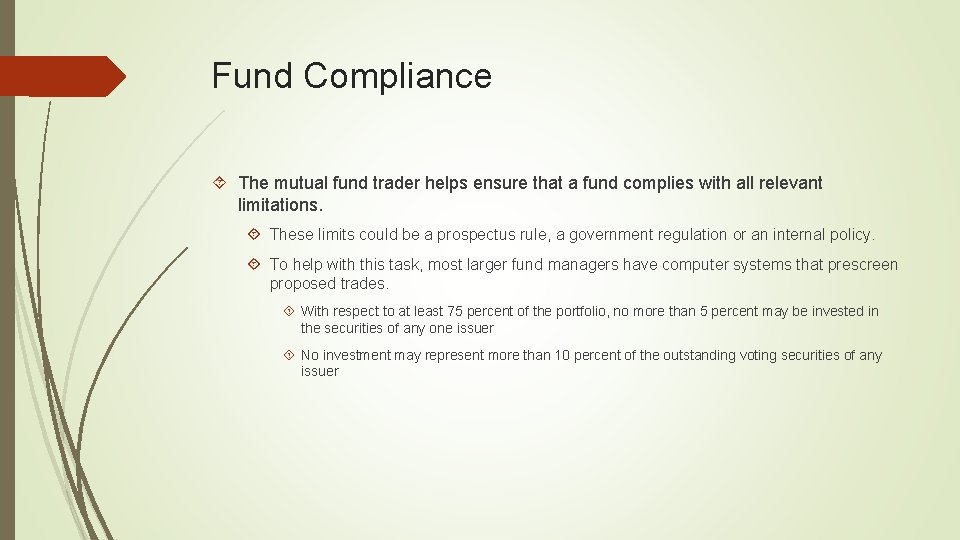
Fund Compliance The mutual fund trader helps ensure that a fund complies with all relevant limitations. These limits could be a prospectus rule, a government regulation or an internal policy. To help with this task, most larger fund managers have computer systems that prescreen proposed trades. With respect to at least 75 percent of the portfolio, no more than 5 percent may be invested in the securities of any one issuer No investment may represent more than 10 percent of the outstanding voting securities of any issuer
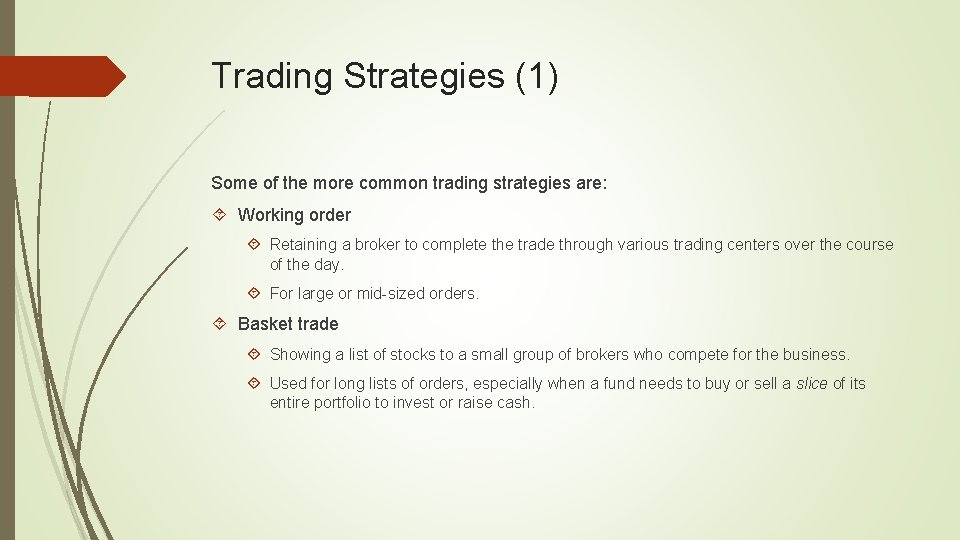
Trading Strategies (1) Some of the more common trading strategies are: Working order Retaining a broker to complete the trade through various trading centers over the course of the day. For large or mid-sized orders. Basket trade Showing a list of stocks to a small group of brokers who compete for the business. Used for long lists of orders, especially when a fund needs to buy or sell a slice of its entire portfolio to invest or raise cash.
Trading Strategies (2) Electronic trades Executing a trade directly in the electronic markets. For smaller orders Algorithmic trading Use mathematical models to submit a series of trading orders through electronic networks. Often used to execute very large orders in smaller pieces.
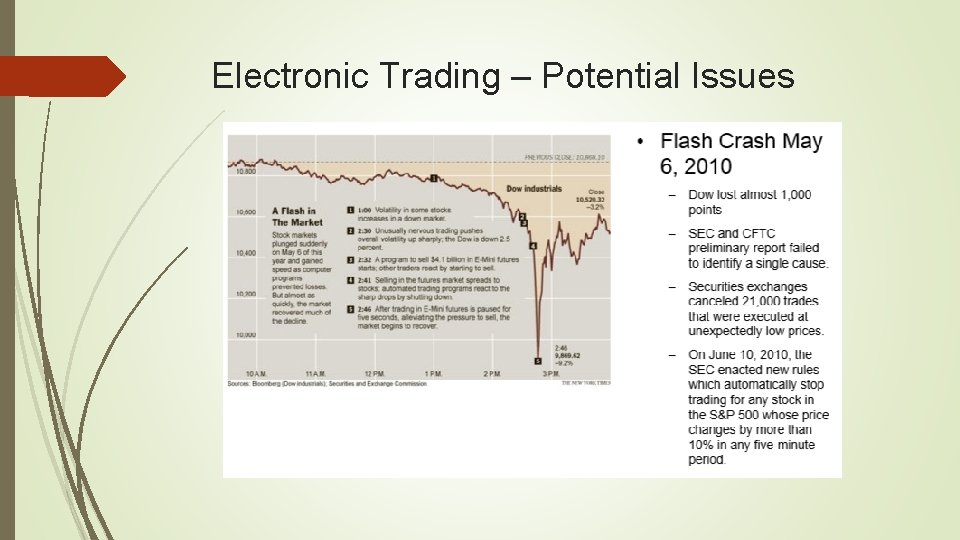
Electronic Trading – Potential Issues
Broker-Dealer Selection Traders primarily consider: Ability to provide best execution. Traders may also consider: Soft dollar services provided = research services that aid the investment process Traders must also be aware of restrictions on the use of affiliated brokerage firms.
Best Execution Difficult to define. Evaluated over time and over many transactions. Considers price and trading commissions on trades executed – along with risk of not executing a trade. Usually evaluated in one of two ways: Volume-weighted average price or VWAP: compares trade price to average price for stock paid that day. Implementation shortfall: compares actual cost of trade to estimated cost.
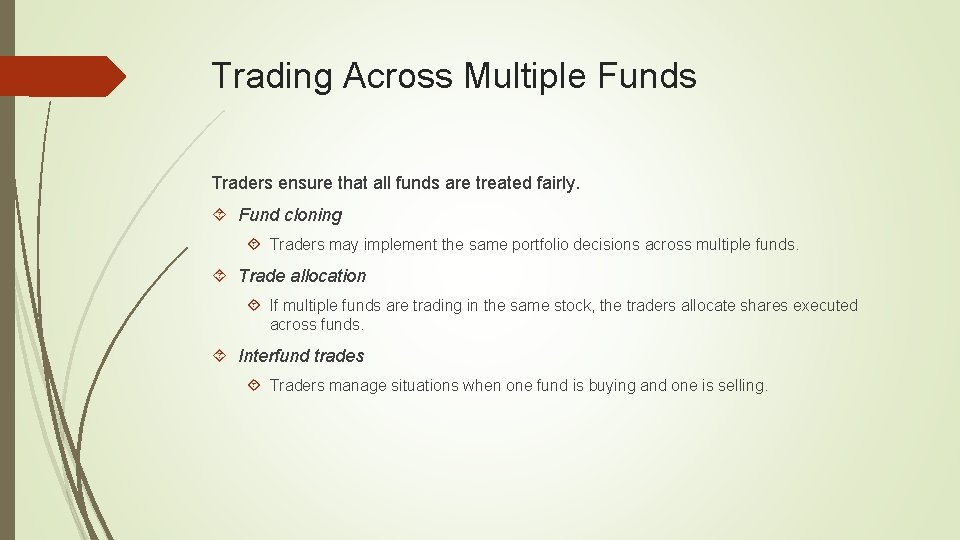
Trading Across Multiple Funds Traders ensure that all funds are treated fairly. Fund cloning Traders may implement the same portfolio decisions across multiple funds. Trade allocation If multiple funds are trading in the same stock, the traders allocate shares executed across funds. Interfund trades Traders manage situations when one fund is buying and one is selling.
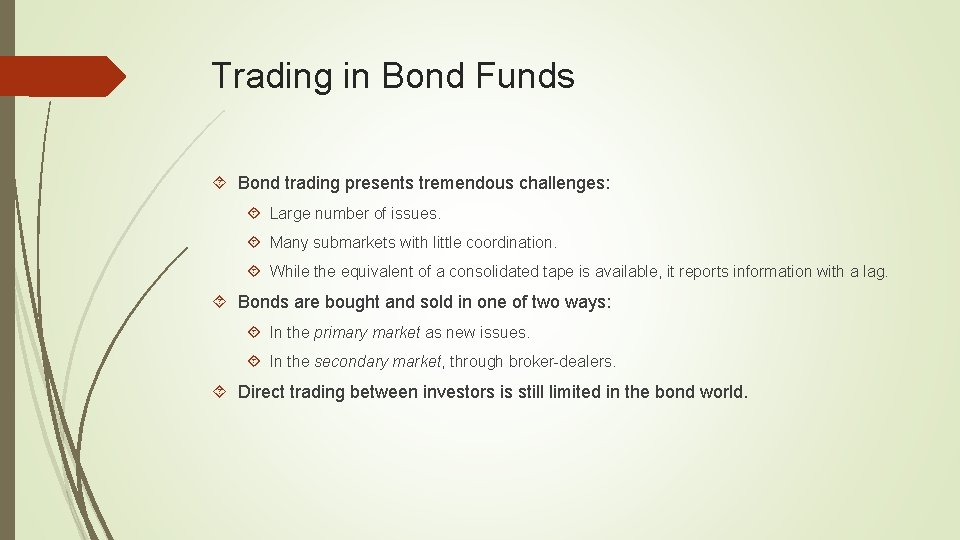
Trading in Bond Funds Bond trading presents tremendous challenges: Large number of issues. Many submarkets with little coordination. While the equivalent of a consolidated tape is available, it reports information with a lag. Bonds are bought and sold in one of two ways: In the primary market as new issues. In the secondary market, through broker-dealers. Direct trading between investors is still limited in the bond world.
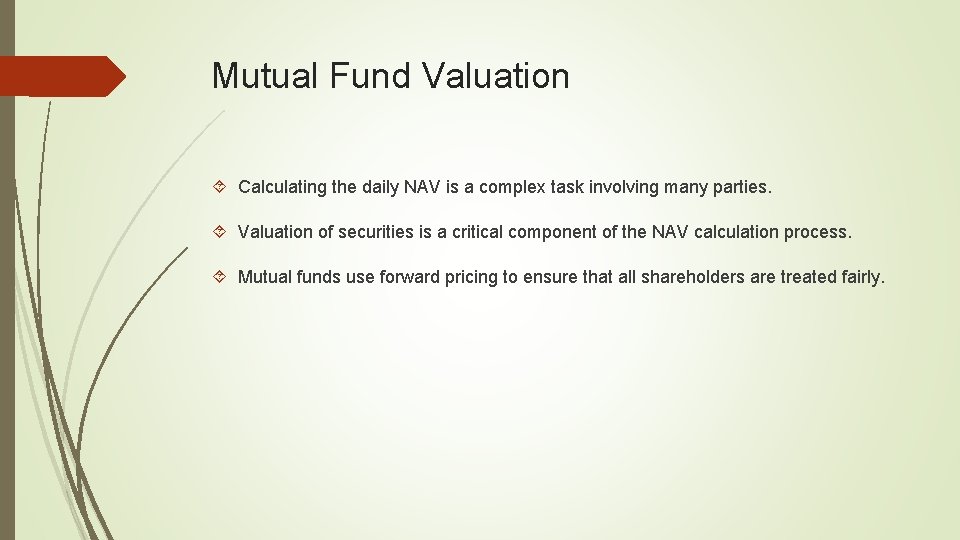
Mutual Fund Valuation Calculating the daily NAV is a complex task involving many parties. Valuation of securities is a critical component of the NAV calculation process. Mutual funds use forward pricing to ensure that all shareholders are treated fairly.
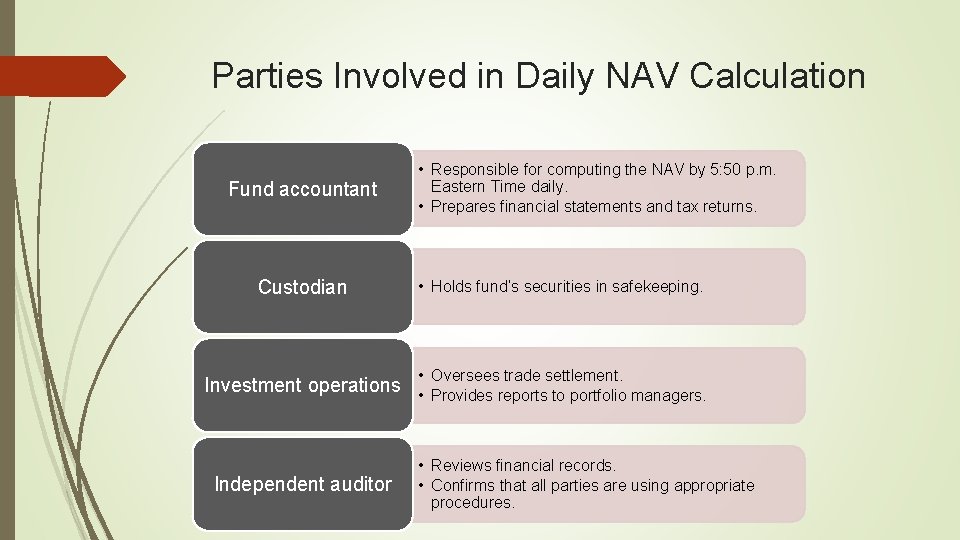
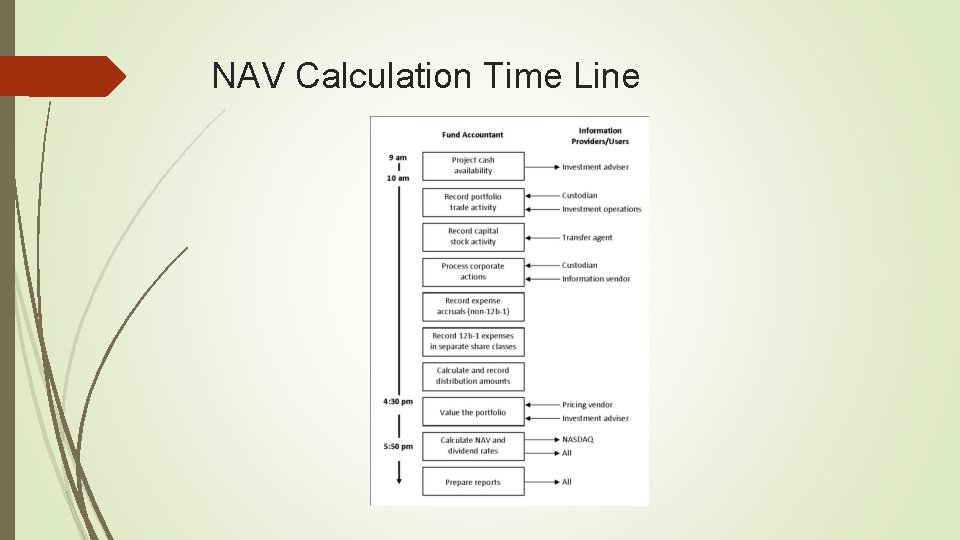
Parties Involved in Daily NAV Calculation Fund accountant Custodian • Responsible for computing the NAV by 5: 50 p. m. Eastern Time daily. • Prepares financial statements and tax returns. • Holds fund’s securities in safekeeping. • Oversees trade settlement. Provides reports to portfolio managers. Investment operations • Independent auditor • Reviews financial records. • Confirms that all parties are using appropriate procedures.
NAV Calculation Time Line
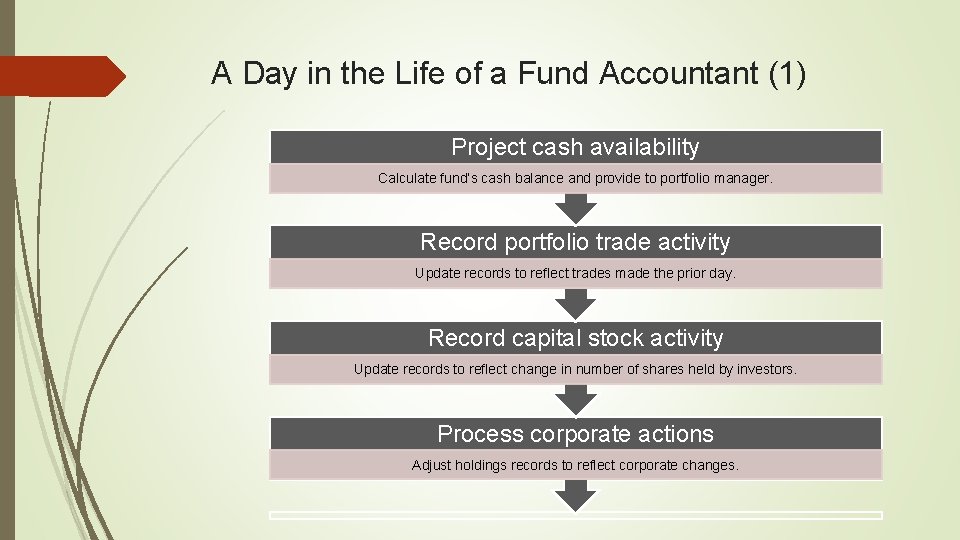
A Day in the Life of a Fund Accountant (1) Project cash availability Calculate fund’s cash balance and provide to portfolio manager. Record portfolio trade activity Update records to reflect trades made the prior day. Record capital stock activity Update records to reflect change in number of shares held by investors. Process corporate actions Adjust holdings records to reflect corporate changes.
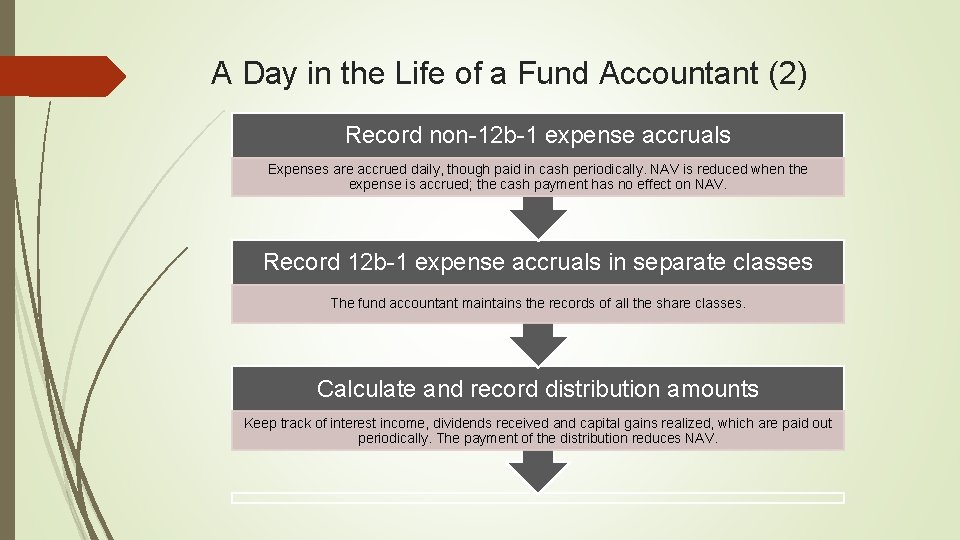
A Day in the Life of a Fund Accountant (2) Record non-12 b-1 expense accruals Expenses are accrued daily, though paid in cash periodically. NAV is reduced when the expense is accrued; the cash payment has no effect on NAV. Record 12 b-1 expense accruals in separate classes The fund accountant maintains the records of all the share classes. Calculate and record distribution amounts Keep track of interest income, dividends received and capital gains realized, which are paid out periodically. The payment of the distribution reduces NAV.
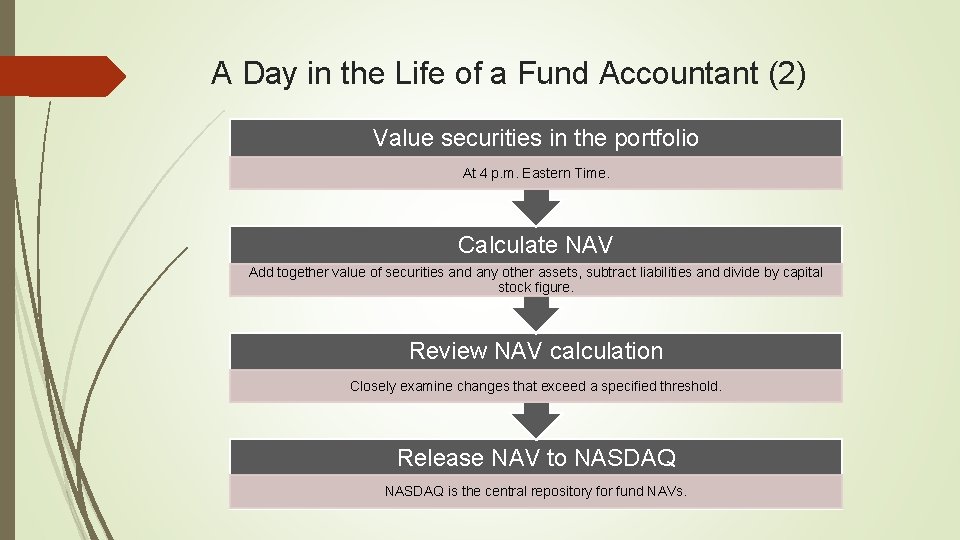
A Day in the Life of a Fund Accountant (2) Value securities in the portfolio At 4 p. m. Eastern Time. Calculate NAV Add together value of securities and any other assets, subtract liabilities and divide by capital stock figure. Review NAV calculation Closely examine changes that exceed a specified threshold. Release NAV to NASDAQ is the central repository for fund NAVs.
Valuation of Portfolio Holdings The NAV must be calculated using current market values for the assets in the portfolio. The board of directors has ultimate authority for the determination of NAV. The board: Reviews and adopts pricing policies. Authorizes exceptions to those policies. Usually establishes a pricing or valuation committee and regularly reviews its decisions. Many funds get valuations from specialized pricing vendors.
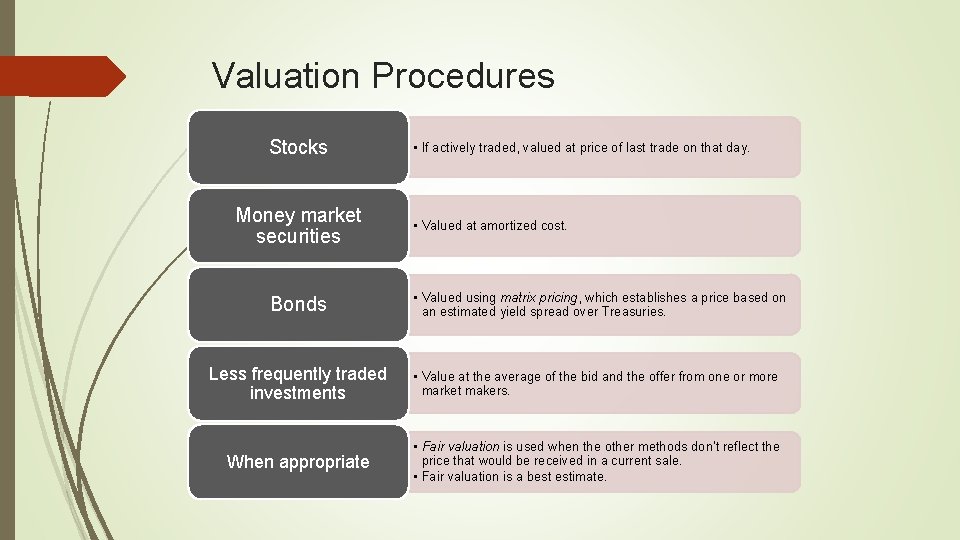
Valuation Procedures Stocks Money market securities Bonds • If actively traded, valued at price of last trade on that day. • Valued at amortized cost. • Valued using matrix pricing, which establishes a price based on an estimated yield spread over Treasuries. Less frequently traded investments • Value at the average of the bid and the offer from one or more market makers. When appropriate • Fair valuation is used when the other methods don’t reflect the price that would be received in a current sale. • Fair valuation is a best estimate.
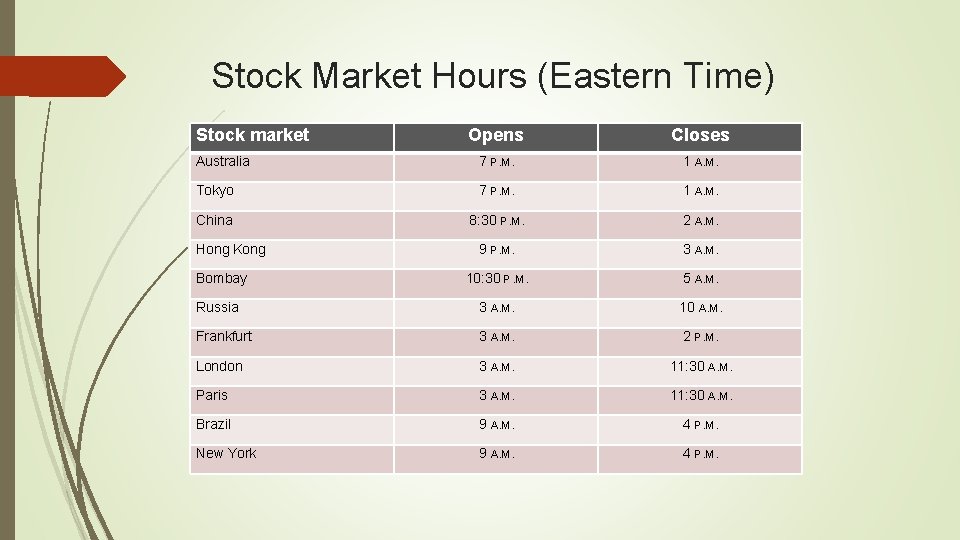
Pricing Issues in International Funds Because markets operate in different time zones – and close before the U. S. market closes – funds that invest overseas use backward pricing for at least a portion of their portfolio. To prevent investors from taking advantage of this backward pricing, funds: Use fair valuation to adjust prices for events that occur after the local market closes but before the U. S. market closes. This may include a significant move in U. S. securities prices. Limit short-term trading.
Stock Market Hours (Eastern Time) Stock market Opens Closes Australia 7 P. M. 1 A. M. Tokyo 7 P. M. 1 A. M. China 8: 30 P. M. 2 A. M. 9 P. M. 3 A. M. 10: 30 P. M. 5 A. M. Russia 3 A. M. 10 A. M. Frankfurt 3 A. M. 2 P. M. London 3 A. M. 11: 30 A. M. Paris 3 A. M. 11: 30 A. M. Brazil 9 A. M. 4 P. M. New York 9 A. M. 4 P. M. Hong Kong Bombay
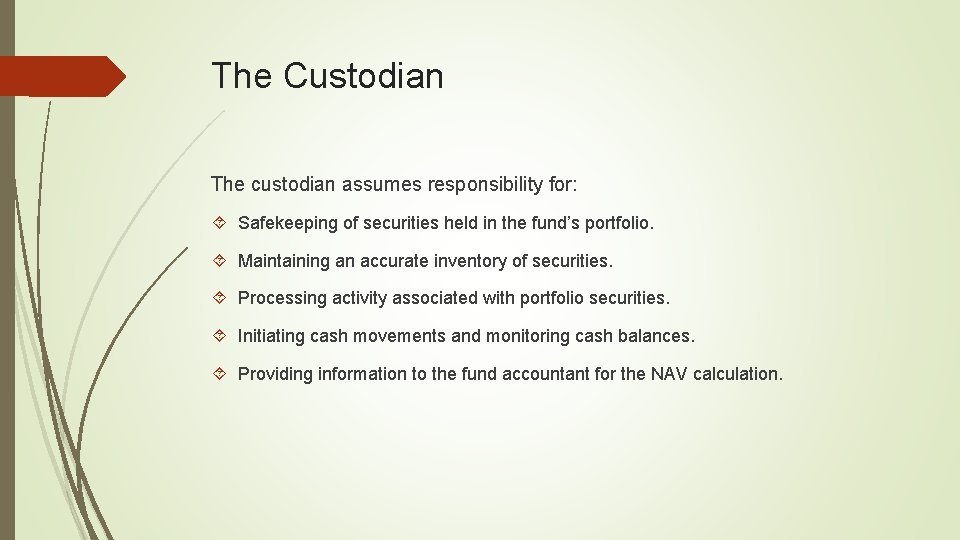
The Custodian The custodian assumes responsibility for: Safekeeping of securities held in the fund’s portfolio. Maintaining an accurate inventory of securities. Processing activity associated with portfolio securities. Initiating cash movements and monitoring cash balances. Providing information to the fund accountant for the NAV calculation.
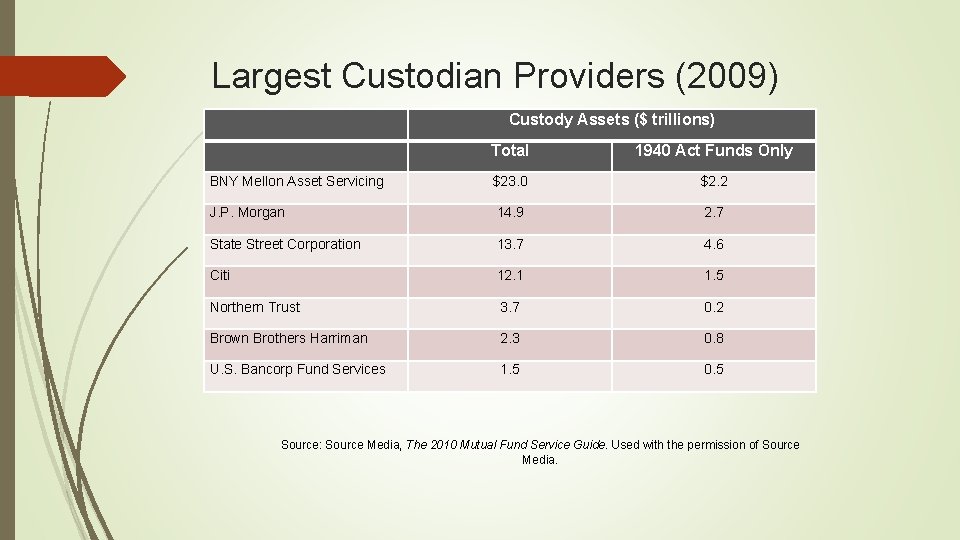
Largest Custodian Providers (2009) Custody Assets ($ trillions) Total 1940 Act Funds Only BNY Mellon Asset Servicing $23. 0 $2. 2 J. P. Morgan 14. 9 2. 7 State Street Corporation 13. 7 4. 6 Citi 12. 1 1. 5 Northern Trust 3. 7 0. 2 Brown Brothers Harriman 2. 3 0. 8 U. S. Bancorp Fund Services 1. 5 0. 5 Source: Source Media, The 2010 Mutual Fund Service Guide. Used with the permission of Source Media.
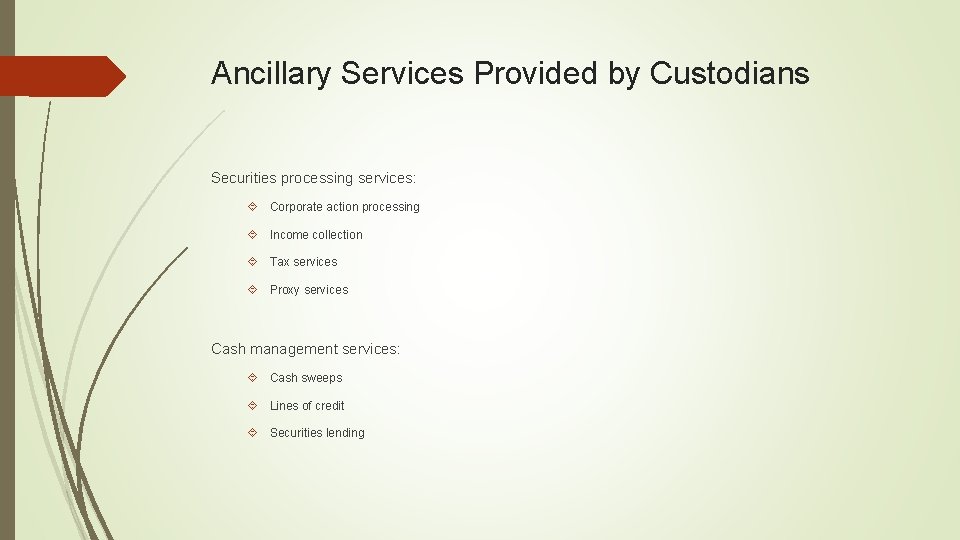
Ancillary Services Provided by Custodians Securities processing services: Corporate action processing Income collection Tax services Proxy services Cash management services: Cash sweeps Lines of credit Securities lending
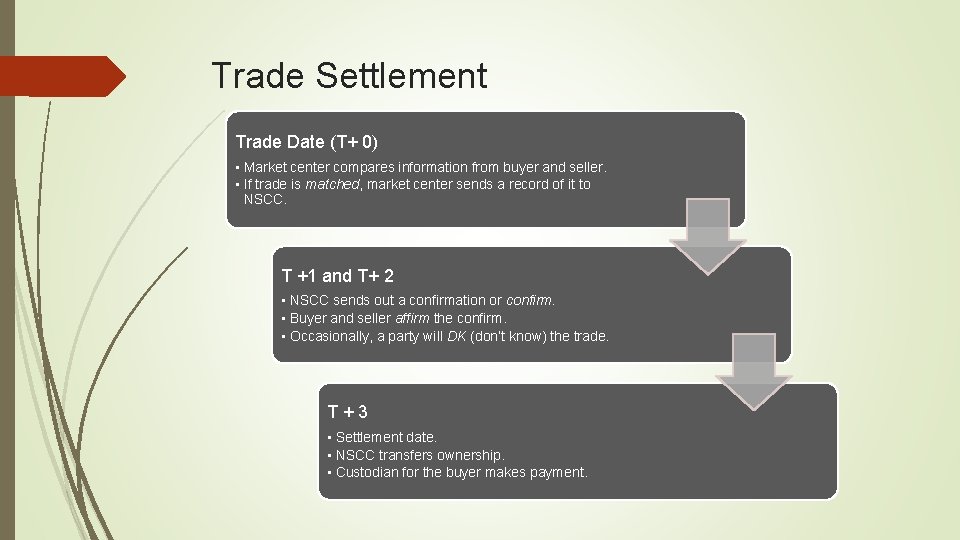
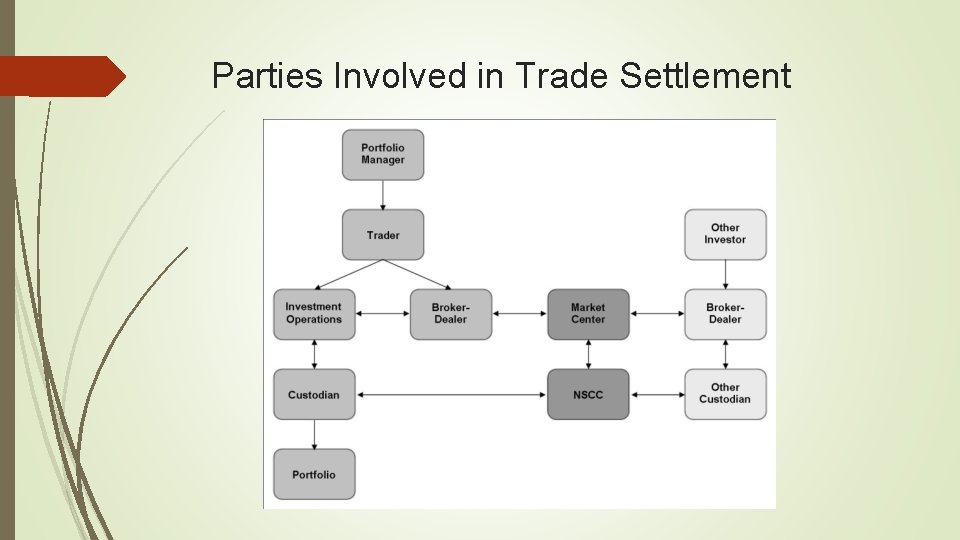
Trade Settlement Trade Date (T+ 0) • Market center compares information from buyer and seller. • If trade is matched, market center sends a record of it to NSCC. T +1 and T+ 2 • NSCC sends out a confirmation or confirm. • Buyer and seller affirm the confirm. • Occasionally, a party will DK (don’t know) the trade. T+3 • Settlement date. • NSCC transfers ownership. • Custodian for the buyer makes payment.
Parties Involved in Trade Settlement
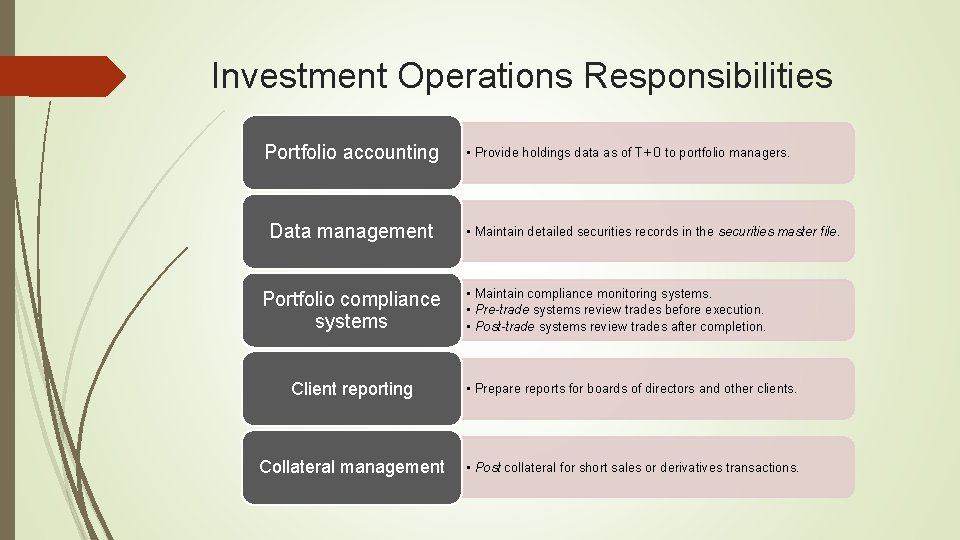
Investment Operations Responsibilities Portfolio accounting Data management Portfolio compliance systems • Provide holdings data as of T+ 0 to portfolio managers. • Maintain detailed securities records in the securities master file. • Maintain compliance monitoring systems. • Pre-trade systems review trades before execution. • Post-trade systems review trades after completion. Client reporting • Prepare reports for boards of directors and other clients. Collateral management • Post collateral for short sales or derivatives transactions.
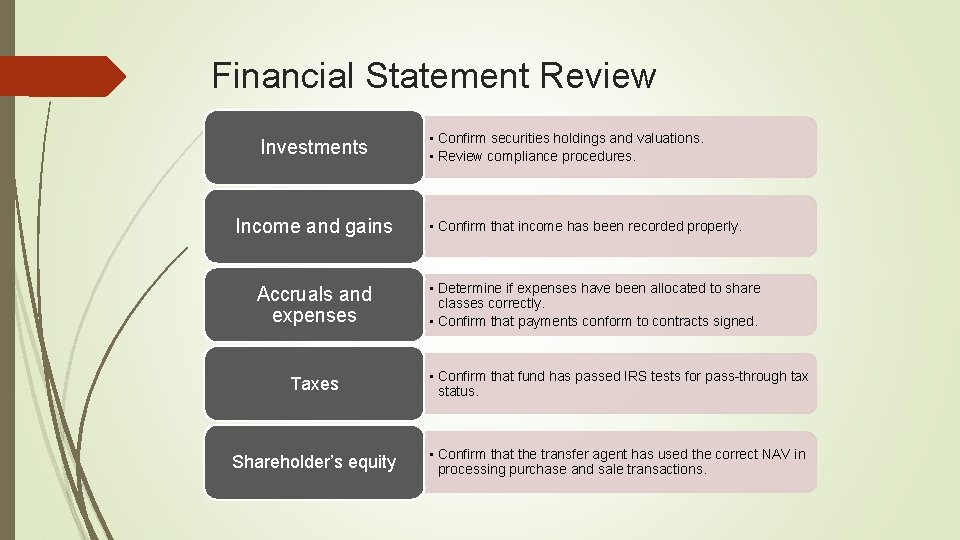
Financial Statement Review Investments Income and gains Accruals and expenses • Confirm securities holdings and valuations. • Review compliance procedures. • Confirm that income has been recorded properly. • Determine if expenses have been allocated to share classes correctly. • Confirm that payments conform to contracts signed. Taxes • Confirm that fund has passed IRS tests for pass-through tax status. Shareholder’s equity • Confirm that the transfer agent has used the correct NAV in processing purchase and sale transactions.
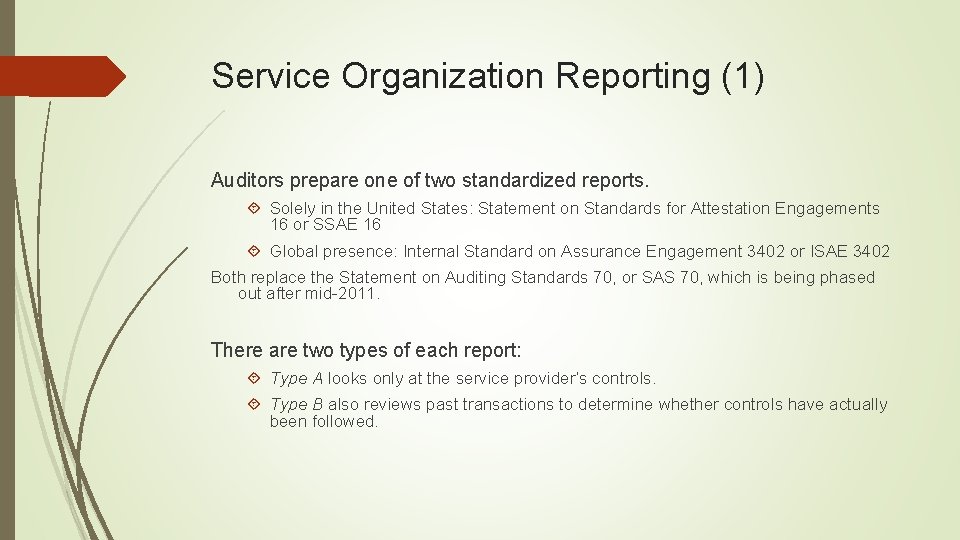
Service Organization Reporting (1) Auditors prepare one of two standardized reports. Solely in the United States: Statement on Standards for Attestation Engagements 16 or SSAE 16 Global presence: Internal Standard on Assurance Engagement 3402 or ISAE 3402 Both replace the Statement on Auditing Standards 70, or SAS 70, which is being phased out after mid-2011. There are two types of each report: Type A looks only at the service provider’s controls. Type B also reviews past transactions to determine whether controls have actually been followed.
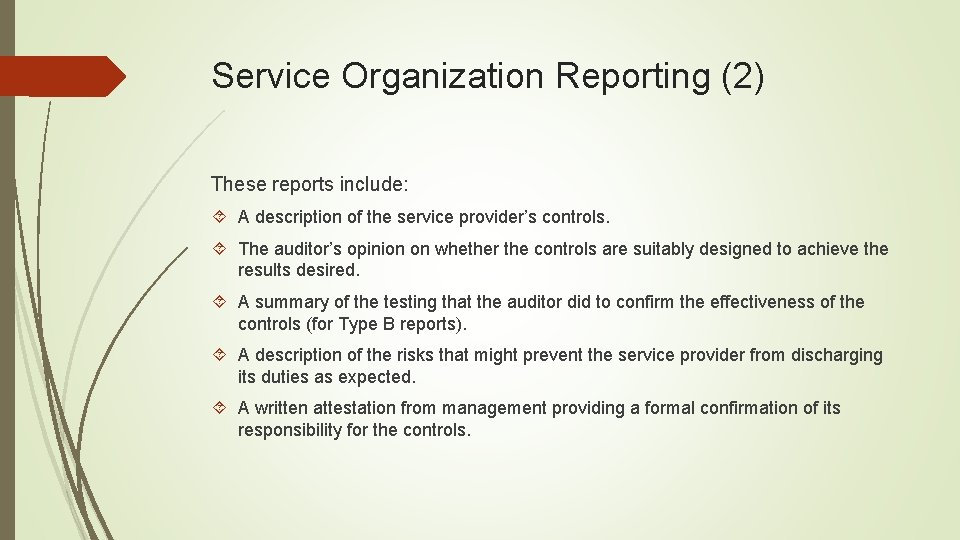
Service Organization Reporting (2) These reports include: A description of the service provider’s controls. The auditor’s opinion on whether the controls are suitably designed to achieve the results desired. A summary of the testing that the auditor did to confirm the effectiveness of the controls (for Type B reports). A description of the risks that might prevent the service provider from discharging its duties as expected. A written attestation from management providing a formal confirmation of its responsibility for the controls.
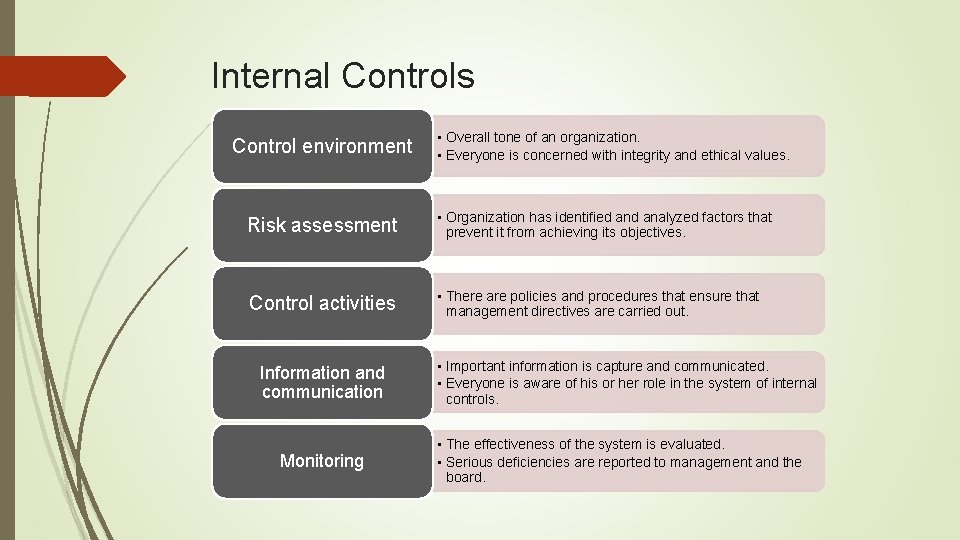
Internal Controls Control environment • Overall tone of an organization. • Everyone is concerned with integrity and ethical values. Risk assessment • Organization has identified analyzed factors that prevent it from achieving its objectives. Control activities • There are policies and procedures that ensure that management directives are carried out. Information and communication Monitoring • Important information is capture and communicated. • Everyone is aware of his or her role in the system of internal controls. • The effectiveness of the system is evaluated. • Serious deficiencies are reported to management and the board.