
Implementing PBIS with a Native Voice Govinda Budrow
Implementing PBIS with a Native Voice Govinda Budrow, Fond du Lac Tribal and Community College; Tara Dupuis, Fond du Lac Ojibwe School; Daniel Torrez, North St. Paul-Maplewood-Oakdale School District; Clay Keller, Minnesota Department of Education 2019 Minnesota PBIS Summer Institute
Overview • Introductions • Adapting PBIS culturally • Work to examine PBIS from a Native perspective 10/30/2020 Leading for educational excellence and equity, every day for every one. | education. mn. gov 2
Reclaiming Native Truth Research 2018 • Reclaiming Native Truth • • Largest public opinion research project on Native Americans Invisibility was a major theme that impacts perceptions and meeting needs in “invisible” communities 3
Invisibility • Media: Little to no--. 0% to. 04%--media representations portray Native Americans as contemporary people (Tukachinsky, Mastro, & Yarchi, 2005; Fryberg, 2003). • Google/Bing Search : 95% of first 100 Google images and 99% on Bing for the terms “Native American” and “American Indian” are antiquated portraits (Leavitt, Covarrubias, Perez, & Fryberg, 2015). • School Curricula : 87% of references to Native Americans in 50 states’ academic standards portray them in a pre-1900 context (Shear, Knowles, Soden, Cnaitz, & Castro, 2015). • Social Science Research : Of the approximately 39, 538 publications peer reviewed publications on prejudice, intergroup relations, stigma, and stereotyping, only 0. 5% of publications mention Native Americans; only 0. 2% include Native American participants (Fryberg & Eason, 2017; see also, Brady, Shoda, Fryberg, 2018). 4
Rarely Encounter Information 71. 7% of people rarely or never encounter or seek out information about Native Americans. 5
Adapting PBIS Culturally 10/30/2020 Leading for educational excellence and equity, every day for every one. | education. mn. gov 6
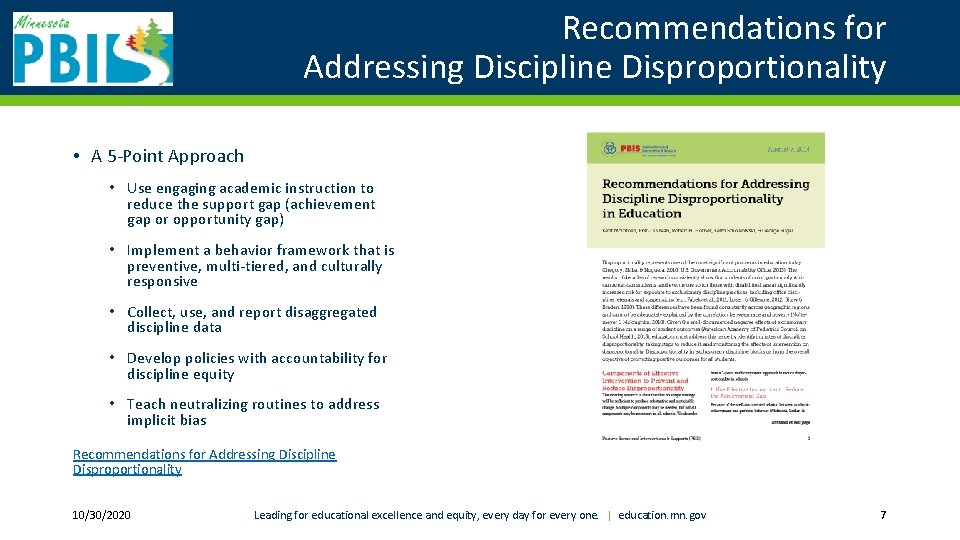
Recommendations for Addressing Discipline Disproportionality • A 5 -Point Approach • Use engaging academic instruction to reduce the support gap (achievement gap or opportunity gap) • Implement a behavior framework that is preventive, multi-tiered, and culturally responsive • Collect, use, and report disaggregated discipline data • Develop policies with accountability for discipline equity • Teach neutralizing routines to address implicit bias Recommendations for Addressing Discipline Disproportionality 10/30/2020 Leading for educational excellence and equity, every day for every one. | education. mn. gov 7
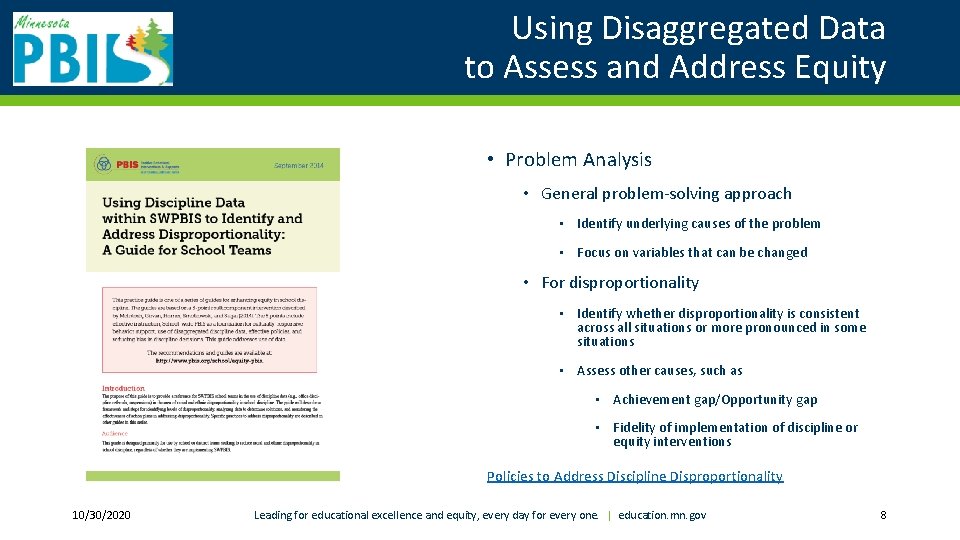
Using Disaggregated Data to Assess and Address Equity • Problem Analysis • General problem-solving approach • Identify underlying causes of the problem • Focus on variables that can be changed • For disproportionality • Identify whether disproportionality is consistent across all situations or more pronounced in some situations • Assess other causes, such as • Achievement gap/Opportunity gap • Fidelity of implementation of discipline or equity interventions Policies to Address Discipline Disproportionality 10/30/2020 Leading for educational excellence and equity, every day for every one. | education. mn. gov 8
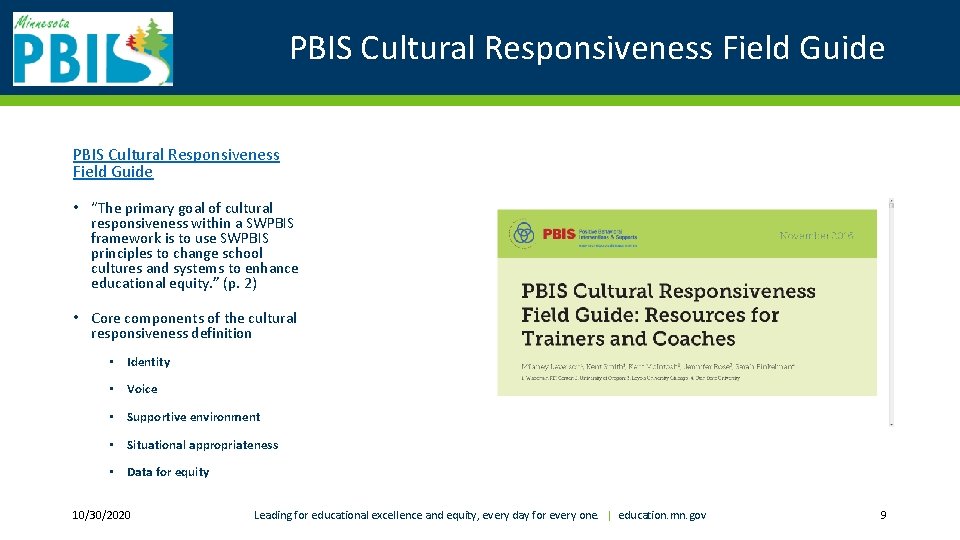
PBIS Cultural Responsiveness Field Guide • “The primary goal of cultural responsiveness within a SWPBIS framework is to use SWPBIS principles to change school cultures and systems to enhance educational equity. ” (p. 2) • Core components of the cultural responsiveness definition • Identity • Voice • Supportive environment • Situational appropriateness • Data for equity 10/30/2020 Leading for educational excellence and equity, every day for every one. | education. mn. gov 9
Examples of Culturally Responsive Elaborations of PBIS from the Field Guide • School SWPBIS leadership teams not only include stakeholders as team members but also actively elicit ownership, voice and broad representation of their families and communities, especially underserved families and cultures. (p. 7) • Teams adopt or revise expectations that are reflective of the cultural values of the surrounding community. Expectations and rules are identified based on a legitimate purpose within the setting, as opposed to simply school tradition or maintaining the status quo. (p. 9) • Teams have a process and procedures for staff to teach students the behaviors necessary to be successful in the school setting regardless of previous learning and without disrespecting families’ beliefs. When expectations differ between home or community and school, staff explicitly teach the differences (i. e. , codeswitching), the purpose of having the expectations at school, and provide additional practice until students demonstrate the behaviors fluently. (p. 10) 10/30/2020 Leading for educational excellence and equity, every day for every one. | education. mn. gov 10
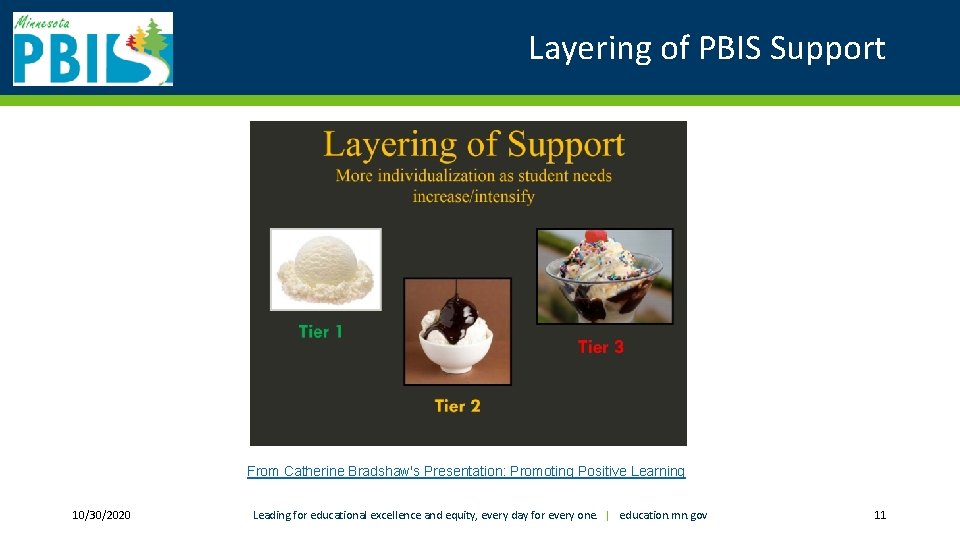
Layering of PBIS Support From Catherine Bradshaw's Presentation: Promoting Positive Learning 10/30/2020 Leading for educational excellence and equity, every day for every one. | education. mn. gov 11
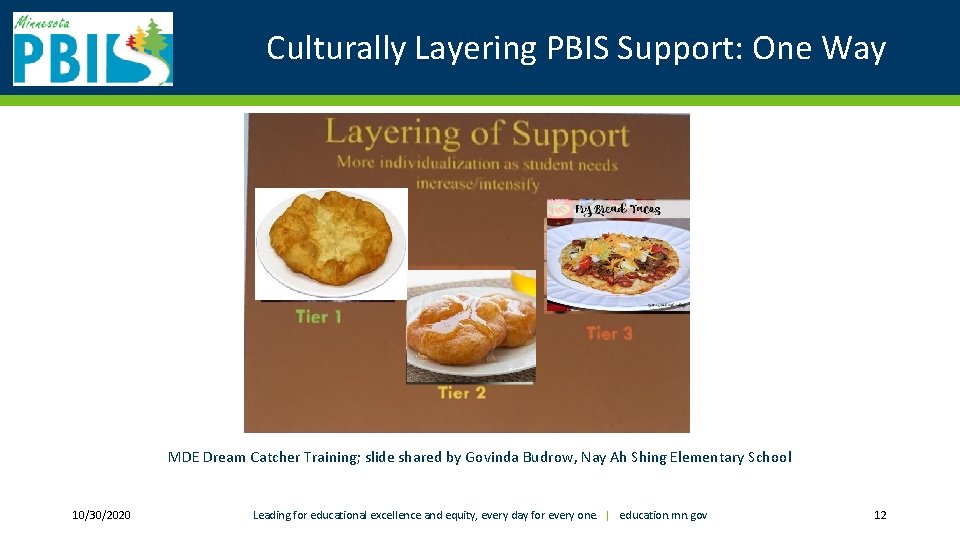
Culturally Layering PBIS Support: One Way MDE Dream Catcher Training; slide shared by Govinda Budrow, Nay Ah Shing Elementary School 10/30/2020 Leading for educational excellence and equity, every day for every one. | education. mn. gov 12
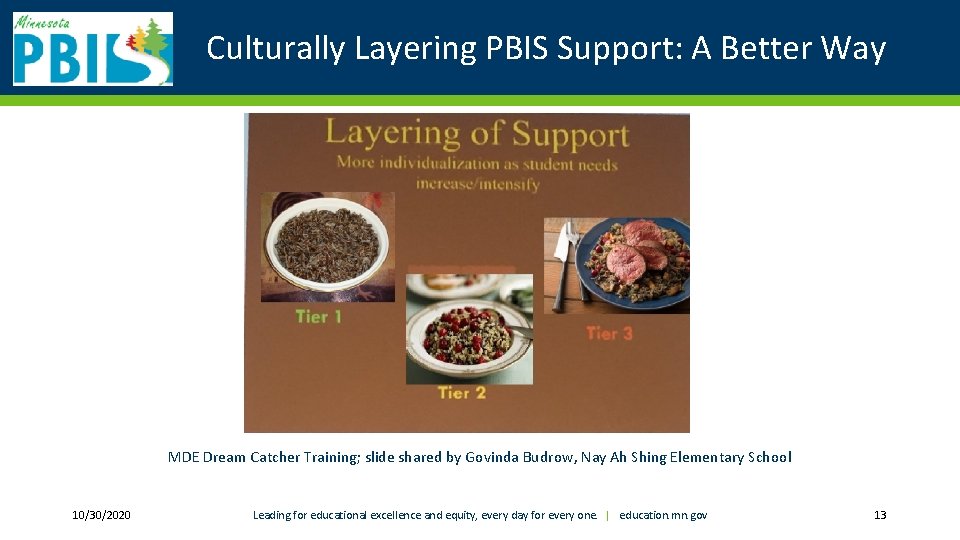
Culturally Layering PBIS Support: A Better Way MDE Dream Catcher Training; slide shared by Govinda Budrow, Nay Ah Shing Elementary School 10/30/2020 Leading for educational excellence and equity, every day for every one. | education. mn. gov 13
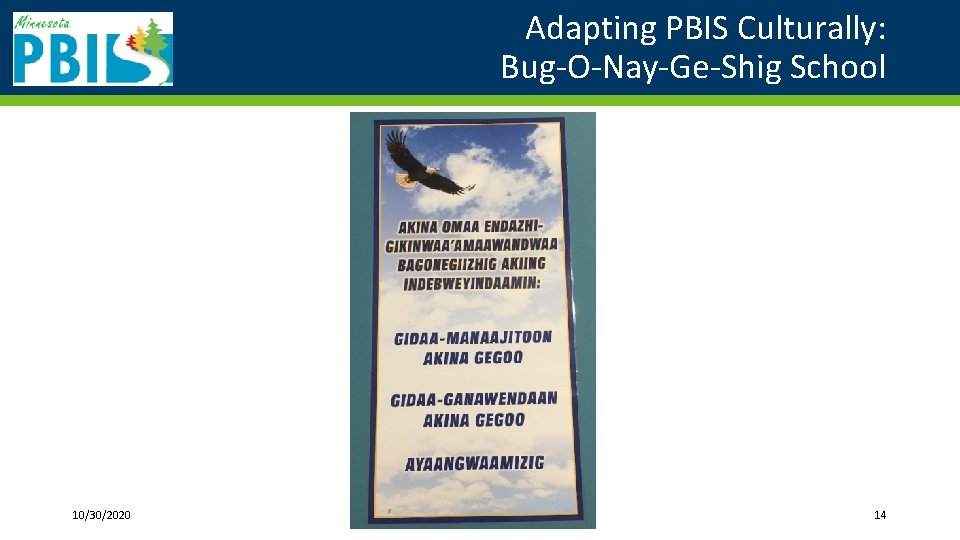
Adapting PBIS Culturally: Bug-O-Nay-Ge-Shig School 10/30/2020 14
How Can We Implement PBIS with a Native Voice? • If these are the major components of PBIS… • Positively stated behavioral expectations • System for positive feedback and acknowledgement • Support system for students who do not display behaviors • Data-based decision making • Supporting academic and behavioral success • Using a team-based approach • How can we implement them in Native ways? 15
Initial Work 10/30/2020 Leading for educational excellence and equity, every day for every one. | education. mn. gov 16
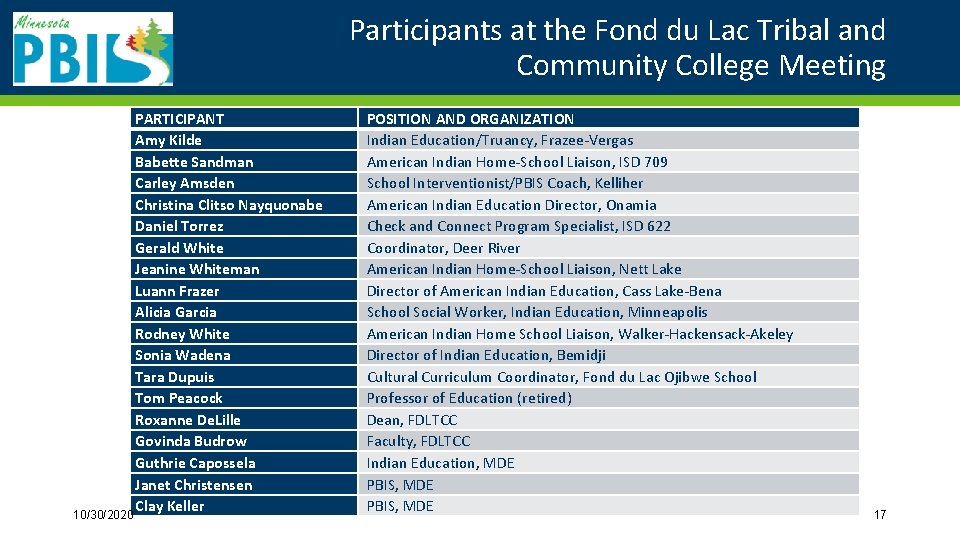
Participants at the Fond du Lac Tribal and Community College Meeting 10/30/2020 PARTICIPANT Amy Kilde Babette Sandman Carley Amsden Christina Clitso Nayquonabe Daniel Torrez Gerald White Jeanine Whiteman Luann Frazer Alicia Garcia Rodney White Sonia Wadena Tara Dupuis Tom Peacock Roxanne De. Lille Govinda Budrow Guthrie Capossela Janet Christensen Clay Keller POSITION AND ORGANIZATION Indian Education/Truancy, Frazee-Vergas American Indian Home-School Liaison, ISD 709 School Interventionist/PBIS Coach, Kelliher American Indian Education Director, Onamia Check and Connect Program Specialist, ISD 622 Coordinator, Deer River American Indian Home-School Liaison, Nett Lake Director of American Indian Education, Cass Lake-Bena School Social Worker, Indian Education, Minneapolis American Indian Home School Liaison, Walker-Hackensack-Akeley Director of Indian Education, Bemidji Cultural Curriculum Coordinator, Fond du Lac Ojibwe School Professor of Education (retired) Dean, FDLTCC Faculty, FDLTCC Indian Education, MDE PBIS, MDE 17
Group Photo 10/30/2020 18
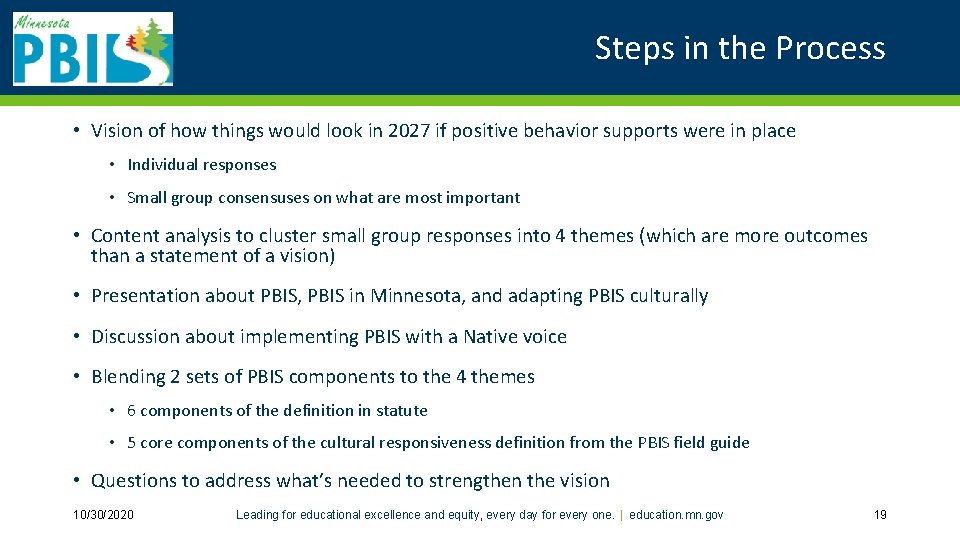
Steps in the Process • Vision of how things would look in 2027 if positive behavior supports were in place • Individual responses • Small group consensuses on what are most important • Content analysis to cluster small group responses into 4 themes (which are more outcomes than a statement of a vision) • Presentation about PBIS, PBIS in Minnesota, and adapting PBIS culturally • Discussion about implementing PBIS with a Native voice • Blending 2 sets of PBIS components to the 4 themes • 6 components of the definition in statute • 5 core components of the cultural responsiveness definition from the PBIS field guide • Questions to address what’s needed to strengthen the vision 10/30/2020 Leading for educational excellence and equity, every day for every one. | education. mn. gov 19
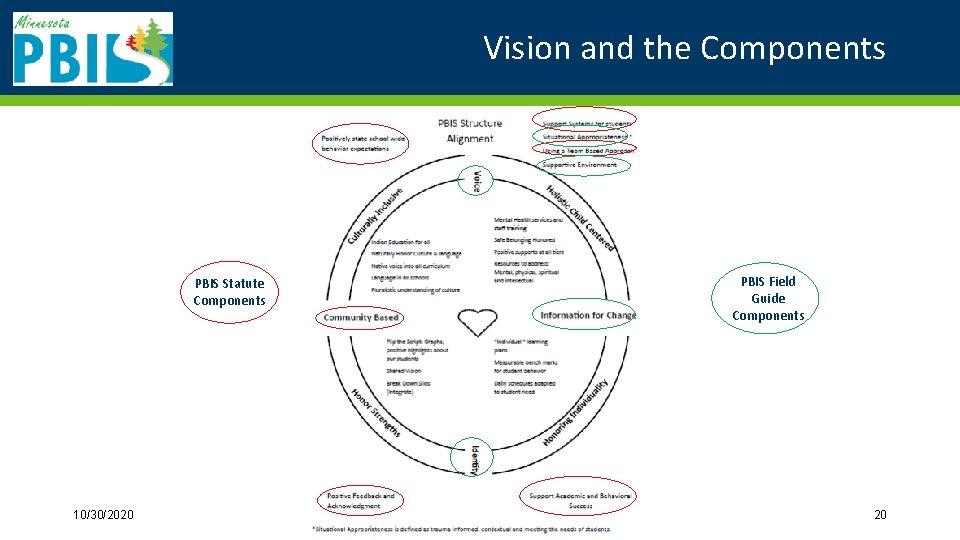
Vision and the Components PBIS Statute Components 10/30/2020 PBIS Field Guide Components 20
Thank You! 10/30/2020 Leading for educational excellence and equity, every day for every one. | education. mn. gov 21
- Slides: 21