
Implementing Pay for Performance in Workforce Development Insights

- Slides: 11
Implementing Pay for Performance in Workforce Development: Insights from the Field February 23, 2018
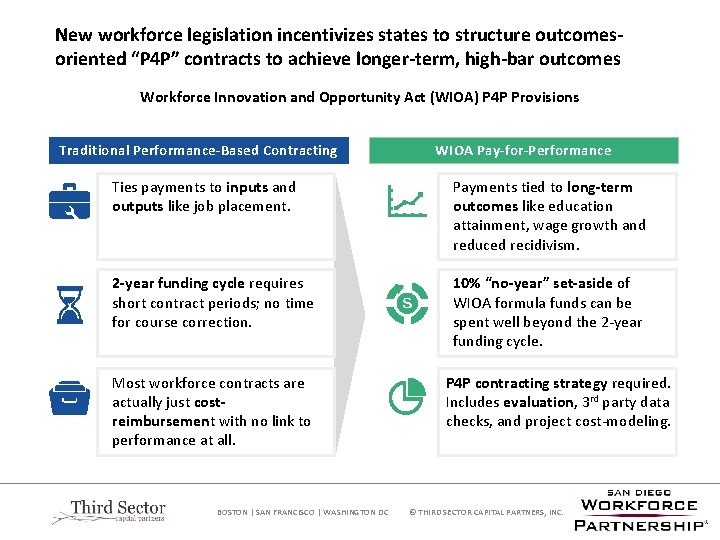
New workforce legislation incentivizes states to structure outcomesoriented “P 4 P” contracts to achieve longer-term, high-bar outcomes Workforce Innovation and Opportunity Act (WIOA) P 4 P Provisions Traditional Performance-Based Contracting WIOA Pay-for-Performance Ties payments to inputs and outputs like job placement. Payments tied to long-term outcomes like education attainment, wage growth and reduced recidivism. 2 -year funding cycle requires short contract periods; no time for course correction. 10% “no-year” set-aside of WIOA formula funds can be spent well beyond the 2 -year funding cycle. Most workforce contracts are actually just costreimbursement with no link to performance at all. BOSTON | SAN FRANCISCO | WASHINGTON DC P 4 P contracting strategy required. Includes evaluation, 3 rd party data checks, and project cost-modeling. © THIRD SECTOR CAPITAL PARTNERS, INC. 1
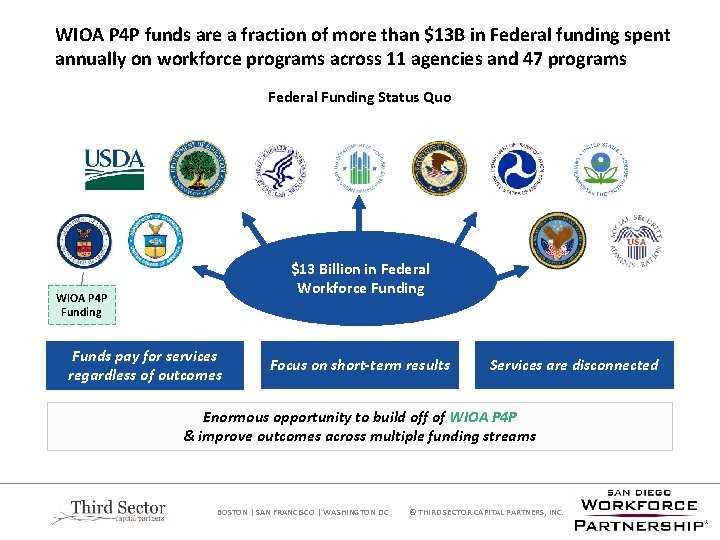
WIOA P 4 P funds are a fraction of more than $13 B in Federal funding spent annually on workforce programs across 11 agencies and 47 programs Federal Funding Status Quo $13 Billion in Federal Workforce Funding WIOA P 4 P Funding Funds pay for services regardless of outcomes Focus on short-term results Services are disconnected Enormous opportunity to build off of WIOA P 4 P & improve outcomes across multiple funding streams BOSTON | SAN FRANCISCO | WASHINGTON DC © THIRD SECTOR CAPITAL PARTNERS, INC. 2
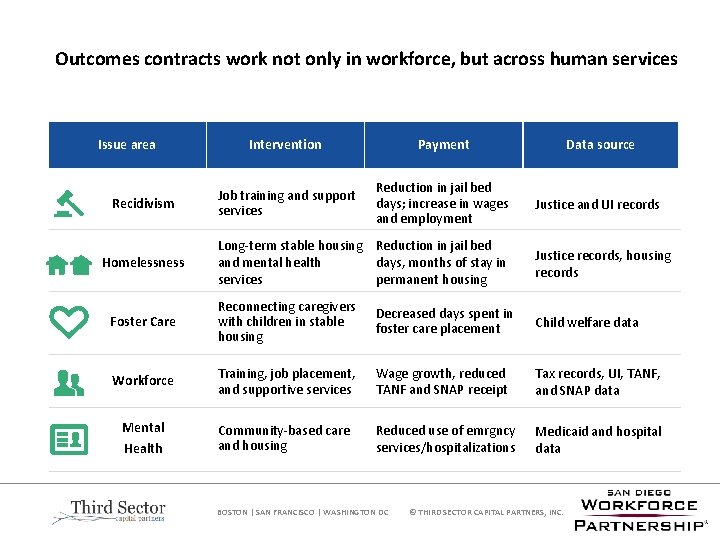
Outcomes contracts work not only in workforce, but across human services Issue area Recidivism Intervention Payment Data source Job training and support services Reduction in jail bed days; increase in wages and employment Justice and UI records Long-term stable housing Reduction in jail bed and mental health days, months of stay in services permanent housing Justice records, housing records Foster Care Reconnecting caregivers with children in stable housing Decreased days spent in foster care placement Child welfare data Workforce Training, job placement, and supportive services Wage growth, reduced TANF and SNAP receipt Tax records, UI, TANF, and SNAP data Mental Health Community-based care and housing Reduced use of emrgncy services/hospitalizations Medicaid and hospital data Homelessness BOSTON | SAN FRANCISCO | WASHINGTON DC © THIRD SECTOR CAPITAL PARTNERS, INC. 3
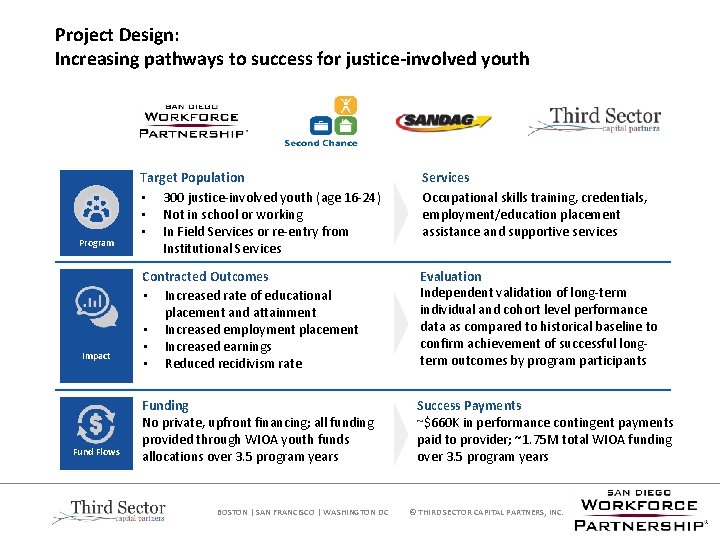
Project Design: Increasing pathways to success for justice-involved youth Program Impact Fund Flows Target Population • 300 justice-involved youth (age 16 -24) • Not in school or working • In Field Services or re-entry from Institutional Services Occupational skills training, credentials, employment/education placement assistance and supportive services Contracted Outcomes • Increased rate of educational placement and attainment • Increased employment placement • Increased earnings • Reduced recidivism rate Evaluation Independent validation of long-term individual and cohort level performance data as compared to historical baseline to confirm achievement of successful longterm outcomes by program participants Funding No private, upfront financing; all funding provided through WIOA youth funds allocations over 3. 5 program years Success Payments ~$660 K in performance contingent payments paid to provider; ~1. 75 M total WIOA funding over 3. 5 program years BOSTON | SAN FRANCISCO | WASHINGTON DC © THIRD SECTOR CAPITAL PARTNERS, INC. 4
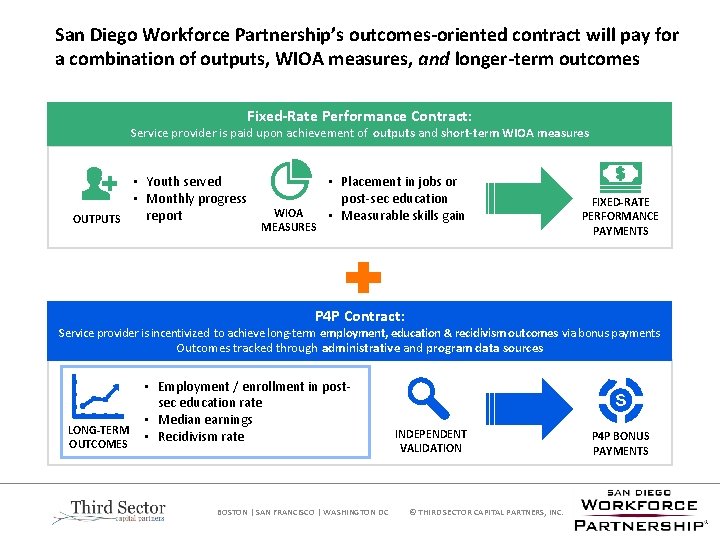
San Diego Workforce Partnership’s outcomes-oriented contract will pay for a combination of outputs, WIOA measures, and longer-term outcomes Fixed-Rate Performance Contract: Service provider is paid upon achievement of outputs and short-term WIOA measures • Youth served • Monthly progress report OUTPUTS WIOA MEASURES • Placement in jobs or post-sec education • Measurable skills gain FIXED-RATE PERFORMANCE PAYMENTS P 4 P Contract: Service provider is incentivized to achieve long-term employment, education & recidivism outcomes via bonus payments Outcomes tracked through administrative and program data sources LONG-TERM OUTCOMES • Employment / enrollment in postsec education rate • Median earnings • Recidivism rate BOSTON | SAN FRANCISCO | WASHINGTON DC INDEPENDENT VALIDATION © THIRD SECTOR CAPITAL PARTNERS, INC. P 4 P BONUS PAYMENTS 7
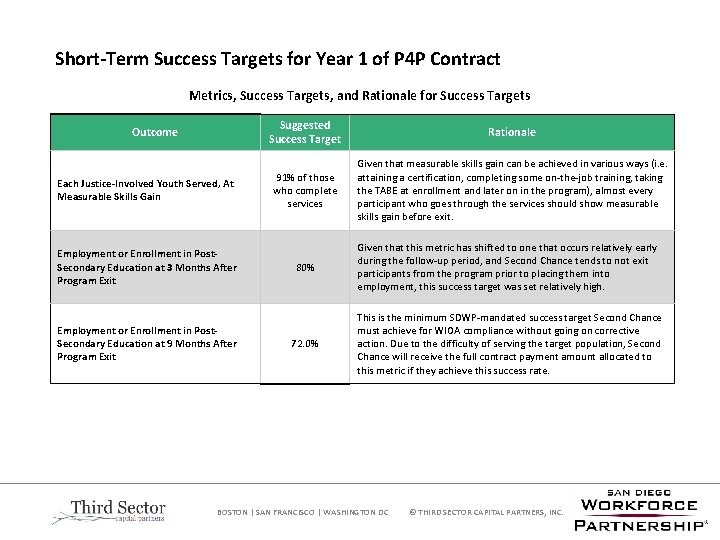
Short-Term Success Targets for Year 1 of P 4 P Contract Metrics, Success Targets, and Rationale for Success Targets Outcome Each Justice-Involved Youth Served, At Measurable Skills Gain Employment or Enrollment in Post. Secondary Education at 3 Months After Program Exit Employment or Enrollment in Post. Secondary Education at 9 Months After Program Exit Suggested Success Target Rationale 91% of those who complete services Given that measurable skills gain can be achieved in various ways (i. e. attaining a certification, completing some on-the-job training, taking the TABE at enrollment and later on in the program), almost every participant who goes through the services should show measurable skills gain before exit. 80% Given that this metric has shifted to one that occurs relatively early during the follow-up period, and Second Chance tends to not exit participants from the program prior to placing them into employment, this success target was set relatively high. 72. 0% This is the minimum SDWP-mandated success target Second Chance must achieve for WIOA compliance without going on corrective action. Due to the difficulty of serving the target population, Second Chance will receive the full contract payment amount allocated to this metric if they achieve this success rate. BOSTON | SAN FRANCISCO | WASHINGTON DC © THIRD SECTOR CAPITAL PARTNERS, INC. 6
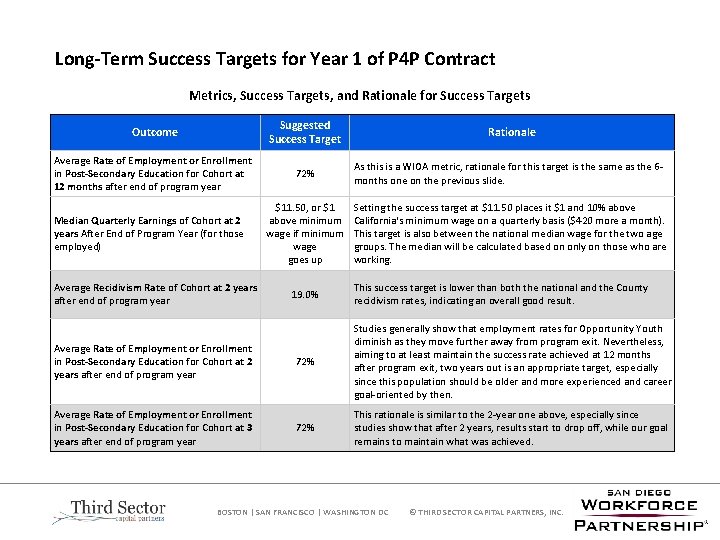
Long-Term Success Targets for Year 1 of P 4 P Contract Metrics, Success Targets, and Rationale for Success Targets Outcome Suggested Success Target Average Rate of Employment or Enrollment in Post-Secondary Education for Cohort at 12 months after end of program year 72% As this is a WIOA metric, rationale for this target is the same as the 6 months one on the previous slide. $11. 50, or $1 above minimum wage if minimum wage goes up Setting the success target at $11. 50 places it $1 and 10% above California's minimum wage on a quarterly basis ($420 more a month). This target is also between the national median wage for the two age groups. The median will be calculated based on only on those who are working. Median Quarterly Earnings of Cohort at 2 years After End of Program Year (for those employed) Average Recidivism Rate of Cohort at 2 years after end of program year 19. 0% Rationale This success target is lower than both the national and the County recidivism rates, indicating an overall good result. Average Rate of Employment or Enrollment in Post-Secondary Education for Cohort at 2 years after end of program year 72% Studies generally show that employment rates for Opportunity Youth diminish as they move further away from program exit. Nevertheless, aiming to at least maintain the success rate achieved at 12 months after program exit, two years out is an appropriate target, especially since this population should be older and more experienced and career goal-oriented by then. Average Rate of Employment or Enrollment in Post-Secondary Education for Cohort at 3 years after end of program year 72% This rationale is similar to the 2 -year one above, especially since studies show that after 2 years, results start to drop off, while our goal remains to maintain what was achieved. BOSTON | SAN FRANCISCO | WASHINGTON DC © THIRD SECTOR CAPITAL PARTNERS, INC. 7
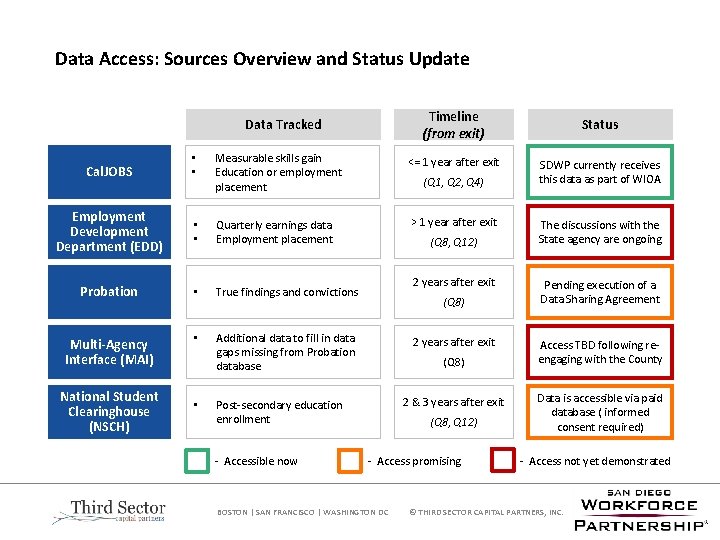
Data Access: Sources Overview and Status Update Timeline (from exit) Data Tracked • • Measurable skills gain Education or employment placement <= 1 year after exit Employment Development Department (EDD) • • Quarterly earnings data Employment placement > 1 year after exit Probation • True findings and convictions Multi-Agency Interface (MAI) • Additional data to fill in data gaps missing from Probation database Cal. JOBS National Student Clearinghouse (NSCH) • (Q 1, Q 2, Q 4) (Q 8, Q 12) 2 years after exit (Q 8) 2 & 3 years after exit Post-secondary education enrollment - Accessible now (Q 8, Q 12) - Access promising BOSTON | SAN FRANCISCO | WASHINGTON DC Status SDWP currently receives this data as part of WIOA The discussions with the State agency are ongoing Pending execution of a Data Sharing Agreement Access TBD following reengaging with the County Data is accessible via paid database ( informed consent required) - Access not yet demonstrated © THIRD SECTOR CAPITAL PARTNERS, INC. 8
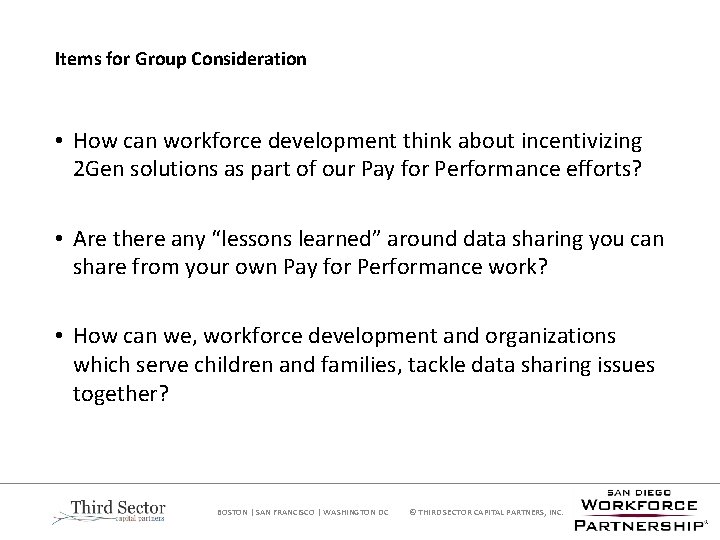
Items for Group Consideration • How can workforce development think about incentivizing 2 Gen solutions as part of our Pay for Performance efforts? • Are there any “lessons learned” around data sharing you can share from your own Pay for Performance work? • How can we, workforce development and organizations which serve children and families, tackle data sharing issues together? BOSTON | SAN FRANCISCO | WASHINGTON DC © THIRD SECTOR CAPITAL PARTNERS, INC. 10/21/2021 9
Disclosure This presentation contains confidential, proprietary, copyright and/or trade secret information of Third Sector Capital Partners that may not be reproduced, disclosed to anyone, or used for the benefit of anyone other than Third Sector Capital Partners unless expressly authorized in writing by an executive officer of Third Sector Capital Partners, Inc. Boston San Francisco Washington, D. C. info@thirdsectorcap. org | www. thirdsectorcap. org BOSTON | SAN FRANCISCO | WASHINGTON DC © THIRD SECTOR CAPITAL PARTNERS, INC. 10/21/2021 10