
IMPLEMENTING PARALLEL PROGRAMMING DESIGN PATTERNS USING EFL FORPYTHON

![LOGLOOP -BLOCK L = [1, 2, 3, 4, 5, 6, 7, 8] func =](https://slidetodoc.com/presentation_image_h2/8b661ce8f24286314e61ac02f4fb63a9/image-35.jpg "LOGLOOP -BLOCK L = [1, 2, 3, 4, 5, 6, 7, 8] func =")
![LOGLOOP -BLOCK L = [[1, 2], [3, 4], [5, 6], [7, 8]] func =](https://slidetodoc.com/presentation_image_h2/8b661ce8f24286314e61ac02f4fb63a9/image-36.jpg "LOGLOOP -BLOCK L = [[1, 2], [3, 4], [5, 6], [7, 8]] func =")

- Slides: 49
IMPLEMENTING PARALLEL PROGRAMMING DESIGN PATTERNS USING EFL FORPYTHON 1 David Dayan, Moshe Goldstein, Elad Bussani Levy, Moshe Naaman, Mor Nagar, Ditsa Soudry, Raphael B. Yehezkael Euro. Python 2016
AGENDA Motivation Objectives EFL Programming Model EFL Execution Model EFL Implementation Parallel Design Patterns in EFL Conclusions Further Work 2
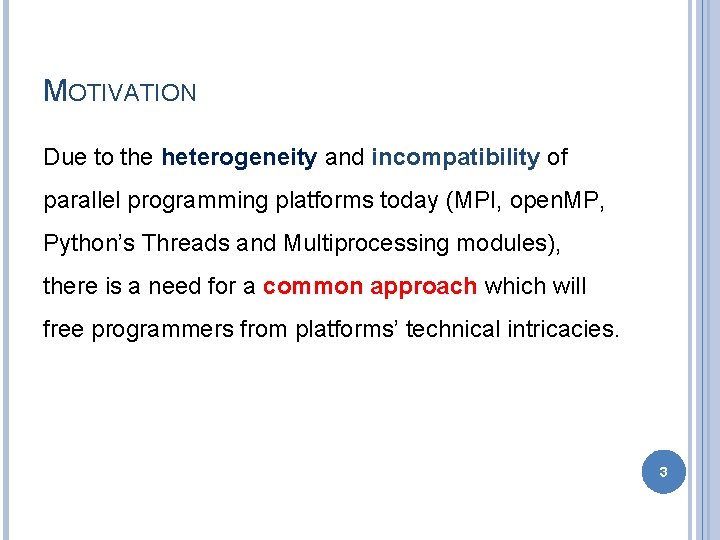
MOTIVATION Due to the heterogeneity and incompatibility of parallel programming platforms today (MPI, open. MP, Python’s Threads and Multiprocessing modules), there is a need for a common approach which will free programmers from platforms’ technical intricacies. 3
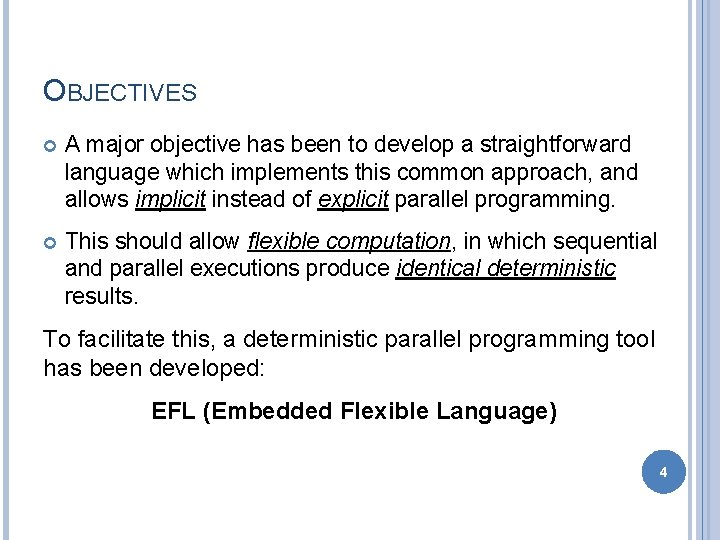
OBJECTIVES A major objective has been to develop a straightforward language which implements this common approach, and allows implicit instead of explicit parallel programming. This should allow flexible computation, in which sequential and parallel executions produce identical deterministic results. To facilitate this, a deterministic parallel programming tool has been developed: EFL (Embedded Flexible Language) 4
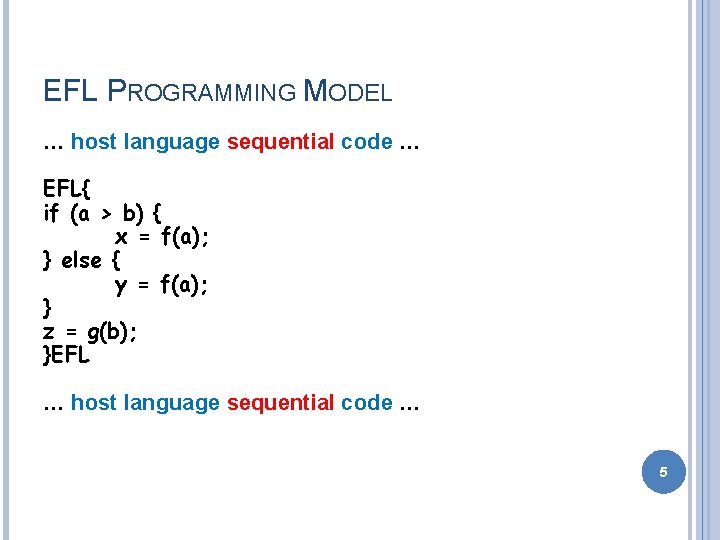
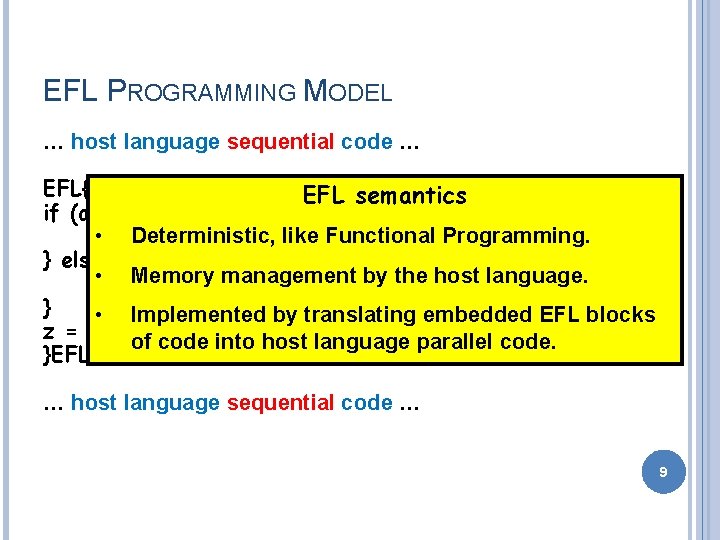
EFL PROGRAMMING MODEL … host language sequential code … EFL{ if (a > b) { x = f(a); } else { y = f(a); } z = g(b); }EFL … host language sequential code … 5
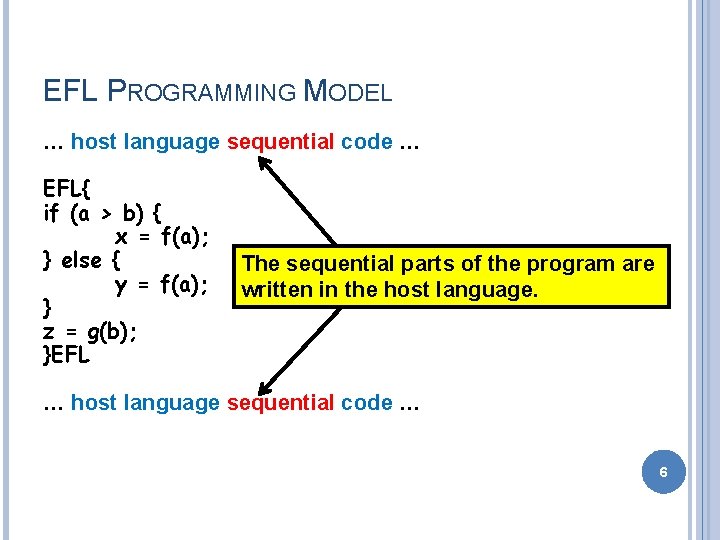
EFL PROGRAMMING MODEL … host language sequential code … EFL{ if (a > b) { x = f(a); } else { y = f(a); } z = g(b); }EFL The sequential parts of the program are written in the host language. … host language sequential code … 6
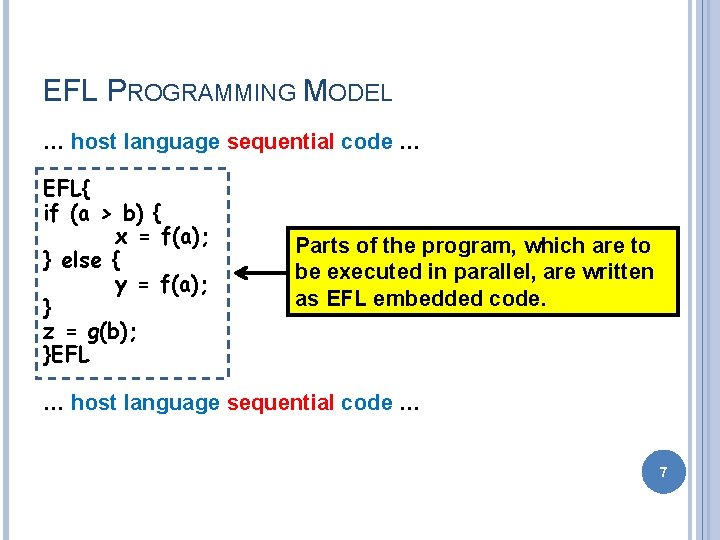
EFL PROGRAMMING MODEL … host language sequential code … EFL{ if (a > b) { x = f(a); } else { y = f(a); } z = g(b); }EFL Parts of the program, which are to be executed in parallel, are written as EFL embedded code. … host language sequential code … 7
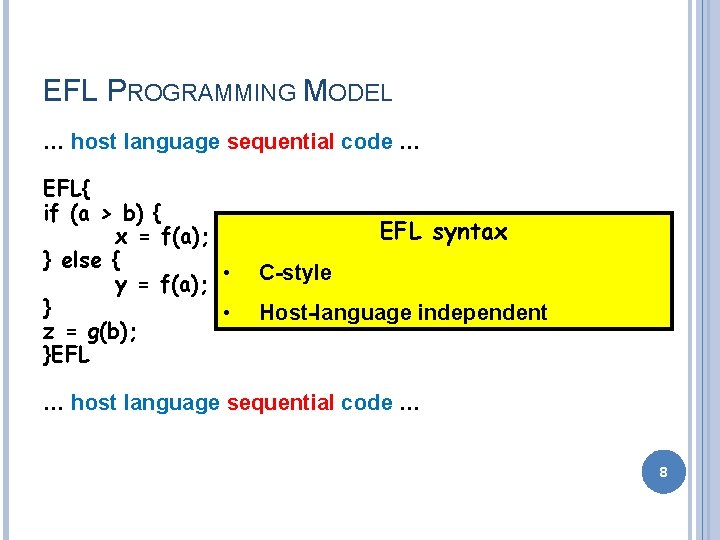
EFL PROGRAMMING MODEL … host language sequential code … EFL{ if (a > b) { x = f(a); } else { y = f(a); • } • z = g(b); }EFL syntax C-style Host-language independent … host language sequential code … 8
EFL PROGRAMMING MODEL … host language sequential code … EFL{ EFL semantics if (a > b) { • x Deterministic, like Functional Programming. = f(a); } else { • y Memory = f(a); management by the host language. } • Implemented by translating embedded EFL blocks z = g(b); of code into host language parallel code. }EFL … host language sequential code … 9
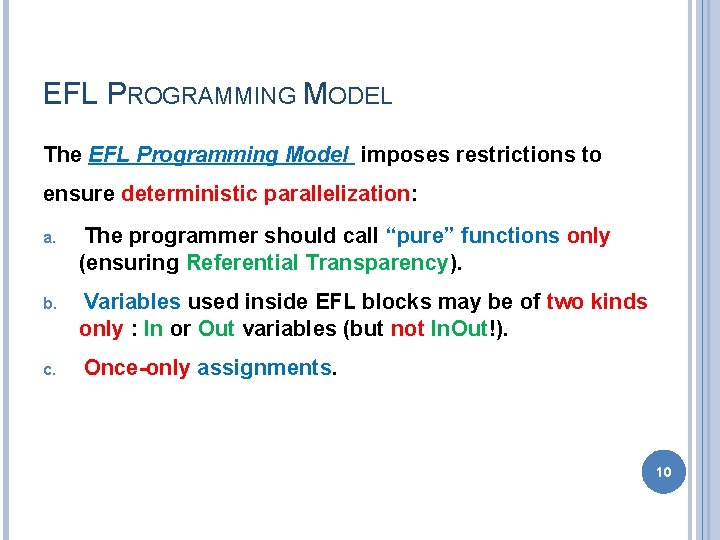
EFL PROGRAMMING MODEL The EFL Programming Model imposes restrictions to ensure deterministic parallelization: a. The programmer should call “pure” functions only (ensuring Referential Transparency). b. Variables used inside EFL blocks may be of two kinds only : In or Out variables (but not In. Out!). c. Once-only assignments. 10
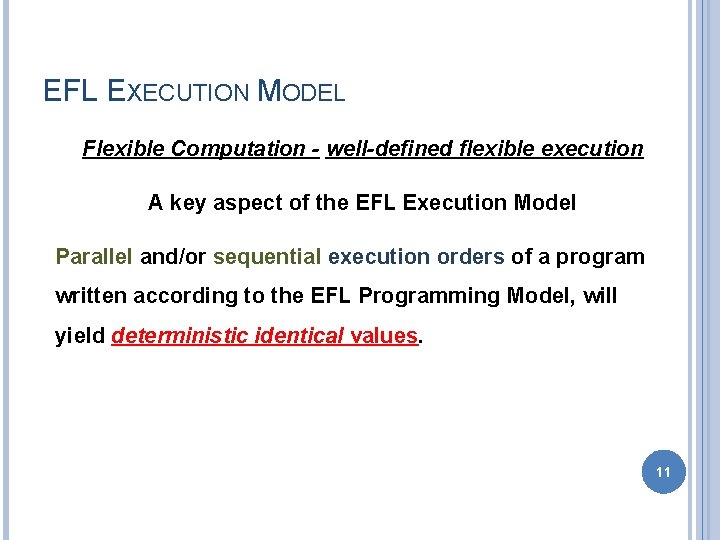
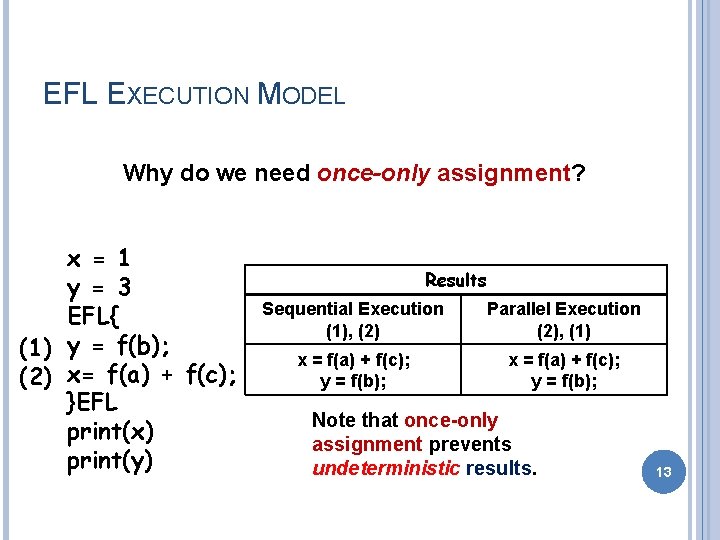
EFL EXECUTION MODEL Flexible Computation - well-defined flexible execution A key aspect of the EFL Execution Model Parallel and/or sequential execution orders of a program written according to the EFL Programming Model, will yield deterministic identical values. 11
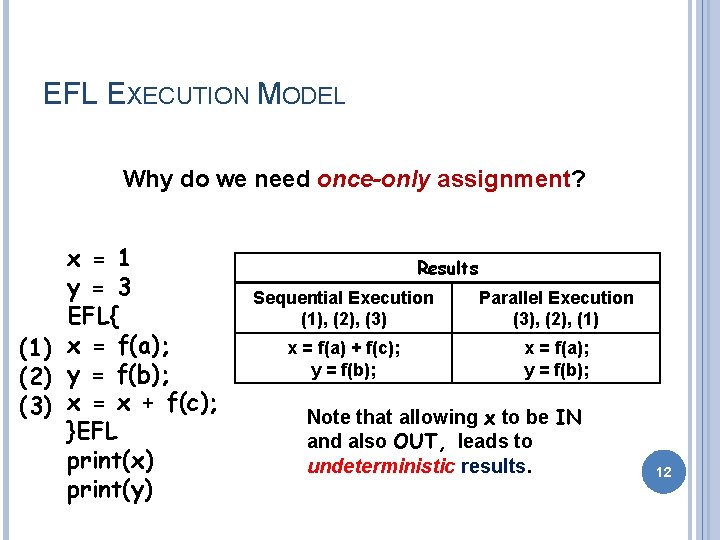
EFL EXECUTION MODEL Why do we need once-only assignment? x = 1 y = 3 EFL{ (1) x = f(a); (2) y = f(b); (3) x = x + f(c); }EFL print(x) print(y) Results Sequential Execution (1), (2), (3) Parallel Execution (3), (2), (1) x = f(a) + f(c); y = f(b); x = f(a); y = f(b); Note that allowing x to be IN and also OUT, leads to undeterministic results. 12
EFL EXECUTION MODEL Why do we need once-only assignment? x = 1 y = 3 EFL{ (1) y = f(b); (2) x= f(a) + f(c); }EFL print(x) print(y) Results Sequential Execution (1), (2) Parallel Execution (2), (1) x = f(a) + f(c); y = f(b); Note that once-only assignment prevents undeterministic results. 13
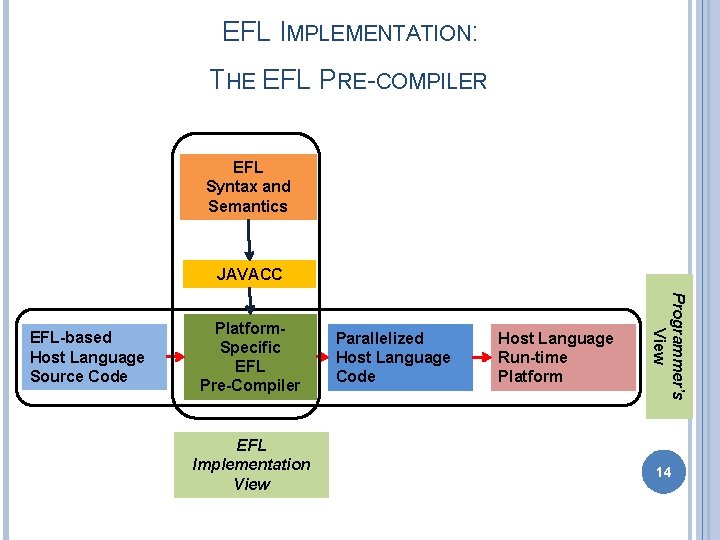
EFL IMPLEMENTATION: THE EFL PRE-COMPILER EFL Syntax and Semantics JAVACC Platform. Specific EFL Pre-Compiler EFL Implementation View Parallelized Host Language Code Host Language Run-time Platform Programmer’s View EFL-based Host Language Source Code 14
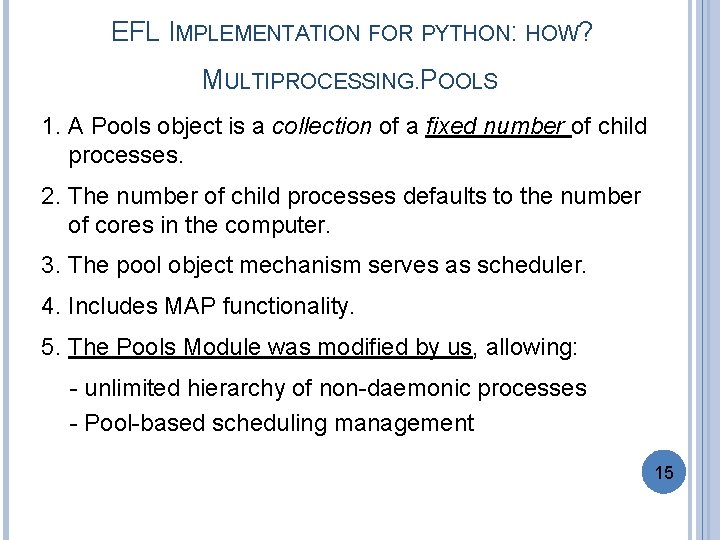
EFL IMPLEMENTATION FOR PYTHON: HOW? MULTIPROCESSING. POOLS 1. A Pools object is a collection of a fixed number of child processes. 2. The number of child processes defaults to the number of cores in the computer. 3. The pool object mechanism serves as scheduler. 4. Includes MAP functionality. 5. The Pools Module was modified by us, allowing: - unlimited hierarchy of non-daemonic processes - Pool-based scheduling management 15
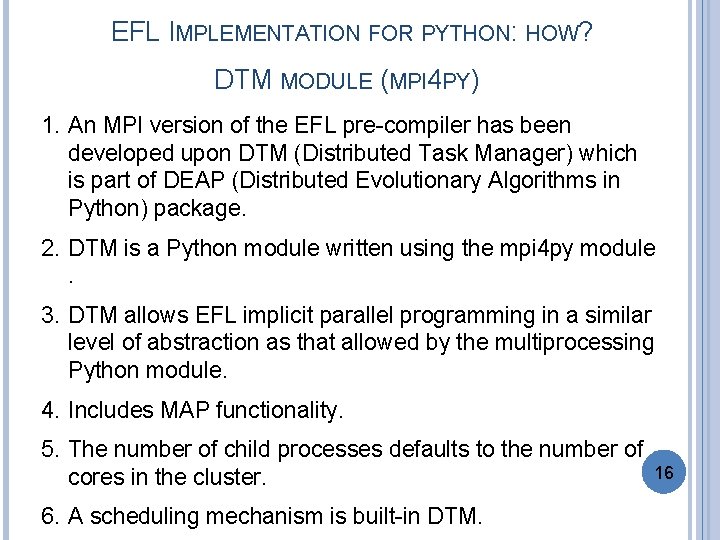
EFL IMPLEMENTATION FOR PYTHON: HOW? DTM MODULE (MPI 4 PY) 1. An MPI version of the EFL pre-compiler has been developed upon DTM (Distributed Task Manager) which is part of DEAP (Distributed Evolutionary Algorithms in Python) package. 2. DTM is a Python module written using the mpi 4 py module. 3. DTM allows EFL implicit parallel programming in a similar level of abstraction as that allowed by the multiprocessing Python module. 4. Includes MAP functionality. 5. The number of child processes defaults to the number of cores in the cluster. 6. A scheduling mechanism is built-in DTM. 16
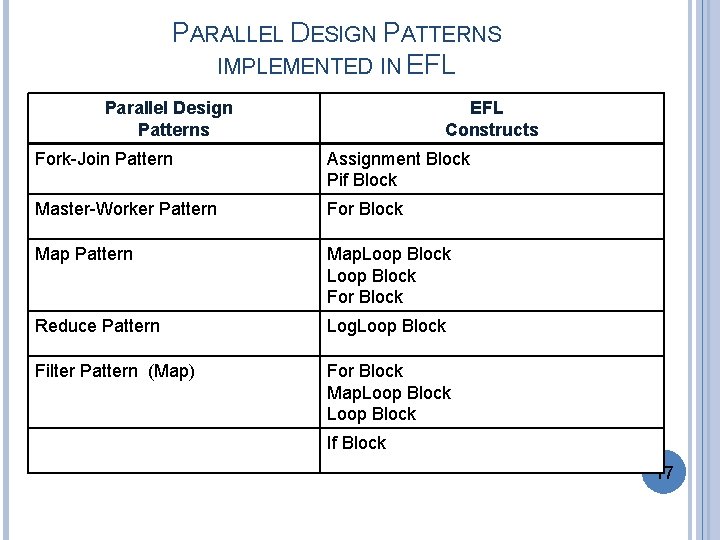
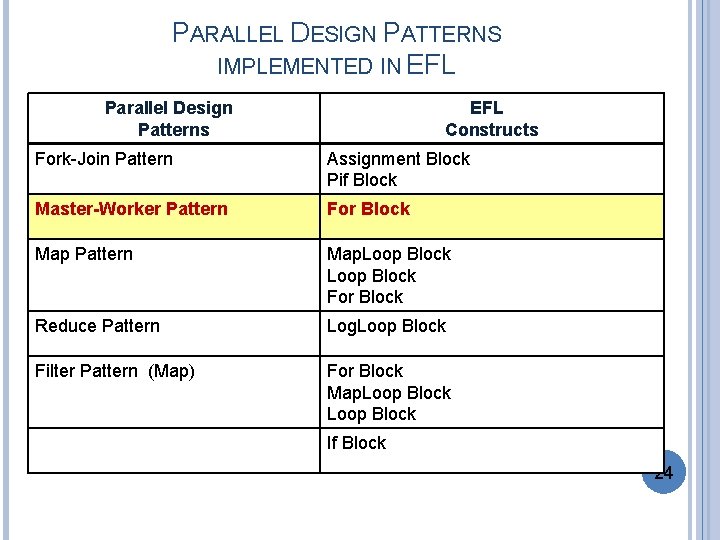
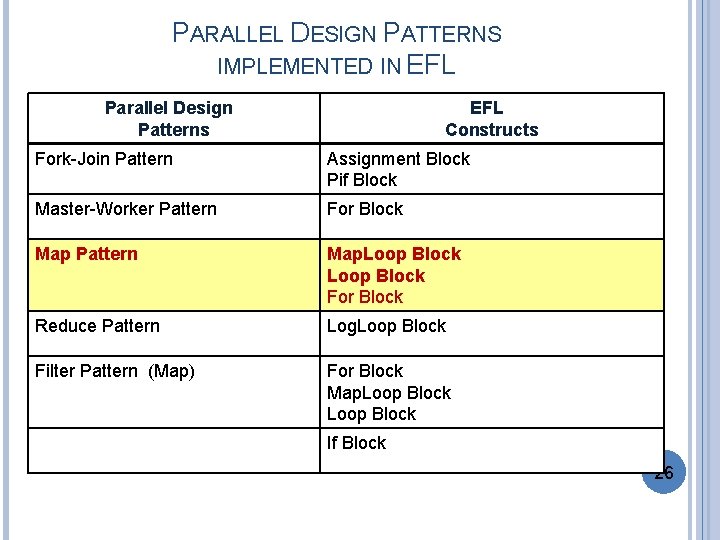
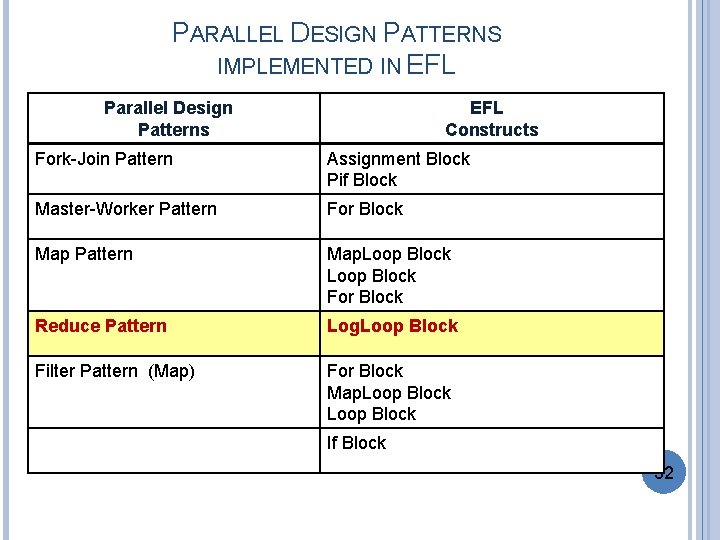
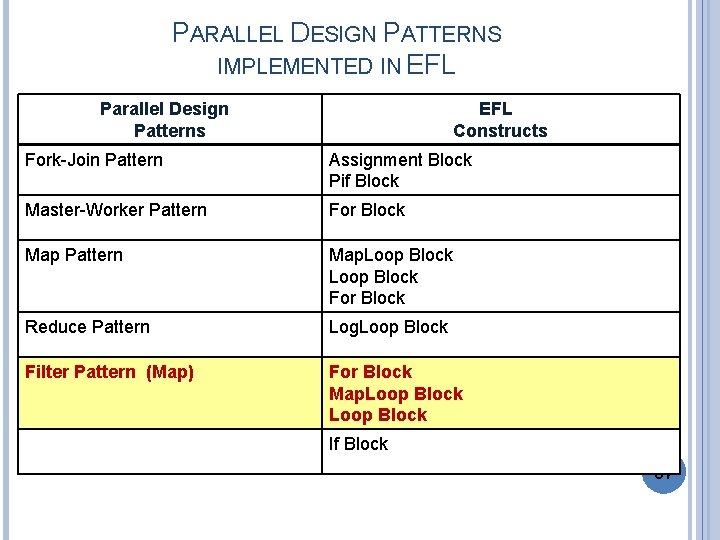
PARALLEL DESIGN PATTERNS IMPLEMENTED IN EFL Parallel Design Patterns EFL Constructs Fork-Join Pattern Assignment Block Pif Block Master-Worker Pattern For Block Map Pattern Map. Loop Block For Block Reduce Pattern Log. Loop Block Filter Pattern (Map) For Block Map. Loop Block If Block 17
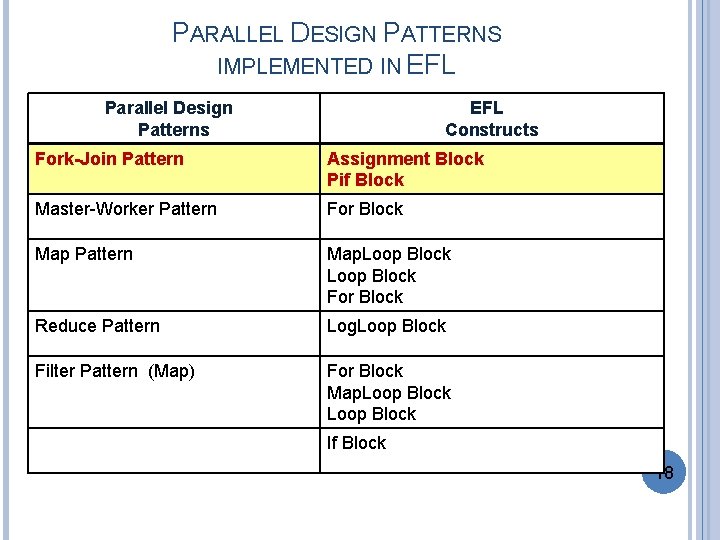
PARALLEL DESIGN PATTERNS IMPLEMENTED IN EFL Parallel Design Patterns EFL Constructs Fork-Join Pattern Assignment Block Pif Block Master-Worker Pattern For Block Map Pattern Map. Loop Block For Block Reduce Pattern Log. Loop Block Filter Pattern (Map) For Block Map. Loop Block If Block 18
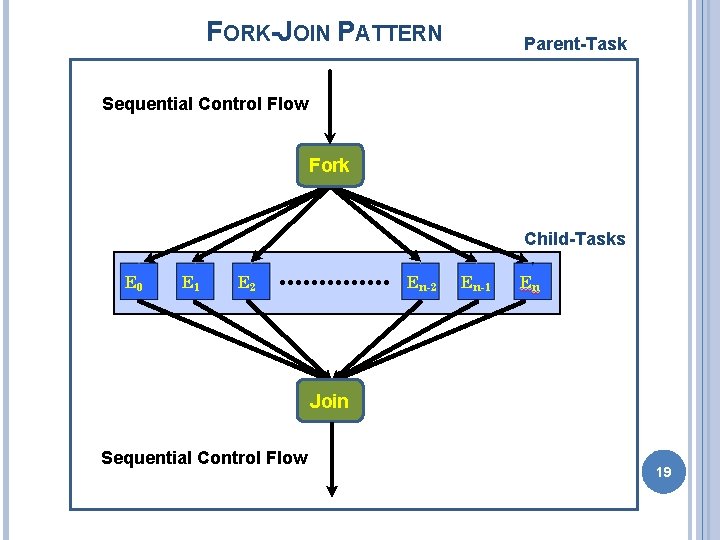
FORK-JOIN PATTERN Parent-Task Sequential Control Flow Fork Child-Tasks Join Sequential Control Flow 19
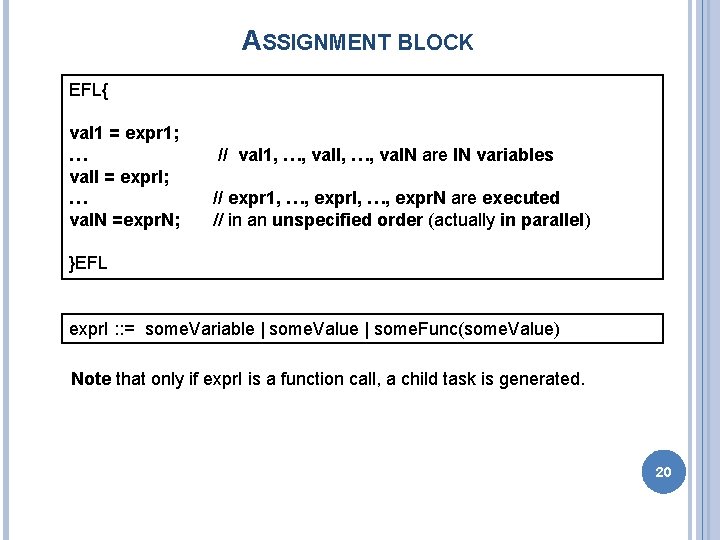
ASSIGNMENT BLOCK EFL{ val 1 = expr 1; … val. I = expr. I; … val. N =expr. N; // val 1, …, val. I, …, val. N are IN variables // expr 1, …, expr. I, …, expr. N are executed // in an unspecified order (actually in parallel) }EFL expr. I : : = some. Variable | some. Value | some. Func(some. Value) Note that only if expr. I is a function call, a child task is generated. 20
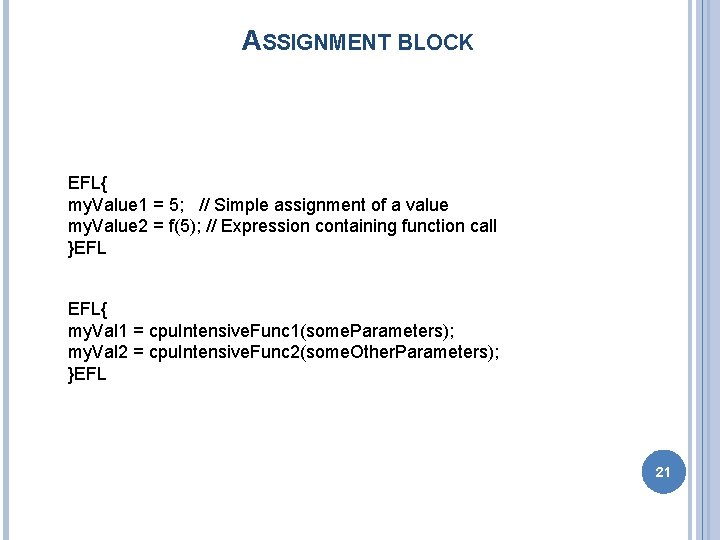
ASSIGNMENT BLOCK EFL{ my. Value 1 = 5; // Simple assignment of a value my. Value 2 = f(5); // Expression containing function call }EFL EFL{ my. Val 1 = cpu. Intensive. Func 1(some. Parameters); my. Val 2 = cpu. Intensive. Func 2(some. Other. Parameters); }EFL 21
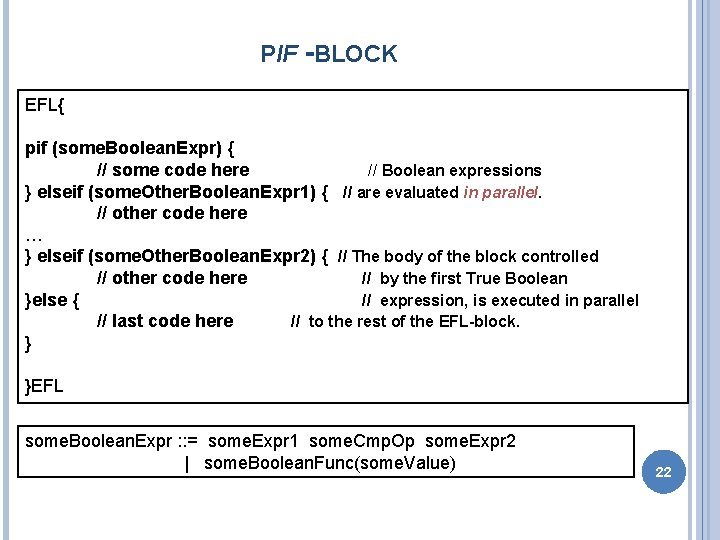
PIF -BLOCK EFL{ pif (some. Boolean. Expr) { // some code here // Boolean expressions } elseif (some. Other. Boolean. Expr 1) { // are evaluated in parallel. // other code here … } elseif (some. Other. Boolean. Expr 2) { // The body of the block controlled // other code here // by the first True Boolean }else { // expression, is executed in parallel // last code here // to the rest of the EFL-block. } }EFL some. Boolean. Expr : : = some. Expr 1 some. Cmp. Op some. Expr 2 | some. Boolean. Func(some. Value) 22
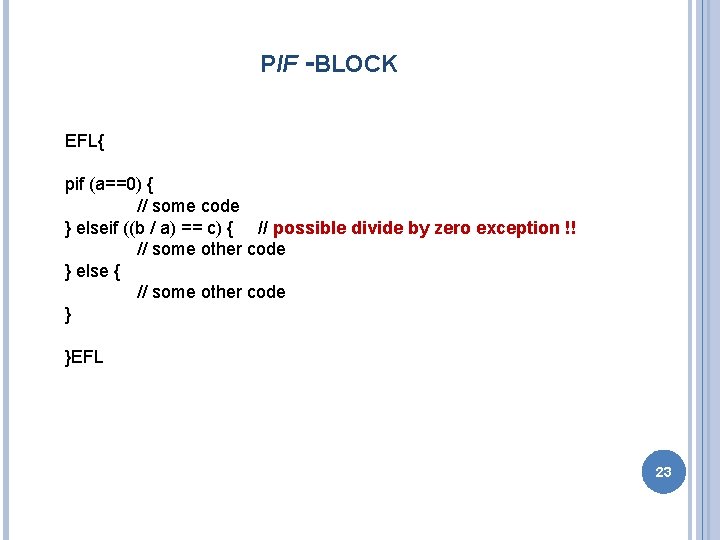
PIF -BLOCK EFL{ pif (a==0) { // some code } elseif ((b / a) == c) { // possible divide by zero exception !! // some other code } else { // some other code } }EFL 23
PARALLEL DESIGN PATTERNS IMPLEMENTED IN EFL Parallel Design Patterns EFL Constructs Fork-Join Pattern Assignment Block Pif Block Master-Worker Pattern For Block Map Pattern Map. Loop Block For Block Reduce Pattern Log. Loop Block Filter Pattern (Map) For Block Map. Loop Block If Block 24
FOR BLOCK EFL{ for ( i = 0; i < N ; i = i + 1) { // N is the length of Seq[i] = cpu. Intensive. Calculation(i); } }EFL Suppose there are M processors (or cores) in the system. When N > M, the scheduling built into the Pools module of Multiprocessing, and in the Task Manager of DTM, allow to implicitly implement the Master-Worker pattern. When N == M, the Fork-Join pattern is actually implemented. 25
PARALLEL DESIGN PATTERNS IMPLEMENTED IN EFL Parallel Design Patterns EFL Constructs Fork-Join Pattern Assignment Block Pif Block Master-Worker Pattern For Block Map Pattern Map. Loop Block For Block Reduce Pattern Log. Loop Block Filter Pattern (Map) For Block Map. Loop Block If Block 26
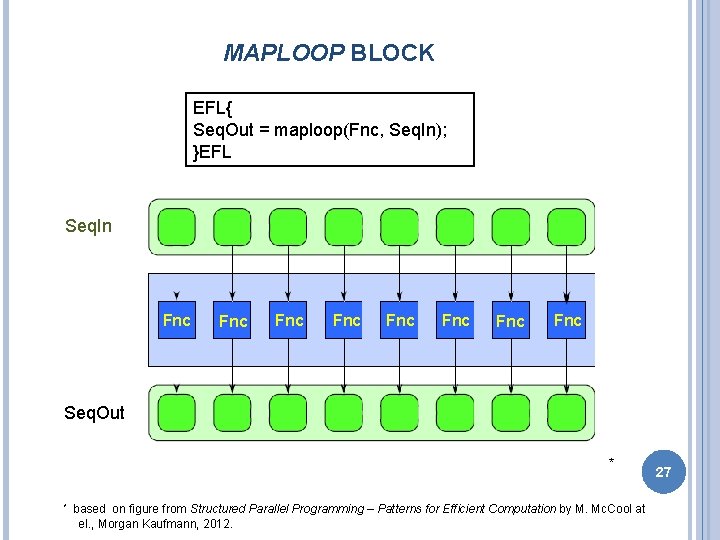
MAPLOOP BLOCK EFL{ Seq. Out = maploop(Fnc, Seq. In); }EFL Seq. In Fnc Fnc Seq. Out * * based on figure from Structured Parallel Programming – Patterns for Efficient Computation by M. Mc. Cool at el. , Morgan Kaufmann, 2012. 27
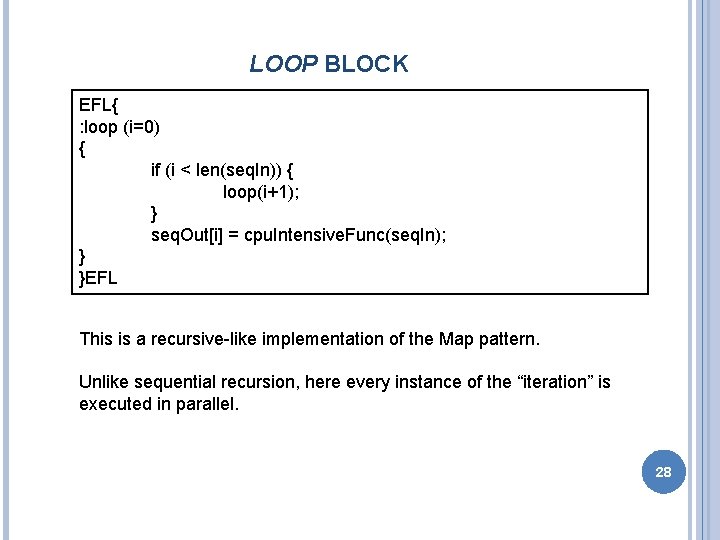
LOOP BLOCK EFL{ : loop (i=0) { if (i < len(seq. In)) { loop(i+1); } seq. Out[i] = cpu. Intensive. Func(seq. In); } }EFL This is a recursive-like implementation of the Map pattern. Unlike sequential recursion, here every instance of the “iteration” is executed in parallel. 28
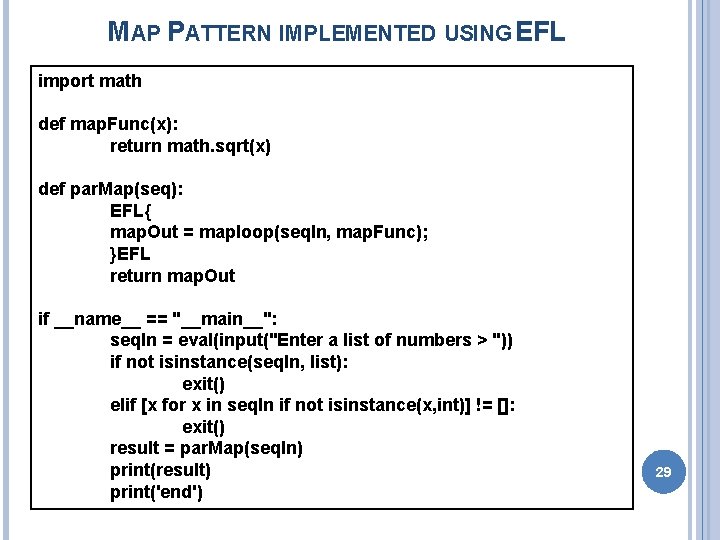
MAP PATTERN IMPLEMENTED USING EFL import math def map. Func(x): return math. sqrt(x) def par. Map(seq): EFL{ map. Out = maploop(seq. In, map. Func); }EFL return map. Out if __name__ == "__main__": seq. In = eval(input("Enter a list of numbers > ")) if not isinstance(seq. In, list): exit() elif [x for x in seq. In if not isinstance(x, int)] != []: exit() result = par. Map(seq. In) print(result) print('end') 29
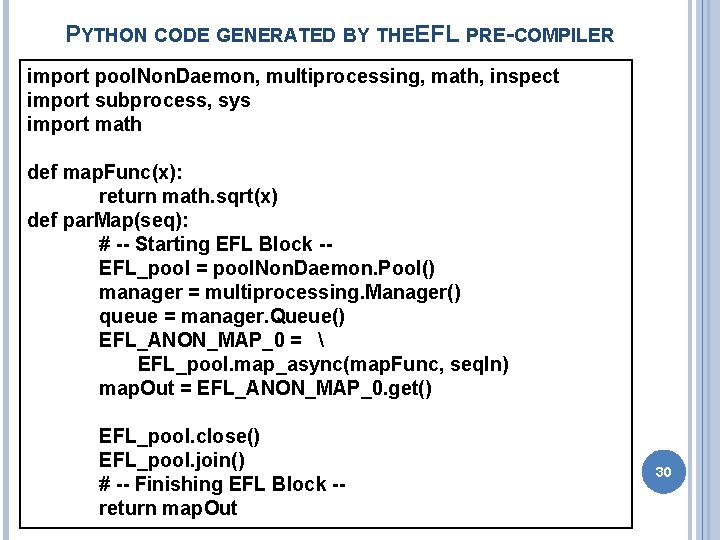
PYTHON CODE GENERATED BY THEEFL PRE-COMPILER import pool. Non. Daemon, multiprocessing, math, inspect import subprocess, sys import math def map. Func(x): return math. sqrt(x) def par. Map(seq): # -- Starting EFL Block -EFL_pool = pool. Non. Daemon. Pool() manager = multiprocessing. Manager() queue = manager. Queue() EFL_ANON_MAP_0 = EFL_pool. map_async(map. Func, seq. In) map. Out = EFL_ANON_MAP_0. get() EFL_pool. close() EFL_pool. join() # -- Finishing EFL Block -return map. Out 30
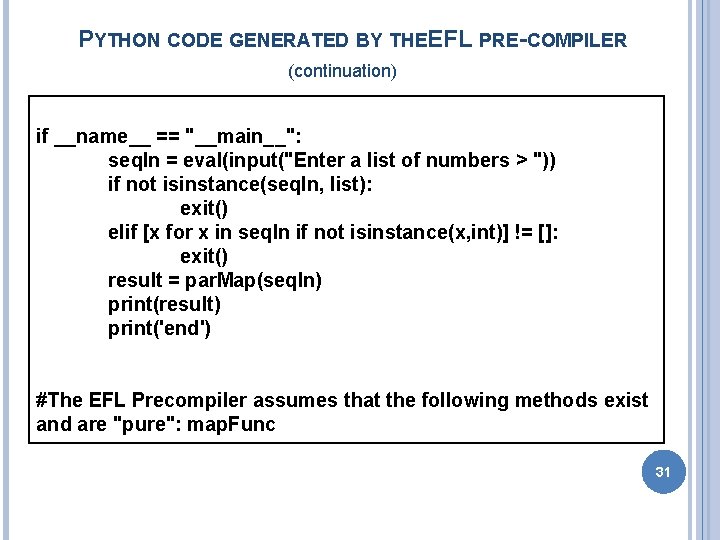
PYTHON CODE GENERATED BY THEEFL PRE-COMPILER (continuation) if __name__ == "__main__": seq. In = eval(input("Enter a list of numbers > ")) if not isinstance(seq. In, list): exit() elif [x for x in seq. In if not isinstance(x, int)] != []: exit() result = par. Map(seq. In) print(result) print('end') #The EFL Precompiler assumes that the following methods exist and are "pure": map. Func 31
PARALLEL DESIGN PATTERNS IMPLEMENTED IN EFL Parallel Design Patterns EFL Constructs Fork-Join Pattern Assignment Block Pif Block Master-Worker Pattern For Block Map Pattern Map. Loop Block For Block Reduce Pattern Log. Loop Block Filter Pattern (Map) For Block Map. Loop Block If Block 32
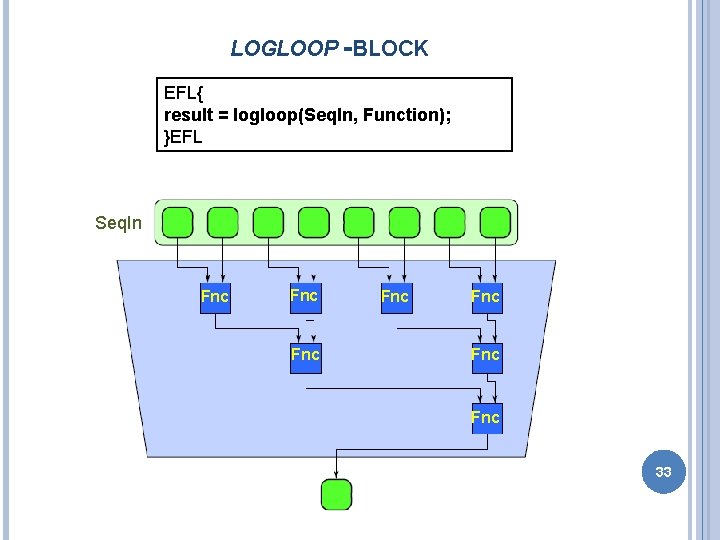
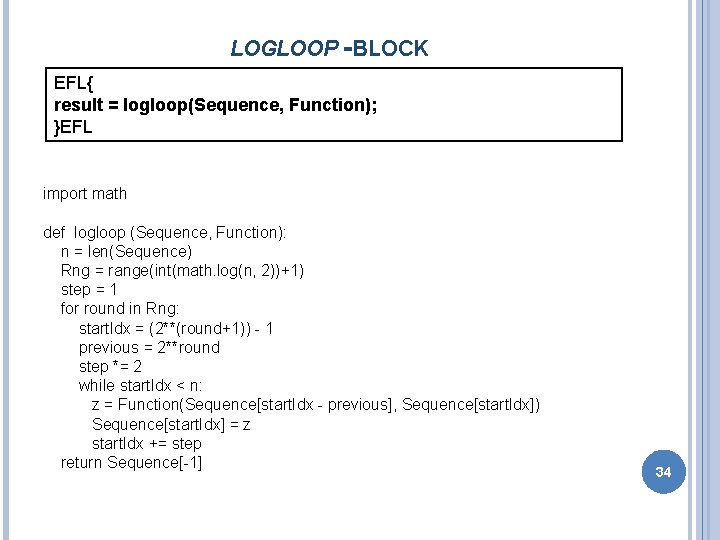
LOGLOOP -BLOCK EFL{ result = logloop(Seq. In, Function); }EFL Seq. In Fnc Fnc result 33
LOGLOOP -BLOCK EFL{ result = logloop(Sequence, Function); }EFL import math def logloop (Sequence, Function): n = len(Sequence) Rng = range(int(math. log(n, 2))+1) step = 1 for round in Rng: start. Idx = (2**(round+1)) - 1 previous = 2**round step *= 2 while start. Idx < n: z = Function(Sequence[start. Idx - previous], Sequence[start. Idx]) Sequence[start. Idx] = z start. Idx += step return Sequence[-1] 34
LOGLOOP -BLOCK L = [1, 2, 3, 4, 5, 6, 7, 8] func = int. __add__ EFL{ result = logloop(L, func); }EFL print (result) 35
LOGLOOP -BLOCK L = [[1, 2], [3, 4], [5, 6], [7, 8]] func = list. __add__ EFL{ result = logloop(L, func); }EFL print (result) L = ['abc', 'erdt', 'wsde', 'xswdf'] func = str. __add__ EFL{ result = logloop(L, func); }EFL print (result) [1, 2, 3, 4, 5, 6, 7, 8] 'abcerdtwsdexswdf' L = [1, 2, 3, 4, 5, 6, 7, 8] func = int. __mul__ EFL{ result = logloop(L, func); }EFL print (result) 40320 36
PARALLEL DESIGN PATTERNS IMPLEMENTED IN EFL Parallel Design Patterns EFL Constructs Fork-Join Pattern Assignment Block Pif Block Master-Worker Pattern For Block Map Pattern Map. Loop Block For Block Reduce Pattern Log. Loop Block Filter Pattern (Map) For Block Map. Loop Block If Block 37
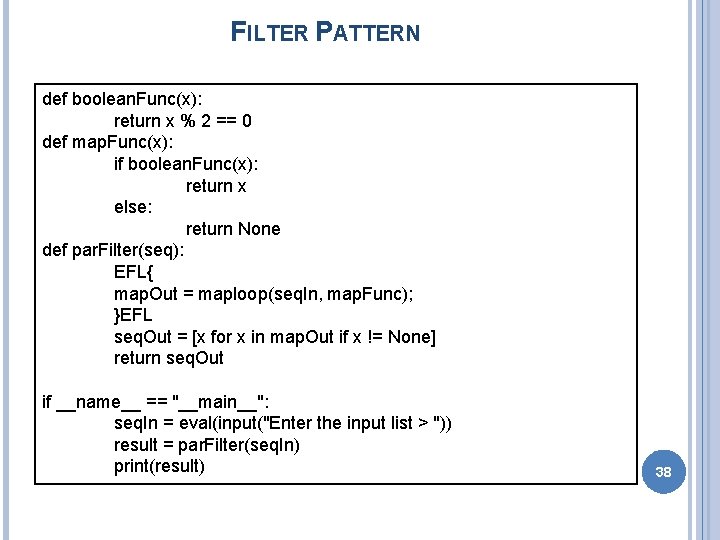
FILTER PATTERN def boolean. Func(x): return x % 2 == 0 def map. Func(x): if boolean. Func(x): return x else: return None def par. Filter(seq): EFL{ map. Out = maploop(seq. In, map. Func); }EFL seq. Out = [x for x in map. Out if x != None] return seq. Out if __name__ == "__main__": seq. In = eval(input("Enter the input list > ")) result = par. Filter(seq. In) print(result) 38
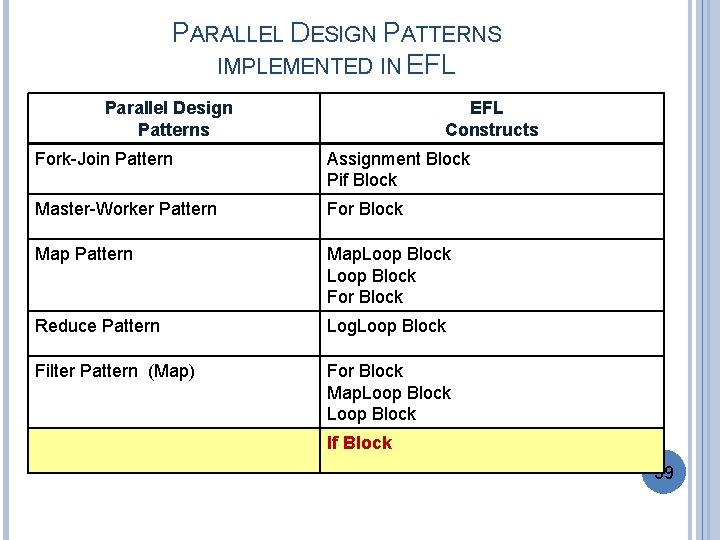
PARALLEL DESIGN PATTERNS IMPLEMENTED IN EFL Parallel Design Patterns EFL Constructs Fork-Join Pattern Assignment Block Pif Block Master-Worker Pattern For Block Map Pattern Map. Loop Block For Block Reduce Pattern Log. Loop Block Filter Pattern (Map) For Block Map. Loop Block If Block 39
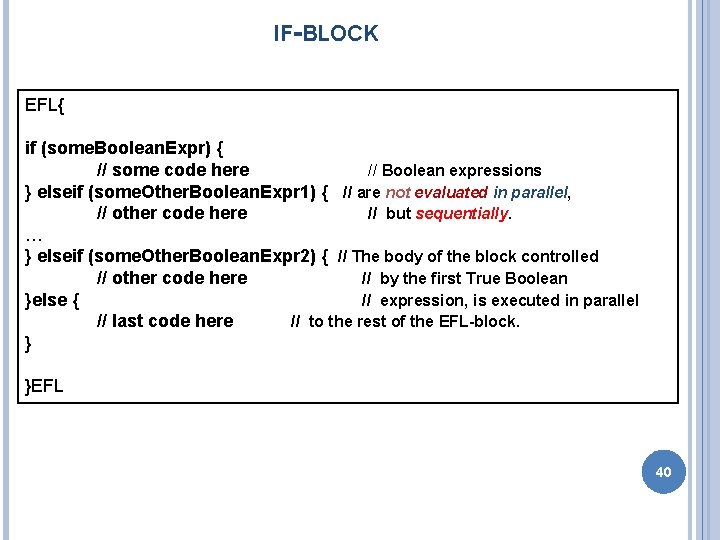
IF-BLOCK EFL{ if (some. Boolean. Expr) { // some code here // Boolean expressions } elseif (some. Other. Boolean. Expr 1) { // are not evaluated in parallel, // other code here // but sequentially. … } elseif (some. Other. Boolean. Expr 2) { // The body of the block controlled // other code here // by the first True Boolean }else { // expression, is executed in parallel // last code here // to the rest of the EFL-block. } }EFL 40
EFL PROGRAMMING EXAMPLES 41
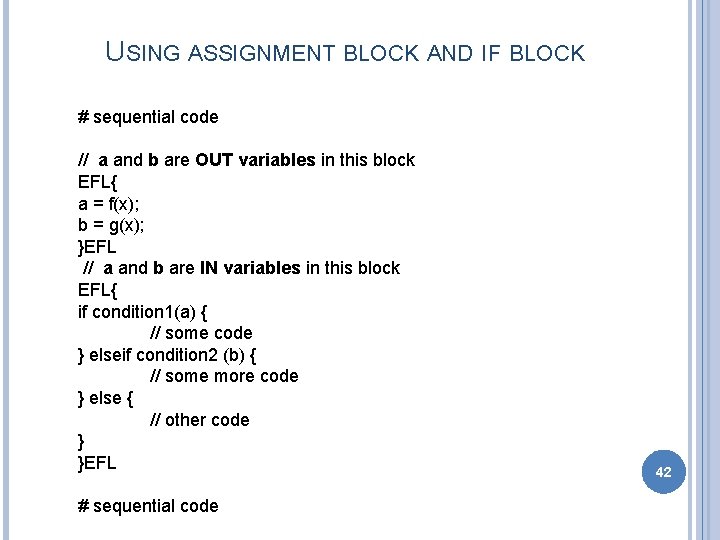
USING ASSIGNMENT BLOCK AND IF BLOCK # sequential code // a and b are OUT variables in this block EFL{ a = f(x); b = g(x); }EFL // a and b are IN variables in this block EFL{ if condition 1(a) { // some code } elseif condition 2 (b) { // some more code } else { // other code } }EFL # sequential code 42
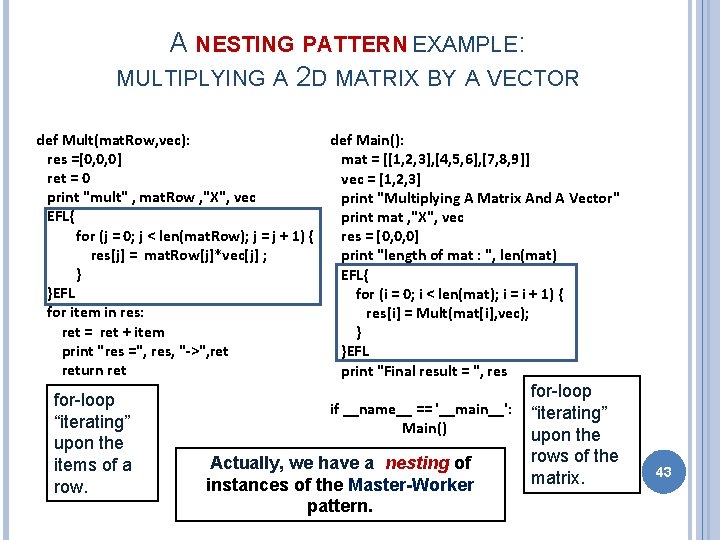
A NESTING PATTERN EXAMPLE: MULTIPLYING A 2 D MATRIX BY A VECTOR def Mult(mat. Row, vec): res =[0, 0, 0] ret = 0 print "mult" , mat. Row , "X", vec EFL{ for (j = 0; j < len(mat. Row); j = j + 1) { res[j] = mat. Row[j]*vec[j] ; } }EFL for item in res: ret = ret + item print "res =", res, "->", return ret for-loop “iterating” upon the items of a row. def Main(): mat = [[1, 2, 3], [4, 5, 6], [7, 8, 9]] vec = [1, 2, 3] print "Multiplying A Matrix And A Vector" print mat , "X", vec res = [0, 0, 0] print "length of mat : ", len(mat) EFL{ for (i = 0; i < len(mat); i = i + 1) { res[i] = Mult(mat[i], vec); } }EFL print "Final result = ", res if __name__ == '__main__': Main() Actually, we have a nesting of instances of the Master-Worker pattern. for-loop “iterating” upon the rows of the matrix. 43
CONCLUSIONS ü Two EFL pre-compilers were implemented. ü Safe and efficient parallelism has been made possible by the EFL framework. ü Parallel Design Patterns have been shown to be implementable using EFL 44
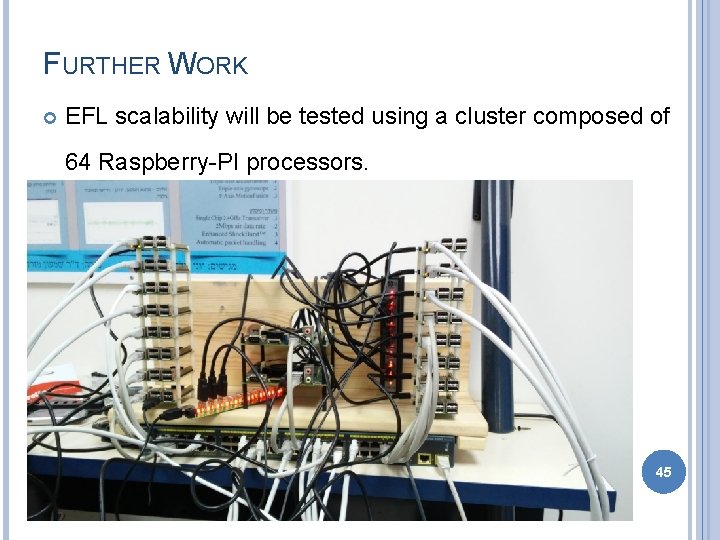
FURTHER WORK EFL scalability will be tested using a cluster composed of 64 Raspberry-PI processors. 45
FURTHER WORK EFL curriculum, to teach how to implement serial and parallel algorithms with EFL. Concurrent Data Structures implementation using EFL. Are Purely Functional Data Structures EFL-compatible? DEEPSAM (a parallel protein structure prediction program) is in the way to be rewritten using EFL and STM (a joint project with Prof. Miroslav Popovic). 46
INVITATION We invite you to join us to: 1. Re-design EFL with Python-like syntax. 2. Implement new versions of the EFL pre-compiler for other parallel programming platforms and other host programming languages. 3. Implement all the Parallel Design Patterns using EFL (are there patterns that cannot be implemented within the EFL framework? ). 47
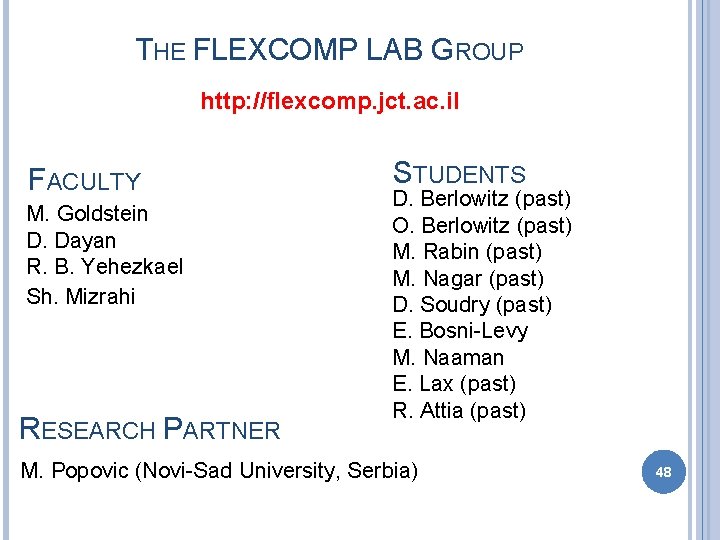
THE FLEXCOMP LAB GROUP http: //flexcomp. jct. ac. il FACULTY M. Goldstein D. Dayan R. B. Yehezkael Sh. Mizrahi RESEARCH PARTNER STUDENTS D. Berlowitz (past) O. Berlowitz (past) M. Rabin (past) M. Nagar (past) D. Soudry (past) E. Bosni-Levy M. Naaman E. Lax (past) R. Attia (past) M. Popovic (Novi-Sad University, Serbia) 48
Lev Academic Center Jerusalem College of Technology 49