
IMPLEMENTING KANBAN SYSTEMS Jeff Strabala IMPLEMENTING KANBAN SYSTEMS
IMPLEMENTING KANBAN SYSTEMS Jeff Strabala

IMPLEMENTING KANBAN SYSTEMS Refresh Understanding: PURPOSE of Kanban a) Kanban is the TOOL for Just In Time Production (Pull System) b) Additionally, it is used to expose & visualize Problems c) And Kanban can be used to kaizen the process The 4 FUNCTIONS of KANBAN: 1) Instructions for Production and Conveyance a) Kanban MUST attach to product 2) Tool for VISUAL Control of Production a) Prevents Over Production b) Monitor Progress & Process Delays 3) Tool for Process Kaizen e. g. : reduce # Kanban's => “Problem” => Problem Solving to fix (=Improvement) 4) Method for Automatically making Minor Adjustments to Production a) NO Kanban = NO production and/or NO conveyance b) Must have the Discipline to follow Kanban System c) Do NOT pass defective product to next process (Kanban only for “OK” product)
IMPLEMENTING KANBAN SYSTEMS CONDITIONS REQUIRED TO IMPLEMENT: 1. Stable Operations 2. Smooth Product Flows 3. Heijunka is “formal” requirement 4. Stable Lead Times throughout manufacturing areas 5. Full Area Discipline to use Kanban correctly
IMPLEMENTING KANBAN SYSTEMS CONDITION # 1: STABLE OPERATIONS Defining “Stable Operation” = Manufacturing metrics used to measure performance are consistent, activities adhere to production plans, in-process quality, output quantity and shipping metrics are also reliable. Typical Manufacturing Results & Process metrics: a) OEE b) Volume c) Efficiency (Labor, Energy, etc. ) d) Lead Time (production, total) e) Schedule attainment

IMPLEMENTING KANBAN SYSTEMS CONDITION # 1: STABLE OPERATIONS Typical Manufacturing Quality metrics: a) First Time Pass Ratio b) Process Yield Percentage c) Customer Complaints/Returns d) Supplier Quality Typical Manufacturing Delivery metrics: a) On-Time and In Full (OTIF) b) Shipping Costs c) On-time New Product Launch
IMPLEMENTING KANBAN SYSTEMS CONDITION # 1: STABLE OPERATIONS Typical Manufacturing Quality metrics: a) First Time Pass Ratio b) Process Yield Percentage c) Customer Complaints/Returns d) Supplier Quality Typical Manufacturing Delivery metrics: a) On-Time and In Full (OTIF) b) Shipping Costs c) On-time New Product Launch
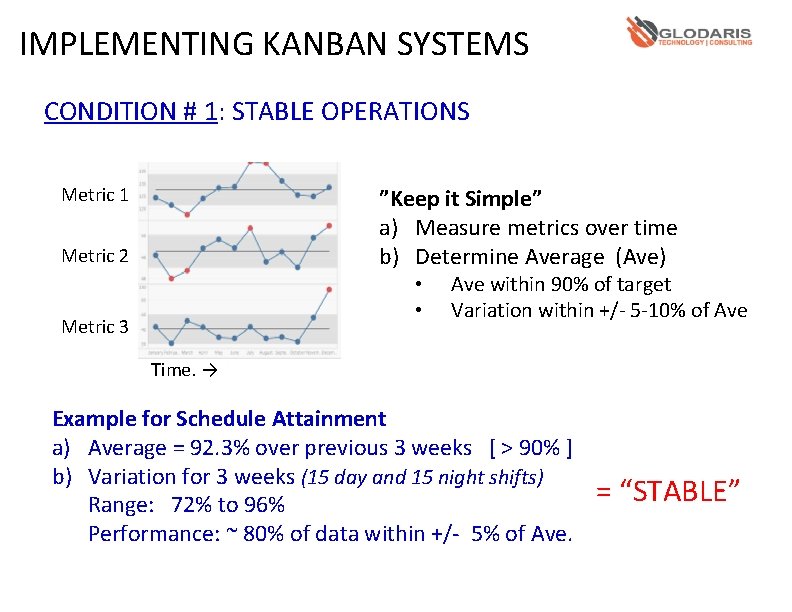
IMPLEMENTING KANBAN SYSTEMS CONDITION # 1: STABLE OPERATIONS Metric 1 ”Keep it Simple” a) Measure metrics over time b) Determine Average (Ave) Metric 2 • • Metric 3 Ave within 90% of target Variation within +/- 5 -10% of Ave Time. → Example for Schedule Attainment a) Average = 92. 3% over previous 3 weeks [ > 90% ] b) Variation for 3 weeks (15 day and 15 night shifts) Range: 72% to 96% Performance: ~ 80% of data within +/- 5% of Ave. = “STABLE”
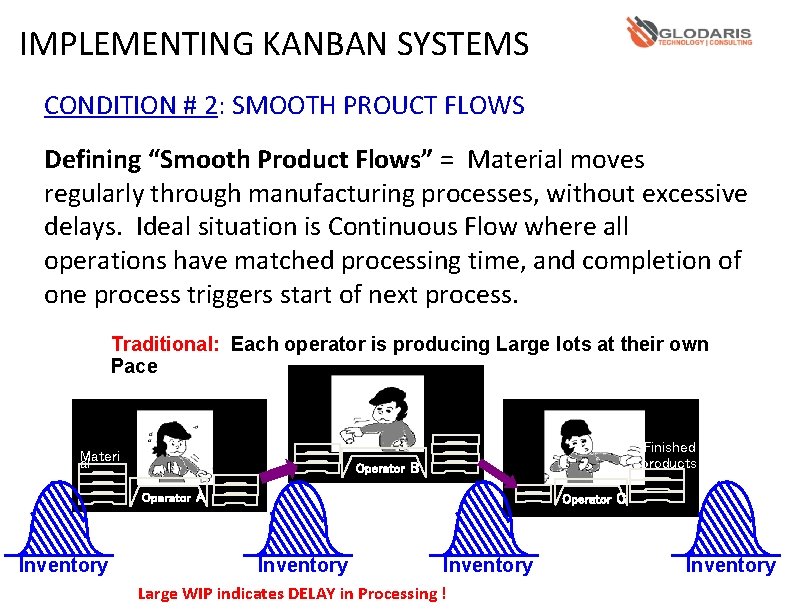
IMPLEMENTING KANBAN SYSTEMS CONDITION # 2: SMOOTH PROUCT FLOWS Defining “Smooth Product Flows” = Material moves regularly through manufacturing processes, without excessive delays. Ideal situation is Continuous Flow where all operations have matched processing time, and completion of one process triggers start of next process. Traditional: Each operator is producing Large lots at their own Pace Materi al Finished products Operator B Operator A Inventory Operator C Inventory Large WIP indicates DELAY in Processing ! Inventory
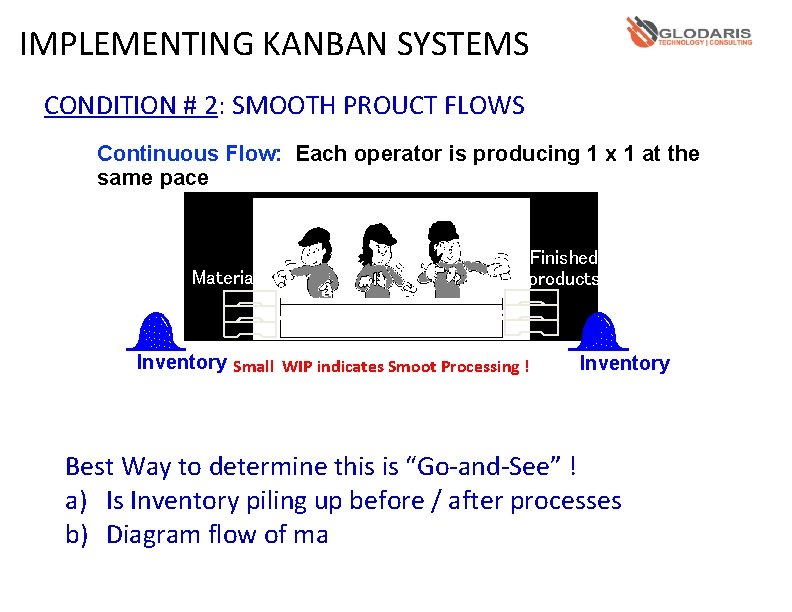
IMPLEMENTING KANBAN SYSTEMS CONDITION # 2: SMOOTH PROUCT FLOWS Continuous Flow: Each operator is producing 1 x 1 at the same pace Finished products Material Operator A Operator B Operator C Inventory Small WIP indicates Smoot Processing ! Inventory Best Way to determine this is “Go-and-See” ! a) Is Inventory piling up before / after processes b) Diagram flow of ma
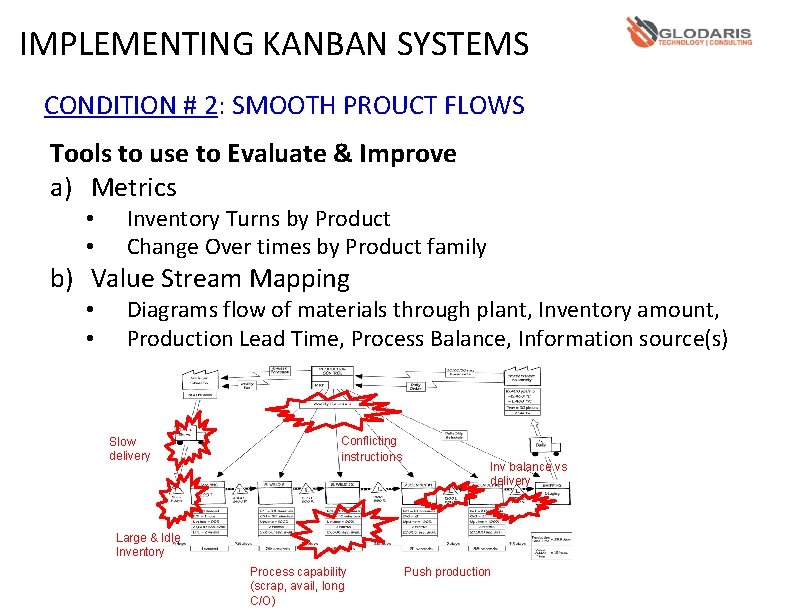
IMPLEMENTING KANBAN SYSTEMS CONDITION # 2: SMOOTH PROUCT FLOWS Tools to use to Evaluate & Improve a) Metrics • • Inventory Turns by Product Change Over times by Product family b) Value Stream Mapping • • Diagrams flow of materials through plant, Inventory amount, Production Lead Time, Process Balance, Information source(s) Slow delivery Conflicting instructions Inv balance vs delivery Large & Idle Inventory Process capability (scrap, avail, long C/O) Push production
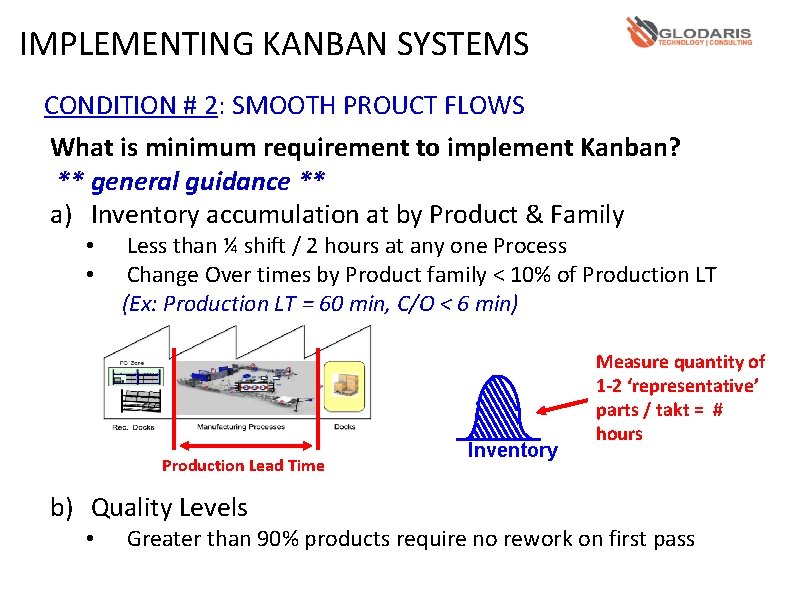
IMPLEMENTING KANBAN SYSTEMS CONDITION # 2: SMOOTH PROUCT FLOWS What is minimum requirement to implement Kanban? ** general guidance ** a) Inventory accumulation at by Product & Family • • Less than ¼ shift / 2 hours at any one Process Change Over times by Product family < 10% of Production LT (Ex: Production LT = 60 min, C/O < 6 min) Production Lead Time b) Quality Levels • Inventory Measure quantity of 1 -2 ‘representative’ parts / takt = # hours Greater than 90% products require no rework on first pass
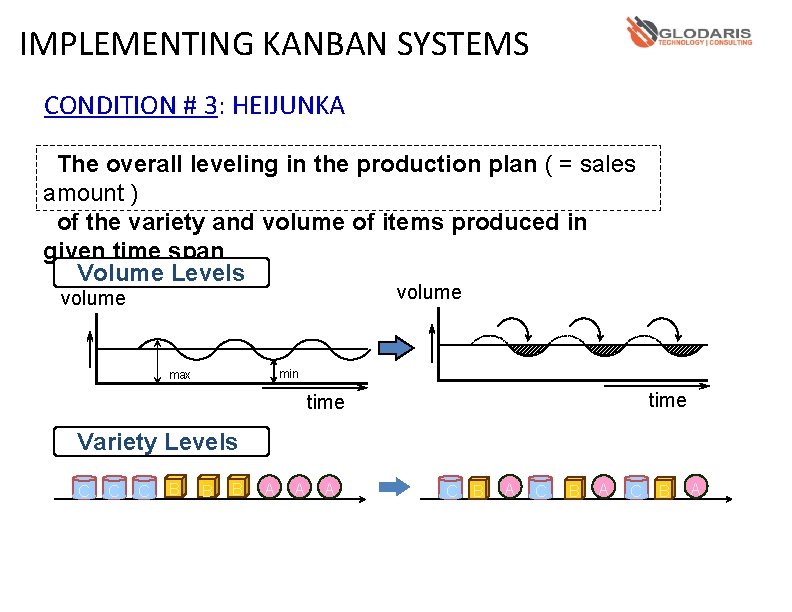
IMPLEMENTING KANBAN SYSTEMS CONDITION # 3: HEIJUNKA The overall leveling in the production plan ( = sales amount ) of the variety and volume of items produced in given time span Volume Levels volume min max time Variety Levels C C C B B B A A A C B A
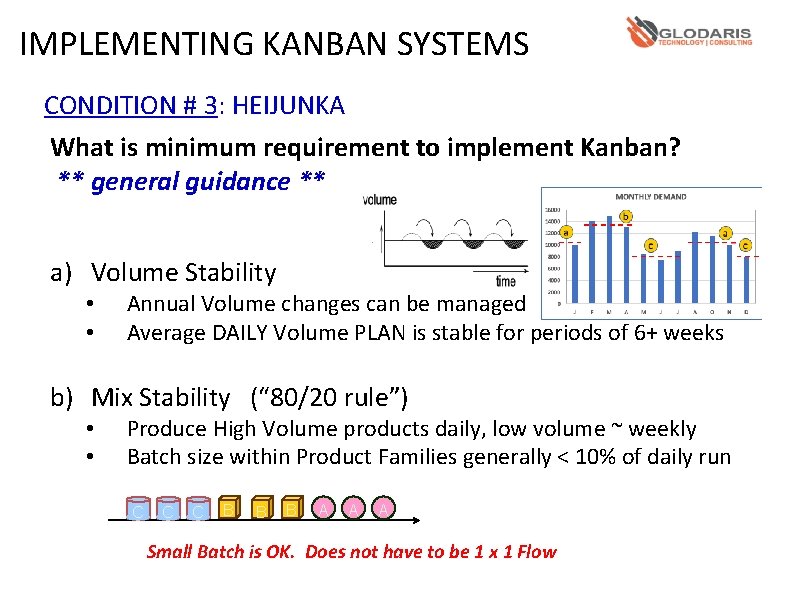
IMPLEMENTING KANBAN SYSTEMS CONDITION # 3: HEIJUNKA What is minimum requirement to implement Kanban? ** general guidance ** a) Volume Stability • • Annual Volume changes can be managed Average DAILY Volume PLAN is stable for periods of 6+ weeks b) Mix Stability (“ 80/20 rule”) • • Produce High Volume products daily, low volume ~ weekly Batch size within Product Families generally < 10% of daily run C C C B B B A A A Small Batch is OK. Does not have to be 1 x 1 Flow
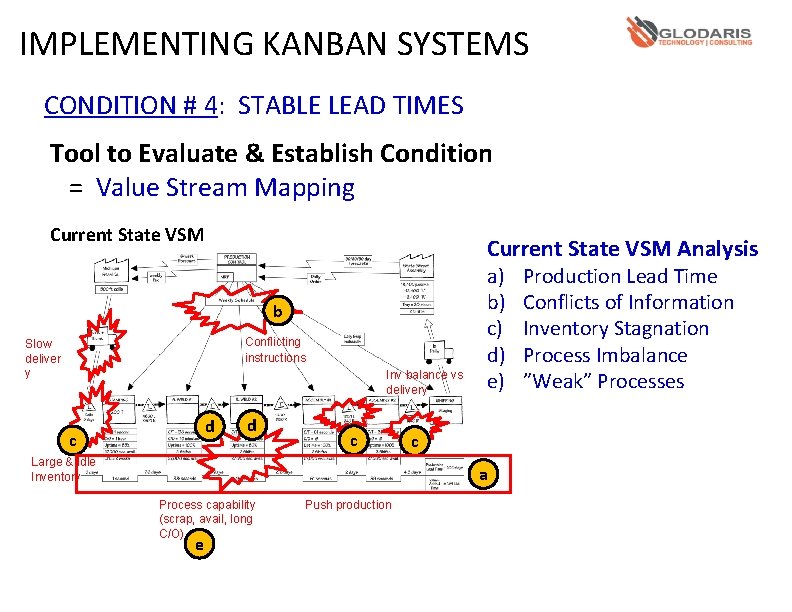
IMPLEMENTING KANBAN SYSTEMS CONDITION # 4: STABLE LEAD TIMES Tool to Evaluate & Establish Condition = Value Stream Mapping Current State VSM Analysis b Conflicting instructions Slow deliver y Inv balance vs delivery d c Large & Idle Inventory a) b) c) d) e) c a Process capability (scrap, avail, long C/O) e Push production Production Lead Time Conflicts of Information Inventory Stagnation Process Imbalance ”Weak” Processes
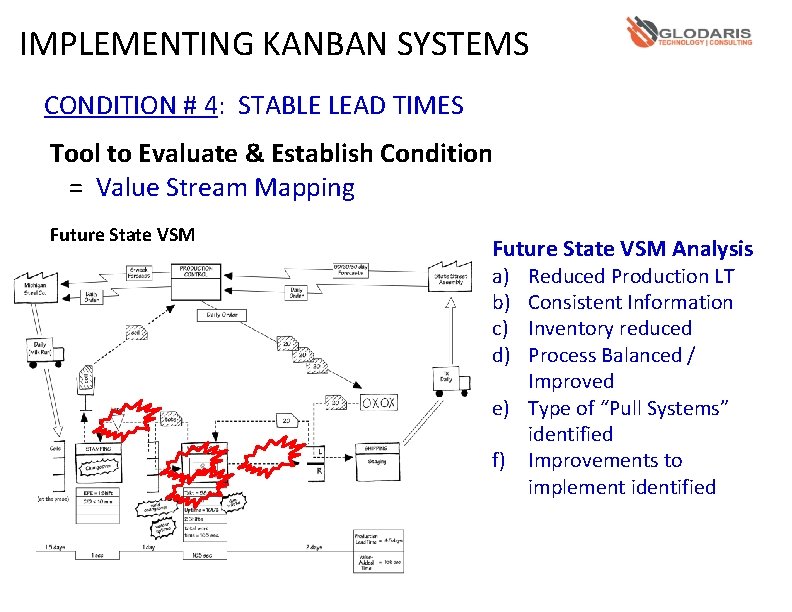
IMPLEMENTING KANBAN SYSTEMS CONDITION # 4: STABLE LEAD TIMES Tool to Evaluate & Establish Condition = Value Stream Mapping Future State VSM Analysis a) b) c) d) Reduced Production LT Consistent Information Inventory reduced Process Balanced / Improved e) Type of “Pull Systems” identified f) Improvements to implement identified
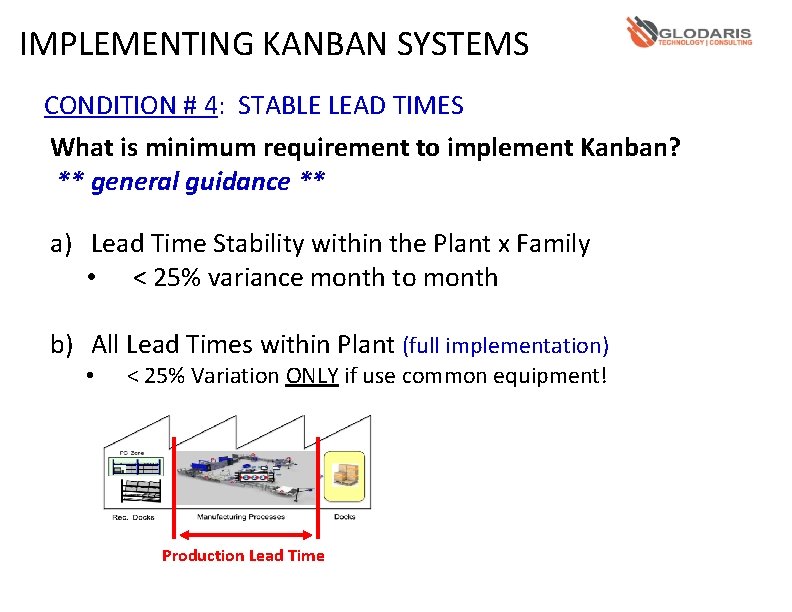
IMPLEMENTING KANBAN SYSTEMS CONDITION # 4: STABLE LEAD TIMES What is minimum requirement to implement Kanban? ** general guidance ** a) Lead Time Stability within the Plant x Family • < 25% variance month to month b) All Lead Times within Plant (full implementation) • < 25% Variation ONLY if use common equipment! Production Lead Time
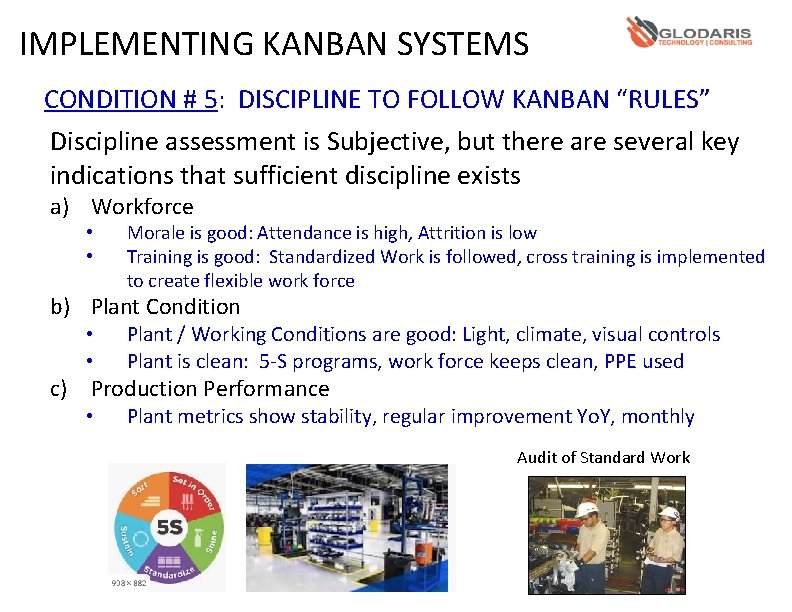
IMPLEMENTING KANBAN SYSTEMS CONDITION # 5: DISCIPLINE TO FOLLOW KANBAN “RULES” Discipline assessment is Subjective, but there are several key indications that sufficient discipline exists a) Workforce • • Morale is good: Attendance is high, Attrition is low Training is good: Standardized Work is followed, cross training is implemented to create flexible work force b) Plant Condition • • Plant / Working Conditions are good: Light, climate, visual controls Plant is clean: 5 -S programs, work force keeps clean, PPE used c) Production Performance • Plant metrics show stability, regular improvement Yo. Y, monthly Audit of Standard Work

IMPLEMENTING KANBAN SYSTEMS CONDITION # 5: DISCIPLINE TO FOLLOW KANBAN “RULES” “ 6 Rules” of KANBAN: 1. NO Defects to continue in system 2. Following Process ‘goes back’ to Previous Process 3. Production amount must equal Quantity withdrawn from following process (Pull) 4. NO Production OR Conveyance without KANBAN Audit of Standard Work 5. KANBAN must be attached to Parts/Material 6. # Parts, Info contained on KANBAN
IMPLEMENTING KANBAN SYSTEMS REVIEW & EXERCISE: Does your Company / Plant meet All these Pre-Conditions? check all that answer is “YES” PRE-CONDITIONS 1. Stable Operations 2. Smooth Product Flows 3. Heijunka is “formal” requirement 4. Stable Lead Times throughout manufacturing areas 5. Full Area Discipline to use Kanban correctly
IMPLEMENTING KANBAN SYSTEMS IMPLEMENTATION 1. Establish Multi-function Project Team & Train them 2. Select Product Family / Section of Plant 3. Conduct Value Stream Mapping 4. Pre-Conditions meet guidelines in selected Area 5. Decide on Kanban System to use 6. Implement, Evaluate & Stabilize
IMPLEMENTING KANBAN SYSTEMS IMPLEMENTATION STEP # 1: Form the Team 1. Leader of Team • • Management Level of either Operations or Material Handling Needs knowledge / experience with Kanban (or Supporter) 2. Functions to include on Team (minimum) “Forming” • • • Operations, Material Handling, Planning Consider Maintenance, Quality, Engineering as needed Purchasing, IT, Shipping for external 3. Level of Organization = usually Supervisor level 4. Storming / Norming / Performing / Adjourning • • • Need to set Roles and Responsibilities, Meeting frequency & Decision Making method, Resources available Project Goals & Metrics, Project Timing, Reporting structure How to share learning
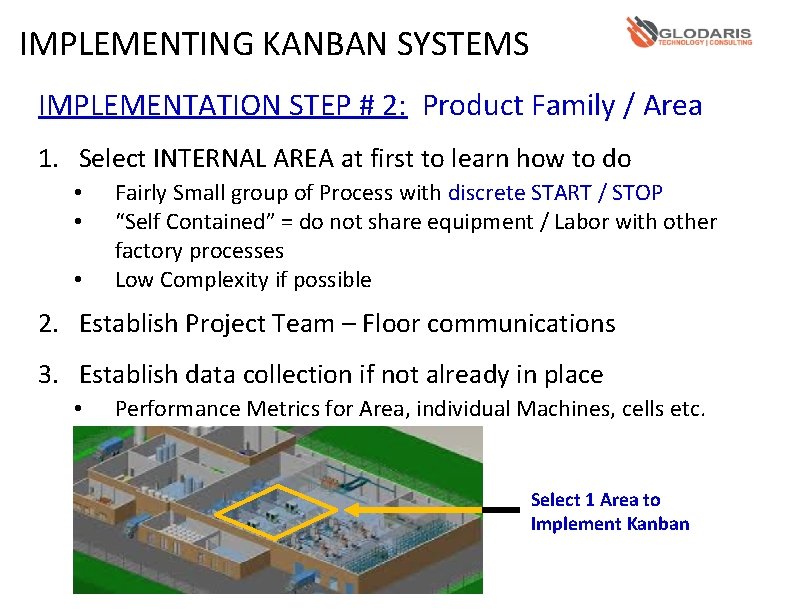
IMPLEMENTING KANBAN SYSTEMS IMPLEMENTATION STEP # 2: Product Family / Area 1. Select INTERNAL AREA at first to learn how to do • • • Fairly Small group of Process with discrete START / STOP “Self Contained” = do not share equipment / Labor with other factory processes Low Complexity if possible 2. Establish Project Team – Floor communications 3. Establish data collection if not already in place • Performance Metrics for Area, individual Machines, cells etc. Select 1 Area to Implement Kanban
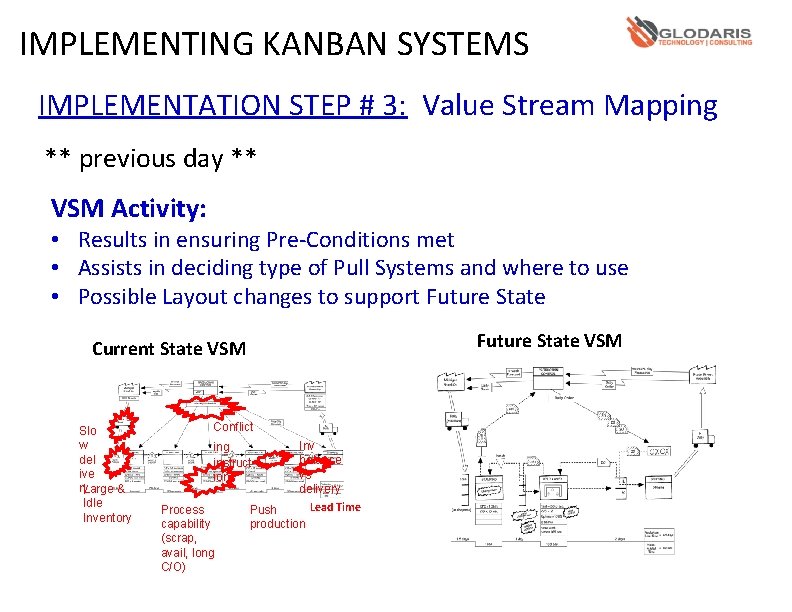
IMPLEMENTING KANBAN SYSTEMS IMPLEMENTATION STEP # 3: Value Stream Mapping ** previous day ** VSM Activity: • Results in ensuring Pre-Conditions met • Assists in deciding type of Pull Systems and where to use • Possible Layout changes to support Future State VSM Current State VSM Slo w del ive ry Large & Idle Inventory Conflict ing instruct ions Process capability (scrap, avail, long C/O) Inv balance vs delivery Lead Time Push production
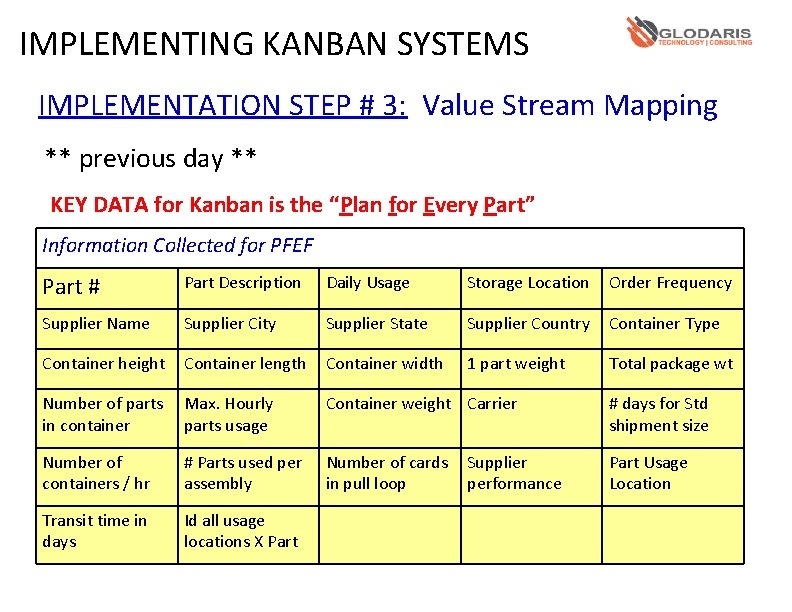
IMPLEMENTING KANBAN SYSTEMS IMPLEMENTATION STEP # 3: Value Stream Mapping ** previous day ** KEY DATA for Kanban is the “Plan for Every Part” Information Collected for PFEF Part # Part Description Daily Usage Storage Location Order Frequency Supplier Name Supplier City Supplier State Supplier Country Container Type Container height Container length Container width 1 part weight Total package wt Number of parts in container Max. Hourly parts usage Container weight Carrier # days for Std shipment size Number of containers / hr # Parts used per assembly Number of cards in pull loop Part Usage Location Transit time in days Id all usage locations X Part Supplier performance
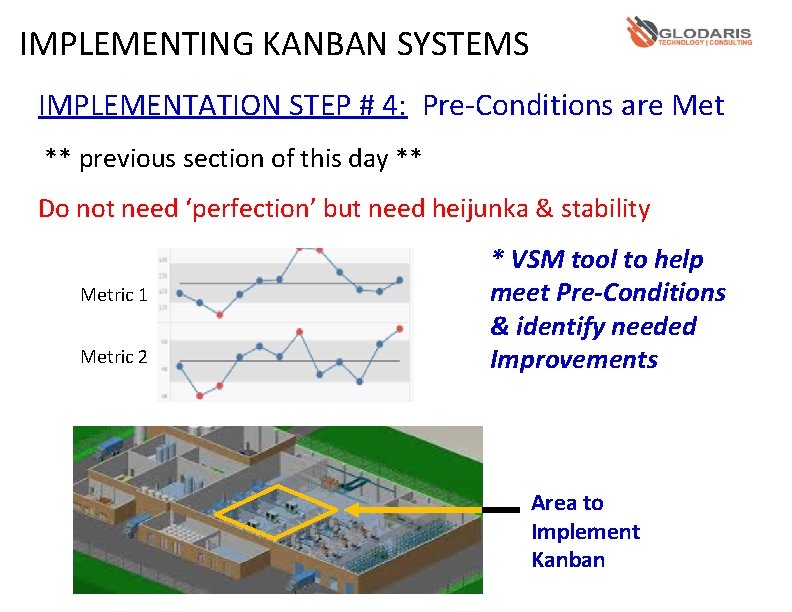
IMPLEMENTING KANBAN SYSTEMS IMPLEMENTATION STEP # 4: Pre-Conditions are Met ** previous section of this day ** Do not need ‘perfection’ but need heijunka & stability Metric 1 Metric 2 * VSM tool to help meet Pre-Conditions & identify needed Improvements Area to Implement Kanban
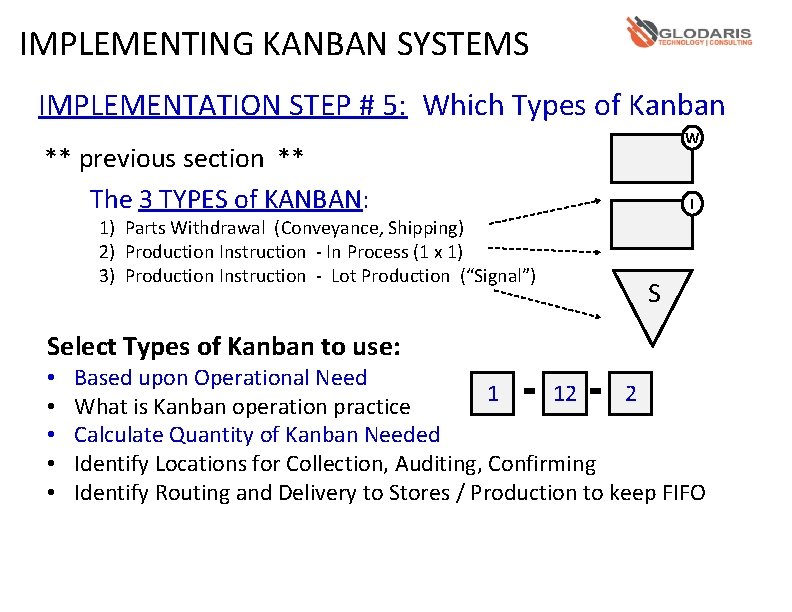
IMPLEMENTING KANBAN SYSTEMS IMPLEMENTATION STEP # 5: Which Types of Kanban W ** previous section ** The 3 TYPES of KANBAN: 1) Parts Withdrawal (Conveyance, Shipping) 2) Production Instruction - In Process (1 x 1) 3) Production Instruction - Lot Production (“Signal”) Select Types of Kanban to use: • • • I S Based upon Operational Need 1 12 2 What is Kanban operation practice Calculate Quantity of Kanban Needed Identify Locations for Collection, Auditing, Confirming Identify Routing and Delivery to Stores / Production to keep FIFO
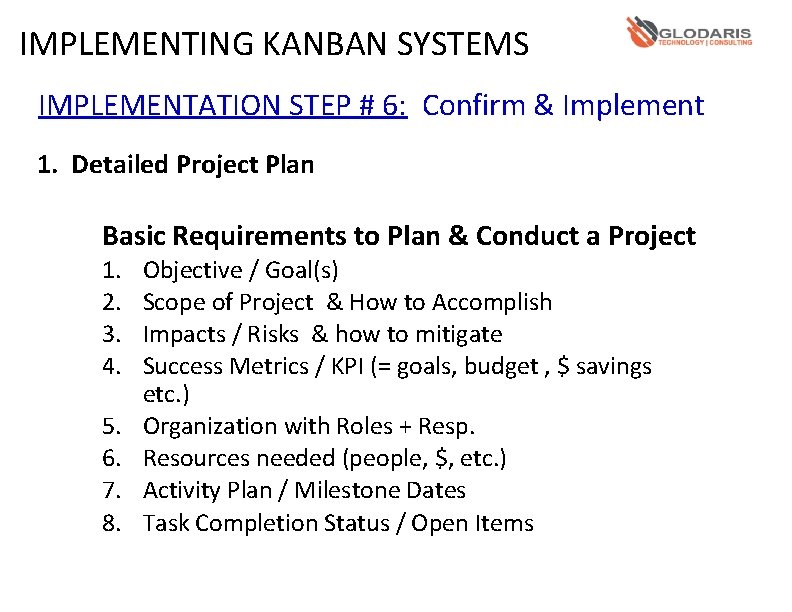
IMPLEMENTING KANBAN SYSTEMS IMPLEMENTATION STEP # 6: Confirm & Implement 1. Detailed Project Plan Basic Requirements to Plan & Conduct a Project 1. 2. 3. 4. 5. 6. 7. 8. Objective / Goal(s) Scope of Project & How to Accomplish Impacts / Risks & how to mitigate Success Metrics / KPI (= goals, budget , $ savings etc. ) Organization with Roles + Resp. Resources needed (people, $, etc. ) Activity Plan / Milestone Dates Task Completion Status / Open Items
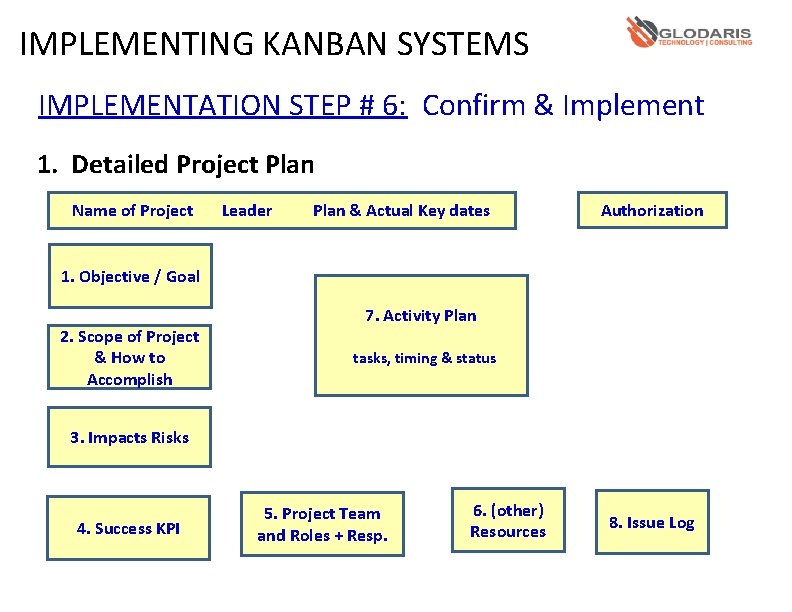
IMPLEMENTING KANBAN SYSTEMS IMPLEMENTATION STEP # 6: Confirm & Implement 1. Detailed Project Plan Name of Project Leader Plan & Actual Key dates Authorization 1. Objective / Goal 2. Scope of Project & How to Accomplish 7. Activity Plan tasks, timing & status 3. Impacts Risks 4. Success KPI 5. Project Team and Roles + Resp. 6. (other) Resources 8. Issue Log
IMPLEMENTING KANBAN SYSTEMS IMPLEMENTATION STEP # 6: Confirm & Implement Pilot Area Preparation (don’t forget!): 1. Build any Material Buffers needed to protect the operation • • Downstream Processes Upstream Processes 2. Training for all participants & stakeholders • • • Implementation Team Area Operations team Include Maps / Overviews of Area and Changes 3. Ensure Ability to measure progress and success in place • What new data needed / who collects / how often 4. Initial Process Set Up and Layout changes • Conduct over weekend / extended non-production time • Floor Markings, Overhead Labels, Equipment, etc. 5. Communicate + Communicate
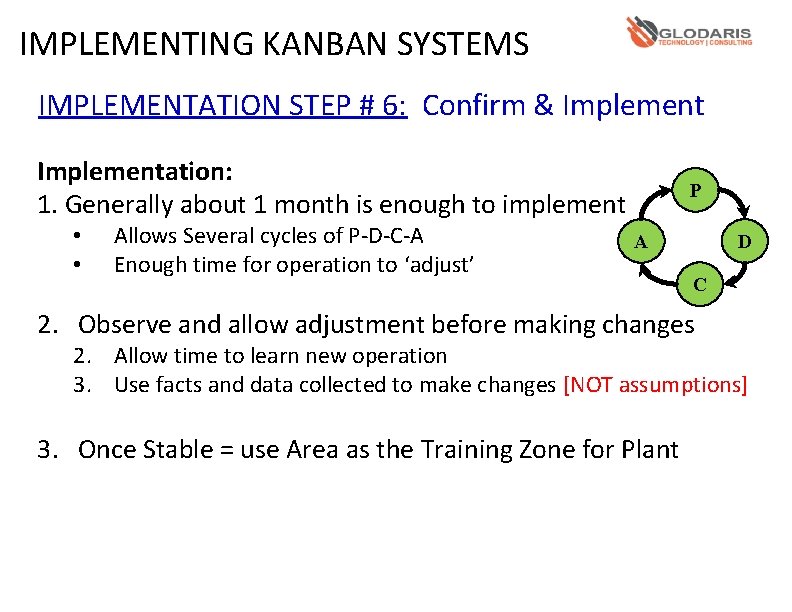
IMPLEMENTING KANBAN SYSTEMS IMPLEMENTATION STEP # 6: Confirm & Implementation: 1. Generally about 1 month is enough to implement • • Allows Several cycles of P-D-C-A Enough time for operation to ‘adjust’ P A D C 2. Observe and allow adjustment before making changes 2. Allow time to learn new operation 3. Use facts and data collected to make changes [NOT assumptions] 3. Once Stable = use Area as the Training Zone for Plant
- Slides: 30