
Implementing Image Processing Pipelines in a HardwareSoftware Environment
- Slides: 1
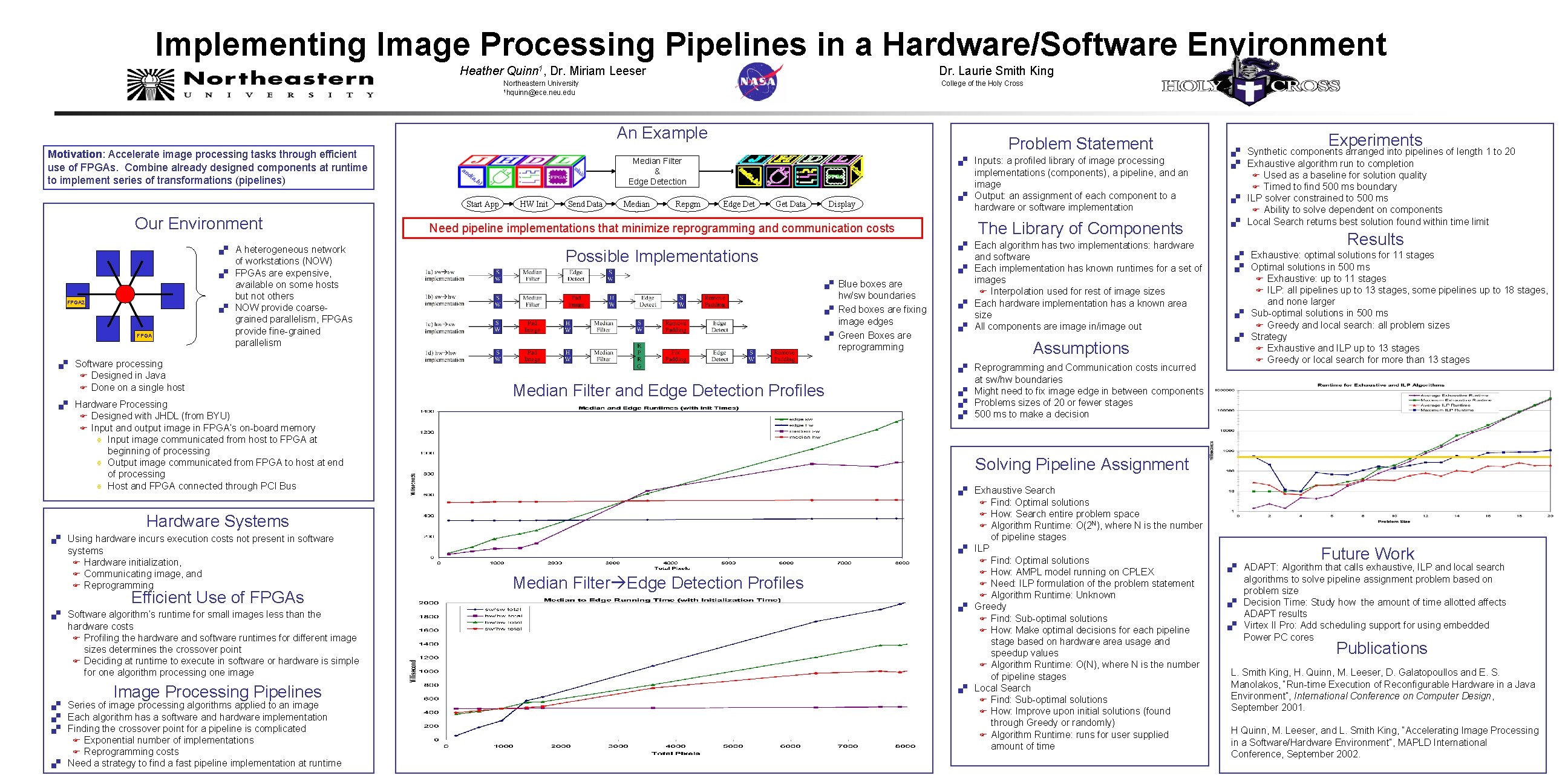
Implementing Image Processing Pipelines in a Hardware/Software Environment Heather Quinn 1, Dr. Miriam Leeser Dr. Laurie Smith King Northeastern University 1 hquinn@ece. neu. edu College of the Holy Cross An Example Motivation: Accelerate image processing tasks through efficient use of FPGAs. Combine already designed components at runtime to implement series of transformations (pipelines) . A heterogeneous network FPGA 2 FPGA of workstations (NOW). FPGAs are expensive, available on some hosts but not others. NOW provide coarsegrained parallelism, FPGAs provide fine-grained parallelism . Inputs: a profiled library of image processing Median Filter & Edge Detection Start App Our Environment Problem Statement HW Init Send Data Median Repgm Edge Det Get Data Display Need pipeline implementations that minimize reprogramming and communication costs Designed in Java Done on a single host . Hardware Processing F F Possible Implementations. Blue boxes are hw/sw boundaries. Red boxes are fixing image edges. Green Boxes are reprogramming Median Filter and Edge Detection Profiles hardware costs F Profiling the hardware and software runtimes for different image sizes determines the crossover point F Deciding at runtime to execute in software or hardware is simple for one algorithm processing one image Image Processing Pipelines . Series of image processing algorithms applied to an image. Each algorithm has a software and hardware implementation. Finding the crossover point for a pipeline is complicated Exponential number of implementations Reprogramming costs. Need a strategy to find a fast pipeline implementation at runtime F F Used as a baseline for solution quality Timed to find 500 ms boundary. ILP solver constrained to 500 ms F Ability to solve dependent on components. Local Search returns best solution found within time limit F F Results. Exhaustive: optimal solutions for 11 stages. Optimal solutions in 500 ms Exhaustive: up to 11 stages ILP: all pipelines up to 13 stages, some pipelines up to 18 stages, and none larger. Sub-optimal solutions in 500 ms F Greedy and local search: all problem sizes. Strategy F Exhaustive and ILP up to 13 stages F Greedy or local search for more than 13 stages F F at sw/hw boundaries. Might need to fix image edge in between components. Problems sizes of 20 or fewer stages. 500 ms to make a decision . Exhaustive Search F F F . Using hardware incurs execution costs not present in software . Software algorithm’s runtime for small images less than the Assumptions . Synthetic components arranged into pipelines of length 1 to 20. Exhaustive algorithm run to completion Solving Pipeline Assignment Hardware Systems Efficient Use of FPGAs and software. Each implementation has known runtimes for a set of images F Interpolation used for rest of image sizes. Each hardware implementation has a known area size. All components are image in/image out . Reprogramming and Communication costs incurred Designed with JHDL (from BYU) Input and output image in FPGA’s on-board memory X Input image communicated from host to FPGA at beginning of processing X Output image communicated from FPGA to host at end of processing X Host and FPGA connected through PCI Bus systems F Hardware initialization, F Communicating image, and F Reprogramming The Library of Components. Each algorithm has two implementations: hardware . Software processing F F implementations (components), a pipeline, and an image. Output: an assignment of each component to a hardware or software implementation Experiments Find: Optimal solutions How: Search entire problem space Algorithm Runtime: O(2 N), where N is the number of pipeline stages . ILP Median Filter Edge Detection Profiles Find: Optimal solutions How: AMPL model running on CPLEX Need: ILP formulation of the problem statement Algorithm Runtime: Unknown. Greedy F Find: Sub-optimal solutions F How: Make optimal decisions for each pipeline stage based on hardware area usage and speedup values F Algorithm Runtime: O(N), where N is the number of pipeline stages. Local Search F Find: Sub-optimal solutions F How: Improve upon initial solutions (found through Greedy or randomly) F Algorithm Runtime: runs for user supplied amount of time F F Future Work . ADAPT: Algorithm that calls exhaustive, ILP and local search algorithms to solve pipeline assignment problem based on problem size. Decision Time: Study how the amount of time allotted affects ADAPT results. Virtex II Pro: Add scheduling support for using embedded Power PC cores Publications L. Smith King, H. Quinn, M. Leeser, D. Galatopoullos and E. S. Manolakos, “Run-time Execution of Reconfigurable Hardware in a Java Environment”, International Conference on Computer Design, September 2001. H Quinn, M. Leeser, and L. Smith King, “Accelerating Image Processing in a Software/Hardware Environment”, MAPLD International Conference, September 2002.