
Implementing GASB 68 Washington Finance Officers Association January
Implementing GASB 68 Washington Finance Officers Association January 26, 2016 Washington State Auditor’s Office
Today’s presentation q q q q GASB pension standards Understanding the types of pension plans State-sponsored plans Journal entries Deferred outflows and deferred inflows Local government plans Allocation to funds and departments Financial statements, notes and required supplementary information (RSI) q Census data audits q Other post-employment benefits (OPEB) Washington State Auditor’s Office 2
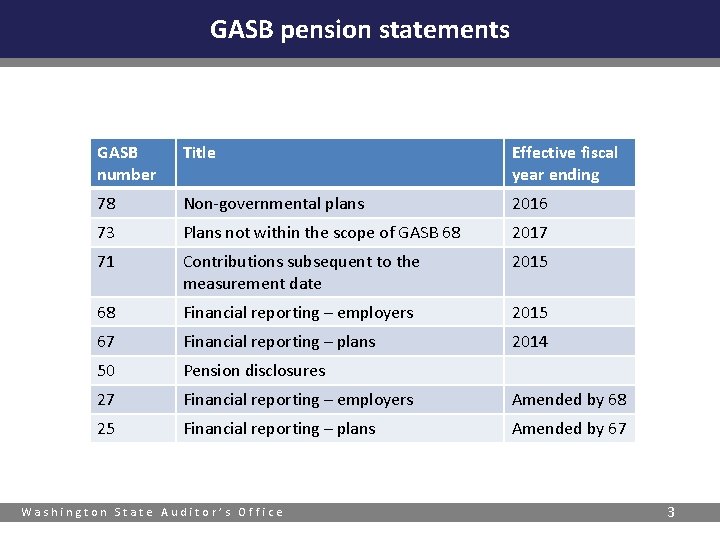
GASB pension statements GASB number Title Effective fiscal year ending 78 Non-governmental plans 2016 73 Plans not within the scope of GASB 68 2017 71 Contributions subsequent to the measurement date 2015 68 Financial reporting – employers 2015 67 Financial reporting – plans 2014 50 Pension disclosures 27 Financial reporting – employers Amended by 68 25 Financial reporting – plans Amended by 67 Washington State Auditor’s Office 3
GASB Statement No. 67 GASB 67 – Financial reporting for pension plans § Amends GASB 25 § Became effective FYE 2014 § Contains financial reporting requirements for pension plans Washington State Auditor’s Office 4
GASB Statement No. 68 GASB 68 – Accounting and financial reporting for pensions § Amends GASB 27 § Became effective FYE 2015 § Contains financial reporting requirements for participating employers Washington State Auditor’s Office 5
Key reporting changes Prior to GASB 68 § Required contribution to plans = Pension expense § Pension liability = Contributions required – Contributions made Key reporting changes § Net pension liability (or asset) reported on the Statement of Net Position § Deferred outflows and deferred inflows related to pensions are reported § Pension expense no longer equals required contributions to the plan These changes affect government-wide and proprietary fund statements, not governmental fund statements. Washington State Auditor’s Office 6
Key new concepts Washington State Auditor’s Office 7
GASB Statement No. 71 GASB 71 – Pension transition for contributions made subsequent to the measurement date § Amends GASB 68 § Effective FYE 2015 § Contributions made after the measurement date of the plan are reported as deferred outflows Washington State Auditor’s Office 8
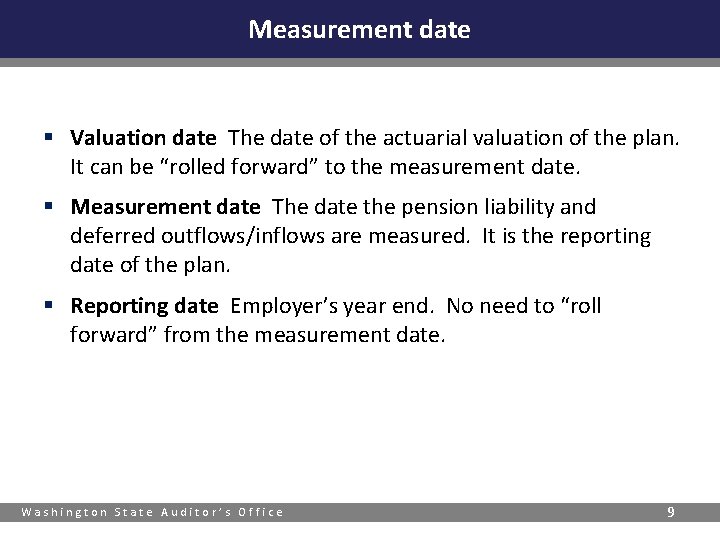
Measurement date § Valuation date The date of the actuarial valuation of the plan. It can be “rolled forward” to the measurement date. § Measurement date The date the pension liability and deferred outflows/inflows are measured. It is the reporting date of the plan. § Reporting date Employer’s year end. No need to “roll forward” from the measurement date. Washington State Auditor’s Office 9
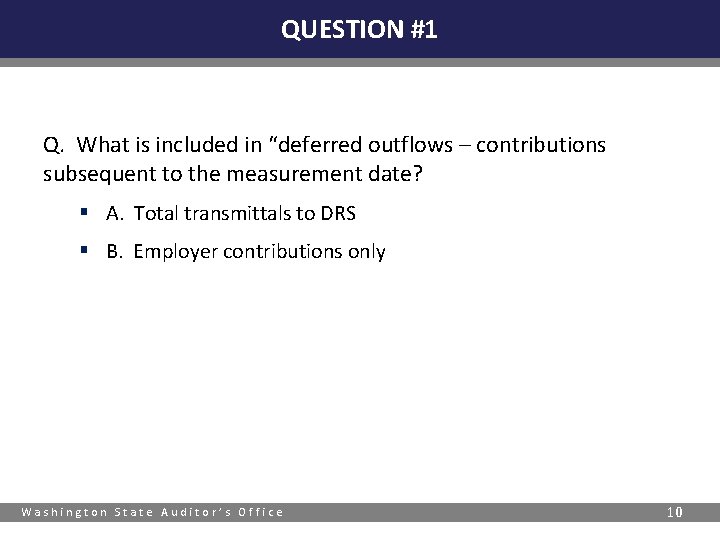
QUESTION #1 Q. What is included in “deferred outflows – contributions subsequent to the measurement date? § A. Total transmittals to DRS § B. Employer contributions only Washington State Auditor’s Office 10
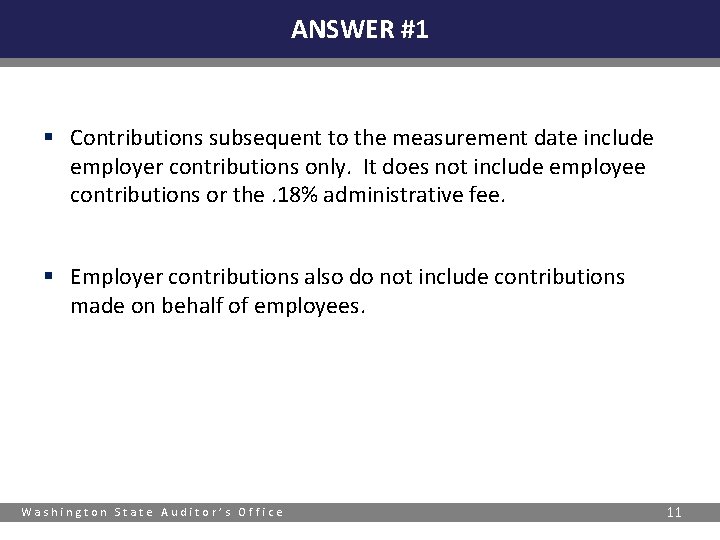
ANSWER #1 § Contributions subsequent to the measurement date include employer contributions only. It does not include employee contributions or the. 18% administrative fee. § Employer contributions also do not include contributions made on behalf of employees. Washington State Auditor’s Office 11
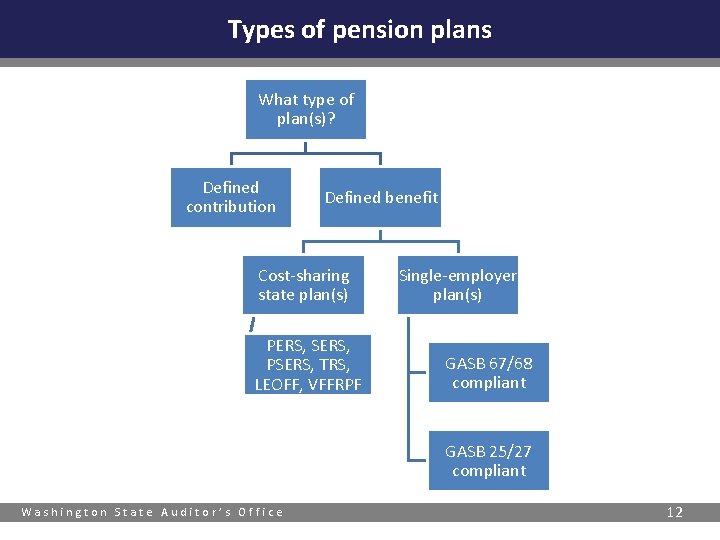
Types of pension plans What type of plan(s)? Defined contribution Defined benefit Cost-sharing state plan(s) PERS, SERS, PSERS, TRS, LEOFF, VFFRPF Single-employer plan(s) GASB 67/68 compliant GASB 25/27 compliant Washington State Auditor’s Office 12
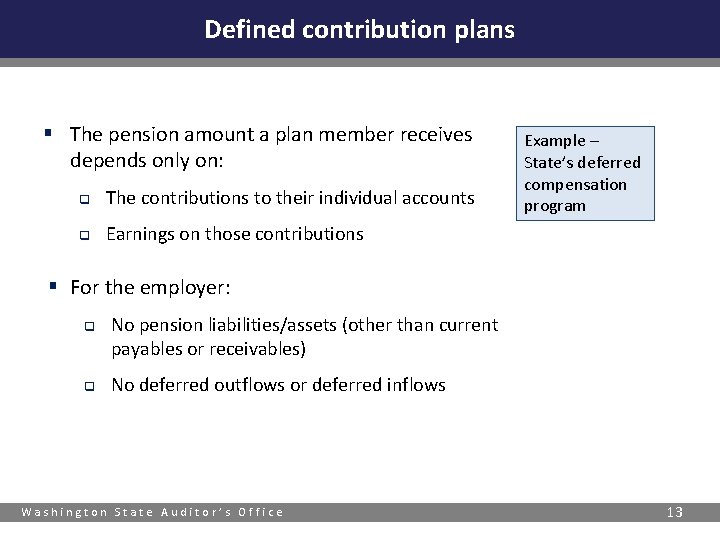
Defined contribution plans § The pension amount a plan member receives depends only on: q The contributions to their individual accounts q Earnings on those contributions Example – State’s deferred compensation program § For the employer: q q No pension liabilities/assets (other than current payables or receivables) No deferred outflows or deferred inflows Washington State Auditor’s Office 13
Defined contribution plans § Simple note disclosures – see the BARS Manual. § “Participation” means the employer contributes to the plan. If only the employees contribute, then the employer is not a participant and no disclosure is required. Washington State Auditor’s Office 14
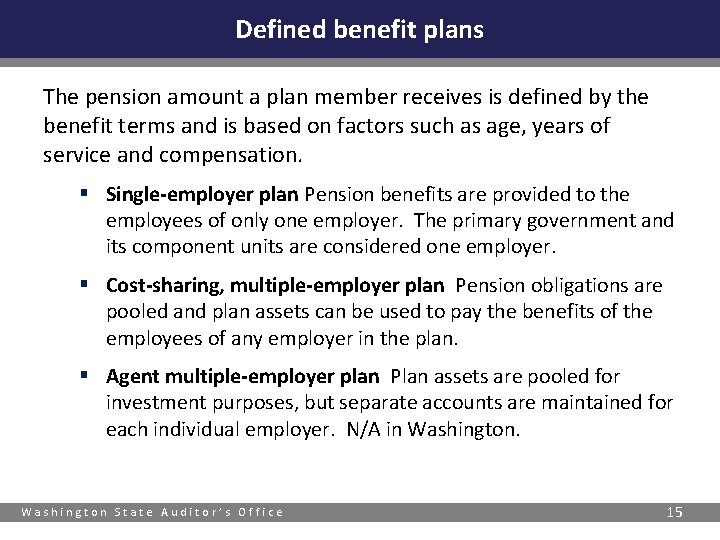
Defined benefit plans The pension amount a plan member receives is defined by the benefit terms and is based on factors such as age, years of service and compensation. § Single-employer plan Pension benefits are provided to the employees of only one employer. The primary government and its component units are considered one employer. § Cost-sharing, multiple-employer plan Pension obligations are pooled and plan assets can be used to pay the benefits of the employees of any employer in the plan. § Agent multiple-employer plan Plan assets are pooled for investment purposes, but separate accounts are maintained for each individual employer. N/A in Washington State Auditor’s Office 15
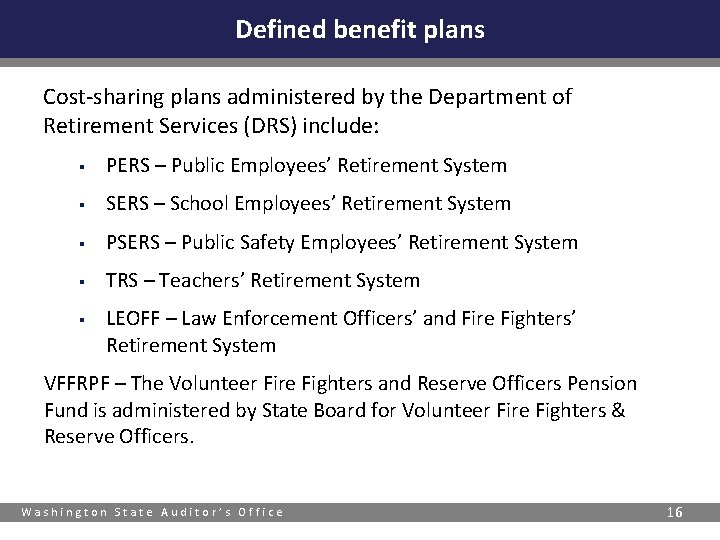
Defined benefit plans Cost-sharing plans administered by the Department of Retirement Services (DRS) include: § PERS – Public Employees’ Retirement System § SERS – School Employees’ Retirement System § PSERS – Public Safety Employees’ Retirement System § TRS – Teachers’ Retirement System § LEOFF – Law Enforcement Officers’ and Fire Fighters’ Retirement System VFFRPF – The Volunteer Fire Fighters and Reserve Officers Pension Fund is administered by State Board for Volunteer Fire Fighters & Reserve Officers. Washington State Auditor’s Office 16
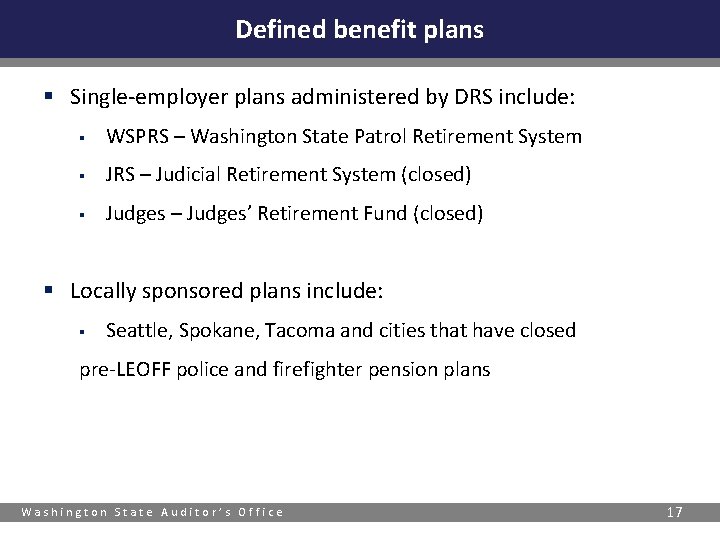
Defined benefit plans § Single-employer plans administered by DRS include: § WSPRS – Washington State Patrol Retirement System § JRS – Judicial Retirement System (closed) § Judges – Judges’ Retirement Fund (closed) § Locally sponsored plans include: § Seattle, Spokane, Tacoma and cities that have closed pre-LEOFF police and firefighter pension plans Washington State Auditor’s Office 17
State-sponsored plans Washington State Auditor’s Office 18
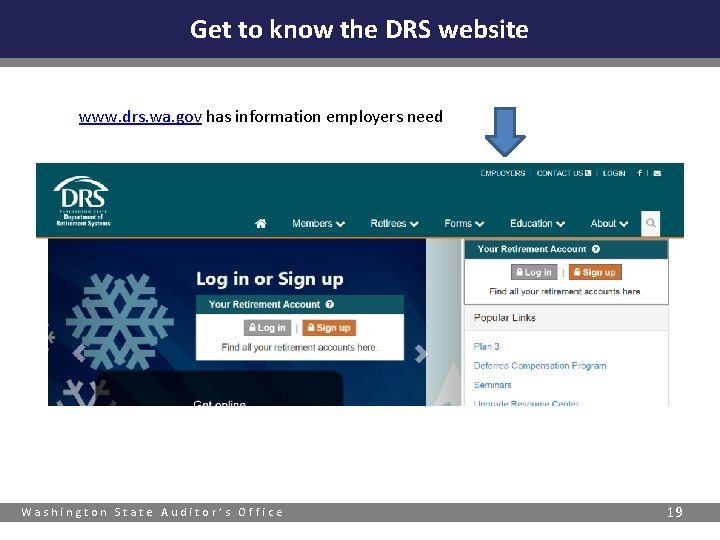
Get to know the DRS website www. drs. wa. gov has information employers need Washington State Auditor’s Office 19
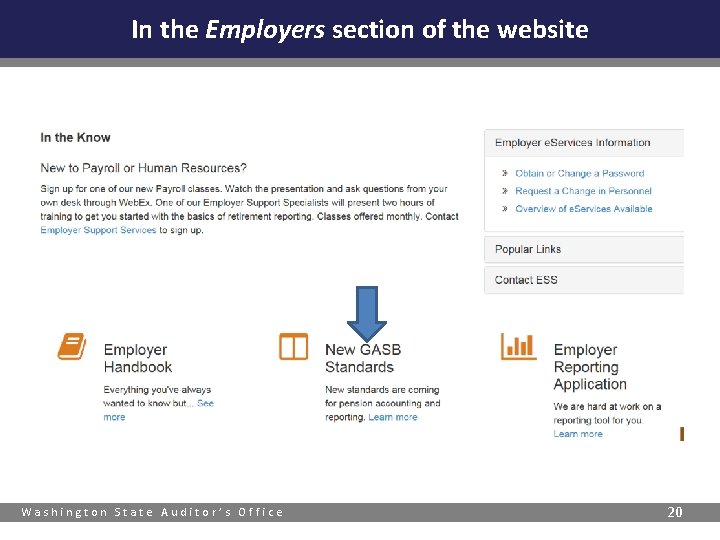
In the Employers section of the website Washington State Auditor’s Office 20
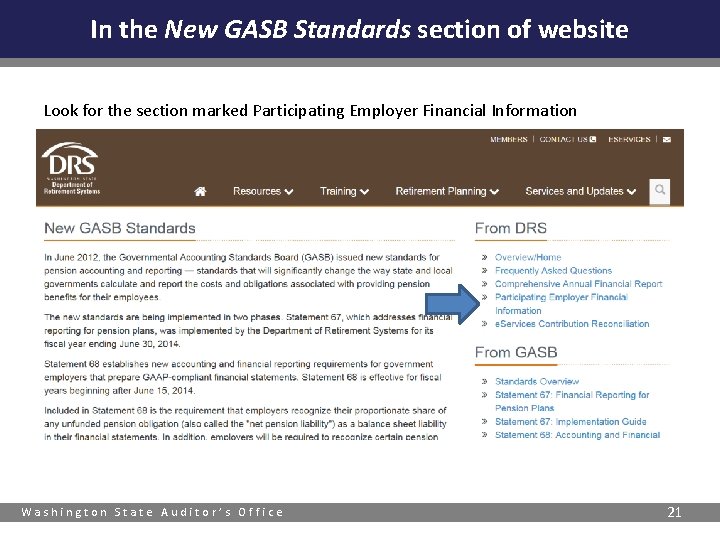
In the New GASB Standards section of website Look for the section marked Participating Employer Financial Information Washington State Auditor’s Office 21
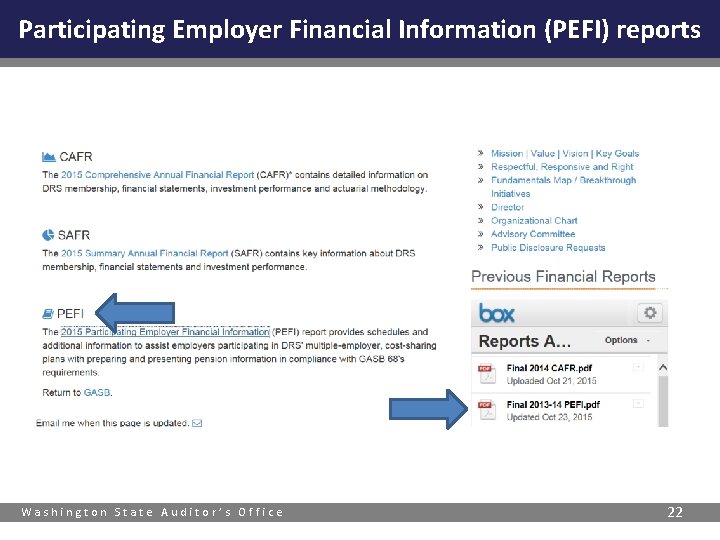
Participating Employer Financial Information (PEFI) reports Washington State Auditor’s Office 22
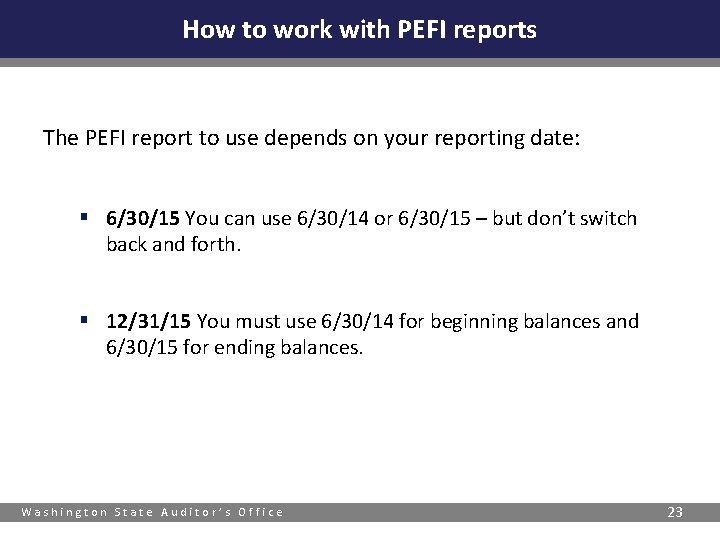
How to work with PEFI reports The PEFI report to use depends on your reporting date: § 6/30/15 You can use 6/30/14 or 6/30/15 – but don’t switch back and forth. § 12/31/15 You must use 6/30/14 for beginning balances and 6/30/15 for ending balances. Washington State Auditor’s Office 23
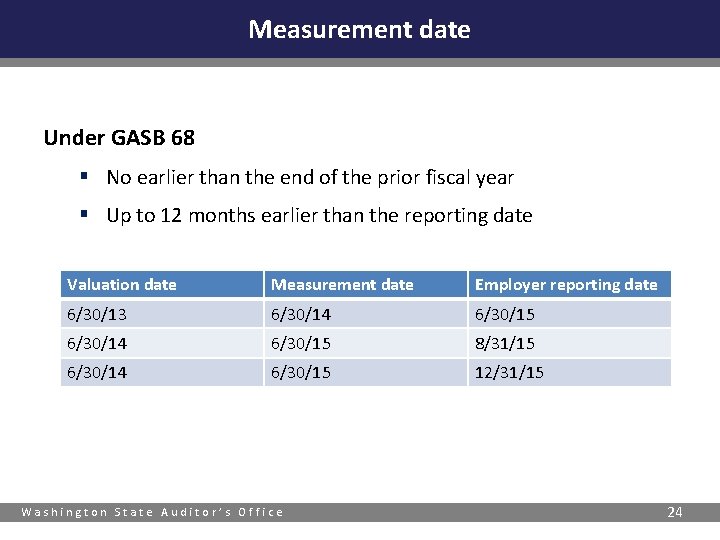
Measurement date Under GASB 68 § No earlier than the end of the prior fiscal year § Up to 12 months earlier than the reporting date Valuation date Measurement date Employer reporting date 6/30/13 6/30/14 6/30/15 8/31/15 6/30/14 6/30/15 12/31/15 Washington State Auditor’s Office 24
How to use the PEFI Washington State Auditor’s Office 25
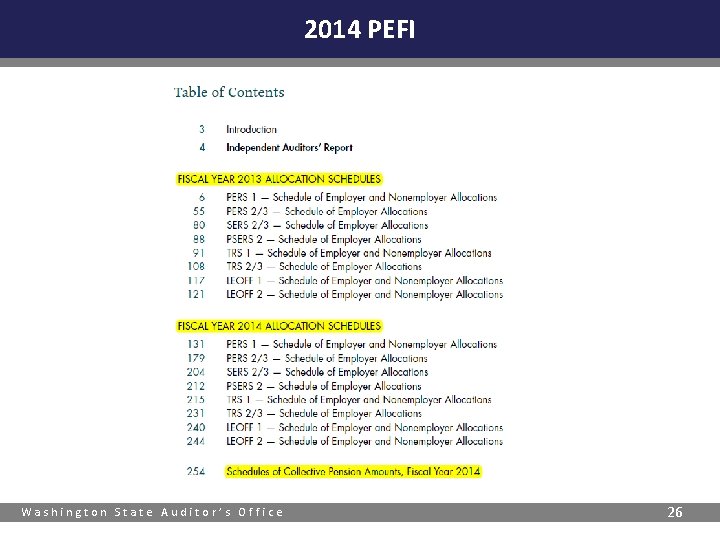
2014 PEFI Washington State Auditor’s Office 26
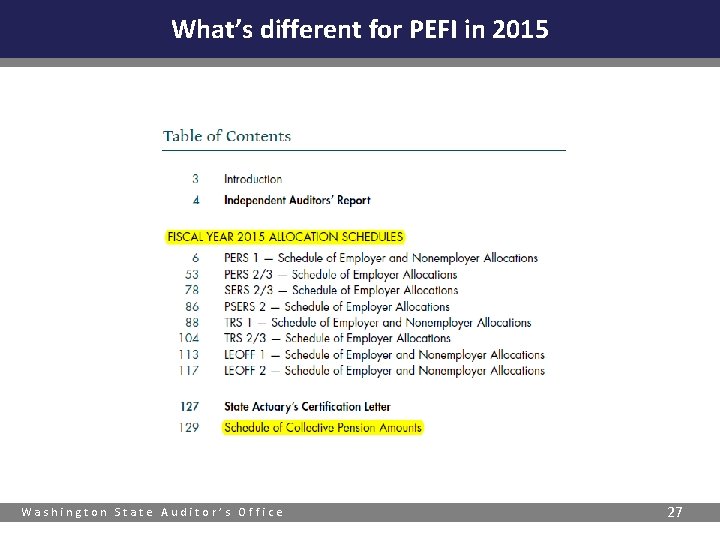
What’s different for PEFI in 2015 Washington State Auditor’s Office 27
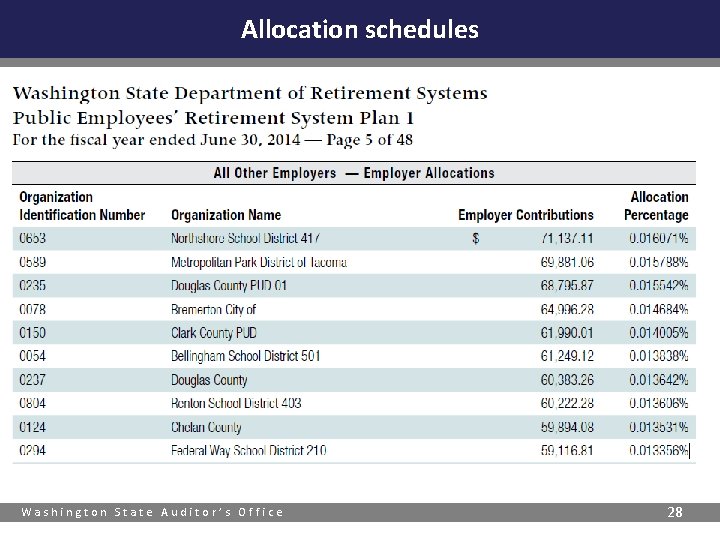
Allocation schedules Washington State Auditor’s Office 28
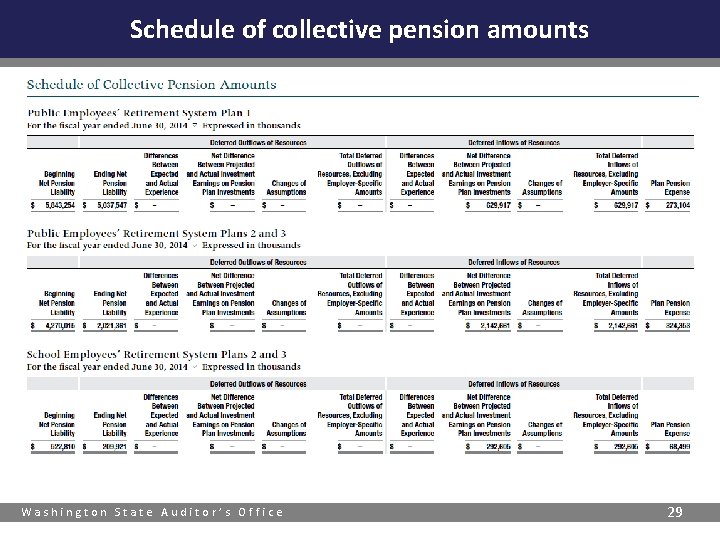
Schedule of collective pension amounts Washington State Auditor’s Office 29
PEFI: Management’s responsibilities Employers are solely responsible for: § Their financial statements § Evaluating the information used to recognize and disclose pension amounts in their financial statements § Verifying and recalculating amounts specific to them. Contributions are the key factor. Washington State Auditor’s Office 30
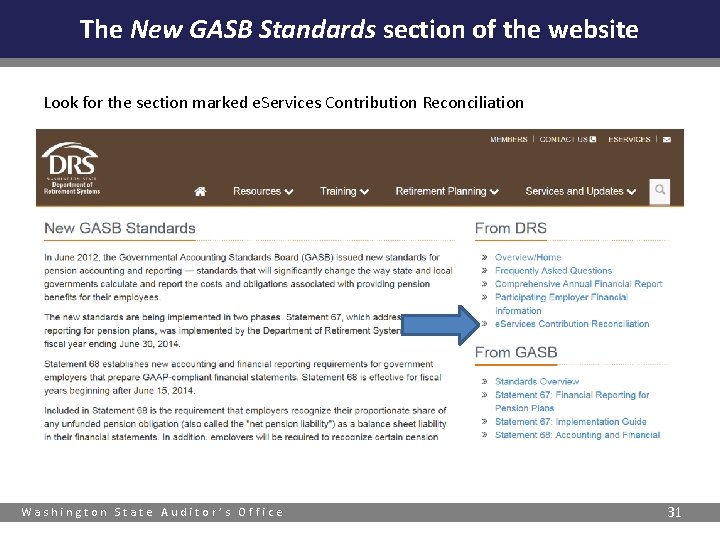
The New GASB Standards section of the website Look for the section marked e. Services Contribution Reconciliation Washington State Auditor’s Office 31
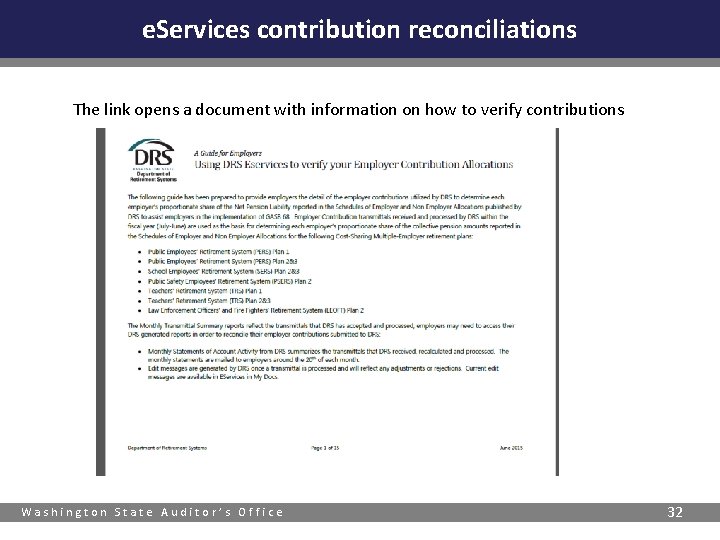
e. Services contribution reconciliations The link opens a document with information on how to verify contributions Washington State Auditor’s Office 32
Let’s implement GASB 68! Washington State Auditor’s Office 33
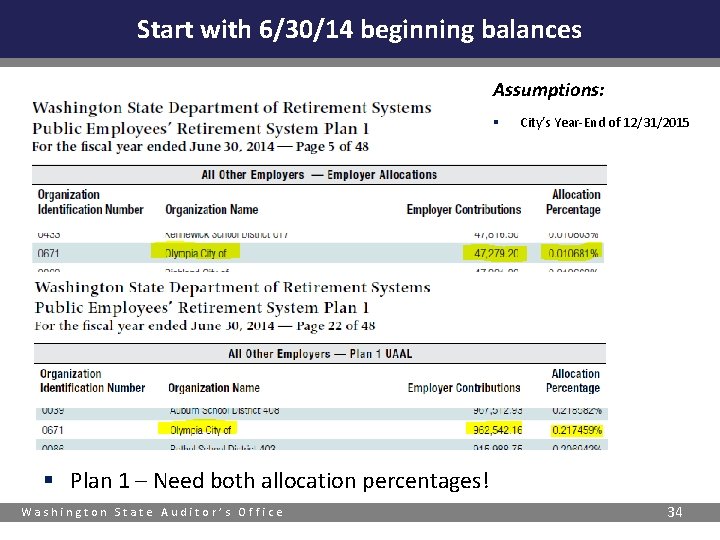
Start with 6/30/14 beginning balances Assumptions: § City’s Year-End of 12/31/2015 § Plan 1 – Need both allocation percentages! Washington State Auditor’s Office 34
What is the Plan 1 Unfunded Actuarial Accrued Liability? Q. I don’t have any Plan 1 employees. How can I have a liability (the UAAL) under Plan 1? A. Under RCW 41. 45. 060, part of the contributions to PERS 2/3, SERS 2/3, PSERS 2, and TRS 2/3 fund the UAALs for PERS 1 and TRS 1. § This is not a special funding situation. Washington State Auditor’s Office 35
Watch out! Note that your allocation percentages are percentages, not simple decimals! Note that the amounts in the Schedule of Collective Pension Amounts are reported in thousands! Washington State Auditor’s Office 36
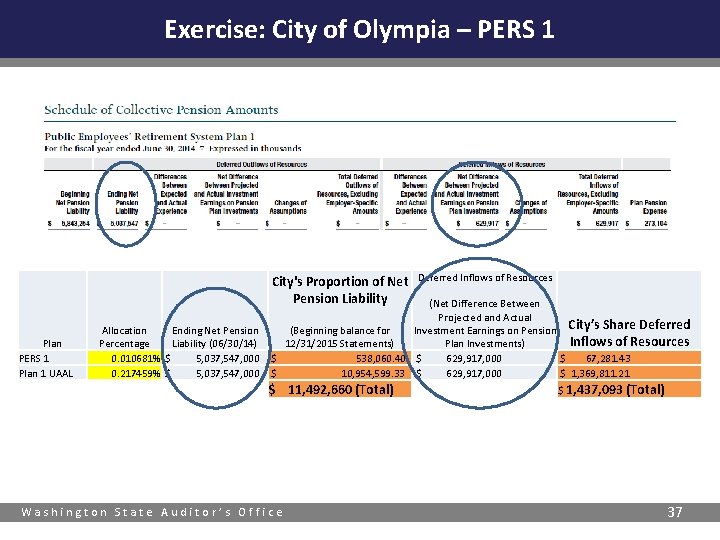
Exercise: City of Olympia – PERS 1 City's Proportion of Net Pension Liability Plan PERS 1 Plan 1 UAAL Allocation Ending Net Pension Percentage Liability (06/30/14) 0. 010681% $ 5, 037, 547, 000 0. 217459% $ 5, 037, 547, 000 Deferred Inflows of Resources (Net Difference Between Projected and Actual (Beginning balance for Investment Earnings on Pension City’s Share Deferred Inflows of Resources 12/31/2015 Statements) Plan Investments) $ 538, 060. 40 $ 629, 917, 000 $ 67, 281. 43 $ 10, 954, 599. 33 $ 629, 917, 000 $ 1, 369, 811. 21 $ 11, 492, 660 (Total) Washington State Auditor’s Office $ 1, 437, 093 (Total) 37
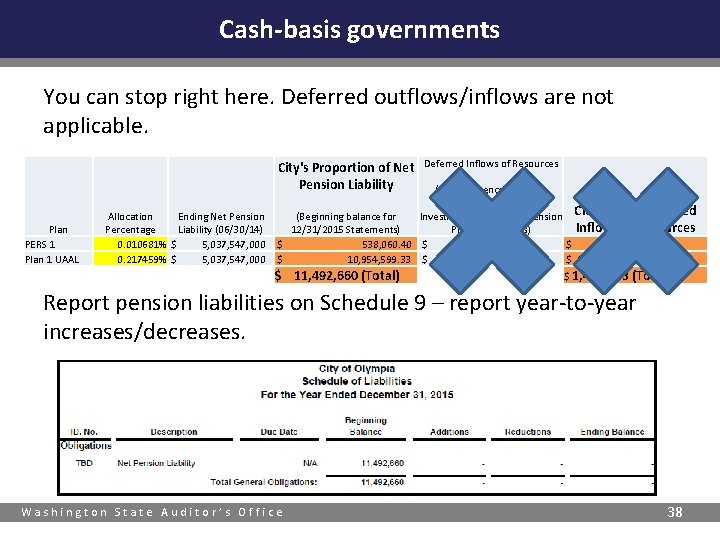
Cash-basis governments You can stop right here. Deferred outflows/inflows are not applicable. City's Proportion of Net Pension Liability Plan PERS 1 Plan 1 UAAL Allocation Ending Net Pension Percentage Liability (06/30/14) 0. 010681% $ 5, 037, 547, 000 0. 217459% $ 5, 037, 547, 000 Deferred Inflows of Resources (Net Difference Between Projected and Actual (Beginning balance for Investment Earnings on Pension City’s Share Deferred Inflows of Resources 12/31/2015 Statements) Plan Investments) $ 538, 060. 40 $ 629, 917, 000 $ 67, 281. 43 $ 10, 954, 599. 33 $ 629, 917, 000 $ 1, 369, 811. 21 $ 11, 492, 660 (Total) $ 1, 437, 093 (Total) Report pension liabilities on Schedule 9 – report year-to-year increases/decreases. Washington State Auditor’s Office 38
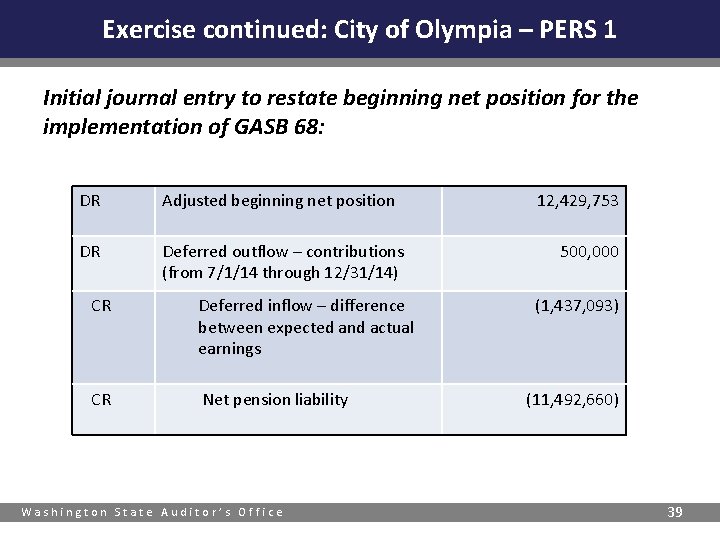
Exercise continued: City of Olympia – PERS 1 Initial journal entry to restate beginning net position for the implementation of GASB 68: DR Adjusted beginning net position DR Deferred outflow – contributions (from 7/1/14 through 12/31/14) CR Deferred inflow – difference between expected and actual earnings CR Net pension liability Washington State Auditor’s Office 12, 429, 753 500, 000 (1, 437, 093) (11, 492, 660) 39
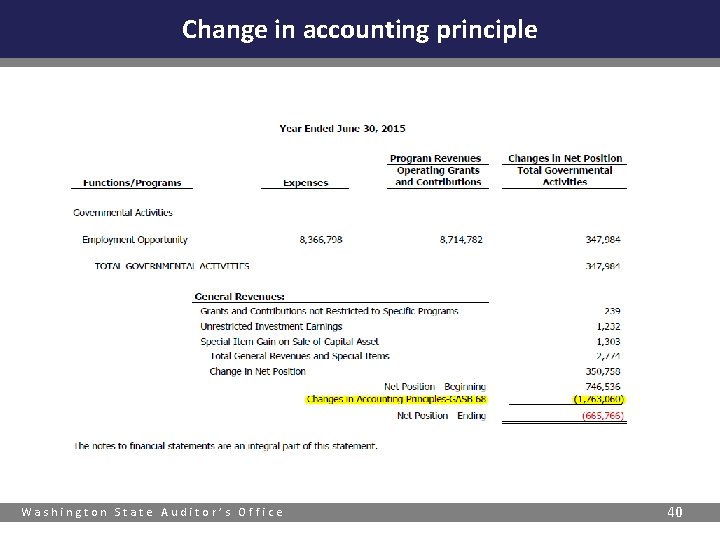
Change in accounting principle Washington State Auditor’s Office 40
Calculating year-end amounts Washington State Auditor’s Office 41
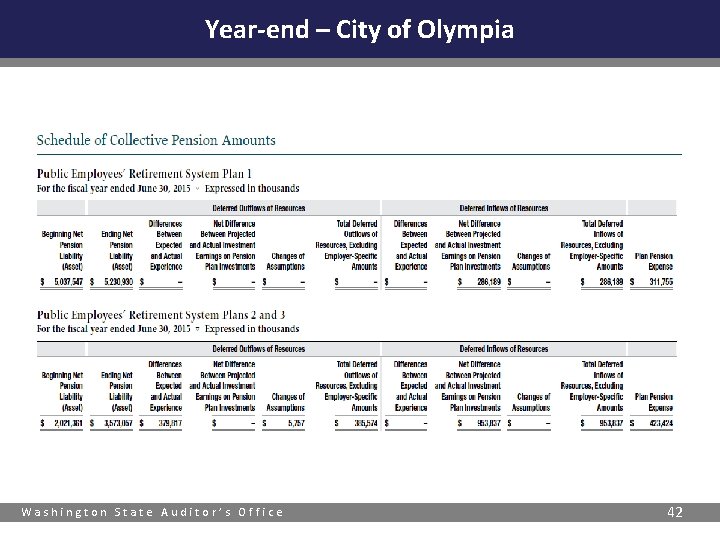
Year-end – City of Olympia Washington State Auditor’s Office 42
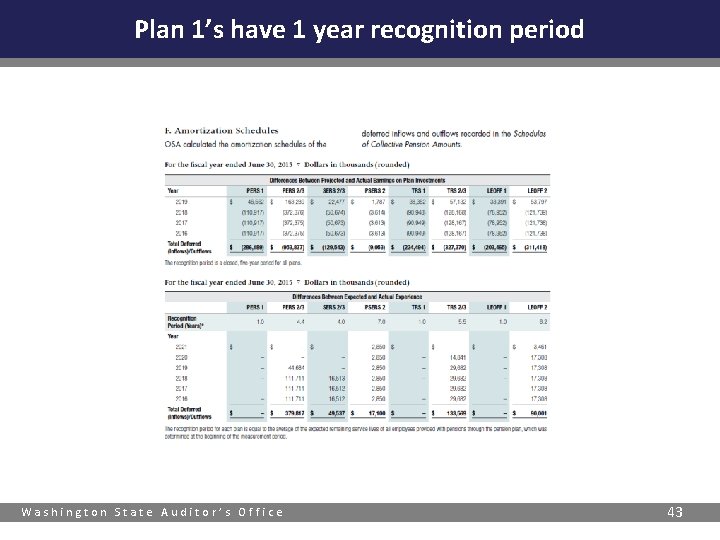
Plan 1’s have 1 year recognition period Washington State Auditor’s Office 43
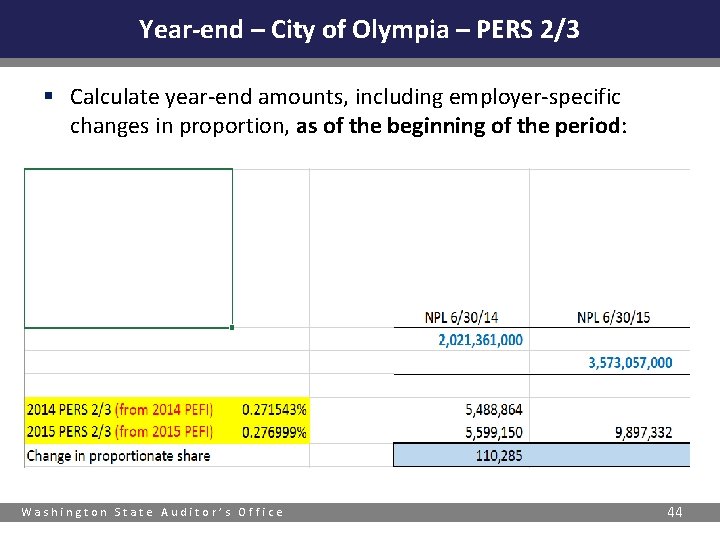
Year-end – City of Olympia – PERS 2/3 § Calculate year-end amounts, including employer-specific changes in proportion, as of the beginning of the period: Washington State Auditor’s Office 44
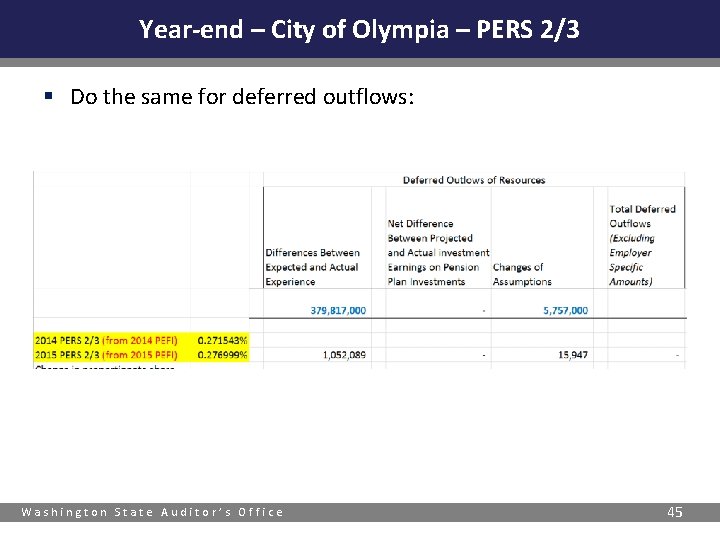
Year-end – City of Olympia – PERS 2/3 § Do the same for deferred outflows: Washington State Auditor’s Office 45
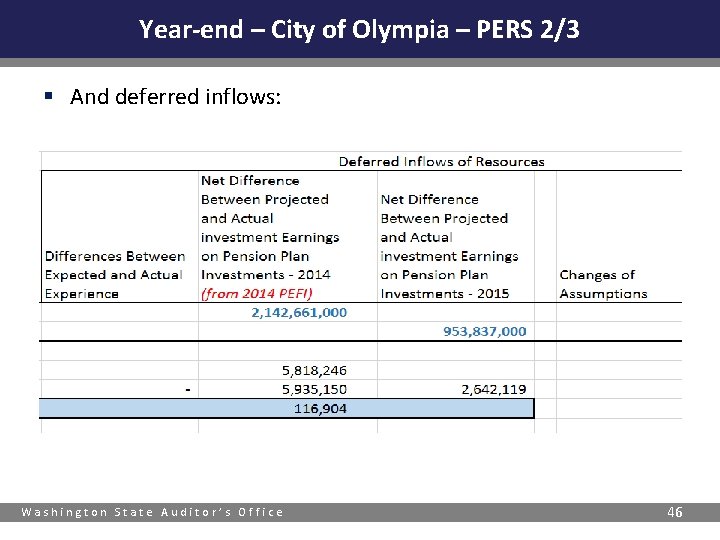
Year-end – City of Olympia – PERS 2/3 § And deferred inflows: Washington State Auditor’s Office 46
QUESTION #2 Q. Under GASB 68, contributions to pension plans are no longer expenses, but reductions of the pension liability. I’ll have to change my payroll accounting system. § TRUE § FALSE Washington State Auditor’s Office 47
ANSWER #2 A. FALSE! … Unless you want to. § You can use a suspense account to accumulate all the debits and credits to pension expense that result from GASB 68 journal entries. This adjustment can then be allocated to the various funds and activities for reporting in the financial statements. Washington State Auditor’s Office 48
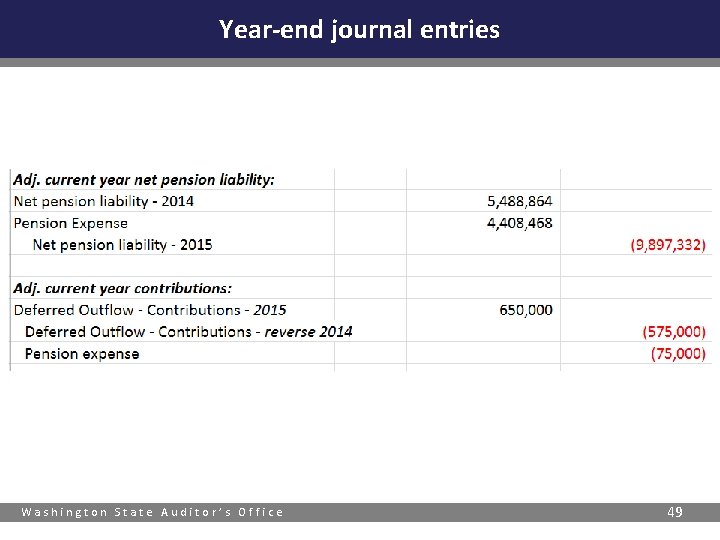
Year-end journal entries Washington State Auditor’s Office 49
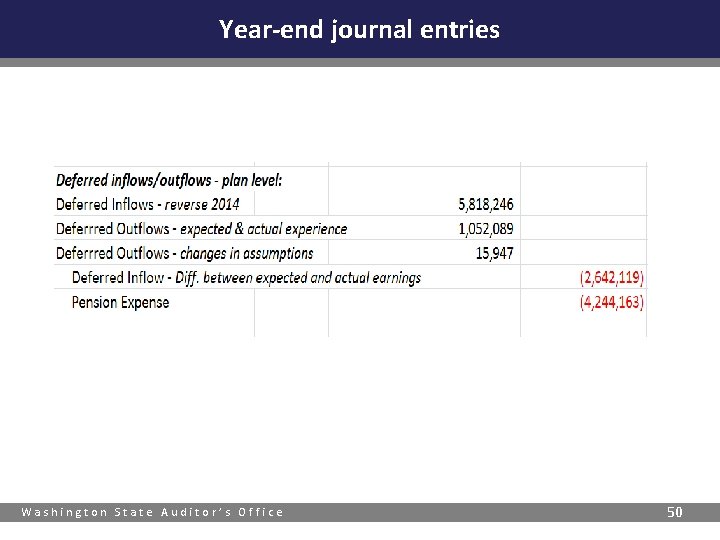
Year-end journal entries Washington State Auditor’s Office 50
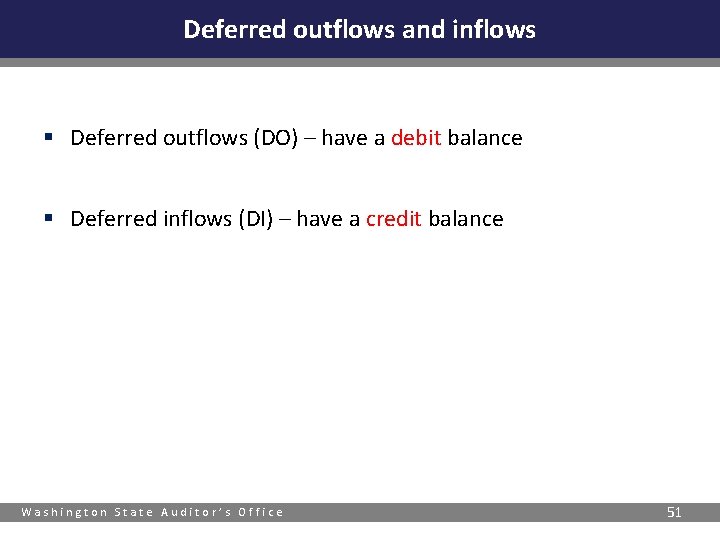
Deferred outflows and inflows § Deferred outflows (DO) – have a debit balance § Deferred inflows (DI) – have a credit balance Washington State Auditor’s Office 51
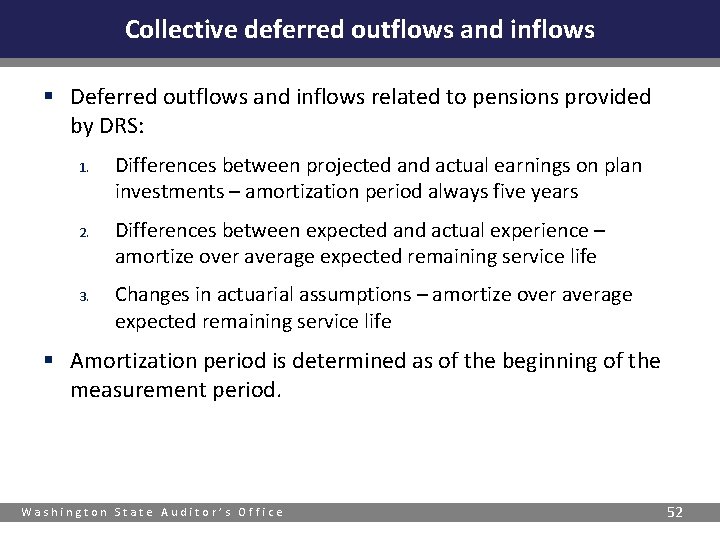
Collective deferred outflows and inflows § Deferred outflows and inflows related to pensions provided by DRS: 1. 2. 3. Differences between projected and actual earnings on plan investments – amortization period always five years Differences between expected and actual experience – amortize over average expected remaining service life Changes in actuarial assumptions – amortize over average expected remaining service life § Amortization period is determined as of the beginning of the measurement period. Washington State Auditor’s Office 52
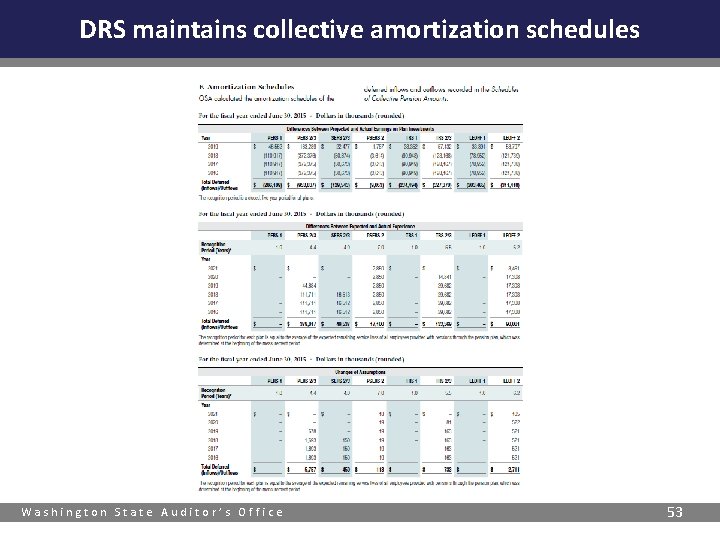
DRS maintains collective amortization schedules Washington State Auditor’s Office 53
Deferred outflows and inflows The recognition period of plan 1 (PERS, TRS, LEOFF) is only one year as of the beginning of the period. § No need to record and amortize changes in the employer’s proportionate share. These changes are already accounted for in the change in the net pension liability. Washington State Auditor’s Office 54
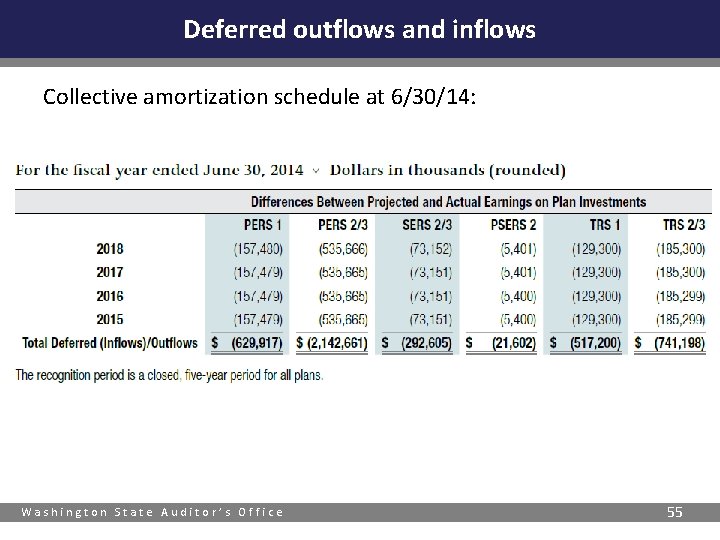
Deferred outflows and inflows Collective amortization schedule at 6/30/14: Washington State Auditor’s Office 55
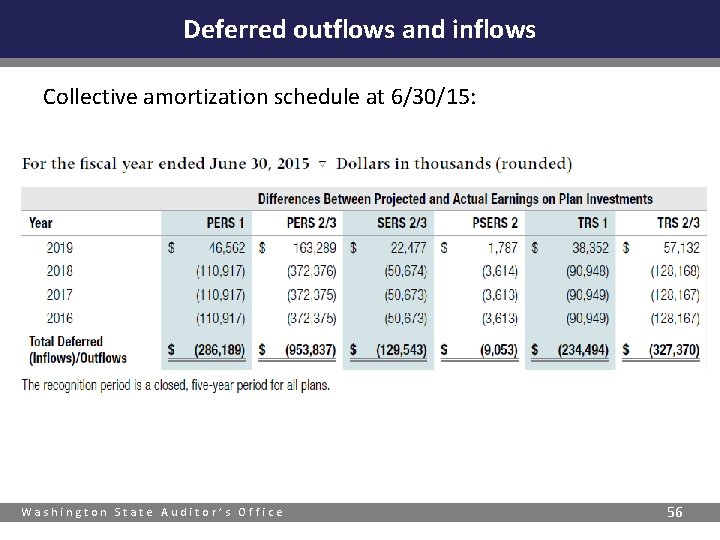
Deferred outflows and inflows Collective amortization schedule at 6/30/15: Washington State Auditor’s Office 56
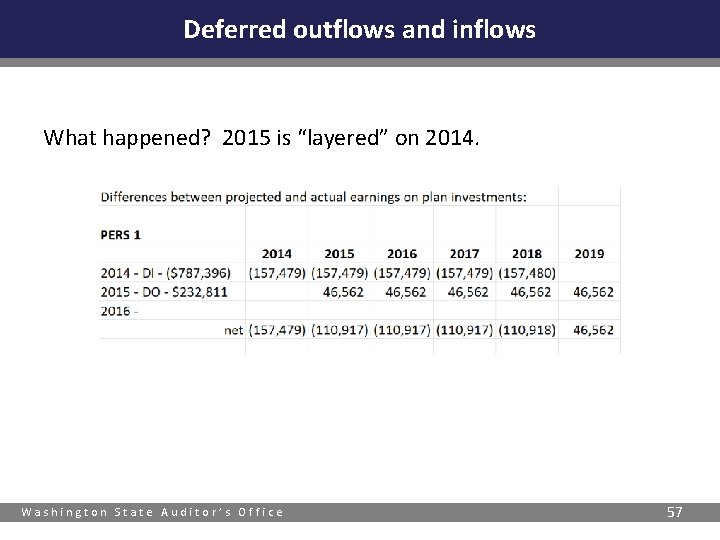
Deferred outflows and inflows What happened? 2015 is “layered” on 2014. Washington State Auditor’s Office 57
Deferred outflows and inflows § Employer-specific deferred outflows and inflows: 4. 5. Changes in proportion – will be amortized over average expected remaining service life Contributions subsequent to the measurement date – always a deferred outflow § Employers must maintain their own amortization schedules Washington State Auditor’s Office 58
Deferred outflows and inflows Changes in proportion - can be netted within the fiscal year but not across fiscal years. § Example from PERS 2 spreadsheet: q q q DO for change in proportion of pension liability - $110, 285 DI for change in proportion of net difference between projected and actual investment earnings – $116, 904 = net deferred inflow of $227, 189 Washington State Auditor’s Office 59
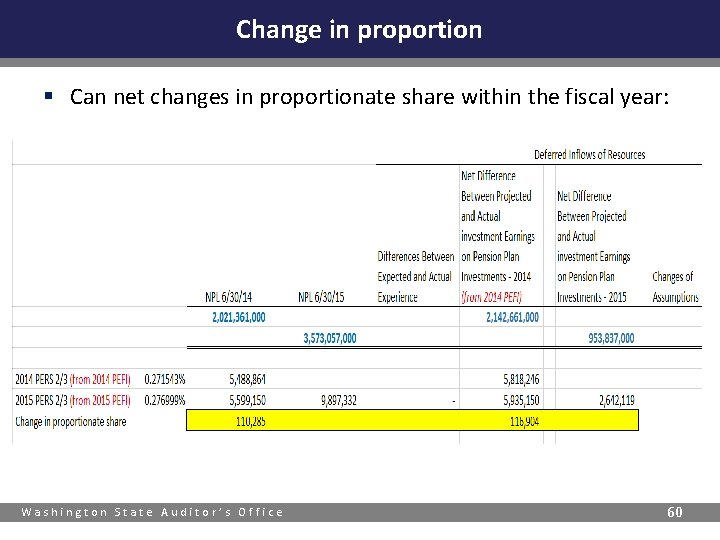
Change in proportion § Can net changes in proportionate share within the fiscal year: Washington State Auditor’s Office 60
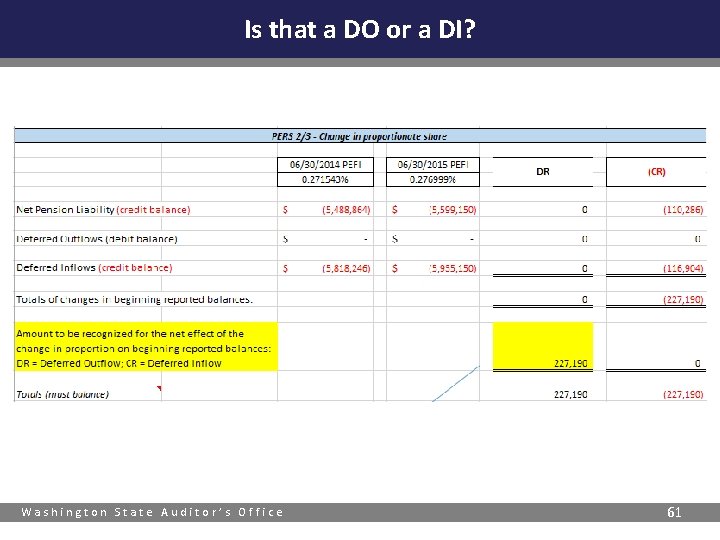
Is that a DO or a DI? Washington State Auditor’s Office 61
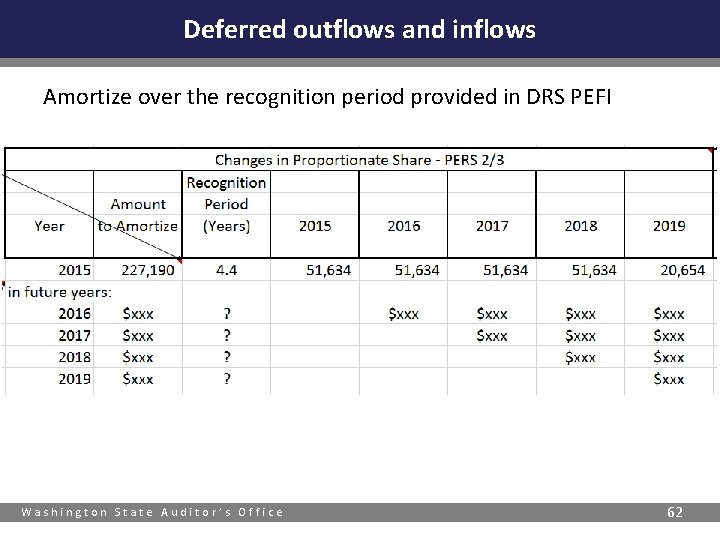
Deferred outflows and inflows Amortize over the recognition period provided in DRS PEFI Washington State Auditor’s Office 62
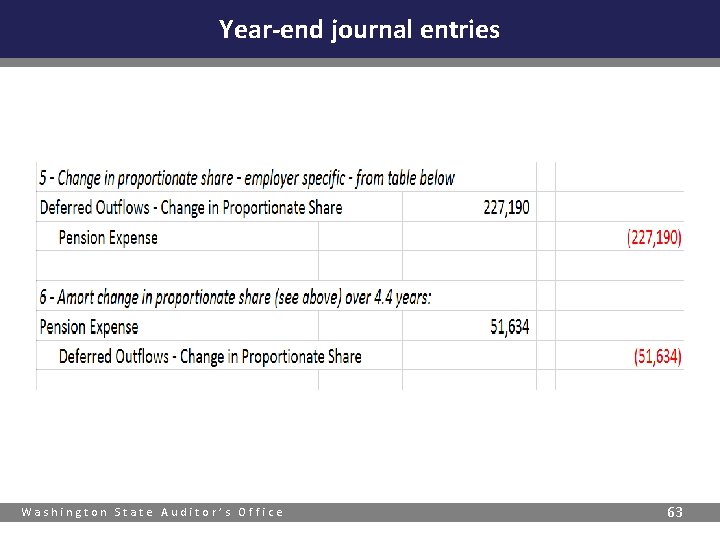
Year-end journal entries Washington State Auditor’s Office 63
Deferred outflows and inflows § The provisions of GASB statements “need not be applied to immaterial items. ” § Consider adopting an amortization threshold for DO/DI related to pensions, similar to setting a capitalization threshold for capital assets. § The threshold should be applied at the individual plan level and should be immaterial. Washington State Auditor’s Office 64
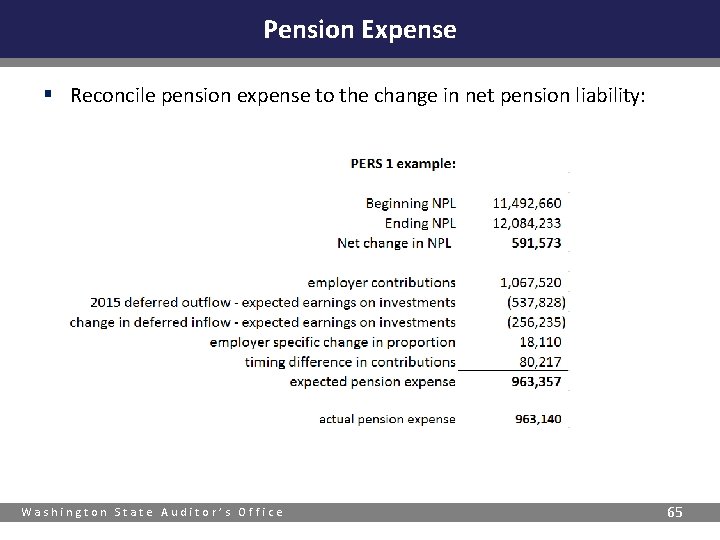
Pension Expense § Reconcile pension expense to the change in net pension liability: Washington State Auditor’s Office 65
Allocation to funds and activities Washington State Auditor’s Office 66
Allocation to funds and activities National Council on Governmental Accounting Statement 1 Long-term liabilities that are directly related to and expected to be paid from proprietary-type funds should be reported in those funds. Washington State Auditor’s Office 67
Allocation to funds and activities Statement of Net Position Allocate the net pension liability (or asset), deferred outflows and deferred inflows to governmental and business-type activities and each proprietary fund. Washington State Auditor’s Office 68
Allocation to funds and activities Operating statement Allocate the adjustment to pension expense by: § Allocating to governmental and business-type activities, by function, and each proprietary fund. § Governmental funds will be further allocated by function (that is, general government, public safety, transportation, social services, etc. – for the statement of activities). Washington State Auditor’s Office 69
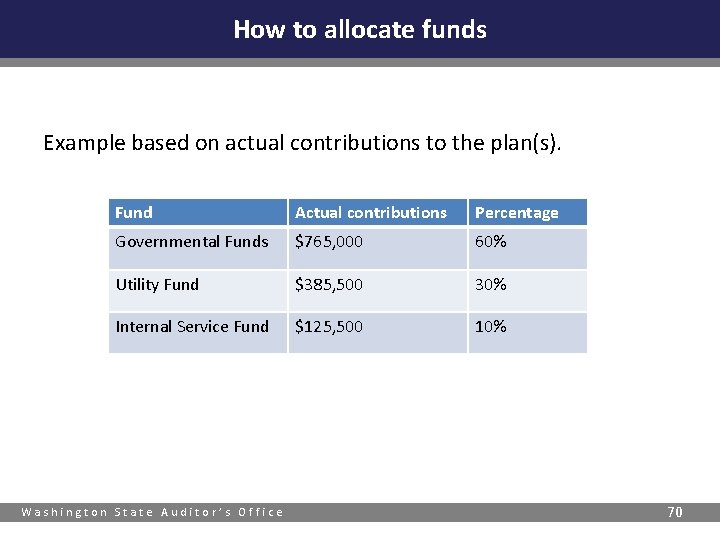
How to allocate funds Example based on actual contributions to the plan(s). Fund Actual contributions Percentage Governmental Funds $765, 000 60% Utility Fund $385, 500 30% Internal Service Fund $125, 500 10% Washington State Auditor’s Office 70
QUESTION #3 Q. I don’t have any Plan 1 members and don’t make any Plan 1 contributions, but I have a portion of the Plan 1 liability. How can I allocate the liability if I don’t have any contributions? § A. You can’t. § B. Use your plan 2 contributions as your allocation base. Washington State Auditor’s Office 71
ANSWER #3 B. Use your Plan 2 contributions as your allocation base. Washington State Auditor’s Office 72
LEOFF special funding situation § LEOFF Plans 1 & 2 include a “special funding situation” in which the state, as a non-employer contributing entity, has a legal obligation to make contributions directly to the plans (RCW 41. 26. 275). § Although the state makes the contributions, individual employers are required to recognize pension expense and an equal amount of revenue for their share of these contributions. Note: LEOFF 1 is fully funded and there have been no contributions since 2000. Washington State Auditor’s Office 73
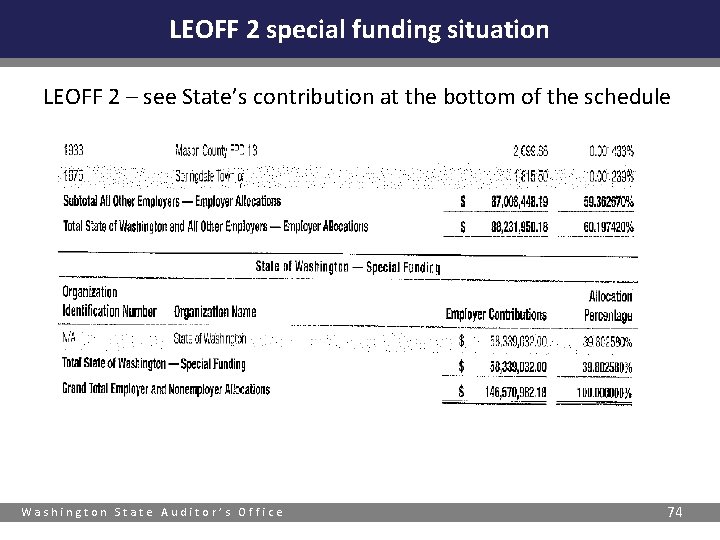
LEOFF 2 special funding situation LEOFF 2 – see State’s contribution at the bottom of the schedule Washington State Auditor’s Office 74
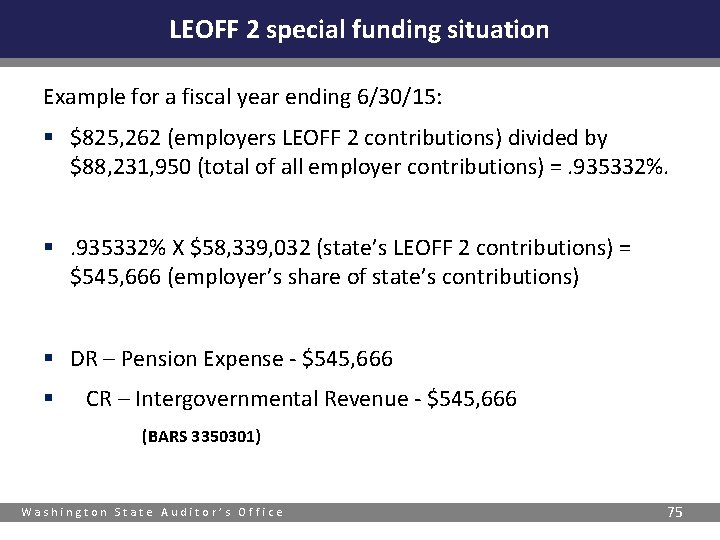
LEOFF 2 special funding situation Example for a fiscal year ending 6/30/15: § $825, 262 (employers LEOFF 2 contributions) divided by $88, 231, 950 (total of all employer contributions) =. 935332%. §. 935332% X $58, 339, 032 (state’s LEOFF 2 contributions) = $545, 666 (employer’s share of state’s contributions) § DR – Pension Expense - $545, 666 § CR – Intergovernmental Revenue - $545, 666 (BARS 3350301) Washington State Auditor’s Office 75
VFFRPF Volunteer Fire Fighters and Reserve Officers Relief and Pension Fund The only state-sponsored, cost-sharing, multi-employer plan that is not administered by DRS. § Administered by State Board for Volunteer Fire Fighters and Reserve Officers § Approximately 500 participating local governments § State contributes 40 percent of fire insurance premium tax § Not a special funding situation Washington State Auditor’s Office 76
How to handle VFFRPF Where do we get the information? § The State Board will publish, on its website, its own schedule of each municipality’s contributions, proportion percentage, and proportionate share ($) of the net pension liability (or asset). § Expected by 12/31 of each year for the 6/30 measurement date. § Nothing for you to calculate! § Plan is not considered material: no DO/DI or census data testing. Washington State Auditor’s Office 77
Local government plans Washington State Auditor’s Office 78
Local government plans - Does GASB 68 apply? GASB 68 is applicable to pension plans that are administered through trusts or equivalent arrangements in which: a. b. c. Contributions to the plan and earnings on those contributions are irrevocable Pension plan assets are dedicated to providing pensions to members in accordance with benefit terms Pension plan assets are legally protected from the creditors of employers, the plan administrator and plan members Washington State Auditor’s Office 79
Local government plans - Does GASB 68 apply? § The way in which individual local governments have established their pre-LEOFF I police and firefighter plans determines whether they meet GASB 68 criteria. § Local governments with these plans should: q Review establishing legislation q Consult with legal counsel regarding the status of the plans § The State Auditor’s Office will not do this analysis or make this determination. Washington State Auditor’s Office 80
Local government plans - Does GASB 68 apply? § Plans that do not meet the criteria can report under the previous standards (GASB 25/27) for 2015 and 2016 § They should then implement GASB 73 in 2017 Washington State Auditor’s Office 81
GASB Statement No. 73 GASB 73 – Accounting and Financial Reporting for Pensions and Related Assets that are not within the scope of GASB 68 § Provisions regarding assets are effective for FYE 2016 § Remainder effective for FYE 2017 Washington State Auditor’s Office 82
GASB Statement No. 73 Substantially the same as GASB 68 except: § Employer recognizes the total pension liability – not the net pension liability. q Accumulated assets are not netted against the total pension liability. Washington State Auditor’s Office 83
Local government plans § Pension liability (or asset), deferred outflows and deferred inflows related to pensions will be determined by your actuarial valuation. § Actuarial valuation – The valuation date can be no more than 30 months and one day prior to the employer’s year end. Washington State Auditor’s Office 84
Local government plans § Valuations should be performed at least biennially by a qualified actuary, and more often if significant changes occur. § Plans may have different valuations for different purposes (accounting vs. funding). § Whether a plan reports under the new pension standards (GASB 67/68) or the old standards (GASB 25/27), the valuation should be appropriate for accounting under those standards. Washington State Auditor’s Office 85
Local government plans Financial statements § The net pension liability (total pension liability less fiduciary net position) is a liability of the employer to the plan. It is not a liability of the plan to itself. § Neither the total pension liability nor the net pension liability is reported as a liability in the pension trust fund. Washington State Auditor’s Office 86
Local government plans § When you implement GASB 68, don’t forget to reverse any existing net pension obligation (NPO) or net pension asset under the old reporting standards. Washington State Auditor’s Office 87
Local government plans § Caution! Postemployment healthcare benefits, even if they are provided as part of a pension plan, are considered OPEB for accounting purposes. § If an old, closed plan is providing OPEB benefits, those benefits need to be reported under GASB 45. Washington State Auditor’s Office 88
GASB Statement No. 78 GASB 78 – Pensions Provided Through Certain Multiple. Employer Defined Benefit Pension Plans § Effective FYE 2016 Washington State Auditor’s Office 89
GASB Statement No. 78 Criteria § Plan is not a state or local government pension plan § Plan provides defined benefit pensions to both governmental and non-governmental employees § Plan has no predominant state or local governmental employer § Example – a union sponsored plan Washington State Auditor’s Office 90
GASB Statement No. 78 § No pension liability or deferred outflows or deferred inflows § Pension expense = Contributions to the plan § Note disclosures § RSI – 10 -year schedule of employer contributions Washington State Auditor’s Office 91
Financial statements Washington State Auditor’s Office 92
Financial statements Q. How do I report a negative pension liability? A. A negative pension liability is an asset. § It is not a receivable from the plan because contributions to a plan are irrevocable. § Pension liabilities and assets should be reported separately; do not net. Washington State Auditor’s Office 93
Financial statements § A net pension liability should be reported as unrestricted: a component of unrestricted net position § A net pension asset should be reported as a restricted asset: a component of restricted net position § Deferred outflows and deferred inflows related to pensions are unrestricted: a component of unrestricted net position Washington State Auditor’s Office 94
Financial statements Q. I present comparative financial statements. Do I have to restate the prior year? A. GASB 68, paragraph 137, states: “To the extent practical. . . The financial statements presented for the periods affected should be restated. ” Washington State Auditor’s Office 95
Notes and required supplementary information See BARS Manual for guidance: § Implementation guidance in the Accounting – Liabilities section § Notes and RSI – templates for state plans and cash-basis entities in the Templates section § Notes and RSI – instructions for GAAP-basis local government plans in the Reporting section § Notes guidance for defined contribution plans in the Reporting section Washington State Auditor’s Office 96
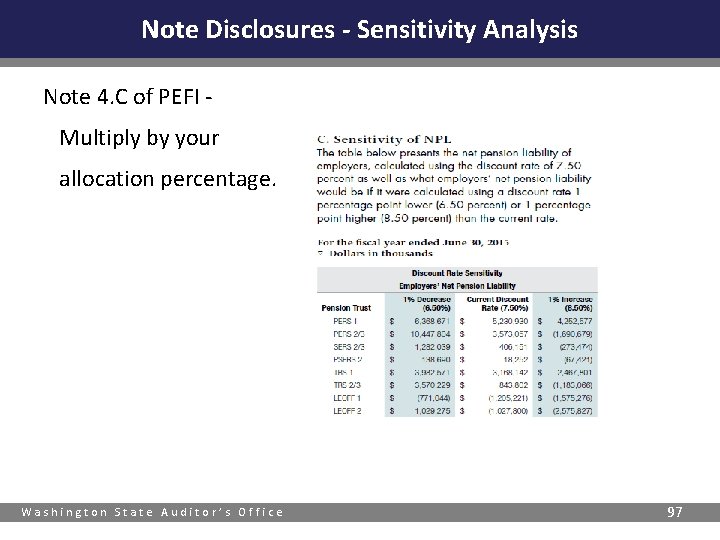
Note Disclosures - Sensitivity Analysis Note 4. C of PEFI Multiply by your allocation percentage. Washington State Auditor’s Office 97
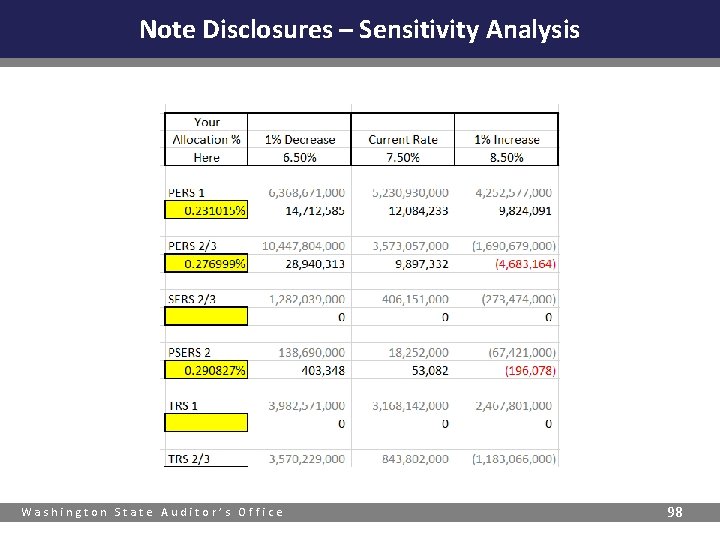
Note Disclosures – Sensitivity Analysis Washington State Auditor’s Office 98
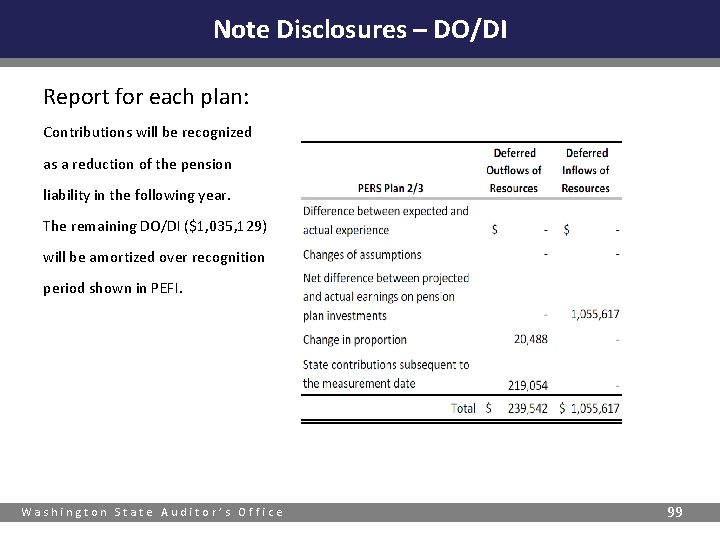
Note Disclosures – DO/DI Report for each plan: Contributions will be recognized as a reduction of the pension liability in the following year. The remaining DO/DI ($1, 035, 129) will be amortized over recognition period shown in PEFI. Washington State Auditor’s Office 99
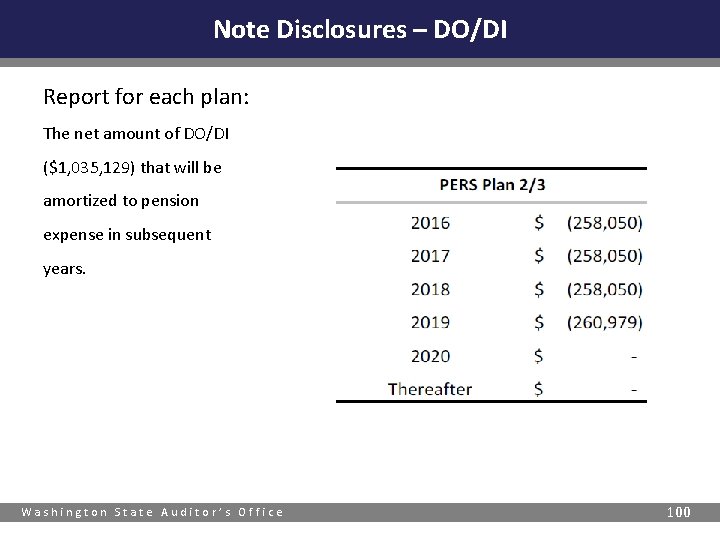
Note Disclosures – DO/DI Report for each plan: The net amount of DO/DI ($1, 035, 129) that will be amortized to pension expense in subsequent years. Washington State Auditor’s Office 100
Required Supplementary Information RSI schedules currently require “covered-employee payroll” to be reported: § Covered-employee payroll is entire payroll of employees that are members of the pension plan. This was a change from the previous standards. However, you can now ignore this. § Covered payroll is the portion of payroll on which contributions to the plan are based. This is the definition under the previous standards. GASB is amending 67/68/73 to conform to this definition. Use this definition for reporting in RSI. Washington State Auditor’s Office 101
QUESTION #4 Q. Can’t I just pay off my pension liability? A. Yes B. No C. It depends Washington State Auditor’s Office 102
ANSWER #4 Single plan employers (like those with the old police and firefighter plans) can reduce their pension liability by funding the plan. But members of the state’s cost-sharing plans cannot affect their individual liabilities through additional funding because all assets and liabilities of the plan are shared by all participating employers. Washington State Auditor’s Office 103
Census data testing Washington State Auditor’s Office 104
Census Data Testing Census data is information about plan members the actuary uses to perform the valuation – that is, to determine the total pension liability § Examples: q Date of birth q Gender q Service credit q Compensation q Contributions Washington State Auditor’s Office 105
Census data must be audited § Completeness and accuracy of census data affects the accuracy of the actuarial valuation. § The valuation affects the accuracy of the Schedule of Collective Pension Amounts. q Pension liability/(asset), deferred outflows/inflows, pension expense § The completeness and accuracy of employer contributions affects the accuracy of the Schedule of Employer Allocations. q Employer’s allocation percentage Washington State Auditor’s Office 106
Census data audits – Why pick me? Employers are selected by tiered random sample: § Greater than 20% of plan contributions – annually § From 5% to 20% – every 5 years § From 2% in the aggregate to less than 5% – every 10 years § Less than 2% in the aggregate – never Washington State Auditor’s Office 107
Other post-employment benefits (OPEB) Washington State Auditor’s Office 108
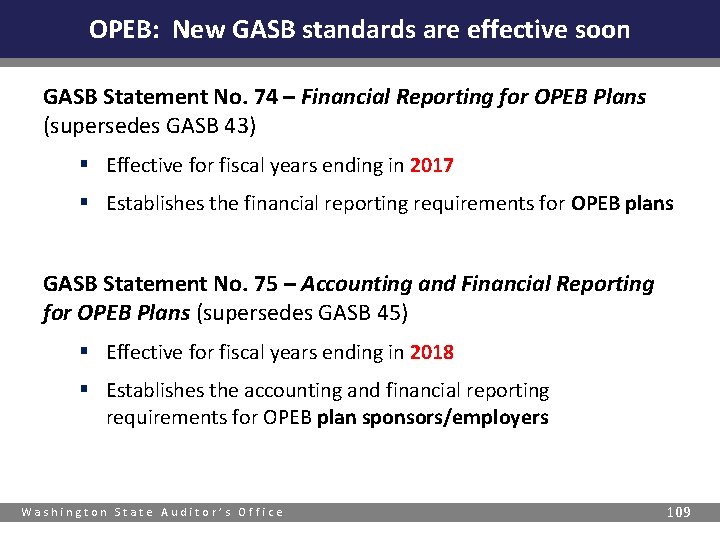
OPEB: New GASB standards are effective soon GASB Statement No. 74 – Financial Reporting for OPEB Plans (supersedes GASB 43) § Effective for fiscal years ending in 2017 § Establishes the financial reporting requirements for OPEB plans GASB Statement No. 75 – Accounting and Financial Reporting for OPEB Plans (supersedes GASB 45) § Effective for fiscal years ending in 2018 § Establishes the accounting and financial reporting requirements for OPEB plan sponsors/employers Washington State Auditor’s Office 109
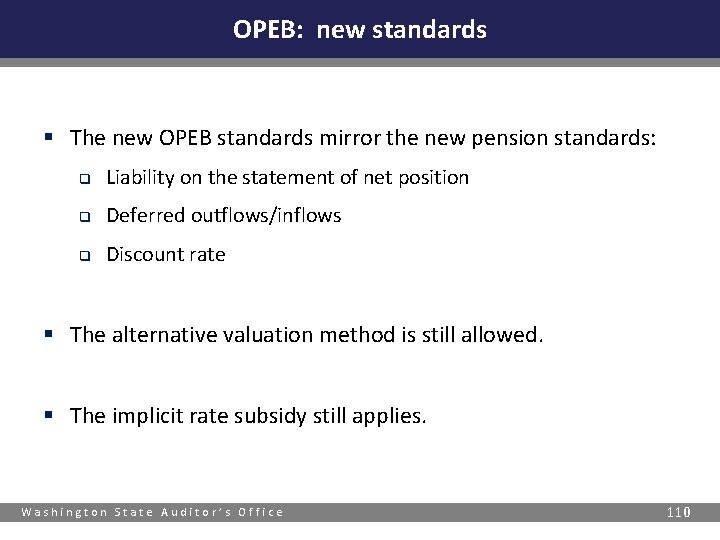
OPEB: new standards § The new OPEB standards mirror the new pension standards: q Liability on the statement of net position q Deferred outflows/inflows q Discount rate § The alternative valuation method is still allowed. § The implicit rate subsidy still applies. Washington State Auditor’s Office 110
Resources online § Department of Retirement Systems (DRS) – Employers – New GASB Standards web page www. drs. wa. gov § Governmental Accounting Standards Board (GASB) www. gasb. org q Statements q Implementation Guides q Podcasts q Fact Sheets Washington State Auditor’s Office 111
Resources at the State Auditor’s Office Contact the Local Government Support team q Debra Burleson, CPA, Assistant Audit Manager § Debra. Burleson@sao. wa. gov q Philip Mendoza, CPA, Assistant Audit Manager § Philip. Mendoza@sao. wa. gov Washington State Auditor’s Office 112
- Slides: 112