
Implementing Flipped Learning In Neuroradiology Instruction Erin OConnor


- Slides: 35
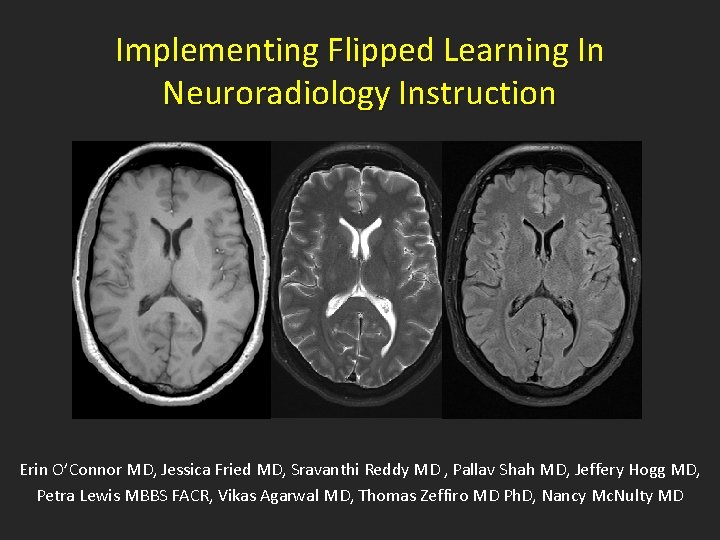
Implementing Flipped Learning In Neuroradiology Instruction Erin O’Connor MD, Jessica Fried MD, Sravanthi Reddy MD , Pallav Shah MD, Jeffery Hogg MD, Petra Lewis MBBS FACR, Vikas Agarwal MD, Thomas Zeffiro MD Ph. D, Nancy Mc. Nulty MD
What is flipped learning?
Flipped Learning Definition • Pedagogical approach that inverts the typical cycle of knowledge acquisition and application • Self-paced learning used to prepare for participation in class • Educators guide learners in the application of knowledge and key concepts in an interactive learning environment that encourages the use of higher order thinking skills Sams A, Bergmann J, Daniels K, Bennett B, Marshall HW, Arfstrom KM. Flipped Learning Network (FLN). (2014) The Four Pillars of F-L-I-P™.
Flipped Learning Definition
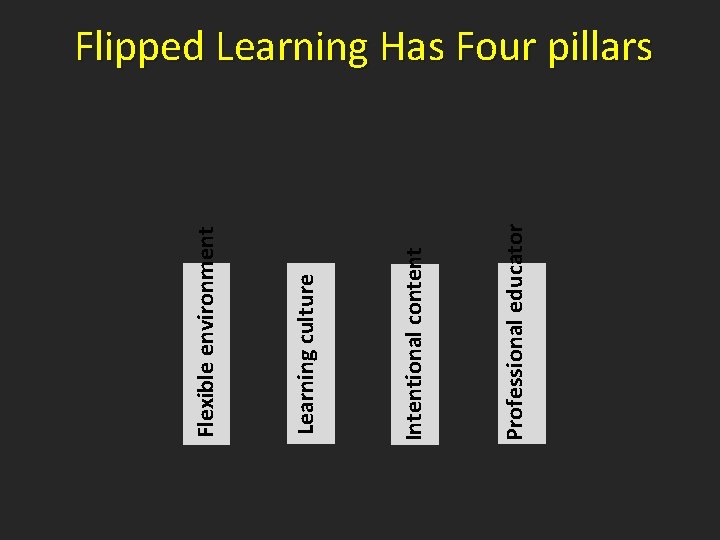
Professional educator Intentional content Learning culture Flexible environment Flipped Learning Has Four pillars
Flexible Environment • Provides – Different ways to learn – Self-paced learning using online tutorials, video, and pre-recorded lectures • Adapts the teaching session to learners’ needs – More time for concepts that learners find more challenging – Less time on concepts that learners have already mastered
Learning Culture • Shifts instruction to a learner-centered approach – Learners engage in activities without the instructor being central • Allows active knowledge construction – Understanding derived from what the learners themselves have constructed • Allows personally meaningful learning – Provide clinical contexts that enable learners to see applications to medical practice
Intentional Content • To maximize classroom time, instructors determine – What materials learners can explore on their own – What concepts should be taught or reinforced during class time
Professional Educator • Observes learners – Redirects – Provides clarification – Asks challenging open-ended questions • Provides feedback relevant in the moment • Is available to help struggling learners
Professional Educator • Can focus on the learners rather than on delivery of material • Guides learners to – Deeper thinking – Higher levels of application • Brings personality, passion and experience to class
Flipped Learning in Radiology Results In: • Increased academic achievement • Increased task value – Learners’ judgments of how interesting, important and useful an educational activity is to them • More positive achievement emotions associated with the learning activity – Increased enjoyment – Less boredom O’Connor et al. Academic Radiology 2016.
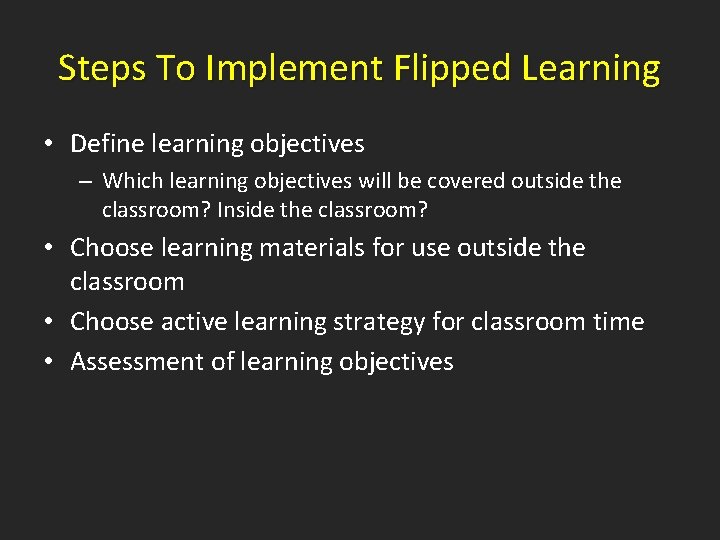
Steps To Implement Flipped Learning • Define learning objectives – Which learning objectives will be covered outside the classroom? Inside the classroom? • Choose learning materials for use outside the classroom • Choose active learning strategy for classroom time • Assessment of learning objectives
Step 1: Learning Objectives • Defining the learning objectives will: – Guide your choice of learning materials – Facilitate your choice of active learning strategy – Improve communication to learners about expectations • Avoid cognitive overload! – Learners are unable to process when given too much information
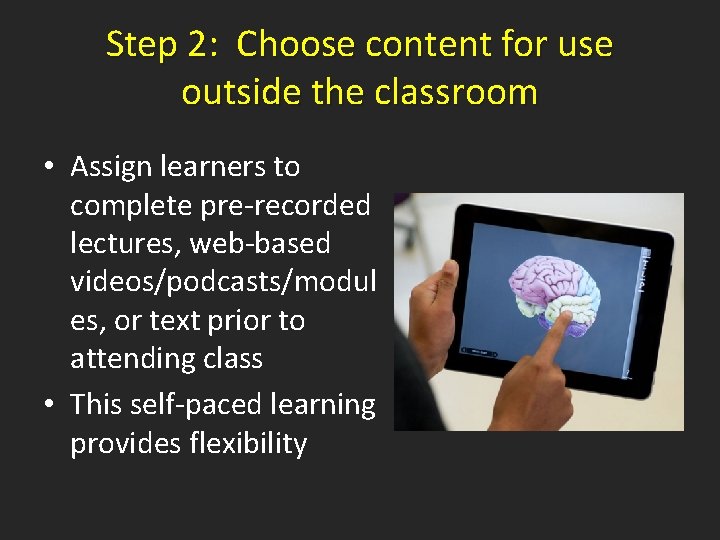
Step 2: Choose content for use outside the classroom • Assign learners to complete pre-recorded lectures, web-based videos/podcasts/modul es, or text prior to attending class • This self-paced learning provides flexibility
Step 2: Choose content for use outside the classroom • Head neck brain spine – http: //headneckbrainspine. com/ • RADPrimer – http: //www. radprimer. com/ • Med. U – www. med-u. org • Radiology Channel – You Tube – https: //www. youtube. com/user/Radiology. Channel • Radiology. Education. com – http: //www. radiologyeducation. com/ Just suggestions. A Google search will reveal a myriad of options!
Step 2: Choose content for use outside the classroom Critique the learning materials you plan to use for: • Quality assurance • Appropriate level of instruction • Enough time for learners to complete the assignment
Step 2: Choose content for use outside the classroom • Give your learners enough time to complete the assignment prior to attending class – At least one week in advance – Email them reminders • Limit the length of the assignments – 30 -60 mins – Coordinate with other faculty
Step 3: Choose active learning strategy for classroom time Examples of active learning strategies: • Peer to peer teaching • Recitation • Employ portable computing devices • Problem-based learning
Step 3: Choose active learning strategy for classroom time • Steer away from traditional didactics – Passive learning does not engage the learner “Lectures are a way of transferring the instructor’s lecture notes to the students’ notebooks without passing through the brains of either. ” -Edwin Emery Slosson
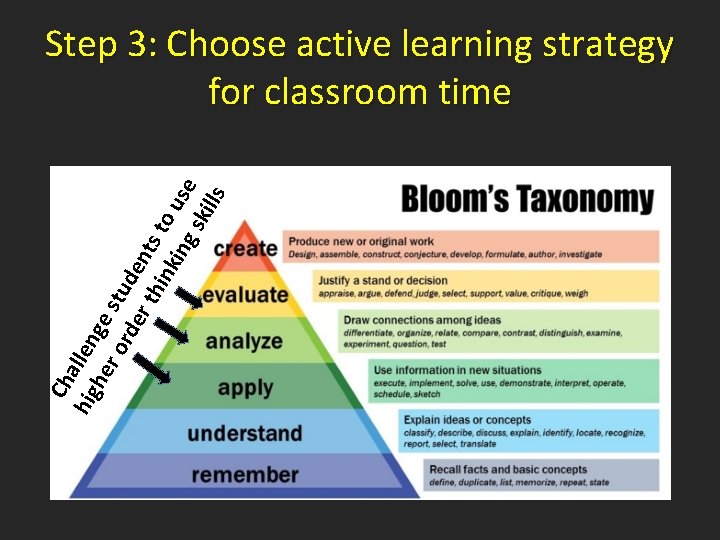
Ch hig allen he ge r o stu rde de r th nts ink to ing use ski lls Step 3: Choose active learning strategy for classroom time
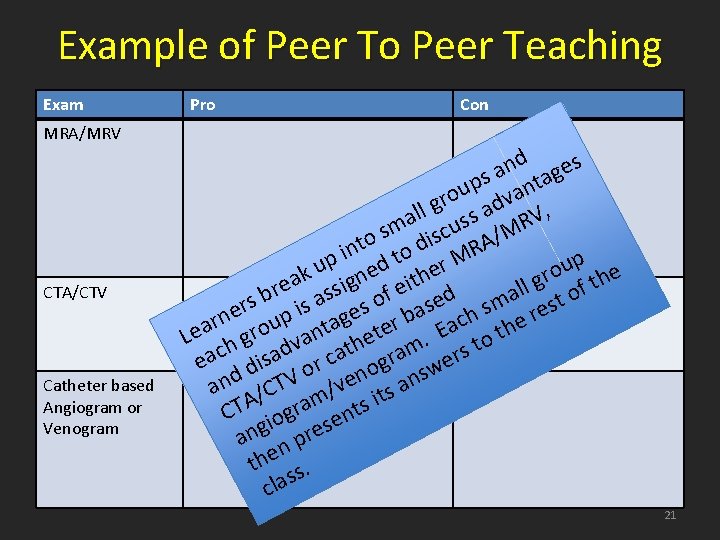
Example of Peer To Peer Teaching Exam Pro Con MRA/MRV CTA/CTV Catheter based Angiogram or Venogram nd ges a s nta p u o dva r g ll ss a RV, a sm iscu A/M o t od R n i t M p p r d u u e e o e k ign r h h a t g t i e l f l r ass of e a o b d t e s m s r p is s bas h s e e e r n g c the r rou a ter a a t E e n L hg a the m. v to d c s a a a r ea dis or c ogr swe n and /CTV m/ve its an CTA iogra sents ang n pre the s. s cla 21
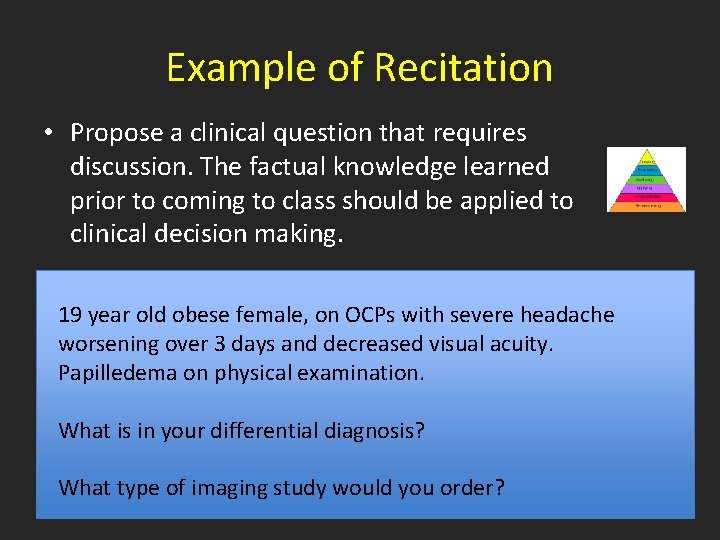
Example of Recitation • Propose a clinical question that requires discussion. The factual knowledge learned prior to coming to class should be applied to clinical decision making. 19 year old obese female, on OCPs with severe headache worsening over 3 days and decreased visual acuity. Papilledema on physical examination. What is in your differential diagnosis? What type of imaging study would you order?
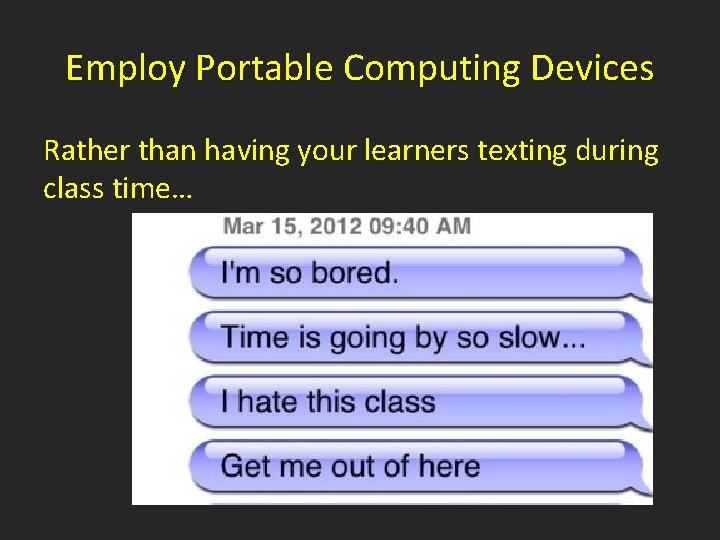
Employ Portable Computing Devices Rather than having your learners texting during class time…
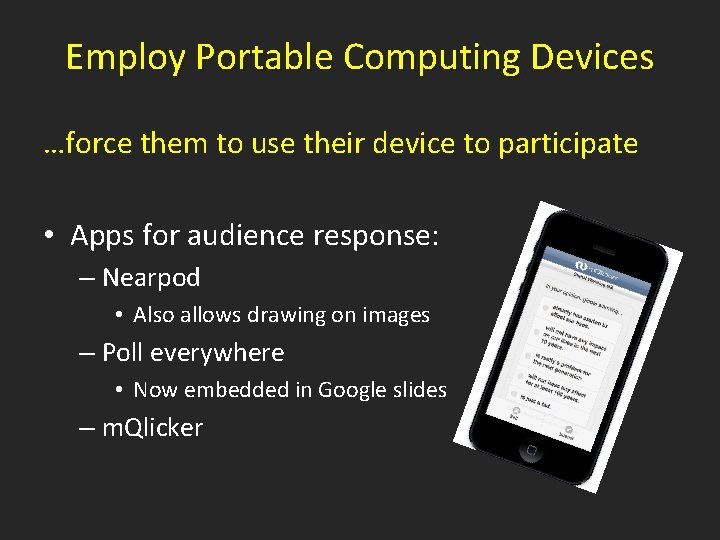
Employ Portable Computing Devices …force them to use their device to participate • Apps for audience response: – Nearpod • Also allows drawing on images – Poll everywhere • Now embedded in Google slides – m. Qlicker
Employ Portable Computing Devices …force them to use their device to participate • Apps for drawing: – 2 screens • Presentation Expert with integrated web browser and white board – Doceri • Interactive whiteboard for i. Pad, screencasting
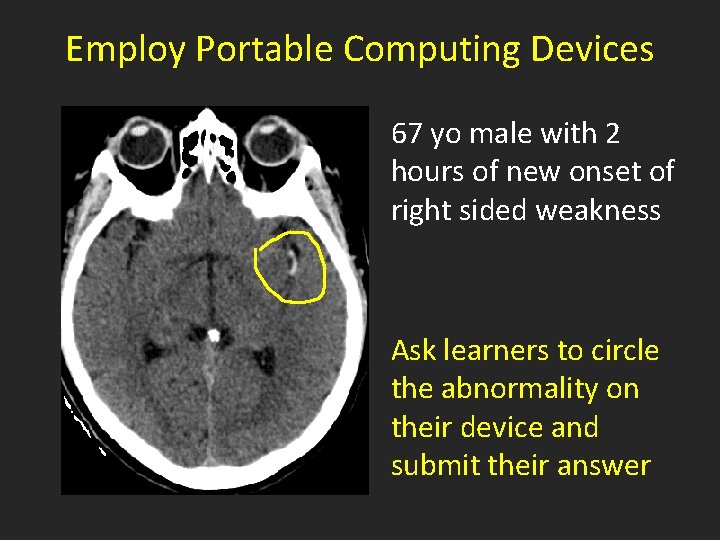
Employ Portable Computing Devices 67 yo male with 2 hours of new onset of right sided weakness Ask learners to circle the abnormality on their device and submit their answer
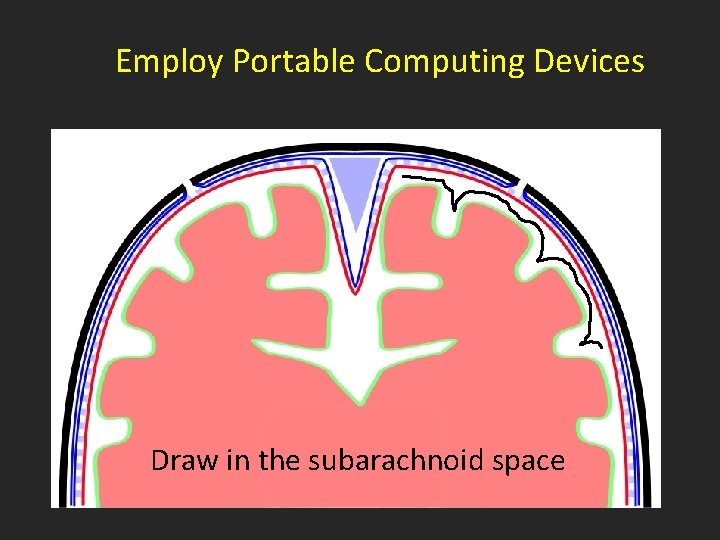
Employ Portable Computing Devices Draw in the subarachnoid space
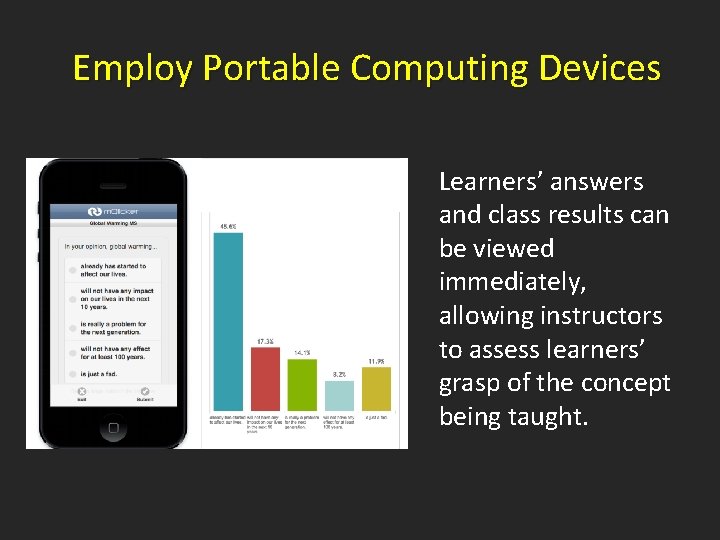
Employ Portable Computing Devices Learners’ answers and class results can be viewed immediately, allowing instructors to assess learners’ grasp of the concept being taught.
Step 4: Assessment Did learners meet learning objectives?
Step 4: Assessment • Administer a quiz prior to commencement of active learning in class – Insight into which concepts need reinforcement
Step 4: Assessment Begin in class active learning with the questions: “What was difficult? What needs clarification? ”
Step 4: Assessment • Formative assessment for learners in process – Provide feedback for improvement • Pre-test/post-test before to assess advances in knowledge achieved during the session • Summative assessment – Resident: ACR In-Training Exam • Assessment of long term retention of knowledge – Student: Radiology Examweb • http: //radiology. examweb. com/
Conclusions Using flipped learning in neuroimaging instruction: • Learning outside of class is self-paced • Class time is more efficient and effective • Class sessions can be adapted to meet the needs of learners • Technology can be integrated into learning to enhance educational experiences
Conclusion It is not what you teach, it is what your audience learns Read more at: http: //www. academicradiology. org/article/S 10766332%2816%2900113 -6/abstract
Acknowledgments This work was supported by a grant from Med. U