
Implementing ELearning Solutions By Linette Richie 2012 What
Implementing E-Learning Solutions By, Linette Richie 2012
What is E-Learning
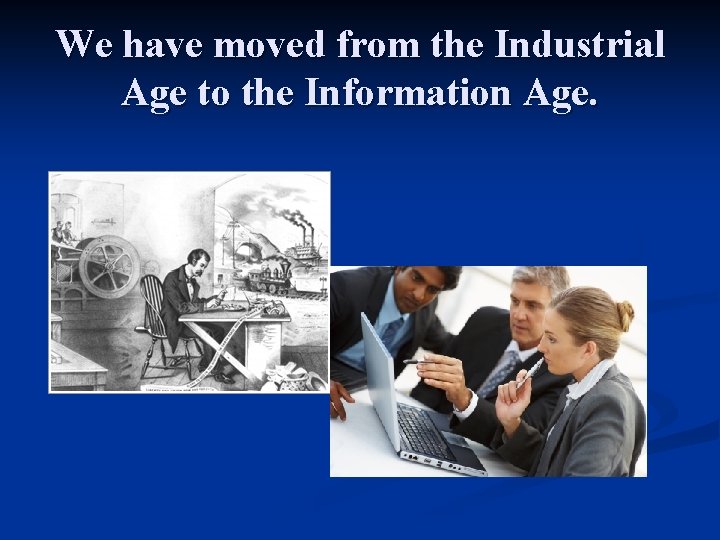
We have moved from the Industrial Age to the Information Age.
Planning/ Development Process and the Delivery/ Learning Process
How Can This Happen? n n Instructors and curriculum developers can share resources more easily and together build learningobject repositories. Multimedia and expanded resources from the network can enhance the traditional classroom experience dramatically. Online synchronous tools create a new kind of cyberclassroom, connecting distance learners from any where in peer-to-peer engagement. Online self-paced tutorials create enriched interactive and exploratory learning experiences that are accessible on-demand at any time when a learner is ready.
E-Learning Includes Important Educational Elements Web-based student enrollment n Tracking and class administration n Email communication between learner and instructor n Internet research for exploratory learning n Digital collaboration n Virtual classrooms n Computer labs to enhance the classroom. n
Learners Can Communicate, Collaborate and Interact n n n n Multimedia instruction ("anytime, anywhere" — asynchronous learning) Live "virtual classrooms" (synchronous learning) Streaming video and audio Internet phone Instructor resource sharing (instructors are now collaborating and building shared curriculum archive in ways never before possible) Enhanced instructor-student and student-student communication Global access to learners and instructors.
n E-Learning tools are not meant to replace the direct human-to-human contact of the classroom.
A New Set of Tools
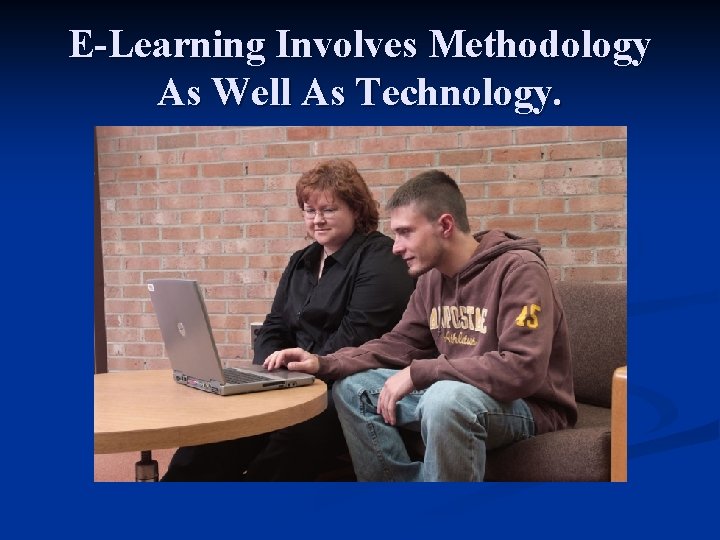
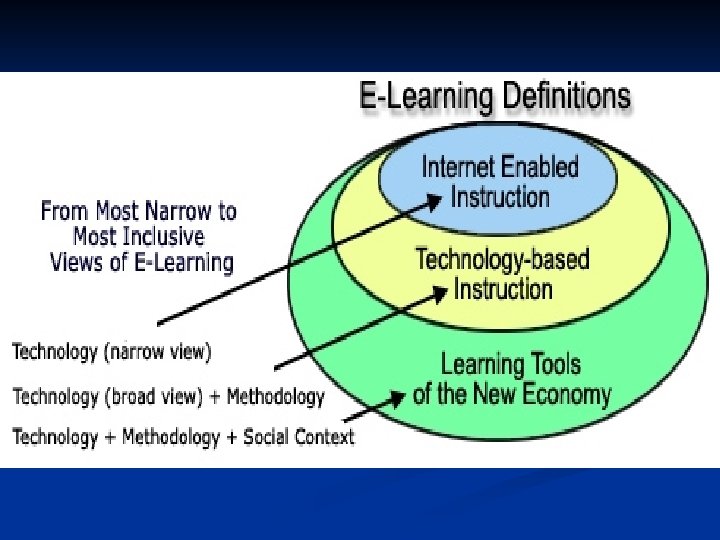
E-Learning Involves Methodology As Well As Technology.
Four Primary Goals of E-Learning Process & Goal: "information vs. instruction" (broadcast, transfer, develop & certify) n Content: "scope & depth" (awareness, understanding, use & mastery) n Learning Tasks: "simple vs. complex" (degree of required practice & interaction) n Development Time: "rapid vs. robust" (amount of time / effort required for product development). n
The Focus on “Technology-Based Instruction" Particularly Includes: n n New online collaboration tools — which support team learning, mentoring, and especially virtual classrooms "Blended Learning" — which combines Internet delivery with the traditional classroom and textbooks Advances in instructional design — such as "interactive multimedia, " "learning object, " "personalization, " and "simulation Earlier electronic technologies — such as audiotape, videotape and videoconferencing are recognized as essential tools.
Best Practices for Media Use Typical Tools 1. 2. 3. Simple WBT courseware Virtual Classroom (live & recorded) Blended Learning
Learner Interaction Read n Listen n Answer questions n Relate accurate information to appropriate context n Dialogue, Collaboration n Think With Others (responsively) n Think Independently & Creatively n
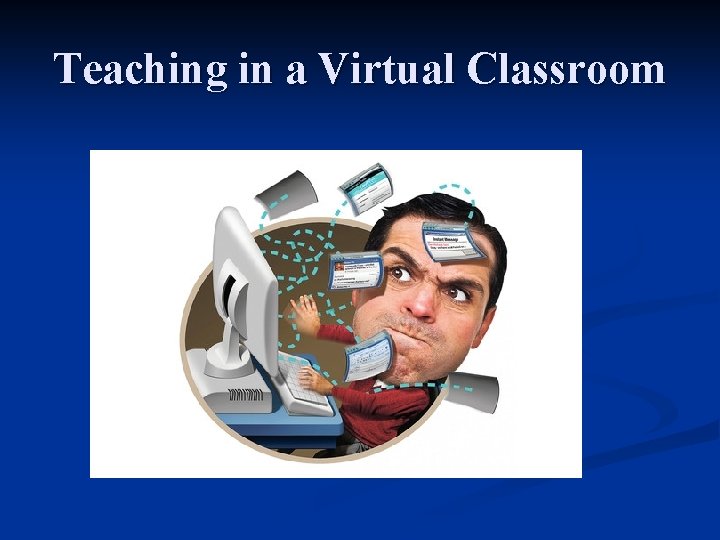
Managing Virtual Courses n Failure to provide details regarding course operations and practices will likely cause confusion for students and develop into a stressful environment for students and faculty alike.
Communication
Teaching in a Virtual Classroom
Personalized Contact n Respond promptly to e-mails.
"E-learning is Not Simply ‘E-training. '
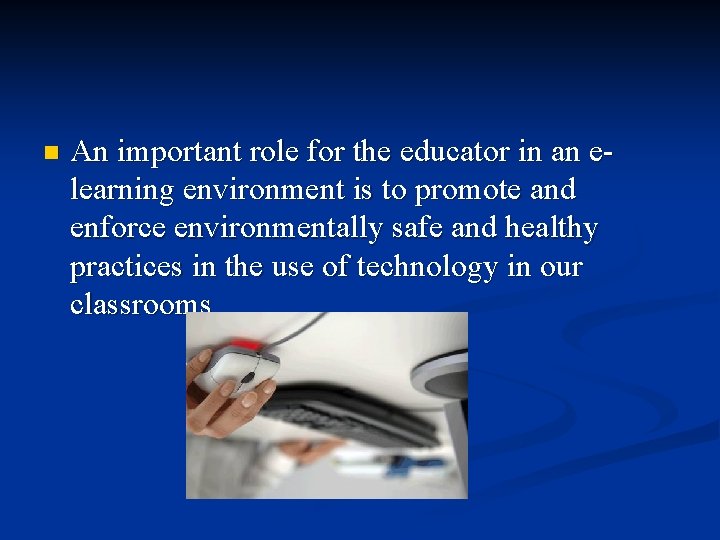
n An important role for the educator in an elearning environment is to promote and enforce environmentally safe and healthy practices in the use of technology in our classrooms
n Educators have the responsibility to teach our students about copyright issues and how they need to site references if they use any author, composer, playwright, publisher, or distributor to exclusive publication, and musical, dramatic, or artistic work in any of their assignments.
n It is also our responsibility as an educator to identify, communicate, model, and enforce social, legal, and ethical practices to promote responsible use of technology. A part of this is promoting and enforcing privacy, security, and online safety related to the use of technology (Willard 2003).
References Horton, W. (2006). E-Learning Lockyer, L. , & Patterson, J. (2008). Integrating Social Networking Horton, W. (2006). E-Learning by design. San Francisco: Wiley Lockyer Technologies in Education: A Case Study of a Formal Learning Environment. IEEEXPLORE, 529 – 533. Wikipedia. E-learning. Retrieved on January 14, 2012 from http: //en. wikipedia. org/wiki/E-learning Wikipedia. E-learning. Credit Report. Retrieved on January 14, 2012 from http: //blog. creditreport. com/? p=27986 CMS School Board Forum Gets Interactive. Retrieved on January 14, 2012 from http: //www. wfae. org/wfae/1_87_316. cfm? action=display&id=7896 Go Daddy. Retrieved on January 14, 2012 from http: //www. cookevillecomputer. com/index. php? option=com_content&view=category&layout=blog&id=46&Itemid=169 Inkity. Retrieved on January 14, 2012 from http: //www. inkity. com/catalog/product/2/2392/Man-At-Laptop-Computer. html The Daily Green. Retrieved on January 14, 2012 from http: //www. thedailygreen. com/environmental-news/latest/solar-power-solarpanels-460409 Willard, Nancy E. (2003). Safe and Responsible Use of the Internet: A Guide for Educators. Retrieved on October 10, 2012 from http: //csriu. org/onlinedocs/pdf/srui/entire. pdf Windows Talk. Retrieved on January 14, 2012 from http: //www. windowstalk. org/2011/06/tablet-computers-vs-laptop-computers/
- Slides: 24