
Implementing Effective Metadata Brian Lavoie Office of Research
Implementing Effective Metadata Brian Lavoie Office of Research OCLC Online Computer Library Center, Inc. Intranets ‘ 99, San Francisco April 27, 1999
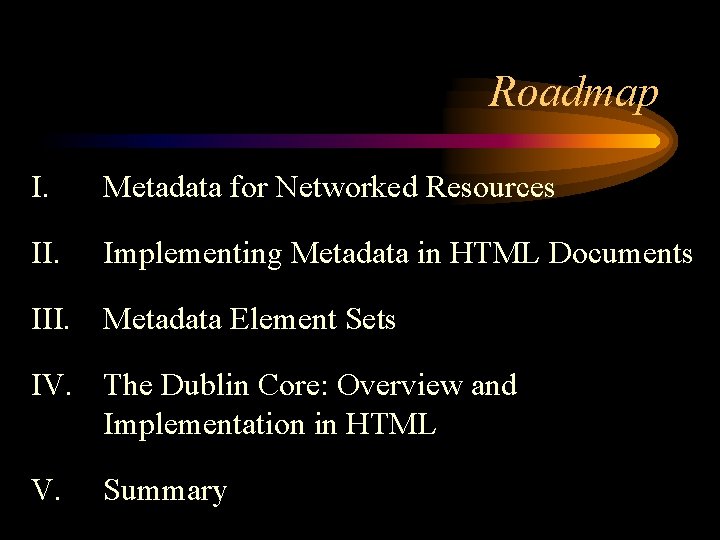
Roadmap I. Metadata for Networked Resources II. Implementing Metadata in HTML Documents III. Metadata Element Sets IV. The Dublin Core: Overview and Implementation in HTML V. Summary
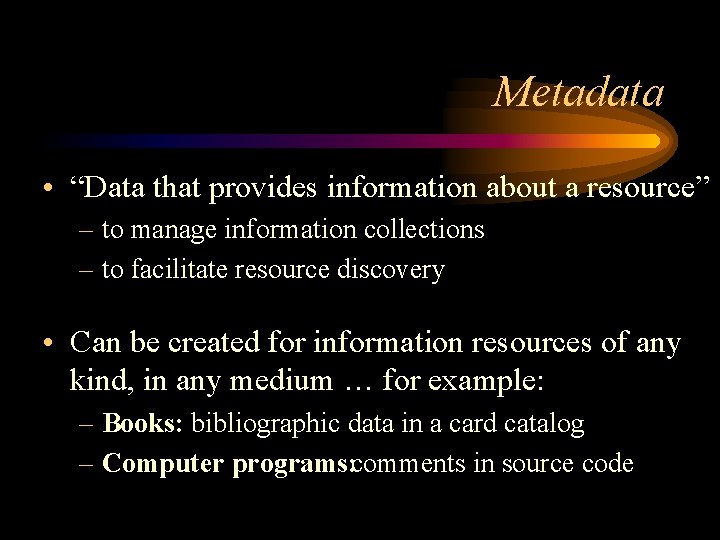
Metadata • “Data that provides information about a resource” – to manage information collections – to facilitate resource discovery • Can be created for information resources of any kind, in any medium … for example: – Books: bibliographic data in a card catalog – Computer programs: comments in source code
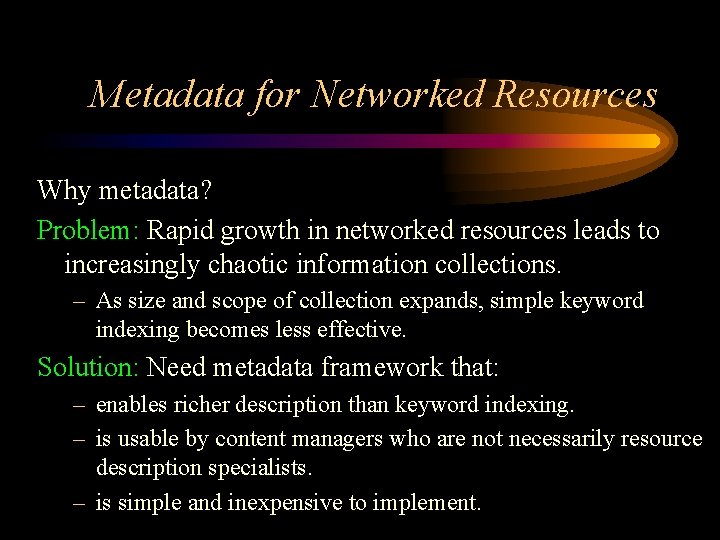
Metadata for Networked Resources Why metadata? Problem: Rapid growth in networked resources leads to increasingly chaotic information collections. – As size and scope of collection expands, simple keyword indexing becomes less effective. Solution: Need metadata framework that: – enables richer description than keyword indexing. – is usable by content managers who are not necessarily resource description specialists. – is simple and inexpensive to implement.
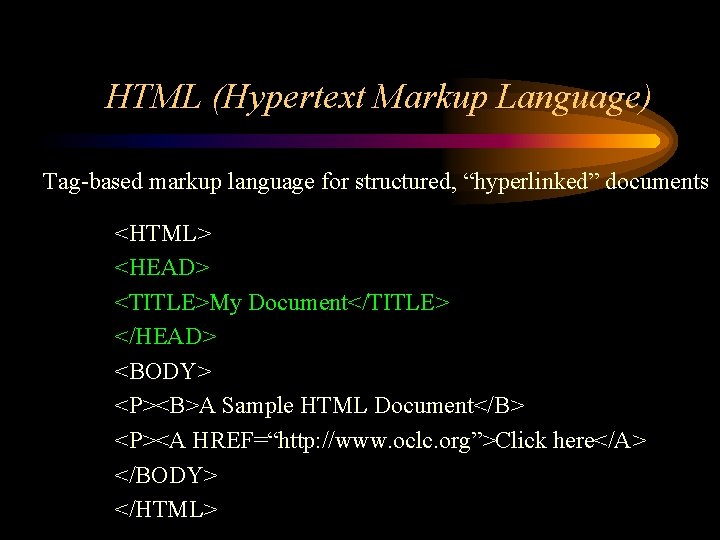
HTML (Hypertext Markup Language) Tag-based markup language for structured, “hyperlinked” documents <HTML> <HEAD> <TITLE>My Document</TITLE> </HEAD> <BODY> <P><B>A Sample HTML Document</B> <P><A HREF=“http: //www. oclc. org”>Click here</A> </BODY> </HTML>

Implementing Metadata in HTML Documents The META tag: Container for embedded resource description <HEAD> <META name=“…” content=“. . . ”> </HEAD> Name Attribute= property or characteristic of a resource (e. g. , title, author, keywords) Content Attribute= specific value of a property (e. g. , “War and Peace”, Leo Tolstoy, Russian literature)
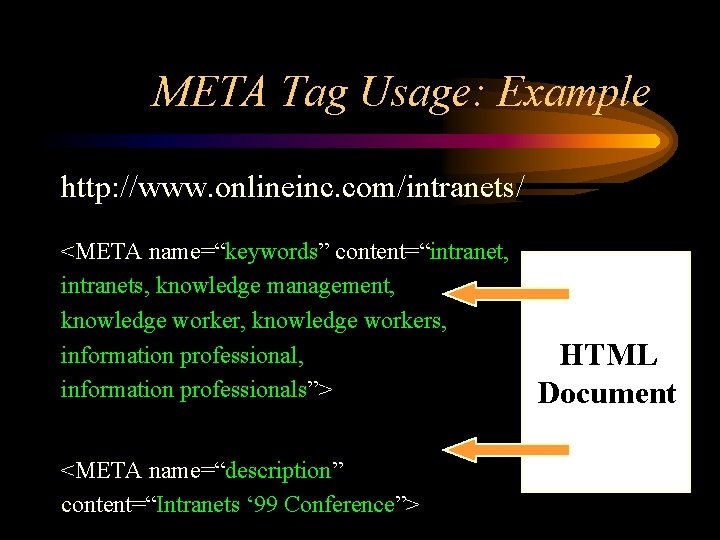
META Tag Usage: Example http: //www. onlineinc. com/intranets/ <META name=“keywords” content=“intranet, intranets, knowledge management, knowledge workers, information professionals”> <META name=“description” content=“Intranets ‘ 99 Conference”> HTML Document
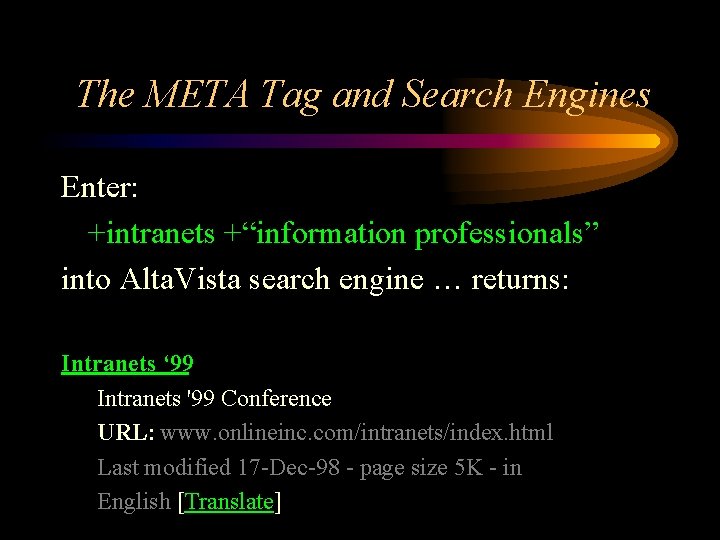
The META Tag and Search Engines Enter: +intranets +“information professionals” into Alta. Vista search engine … returns: Intranets ‘ 99 Intranets '99 Conference URL: www. onlineinc. com/intranets/index. html Last modified 17 -Dec-98 - page size 5 K - in English [Translate]
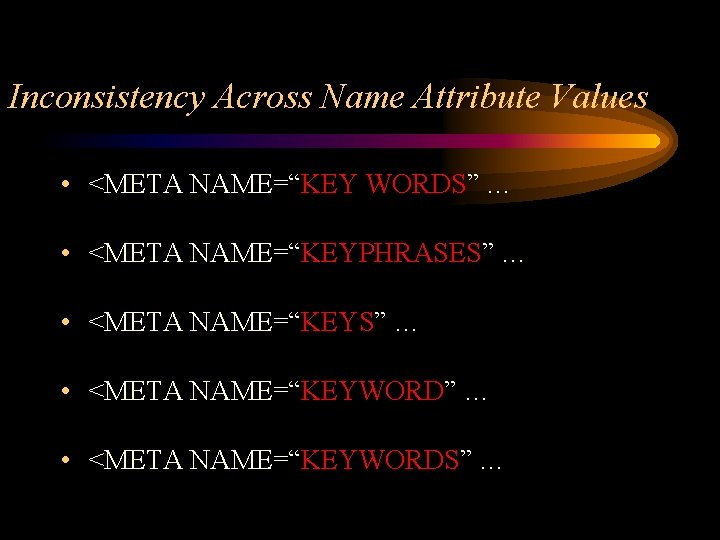
Inconsistency Across Name Attribute Values • <META NAME=“KEY WORDS” … • <META NAME=“KEYPHRASES” … • <META NAME=“KEYWORD” … • <META NAME=“KEYWORDS” …
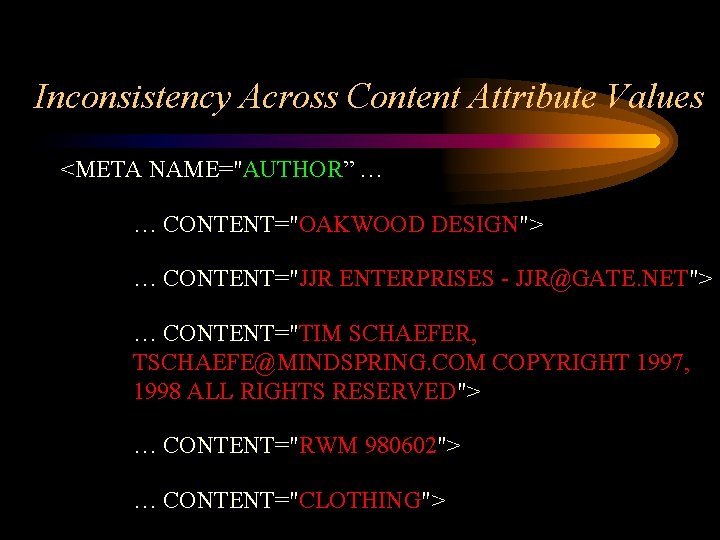
Inconsistency Across Content Attribute Values <META NAME="AUTHOR” … … CONTENT="OAKWOOD DESIGN"> … CONTENT="JJR ENTERPRISES - JJR@GATE. NET"> … CONTENT="TIM SCHAEFER, TSCHAEFE@MINDSPRING. COM COPYRIGHT 1997, 1998 ALL RIGHTS RESERVED"> … CONTENT="RWM 980602"> … CONTENT="CLOTHING">
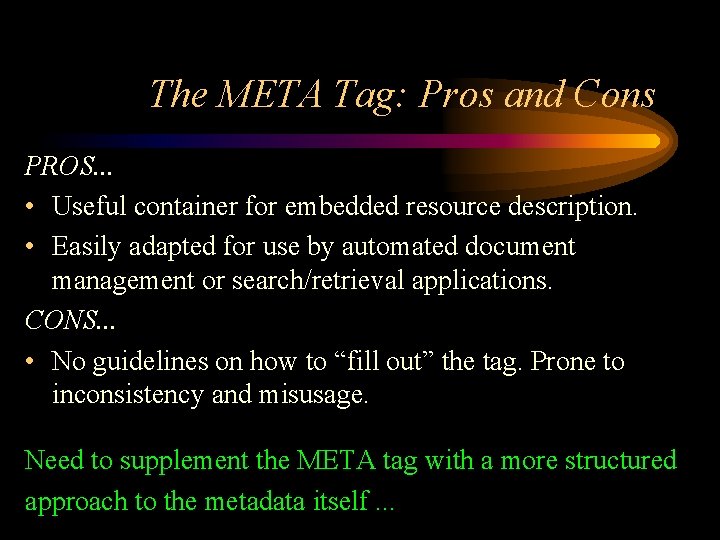
The META Tag: Pros and Cons PROS. . . • Useful container for embedded resource description. • Easily adapted for use by automated document management or search/retrieval applications. CONS. . . • No guidelines on how to “fill out” the tag. Prone to inconsistency and misusage. Need to supplement the META tag with a more structured approach to the metadata itself. . .
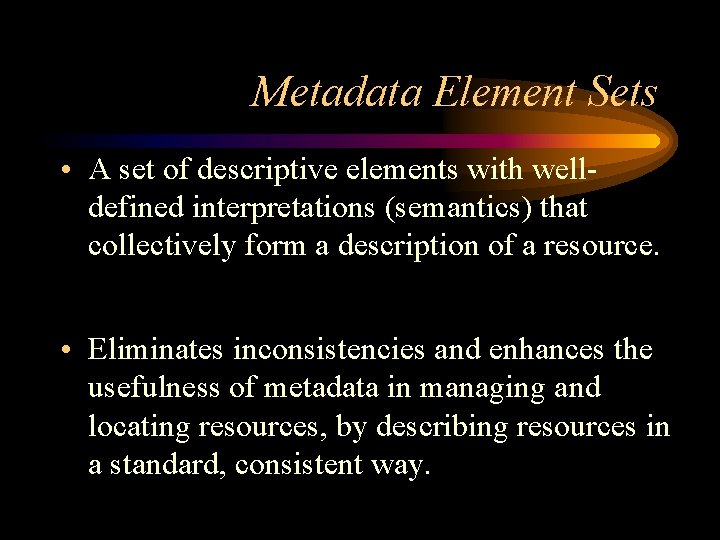
Metadata Element Sets • A set of descriptive elements with welldefined interpretations (semantics) that collectively form a description of a resource. • Eliminates inconsistencies and enhances the usefulness of metadata in managing and locating resources, by describing resources in a standard, consistent way.
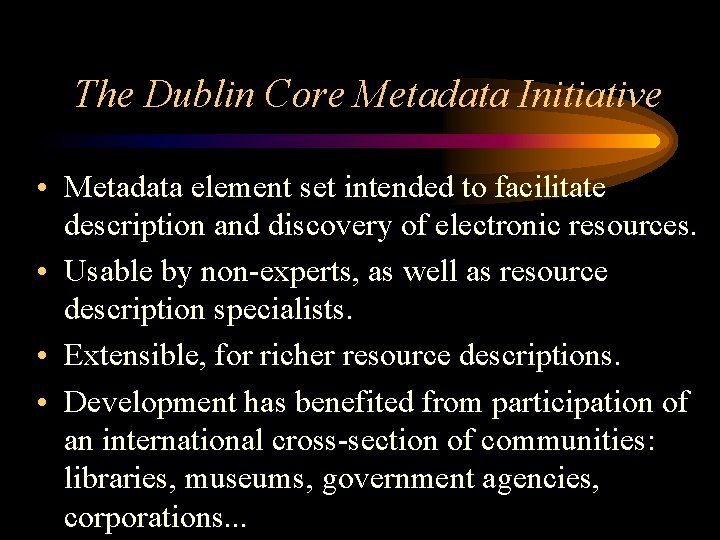
The Dublin Core Metadata Initiative • Metadata element set intended to facilitate description and discovery of electronic resources. • Usable by non-experts, as well as resource description specialists. • Extensible, for richer resource descriptions. • Development has benefited from participation of an international cross-section of communities: libraries, museums, government agencies, corporations. . .
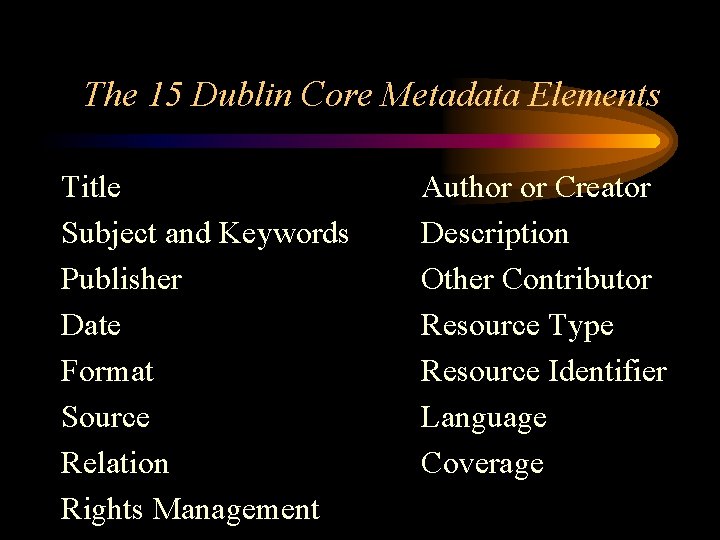
The 15 Dublin Core Metadata Elements Title Subject and Keywords Publisher Date Format Source Relation Rights Management Author or Creator Description Other Contributor Resource Type Resource Identifier Language Coverage
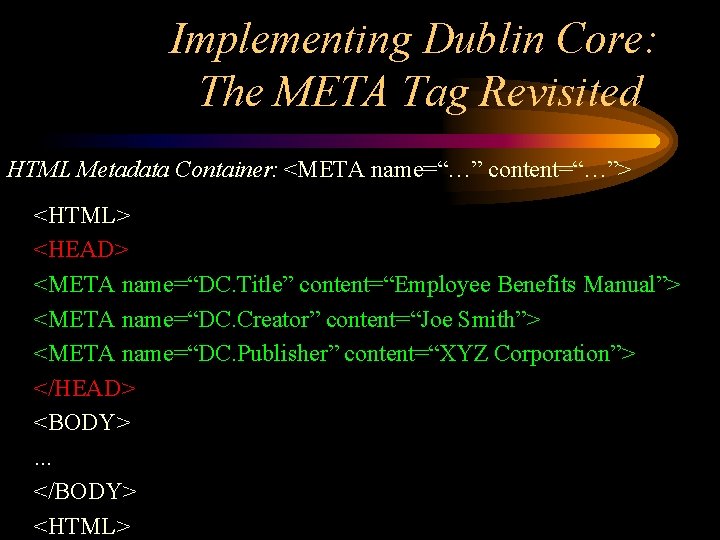
Implementing Dublin Core: The META Tag Revisited HTML Metadata Container: <META name=“…” content=“…”> <HTML> <HEAD> <META name=“DC. Title” content=“Employee Benefits Manual”> <META name=“DC. Creator” content=“Joe Smith”> <META name=“DC. Publisher” content=“XYZ Corporation”> </HEAD> <BODY>. . . </BODY> <HTML>
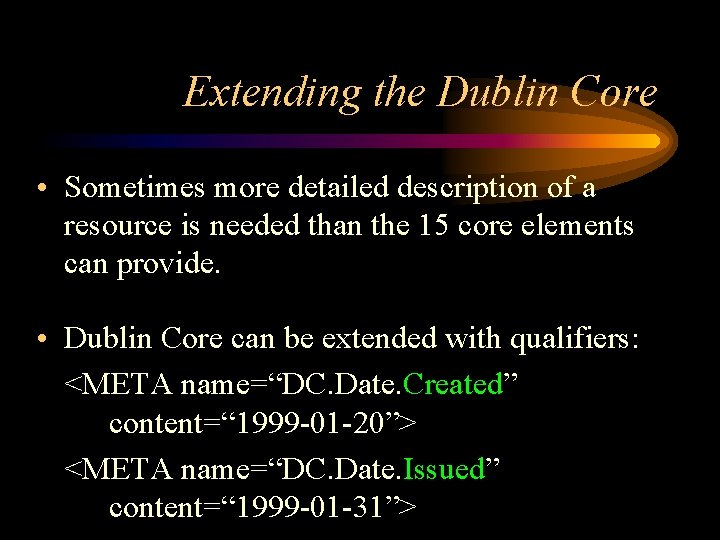
Extending the Dublin Core • Sometimes more detailed description of a resource is needed than the 15 core elements can provide. • Dublin Core can be extended with qualifiers: <META name=“DC. Date. Created” content=“ 1999 -01 -20”> <META name=“DC. Date. Issued” content=“ 1999 -01 -31”>
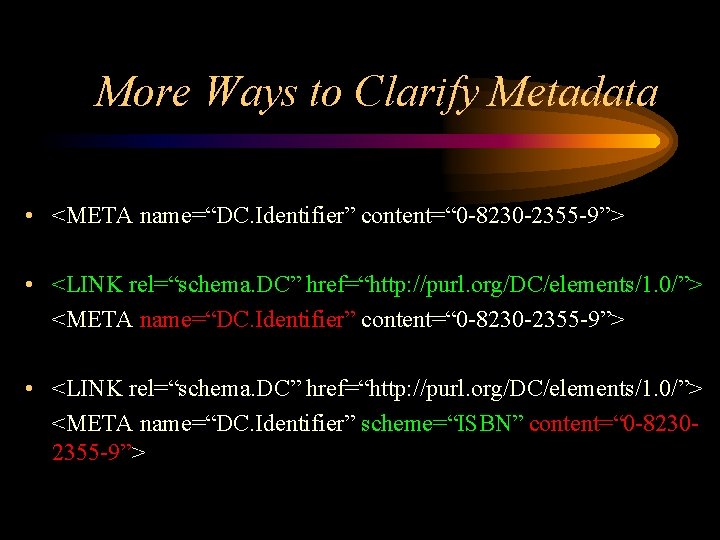
More Ways to Clarify Metadata • <META name=“DC. Identifier” content=“ 0 -8230 -2355 -9”> • <LINK rel=“schema. DC” href=“http: //purl. org/DC/elements/1. 0/”> <META name=“DC. Identifier” scheme=“ISBN” content=“ 0 -82302355 -9”>
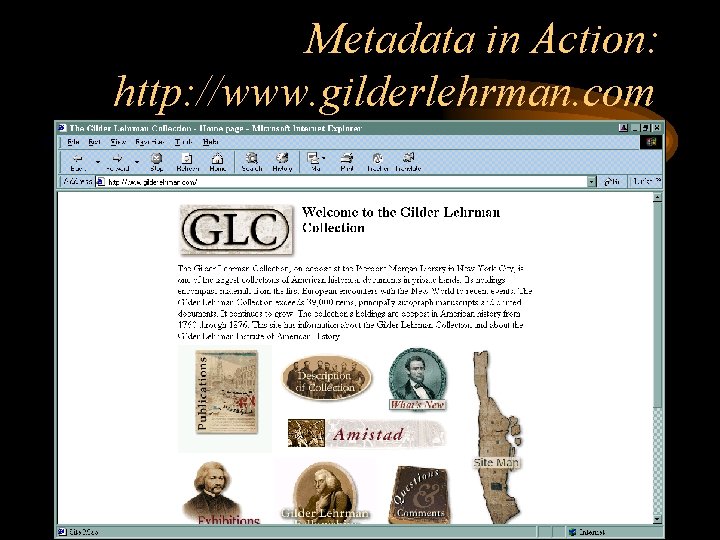
Metadata in Action: http: //www. gilderlehrman. com
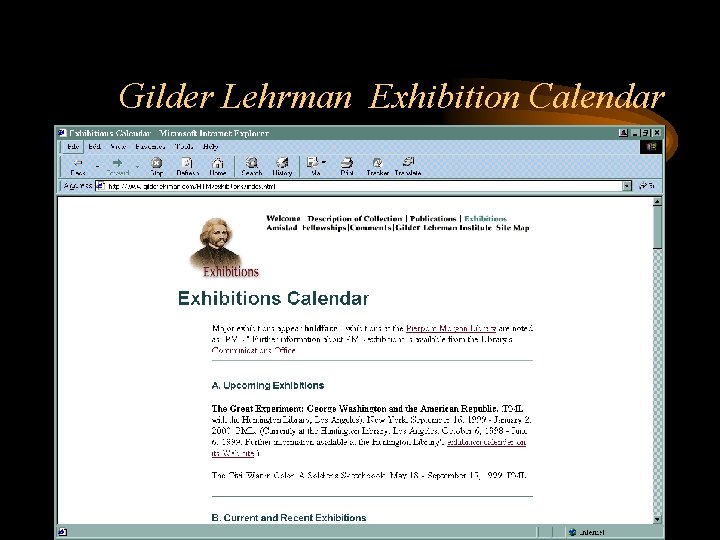
Gilder Lehrman Exhibition Calendar
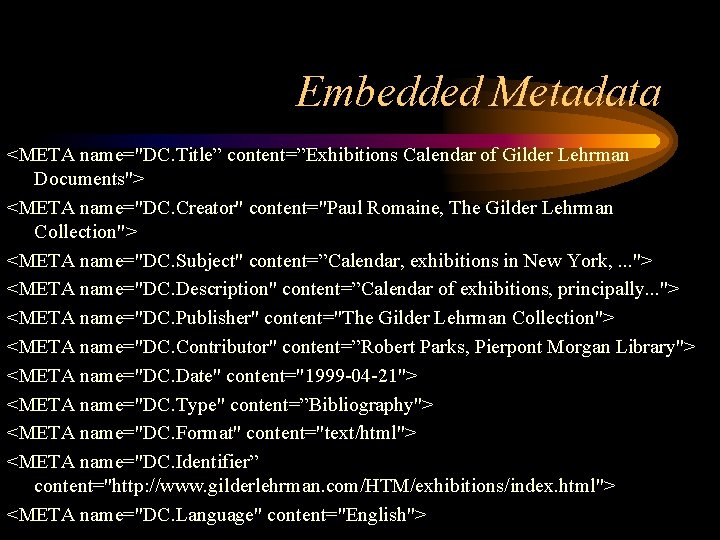
Embedded Metadata <META name="DC. Title” content=”Exhibitions Calendar of Gilder Lehrman Documents"> <META name="DC. Creator" content="Paul Romaine, The Gilder Lehrman Collection"> <META name="DC. Subject" content=”Calendar, exhibitions in New York, . . . "> <META name="DC. Description" content=”Calendar of exhibitions, principally. . . "> <META name="DC. Publisher" content="The Gilder Lehrman Collection"> <META name="DC. Contributor" content=”Robert Parks, Pierpont Morgan Library"> <META name="DC. Date" content="1999 -04 -21"> <META name="DC. Type" content=”Bibliography"> <META name="DC. Format" content="text/html"> <META name="DC. Identifier” content="http: //www. gilderlehrman. com/HTM/exhibitions/index. html"> <META name="DC. Language" content="English">
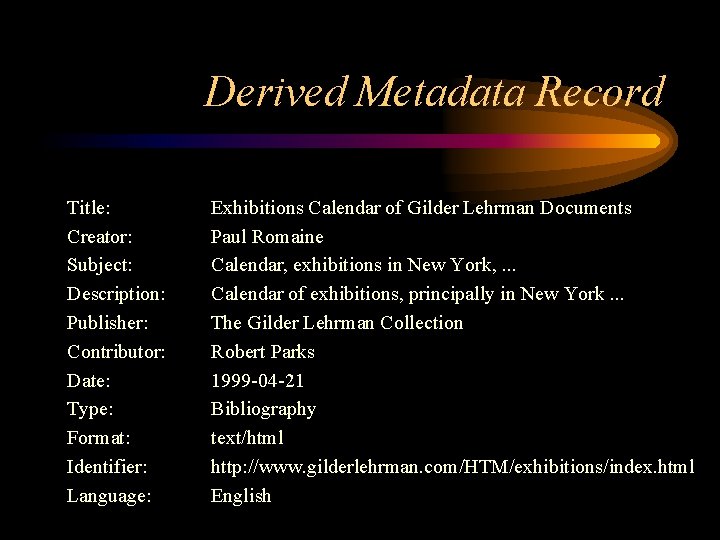
Derived Metadata Record Title: Creator: Subject: Description: Publisher: Contributor: Date: Type: Format: Identifier: Language: Exhibitions Calendar of Gilder Lehrman Documents Paul Romaine Calendar, exhibitions in New York, . . . Calendar of exhibitions, principally in New York. . . The Gilder Lehrman Collection Robert Parks 1999 -04 -21 Bibliography text/html http: //www. gilderlehrman. com/HTM/exhibitions/index. html English
Summary: Implementing Effective Metadata Implementing Metadata: • META tag provides framework for deploying metadata as embedded resource description in HTML documents. Implementing Effective Metadata: • Use a well-defined metadata element set. • Dublin Core offers rich description; usable by description experts and non-experts; simple and inexpensive to implement. • Clarify potentially ambiguous metadata with LINK tag and scheme attribute.
For More Information. . . • META Tag: http: //www. w 3. org/TR/REC-html 40/ • Metadata: http: //www. w 3. org/Metadata • Dublin Core: http: //purl. org/dc
- Slides: 23