
Implementing CCBHC Implementation guidance for Certified Community Behavioral
Implementing CCBHC Implementation guidance for Certified Community Behavioral Health Clinics (CCBHC) Wednesday, June 7, 2017 1
DHS Team • Jennifer Blanchard, Community and Care Integration Director • Leah Montgomery, Community and Care Integration Policy • Amanda Calmbacher, TCM policy • Julie Pearson, CCBHC Project Manager • Gary Cox, Medicaid Supervisor • Dwight Heil, Children's Mental Health • Jane King, Certification Specialist • Michelle Maruska, ADAD Project Manager • Lucas Peterson, MCO Liaison • Ma Xiong, Quality of Care Analyst • John Zakelj, Payment Specialist 2
Background Julie Pearson – CCBHC Project Manager 3

CCBHC Demonstration Timeline • In 2014, the U. S. Congress enacted the Excellence in Mental Health Act, which established an eight-state demonstration project to test CCBHCs (PAMA, Section 223). • The 2015 Minnesota legislature provided funding to support planning and Minnesota received a SAMHSA planning grant. • The 2016 Minnesota legislature appropriated state Medicaid match. • In December 2016, Minnesota was chosen to be one of eight states to pilot CCBHC. • Clinics will begin providing services under the CCBHC model by July 1, 2017. During the demonstration period, states will receive an enhanced federal match on Medicaid for the services provided by CCBHCs. The pilot is scheduled to run until June 30, 2019. 4

CCBHC Demonstration Opportunities • CCBHC service delivery model • Comprehensive, trauma-informed, evidence based, person- and familycentered services including care coordination • Serve all ages • Provide outreach and increase access to underserved populations • Serve as a “one-stop-shop” • Free choice of providers 5
CCBHC Demonstration Opportunities • CCBHC payment model (Prospective Payment Rate – PPS) • PPS rate is unique to each CCBHC • Rate based on allowable costs of furnishing all CCBHC services • Same rate is paid for each qualifying day of service (“visit”), regardless of the intensity of services provided • Opportunity to receive bonus payments for meeting quality measure targets 6
Need for Continued County Coordination • Changes to county authorization and payment for TCM and Chemical Dependency Services • Coordination and support in accessing county services remains critical for individuals receiving CCBHC services • County maintains their role/responsibility to individuals who are not on Medical Assistance • Counties maintain their legal responsibility and authority under the Commitment Act 7

CCBHC States Minnesota Nevada Missouri Oklahoma New York Oregon New Jersey Pennsylvania 8
Selection Process • Organizational Readiness Assessment • Geographical Needs Assessment • Certification Process • organizational policy and work plan development • staff training, recruitment and hiring 9

CCBHC Clinics • Northern Pines Mental Health Center • Northwestern Mental Health Center • People Incorporated • Ramsey County Mental Health Center • Wilder Children and Family Services • Zumbro Valley Health Center 10
Federal Criteria for Services Program Requirements 1. Staffing 2. Availability and Accessibility of Services 3. Care Coordination 4. Scope of Services 5. Quality and other Reporting 6. Organizational Authority, Governance and Accreditation Section 223 Program Requirements - full criteria 11
State Specific Standards • Rule 31 Chemical Dependency License • Rule 29 Mental Health Center/Clinic Certification • ARMHS Certification • CTSS Certification • TCM Services (adults and kids) • Crisis Response Services (adults and kids) • Rule 47 – Medicaid standards for outpatient mental health services 12
State-Specific Standards Evidence Based Practices: Peer Recovery Services: • Motivational Interviewing • Certified Peer Specialist • CBT • Family Peer Specialist • Stages of Change • Recovery Support Specialist • Trauma Treatment • TF-CBT (Children) • EMDR (Adults) • Seeking Safety (Adults) 13
CCBHC Services Jane King – CCBHC Certification Specialist 14
Who is considered a CCBHC recipient? • An individual who is currently receiving services from one of the six identified CCBHCs. • Must receive one or more of the nine CCBHC services from the CCBHC to be considered a recipient. • An individual who is new to receiving services from one of the six identified CCBHCs. • Must have a completed a preliminary screening and risk assessment and receive one or more of the nine CCBHC services from the CCBHC to be considered a recipient. • No enrollment process. 15
CCBHC Services • Outpatient mental health and substance use services • Person-centered treatment planning • Primary care screening and monitoring • Targeted case management • Screening, assessment and diagnosis, including risk management • Services for members of the armed forces and veterans • Crisis mental health services, including 24 -mobile crisis teams, emergency crisis Intervention services and crisis stabilization • Peer and family support • Connections with other providers and systems • Psychiatric rehabilitation services 16
Scope of Services • Aligns coverage policy w/ demonstration objectives • Policy change examples: • Expand coverage across the age span • Allow for a more person-centered assessment • Expedites access into services • Increases access to Certified Peer Specialist and Peer Recovery Supports • Opportunity – to align future coverage policy statewide 17
Scope of Services Table • DHS has issued a Scope of Services table which translates the federally required and optional CCBHC services into specific procedure codes for Minnesota • The table includes 47 existing procedure codes and one new procedure code • The new procedure code is H 0014 Withdrawal Management Level 2 • Seven existing procedure codes involve changes and expansions in coverage to comply with CCBHC criteria • The Q 2 modifier designates coverage changes which apply only to the CCBHC demo; Q 2 facilitates bypass of current claims processing edits. 18
Coding and Service Changes with Q 2 Modifier • 90899 -Q 2 - Clinical Care Consultation for adults 21+ • H 2027 -Q 2 - Family Psychoeducation for adults 21+ • H 0032 - Q 2 -UD - Treatment Plan Development: bypass current authorization thresholds and expand beyond ARMHS and CTSS • H 0038 -Q 2 - Peer Support for people in recovery from chemical dependency • 90791/90792 -Q 2 -52 – Brief DA is redefined to be consistent with CCBHC criteria for the Initial Evaluation; and to allow additional sessions • 90791/90792 -Q 2 – Diagnostic Assessments: bypass current authorization thresholds 19
Coding and Service Changes without Q 2 Modifier • H 0031 - UD - Functional Assessment expanded beyond ARMHS and CTSS • H 0038 - MH Peer Specialist services expanded beyond ARMHS and CTSS • MMIS is being reprogrammed to allow CCBHCs to bypass current edits which restrict these codes to service locations that have a CTSS or ARMHS package of service; as far as we know, this will not be an issue for MCOs 20
Prospective Payment System (PPS) John Zakelj – Mental Health Division 21
Current MA payment model • Fixed rates per unit of service • Rates are inadequate to support quality services • Incentive is for quantity over quality • Limited flexibility to tailor services to individual needs • Separate payment structures for mental health and substance abuse disorder services 22
CCBHC payment model (Prospective Payment Rate – PPS) • Reimbursement based on actual and projected costs of serving CCBHC consumers, not on fee schedule • PPS rate is unique to each CCBHC • Rate based on allowable costs of furnishing all CCBHC services • Same rate is paid for each qualifying day of service (“visit”), regardless of the intensity of services provided • Integrated payment for mental health and substance abuse disorder services • DHS has worked collaboratively with our CCBHCs, MCOs and state MMIS to implement this model in Minnesota. See following slides. 23
CCBHC payment model (Prospective Payment Rate – PPS) • Will provide about $30 million per year in new state and federal funding • Most of the new funding will come in supplemental wrap payments • Wrap payments will support integrated, coordinated, quality services • We preferred a full, upfront PPS payment, but the wrap payment was a compromise for the demo, due to a number of factors 24
PPS Payment: Demo vs Post-Demo • In order to meet the CCBHC timelines Minnesota is working with a contractor to develop a payment infrastructure process specific to this project. See wraparound payment methodology slide • Upon permanent enactment of CCBHC in Minnesota, PPS methodology will be fully implemented in the State payment system. • This time-limited payment process mitigates the re-programming burden on the State’s legacy MMIS and MCO claims-payment systems and reconciles traditional payments with PPS rates. • Continuation of billing by procedure code during the demo captures data required for the national CCBHC evaluation 25
PPS Rates: First Year vs Second Year • PPS Rates for Year 1 (July 1, 2017 to June 30, 2018) will be communicated to CCBHCs mid-June 2017 • Rates will be based on actual costs from a recent fiscal year, plus approved anticipated costs for Year 1, plus an inflation factor. • Early in 2018, DHS will, in consultation with the CCBHCs, determine whether to rebase rates for Year 2. • If rates are not rebased, rates for Year 2 will be the same as Year 1 plus an inflation factor 26
Wraparound Payment Methodology • For this two-year demo, Minnesota will use a uniform wraparound payment methodology for all qualified Medicaid recipients, including fee-for-service (FFS) and managed care. • MCOs and the state’s FFS system will pay a rate to the CCBHCs that other providers would receive for similar services. • The State will make a supplemental payment (wraparound) to ensure payment to CCBHCs is equal to the PPS to ensure that all CCBHCs receive the full PPS rate plus appropriate Quality Bonus Payments for all qualified recipients. • If the minimum payment was not achieved, the state (not the MCO) will make supplemental payments to the CCBHCs to make up the shortfall. • This methodology includes ongoing oversight of all managed care payments to CCBHCs and a monthly reconciliation process between the state and the CCBHCs. 27
CCBHC Payment Timeline • Payment for currently covered services will continue as is • For services that are expanded (see earlier slide), CCBHCs will receive payment retroactive to dates of service after July 1, 2017 • Wrap payments will be made on the following schedule: • For fee-for-service claims, about a month after the claim is processed • For managed care claims, about 2 months after the claim is processed 28
Quality Bonus Payments • CCBHCs will be eligible for Quality Bonus Payments based on their performance on quality measures described in a later slide • The first bonus payments will be made after data is complete regarding performance during Year 1 • The second bonus payments will be made after data is complete regarding performance during Year 2 • These bonus payments will be in addition to all other payments and can average up to a 5% add-on to the other payments 29
Ideas for group discussion of payment issues • How will your clinic use this new payment system as an opportunity to improve services? • What are your main concerns regarding payment plans? • Idea for addressing your concerns 30
Evaluation 31
CCBHC State Lead Measures Lori Allerson – Health Research and Quality 32
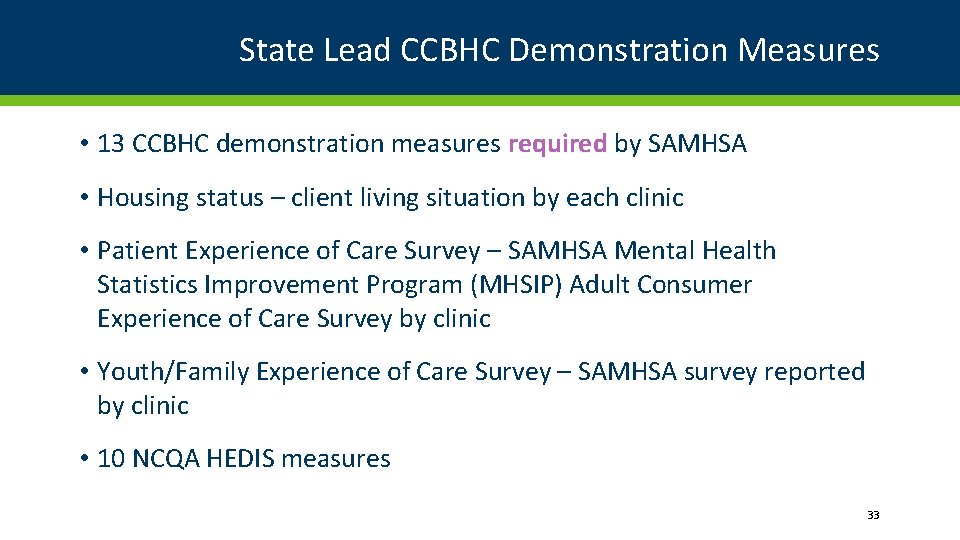
State Lead CCBHC Demonstration Measures • 13 CCBHC demonstration measures required by SAMHSA • Housing status – client living situation by each clinic • Patient Experience of Care Survey – SAMHSA Mental Health Statistics Improvement Program (MHSIP) Adult Consumer Experience of Care Survey by clinic • Youth/Family Experience of Care Survey – SAMHSA survey reported by clinic • 10 NCQA HEDIS measures 33
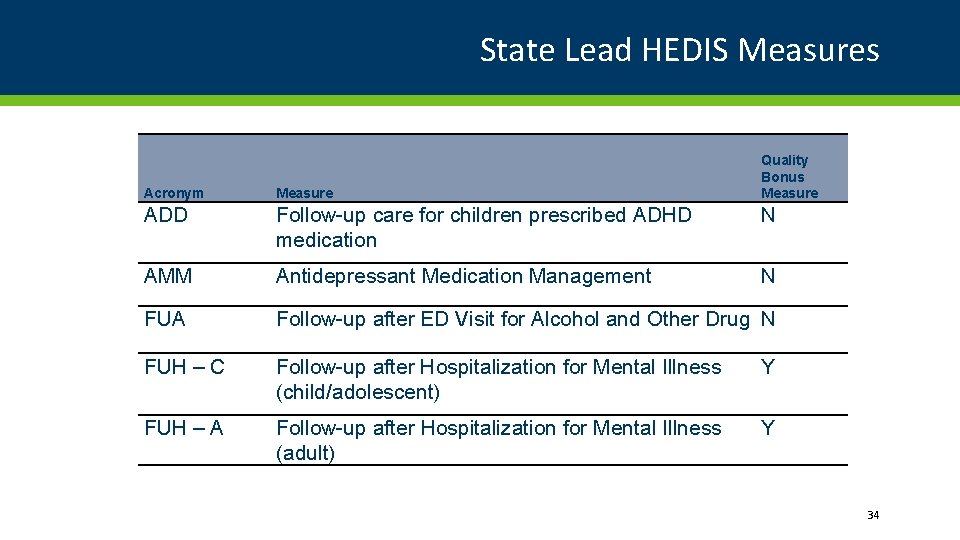
State Lead HEDIS Measures Quality Bonus Measure Acronym Measure ADD Follow-up care for children prescribed ADHD medication N AMM Antidepressant Medication Management N FUA Follow-up after ED Visit for Alcohol and Other Drug N FUH – C Follow-up after Hospitalization for Mental Illness (child/adolescent) Y FUH – A Follow-up after Hospitalization for Mental Illness (adult) Y 34
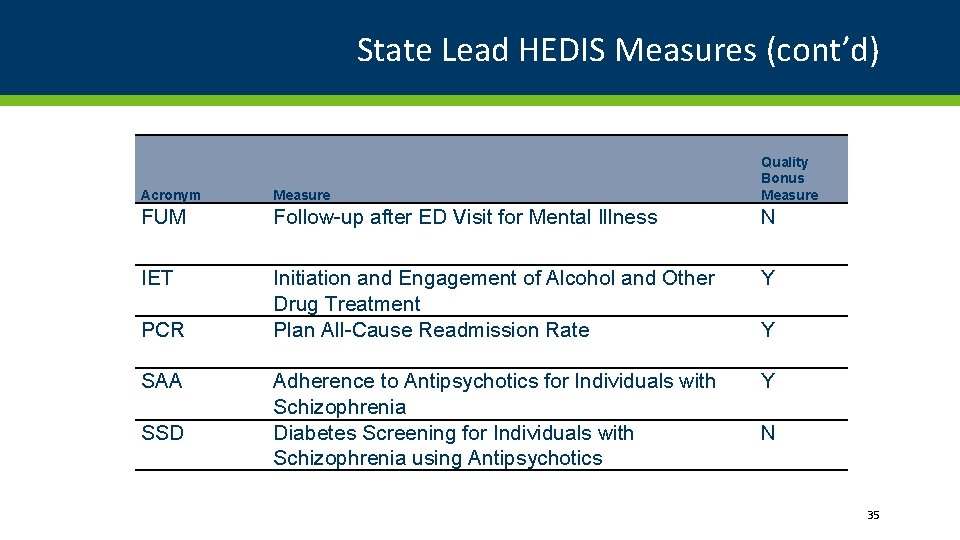
State Lead HEDIS Measures (cont’d) Acronym Measure Quality Bonus Measure FUM Follow-up after ED Visit for Mental Illness N IET Initiation and Engagement of Alcohol and Other Drug Treatment Plan All-Cause Readmission Rate Y Adherence to Antipsychotics for Individuals with Schizophrenia Diabetes Screening for Individuals with Schizophrenia using Antipsychotics Y PCR SAA SSD Y N 35
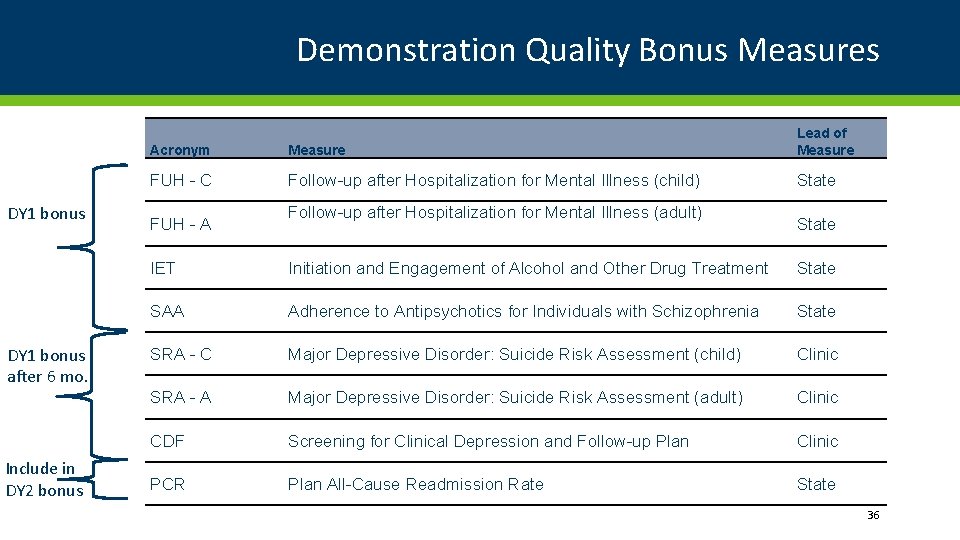
Demonstration Quality Bonus Measures DY 1 bonus after 6 mo. Include in DY 2 bonus Acronym Measure Lead of Measure FUH - C Follow-up after Hospitalization for Mental Illness (child) State FUH - A Follow-up after Hospitalization for Mental Illness (adult) State IET Initiation and Engagement of Alcohol and Other Drug Treatment State SAA Adherence to Antipsychotics for Individuals with Schizophrenia State SRA - C Major Depressive Disorder: Suicide Risk Assessment (child) Clinic SRA - A Major Depressive Disorder: Suicide Risk Assessment (adult) Clinic CDF Screening for Clinical Depression and Follow-up Plan Clinic PCR Plan All-Cause Readmission Rate State 36
RDA and HEDIS validation audit • Research and Data Analysis • Provide high-quality data analysis and research analysis to inform administrators, policy makers, public about Minnesota Health Care Programs • HEDIS measures • Annually review, modify, or add HEDIS measures based on priorities at DHS • Run year 2017 – 36 HEDIS measures • Vendor reviews capabilities of DHS’ ability to produce HEDIS reports • Report results by MHCP and MCO • NEW for Run year 2017 – report results by MHCP 37
CCBHC HEDIS measures • SAMHSA HEDIS specification generally the same except… • Stratify by Medicaid, Medicare and Medicaid dual eligibles, or other • Report by provider entity (BH clinic) • Demonstration year time period • DY 1: July 1, 2017 – June 30, 2018 • DY 2: July 1, 2018 – June 30, 2019 • Some measures specify appropriate practitioners • Practitioner with prescribing authority, mental health practitioner, any practitioner 38
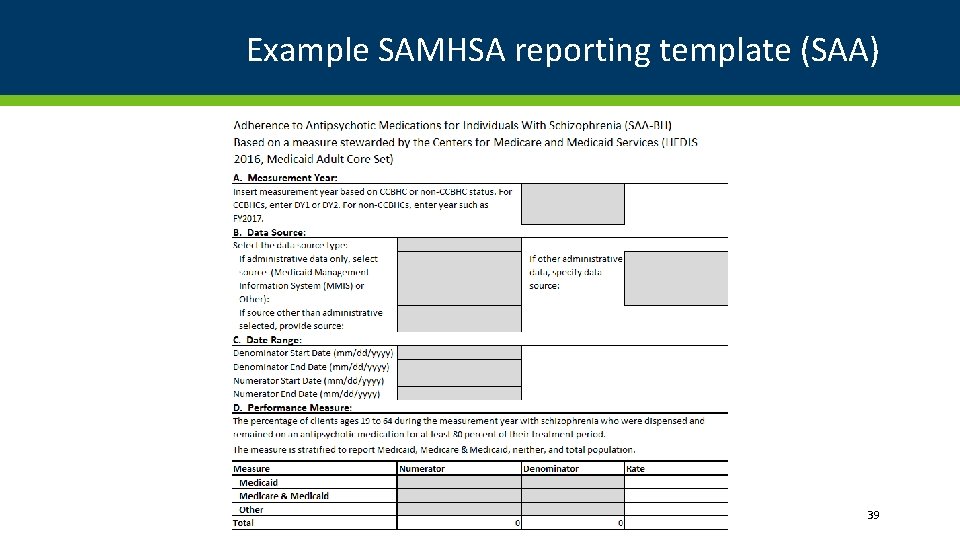
Example SAMHSA reporting template (SAA) 39
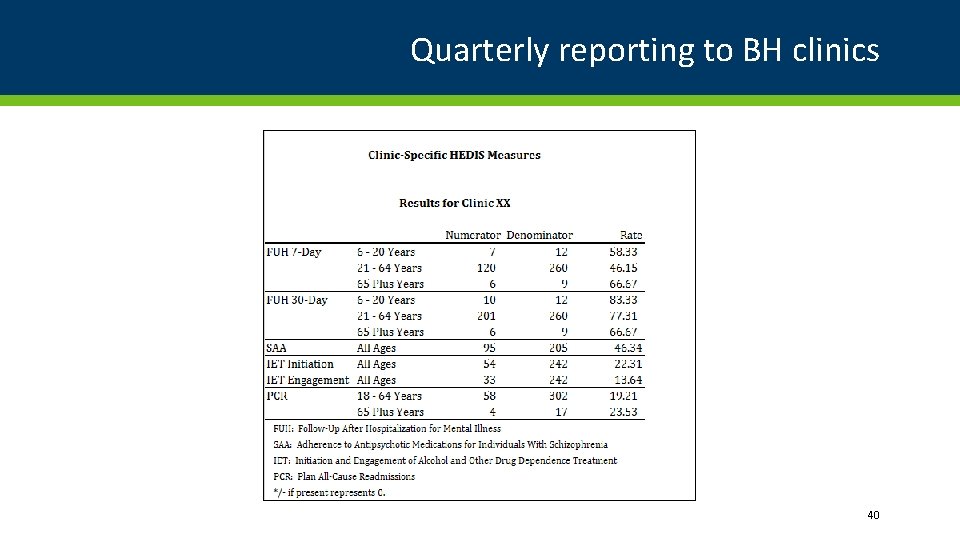
Quarterly reporting to BH clinics 40
CCBHC Clinic Lead Measures Ma Xiong, Quality of Care Analyst – Mental Health Division 41
CCBHC Clinic Lead Measures • CCBHCs will report data for 9 measures required by SAMHSA (known as Clinic lead or BHC-lead measures) • The Measurement Years are: • DY 1: July 1, 2017 – June 30, 2018 • DY 2: July 1, 2018 – June 30, 2019 • Measurement periods may differ according to measure • Stratify by Medicaid, Medicare and Medicaid dual eligibles, or other • Stratify by age groups if applicable • Report by provider entity (CCBHC) • DHS submits data received from each CCBHC to SAMHSA 42
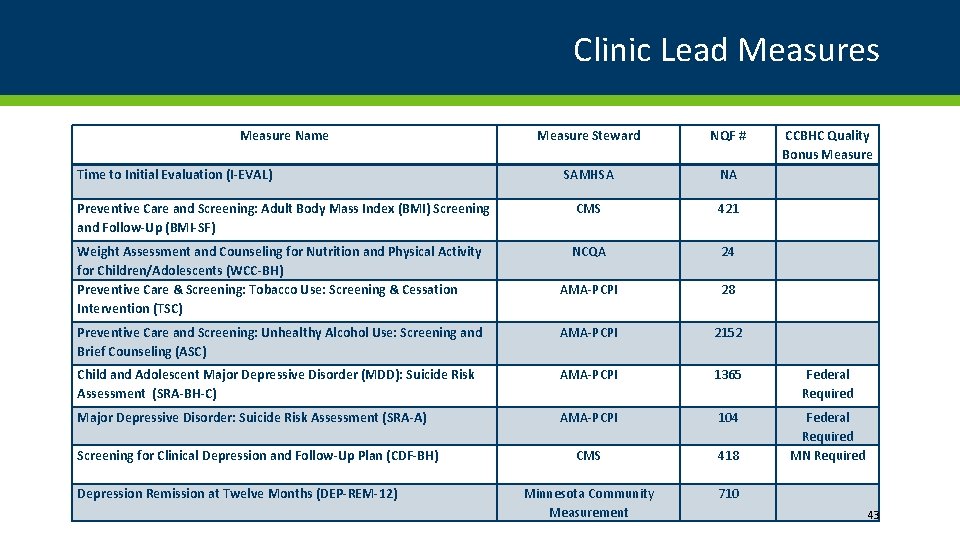
Clinic Lead Measures Measure Name Measure Steward NQF # SAMHSA NA Preventive Care and Screening: Adult Body Mass Index (BMI) Screening and Follow-Up (BMI-SF) CMS 421 Weight Assessment and Counseling for Nutrition and Physical Activity for Children/Adolescents (WCC-BH) Preventive Care & Screening: Tobacco Use: Screening & Cessation Intervention (TSC) NCQA 24 AMA-PCPI 28 Preventive Care and Screening: Unhealthy Alcohol Use: Screening and Brief Counseling (ASC) AMA-PCPI 2152 Child and Adolescent Major Depressive Disorder (MDD): Suicide Risk Assessment (SRA-BH-C) AMA-PCPI 1365 Federal Required Major Depressive Disorder: Suicide Risk Assessment (SRA-A) AMA-PCPI 104 CMS 418 Federal Required MN Required Minnesota Community Measurement 710 Time to Initial Evaluation (I-EVAL) Screening for Clinical Depression and Follow-Up Plan (CDF-BH) Depression Remission at Twelve Months (DEP-REM-12) CCBHC Quality Bonus Measure 43
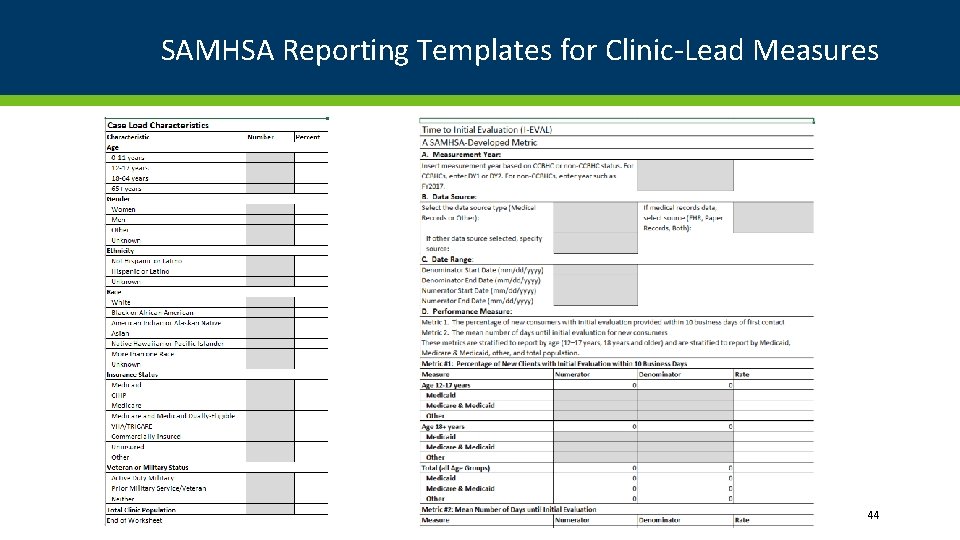
SAMHSA Reporting Templates for Clinic-Lead Measures 44
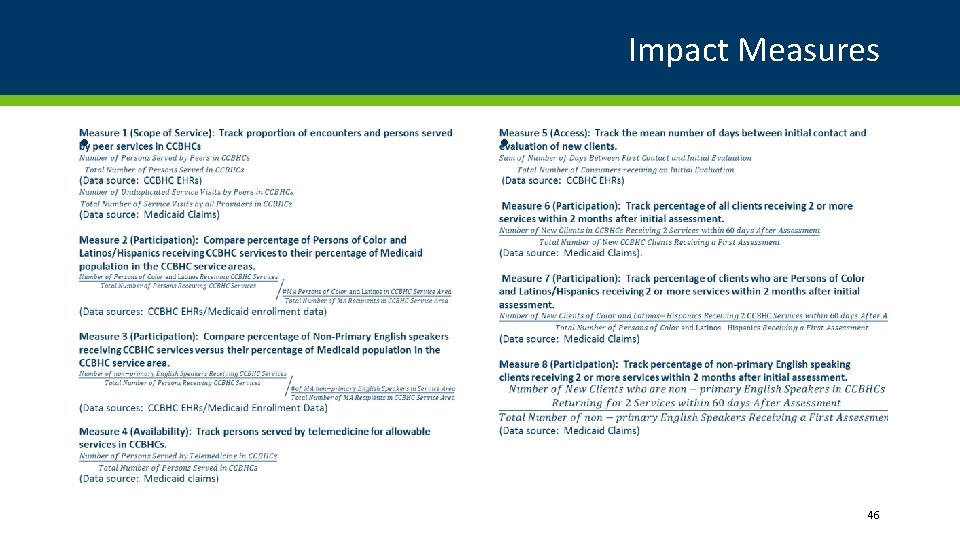
Impact Measures • Evaluate impact of Minnesota’s participation in CCBHC service delivery model • 8 Minnesota impact measures • Clinics will submit consumer level data that will be used to calculate the measures 45
Impact Measures • • 46
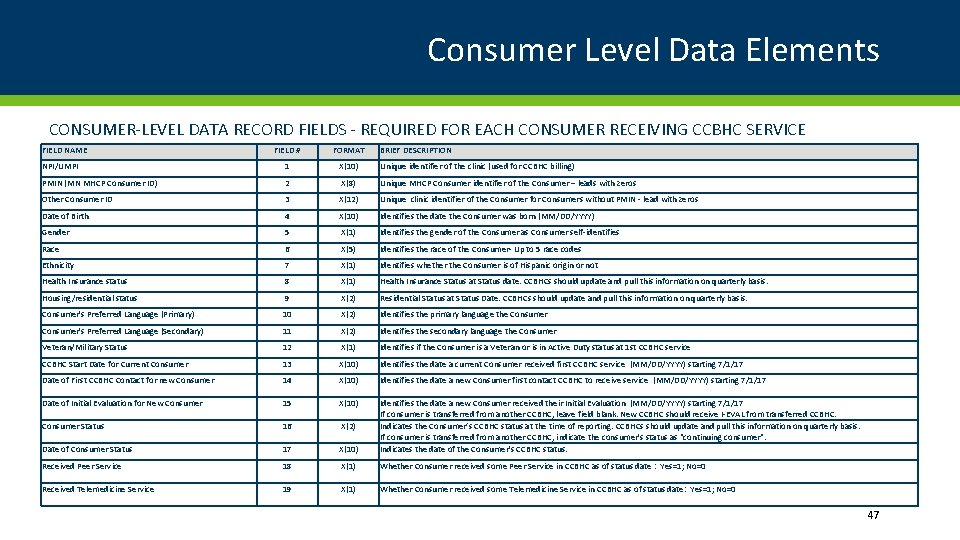
Consumer Level Data Elements CONSUMER-LEVEL DATA RECORD FIELDS - REQUIRED FOR EACH CONSUMER RECEIVING CCBHC SERVICE FIELD NAME FIELD # FORMAT BRIEF DESCRIPTION NPI/UMPI 1 X(10) Unique identifier of the clinic (used for CCBHC billing) PMIN (MN MHCP Consumer ID) 2 X(8) Unique MHCP Consumer identifier of the Consumer – leads with zeros Other Consumer ID 3 X(12) Unique clinic identifier of the Consumer for Consumers without PMIN - lead with zeros Date of Birth 4 X(10) Identifies the date the Consumer was born (MM/DD/YYYY) Gender 5 X(1) Identifies the gender of the Consumer as Consumer self-identifies Race 6 X(5) Identifies the race of the Consumer- Up to 5 race codes Ethnicity 7 X(1) Identifies whether the Consumer is of Hispanic origin or not Health Insurance status 8 X(1) Health Insurance Status at Status date. CCBHCs should update and pull this information on quarterly basis. Housing/residential status 9 X(2) Residential Status at Status Date. CCBHCs should update and pull this information on quarterly basis. Consumer's Preferred Language (Primary) 10 X(2) Identifies the primary language the Consumer's Preferred Language (Secondary) 11 X(2) Identifies the secondary language the Consumer Veteran/Military Status 12 X(1) Identifies if the Consumer is a Veteran or is in Active Duty status at 1 st CCBHC service CCBHC Start Date for Current Consumer 13 X(10) Identifies the date a current Consumer received first CCBHC service (MM/DD/YYYY) starting 7/1/17 Date of First CCBHC Contact for new Consumer 14 X(10) Identifies the date a new Consumer first contact CCBHC to receive service (MM/DD/YYYY) starting 7/1/17 Date of Initial Evaluation for New Consumer 15 X(10) Consumer Status 16 X(2) Date of Consumer Status 17 X(10) Identifies the date a new Consumer received their Initial Evaluation (MM/DD/YYYY) starting 7/1/17 If consumer is transferred from another CCBHC, leave field blank. New CCBHC should receive I-EVAL from transferred CCBHC. Indicates the Consumer’s CCBHC status at the time of reporting. CCBHCs should update and pull this information on quarterly basis. If consumer is transferred from another CCBHC, indicate the consumer's status as "continuing consumer". Indicates the date of the Consumer's CCBHC status. Received Peer Service 18 X(1) Whether Consumer received some Peer Service in CCBHC as of status date : Yes=1; No=0 Received Telemedicine Service 19 X(1) Whether Consumer received some Telemedicine Service in CCBHC as of status date: Yes=1; No=0 47
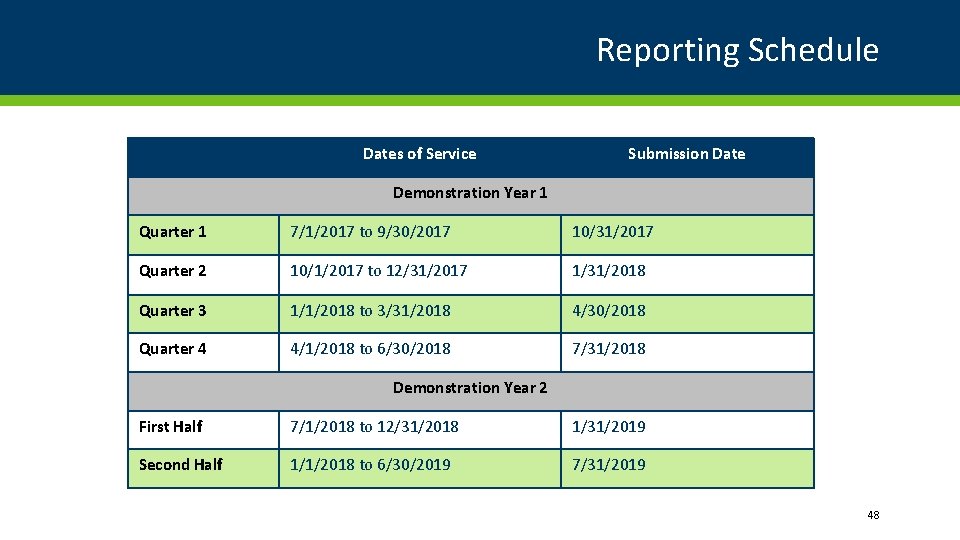
Reporting Schedule Dates of Service Submission Date Demonstration Year 1 Quarter 1 7/1/2017 to 9/30/2017 10/31/2017 Quarter 2 10/1/2017 to 12/31/2017 1/31/2018 Quarter 3 1/1/2018 to 3/31/2018 4/30/2018 Quarter 4 4/1/2018 to 6/30/2018 7/31/2018 Demonstration Year 2 First Half 7/1/2018 to 12/31/2018 1/31/2019 Second Half 1/1/2018 to 6/30/2019 7/31/2019 48
CCBHC Care Coordination and Managed Care organizations Leah Montgomery – Health Care Administration - BHH 49
CCBHC Care Coordination Criteria • Section 223 of the Protecting Access to Medicare Act (PAMA) established federal authority for a Medicaid demonstration project to test new mental health and physical health service delivery and integration model. • Section 223 of PAMA required the Secretary to develop of criteria for certification of CCBHCs. SAMHSA was tasked with development of the criteria. The full criteria can be found on the SAMHSA Section 223 website. 50
Care Coordination and MA Managed Care • Different requirements for care management and care coordination apply to the different MA managed care products. • CCBHCs need to understand the basic differences between the different managed care products in order to leverage all available resources on behalf of consumers. 51
Minnesota’s MA Managed Care Products Families & Children SNBC MSHO/MSC+ • Plans are required to have • Plans are required to offer ability to offer care each enrollee a health risk management (e. g. assessment annually. assessment, care plan, monitoring) to enrollee if • If care management is • Every MSHO and MSC+ EW necessary. needed, the plans are enrollee is assigned a care responsible for providing coordinator. care plan development and monitoring as appropriate based on the needs of the enrollee. 52
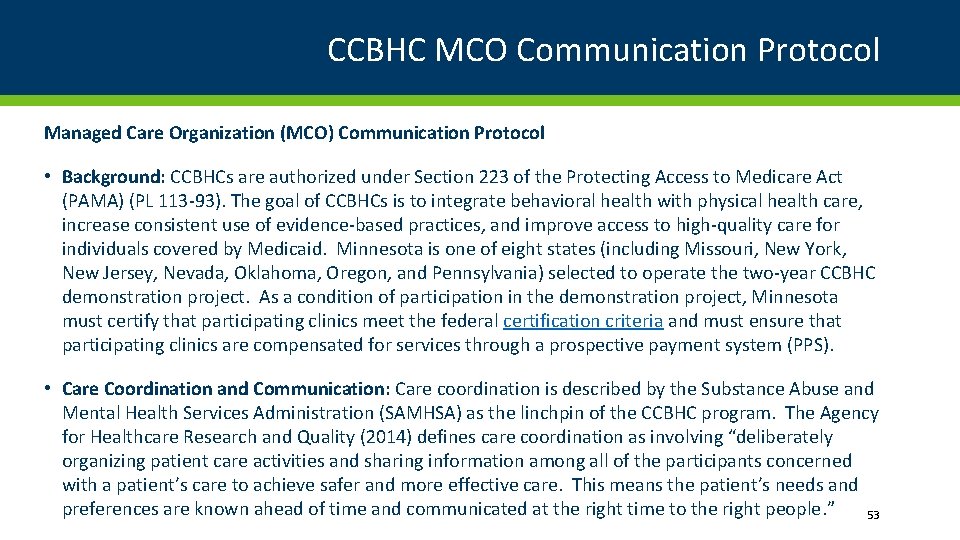
CCBHC MCO Communication Protocol Managed Care Organization (MCO) Communication Protocol • Background: CCBHCs are authorized under Section 223 of the Protecting Access to Medicare Act (PAMA) (PL 113 -93). The goal of CCBHCs is to integrate behavioral health with physical health care, increase consistent use of evidence-based practices, and improve access to high-quality care for individuals covered by Medicaid. Minnesota is one of eight states (including Missouri, New York, New Jersey, Nevada, Oklahoma, Oregon, and Pennsylvania) selected to operate the two-year CCBHC demonstration project. As a condition of participation in the demonstration project, Minnesota must certify that participating clinics meet the federal certification criteria and must ensure that participating clinics are compensated for services through a prospective payment system (PPS). • Care Coordination and Communication: Care coordination is described by the Substance Abuse and Mental Health Services Administration (SAMHSA) as the linchpin of the CCBHC program. The Agency for Healthcare Research and Quality (2014) defines care coordination as involving “deliberately organizing patient care activities and sharing information among all of the participants concerned with a patient’s care to achieve safer and more effective care. This means the patient’s needs and preferences are known ahead of time and communicated at the right time to the right people. ” 53
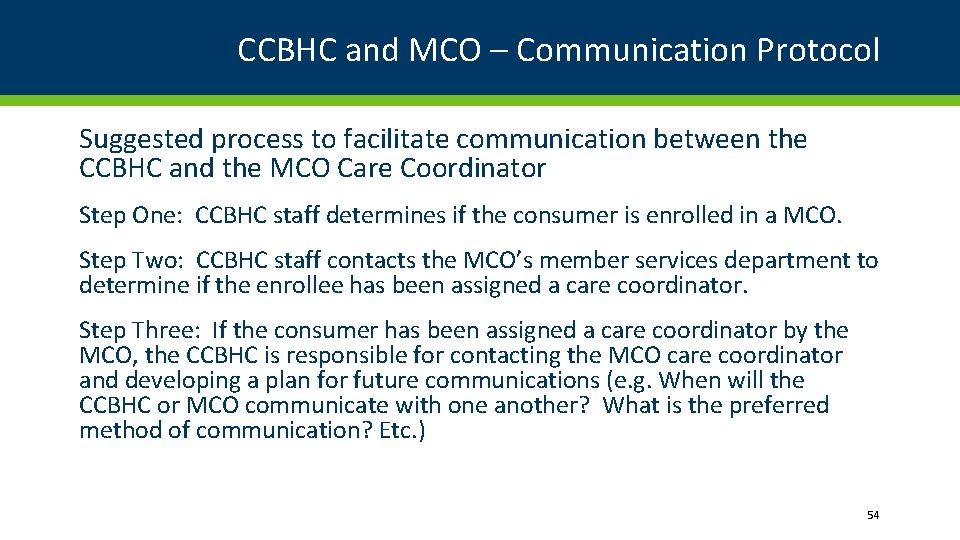
CCBHC and MCO – Communication Protocol Suggested process to facilitate communication between the CCBHC and the MCO Care Coordinator Step One: CCBHC staff determines if the consumer is enrolled in a MCO. Step Two: CCBHC staff contacts the MCO’s member services department to determine if the enrollee has been assigned a care coordinator. Step Three: If the consumer has been assigned a care coordinator by the MCO, the CCBHC is responsible for contacting the MCO care coordinator and developing a plan for future communications (e. g. When will the CCBHC or MCO communicate with one another? What is the preferred method of communication? Etc. ) 54
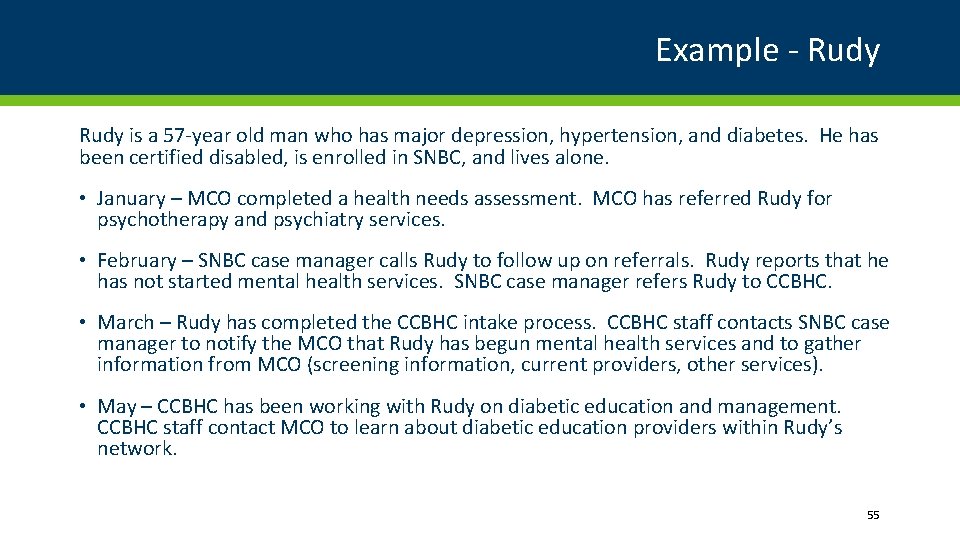
Example - Rudy is a 57 -year old man who has major depression, hypertension, and diabetes. He has been certified disabled, is enrolled in SNBC, and lives alone. • January – MCO completed a health needs assessment. MCO has referred Rudy for psychotherapy and psychiatry services. • February – SNBC case manager calls Rudy to follow up on referrals. Rudy reports that he has not started mental health services. SNBC case manager refers Rudy to CCBHC. • March – Rudy has completed the CCBHC intake process. CCBHC staff contacts SNBC case manager to notify the MCO that Rudy has begun mental health services and to gather information from MCO (screening information, current providers, other services). • May – CCBHC has been working with Rudy on diabetic education and management. CCBHC staff contact MCO to learn about diabetic education providers within Rudy’s network. 55
Thank you! Julie Pearson, MSW, LISW Minnesota Department of Human Services CCBHC Project Manager | Mental Health Division Julie. Pearson@state. mn. us 56
- Slides: 56