
Implementing BIBFRAME The UC Davis BIBFLOW Project Xiaoli
Implementing BIBFRAME: The UC Davis BIBFLOW Project Xiaoli Li Co-head of Content Support Services University of California Davis Library New York Technical Services Librarians November 16, 2015
Outline • Introduction to BIBFRAME o What is BIBFRAME? o Goals for BIBFRAME • BIBFLOW Project o What have been done? o Where are we? o Demo
PART I: What Is BIBFRAME? BIBliographic FRAMEwork Initiative
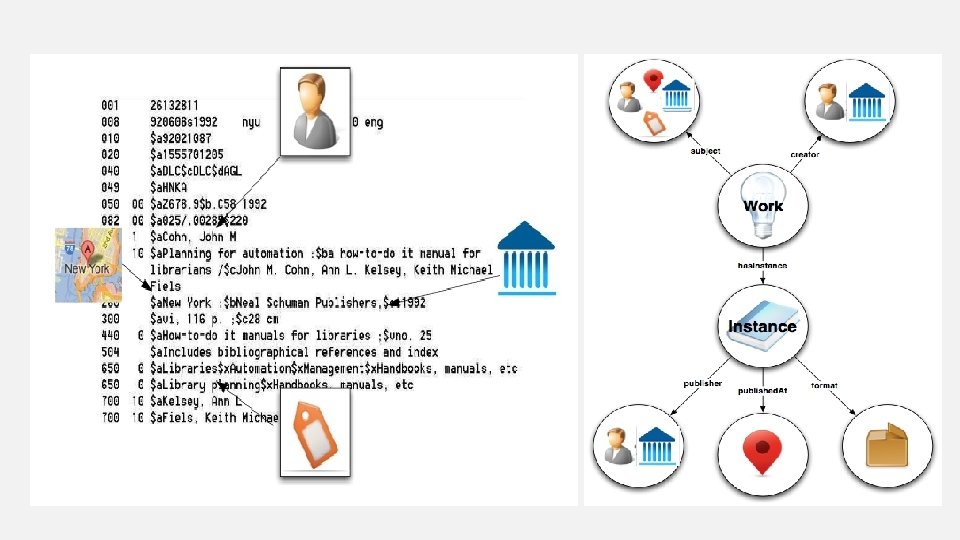
What Is BIBFRAME? • Library Congress’ project started in 2011 • It’s the replacement for MARC o can and will serve as an encoding standard for RDA and other content standards AND • It leverages the current web technology (sematic web/Linked Data) and uses Resource Description Framework (RDF) modeling practice.
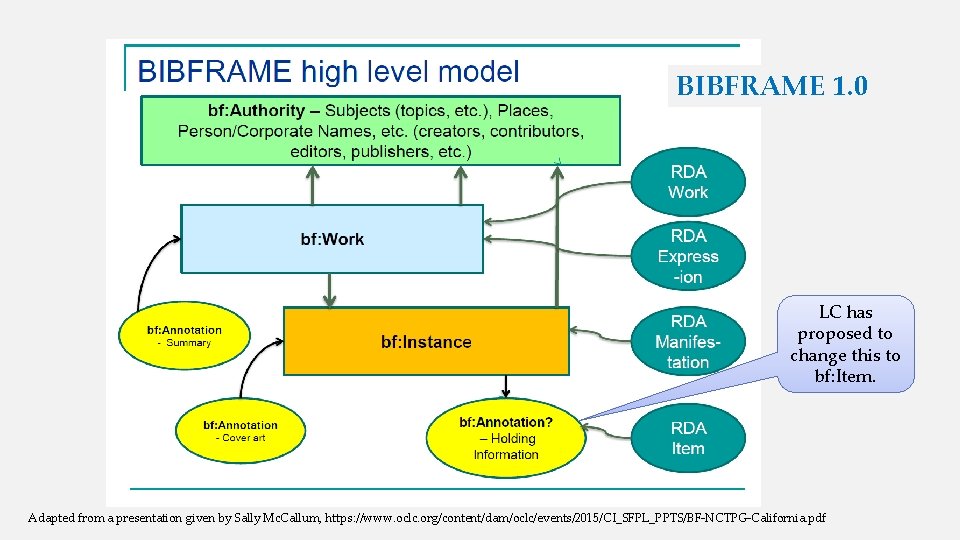
BIBFRAME 1. 0 LC has proposed to change this to bf: Item. Adapted from a presentation given by Sally Mc. Callum, https: //www. oclc. org/content/dam/oclc/events/2015/CI_SFPL_PPTS/BF-NCTPG-California. pdf
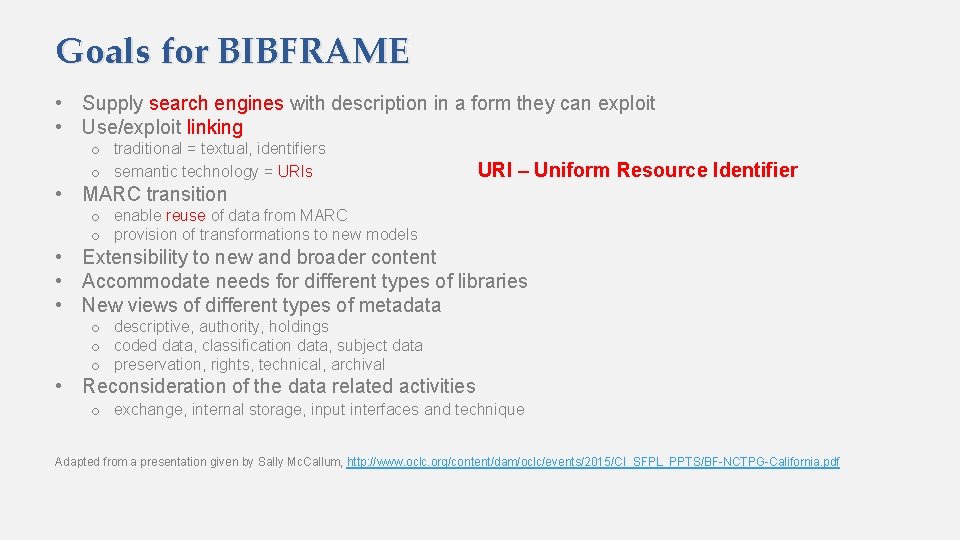
Goals for BIBFRAME • Supply search engines with description in a form they can exploit • Use/exploit linking o traditional = textual, identifiers o semantic technology = URIs URI – Uniform Resource Identifier • MARC transition o enable reuse of data from MARC o provision of transformations to new models • Extensibility to new and broader content • Accommodate needs for different types of libraries • New views of different types of metadata o descriptive, authority, holdings o coded data, classification data, subject data o preservation, rights, technical, archival • Reconsideration of the data related activities o exchange, internal storage, input interfaces and technique Adapted from a presentation given by Sally Mc. Callum, http: //www. oclc. org/content/dam/oclc/events/2015/CI_SFPL_PPTS/BF-NCTPG-California. pdf
PART II: What Is BIBFLOW BIBframe + work. FLOW
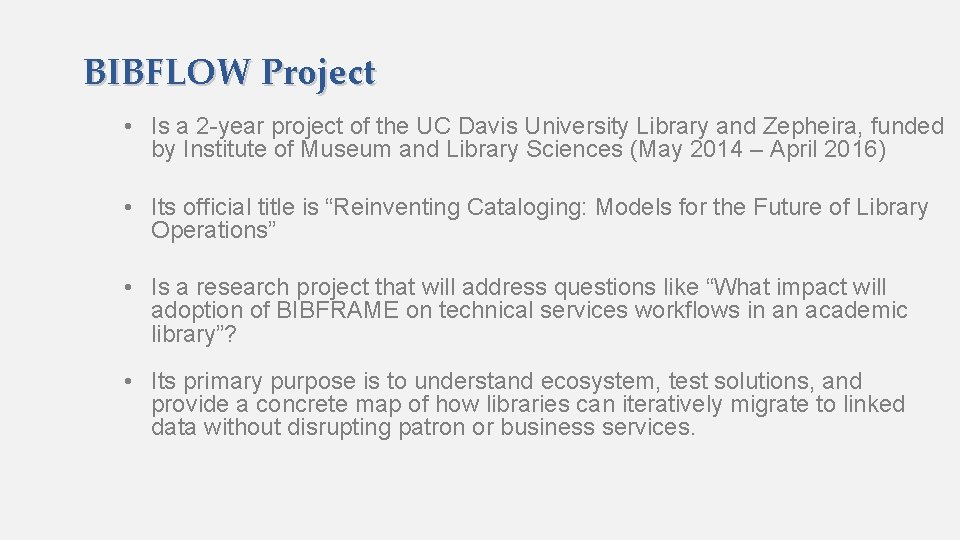
BIBFLOW Project • Is a 2 -year project of the UC Davis University Library and Zepheira, funded by Institute of Museum and Library Sciences (May 2014 – April 2016) • Its official title is “Reinventing Cataloging: Models for the Future of Library Operations” • Is a research project that will address questions like “What impact will adoption of BIBFRAME on technical services workflows in an academic library”? • Its primary purpose is to understand ecosystem, test solutions, and provide a concrete map of how libraries can iteratively migrate to linked data without disrupting patron or business services.

How?
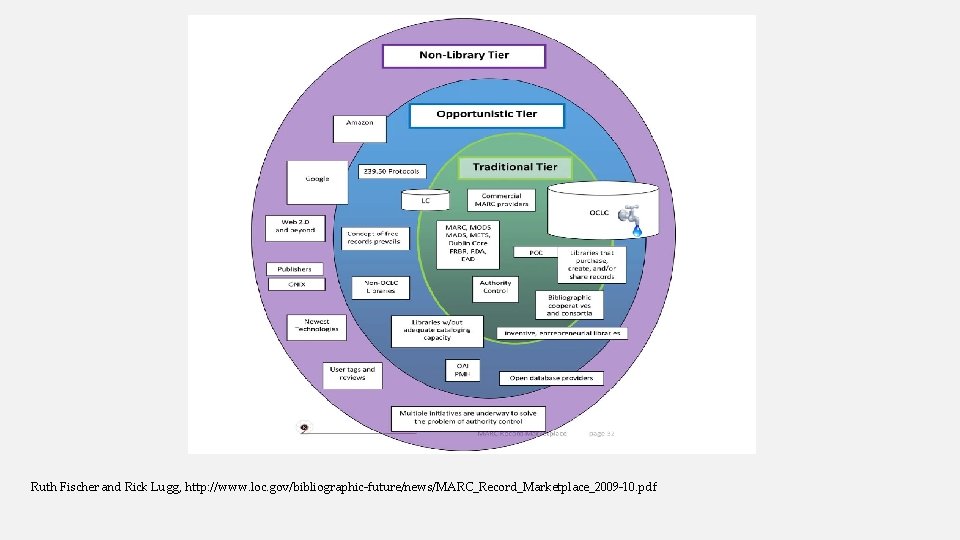
Ruth Fischer and Rick Lugg, http: //www. loc. gov/bibliographic-future/news/MARC_Record_Marketplace_2009 -10. pdf
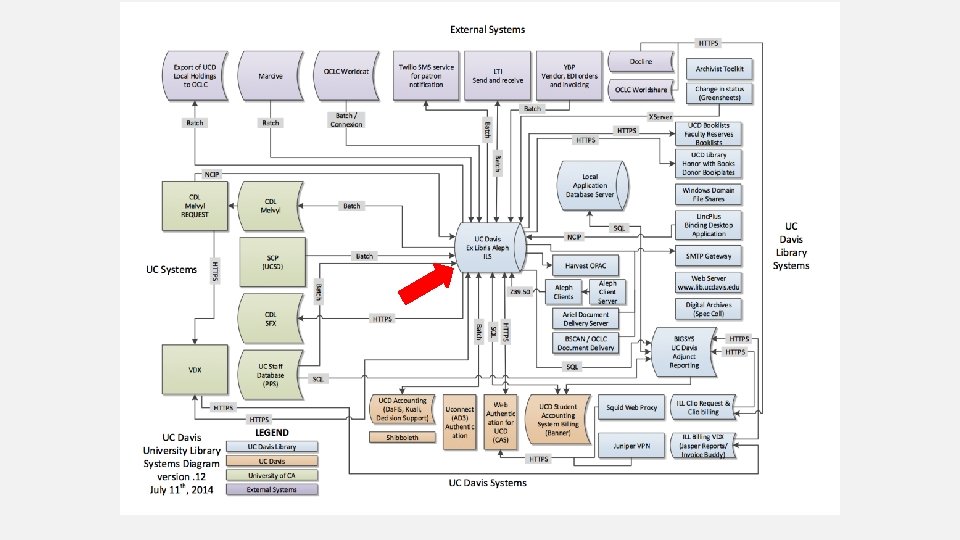
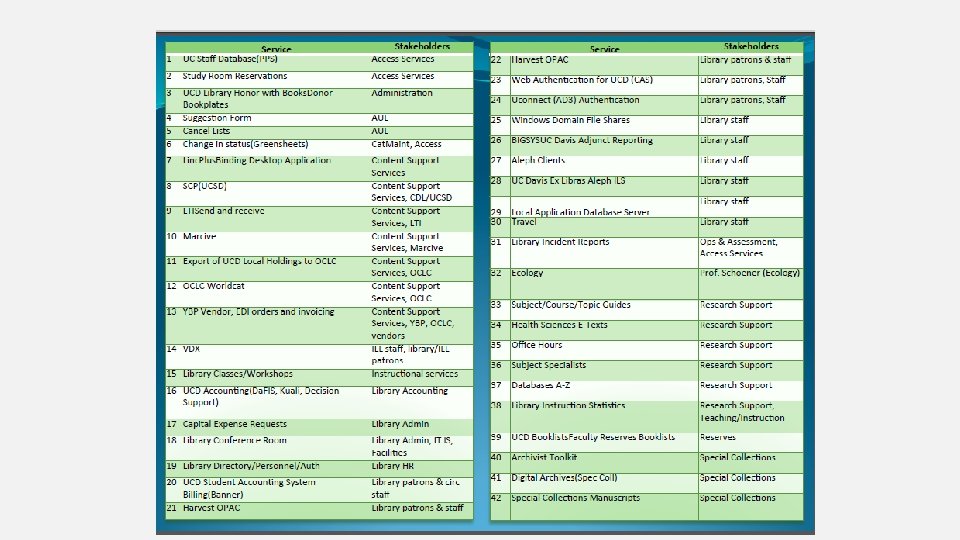
This complexity leads to the inevitable conclusion that moving away from MARC into BIBFRAME represents an evolutionary leap for libraries and not a simple migration.
Workflows and Use Cases BIBFLOW’s focus is on developing a roadmap for migrating essential library work efforts (workflows) to a BIBFRAME / LOD ecosystem. Library work involves daily engagement with a large collection of software systems, institutions, and vendors. As such, moving to a LOD ecosystem is not simply a matter of understanding its impact on library data but also on these complex workflows.
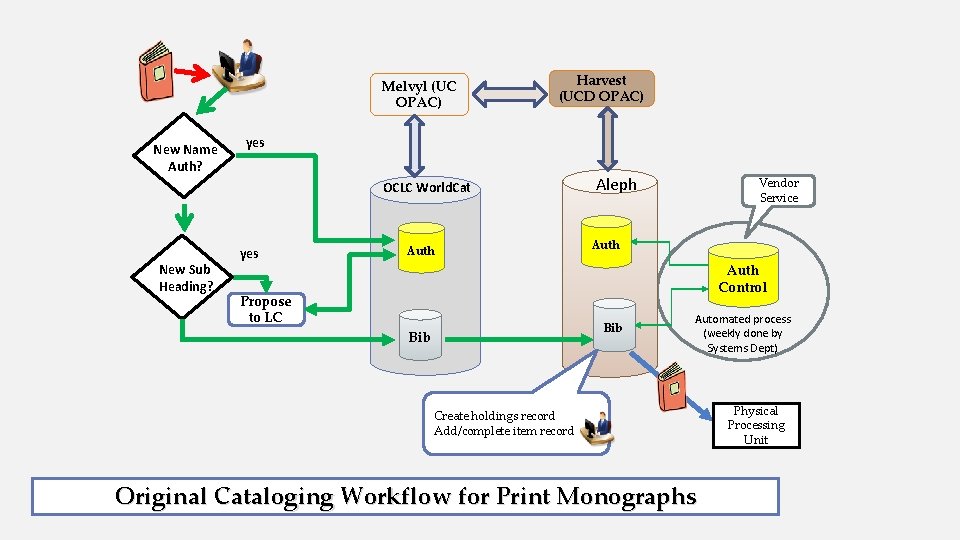
Melvyl (UC OPAC) New Name Auth? Harvest (UCD OPAC) yes OCLC World. Cat New Sub Heading? yes Auth Aleph Vendor Service Auth Control Propose to LC Bib Automated process (weekly done by Systems Dept) Create holdings record Add/complete item record Original Cataloging Workflow for Print Monographs Physical Processing Unit
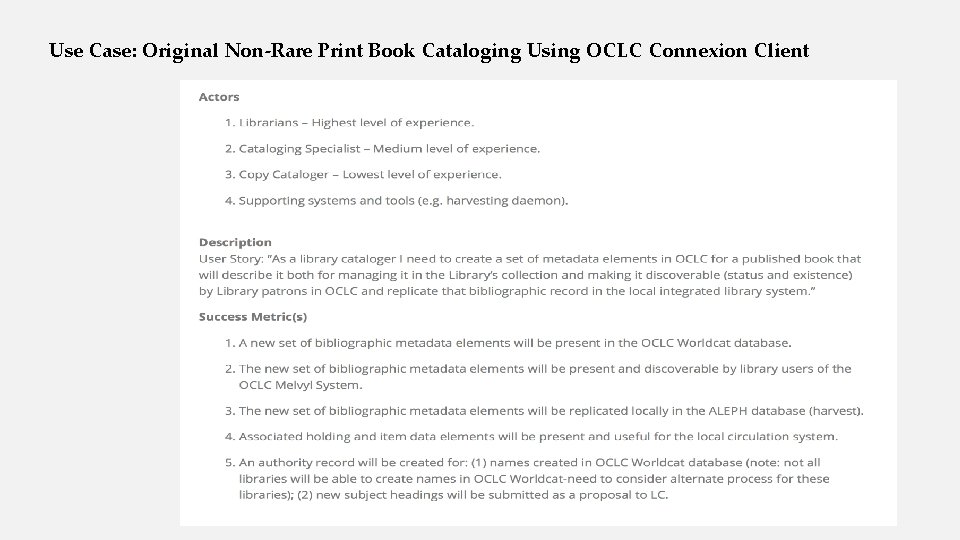
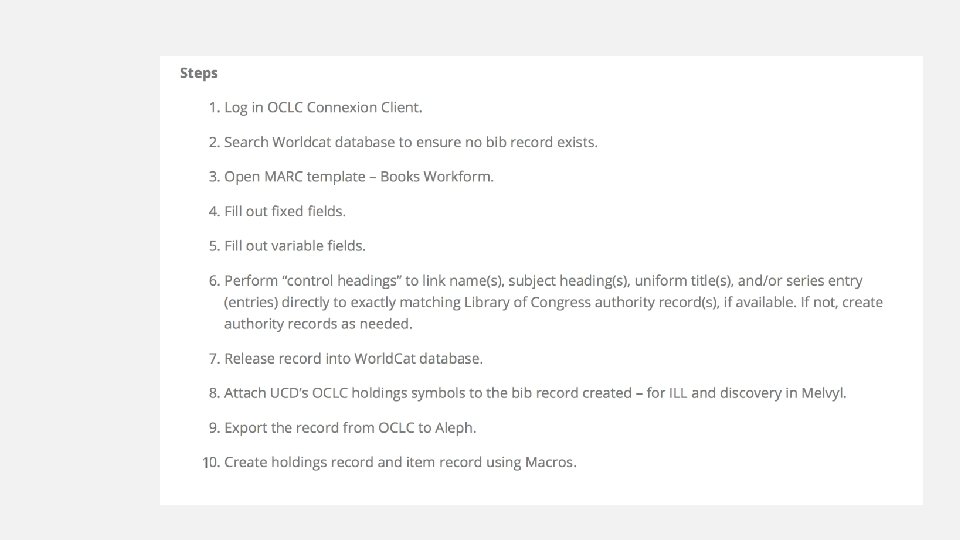
Use Case: Original Non-Rare Print Book Cataloging Using OCLC Connexion Client
Assessment of Library Management System To make the transition into BIBFRAME possible, library community needs a linked data oriented system.
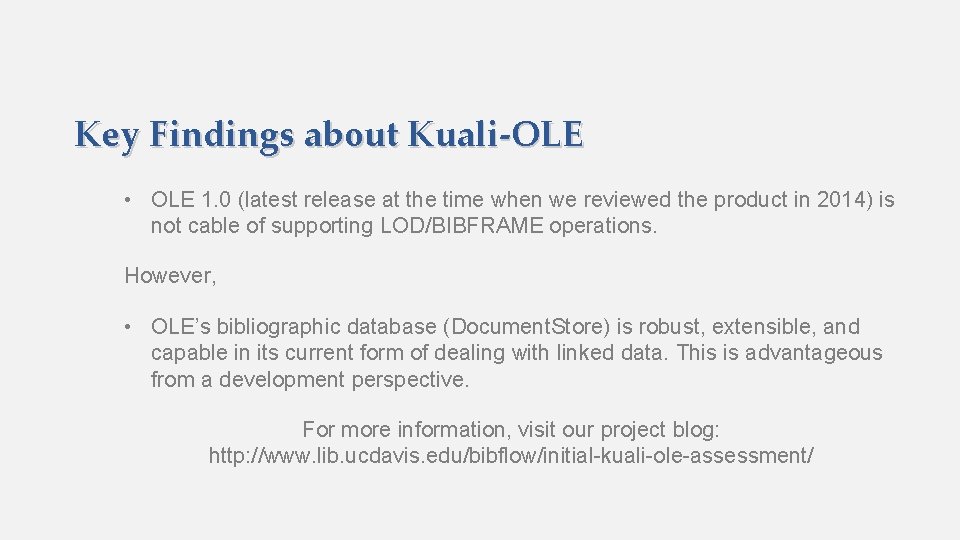
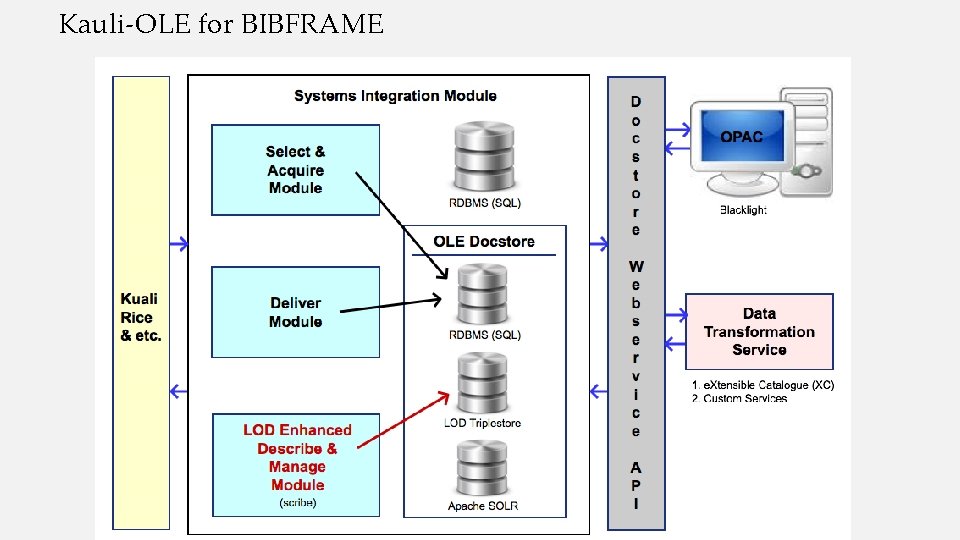
Key Findings about Kuali-OLE • OLE 1. 0 (latest release at the time when we reviewed the product in 2014) is not cable of supporting LOD/BIBFRAME operations. However, • OLE’s bibliographic database (Document. Store) is robust, extensible, and capable in its current form of dealing with linked data. This is advantageous from a development perspective. For more information, visit our project blog: http: //www. lib. ucdavis. edu/bibflow/initial-kuali-ole-assessment/
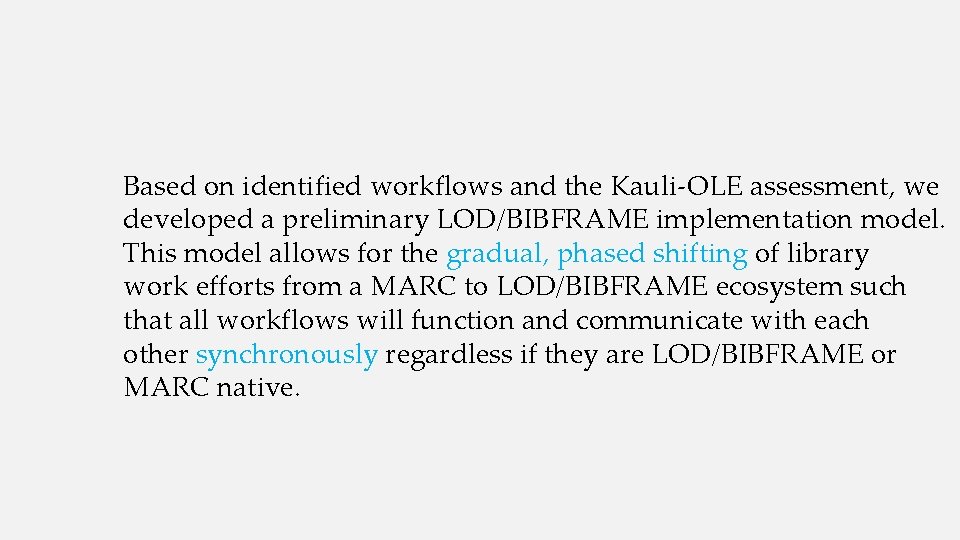
Based on identified workflows and the Kauli-OLE assessment, we developed a preliminary LOD/BIBFRAME implementation model. This model allows for the gradual, phased shifting of library work efforts from a MARC to LOD/BIBFRAME ecosystem such that all workflows will function and communicate with each other synchronously regardless if they are LOD/BIBFRAME or MARC native.
Where Are We?
Kauli-OLE for BIBFRAME
Testing Workflows • • Original cataloging of non-rare print books Copy cataloging of non-rare print books Original cataloging of electronic dissertations Original cataloging of print maps Original cataloging of print serials Personal and corporate name authority record creation Original cataloging of rare non-book items
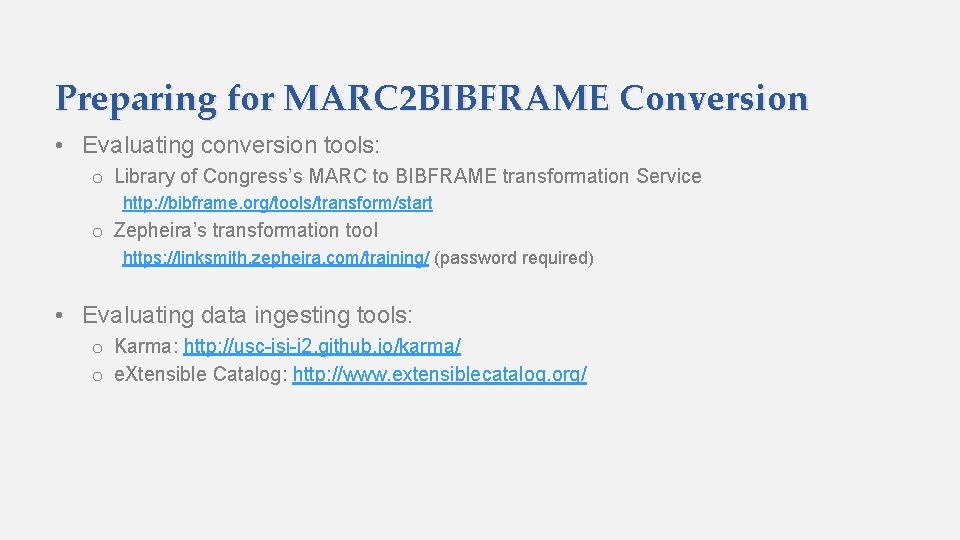
Preparing for MARC 2 BIBFRAME Conversion • Evaluating conversion tools: o Library of Congress’s MARC to BIBFRAME transformation Service http: //bibframe. org/tools/transform/start o Zepheira’s transformation tool https: //linksmith. zepheira. com/training/ (password required) • Evaluating data ingesting tools: o Karma: http: //usc-isi-i 2. github. io/karma/ o e. Xtensible Catalog: http: //www. extensiblecatalog. org/
Demo
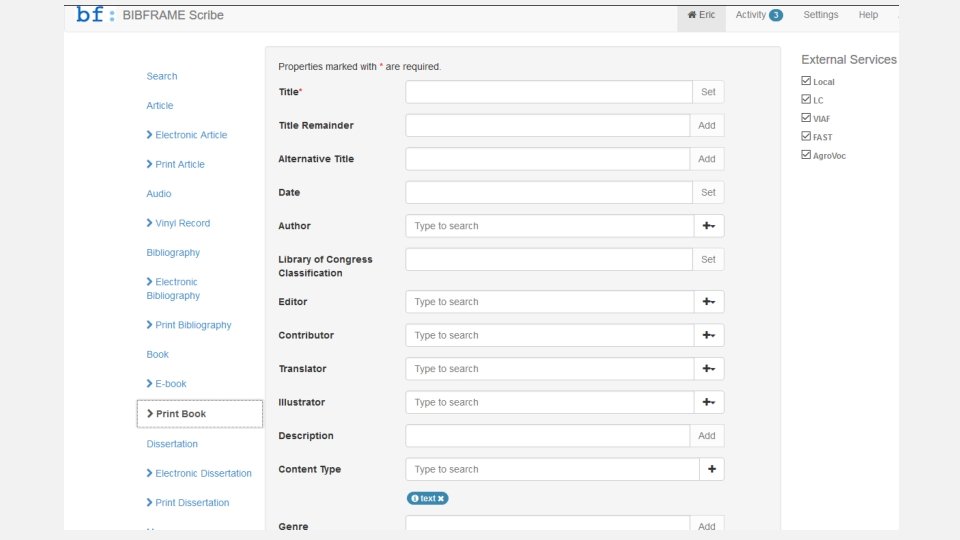
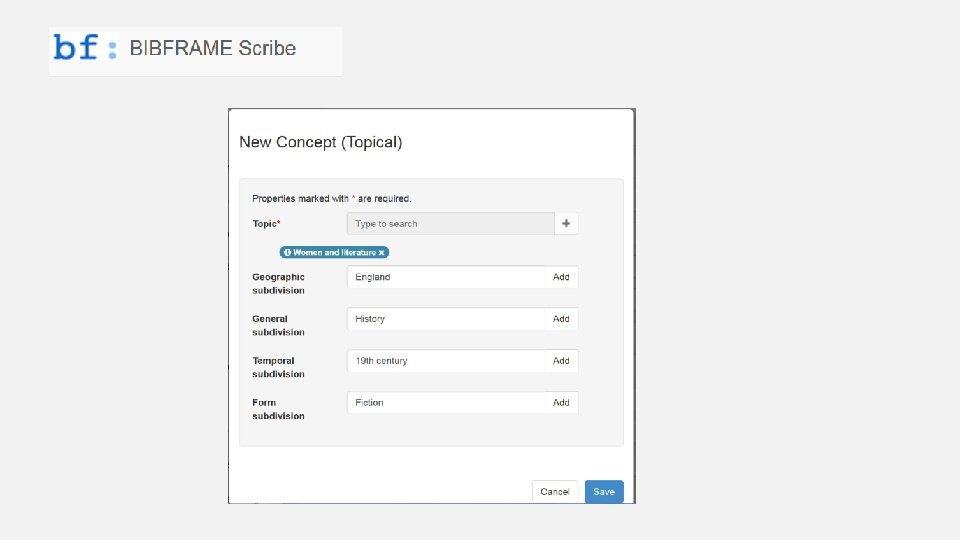
DEMO #1 Input Subject Terms Using Scribe (Zepheira’s BIBFRAME Editor)
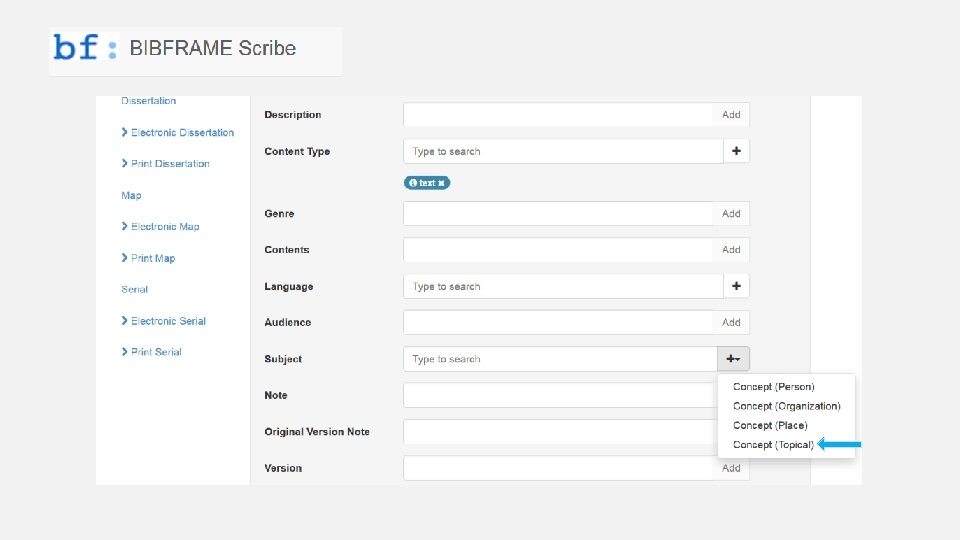
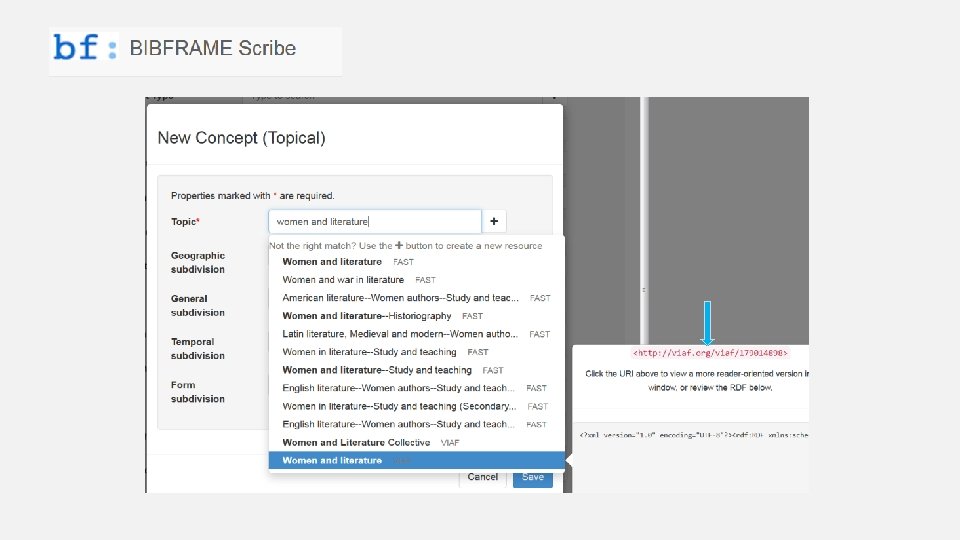
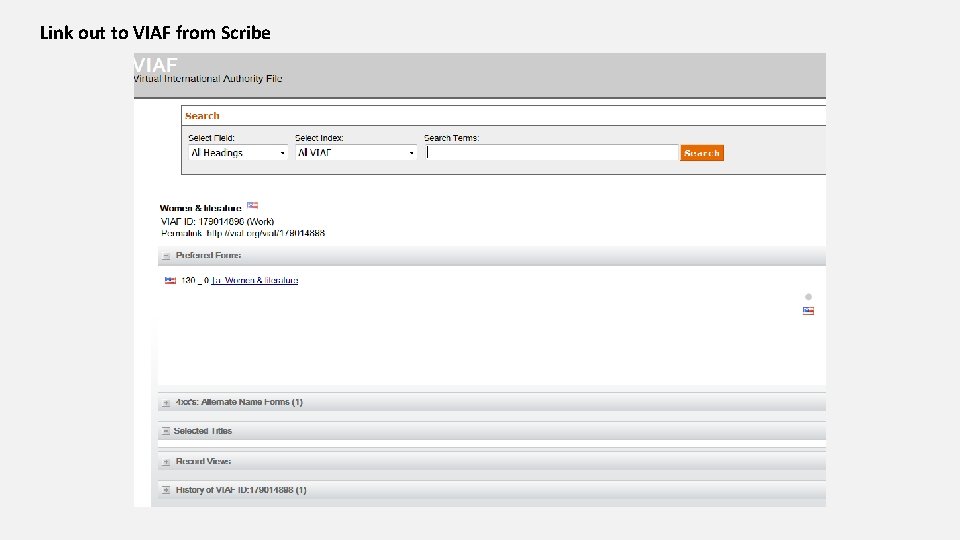
Link out to VIAF from Scribe
Demo #2: Workflow - Auto Fill Data Elements Retrieved from OCLC
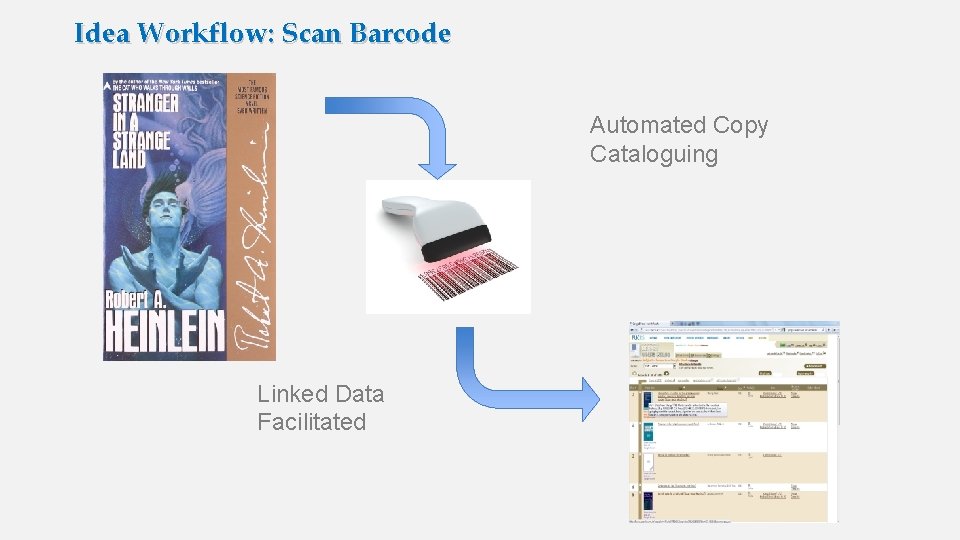
Idea Workflow: Scan Barcode Automated Copy Cataloguing Linked Data Facilitated
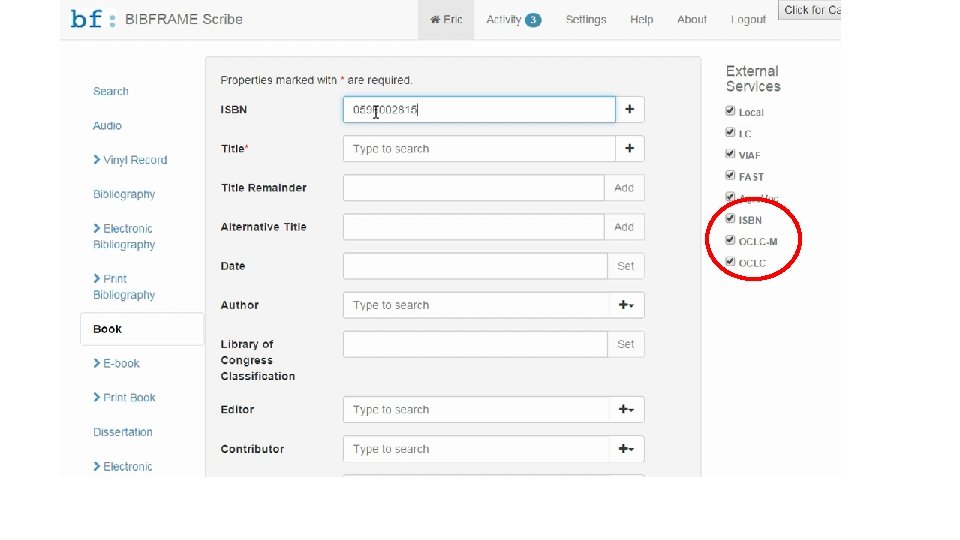

N I K R O W S S E R G O R P
Demo #3: MARC BIBFRMAE
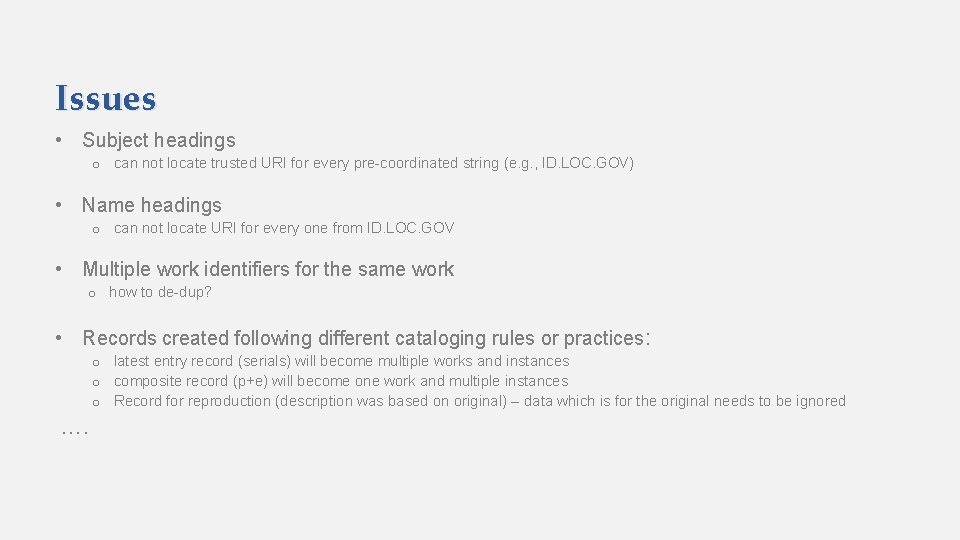
Issues • Subject headings o can not locate trusted URI for every pre-coordinated string (e. g. , ID. LOC. GOV) • Name headings o can not locate URI for every one from ID. LOC. GOV • Multiple work identifiers for the same work o how to de-dup? • Records created following different cataloging rules or practices: o latest entry record (serials) will become multiple works and instances o composite record (p+e) will become one work and multiple instances o Record for reproduction (description was based on original) – data which is for the original needs to be ignored ….
Issue – Subject Headings
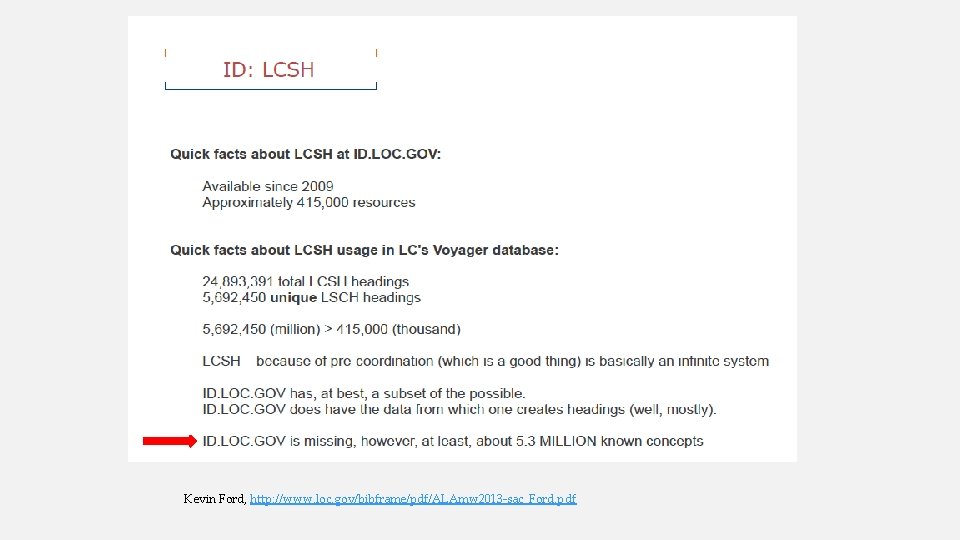
Kevin Ford, http: //www. loc. gov/bibframe/pdf/ALAmw 2013 -sac_Ford. pdf
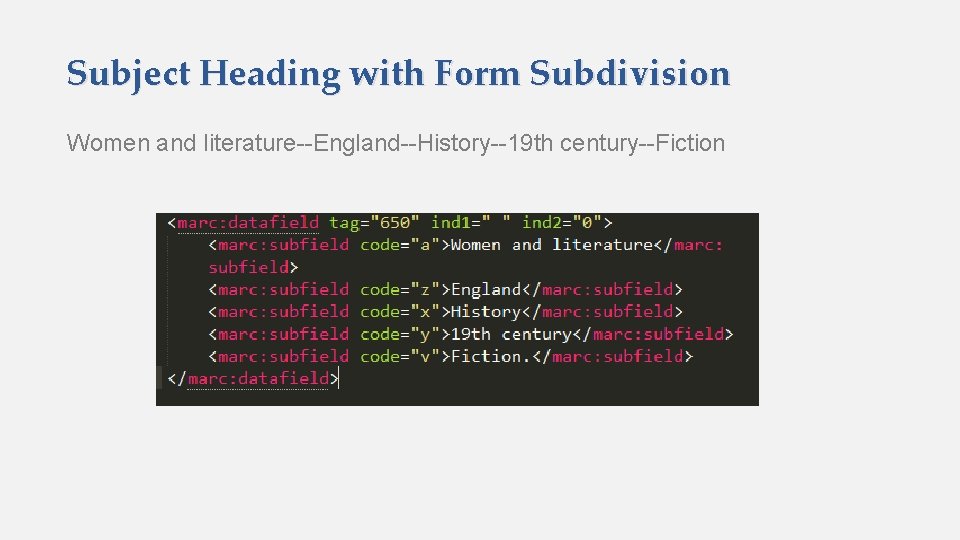
Subject Heading with Form Subdivision Women and literature--England--History--19 th century--Fiction
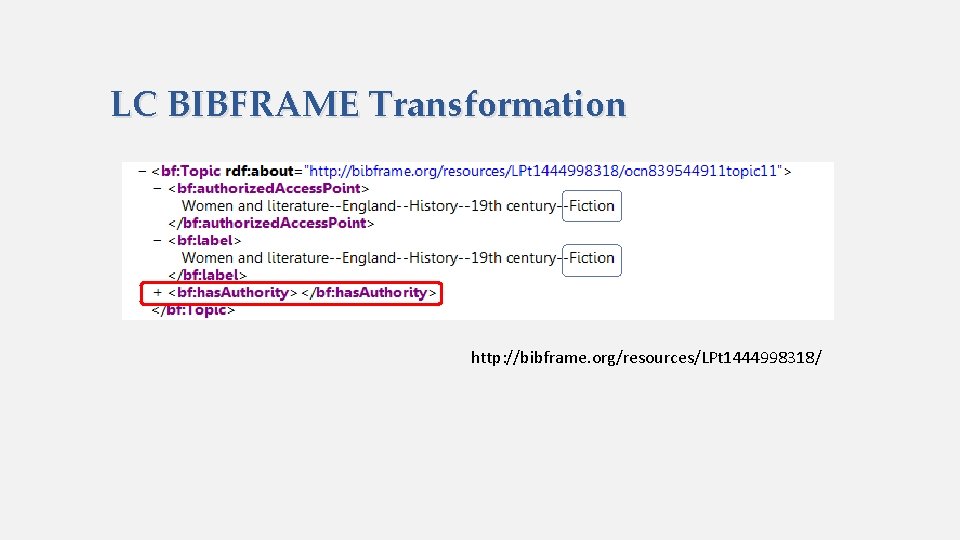
LC BIBFRAME Transformation http: //bibframe. org/resources/LPt 1444998318/
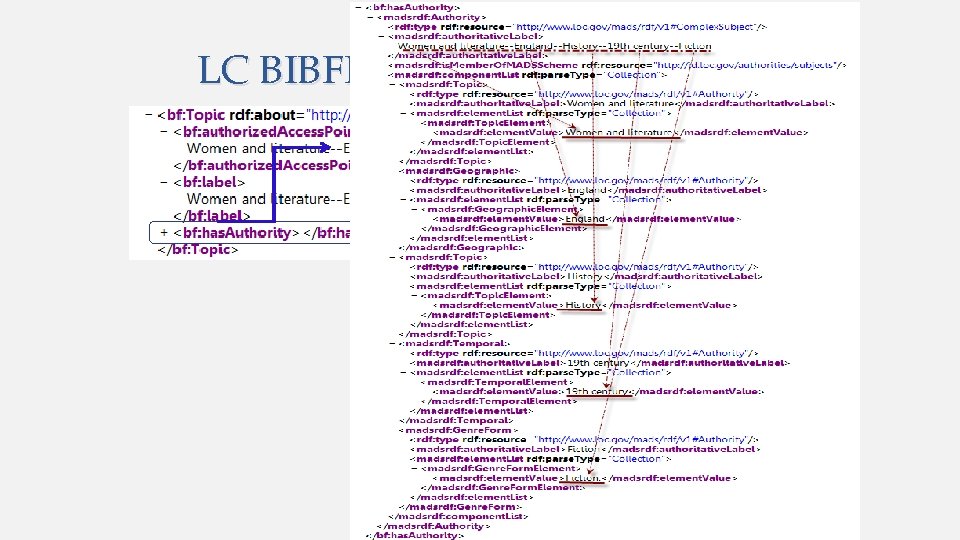
LC BIBFRAME Transformation
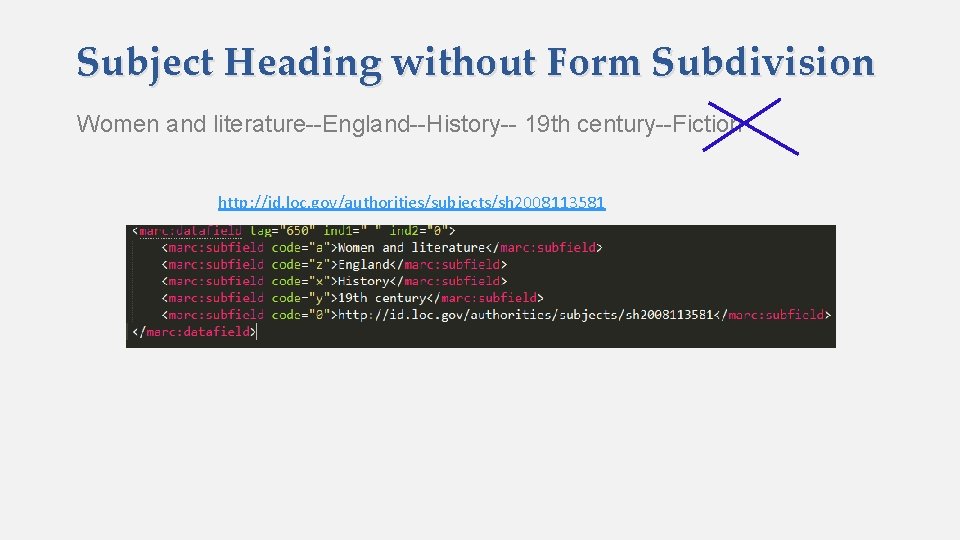
Subject Heading without Form Subdivision Women and literature--England--History-- 19 th century--Fiction http: //id. loc. gov/authorities/subjects/sh 2008113581
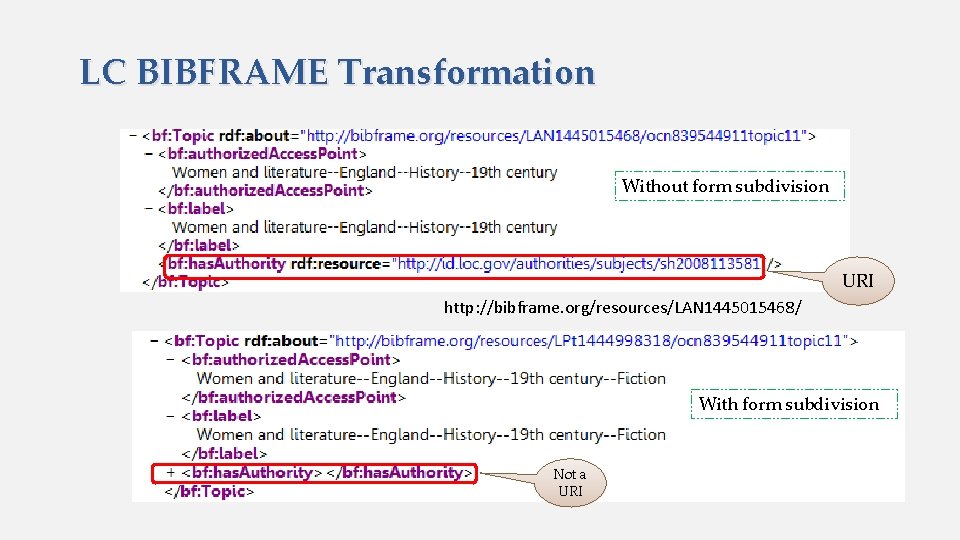
LC BIBFRAME Transformation Without form subdivision URI http: //bibframe. org/resources/LAN 1445015468/ With form subdivision Not a URI
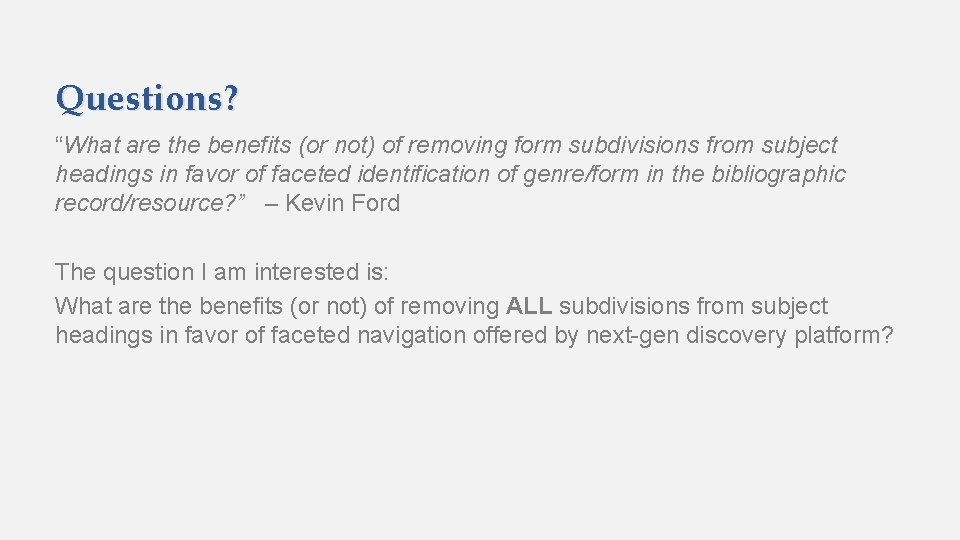
Questions? “What are the benefits (or not) of removing form subdivisions from subject headings in favor of faceted identification of genre/form in the bibliographic record/resource? ” – Kevin Ford The question I am interested is: What are the benefits (or not) of removing ALL subdivisions from subject headings in favor of faceted navigation offered by next-gen discovery platform?
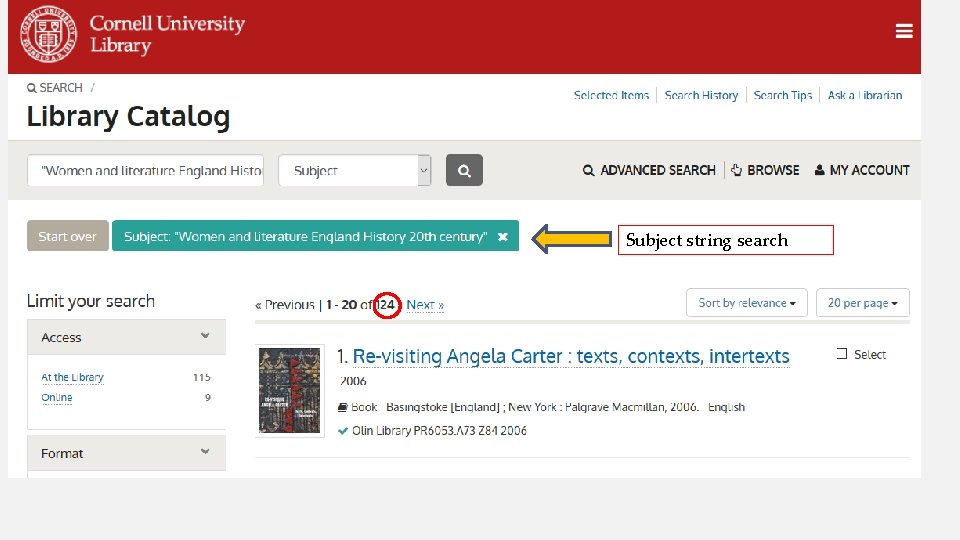
Subject string search
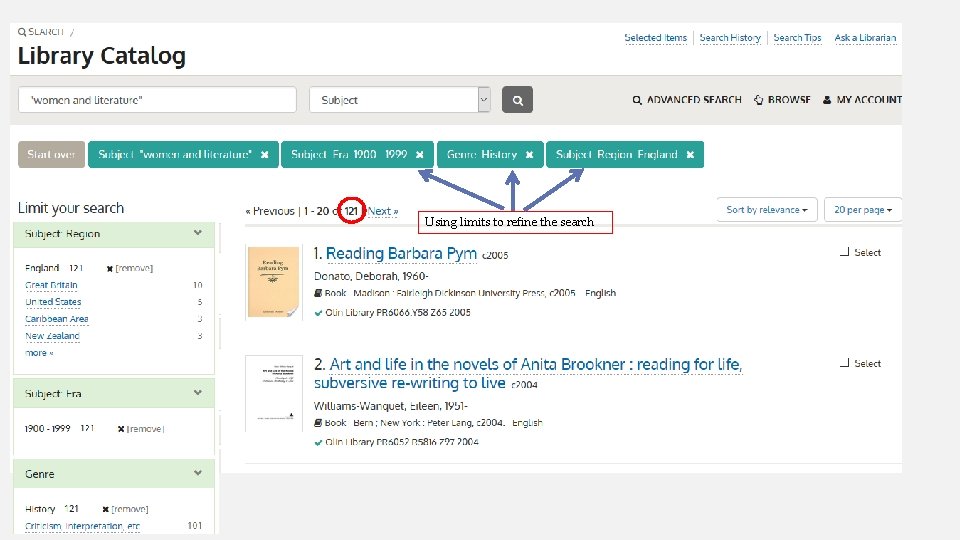
Using limits to refine the search
Issue – Name Headings
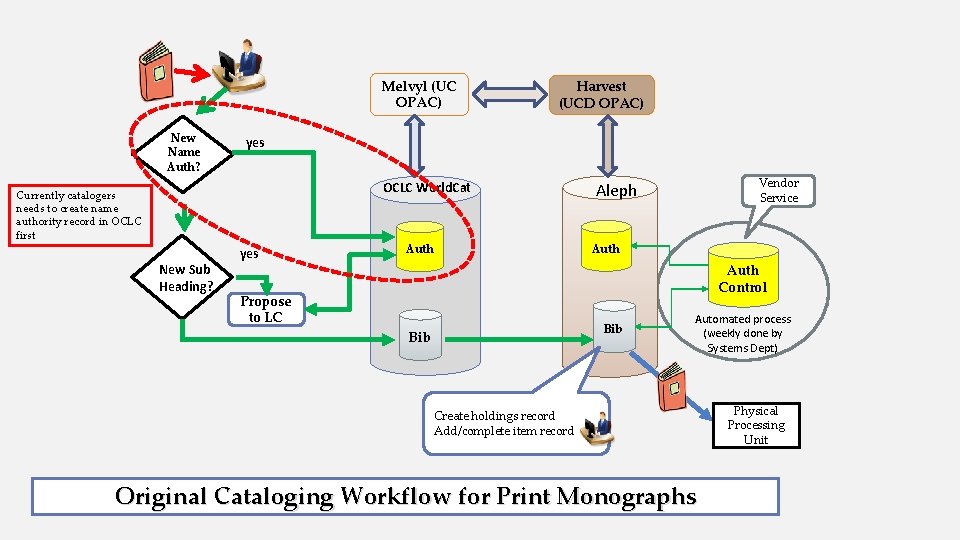
Melvyl (UC OPAC) New Name Auth? Harvest (UCD OPAC) yes OCLC World. Cat Currently catalogers needs to create name authority record in OCLC first New Sub Heading? yes Auth Vendor Service Aleph Auth Control Propose to LC Bib Automated process (weekly done by Systems Dept) Create holdings record Add/complete item record Original Cataloging Workflow for Print Monographs Physical Processing Unit
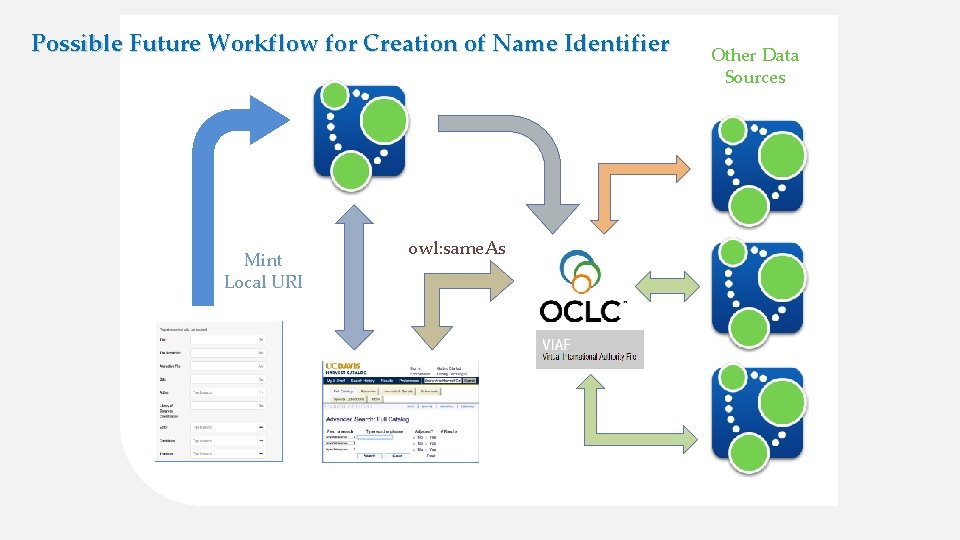
Possible Future Workflow for Creation of Name Identifier Mint Local URI owl: same. As Other Data Sources
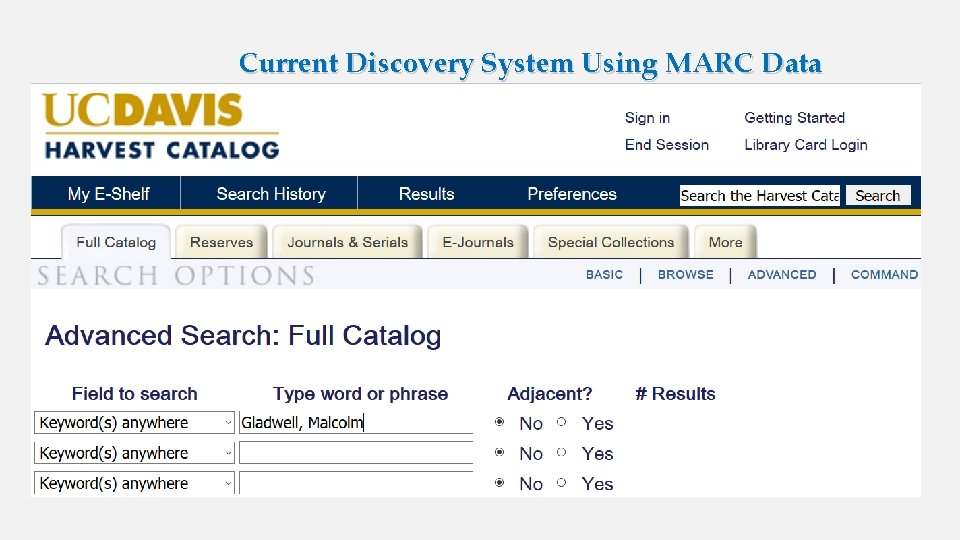
Current Discovery System Using MARC Data
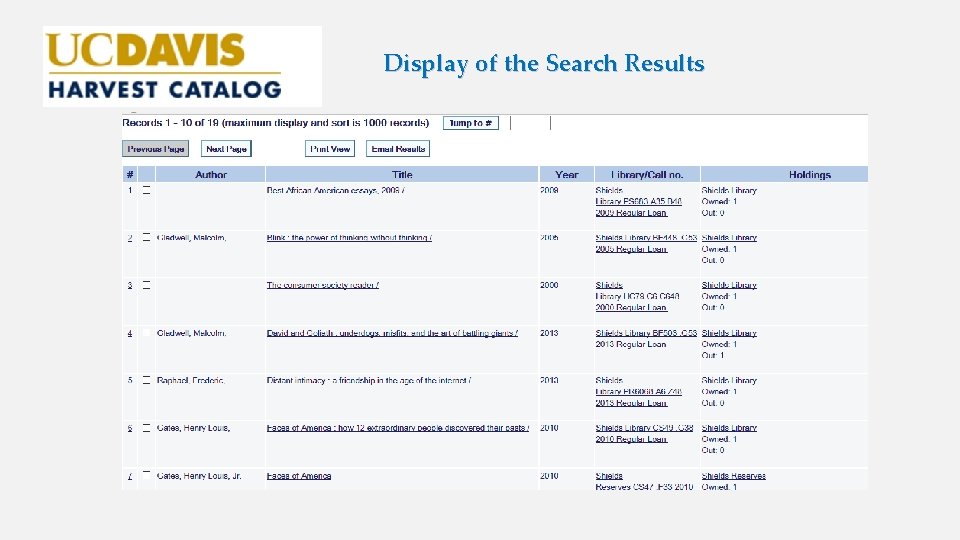
Display of the Search Results
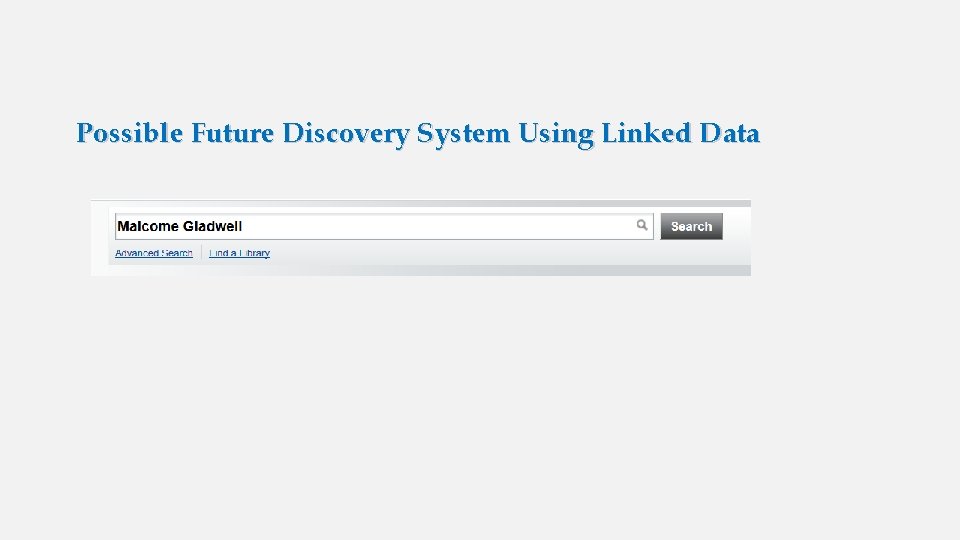
Possible Future Discovery System Using Linked Data
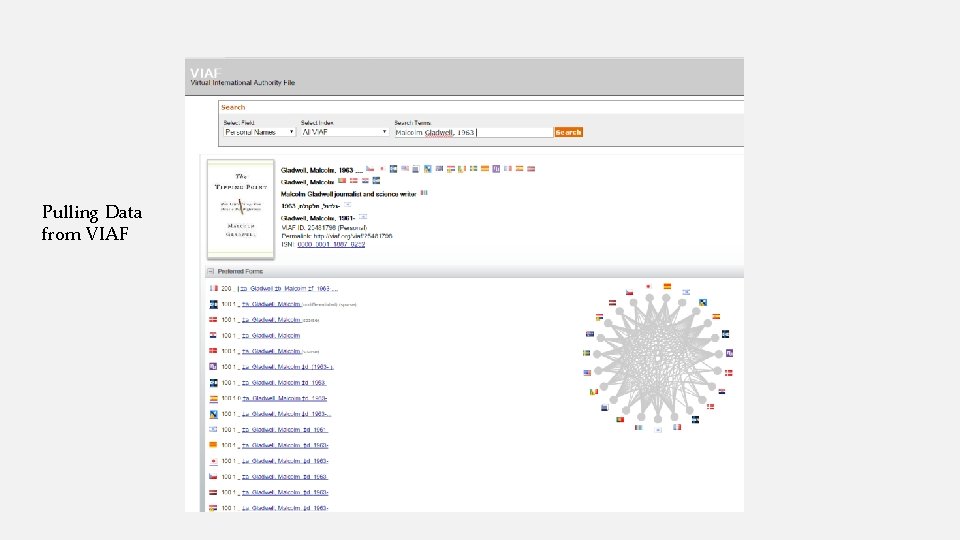
Pulling Data from VIAF
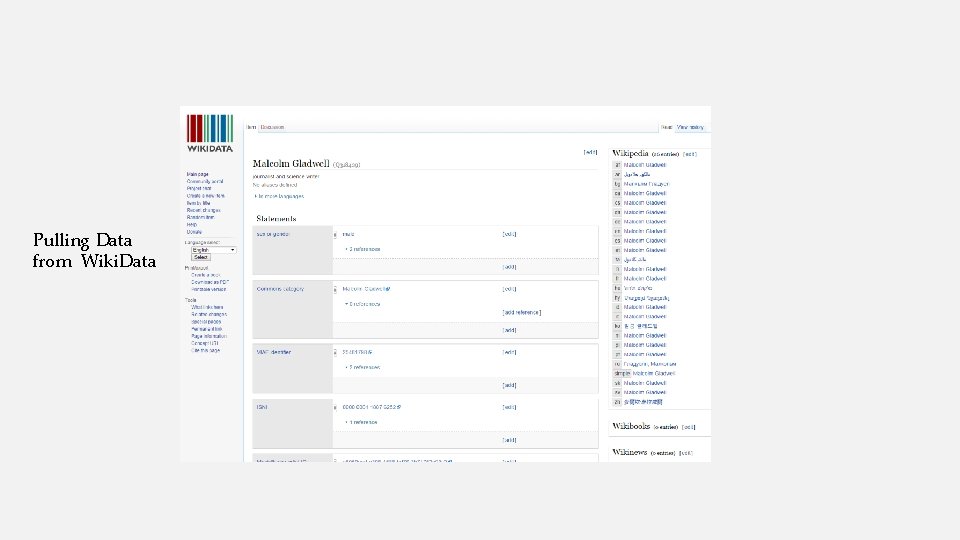
Pulling Data from Wiki. Data
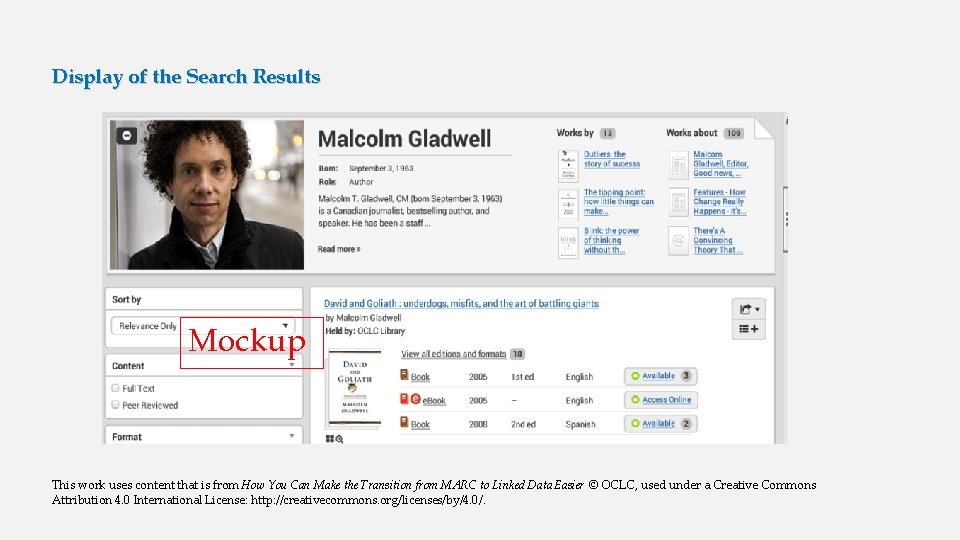
Display of the Search Results Mockup This work uses content that is from How You Can Make the Transition from MARC to Linked Data Easier © OCLC, used under a Creative Commons Attribution 4. 0 International License: http: //creativecommons. org/licenses/by/4. 0/.
References Mc. Callum, S. (2015). BIBFRAME Update – Why, What, When [PDF document]. Retrieve from https: //www. oclc. org/content/dam/oclc/events/2015/CI_SFPL_PPTS/BF-NCTPG-California. pdf Ford, K. (2013). When URIs become authority: Benefits and challenges of library Linked Data [PDF document ]. Retrieved from http: //www. loc. gov/bibframe/pdf/ALAmw 2013 -sac_Ford. pdf Fischer, R. and Lugg R. (2009). Study of the North American MARC Records Marketplace. Retrieved from http: //www. loc. gov/bibliographic-future/news/MARC_Record_Marketplace_2009 -10. pdf Godby, J. and Smith-Yoshimura, K. (2015). How You Can Make the Transition from MARC to Linked Data Easier. Retrieved from http: //www. oclc. org/content/dam/research/events/2015/marc-to-linked-data-webinar. pptx
BIBFLOW: A Roadmap for Success Thank you!
- Slides: 59