
Implementing an Automated Identity and Access Management System













- Slides: 38
Implementing an Automated Identity and Access Management System: Tracking Students on (and away from)Your Campus Through Roles Ted Bross, Ed. D. Associate Director, Administrative Information Services Office of Information Technology Princeton University tbross@princeton. edu
Who Am I And How Did I Get Here Today (And Why)? • What I learned in Graduate School – Make sure you have lots of coffee – Don’t tell adults what they already know • My career at Princeton and before – My day job (takes up 98% of my time) – Identity Management (takes up the remaining 22%) – 98%+22%<>100%
Princeton University • • • 4900 Undergraduate Students (all full-time, day) 2300 Graduate Students (almost all full-time, fully funded) 850 Full-time Faculty Members, 6000+ other employees People. Soft ERP (HR, Student, Financials) with many locally developed applications using PL/SQL, Java, PHP and dot. Net for other administrative functions; BSR ADVANCE and Blackboard among a set of third party vendor applications No Medical School, Dental School, Law School, Business School (I died and went to heaven) Existing “Patchwork” set of incomplete and manually intensive solutions for Identity Management (some of our faculty and staff died, went to heaven and still appeared on our on-line directory) LDAP enabled Sun Directory used for authentication with People. Soft Campus Community as the authoritative source of people New Identity Management Project kicked off in September 2007; restarted in September 2008; go-live on July 7, 2009 (Phase I-yes it is a project) Data governance structure fully in place since 2000, primarily due to Campus Community
“No grand idea was ever born in a conference, but a lot of foolish ideas have died there. ” F. Scott Fitzgerald
High Level Objectives of the Identity Management Project (Phase I-YES, IT IS A PROJECT) • • • Automate the creation of the university Net. IDs Automate the provisioning and deprovisioning of user accounts and the services to which those users are entitled (e. g. -Unix, AD, Public Search Directory, OPM etc. ). This is for central authentication, not authorization, only Establish self-service user account claiming and password reset processes Support Single Sign On (SSO) Strengthen application security, starting with the 9. 0 version of the People. Soft HR and Student systems, by using stepped up, “bank-like” functionality Lay the groundwork for additional phases, such as centralized authorization and federated identities
Source System: Where it all Begins • Princeton uses People. Soft for all ERP Systems (Student, HR, Financials) • Combined Student, HR database with Campus Community holding all the “person” records • Only one record may exist person with a unique number generated in Campus Community • People. Soft feeds the Oracle Identity Management Suite(creates records and then reads Sun LDAP enabled directory) • Princeton created the concept of affiliations and statuses in People. Soft in 2001 (bolt on)
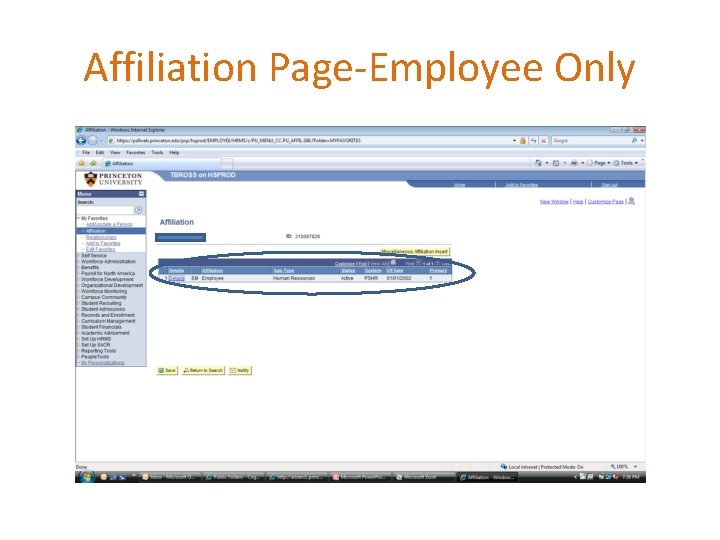
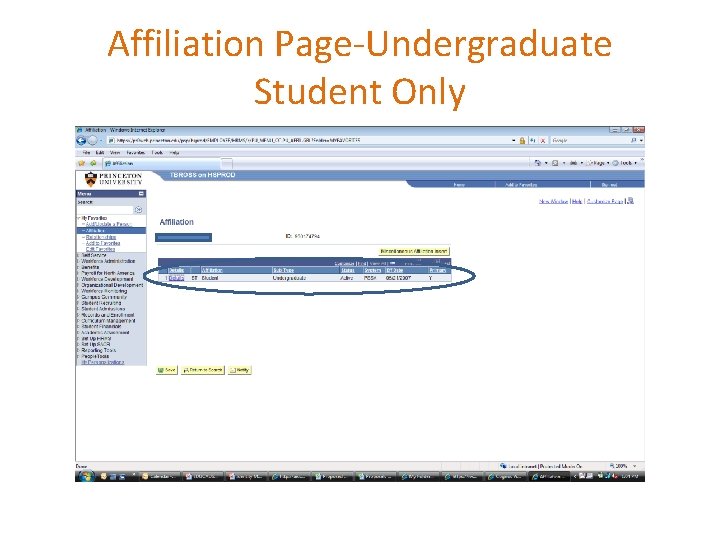
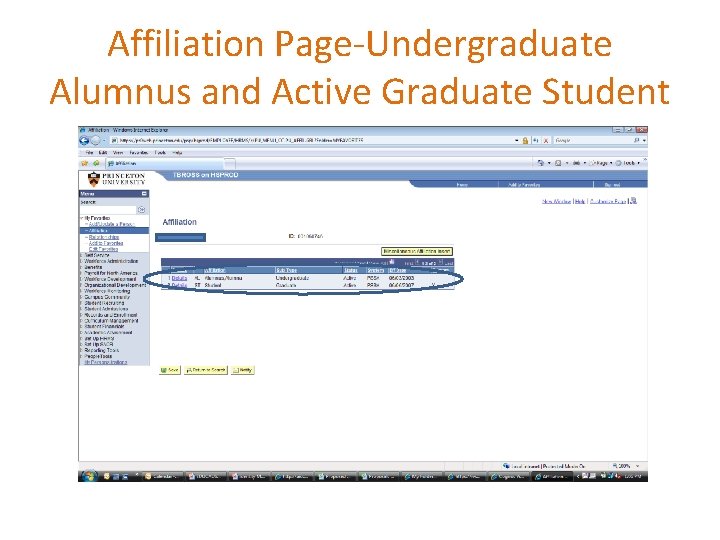
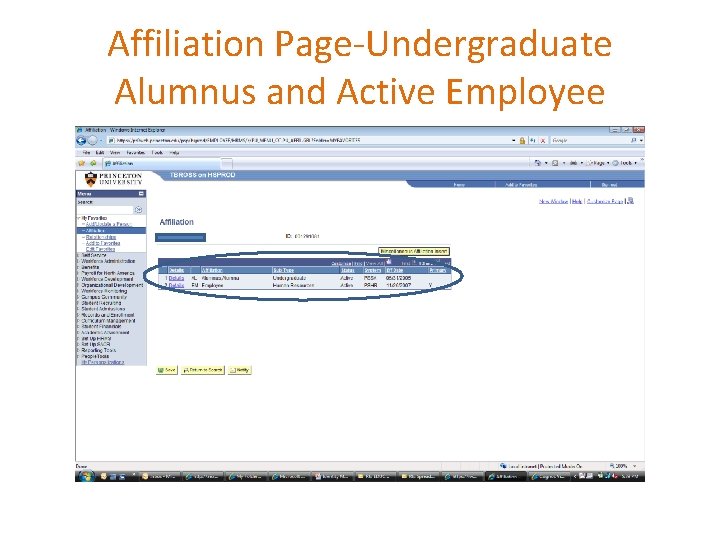
Key Considerations • Each Step in the Person Life Cycle=New Affiliation/Status (Role) • Affiliation=How You are Related to the University (High Level) – Student, Employee, Alumnus, Kin, Miscellaneous • Affiliation Group=Further Defines the Affiliation – Student: Undergraduate, Graduate, Special Student – Employee: Dean of Faculty, Human Resources, PPPL – Miscellaneous: Departmental Computer user, Docent, Trustee, Corporate Vendor • Status=Temporal and Relative Relationship – Active, Inactive, Deceased, Retired (High Level) • • On Leave, Voluntary Withdrawal, Suspended (Granular) i. e. -a student on leave is still considered active; a student who is suspended is considered inactive
Affiliation Page-Employee Only
Affiliation Page-Undergraduate Student Only
Affiliation Page-Undergraduate Alumnus and Active Graduate Student
Affiliation Page-Undergraduate Alumnus and Active Employee
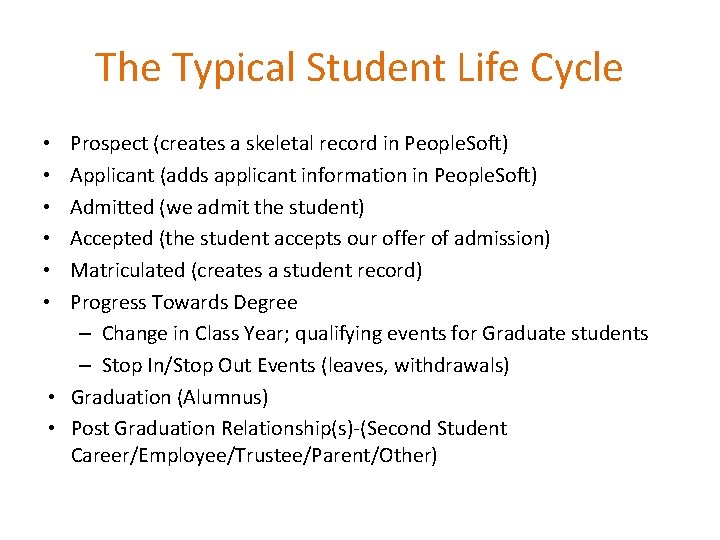
The Typical Student Life Cycle Prospect (creates a skeletal record in People. Soft) Applicant (adds applicant information in People. Soft) Admitted (we admit the student) Accepted (the student accepts our offer of admission) Matriculated (creates a student record) Progress Towards Degree – Change in Class Year; qualifying events for Graduate students – Stop In/Stop Out Events (leaves, withdrawals) • Graduation (Alumnus) • Post Graduation Relationship(s)-(Second Student Career/Employee/Trustee/Parent/Other) • • •
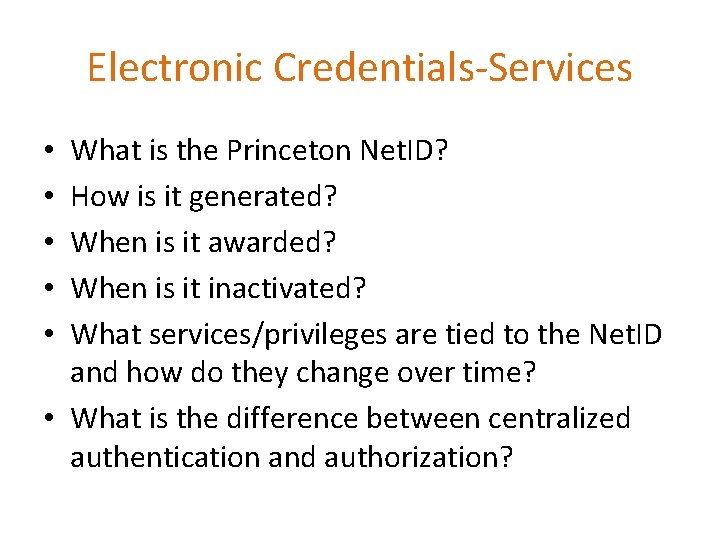
Electronic Credentials-Services What is the Princeton Net. ID? How is it generated? When is it awarded? When is it inactivated? What services/privileges are tied to the Net. ID and how do they change over time? • What is the difference between centralized authentication and authorization? • • •
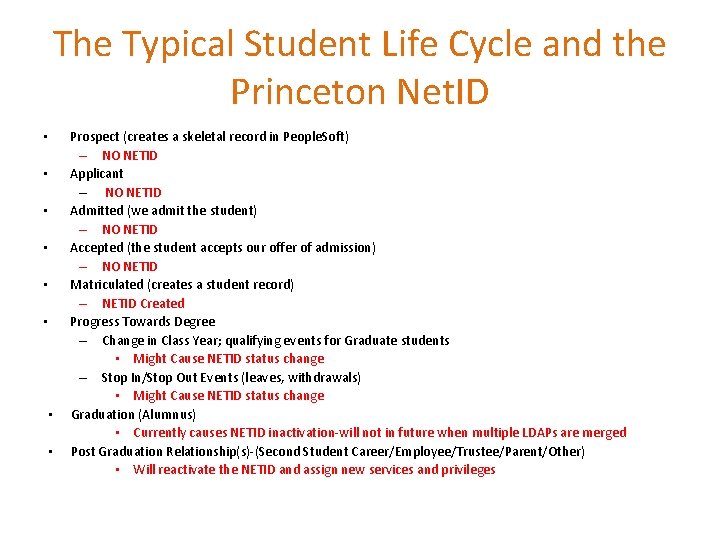
The Typical Student Life Cycle and the Princeton Net. ID • • Prospect (creates a skeletal record in People. Soft) – NO NETID Applicant – NO NETID Admitted (we admit the student) – NO NETID Accepted (the student accepts our offer of admission) – NO NETID Matriculated (creates a student record) – NETID Created Progress Towards Degree – Change in Class Year; qualifying events for Graduate students • Might Cause NETID status change – Stop In/Stop Out Events (leaves, withdrawals) • Might Cause NETID status change Graduation (Alumnus) • Currently causes NETID inactivation-will not in future when multiple LDAPs are merged Post Graduation Relationship(s)-(Second Student Career/Employee/Trustee/Parent/Other) • Will reactivate the NETID and assign new services and privileges
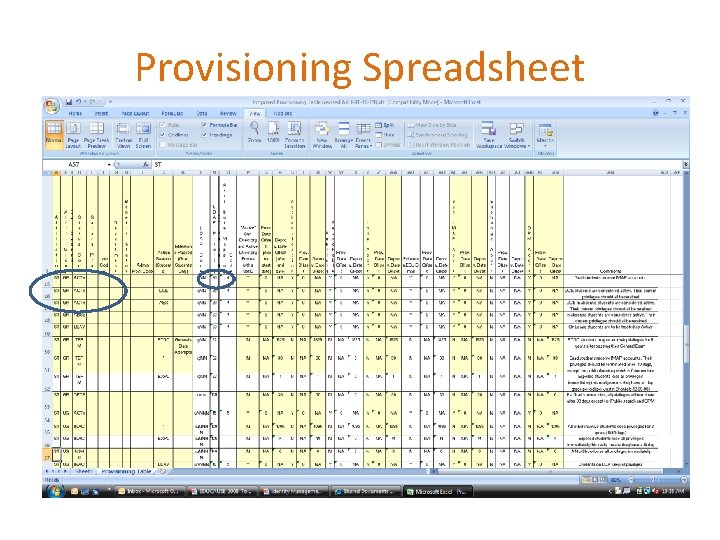
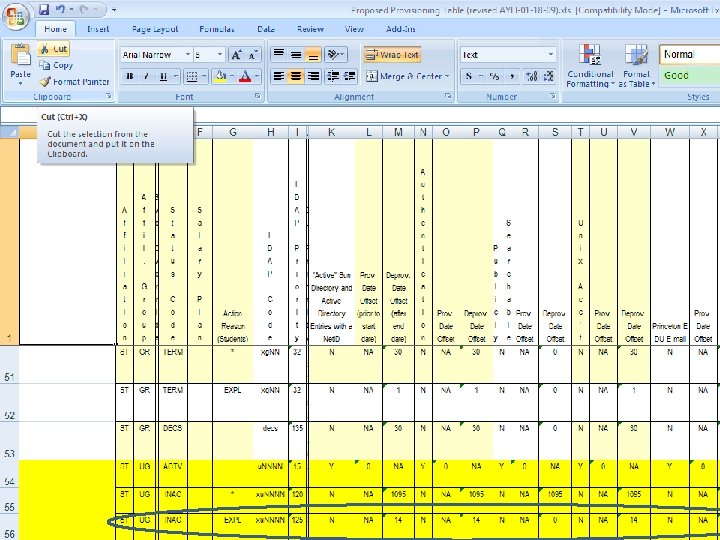
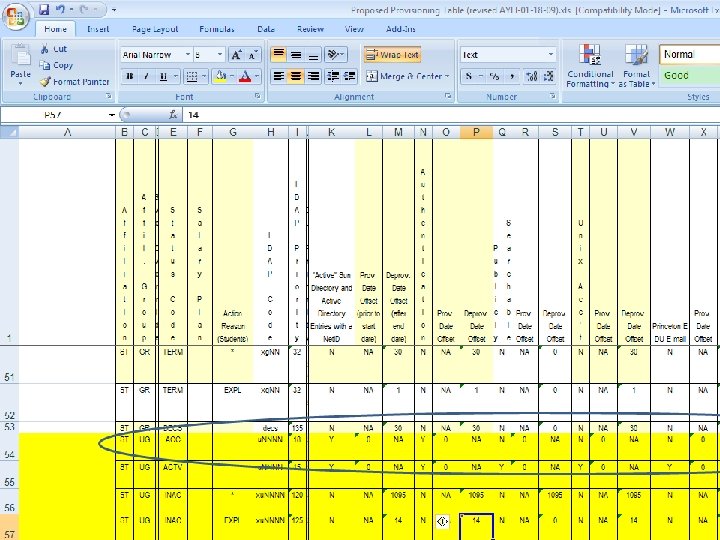
Provisioning Spreadsheet
Some Real Life Challenges • Special Students who do not enroll in consecutive terms • Systems that do not have their own authentication mechanisms and equate authorization with authentication • Alumni who need transcripts
Special Students • Most do enroll in consecutive terms – Extend their “offset” deprovisioning rule to 122 days – This allows for a smooth transition from fall to spring and spring to fall registrants – Still causes a problem for fall to fall and spring to spring registrants (the Net. ID becomes inactive prior to their next term)
Authentication=Authorization • Some of the older systems (few left) • Limited threat (any system that needs more security has that built in already) • The problem will be addressed in Phase II by using Virtual Directories – The Id. Management system will authenticate against a virtual directory that has only students, faculty and staff and not include others with a valid Net. ID
Alumni Transcripts • Current mechanism is for alumni to enter a web application that authenticates against the “alumni LDAP” directory • The request returns the PUID (9 digit number that is generated in People. Soft and replicated in both directories) • The PUID is then sent, via batch, to People. Soft and a transcript is created for the alumnus • Phase II calls for the merging of the directories so that alumni will use the same application as do current students – The alumnus will keep his Net. ID and authentication privileges – All other services will be deprovisioned according to the spreadsheet (122 days after commencement)
Top 10 Things Learned in an Identity Management Project 10. Identity management is still in its infancy and you will soon become an expert and a leader in the field very quickly. 9. Make sure you have full campus buy in, both from the top down and bottom up 8. Treat the project like a full ERP implementation, with a dedicated project team, a full project plan, stakeholders and a proactive communications plan. 7. Do not underestimate the sheer volume of work/time needed, both from a technical and from a functional perspective. 6. Make sure you actively manage your consulting partner.
Top 10 Things Learned in an Identity Management Project (cont. ) 5. Make sure your consulting partner and your application vendor are on the same page. 4. Make sure your consulting partner and your application vendor understand the complexities and idiosyncrasies of a university environment. 3. Nail down all your business rules early in the project and look for ways to reengineer antiquated university business practices. 2. Make sure you enlist (and keep) the correct people on the project, both on your own project team and on your consulting partner’s team as well. 1. If it looks and sounds too easy to be true…it probably is.
Thank you for your interest! Questions, comments, concerns?