
Implementing a Contract Management System A Journey That


- Slides: 18
Implementing a Contract Management System: A Journey That Need Not Take a Lifetime
Contract Management at Colgate • Scope – Buy Side NDA, Supply, Services, Sows, Logistics, Amendments/Renewals, Repository – North America and Corporate – Roughly 100 Requests per Month • Technology – Apttus Implementation w/ Docusign • People and Process – COE in Mexico Service Center – 2 Legal, 2 Procurement – Detailed and Automated Flows • Next Phases / Rollout
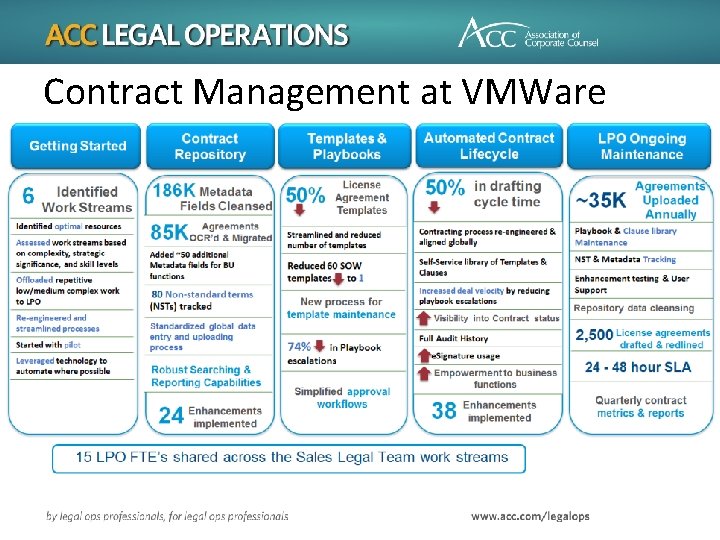
Contract Management at VMWare
Steps to Effective Contract Management • Evaluate Current State • Design End State • Develop Road Map • Implement
Steps to Effective Contract Management c • Evaluate Current State • Design End State • Develop Road Map • Implement
Evaluate Current State • What is in-scope? • How are you doing it today? – People, process, technology – Outside Counsel ($s) – Internal resources (Hrs) • How well are you doing it? – Internal clients • Is there a business case? – Senior leadership
Evaluate Current State • Tools to Use – Surveys and interviews – FTE Analysis – Turnaround time analysis – Collect templates and playbooks (if any) • Lessons Learned – Part art, part science – Ownership at the top – Look for existing internal programs – Avoid favoring internal tools
Steps to Effective Contract Management • Evaluate Current State c • Design End State • Develop Road Map • Implement
Design End State • Who will do it tomorrow? – Same resources, new headcount, LPOs • What process will you follow? – Automation, templates, risk tolerance – Streamlining effort / process reengineering • • What technology will you use? What information will you track/report? How much will it cost? Has it been done before?
Design End State • Tools to Use – Requirements documents – Consultants and peer companies – Demos from vendors – Job profiles – Detailed templates and playbooks
Design End State • Lessons Learned – Details matter – Being on the “road map” may not be enough – Plan to capture data for your metrics – Choose metrics that will be used – Make tough decisions – Standardize as much as possible – All stakeholders/users at table (“Silent Saboteur”) – This is your chance to drive change
Steps to Effective Contract Management • Evaluate Current State • Design End State • Develop Roadc Map • Implement
Develop Road Map • Do you have available resources? – SMEs, project management, leadership • • Who is responsible for failures? Have you defined criteria for go/no-go date? What steps are on the critical path? Waterfall or iterative approach?
Develop Road Map • Tools to Use – Project management function/discipline – Recurring meetings on calendar – Leads for different work streams • Lessons Learned – “Overplan” for change management – Effort and duration are not the same – Plan for iterations – Don’t forget dependencies
Steps to Effective Contract Management • Evaluate Current State • Design End State • Develop Road Map • Implement c
Implement • Tiered roll-out or “big bang”? • Do you have available resources? – SMEs, project management, leadership • • Do you understand the technology? Does your vendor understand your content? Professional services from vendor? Did you budget the right amount?
Implement • Tools to Use – Collaboration tools • Lessons Learned – Everyone has a “day job” and “Project fatigue” is real – Over configuration is bad too – Individuals that know substance & technology – Play to the strengths of your technology – A solid process can solve holes in technology – Fixed fees are good – Change management and training are critical
Questions?