
Implemented by Module 6 GCF grant proposal development

Implemented by Module 6: GCF grant proposal development – the concept note template Page 1
Implemented by Content • Objectives of this session • Context: The GCF Initial Proposal Approval Process • Overview of GCF Concept Note Template • GCF Concept Note in Detail • Key take-away messages Page 4
Implemented by Context: The GCF Initial Proposal Approval Process Page 6
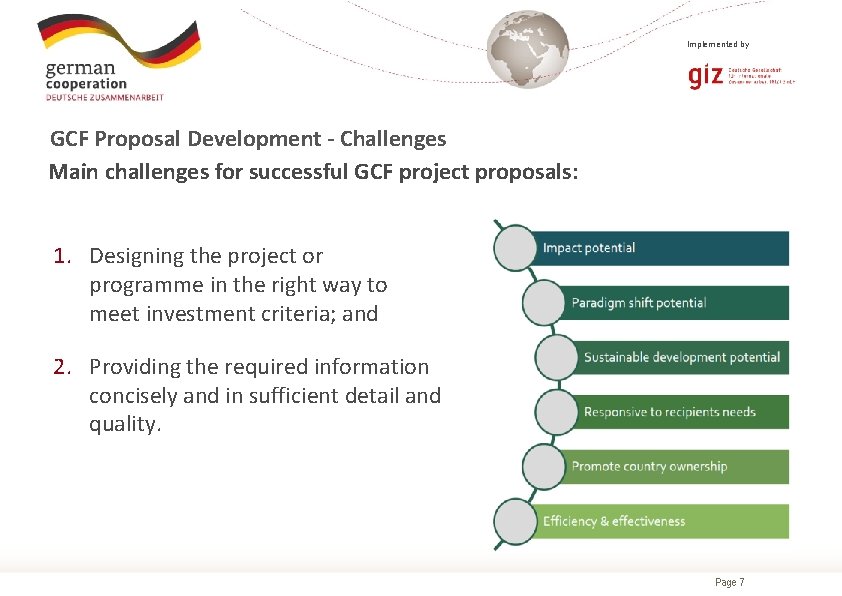
Implemented by GCF Proposal Development - Challenges Main challenges for successful GCF project proposals: 1. Designing the project or programme in the right way to meet investment criteria; and 2. Providing the required information concisely and in sufficient detail and quality. Page 7
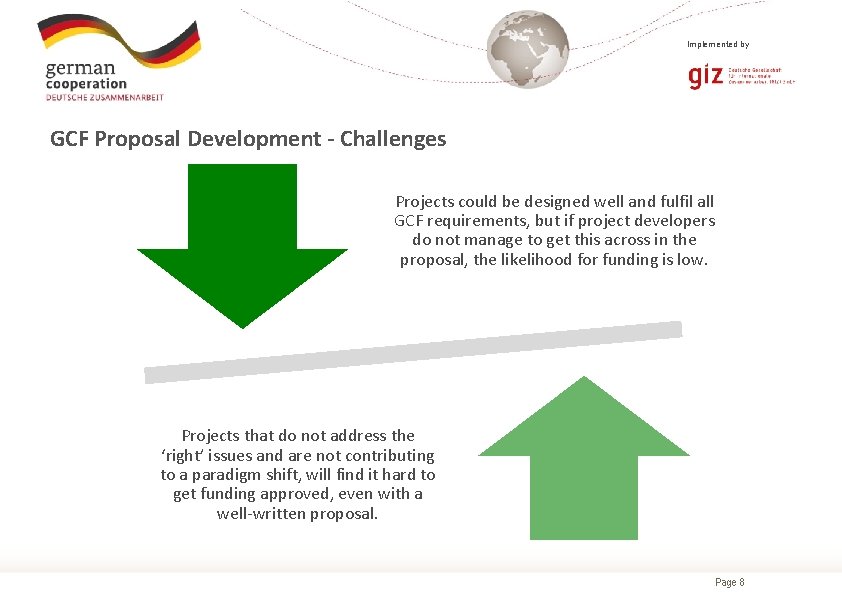
Implemented by GCF Proposal Development - Challenges Projects could be designed well and fulfil all GCF requirements, but if project developers do not manage to get this across in the proposal, the likelihood for funding is low. Projects that do not address the ‘right’ issues and are not contributing to a paradigm shift, will find it hard to get funding approved, even with a well-written proposal. Page 8
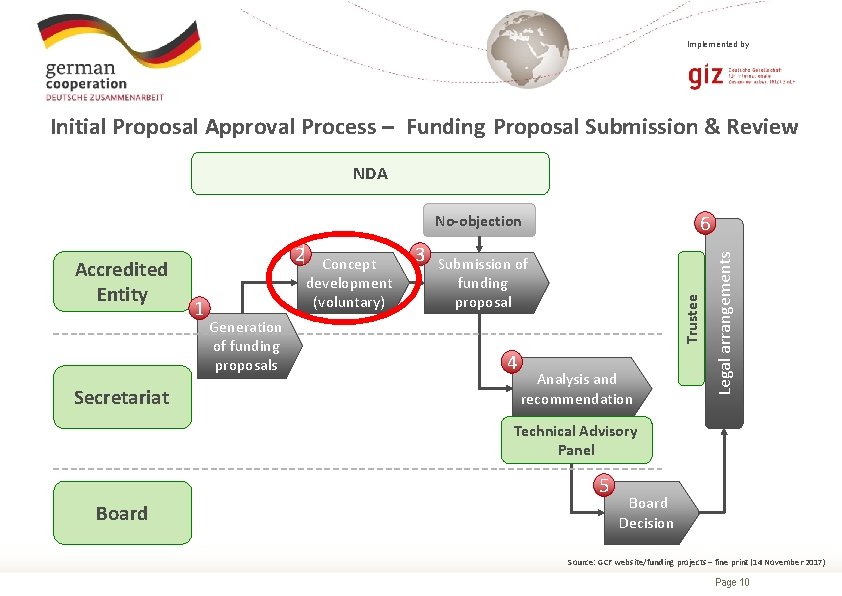
Implemented by Initial Proposal Approval Process – Funding Proposal Submission & Review NDA Secretariat 2 1 Generation of funding proposals Concept development (voluntary) 3 Submission of funding proposal 4 Trustee Accredited Entity Analysis and recommendation Legal arrangements 6 No-objection Technical Advisory Panel 5 Board Decision Source: GCF website/funding projects – fine print (14 November 2017) Page 10
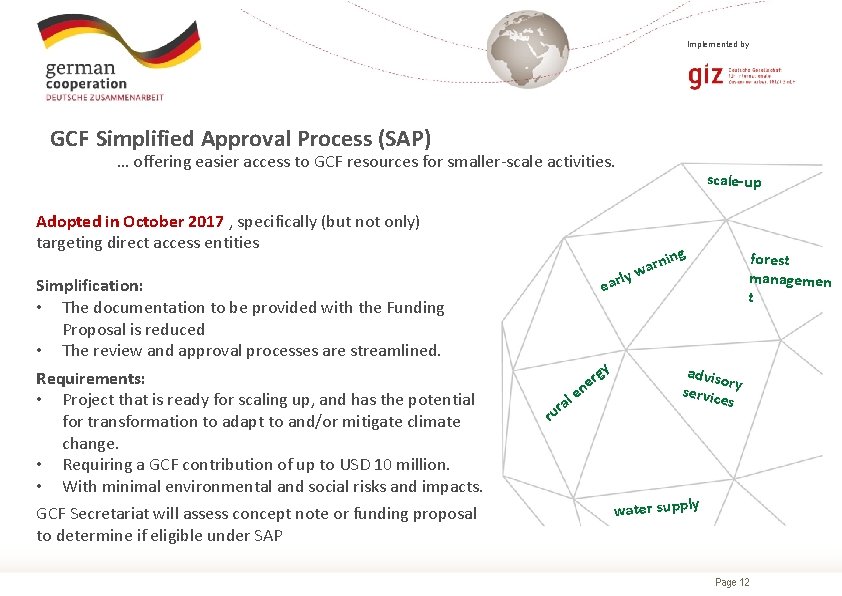
Implemented by GCF Simplified Approval Process (SAP) … offering easier access to GCF resources for smaller-scale activities. Adopted in October 2017 , specifically (but not only) targeting direct access entities ly ear Simplification: • The documentation to be provided with the Funding Proposal is reduced • The review and approval processes are streamlined. Requirements: • Project that is ready for scaling up, and has the potential for transformation to adapt to and/or mitigate climate change. • Requiring a GCF contribution of up to USD 10 million. • With minimal environmental and social risks and impacts. GCF Secretariat will assess concept note or funding proposal to determine if eligible under SAP gy r a ur le r ne scale-up ing forest managemen t n war adviso r servic y es water supply Page 12

Implemented by Overview of GCF Concept Note Template Page 14
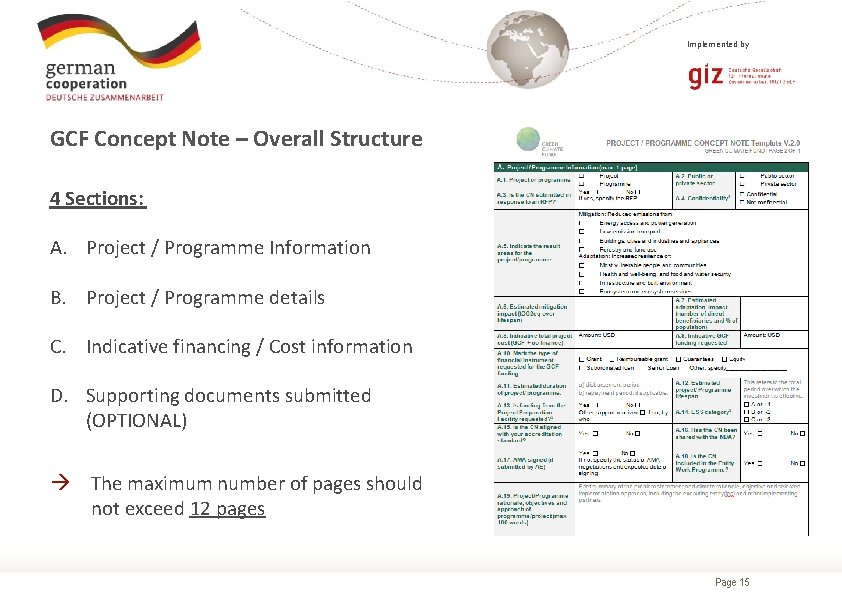
Implemented by GCF Concept Note – Overall Structure 4 Sections: A. Project / Programme Information B. Project / Programme details C. Indicative financing / Cost information D. Supporting documents submitted (OPTIONAL) The maximum number of pages should not exceed 12 pages Page 15
Implemented by GCF Concept Note – Cover Page Ø Provide the full title of the proposed project/programme Ø Enter the country (or countries) or region in which the proposed project/ programme will be implemented. Ø Insert the name of the national designated authority (NDA) or focal point as a national-level interface with the Fund. Ø Insert the name of an entity that has been accredited by the Board Page 18
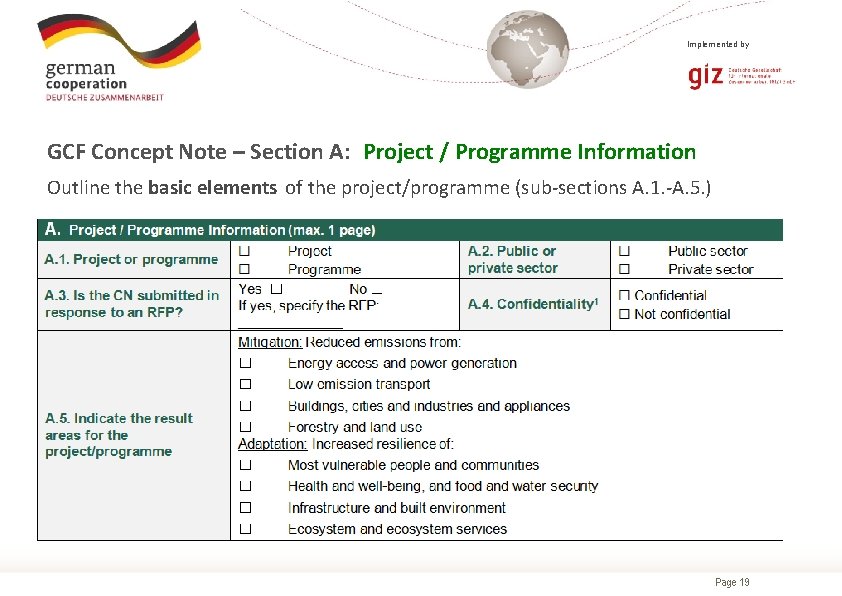
Implemented by GCF Concept Note – Section A: Project / Programme Information Outline the basic elements of the project/programme (sub-sections A. 1. -A. 5. ) Page 19
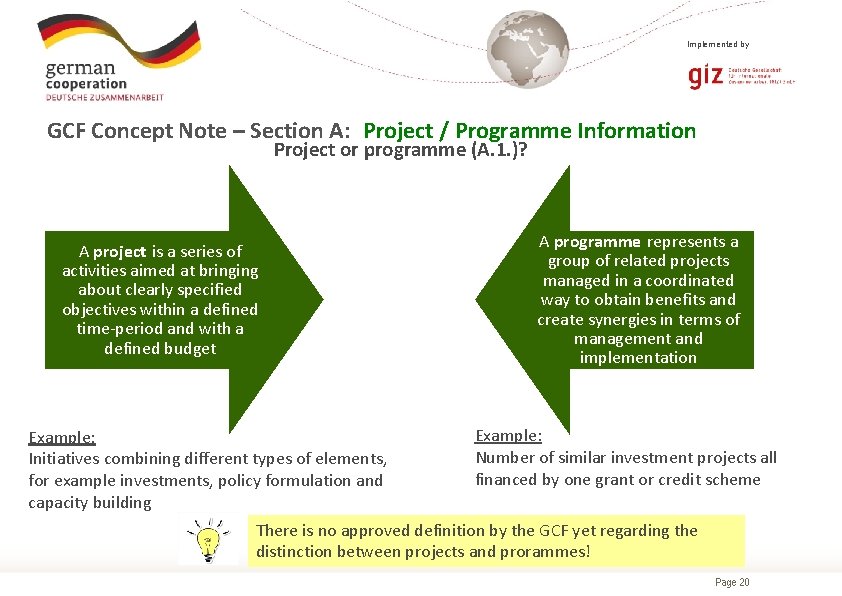
Implemented by GCF Concept Note – Section A: Project / Programme Information Project or programme (A. 1. )? A project is a series of activities aimed at bringing about clearly specified objectives within a defined time-period and with a defined budget Example: Initiatives combining different types of elements, for example investments, policy formulation and capacity building A programme represents a group of related projects managed in a coordinated way to obtain benefits and create synergies in terms of management and implementation Example: Number of similar investment projects all financed by one grant or credit scheme There is no approved definition by the GCF yet regarding the distinction between projects and prorammes! Page 20
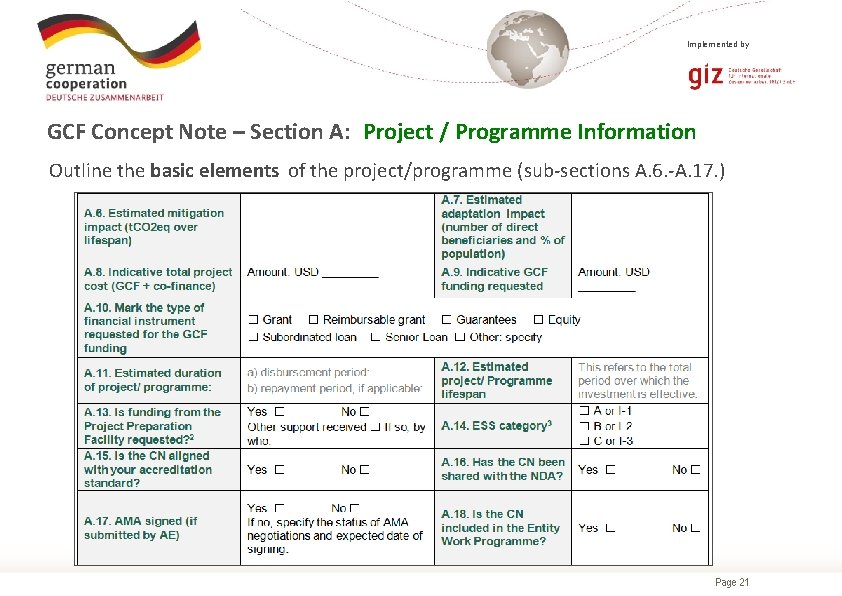
Implemented by GCF Concept Note – Section A: Project / Programme Information Outline the basic elements of the project/programme (sub-sections A. 6. -A. 17. ) Page 21
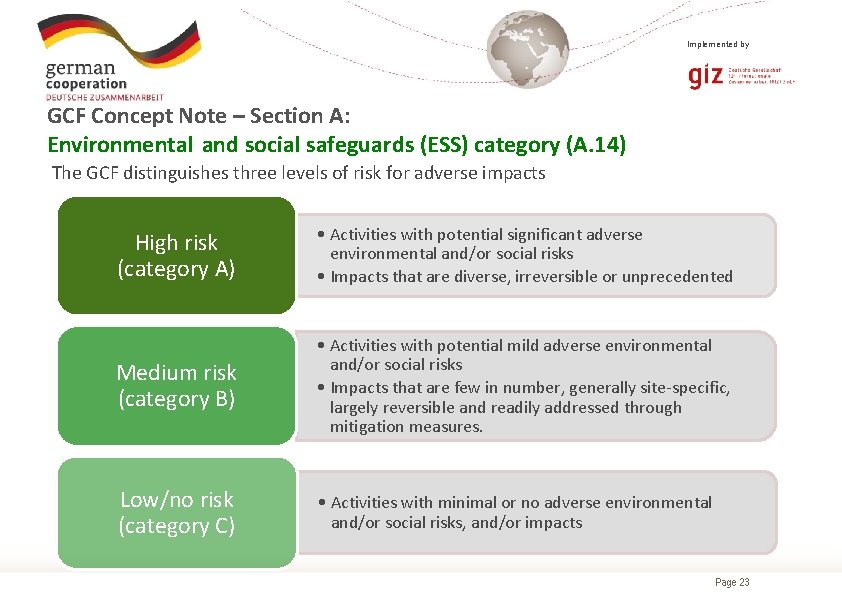
Implemented by GCF Concept Note – Section A: Environmental and social safeguards (ESS) category (A. 14) The GCF distinguishes three levels of risk for adverse impacts High risk (category A) • Activities with potential significant adverse environmental and/or social risks • Impacts that are diverse, irreversible or unprecedented Medium risk (category B) • Activities with potential mild adverse environmental and/or social risks • Impacts that are few in number, generally site-specific, largely reversible and readily addressed through mitigation measures. Low/no risk (category C) • Activities with minimal or no adverse environmental and/or social risks, and/or impacts Page 23
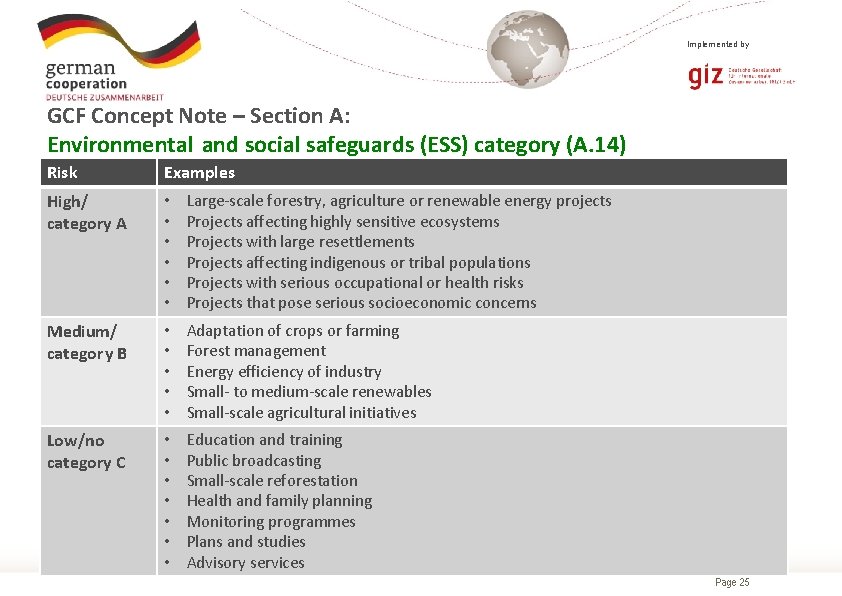
Implemented by GCF Concept Note – Section A: Environmental and social safeguards (ESS) category (A. 14) Risk Examples High/ category A • • • Large-scale forestry, agriculture or renewable energy projects Projects affecting highly sensitive ecosystems Projects with large resettlements Projects affecting indigenous or tribal populations Projects with serious occupational or health risks Projects that pose serious socioeconomic concerns Medium/ category B • • • Adaptation of crops or farming Forest management Energy efficiency of industry Small- to medium-scale renewables Small-scale agricultural initiatives Low/no category C • • Education and training Public broadcasting Small-scale reforestation Health and family planning Monitoring programmes Plans and studies Advisory services Page 25
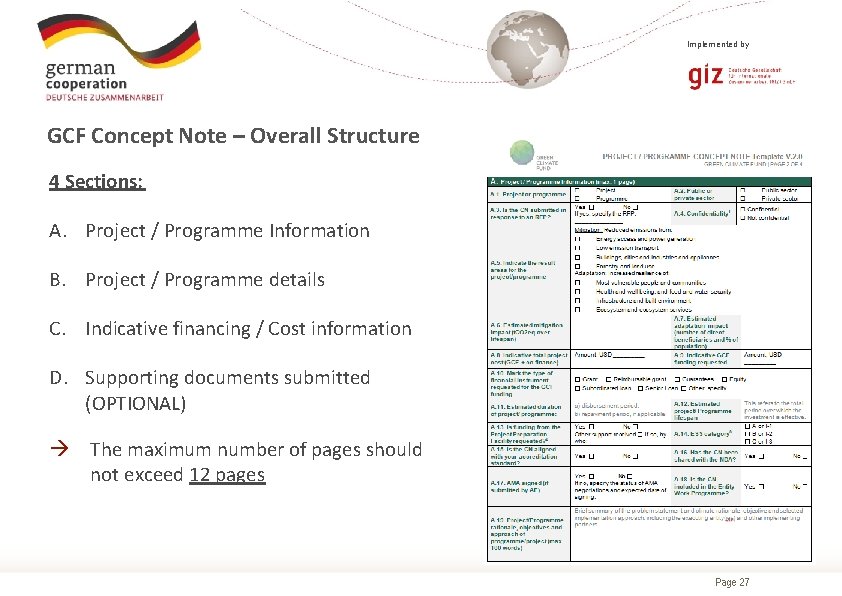
Implemented by GCF Concept Note – Overall Structure 4 Sections: A. Project / Programme Information B. Project / Programme details C. Indicative financing / Cost information D. Supporting documents submitted (OPTIONAL) The maximum number of pages should not exceed 12 pages Page 27
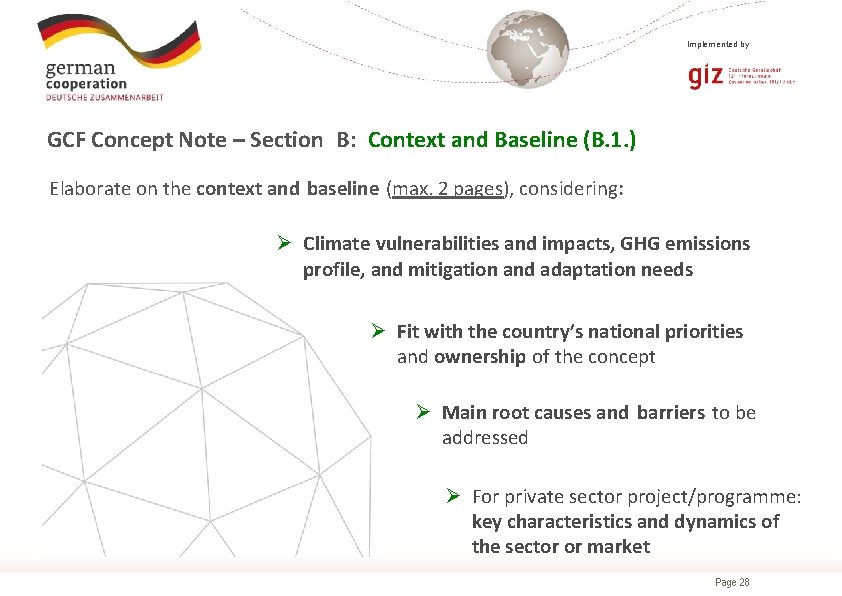
Implemented by GCF Concept Note – Section B: Context and Baseline (B. 1. ) Elaborate on the context and baseline (max. 2 pages), considering: Ø Climate vulnerabilities and impacts, GHG emissions profile, and mitigation and adaptation needs Ø Fit with the country’s national priorities and ownership of the concept Ø Main root causes and barriers to be addressed Ø For private sector project/programme: key characteristics and dynamics of the sector or market Page 28
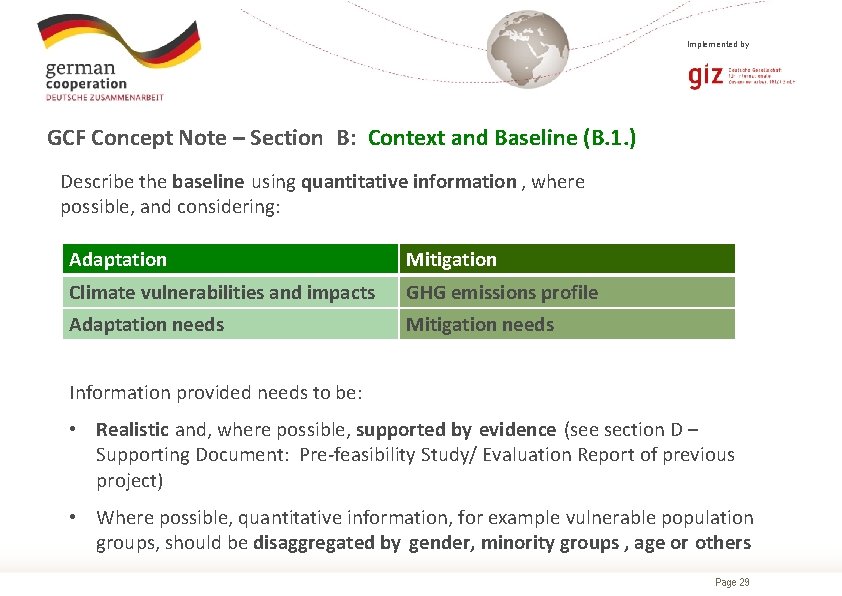
Implemented by GCF Concept Note – Section B: Context and Baseline (B. 1. ) Describe the baseline using quantitative information , where possible, and considering: Adaptation Mitigation Climate vulnerabilities and impacts GHG emissions profile Adaptation needs Mitigation needs Information provided needs to be: • Realistic and, where possible, supported by evidence (see section D – Supporting Document: Pre-feasibility Study/ Evaluation Report of previous project) • Where possible, quantitative information, for example vulnerable population groups, should be disaggregated by gender, minority groups , age or others Page 29
Implemented by GCF Concept Note – Section B: Context and Baseline (B. 1. ) Fit of the activities with the country’s national priorities and full country ownership of the concept How does the project/programme link to the content of the relevant national documents? Potential linkages: • Sector priorities defined in (I)NDC or strategy documents • Revision of existing strategies as part of the project/programme • Programme/project supports to the draft of legislation, regulation or setting up of institutions Page 30
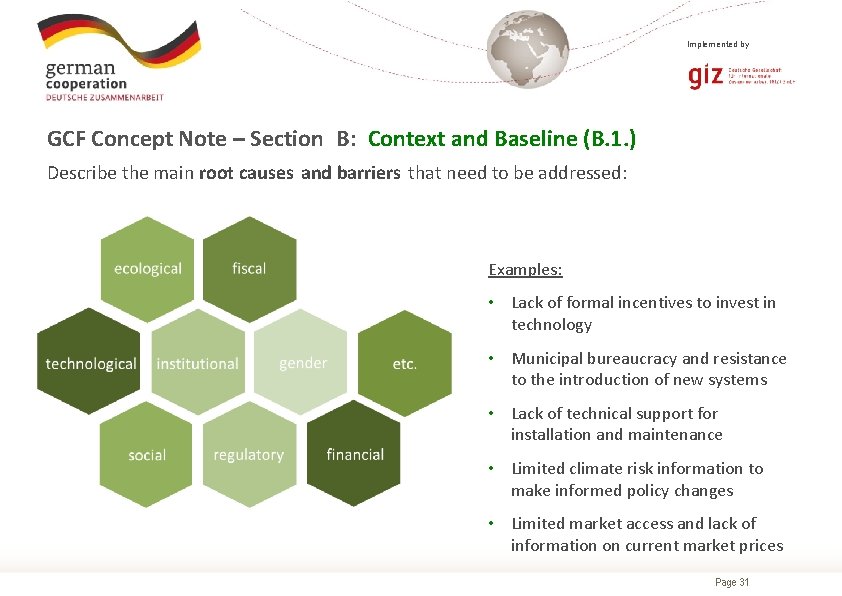
Implemented by GCF Concept Note – Section B: Context and Baseline (B. 1. ) Describe the main root causes and barriers that need to be addressed: Examples: • Lack of formal incentives to invest in technology • Municipal bureaucracy and resistance to the introduction of new systems • Lack of technical support for installation and maintenance • Limited climate risk information to make informed policy changes • Limited market access and lack of information on current market prices Page 31
Implemented by GCF Concept Note – Section B: Project description (B. 2. ) Describe the expected set of components and activities (max. 3 pages), considering: Ø Theory of Change in line with the Fund’s goals and objectives Ø Consistency of activities with national regulatory and legal framework Ø Capacity of Accredited Entity(ies) to undertake planned activities and implementation arrangements Ø Brief overview of the key financial and operational risks and mitigation measures Page 33
Implemented by GCF Concept Note – Section B: Project description (B. 2. ) Theory of Change (To. C) explains the process of change by outlining causal linkages in an initiative, i. e. , its shorter-term, intermediate, and longer-term outcomes. The identified changes are mapped – as the “outcomes pathway” – showing each outcome in logical relationship to all the others, as well as chronological flow. The links between outcomes are explained by “rationales” or statements of why one outcome is thought to be a prerequisite for another. ” (H. Clark & D. Taplin (2012)) The To. C … Ø defines a methodology for planning, participation and evaluation that is used to promote long-term change Ø forms the foundation of the project/programme design – either implicitly or explicitly Ø represents the basis for the formulation of the baseline, detailed activities, risk management and monitoring frameworks Page 34
Implemented by GCF Concept Note – Section B: Project description (B. 2. ) Brief overview of the key financial and operational risks and mitigation measures For each risk, the project proponent will have to indicate the: Category: technical and operational; financial; or social and environmental Level of impact: • low (less than 5% of project value), • medium (between 5% and 20% of project value) or • high (over 20% of project value) Probability of the risk occurring : low, medium or high. This section should concentrate on the main financial and operational risks, those with high impact and/or high probability of occurring Page 39
Implemented by GCF Concept Note – Section B: Project description (B. 2. ) Risk mitigation includes all actions that aim to • reduce the probability of the risk occurring (avoidance) or to • minimize impact should the risk occur. Risk category Examples of possible m itigation measures Turnover in key personnel Permanent training for internal back-up Operational Contractors do not deliver Bank guarantees and strong terms and in time and/or quality conditions implemented in contracts Exchange rate risks Insurance. Preventive provisions in contracts Market changes Permanent market monitoring Financial Page 40
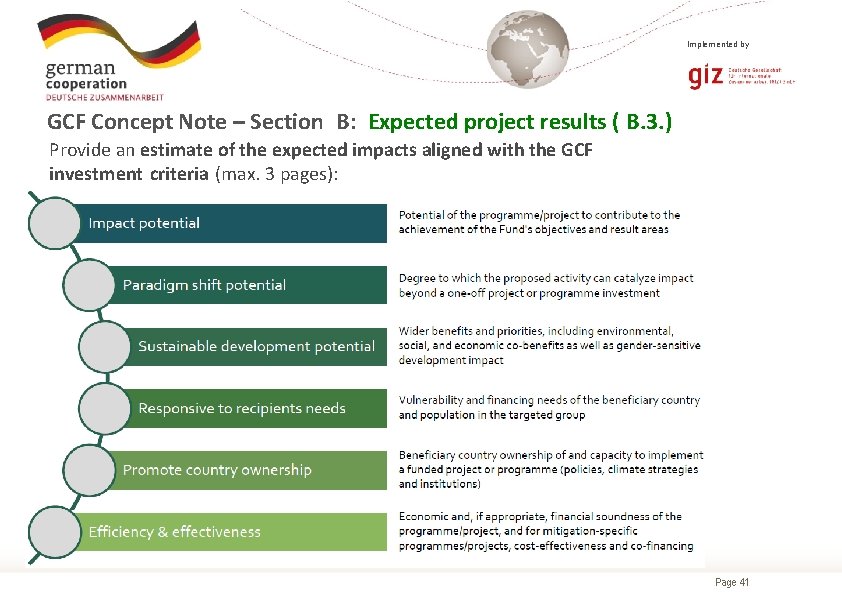
Implemented by GCF Concept Note – Section B: Expected project results ( B. 3. ) Provide an estimate of the expected impacts aligned with the GCF investment criteria (max. 3 pages): Page 41
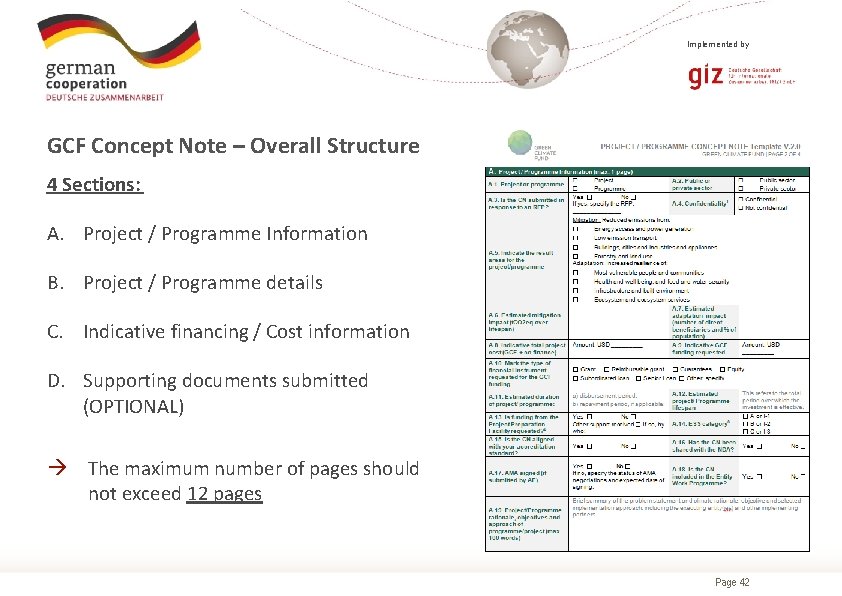
Implemented by GCF Concept Note – Overall Structure 4 Sections: A. Project / Programme Information B. Project / Programme details C. Indicative financing / Cost information D. Supporting documents submitted (OPTIONAL) The maximum number of pages should not exceed 12 pages Page 42
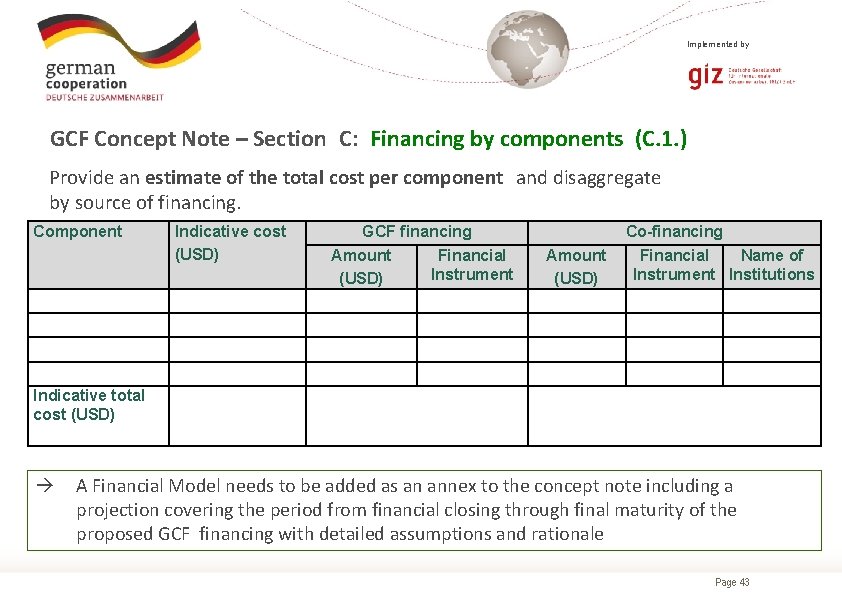
Implemented by GCF Concept Note – Section C: Financing by components (C. 1. ) Provide an estimate of the total cost per component and disaggregate by source of financing. Component Indicative cost (USD) GCF financing Amount (USD) Co-financing Financial Instrument Amount (USD) Financial Name of Instrument Institutions Indicative total cost (USD) A Financial Model needs to be added as an annex to the concept note including a projection covering the period from financial closing through final maturity of the proposed GCF financing with detailed assumptions and rationale Page 43
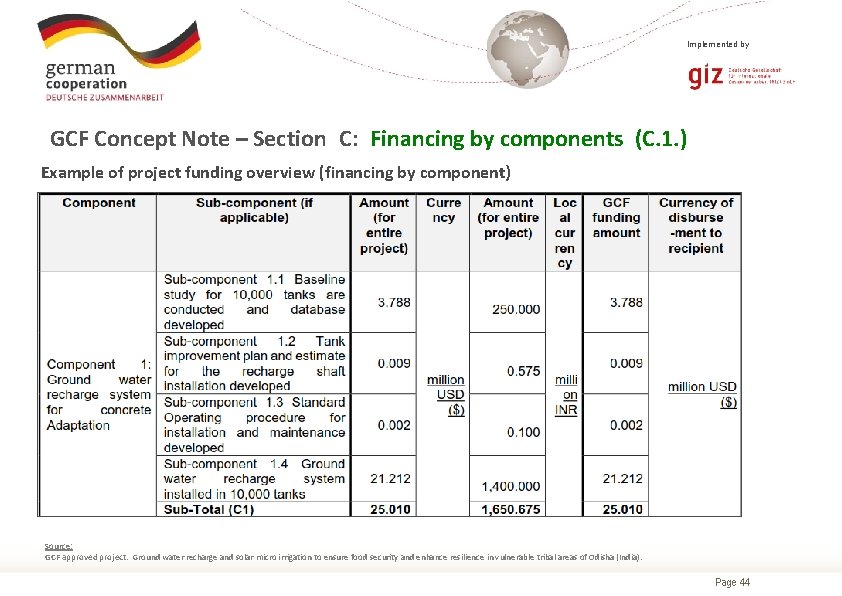
Implemented by GCF Concept Note – Section C: Financing by components (C. 1. ) Example of project funding overview (financing by component) Source: GCF approved project: Ground water recharge and solar micro irrigation to ensure food security and enhance resilience in vulnerable tribal areas of Odisha (India). Page 44
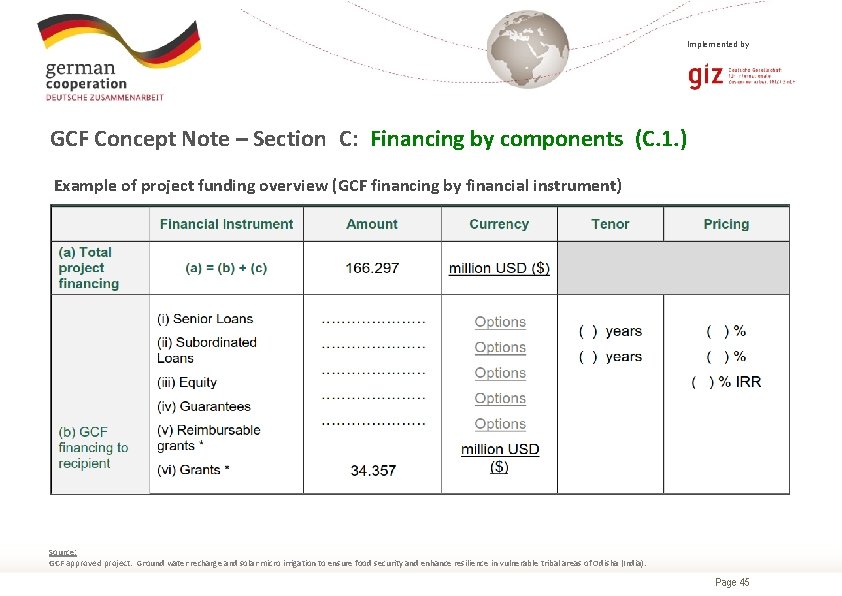
Implemented by GCF Concept Note – Section C: Financing by components (C. 1. ) Example of project funding overview (GCF financing by financial instrument) Source: GCF approved project: Ground water recharge and solar micro irrigation to ensure food security and enhance resilience in vulnerable tribal areas of Odisha (India). Page 45
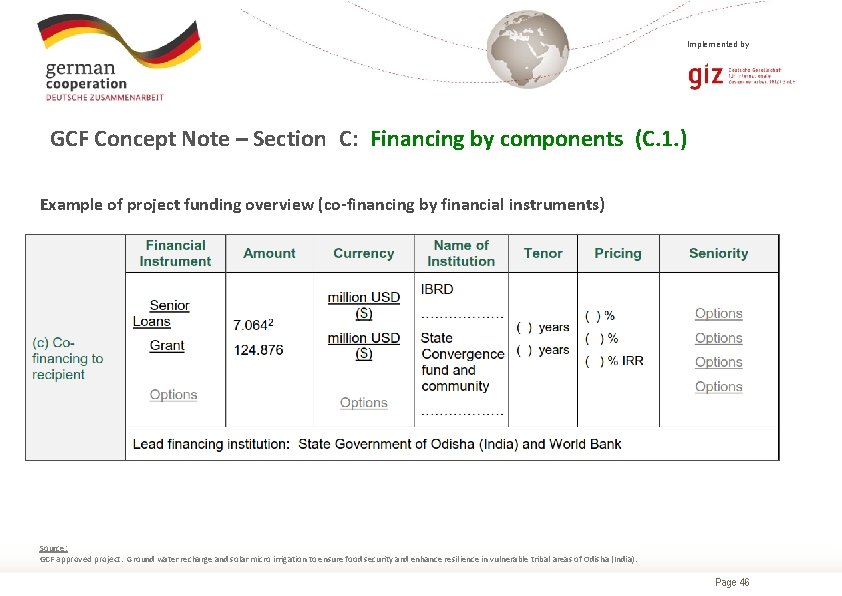
Implemented by GCF Concept Note – Section C: Financing by components (C. 1. ) Example of project funding overview (co-financing by financial instruments) Source: GCF approved project: Ground water recharge and solar micro irrigation to ensure food security and enhance resilience in vulnerable tribal areas of Odisha (India). Page 46
Implemented by GCF Concept Note – Section C: Justification of GCF funding request (C. 2. ) Justification of GCF funding request (max 1 page): Ø Why the Project/ Programme requires GCF funding? Ø Describe alternative funding options for the same activities including an analysis of the barriers to access to finance Ø Justify the rationale and level of concessionality of the GCF financial instrument(s) and describe how this will be passed on to the end-users and beneficiaries. Page 47
Implemented by GCF Concept Note – Section C: Justification of GCF funding request (C. 2. ) Value added for GCF involvement How does the GCF’s support enable the project/programme to promote a transformational change? • Justification for the funding requested and the financial instrument(s) proposed to close the funding gap and bring the project/programme to completion • In the case of grant funding: provide financial and/or economic arguments to ensure that the GCF would maximise its use of resources. Page 48
Implemented by GCF Concept Note – Section C: Justification of GCF funding request (C. 2. ) Project proponents can demonstrate the following as relevant: • Absence of alternative sources of financing: Barriers that have created the lack of alternative funding sources for the project/programme • Potential for crowding-in alternative sources of financing: How GCF funding can help leverage domestic funding, in particular private finance, by improving the real and/or perceived risk and reward profile of climate investments. • High potential for replication and scaling-up : How GCF funding can help scale up past and/or existing investments with a high potential for scalingup or replication. • Target highly vulnerable populations (for adaptation projects) : How GCF funding will support activities that will remain unfunded through mainstream financial channels and targeting highly vulnerable populations Page 49
Implemented by GCF Concept Note – Section C: Engagement among the NDA, AE, and/or other relevant stakeholders in the country (C. 4. ) Describe how engagement among the NDA, AE and/or other relevant stakeholders in the country has taken place and what further engagement will be undertaken (max 1 page) Multi-stakeholder engagement and consultations are seen as important tools to ensure country ownership. Best-practice options for country coordination and multi-stakeholder engagement: • Design a consultative process through which national climate change priorities and strategies can be defined. • A consultative process should aim to be an ongoing process rather than a discrete activity only occurring once , continuous update and regular assessment of progress. • These consultative processes should be inclusive and seek to engage all relevant actors within the government, the private sector, academia, civil society and other relevant stakeholder groups or sectors. Page 52
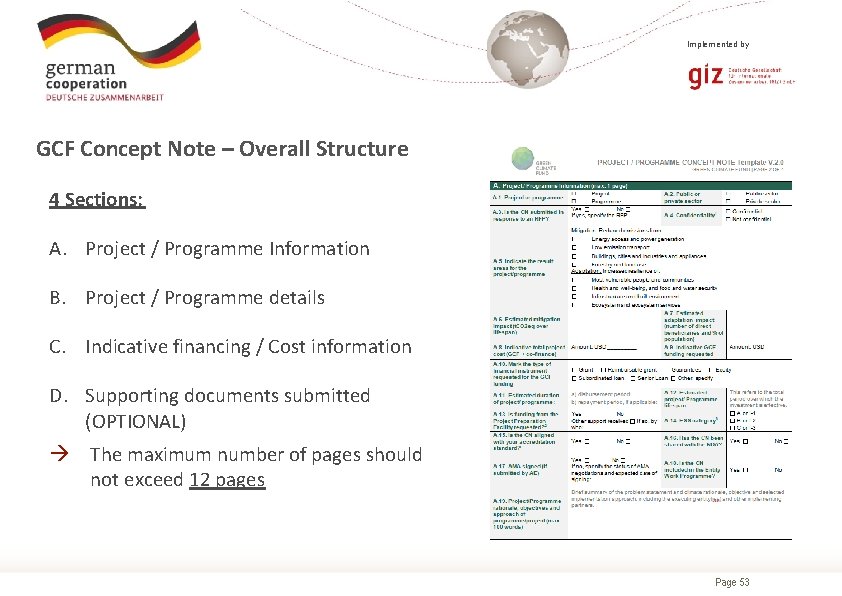
Implemented by GCF Concept Note – Overall Structure 4 Sections: A. Project / Programme Information B. Project / Programme details C. Indicative financing / Cost information D. Supporting documents submitted (OPTIONAL) The maximum number of pages should not exceed 12 pages Page 53
Implemented by GCF Concept Note – Section D : Supporting documents submitted A. Supporting documents submitted (OPTIONAL) ☐ Map indicating the location of the project/programme ☐ Financial Model ☐ ☐ ☐ Pre-feasibility Study Diagram of theory of change (optional) Evaluation Report of previous project (optional) Page 54
Implemented by Key take-aways • Concept note against full proposal: The GCF concept note is optional but a favourable thing to do, since it requires less detail and allows for an in-depth exchange with the secretariat providing feedback on a short term basis. • Cross references between sections: Many of the concept note sections are interlinked respectively building on each other. Therefore it will be important to establish cross-references between the different parts of the concept note template. • Comprehensive process: It is not the aim and purpose of this module to develop a full-fledged GCF concept note but to impart knowledge on the most important parts of the template format. Please note that in the GCF context, proposal writing is rather the task and responsibility of the Accredited Entity (AE). Page 55
Implemented by Thank you for your attention!!! Page 56
- Slides: 38