
Implemented by INTEGRATION OF ENVIRONMENTAL CONSIDERATIONS INTO PLANNING

Implemented by INTEGRATION OF ENVIRONMENTAL CONSIDERATIONS INTO PLANNING OF INDUSTRIAL PARKS WELCOME Orientation Programme for APIIC, May 4 -6, 2015 Page 1
Implemented by INTEGRATION OF ENVIRONMENTAL CONSIDERATIONS INTO PLANNING OF INDUSTRIAL PARKS Orientation Programme for APIIC, May 4 -6, 2015 Page 2
Implemented by n o i t a e t n m e i m r a O gr o r P Expectations? Orientation Programme for APIIC, May 4 -6, 2015 Page 3
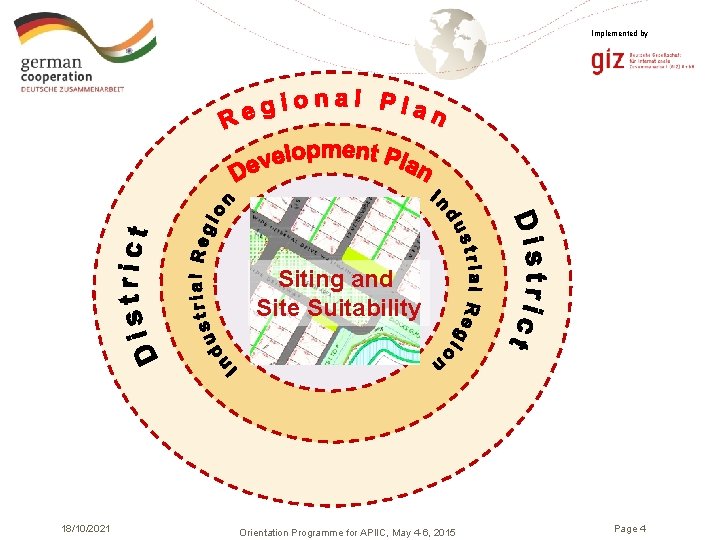
Implemented by Siting and Site Suitability 18/10/2021 Orientation Programme for APIIC, May 4 -6, 2015 Page 4
Implemented by Importance of Siting an Industrial Park • Industry is associated with other activities/land uses • Negative impacts from industries • Legal requirements (EIA/EC, Consent) • Land is an important resource • Sustainability aspects 18/10/2021 Orientation Programme for APIIC, May 4 -6, 2015 Page 5

Implemented by │Impact Potential Energy consumption Atmospheric emissions Water pollution Solid/haz. wastes Ecosystem service areas: Forests Eco sensitive zones – national parks, wildlife sanctuaries etc. Agri. Lands Human habitat Public water supply areas Disaster risks Resource consumption Source Surface water bodies Ground water Monuments, historic places Scenic areas, nature conservation areas Impact Potential Receiver Page 6
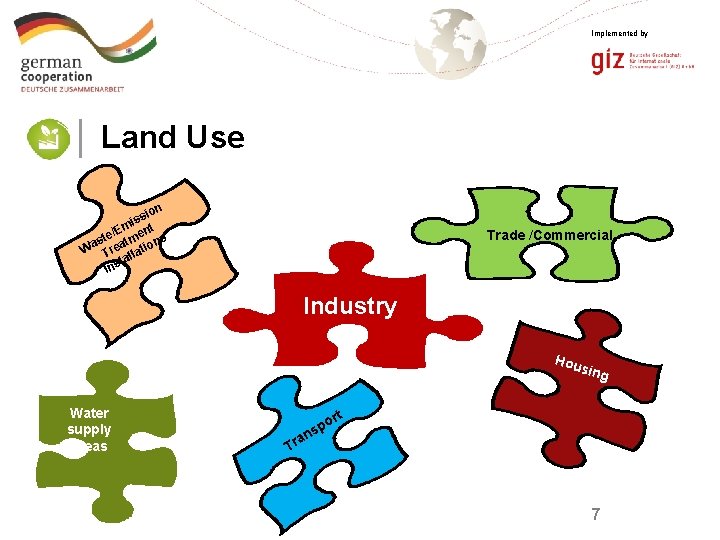
Implemented by │ Land Use ion ss i /Em ent e t s tm ns Wa Trea latio tal s n I Trade /Commercial Industry Hou sing Water supply areas rt o sp an Tr 7 Page 7
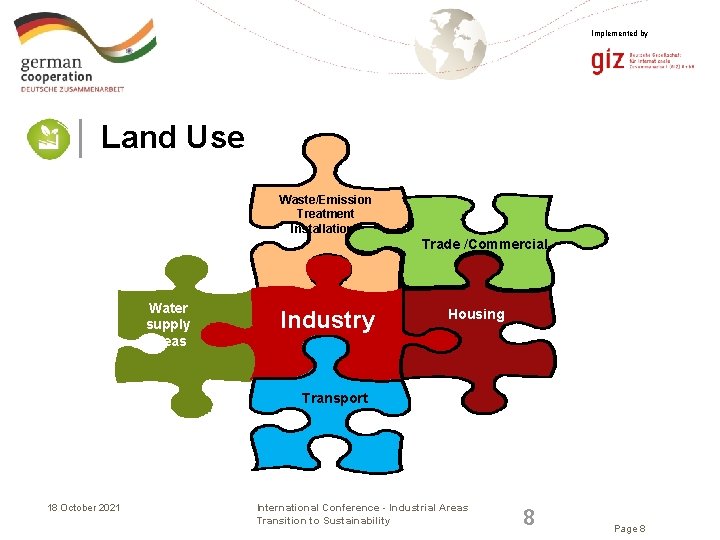
Implemented by │ Land Use Waste/Emission Treatment Installations Trade /Commercial Water supply areas Industry Housing Transport 18 October 2021 International Conference - Industrial Areas Transition to Sustainability 8 Page 8
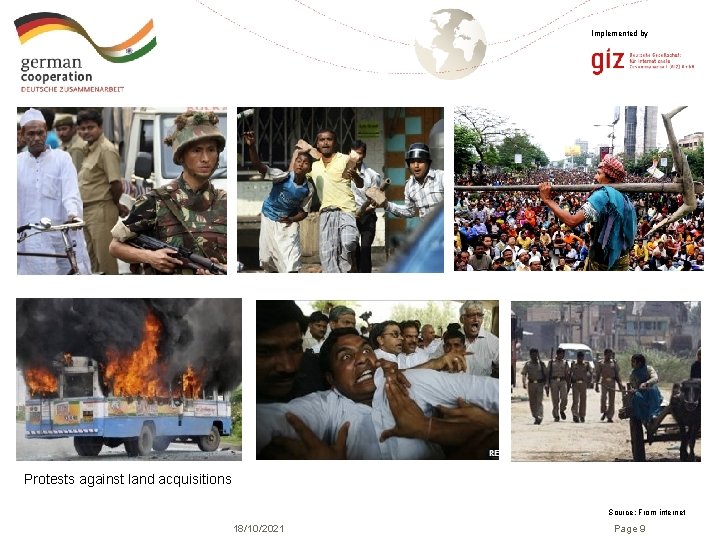
Implemented by Protests against land acquisitions Source: From internet 18/10/2021 Page 9

Implemented by Source: From internet 18/10/2021 Page 10
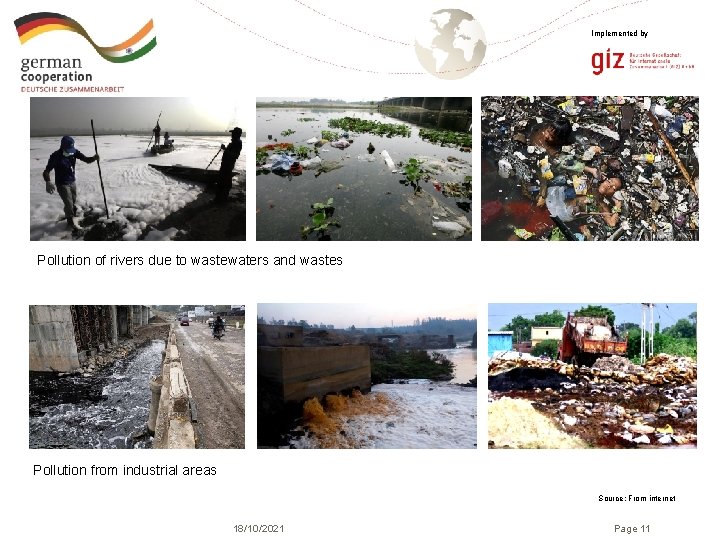
Implemented by Pollution of rivers due to wastewaters and wastes Pollution from industrial areas Source: From internet 18/10/2021 Page 11
Implemented by What are the Solutions? 18/10/2021 Orientation programme for APIIC, May 4 -6, 2015 Page 12
Implemented by Legal Requirements • EIA – Environmental Clearance (EP Act) » All new Industrial Estates including modernisation requires prior Environmental Clearance. Category A: » Atleast one industry is of Category A » > 500 Ha and housing atleast one Category B industry Category B: » Atleast one industry is of Category B and < 500 Ha » > 500 Ha and not housing Category A or B » Category B under the purview of SEAC. • If “General Conditions” apply for Category B, then it will be treated as Category A. • No EC required: < 500 Ha and not housing Category A or B 18/10/2021 Orientation programme for APIIC, May 4 -6, 2015 Page 13
Implemented by Legal Requirements » Water (Prevention and Control of Pollution) Act 1974 » Air (Prevention and Control of Pollution) Act 1981 » Central Pollution Control Board » Railway property » Airport areas » Defence establishments 18/10/2021 Orientation programme for APIIC, May 4 -6, 2015 Page 14
Implemented by Legal Requirements » Pipelines » Heritage Structures » Petrochemical and Gas industries » Natural Hazard Zones » Coastal Regulation Zones (CRZ) » Eco-sensitive zones/ Wild life areas » Near Major Settlement » Near Religious places 18/10/2021 Orientation programme for APIIC, May 4 -6, 2015 Page 15
Implemented by Areas to be Avoided (Mo. EFCC) • Ecologically and/or otherwise sensitive areas: At least 25 km; depending on the geoclimatic conditions the requisite distance hall have to be increased by the appropriate agency. • Coastal areas: at least 1/2 km from High Tide Line. • Flood Plain of the Riverine Systems: at least 1/2 km from flood plain or modified flood plain affected by dam in the upstream or by flood control systems. • Transport/Communication System: at least 1/2 km from highway and railway. • Major settlements(3, 000 population): distance from settlements is difficult to maintain because of urban sprawl. At the time of siting of the industry if any major settlement's notified limit is within 50 km, the spatial direction of growth of the settlement for at least a decade must be assessed and the industry shall be sited at least 25 km from the projected growth boundary of the settlement. 18/10/2021 Orientation programme for APIIC, May 4 -6, 2015 Page 16
Implemented by Siting Criteria (Mo. EFCC) • No forest land shall be converted (Ref: Forest Conservation Act, 1980). • No prime agricultural land shall be converted • Industry must be obscured from general sight • Treatment of waste water • Provision of the green belt • Solid waste storage space and reuse • Lay out and form conforming to the landscape • Associated township of the industry • Ambient air quality measuring stations 18/10/2021 Orientation programme for APIIC, May 4 -6, 2015 Page 17
Implemented by Draft National Land Use Policy! 18/10/2021 Orientation programme for APIIC, May 4 -6, 2015 Page 18
Implemented by • Non-cultivable lands/waste lands to be used for strategic development • National Land Utilisation Policy a guiding framework for state land utilisation policies • Land use and development/conservation should be guided by spatial plans • Unplanned and adhoc land use shifts from one use to another should be stopped • • Identify “Land Utilisation Zones” (LUZ) and undertake land use planning 18/10/2021 Page 19
Implemented by Land Utilisation Zones: Types LUZ - 1: Strategic Development Areas of National Importance LUZ - 2: Urban Areas/Metropolitan Regions/ Areas under transformation LUZ - 3: Industrial Areas LUZ - 4: Rural/Agricultural Areas LUZ - 5: Transportation Corridors LUZ - 6: Mining and Mineral Bearing Areas LUZ - 7: Ecological Areas LUZ - 8: Tourism Areas, Heritage Areas LUZ - 9: Major Hazard Vulnerable Areas 18/10/2021 Page 20
Implemented by System of Planning • State Perspective Plans specifying the requirements of LUZs. • Regional Perspective Plans for LUZs. • Regional Development Plans for LUZs. • Development Plans for specific portions or nodes (urban centres) or zones, derived from the Regional Plan of the LUZs. • Layout Plans for specific areas or zones derived from the Development Plans. 18 October 2021 Page 21
Implemented by How to select a Suitable Site? 18/10/2021 Orientation programme for APIIC, May 4 -6, 2015 Page 22
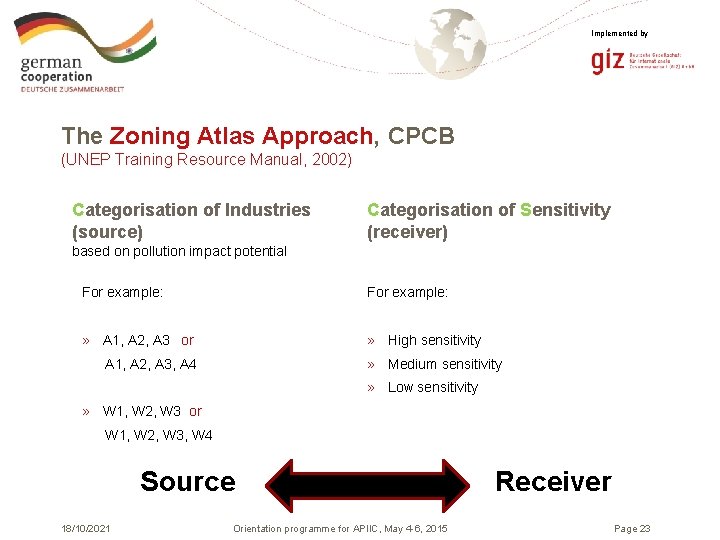
Implemented by The Zoning Atlas Approach, CPCB (UNEP Training Resource Manual, 2002) Categorisation of Industries (source) Categorisation of Sensitivity (receiver) based on pollution impact potential For example: » A 1, A 2, A 3 or » High sensitivity » Medium sensitivity A 1, A 2, A 3, A 4 » Low sensitivity » W 1, W 2, W 3 or W 1, W 2, W 3, W 4 Source 18/10/2021 Orientation programme for APIIC, May 4 -6, 2015 Receiver Page 23
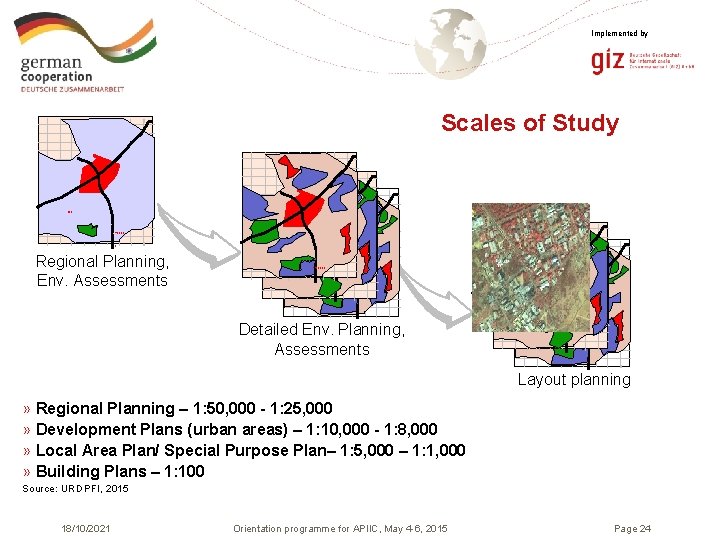
Implemented by Scales of Study S II 1: 50, 00 0 Regional Planning, Env. Assessments 1: 50, 000 Detailed Env. Planning, Assessments Layout planning » Regional Planning – 1: 50, 000 - 1: 25, 000 » Development Plans (urban areas) – 1: 10, 000 - 1: 8, 000 » Local Area Plan/ Special Purpose Plan– 1: 5, 000 – 1: 1, 000 » Building Plans – 1: 100 Source: URDPFI, 2015 18/10/2021 Orientation programme for APIIC, May 4 -6, 2015 Page 24
Implemented by 1: 250, 000 scale Zoning Atlas (district level studies) 18/10/2021 Orientation programme for APIIC, May 4 -6, 2015 1: 2, 500 scale Industrial Park Planning Page 25
Implemented by Scale 1: 250, 000 18/10/2021 Orientation programme for APIIC, May 4 -6, 2015 Page 26
Implemented by Summarization of Parameters » Flow charts, decision trees » Weightages, ranking » Elimination technique » Decision Matrices, Overlay techniques 18/10/2021 Orientation programme for APIIC, May 4 -6, 2015 Page 27
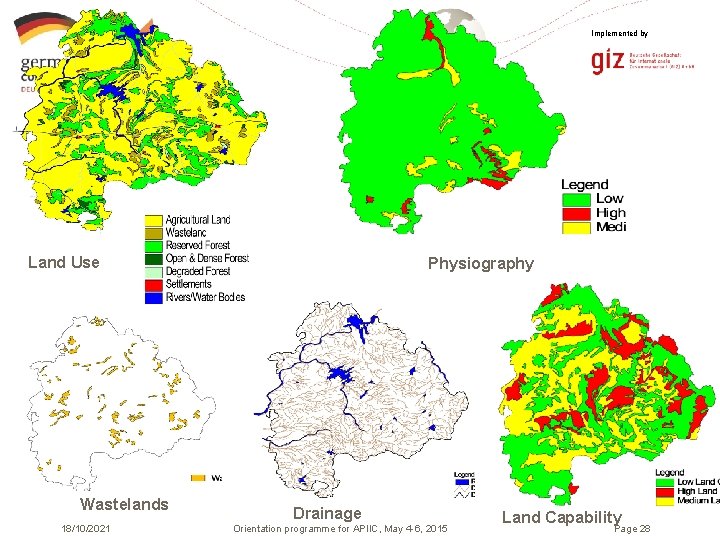
Implemented by Land Use Wastelands 18/10/2021 Physiography Drainage Orientation programme for APIIC, May 4 -6, 2015 Land Capability Page 28
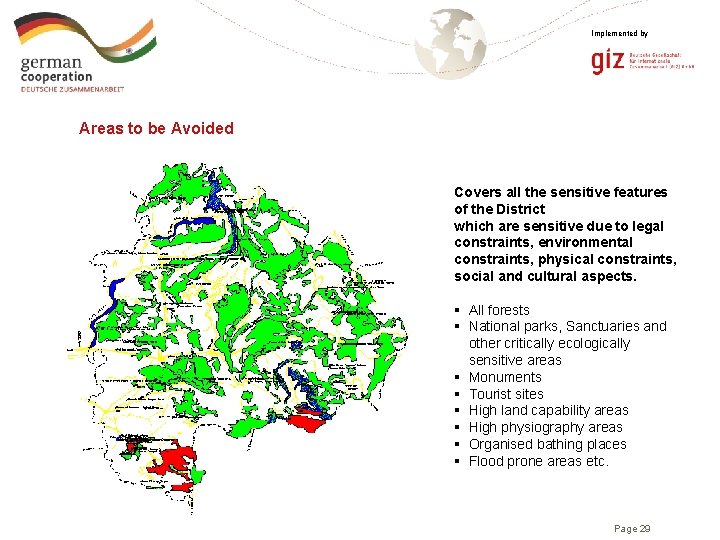
Implemented by Areas to be Avoided Covers all the sensitive features of the District which are sensitive due to legal constraints, environmental constraints, physical constraints, social and cultural aspects. § All forests § National parks, Sanctuaries and other critically ecologically sensitive areas § Monuments § Tourist sites § High land capability areas § High physiography areas § Organised bathing places § Flood prone areas etc. Page 29
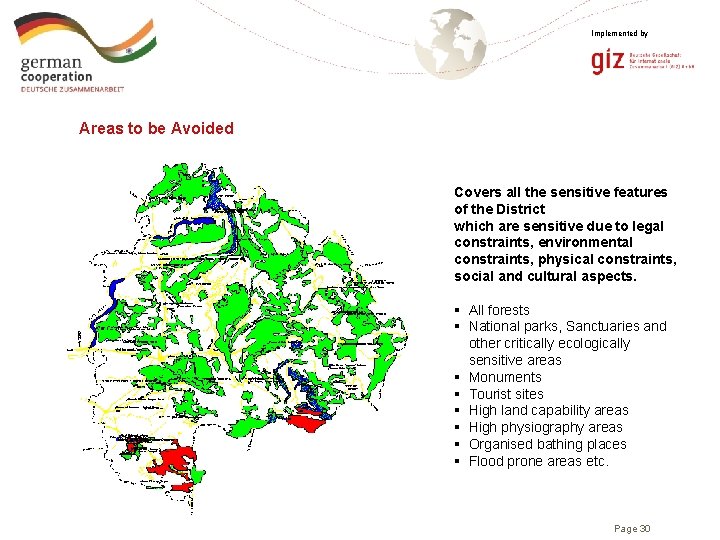
Implemented by Areas to be Avoided Covers all the sensitive features of the District which are sensitive due to legal constraints, environmental constraints, physical constraints, social and cultural aspects. § All forests § National parks, Sanctuaries and other critically ecologically sensitive areas § Monuments § Tourist sites § High land capability areas § High physiography areas § Organised bathing places § Flood prone areas etc. Page 30
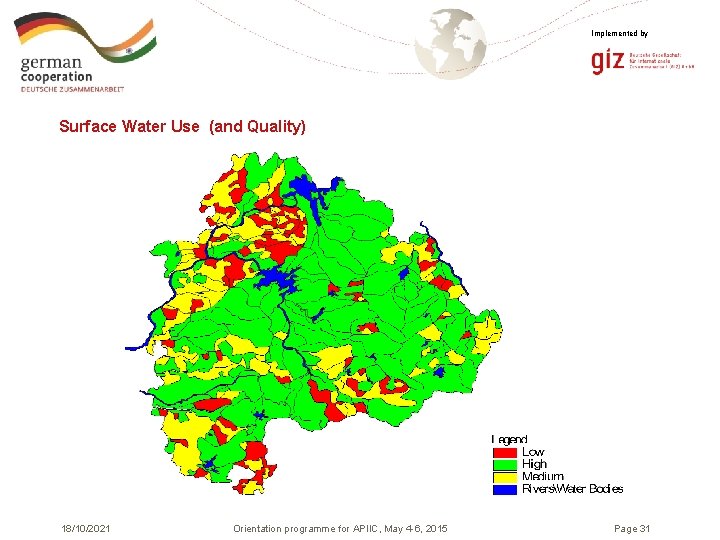
Implemented by Surface Water Use (and Quality) 18/10/2021 Orientation programme for APIIC, May 4 -6, 2015 Page 31
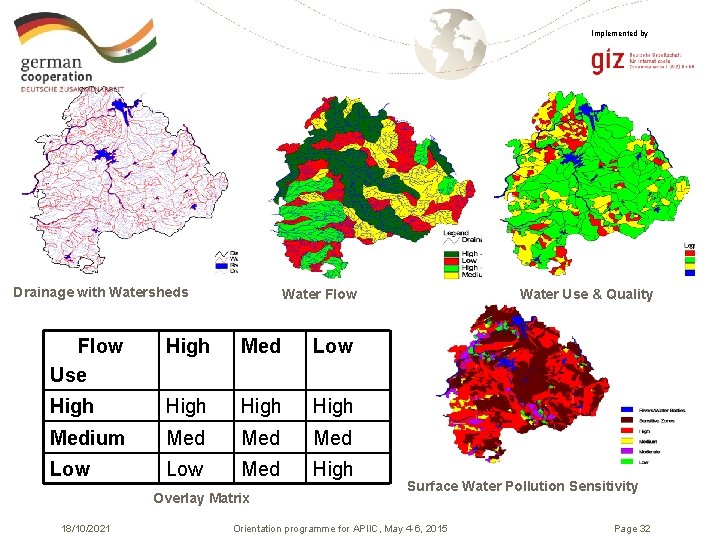
Implemented by Drainage with Watersheds Water Flow Use High Med Low High Medium Med Med Low Med High Overlay Matrix 18/10/2021 Water Use & Quality Surface Water Pollution Sensitivity Orientation programme for APIIC, May 4 -6, 2015 Page 32
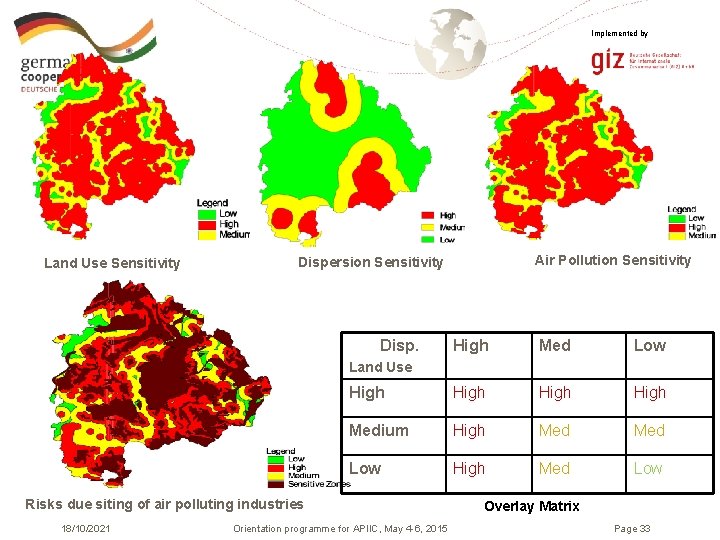
Implemented by Land Use Sensitivity Air Pollution Sensitivity Dispersion Sensitivity Disp. High Med Low High Medium High Med Low Land Use Risks due siting of air polluting industries 18/10/2021 Orientation programme for APIIC, May 4 -6, 2015 Overlay Matrix Page 33

Implemented by Site Suitability Map 18/10/2021 Orientation programme for APIIC, May 4 -6, 2015 Page 34
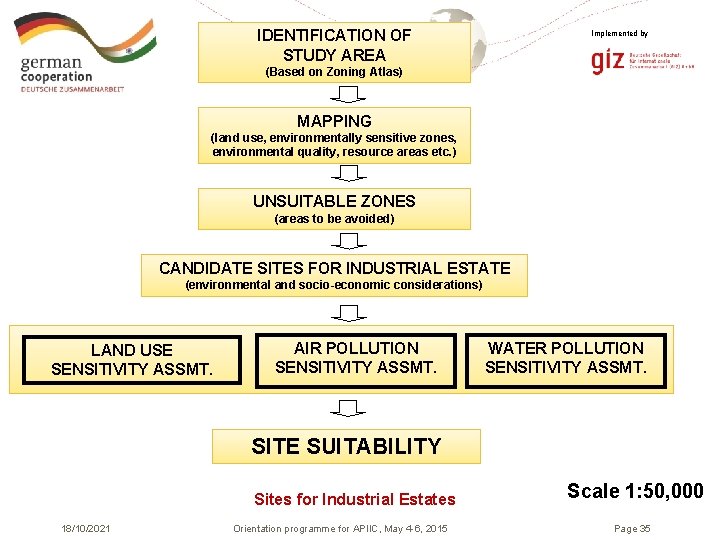
IDENTIFICATION OF STUDY AREA Implemented by (Based on Zoning Atlas) MAPPING (land use, environmentally sensitive zones, environmental quality, resource areas etc. ) UNSUITABLE ZONES (areas to be avoided) CANDIDATE SITES FOR INDUSTRIAL ESTATE (environmental and socio-economic considerations) LAND USE SENSITIVITY ASSMT. AIR POLLUTION SENSITIVITY ASSMT. WATER POLLUTION SENSITIVITY ASSMT. SITE SUITABILITY Sites for Industrial Estates 18/10/2021 Orientation programme for APIIC, May 4 -6, 2015 Scale 1: 50, 000 Page 35
Implemented by Approach • Notify siting criteria, safety distances • Exclusion analysis, inclusion analysis • Environmental Risks [water and soil protection, climate change, biodiversity, pollution etc. ] • Hazard Risks [earthquake; avalanches; storm; flood; landslide, soil subsidence] • Land Use [proportion of fallow land; area integration; area pollution] • Energy demand assessment • Resource-efficiency [water, energy, materials] 18 October 2021 Page 36
Implemented by What other States do? 18/10/2021 Orientation programme for APIIC, May 4 -6, 2015 Page 37
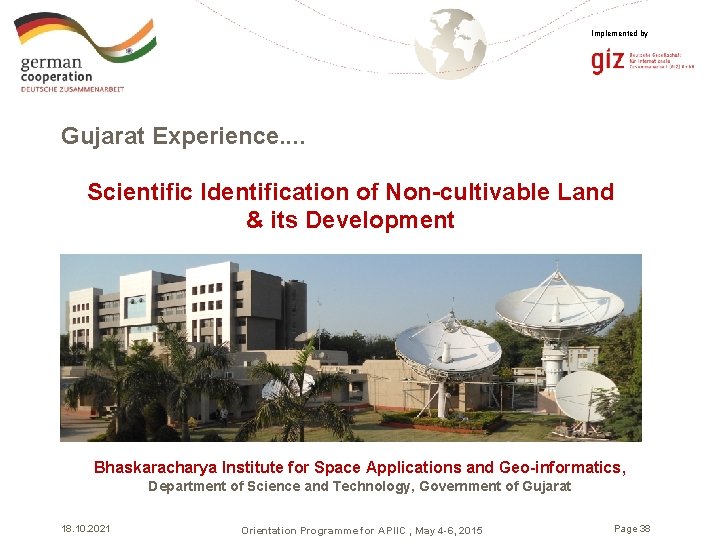
Implemented by Gujarat Experience. . Scientific Identification of Non-cultivable Land & its Development Bhaskaracharya Institute for Space Applications and Geo-informatics, Department of Science and Technology, Government of Gujarat 18. 10. 2021 Orientation Programme for APIIC , May 4 -6, 2015 Page 38
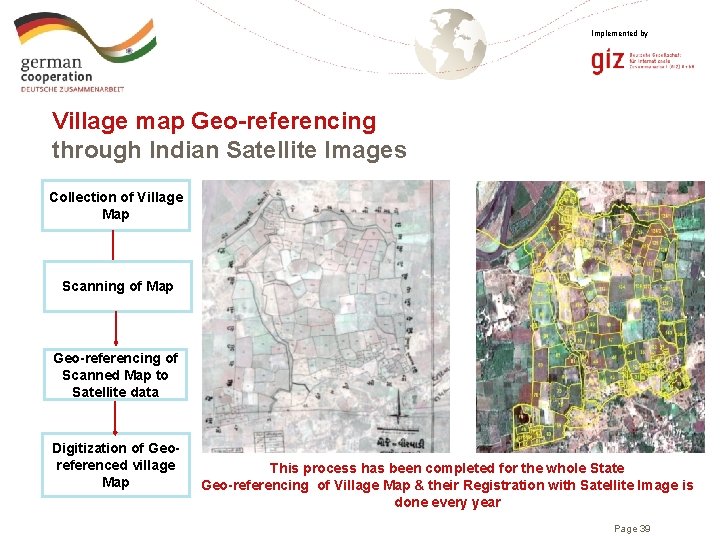
Implemented by Village map Geo-referencing through Indian Satellite Images Collection of Village Map Scanning of Map Geo-referencing of Scanned Map to Satellite data Digitization of Georeferenced village Map This process has been completed for the whole State Geo-referencing of Village Map & their Registration with Satellite Image is done every year Page 39
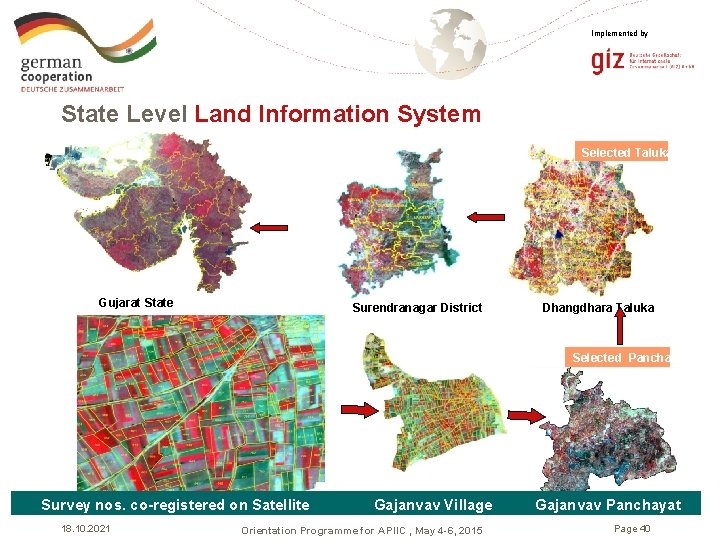
Implemented by State Level Land Information System Selected District Gujarat State Surendranagar District Selected Taluka Dhangdhara Taluka Selected Panchayat Gajanvav Village Survey nos. co-registered on Satellite Image 18. 10. 2021 Orientation Programme for APIIC , May 4 -6, 2015 Gajanvav Panchayat Page 40
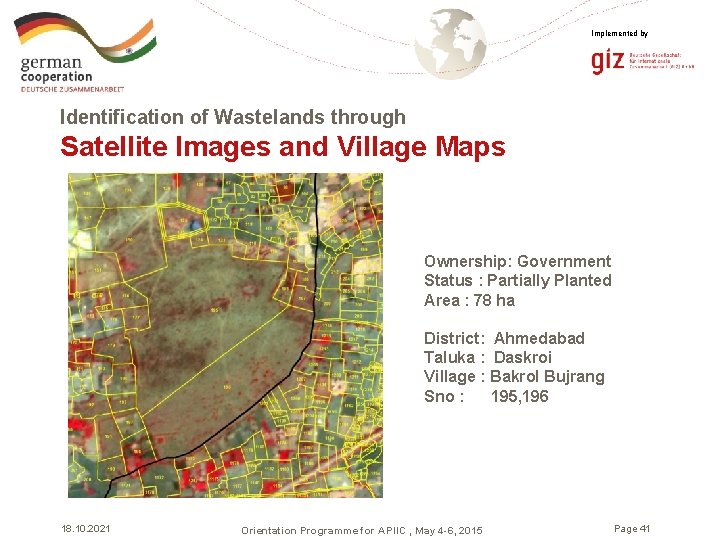
Implemented by Identification of Wastelands through Satellite Images and Village Maps Ownership: Government Status : Partially Planted Area : 78 ha District: Ahmedabad Taluka : Daskroi Village : Bakrol Bujrang Sno : 195, 196 18. 10. 2021 Orientation Programme for APIIC , May 4 -6, 2015 Page 41
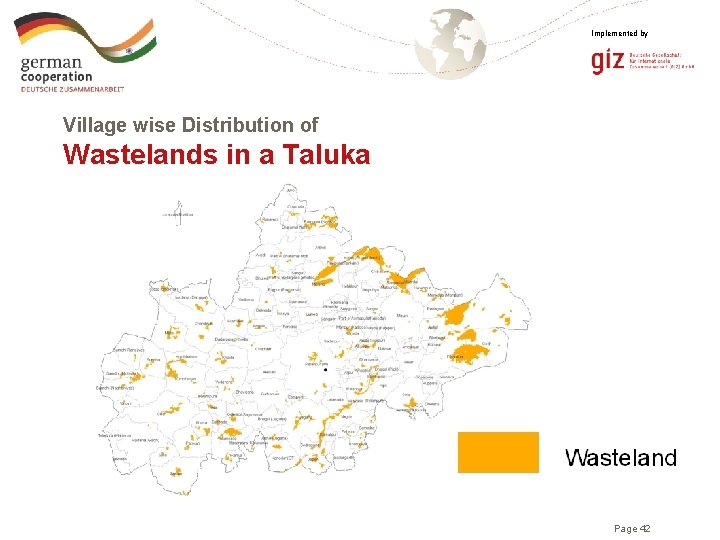
Implemented by Village wise Distribution of Wastelands in a Taluka Page 42
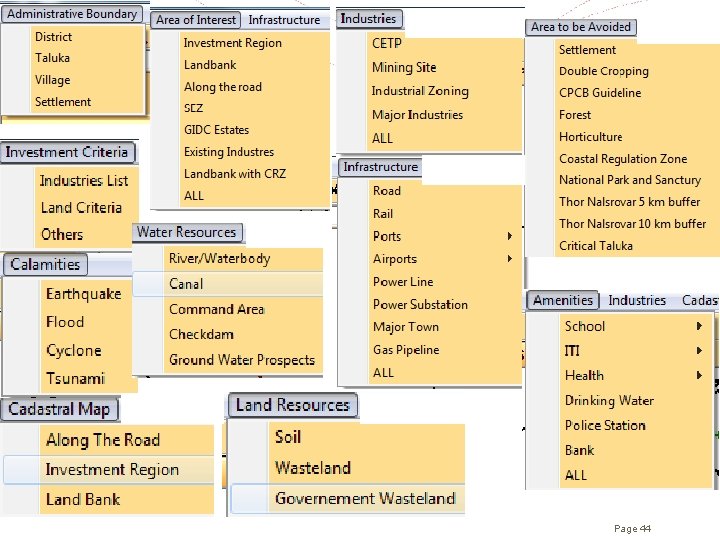
Implemented by Selected Parameters for Selection of Industrial Site Page 43
Implemented by Page 44
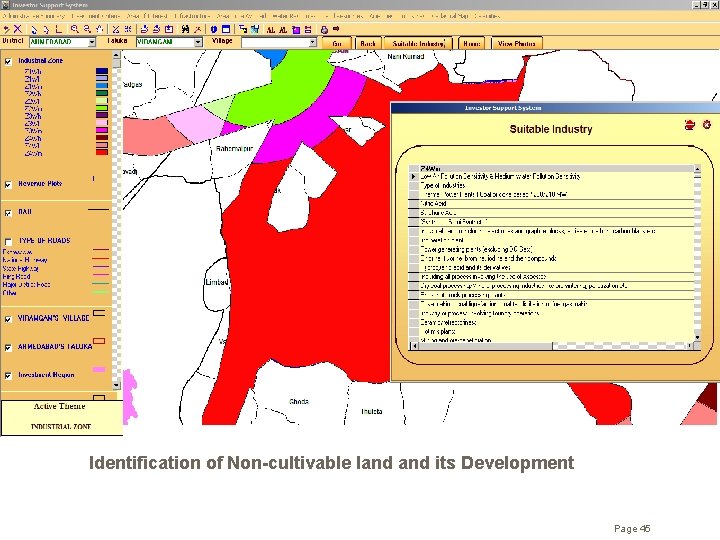
Identification of Non-cultivable land its Development Page 45
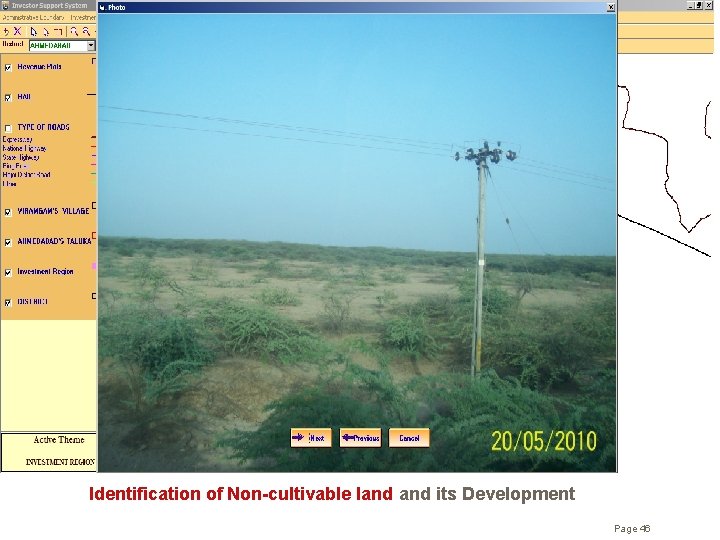
Identification of Non-cultivable land its Development Page 46
Implemented by Gujarat Experience. . (contd. ) Investor Support System Regional Integrated Industrial Development Approach Concept is to put in use Government Waste land, Identification of Single Crop land suitable to industry by applying various Parameters of No-Go Areas as per government regulation and integrating it with relevant infrastructure required for industry including social infrastructure 18. 10. 2021 Orientation Programme for APIIC , May 4 -6, 2015 Page 47
Implemented by Gujarat Experience. . (contd. ) Avoid haphazard development of industries by three stage Planning • • • Stage – 1 Zoning – Identification • Image Interpretation • Multi Criteria Analysis • Field Verification – Selection – Phasing Stage – 2 Master Planning Stage – 3 Regulation Plan Infrastructure of various department in Sustainable and Harmonious way 18. 10. 2021 Orientation Programme for APIIC , May 4 -6, 2015 Page 48
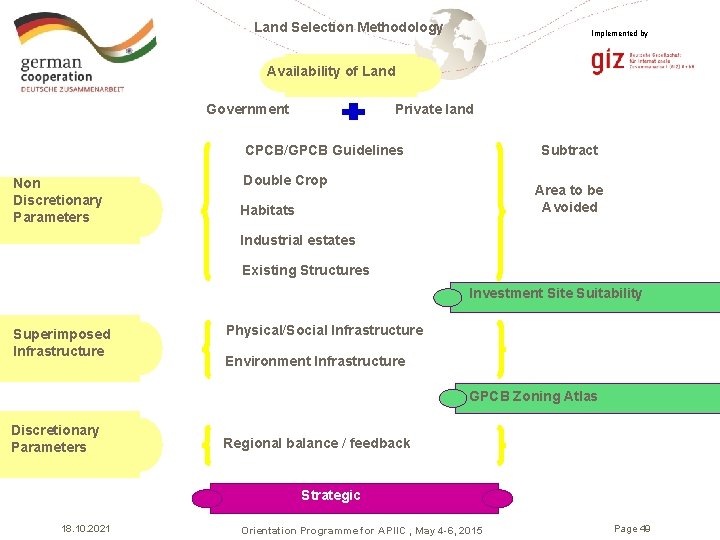
Land Selection Methodology Implemented by Availability of Land Government Private land CPCB/GPCB Guidelines Non Discretionary Parameters Subtract Double Crop Area to be Avoided Habitats Industrial estates Existing Structures Investment Site Suitability Superimposed Infrastructure Physical/Social Infrastructure Environment Infrastructure GPCB Zoning Atlas Discretionary Parameters Regional balance / feedback Strategic 18. 10. 2021 Orientation Programme for APIIC , May 4 -6, 2015 Page 49
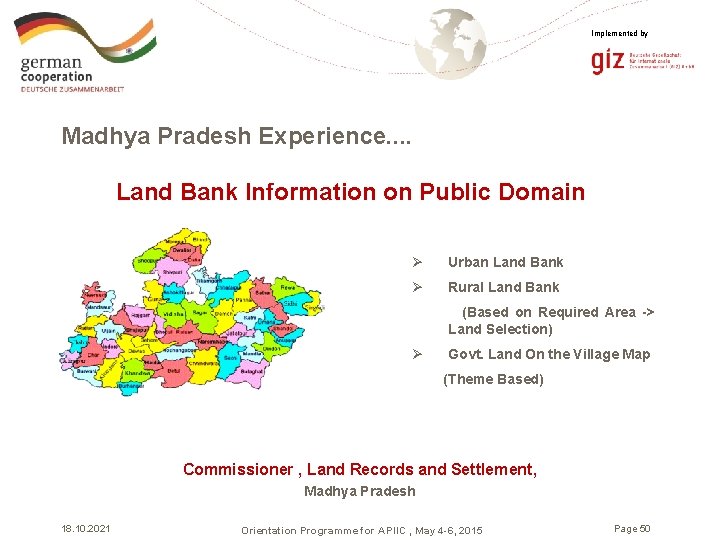
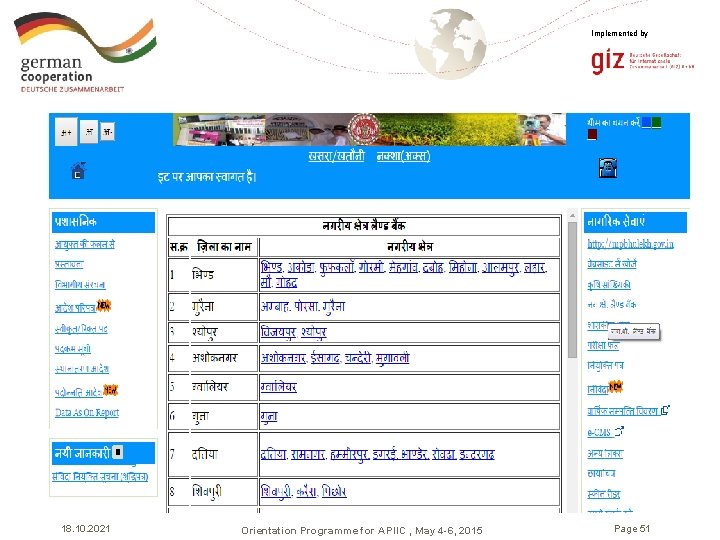
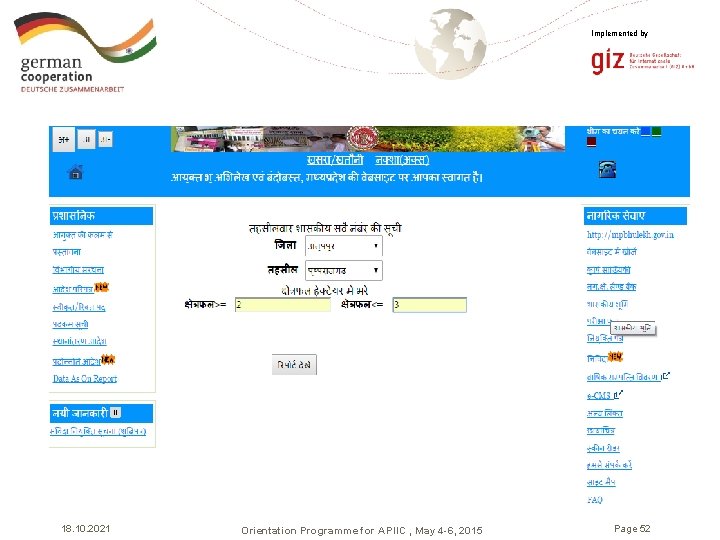
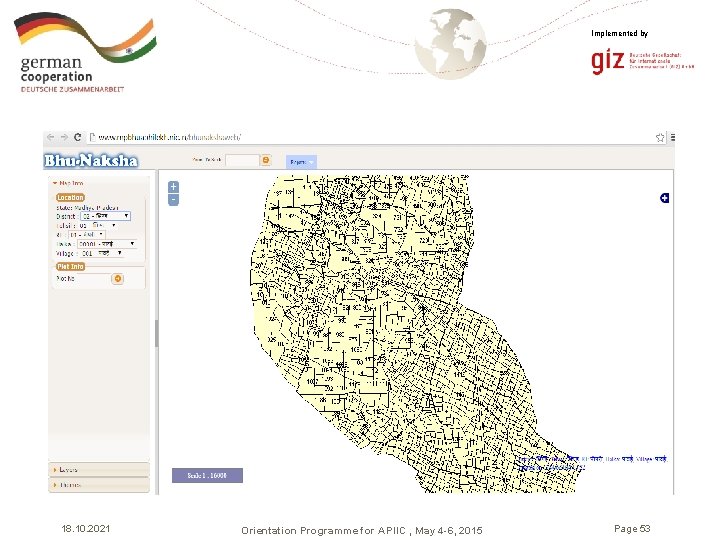
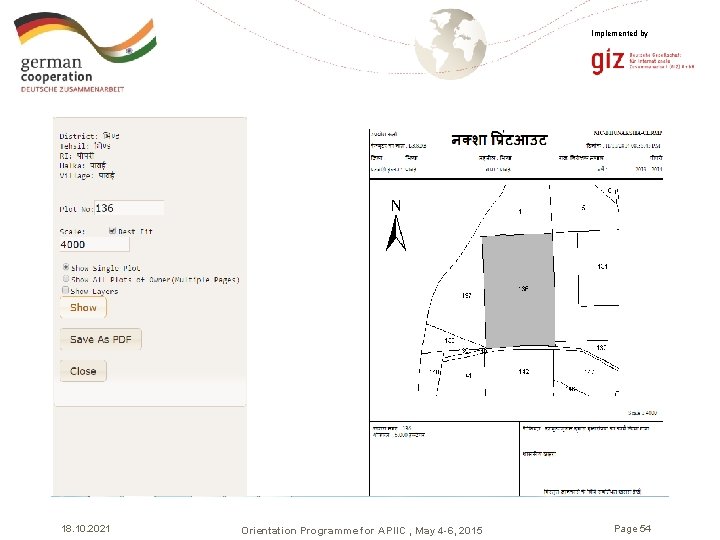
Implemented by Madhya Pradesh Experience. . Land Bank Information on Public Domain Ø Urban Land Bank Ø Rural Land Bank (Based on Required Area -> Land Selection) Ø Govt. Land On the Village Map (Theme Based) Commissioner , Land Records and Settlement, Madhya Pradesh 18. 10. 2021 Orientation Programme for APIIC , May 4 -6, 2015 Page 50
Implemented by 18. 10. 2021 Orientation Programme for APIIC , May 4 -6, 2015 Page 51
Implemented by 18. 10. 2021 Orientation Programme for APIIC , May 4 -6, 2015 Page 52
Implemented by 18. 10. 2021 Orientation Programme for APIIC , May 4 -6, 2015 Page 53
Implemented by 18. 10. 2021 Orientation Programme for APIIC , May 4 -6, 2015 Page 54

Implemented by Your Ideas? Source: Retrieved from www. leadingmenonly. com 18. 10. 2021 Orientation Programme for APIIC , May 4 -6, 2015 Page 55
Implemented by As a federal enterprise, GIZ supports the German Government in achieving its objectives in the field of international cooperation for sustainable development. Published by Deutsche Gesellschaft für Internationale Zusammenarbeit (GIZ) Gmb. H Registered offices, Bonn and Eschborn, Germany Indo- German Environment Partnership Programme Responsible N. Raghu Babu, Anshika Gupta Author(s) N. Raghu Babu Photo credits © GIZ Layout GIZ Corporate Design Centre, Anshika Gupta 3 rd Floor, B 5 / 2, Safdarjung Enclave New Delhi 110029 T +91 11 49 49 53 53 F +49 11 49 49 53 51 E contact@giz. de I www. giz. de, www. igep. in 18/10/2021 Page 56
- Slides: 56