
Implementation Plan for Food Security Forecasting Model F
![4. Activity Schedule [First year] Jan Feb Mar Apr Investigating meeting Workshop A F](https://slidetodoc.com/presentation_image_h2/e82de22cec115c8bf2a4c25650fc56a3/image-8.jpg "4. Activity Schedule [First year] Jan Feb Mar Apr Investigating meeting Workshop A F")
![4. Activity Schedule (2) [Second year] Jan Feb Mar Apr May Jun Jul Aug](https://slidetodoc.com/presentation_image_h2/e82de22cec115c8bf2a4c25650fc56a3/image-9.jpg "4. Activity Schedule (2) [Second year] Jan Feb Mar Apr May Jun Jul Aug")
![4. Activity Schedule (3) [Third year] Jan Feb Mar Apr May Jun Jul Aug](https://slidetodoc.com/presentation_image_h2/e82de22cec115c8bf2a4c25650fc56a3/image-10.jpg "4. Activity Schedule (3) [Third year] Jan Feb Mar Apr May Jun Jul Aug")
- Slides: 18
Implementation Plan for Food Security Forecasting Model (F Model) Information in AFSIS Shoji KIMURA Expert of ASEAN Food Security Information System (AFSIS) Project 1
1. Purpose Desires to promote the Food Security Forecasting Model, in the field of standardization and conformity assessment on the basis of equality and mutual benefits. Recognizing that such cooperation shall promote economic partnership and support friendly relationships between member countries. 2
2. Period 2013 - 2015 3
3. Activity 3 -1. To create the mid-long term supply and demand forecasting information. 3 -2. To broaden the necessary data for creating mid-long term supply and demand forecasting information. 4
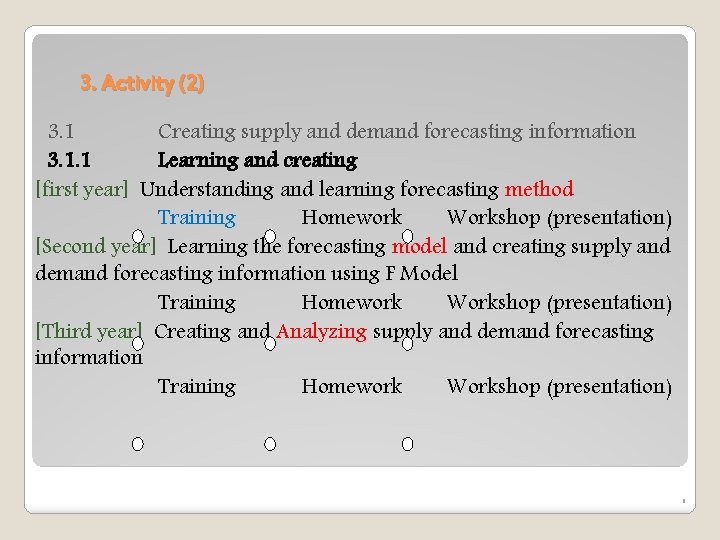
3. Activity (2) 3. 1 Creating supply and demand forecasting information 3. 1. 1 Learning and creating [first year] Understanding and learning forecasting method Training Homework Workshop (presentation) [Second year] Learning the forecasting model and creating supply and demand forecasting information using F Model Training Homework Workshop (presentation) [Third year] Creating and Analyzing supply and demand forecasting information Training Homework Workshop (presentation) 5
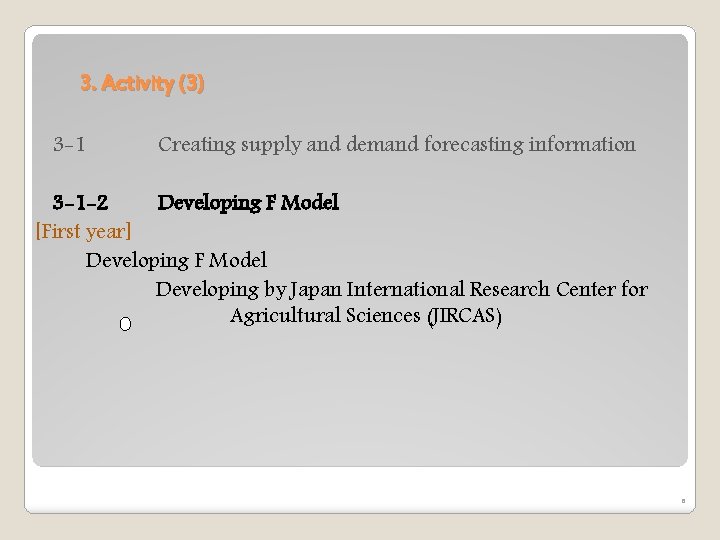
3. Activity (3) 3 -1 Creating supply and demand forecasting information 3 -1 -2 Developing F Model [First year] Developing F Model Developing by Japan International Research Center for Agricultural Sciences (JIRCAS) 6
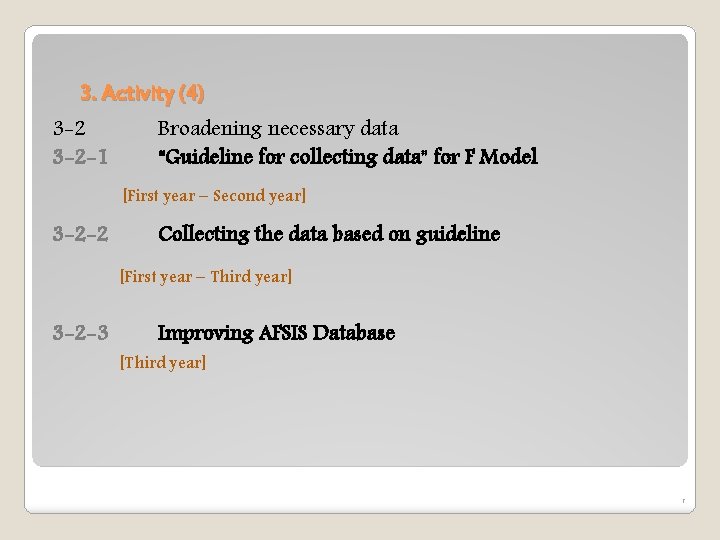
3. Activity (4) 3 -2 -1 Broadening necessary data “Guideline for collecting data” for F Model [First year – Second year] 3 -2 -2 Collecting the data based on guideline [First year – Third year] 3 -2 -3 Improving AFSIS Database [Third year] 7
4. Activity Schedule [First year] Jan Feb Mar Apr Investigating meeting Workshop A F S I S Jun Workshop Jul Aug Sep Oct Nov Dec Training Developing F Model (JIRCAS) Guideline for other crops M E M B E R C O U N T R I E May Guideline for data (draft) Guideline for rice Homework regression formula Creating forecasting information using Forecasting report 8
4. Activity Schedule (2) [Second year] Jan Feb Mar Apr May Jun Jul Aug Training A F S I S (JIRCAS) Oct Nov Dec Workshop F Model review (JIRCAS) F Model parameter Guideline for meats Improving statistical method countries) M E M B E R C O U N T R I Sep (Supporting for target Homework commodities Creating forecasting information using F Model Forecasting report Extending target 9
4. Activity Schedule (3) [Third year] Jan Feb Mar Apr May Jun Jul Aug Sep Oct Nov Dec Training A F S I S Workshop F Model parameter review (JIRCAS) Improving Database Information in ASEAN Improving statistical method countries) M E M B E R C O U N T R I Announcement of Forecasting (Supporting for Target Providing new data to AFSIS Homework Creating forecasting information using model (reflecting agricultural policy) Forecasting report 10
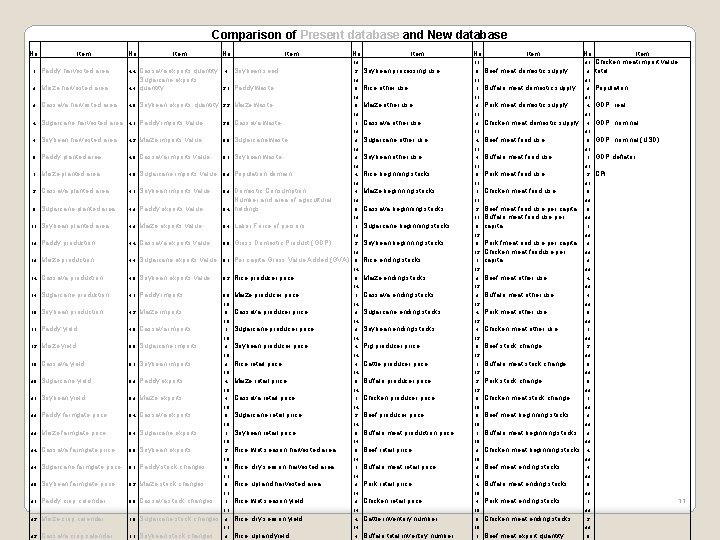
Comparison of Present database and New database No. Item 1 Paddy harvested area No. Item No. 2 Maize harvested area 44 Cassava exports quantity 5 Sugarcane exports 45 quantity 87 3 Cassava harvested area 46 Soybean exports quantity 88 4 Sugarcane harvested area 47 Paddy imports value 89 5 Soybean harvested area 48 Maize imports value 90 6 Paddy planted area 49 Cassava imports value 91 7 Maize planted area 50 Sugarcane imports value 92 8 Cassava planted area 51 Soybean imports value 93 9 Sugarcane planted area 52 Paddy exports value 94 11 Soybean planted area 53 Maize exports value 95 12 Paddy production 54 Cassava exports value 96 13 Maize production 55 Sugarcane exports value 97 14 Cassava production 56 Soybean exports value 15 Sugarcane production 57 Paddy imports 16 Soybean production 58 17 Paddy yield 59 18 Maize yield 60 19 Cassava yield 61 20 Sugarcane yield 62 21 Soybean yield 63 22 Paddy farmgate price 64 23 Maize farmgate price 65 24 Cassava farmgate price 66 25 Sugarcane farmgate price 67 26 Soybean farmgate price 68 27 Paddy crop calendar 69 28 Maize crop calendar 70 28 Cassava crop calendar 71 98 99 10 Maize imports 0 10 Cassava imports 1 10 Sugarcane imports 2 10 Soybean imports 3 10 Paddy exports 4 10 Maize exports 5 10 Cassava exports 6 10 Sugarcane exports 7 10 Soybean exports 8 10 Paddy stock changes 9 11 Maize stock changes 0 11 Cassava stock changes 1 11 Sugarcane stock changes 2 11 Soybean stock changes 3 Item No. Item 12 Soybean seed 8 Soybean processing use 12 Paddy waste 9 Rice other use 13 Maize waste 0 Maize other use 13 Cassava waste 1 Cassava other use 13 Sugarcane waste 2 Sugarcane other use 13 Soybean waste 3 Soybean other use 13 Population domain 4 Rice beginning stocks 13 Domestic Consumption 5 Maize beginning stocks Number and area of agricultural 13 holdings 6 Cassava beginning stocks 13 Labor Force of persons 7 Sugarcane beginning stocks 13 Gross Domestic Product (GDP) 8 Soybean beginning stocks 13 Per capita Gross Value Added (GVA) 9 Rice ending stocks 14 Rice producer price 0 Maize ending stocks 14 Maize producer price 1 Cassava ending stocks 14 Cassava producer price 2 Sugarcane ending stocks 14 Sugarcane producer price 3 Soybean ending stocks 14 Soybean producer price 4 Pig producer price 14 Rice retail price 5 Cattle producer price 14 Maize retail price 6 Buffalo producer price 14 Cassava retail price 7 Chicken producer price 14 Sugarcane retail price 8 Beef producer price 14 Soybean retail price 9 Buffalo meat production price 15 Rice, wet season harvested area 0 Beef retail price 15 Rice, dry season harvested area 1 Buffalo meat retail price 15 Rice, upland harvested area 2 Pork retail price 15 Rice, wet season yield 3 Chicken retail price 15 Rice, dry season yield 4 Cattle inventory number 15 Rice, upland yield 5 Buffalo total inventoy number No. Item 17 0 Beef meat domestic supply 17 1 Buffalo meat domestic supply 17 2 Pork meat domestic supply 17 3 Chicken meat domestic supply 17 4 Beef meat food use 17 5 Buffalo meat food use 17 6 Pork meat food use 17 7 Chicken meat food use 17 8 Beef meat food use per capita 17 Buffalo meat food use per 9 capita 18 0 Pork fmeat ood use per capita 18 Chicken meat fooduse per 1 capita 18 2 Beef meat other use 18 3 Buffalo meat other use 18 4 Pork meat other use 18 5 Chicken meat other use 18 6 Beef stock change 18 7 Buffalo meat stock change 18 8 Pork stock change 18 9 Chicken meat stock change 19 0 Beef meat beginning stocks 19 1 Buffalo meat beginning stocks 19 2 Chicken meat beginning stocks 19 3 Beef meat ending stocks 19 4 Buffalo meat ending stocks 19 5 Pork meat ending stocks 19 6 Chicken meat ending stocks 19 7 Beef meat export quantity No. Item 21 Chicken meat import value 2 total 21 3 Population 21 4 GDP, real 21 5 GDP, nominal 21 6 GDP, nominal (USD) 21 7 GDP deflator 21 8 CPI 21 9 22 0 22 1 22 2 22 3 22 4 22 5 22 6 22 7 22 8 22 9 23 0 23 1 23 2 23 3 23 4 23 5 23 6 23 11 7 23 8 23 9
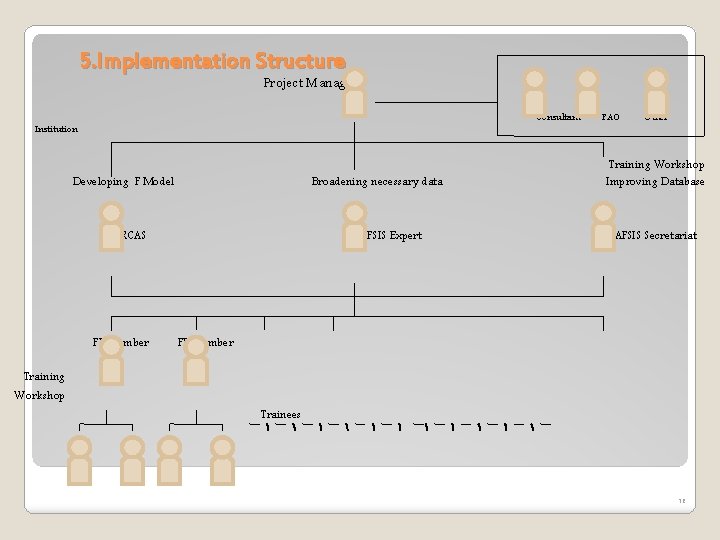
5. Implementation Structure Project Manager Consultant Institution Developing F Model Broadening necessary data JIRCAS FP Member AFSIS Expert FAO Other Training Workshop Improving Database AFSIS Secretariat FP Member Training Workshop Trainees 12
6. Responsibilities of Member countries (1) 6 -1 Member countries collaborate in the implementation and development of forecasting information conducted in ASEAN Member States. 6 -2 Member countries must prepare the working group for F Model activity. This working group consists of a chief (FP member) and two trainee staffs. 13
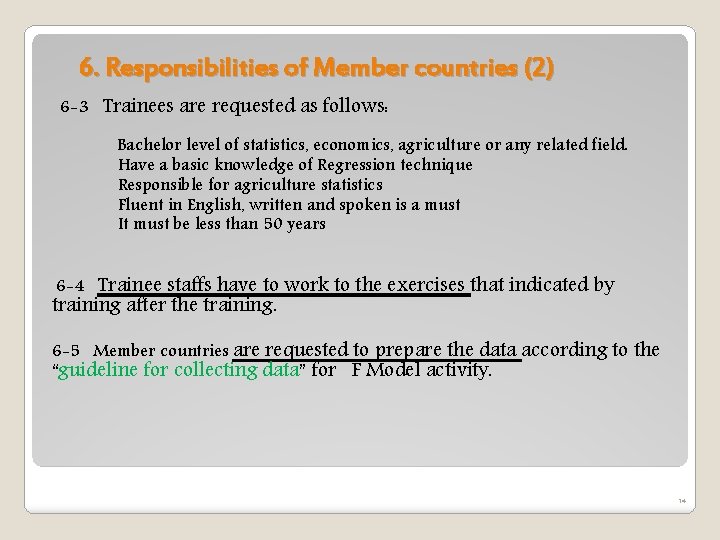
6. Responsibilities of Member countries (2) 6 -3 Trainees are requested as follows: Bachelor level of statistics, economics, agriculture or any related field. Have a basic knowledge of Regression technique Responsible for agriculture statistics Fluent in English, written and spoken is a must It must be less than 50 years 6 -4 Trainee staffs have to work to the exercises that indicated by training after the training. 6 -5 Member countries are requested to prepare the data according to the “guideline for collecting data” for F Model activity. 14
7. Continuity to obtain and tackle To guarantee a prompt response and dissemination of acquired knowledge and information with the members of working group, pioneering participant of this training would be responsible to obtain and tackle the succeeding trainings to be conducted. Training certificate would be given to a trainee who complete the presentation in workshop by each year. 15
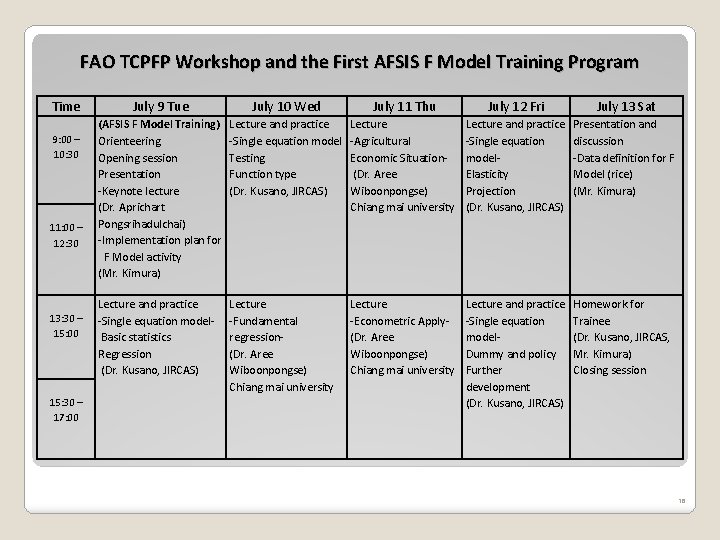
FAO TCPFP Workshop and the First AFSIS F Model Training Program Time 9: 00 – 10: 30 11: 00 – 12: 30 13: 30 – 15: 00 15: 30 – 17: 00 July 9 Tue July 10 Wed July 11 Thu July 12 Fri July 13 Sat (AFSIS F Model Training) Orienteering Opening session Presentation -Keynote lecture (Dr. Aprichart Pongsrihadulchai) -Implementation plan for F Model activity (Mr. Kimura) Lecture and practice -Single equation model Testing Function type (Dr. Kusano, JIRCAS) Lecture -Agricultural Economic Situation(Dr. Aree Wiboonpongse) Chiang mai university Lecture and practice -Single equation model. Elasticity Projection (Dr. Kusano, JIRCAS) Presentation and discussion -Data definition for F Model (rice) (Mr. Kimura) Lecture and practice -Single equation model. Basic statistics Regression (Dr. Kusano, JIRCAS) Lecture -Fundamental regression(Dr. Aree Wiboonpongse) Chiang mai university Lecture -Econometric Apply(Dr. Aree Wiboonpongse) Chiang mai university Lecture and practice -Single equation model. Dummy and policy Further development (Dr. Kusano, JIRCAS) Homework for Trainee (Dr. Kusano, JIRCAS, Mr. Kimura) Closing session 16
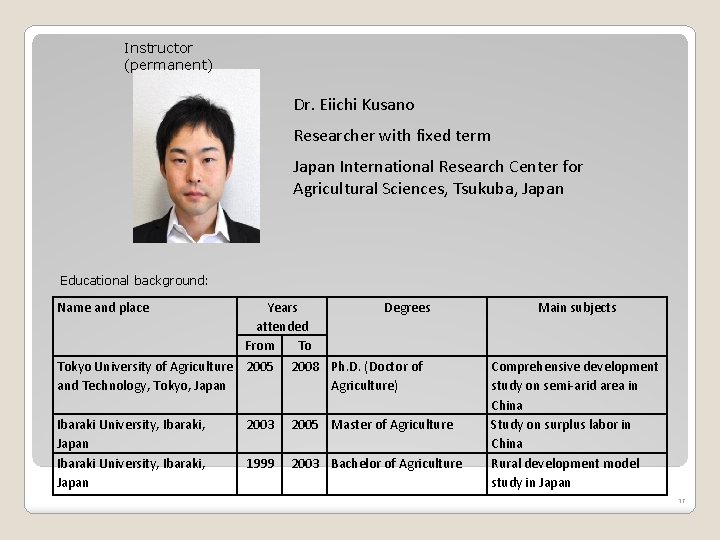
Instructor (permanent) Dr. Eiichi Kusano Researcher with fixed term Japan International Research Center for Agricultural Sciences, Tsukuba, Japan Educational background: Name and place Years Degrees attended From To Tokyo University of Agriculture 2005 2008 Ph. D. (Doctor of and Technology, Tokyo, Japan Agriculture) Ibaraki University, Ibaraki, Japan 2003 2005 Master of Agriculture 1999 2003 Bachelor of Agriculture Main subjects Comprehensive development study on semi-arid area in China Study on surplus labor in China Rural development model study in Japan 17
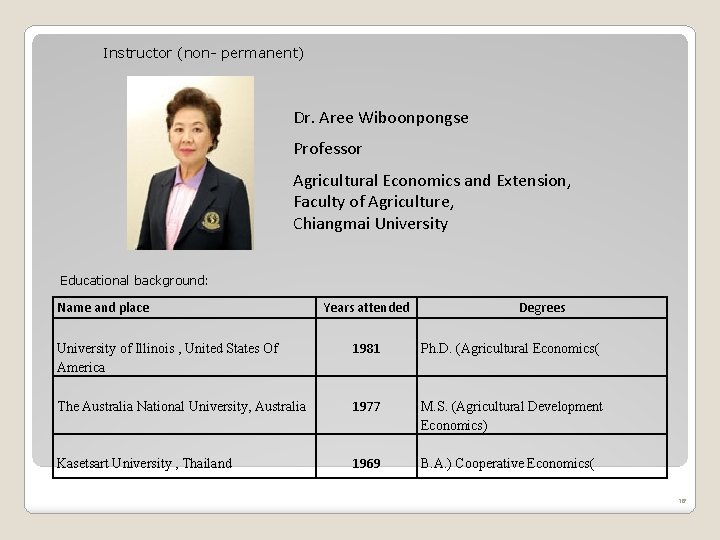
Instructor (non- permanent) Dr. Aree Wiboonpongse Professor Agricultural Economics and Extension, Faculty of Agriculture, Chiangmai University Educational background: Name and place Years attended Degrees University of Illinois , United States Of America 1981 Ph. D. (Agricultural Economics( The Australia National University, Australia 1977 M. S. (Agricultural Development Economics) Kasetsart University , Thailand 1969 B. A. ) Cooperative Economics( 18