
Implementation of the RSA Algorithm on a Dataflow

![Dataflow multiplier 6 a[j] b[i] X Product: hi CPU low 32 bits Stream a](https://slidetodoc.com/presentation_image_h2/79fc8afdcc09330d54bea06cd1a10926/image-6.jpg "Dataflow multiplier 6 a[j] b[i] X Product: hi CPU low 32 bits Stream a")
- Slides: 10
Implementation of the RSA Algorithm on a Dataflow Architecture Nikola Bežanić nbezanic@gmail. com Advisors: Veljko Milutinović, Jelena Popović-Božović, and Ivan Popović School of Electrical Engineering, University of Belgrade, 2013.
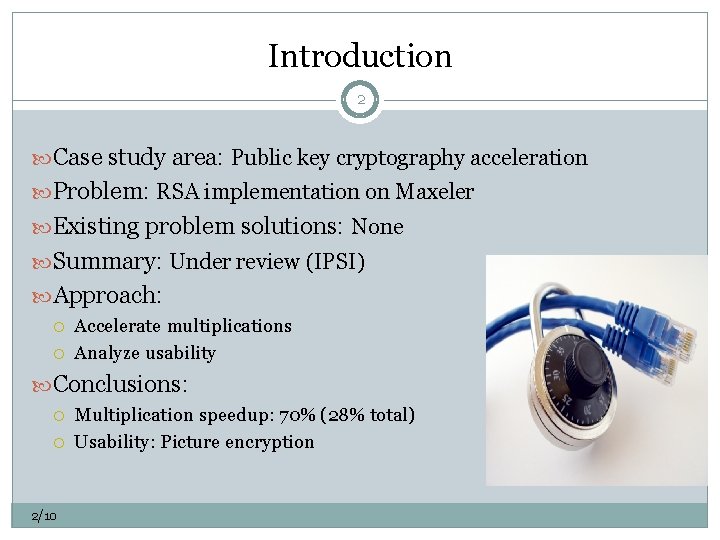
Introduction 2 Case study area: Public key cryptography acceleration Problem: RSA implementation on Maxeler Existing problem solutions: None Summary: Under review (IPSI) Approach: Accelerate multiplications Analyze usability Conclusions: 2/10 Multiplication speedup: 70% (28% total) Usability: Picture encryption
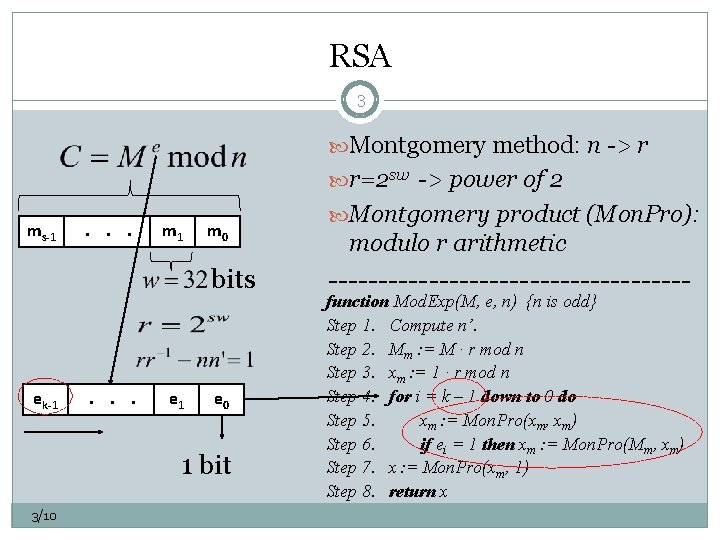
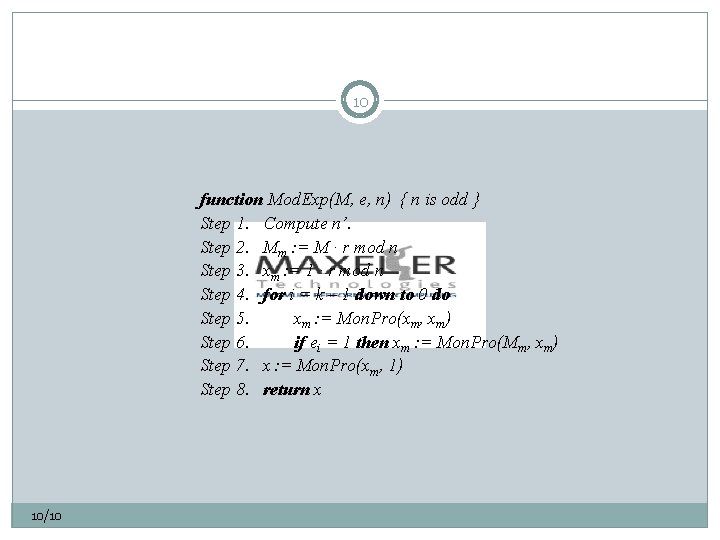
RSA 3 Montgomery method: n -> r r=2 sw -> power of 2 ms-1 . . . m 1 m 0 bits ek-1 . . . e 1 e 0 1 bit 3/10 Montgomery product (Mon. Pro): modulo r arithmetic ------------------ function Mod. Exp(M, e, n) {n is odd} Step 1. Compute n’. Step 2. Mm : = M ∙ r mod n Step 3. xm : = 1 ∙ r mod n Step 4. for i = k – 1 down to 0 do Step 5. xm : = Mon. Pro(xm, xm) Step 6. if ei = 1 then xm : = Mon. Pro(Mm, xm) Step 7. x : = Mon. Pro(xm, 1) Step 8. return x
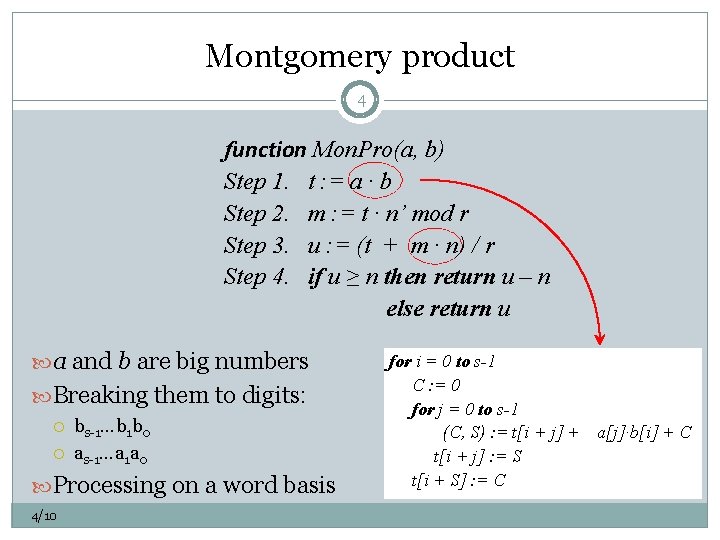
Montgomery product 4 function Mon. Pro(a, b) Step 1. t : = a ∙ b Step 2. m : = t ∙ n’ mod r Step 3. u : = (t + m ∙ n) / r Step 4. if u ≥ n then return u – n else return u a and b are big numbers Breaking them to digits: bs-1…b 1 b 0 as-1…a 1 a 0 Processing on a word basis 4/10 for i = 0 to s-1 C : = 0 for j = 0 to s-1 (C, S) : = t[i + j] + t[i + j] : = S t[i + S] : = C a[j]∙b[i] + C
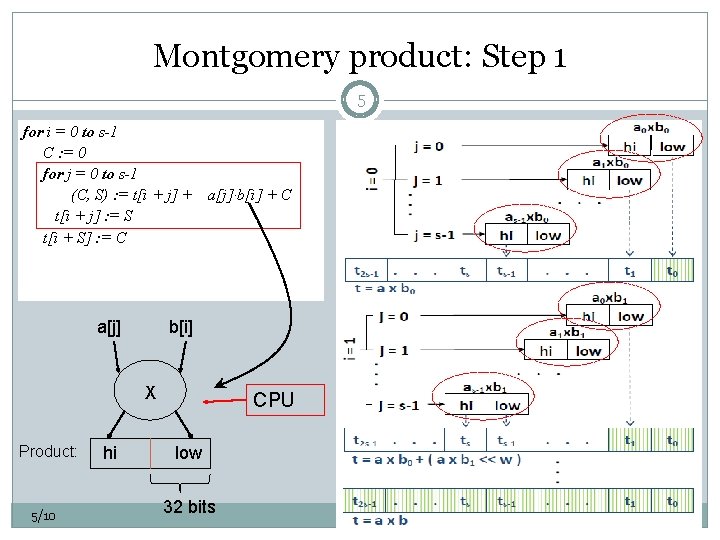
Montgomery product: Step 1 5 for i = 0 to s-1 C : = 0 for j = 0 to s-1 (C, S) : = t[i + j] + t[i + j] : = S t[i + S] : = C a[j]∙b[i] + C b[i] X Product: 5/10 hi CPU low 32 bits
Dataflow multiplier 6 a[j] b[i] X Product: hi CPU low 32 bits Stream a Constant b 0 X Stream y 6/10 Stream x Dataflow engine (DFE)
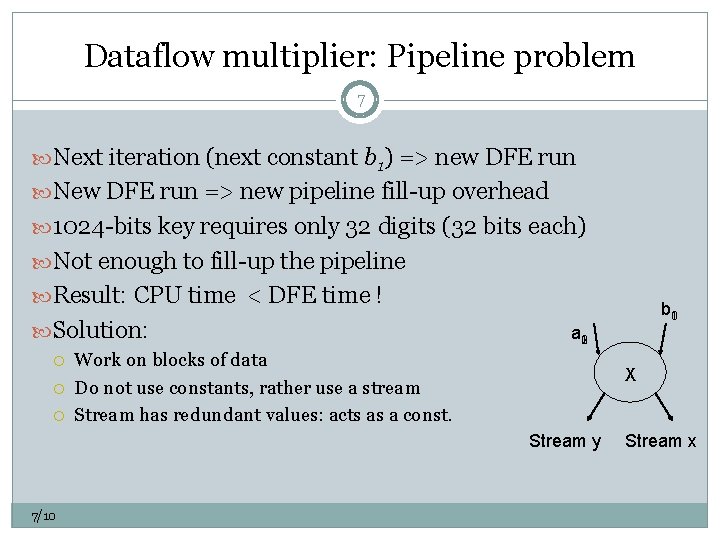
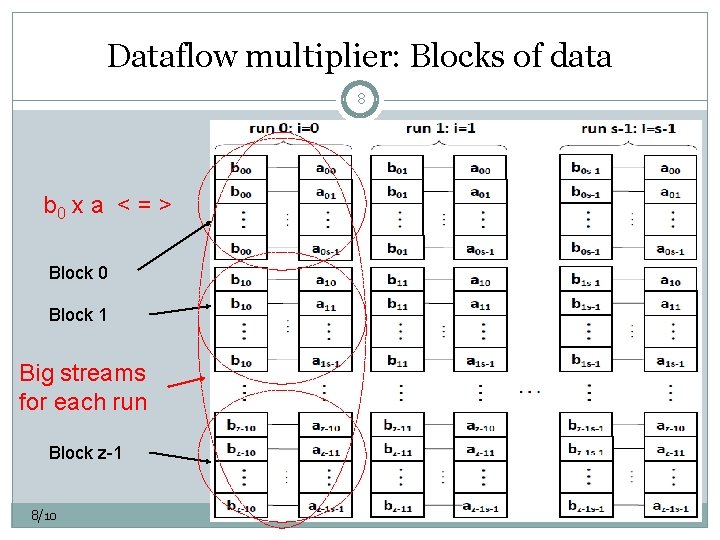
Dataflow multiplier: Pipeline problem 7 Next iteration (next constant b 1) => new DFE run New DFE run => new pipeline fill-up overhead 1024 -bits key requires only 32 digits (32 bits each) Not enough to fill-up the pipeline Result: CPU time < DFE time ! Solution: b 10 a 3210 Work on blocks of data Do not use constants, rather use a stream Stream has redundant values: acts as a const. X Stream y 7/10 Stream x
Dataflow multiplier: Blocks of data 8 b 0 x a < = > Block 0 Block 1 Big streams for each run Block z-1 8/10
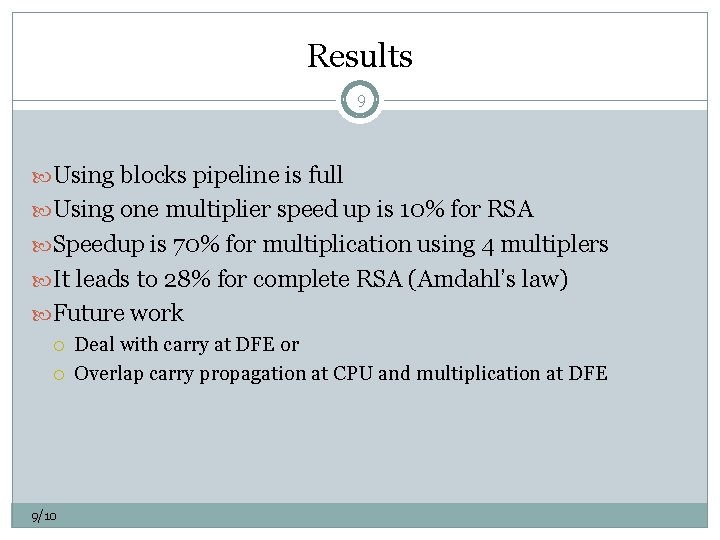
Results 9 Using blocks pipeline is full Using one multiplier speed up is 10% for RSA Speedup is 70% for multiplication using 4 multiplers It leads to 28% for complete RSA (Amdahl’s law) Future work Deal with carry at DFE or Overlap carry propagation at CPU and multiplication at DFE 9/10
10 function Mod. Exp(M, e, n) { n is odd } Step 1. Compute n’. Step 2. Mm : = M ∙ r mod n Step 3. xm : = 1 ∙ r mod n Step 4. for i = k – 1 down to 0 do Step 5. xm : = Mon. Pro(xm, xm) Step 6. if ei = 1 then xm : = Mon. Pro(Mm, xm) Step 7. x : = Mon. Pro(xm, 1) Step 8. return x The End 10/10