
Implementation of the North American Emission Control Area

- Slides: 23
Implementation of the North American Emission Control Area in the United States: Lessons Learned for a Mexican ECA Angela Bandemehr U. S. EPA Office of International and Tribal Affairs Long Beach, California December 12, 2016
WHAT IS AN ECA? • An ECA puts in place stringent standards for ship emissions (SOx, NOx, PM) • ECAs can be established under the Air Pollution Annex of the International Maritime Organization’s Convention on the Prevention of Pollution from Ships (MARPOL Annex VI) • MARPOL Annex VI also establishes global standards that are much less stringent • ECAs provide substantially more public health benefits than MARPOL Annex VI
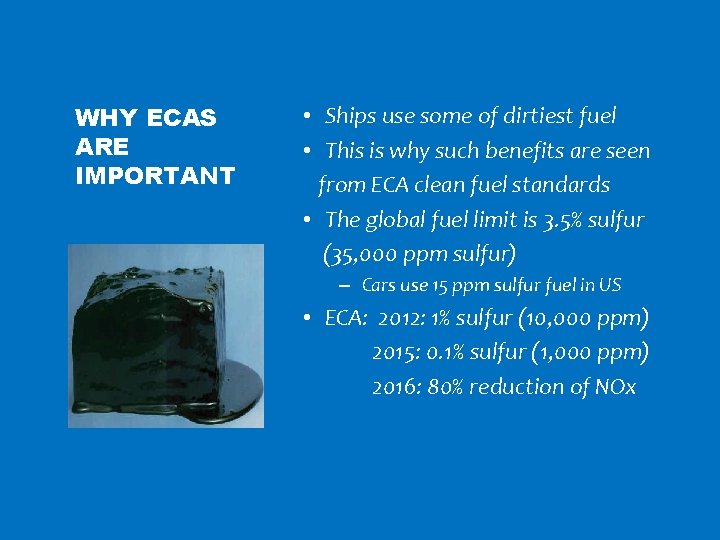
WHY ECAS ARE IMPORTANT • Ships use some of dirtiest fuel • This is why such benefits are seen from ECA clean fuel standards • The global fuel limit is 3. 5% sulfur (35, 000 ppm sulfur) – Cars use 15 ppm sulfur fuel in US • ECA: 2012: 1% sulfur (10, 000 ppm) 2015: 0. 1% sulfur (1, 000 ppm) 2016: 80% reduction of NOx
AIR POLLUTION IS A SEVERE HUMAN HEALTH PROBLEM: RECOGNIZED GLOBALLY Findings • WHO: air pollution is the world’s largest single environmental health risk and caused almost 15% of all deaths in 2012 • Ranks as the 8 th leading cause of deaths worldwide • Heart disease, strokes, lung cancer and other illnesses Global commitments • 2014 UN resolution on air pollution • 2015 World Health Assembly resolution on air pollution
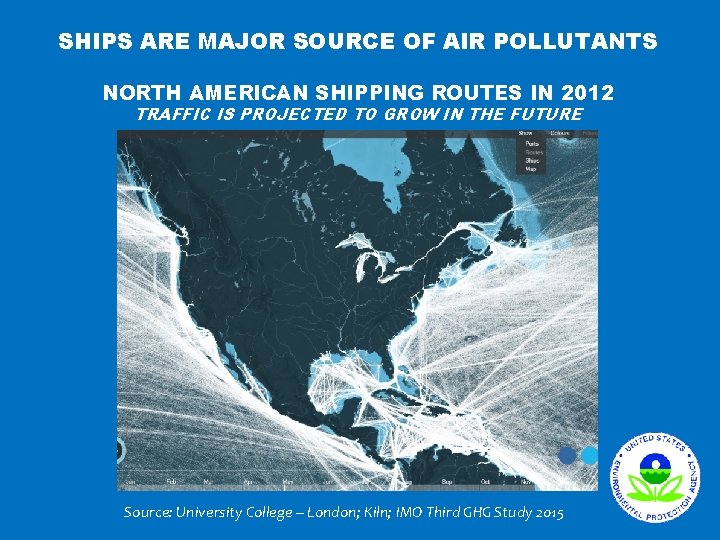
SHIPS ARE MAJOR SOURCE OF AIR POLLUTANTS NORTH AMERICAN SHIPPING ROUTES IN 2012 TRAFFIC IS PROJECTED TO GROW IN THE FUTURE Source: University College – London; Kiln; IMO Third GHG Study 2015
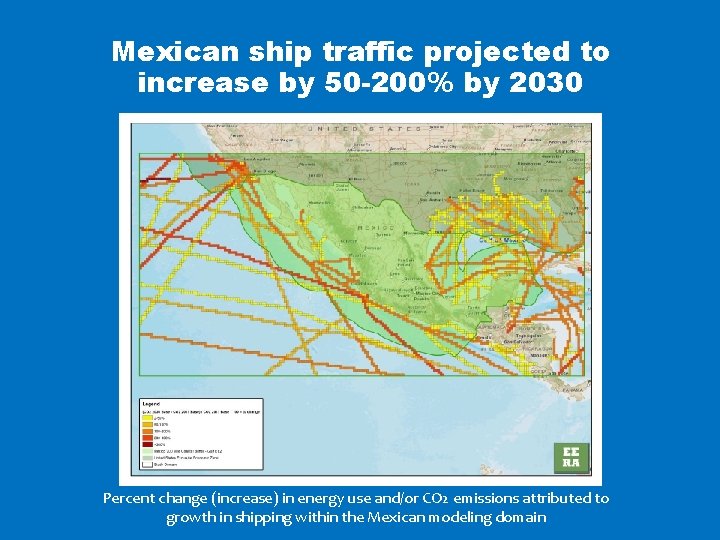
Mexican ship traffic projected to increase by 50 -200% by 2030 Percent change (increase) in energy use and/or CO 2 emissions attributed to growth in shipping within the Mexican modeling domain
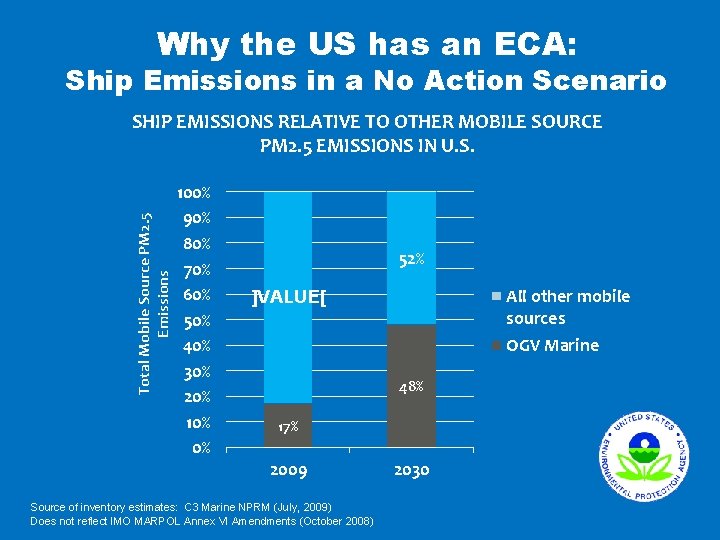
Why the US has an ECA: Ship Emissions in a No Action Scenario Total Mobile Source PM 2. 5 Emissions SHIP EMISSIONS RELATIVE TO OTHER MOBILE SOURCE PM 2. 5 EMISSIONS IN U. S. 100% 90% 80% 70% 60% 50% 40% 30% 20% 10% 0% 52% ]VALUE[ All other mobile sources OGV Marine 48% 17% 2009 Source of inventory estimates: C 3 Marine NPRM (July, 2009) Does not reflect IMO MARPOL Annex VI Amendments (October 2008) 2030
WHY THE USA HAS AN ECA • MARPOL Annex VI global controls are necessary but not sufficient • ECAs require cleaner fuels and lower emission standards • Prefer to meet domestic air quality goals with an ECA • Consistent standards across all U. S. ports and internationally
U. S. EMISSION CONTROL AREAS • North American ECA • US becomes party to MARPOL • • Annex VI: January 8, 2009 NA ECA proposed by US/approved by IMO: July 2009 Adopted by IMO: March 26, 2010 Entry-into-force: August 1, 2011 Enforcement: August 1, 2012 • U. S. Caribbean Sea ECA • Adopted by IMO: July 15, 2011 • Entry-into-force: January 1, 2013 • Enforcement: January 1, 2014
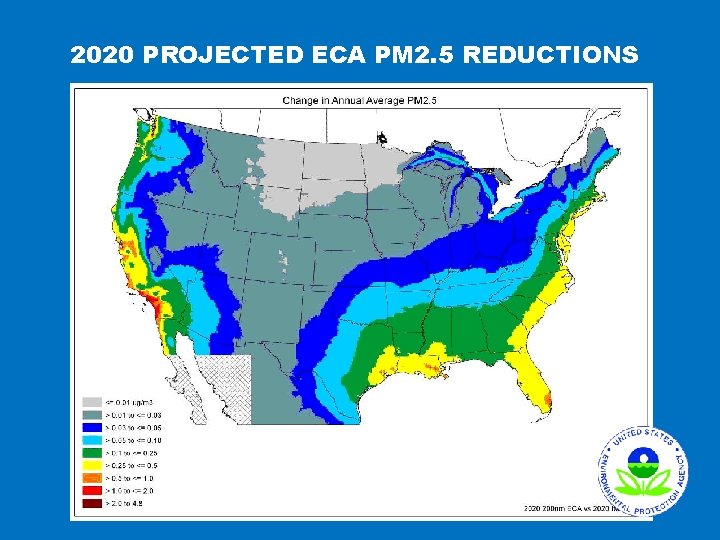
2020 PROJECTED ECA PM 2. 5 REDUCTIONS
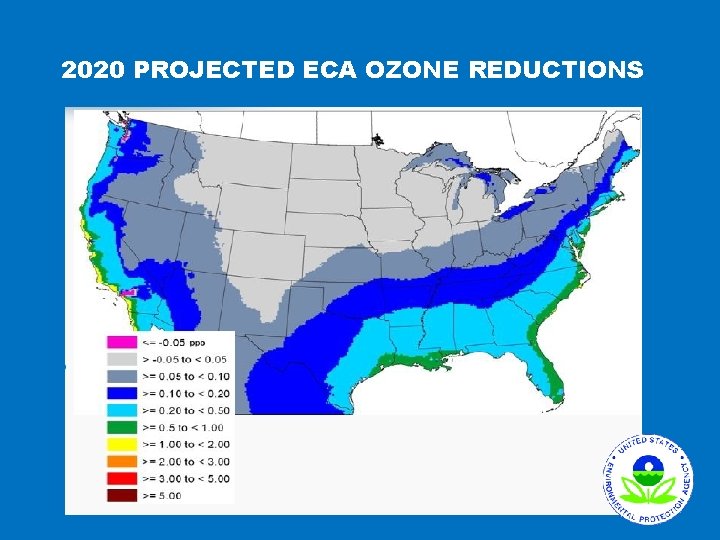
2020 PROJECTED ECA OZONE REDUCTIONS
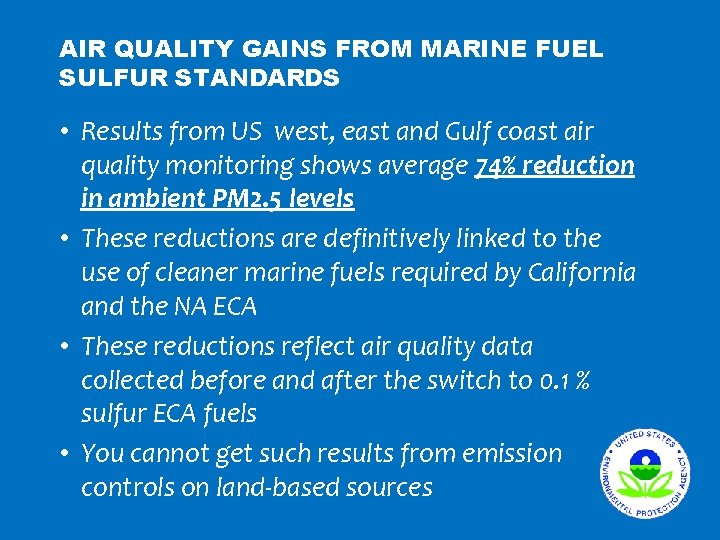
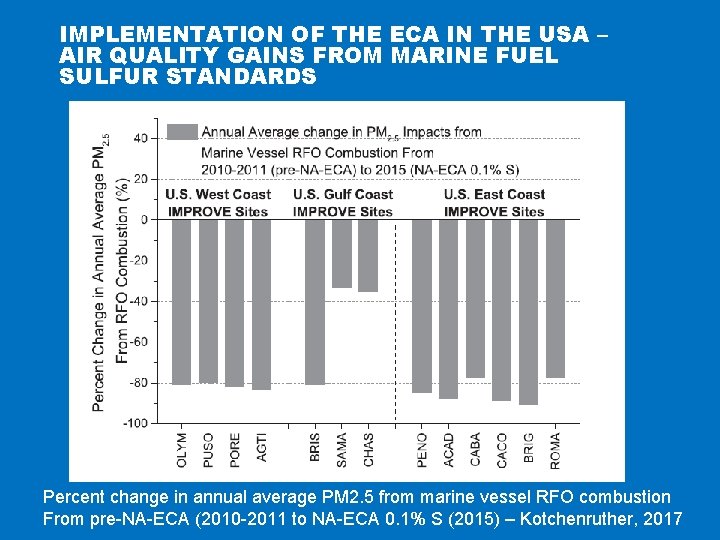
AIR QUALITY GAINS FROM MARINE FUEL SULFUR STANDARDS • Results from US west, east and Gulf coast air quality monitoring shows average 74% reduction in ambient PM 2. 5 levels • These reductions are definitively linked to the use of cleaner marine fuels required by California and the NA ECA • These reductions reflect air quality data collected before and after the switch to 0. 1 % sulfur ECA fuels • You cannot get such results from emission controls on land-based sources
IMPLEMENTATION OF THE ECA IN THE USA – AIR QUALITY GAINS FROM MARINE FUEL SULFUR STANDARDS Percent change in annual average PM 2. 5 from marine vessel RFO combustion From pre-NA-ECA (2010 -2011 to NA-ECA 0. 1% S (2015) – Kotchenruther, 2017
IMPLEMENTATION OF THE ECA IN THE USA – OVERALL APPROACH • US Coast Guard (USCG) is lead for vessels – verify compliance with Annex VI/ECA during vessel exams • EPA is lead for protection of human health and air quality • Coast Guard and EPA are jointly: – Enforcing the ECA – Developing a vessel fuel sampling program – Coordinating with Canada and the EU on enforcement
IMPLEMENTATION OF THE ECA IN THE USA – FUEL AVAILABILITY • We are seeing good compliance with fuel requirements • Compliant fuel is available in US and most regions globally
• Environment Ministers endorse projects under Commission for Environmental Cooperation – Phase I ECA– 2014 -1015: technical analyses HIGH LEVEL – Phase II ECA – 2016 – 2017: IMO proposal COMMITMENT – Fuel Sulfur Enforcement – 2016 -2017: TO WORKING exchange lessons learned in North America WITH MEXICO ON AN ECA • Presidential-level commitment made at the North American Leaders Summit (June 2016) “We are committed […] to work together and through the International Maritime Organization (IMO) to support implementation of a North American Emission Control Area that includes Mexico. ”
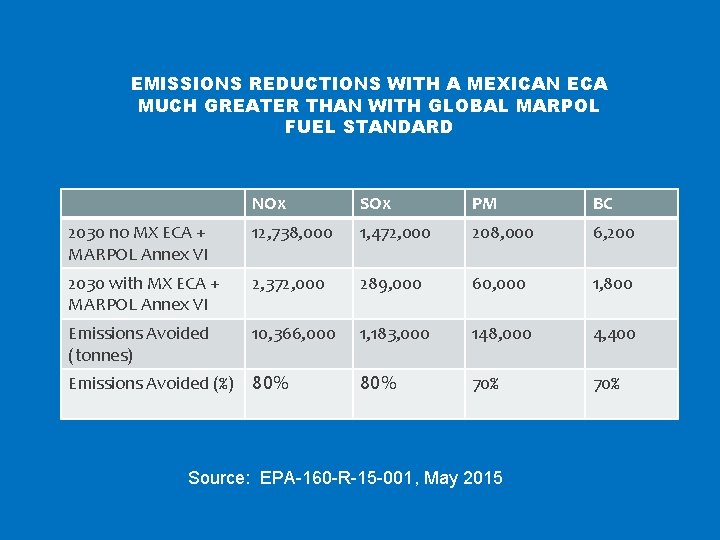
EMISSIONS REDUCTIONS WITH A MEXICAN ECA MUCH GREATER THAN WITH GLOBAL MARPOL FUEL STANDARD NOx SOx PM BC 2030 no MX ECA + MARPOL Annex VI 12, 738, 000 1, 472, 000 208, 000 6, 200 2030 with MX ECA + MARPOL Annex VI 2, 372, 000 289, 000 60, 000 1, 800 Emissions Avoided (tonnes) 10, 366, 000 1, 183, 000 148, 000 4, 400 80% 70% Emissions Avoided (%) 80% Source: EPA-160 -R-15 -001, May 2015
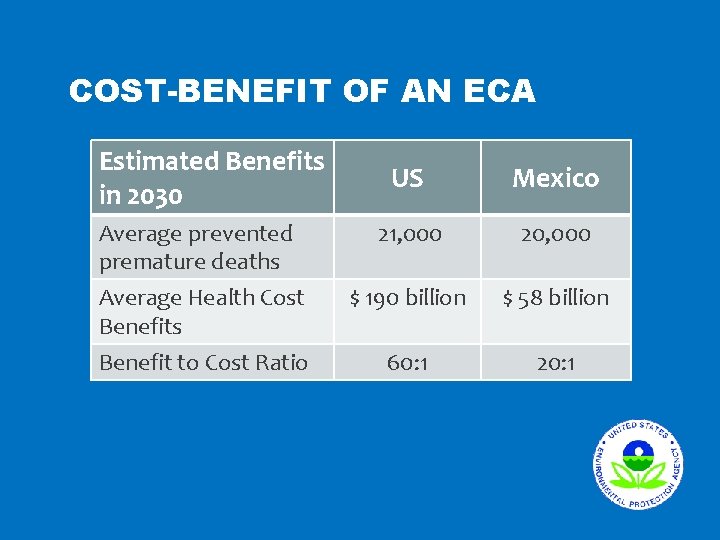
COST-BENEFIT OF AN ECA Estimated Benefits in 2030 Average prevented premature deaths Average Health Cost Benefits Benefit to Cost Ratio US Mexico 21, 000 20, 000 $ 190 billion $ 58 billion 60: 1 20: 1
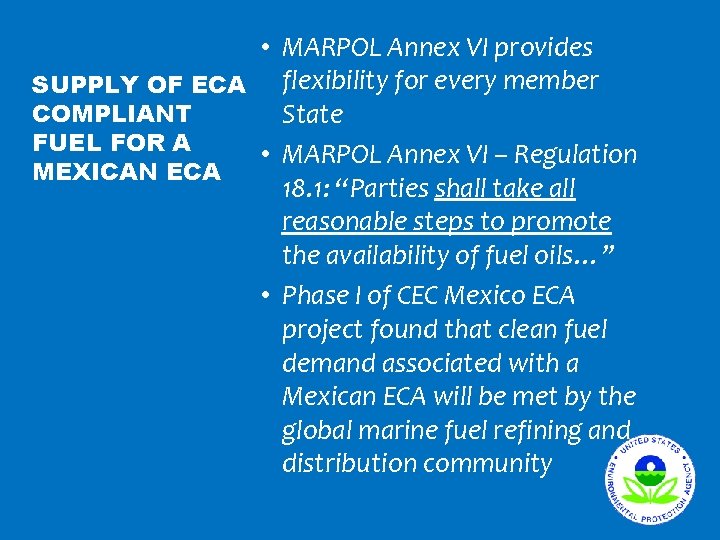
• MARPOL Annex VI provides flexibility for every member SUPPLY OF ECA COMPLIANT State FUEL FOR A • MARPOL Annex VI – Regulation MEXICAN ECA 18. 1: “Parties shall take all reasonable steps to promote the availability of fuel oils…” • Phase I of CEC Mexico ECA project found that clean fuel demand associated with a Mexican ECA will be met by the global marine fuel refining and distribution community
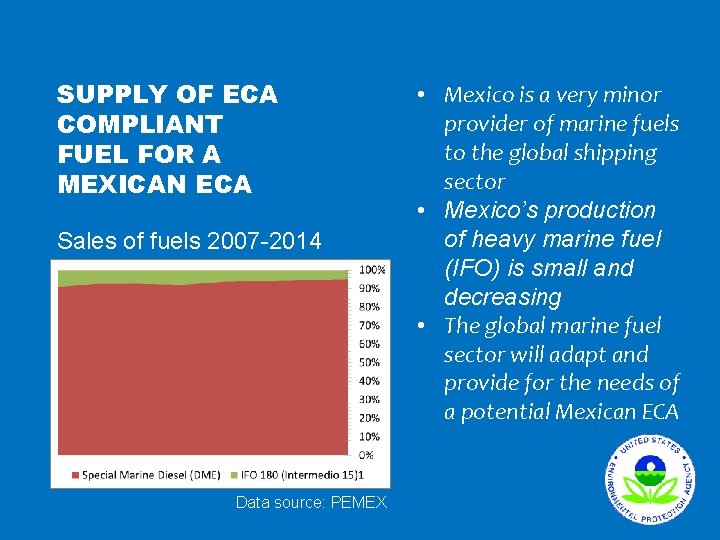
SUPPLY OF ECA COMPLIANT FUEL FOR A MEXICAN ECA Sales of fuels 2007 -2014 Data source: PEMEX • Mexico is a very minor provider of marine fuels to the global shipping sector • Mexico’s production of heavy marine fuel (IFO) is small and decreasing • The global marine fuel sector will adapt and provide for the needs of a potential Mexican ECA
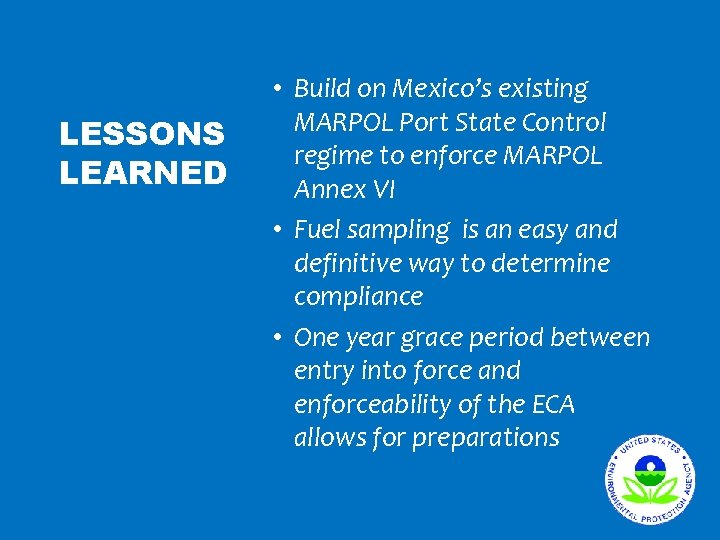
LESSONS LEARNED • Build on Mexico’s existing MARPOL Port State Control regime to enforce MARPOL Annex VI • Fuel sampling is an easy and definitive way to determine compliance • One year grace period between entry into force and enforceability of the ECA allows for preparations
BENEFITS TO MEXICO OF AN ECA • Without an ECA, increased shipping traffic will increase pollutant levels • Reduces PM 2. 5, sulfur dioxide, ozone levels • Improved air quality • Fewer deaths and illnesses
• Because ships have high pollutant emissions compared to other SUMMARY sources, such high emissions reductions and health gains are hard to obtain with other sources • Tremendous health benefits of an ECA, more protective than global standards • Good experiences in the US implementing the NA ECA • US lessons learned are being shared with Mexico for the development of an ECA