
Implementation of the National Development Plan and National



- Slides: 22
Implementation of the National Development Plan and National Planning Framework. Aspiration or Deliverable? Marie Sherlock
1) Can the NDP be realistically delivered? 2) Is it sufficient to meet Ireland’s infrastructure needs?
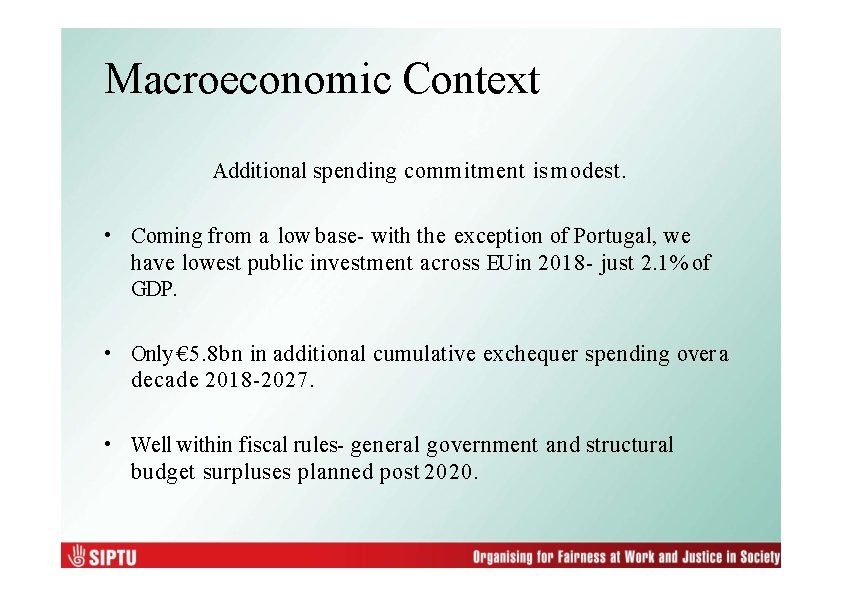
Macroeconomic Context Additional spending commitment is modest. • Coming from a low base- with the exception of Portugal, we have lowest public investment across EU in 2018 - just 2. 1% of GDP. • Only € 5. 8 bn in additional cumulative exchequer spending over a decade 2018 -2027. • Well within fiscal rules- general government and structural budget surpluses planned post 2020.
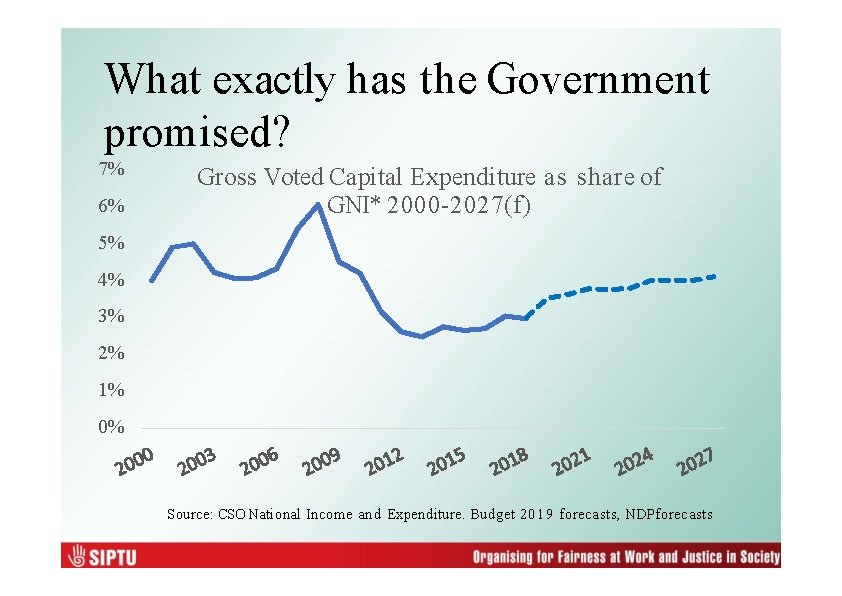
What exactly has the Government promised? 7% 6% Gross Voted Capital Expenditure as share of GNI* 2000 -2027(f) 5% 4% 3% 2% 1% 0% Source: CSO National Income and Expenditure. Budget 2019 forecasts, NDP forecasts
Delivery The key risks 1) Political & Economic 2) Labour supply 3) Operational
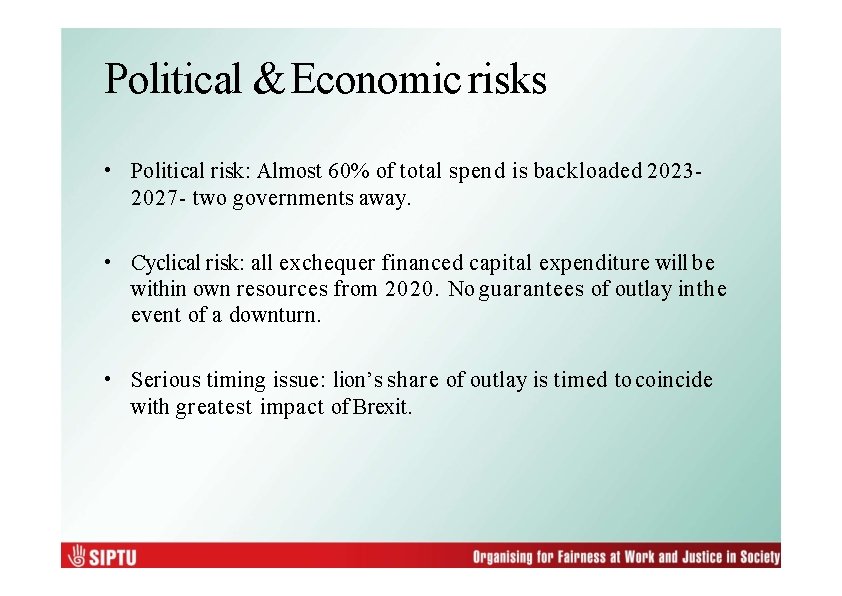
Political & Economic risks • Political risk: Almost 60% of total spend is backloaded 20232027 - two governments away. • Cyclical risk: all exchequer financed capital expenditure will be within own resources from 2020. No guarantees of outlay in the event of a downturn. • Serious timing issue: lion’s share of outlay is timed to coincide with greatest impact of Brexit.
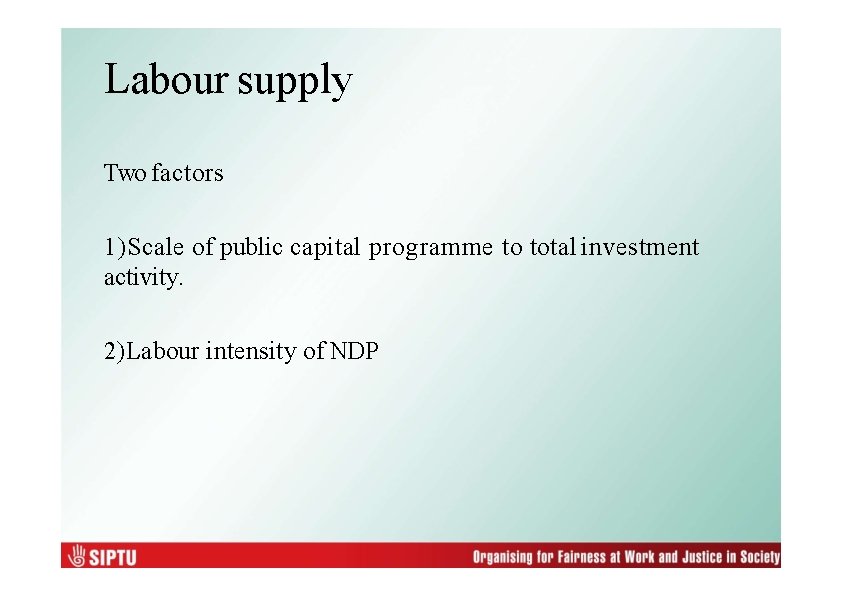
Labour supply Two factors 1) Scale of public capital programme to total investment activity. 2)Labour intensity of NDP
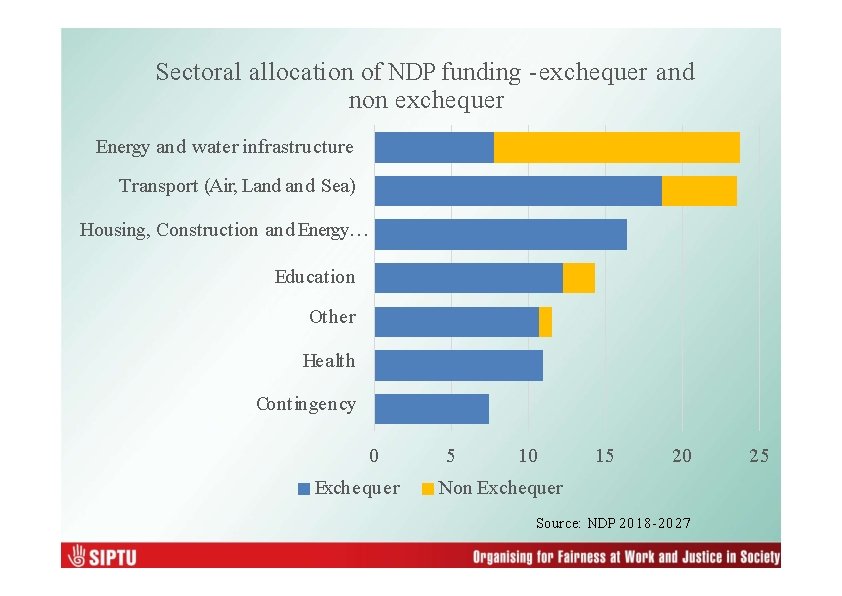
Sectoral allocation of NDP funding - exchequer and non exchequer Energy and water infrastructure Transport (Air, Land Sea) Housing, Construction and Energy… Education Other Health Contingency 0 Exchequer 5 10 15 20 Non Exchequer Source: NDP 2018 -2027 25
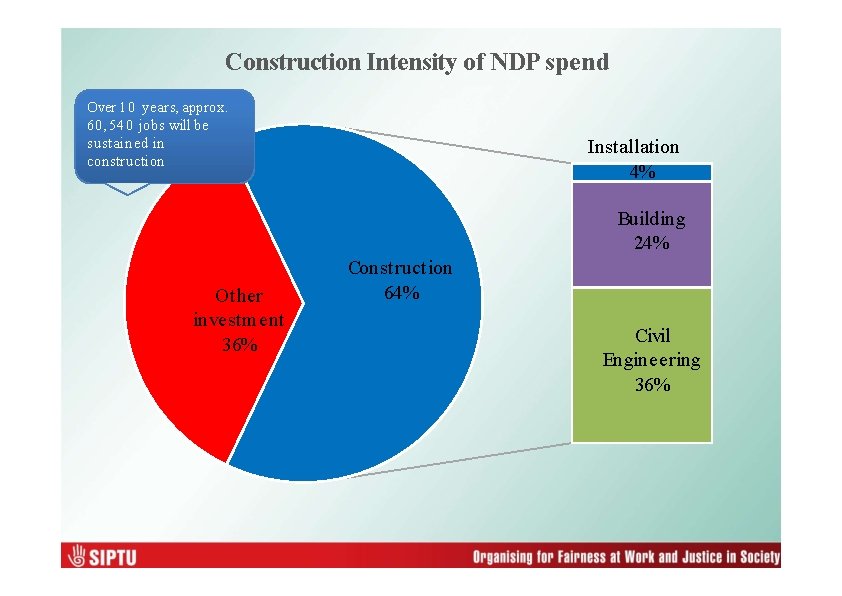
Construction Intensity of NDP spend Over 10 years, approx. 60, 540 jobs will be sustained in construction Installation 4% Building 24% Other investment 36% Construction 64% Civil Engineering 36%
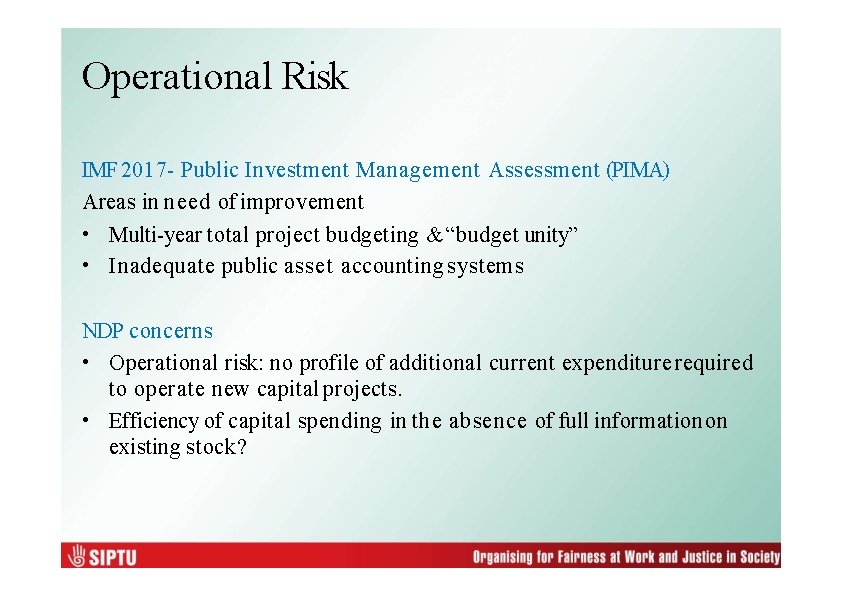
Operational Risk IMF 2017 - Public Investment Management Assessment (PIMA) Areas in need of improvement • Multi-year total project budgeting & “budget unity” • Inadequate public asset accounting systems NDP concerns • Operational risk: no profile of additional current expenditure required to operate new capital projects. • Efficiency of capital spending in the absence of full information on existing stock?
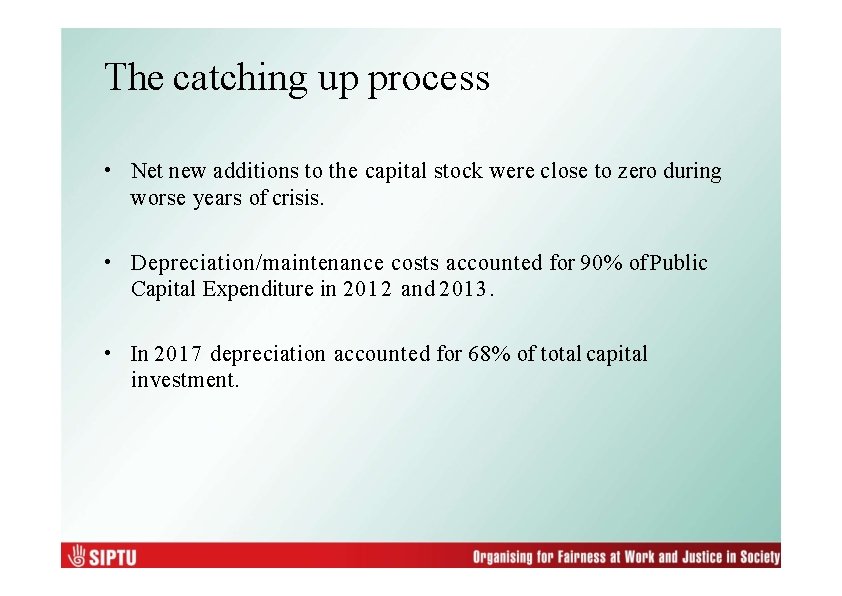
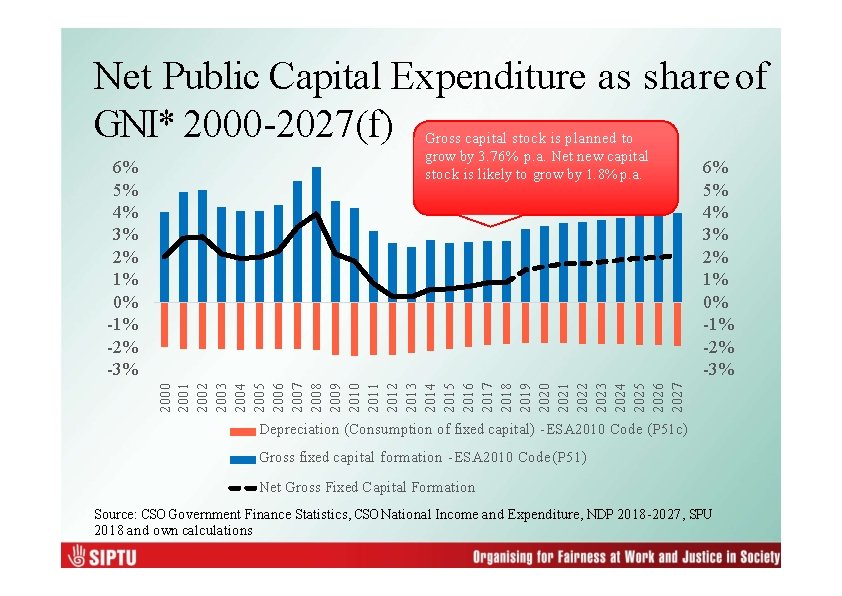
The catching up process • Net new additions to the capital stock were close to zero during worse years of crisis. • Depreciation/maintenance costs accounted for 90% of Public Capital Expenditure in 2012 and 2013. • In 2017 depreciation accounted for 68% of total capital investment.
Net Public Capital Expenditure as share of GNI* 2000 -2027(f) 6% 5% 4% 3% 2% 1% 0% -1% -2% -3% 2000 2001 2002 2003 2004 2005 2006 2007 2008 2009 2010 2011 2012 2013 2014 2015 2016 2017 2018 2019 2020 2021 2022 2023 2024 2025 2026 2027 6% 5% 4% 3% 2% 1% 0% -1% -2% -3% Gross capital stock is planned to grow by 3. 76% p. a. Net new capital stock is likely to grow by 1. 8% p. a. Depreciation (Consumption of fixed capital) - ESA 2010 Code (P 51 c) Gross fixed capital formation - ESA 2010 Code (P 51) Net Gross Fixed Capital Formation Source: CSO Government Finance Statistics, CSO National Income and Expenditure, NDP 2018 -2027, SPU 2018 and own calculations
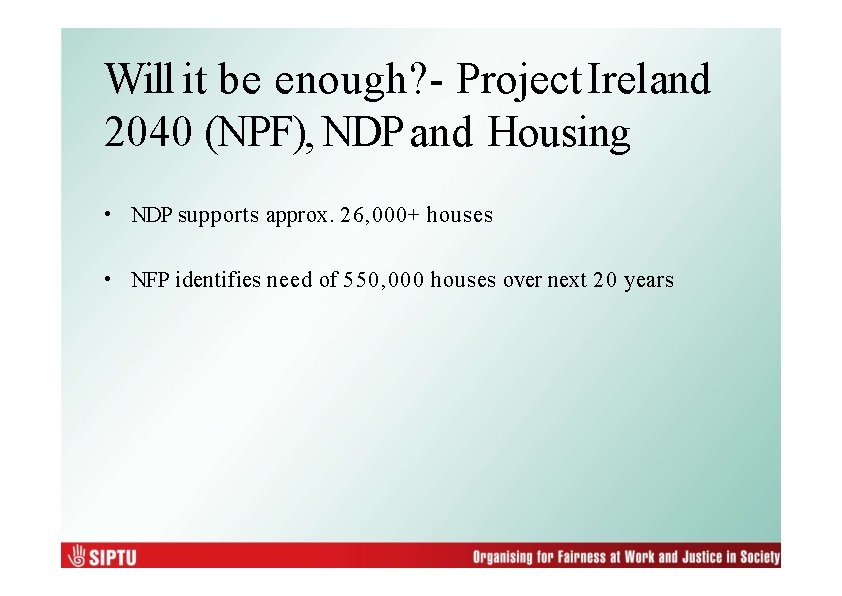
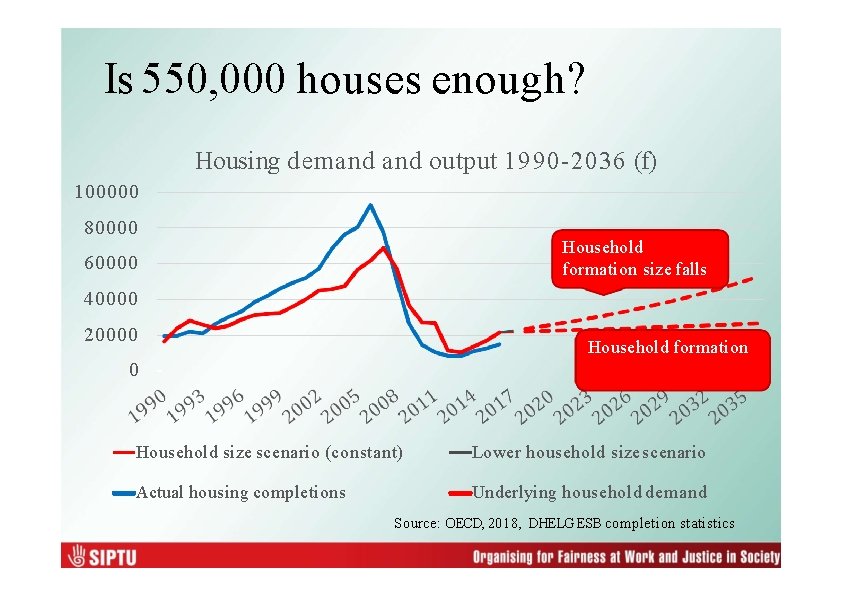
Will it be enough? - Project Ireland 2040 (NPF), NDP and Housing • NDP supports approx. 26, 000+ houses • NFP identifies need of 550, 000 houses over next 20 years
Is 550, 000 houses enough? Housing demand output 1990 -2036 (f) 100000 80000 Household formation size falls 60000 40000 20000 Household formation 0 Household size scenario (constant) Lower household size scenario Actual housing completions Underlying household demand Source: OECD, 2018, DHELG ESB completion statistics
Labour supply Can we get enough construction workers?
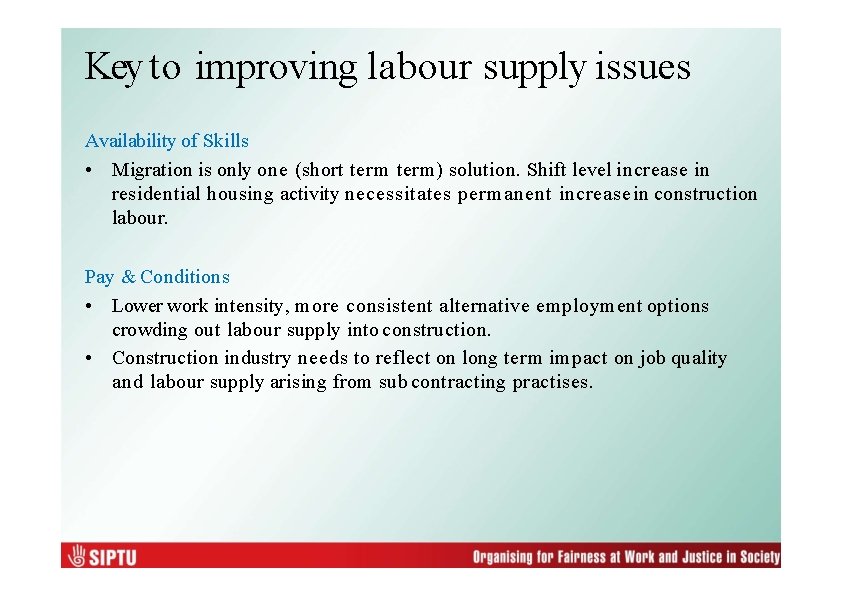
Key to improving labour supply issues Availability of Skills • Migration is only one (short term) solution. Shift level increase in residential housing activity necessitates permanent increase in construction labour. Pay & Conditions • Lower work intensity, more consistent alternative employment options crowding out labour supply into construction. • Construction industry needs to reflect on long term impact on job quality and labour supply arising from sub contracting practises.
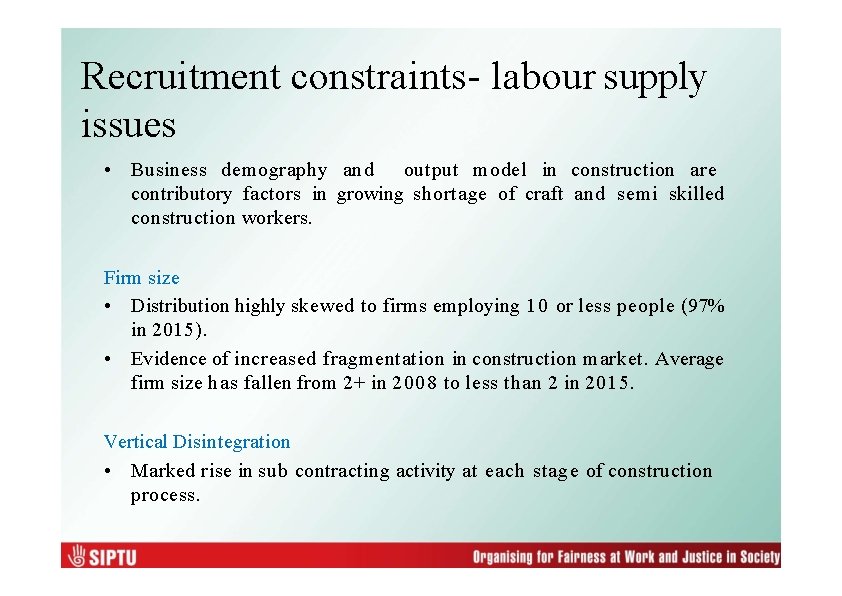
Recruitment constraints- labour supply issues • Business demography and output model in construction are contributory factors in growing shortage of craft and semi skilled construction workers. Firm size • Distribution highly skewed to firms employing 10 or less people (97% in 2015). • Evidence of increased fragmentation in construction market. Average firm size has fallen from 2+ in 2008 to less than 2 in 2015. Vertical Disintegration • Marked rise in sub contracting activity at each stage of construction process.
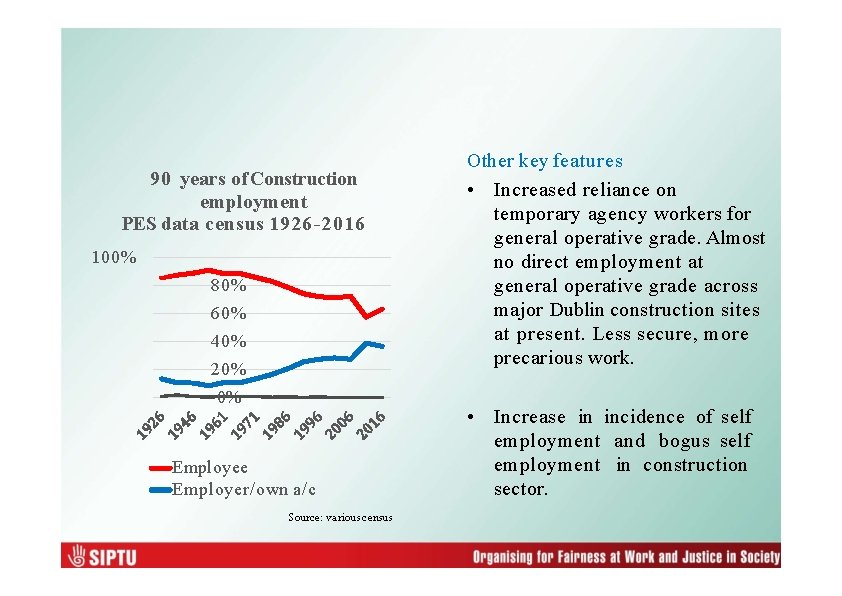
90 years of Construction employment PES data census 1926 -2016 100% 80% 60% 40% 20% 0% Employee Employer/own a/c Source: various census Other key features • Increased reliance on temporary agency workers for general operative grade. Almost no direct employment at general operative grade across major Dublin construction sites at present. Less secure, more precarious work. • Increase in incidence of self employment and bogus self employment in construction sector.
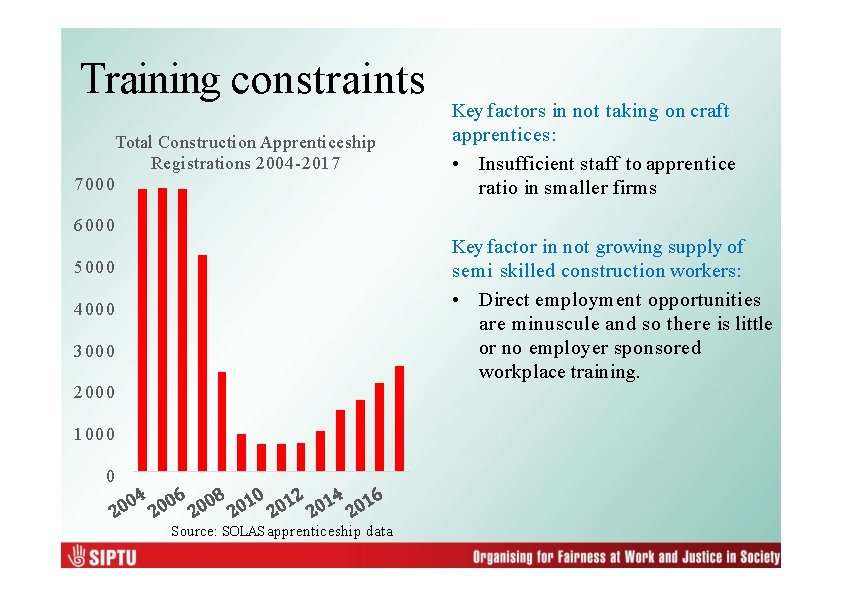
Training constraints Total Construction Apprenticeship Registrations 2004 -2017 7000 6000 Key factors in not taking on craft apprentices: • Insufficient staff to apprentice ratio in smaller firms Key factor in not growing supply of semi skilled construction workers: • Direct employment opportunities are minuscule and so there is little or no employer sponsored workplace training. 5000 4000 3000 2000 1000 0 Source: SOLAS apprenticeship data
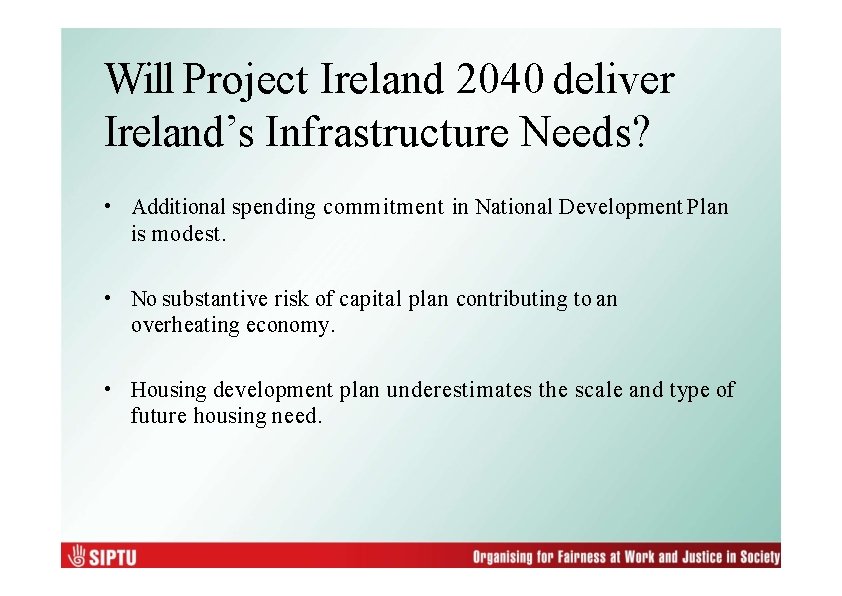
Will Project Ireland 2040 deliver Ireland’s Infrastructure Needs? • Additional spending commitment in National Development Plan is modest. • No substantive risk of capital plan contributing to an overheating economy. • Housing development plan underestimates the scale and type of future housing need.
www. siptu. ie